


 |
市場調查報告書
商品編碼
2121994
自動化倉儲系統(ASRS):市場佔有率分析、產業趨勢與統計資料、成長預測(2026-2031)Automated Storage And Retrieval System (ASRS) - Market Share Analysis, Industry Trends & Statistics, Growth Forecasts (2026 - 2031) |
||||||

※ 本網頁內容可能與最新版本有所差異。詳細情況請與我們聯繫。
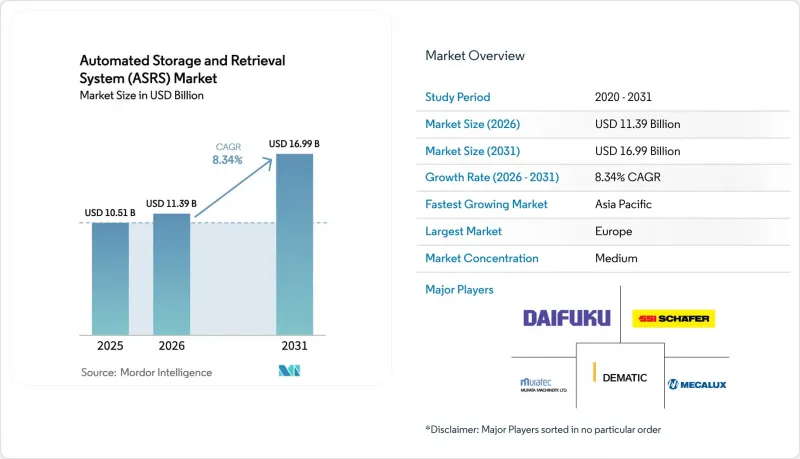
據 Mordor Intelligence 稱,2025 年自動化倉庫系統 (ASRS) 市值為 105.1 億美元,預計到 2031 年將達到 169.9 億美元,而 2026 年為 113.9 億美元,預測期(2026-2031 年)的複合年成長率為 8.34%。
本報告按產品類型(固定巷道起重機系統、穿梭車系統、垂直升降模組 (VLM) 等)、裝載類型(單元貨載、托盤裝載穿梭車、小型負載、中型負載、週轉箱/紙箱等)、應用(存儲和緩衝、貨到人揀貨、套件組裝和定序等)、最終用戶行業(製造業和非製造業)以及地區對行業進行分類。
全球自動化倉儲系統(ASRS)市場趨勢與洞察
電子商務履約壓力
亞馬遜計劃在2025年中期部署一百萬台機器人,這清楚地表明,人工揀貨已無法應對每小時近300行的訂單量。作為回應,其他零售商迅速推進了「立方體」(Cube)和「穿梭車」(Shuttle)項目,將訂單處理週期從數小時縮短至數分鐘,從而加速了自動化倉庫系統(ASRS)市場的發展。服裝和電子產品訂單率的上升也提高了人們對準確性的關注。如今,人工智慧驅動的機械爪的商品識別準確率已超過99%,從而減少了成本高昂的重新出貨。履約業者也發現,機器人部署可以減少堆高機作業和照明的需求,進而降低每筆訂單8%的能源成本。
人事費用上升和安全法規更加嚴格
2024年,美國大部分倉庫死亡事故是由堆高機造成的,每週由此產生的工傷索賠高達8,400萬美元。美國職業安全與健康管理局(OSHA)於2025年生效的新指南改變了雇主責任的範圍,加速了「貨到人」單元佈局的轉變,使工人遠離人流密集的通道。預計到2028年,汽車修理廠將面臨20%的技工缺口,因此他們已經實施了小型裝載系統,並將人手不足的員工從產品揀選工作重新分配到診斷任務。這些趨勢預計將在中期內推動自動化倉庫系統(ASRS)市場成長率提高2個百分點以上。
高初始資本支出(CAPEX)和較長的投資回收期
儘管承包工程項目已被證實具有顯著的成本節約潛力,但其成本從7萬美元到300萬美元不等,對許多小規模經銷商而言一直是個難題。根據總擁有成本 (TCO) 模型,軟體、試運行和培訓成本通常會使標價增加40%,而在宏觀經濟高度不確定性時期,投資回收期可能會超出財務長的承受範圍。雖然基於訂閱的「按次收費」模式開始減輕前期成本負擔,但目前僅限於特定的大批量應用情境。
細分市場分析
即使到了2025年,固定巷道起重機系統仍將佔據全球整體銷售額的37.65%,這主要得益於汽車和消費品製造工廠,這些工廠可預測的物流流程使得部署高層貨架結構成為必要。雖然這些系統歷來是自動化倉庫系統(ASRS)市場的設計模板,但它們也限制了使用者只能使用特定的巷道寬度和容量。基於立方體的網格和機器人儲存線正憑藉60%的儲存密度和70秒以內的取貨時間迅速發展,推動著11.92%的複合年成長率,預計這將在本十年末改變市場格局。領先的第三方物流公司,如AutoStore和DSV,正在九個國家擴大基於立方體系統的部署,凸顯了其多功能性。穿梭車系統則處於中間位置,其模組化的穿梭車道使企業能夠在無需大規模建築維修的情況下逐步擴展規模。這種柔軟性對快速成長的零售商很有吸引力,他們希望根據每年的需求波動調整在自動化倉庫系統 (ASRS) 市場的投資。
垂直升降模組 (VLM) 和旋轉貨架解決方案仍然是小眾市場,銷售額佔比不到 10%,但在占地面積有限且零件完整性至關重要的場合,它們卻能提供顯著的價值。例如,醫療設備組裝使用 VLM 來保護微小的機械零件免受污染,同時實現超過 99.9% 的揀選準確率。混合型倉庫擴大將起重機、穿梭車和立方體貨架相結合,這種架構清晰地展現了自動化倉庫系統 (ASRS) 市場從依賴單一技術向客製化生態系統的演變。 Kardex 與 Berkshire Grey 的合作將 AI 視覺揀選單元整合到 VLM 生產線中,實現了 99.99% 的準確率,進一步鞏固了技術融合塑造現代倉庫設計的趨勢。
到2025年,單元貨載和托盤系統將佔銷售額的41.92%,這主要得益於汽車零件、飲料托盤化以及其他大宗商品運輸(這些商品通常存放在不同的存放位置)。然而,電子商務中SKU的爆炸性成長催生了對週轉箱單元揀選的需求,而單元貨載起重機無法經濟高效地滿足這一需求,從而推動了對小型裝載系統的需求成長,其複合年成長率(CAGR)高達11.08%。預計在全通路食品雜貨領域,小型裝載和周轉箱解決方案的自動化倉庫系統(ASRS)市場將成長得更快,因為該領域平均每個購物籃包含35件線上訂單商品。單一小型裝載通道每小時可處理多達1200個週轉箱循環,從而在相同的面積內實現門市補貨和線上訂購線下取貨的履約。
托盤穿梭車子系統將高吞吐量托盤儲存與選擇性存取需求相結合,提供可配置的深度,以平衡儲存密度和速度。中型貨物應用,例如處理表面小型物品和電子產品及汽車售後市場零件中笨重的中型零件的應用,在專案範圍定義中常常被忽略,但它們在端到端流程中發揮著至關重要的作用。營運商正擴大將貨物類型整合到統一的軟體平台中,使倉庫管理系統 (WMS) 能夠根據每次移動的即時成本而非固定的、孤立的區域來指導揀貨,這表明自動化倉庫系統 (ASRS) 市場正逐漸走向成熟。
區域分析
預計到2025年,歐洲將佔全球銷售額的33.42%,並繼續維持其最大的區域市場佔有率。每小時超過28美元的高昂人事費用以及嚴格的職業安全法規,使得自動化成為一項極具經濟吸引力的選擇。此外,歐盟的永續性法規已將高密度立方體網格結構認可為降低建築能耗的一種手段。德國的「2025高科技戰略」撥款3.692億美元用於機器人研發,並加強了商業生態系統,以培育解決方案供應商。斯堪地那維亞零售商將六個傳統倉庫合併為一個自動化倉庫,使每次出貨的二氧化碳排放量減少了35%。
亞太地區成長最快,複合年成長率達11.67%。在中國,一項耗資1兆元的機器人大型企劃展現了國家層級推進工廠自動化的決心;在日本,連接大阪和東京的500公里輸送機網路計畫正在提案,這將催生對高吞吐量分揀中心的需求。在韓國,政府追加1.28億美元津貼用於智慧工廠建設,作為政策獎勵;在印度,DAIFUKU CO. LTD.計畫於2025年投產的工廠縮短了區域客戶的前置作業時間,使印度成為生產中心。因此,亞太地區的自動化倉庫系統(ASRS)市場正受惠於國內需求和本地產能的雙重推動。
北美仍然是創新中心和超大規模電子商務的試驗場,樹立了全球標竿。亞馬遜已實施基於人工智慧的模型來重新規劃其集群機器人的路線,在提高能源效率的同時,增加了每小時揀選的商品數量。這直接影響著同業採用的設計規範。 AutoStore位於新罕布夏州的新總部設有一個培訓學院,旨在解決技能缺口問題,並支持該公司在2026年底在該地區部署300多個項目的預測。拉丁美洲和中東及非洲正在崛起為蓬勃發展的成長區域。一家沙烏地阿拉伯藥品批發商將於2024年開始試行半自動化履約,一家巴西第三方物流公司正受惠於資本財的稅收優惠;這兩個地區在未來五年內都被視為具有巨大成長潛力的市場。
其他好處:
- Excel格式的市場預測(ME)表
- 3個月的分析師支持
目錄
第1章:引言
- 研究假設和市場定義
- 調查範圍
第2章:調查方法
第3章執行摘要
第4章 市場狀況
- 市場概覽
- 市場促進因素
- 電子商務中的履約負擔
- 人事費用上升和工作場所安全法規更加嚴格。
- 向微型倉配/城市物流中心轉型
- 冷鏈超低溫倉庫的自動化
- 預測性維護分析正在提高投資報酬率。
- 亞太地區和歐洲的產業政策誘因
- 市場限制因素
- 前期資本投入高,投資回收期長。
- 自動化立體倉庫(ASRS)技術員短缺
- 與傳統倉庫管理系統整合的複雜性
- 互聯ASRS中的網路安全漏洞
- 重要法規結構的評估
- 價值鏈分析
- 技術展望
- 波特五力模型
- 對關鍵相關人員的影響評估
- 主要用例和案例研究
- 宏觀經濟因素對市場的影響
- 投資分析
第5章 市場區隔
- 依產品類型
- 固定巷道起重機系統
- 穿梭式系統
- 垂直升降模組(VLM)
- 旋轉模組(垂直和水平)
- 立方體型/機器人型立方體存儲
- 裝載類型
- 單元負荷
- 托盤裝載穿梭車
- 迷你公路
- 中負荷
- 手提袋/紙箱及其他
- 透過使用
- 保存和緩衝
- 揀貨方式:“從產品到人”
- 試劑盒和定序
- 組裝/生產支持
- 冷藏和冷凍
- 按最終用戶行業分類
- 製造業
- 車
- 食品/飲料
- 製藥和生命科學
- 電子和半導體
- 金屬和機械
- 非製造業
- 電子商務與零售
- 第三方物流(3PL)和倉儲業
- 機場和行李處理
- 國防和政府附屬商店
- 製造業
- 按地區
- 北美洲
- 美國
- 加拿大
- 墨西哥
- 南美洲
- 巴西
- 阿根廷
- 其他南美國家
- 歐洲
- 德國
- 英國
- 法國
- 義大利
- 俄羅斯
- 其他歐洲國家
- 亞太地區
- 中國
- 日本
- 韓國
- 印度
- ASEAN
- 其他亞太國家
- 中東和非洲
- 中東
- 沙烏地阿拉伯
- 阿拉伯聯合大公國
- 土耳其
- 其他中東國家
- 非洲
- 南非
- 奈及利亞
- 其他非洲國家
- 中東
- 北美洲
第6章 競爭情勢
- 市場集中度
- 策略趨勢
- 市佔率分析
- 公司簡介
- Daifuku Co., Ltd.
- Schaefer Systems International GmbH(SSI SCHAEFER)
- Dematic Corp.(KION Group AG)
- Murata Machinery, Ltd.
- Mecalux, SA
- Honeywell Intelligrated, Inc.
- KUKA AG
- KNAPP AG
- Kardex Holding AG
- Toyota Industries Corporation
- Viastore Systems GmbH
- AutoStore Holdings Ltd.
- Swisslog Holding AG
- Vanderlande Industries BV
- Bastian Solutions LLC
- System Logistics SpA
- Hanel Storage Systems
- Modula SpA
- TGW Logistics Group GmbH
- BEUMER Group GmbH & Co. KG
- Stocklin Logistik AG
- Godrej Korber Supply Chain Ltd.
- Westfalia Technologies, Inc.
- Shanghai Jingxing Logistics Equipment Engineering Co., Ltd.
- Unitechnik Systems GmbH
第7章 市場機會與未來展望
According to Mordor Intelligence, the automated storage and retrieval system market size was valued at USD 10.51 billion in 2025 and estimated to grow from USD 11.39 billion in 2026 to reach USD 16.99 billion by 2031, at a CAGR of 8.34% during the forecast period (2026-2031).
This report Segments the Industry Into by Product Type (Fixed-Aisle Crane Systems, Shuttle-Based Systems, Vertical Lift Modules (VLM), and More), Load Type (Unit Load, Pallet Load Shuttle, Mini Load, Mid Load, and Tote / Carton and Others), Application (Storage and Buffering, Goods-To-Person Order Picking, Kitting and Sequencing, and More), End-User Industry (Manufacturing, and Non-Manufacturing), and Geography.
Global Automated Storage And Retrieval System (ASRS) Market Trends and Insights
E-commerce fulfillment pressure
By mid-2025, Amazon's deployment of 1 million robots served as visible proof that manual picking cannot sustain order profiles approaching 300 lines per hour. Peer retailers responded by fast-tracking cube and shuttle projects that shrink order cycle times from hours to minutes, driving accelerated bookings for the automated storage and retrieval system market. Higher return rates in apparel and electronics sharpened the focus on accuracy; AI-enhanced grippers now achieve item recognition accuracy above 99%, cutting costly reships. Fulfillment operators also discovered that robotics lowered energy cost per order by 8% by limiting forklift movements and lighting requirements.
Rising labor costs and safety mandates
Forklift incidents accounted for most fatal warehouse accidents in 2024, costing USD 84 million in weekly injury claims across the United States. New OSHA guidelines issued in 2025 shifted employer liability, prompting accelerated conversion to goods-to-person cells that remove humans from high-traffic aisles. Automotive maintenance depots suffering a projected 20% technician shortfall by 2028 adopted mini-load systems to reassign scarce labor from retrieval to diagnostic roles. Collectively, these dynamics add more than two percentage points to automated storage and retrieval system market growth over the mid-term.
High initial CAPEX and extended payback periods
Turnkey projects ranging from USD 70,000 to USD 3 million deterred many small distributors despite demonstrable cost-out potential. TCO models reveal software, commissioning, and training often add another 40% to sticker price, stretching payback beyond CFO comfort zones during periods of macro uncertainty. Subscription-based "pay-per-pick" models started to mitigate upfront expense, though current availability is limited to select high-volume use cases.
Other drivers and restraints analyzed in the detailed report include:
- Shift toward micro-fulfillment centers
- Deep-freeze warehouse automation
- Cyber-security vulnerabilities threaten connected ASRS operations
For complete list of drivers and restraints, kindly check the Table Of Contents.
Segment Analysis
Fixed-aisle crane installations still delivered 37.65% of global revenue in 2025, anchored in automotive and bulk consumer-goods plants where predictable flows justify tall rack structures. These installations historically set the design template for the automated storage and retrieval system market, yet they lock users into specific aisle widths and throughput ceilings. Cube-based grids and robotic storage lines gained momentum by raising storage density 60% and slashing retrieval times to under 70 seconds, driving a 11.92% CAGR that will shift the revenue mix before decade-end. AutoStore and populous 3PLs such as DSV scaled cube deployments across nine countries, underscoring multipurpose adaptability. Shuttle-based systems occupy a middle ground; modular shuttle lanes allow firms to expand incrementally without major building retrofits. That flexibility appeals to fast-growing retailers who want automated storage and retrieval system market investments aligned with year-to-year demand swings.
Vertical lift modules (VLMs) and carousel solutions remain niche at under 10% revenue share, yet they add critical value where floor area is scarce and parts integrity is paramount. Medical-device assemblers, for example, use VLMs to protect micro-mechanical parts from contamination while achieving pick accuracies above 99.9%. Hybrid facilities increasingly mix cranes, shuttles, and cubes, an architecture that exemplifies how the automated storage and retrieval system market evolved toward tailored ecosystems rather than single-technology bets. Kardex's collaboration with Berkshire Grey incorporated AI vision pick cells into VLM lines, attaining 99.99% accuracy and reinforcing the cross-pollination trend shaping modern warehouse design.
Unit-load pallet systems captured 41.92% of 2025 revenue, powered by automotive subassemblies, beverage palletizing, and other bulk flows where each storage location houses homogenous items. Yet the SKU explosion in e-commerce drove tote-level retrieval rates that unit-load cranes cannot satisfy cost-effectively, opening demand for mini-load systems advancing at 11.08% CAGR. The automated storage and retrieval system market size for mini-load tote solutions is projected to expand even faster in omnichannel grocery, where online order lines per basket average 35. A single mini-load aisle can process up to 1,200 tote cycles per hour, enabling store replenishment and click-and-collect fulfillment from one footprint.
Pallet shuttle subsystems bridge high-throughput pallet storage with selective access demands, permitting configurable depth that balances density and speed. Mid-load applications, though smaller in headline numbers, handle awkward medium-sized components in electronics and aftermarket auto parts, functions often overlooked in project scoping yet critical to end-to-end flow. Operators increasingly blend load types inside unified software platforms so that WMS directs picks based on real-time cost per move, rather than rigid siloed zones, signaling a nuanced maturity within the automated storage and retrieval system market.
Complete Report Scope:
- By Product Type
- Fixed-Aisle Crane Systems
- Shuttle-Based Systems
- Vertical Lift Modules (VLM)
- Carousel Modules (Vertical and Horizontal)
- Cube-Based / Robotic Cube Storage
- By Load Type
- Unit Load
- Pallet Load Shuttle
- Mini Load
- Mid Load
- Tote / Carton and Others
- By Application
- Storage and Buffering
- Goods-to-Person Order Picking
- Kitting and Sequencing
- Assembly / Production Support
- Cold-Storage and Deep-Freeze Handling
- By End-user Industry
- Manufacturing
- Automotive
- Food and Beverages
- Pharmaceuticals and Life Sciences
- Electronics and Semiconductor
- Metals and Machinery
- Non-manufacturing
- E-commerce and Retail
- Third-Party Logistics (3PL) and Warehousing
- Airports and Baggage Handling
- Defense and Government Stores
- Manufacturing
- By Geography
- North America
- United States
- Canada
- Mexico
- South America
- Brazil
- Argentina
- Rest of South America
- Europe
- Germany
- United Kingdom
- France
- Italy
- Russia
- Rest of Europe
- Asia-Pacific
- China
- Japan
- South Korea
- India
- ASEAN
- Rest of Asia-Pacific
- Middle East and Africa
- Middle East
- Saudi Arabia
- United Arab Emirates
- Turkey
- Rest of Middle East
- Africa
- South Africa
- Nigeria
- Rest of Africa
- Middle East
- North America
Geography Analysis
Europe retained the largest regional contribution at 33.42% of 2025 global revenue. High labor costs exceeding USD 28 per hour and stringent worker-safety legislation made automation financially compelling, while EU sustainability rules recognized high-density cube grids as a path to lower building energy footprint. Germany's High-Tech Strategy 2025 earmarked USD 369.2 million for robotics R&D, reinforcing commercial ecosystems that nurture solution providers. Scandinavian retailers compressed six conventional warehouses into a single automated facility and cut CO2 per shipped order by 35%.
Asia-Pacific delivered the fastest growth at 11.67% CAGR. China's trillion-yuan robotics megaproject signaled state-level commitment to factory automation, while Japan proposed a 500-kilometer conveyor belt network linking Osaka and Tokyo, creating demand for high-throughput sortation nodes. Korean policy incentives added USD 128 million in grants for smart-factory deployments, and India became a production hub following Daifuku's 2025 plant opening that lowers lead times for regional customers. The automated storage and retrieval system market in Asia-Pacific therefore benefits from both domestic demand and localized manufacturing capacity.
North America remains innovation center, with hyperscale e-commerce proving grounds that set global benchmarks. Amazon introduced AI foundation models to re-route swarm robots, improving energy efficiency while increasing picks per hour, which directly influences design specifications adopted by peers. AutoStore's new headquarters in New Hampshire houses an academy that trains technicians, addressing the skill-gap restraint and underscoring the company's forecast to surpass 300 regional installations by late-2026. Latin America and Middle East and Africa are emerging corridors; Saudi pharmaceutical distributors piloted semi-automated fulfillment in 2024, and Brazilian 3PLs benefitted from tax breaks on capital goods, positioning both regions as growth white space over the next five years.
- Daifuku Co., Ltd.
- Schaefer Systems International GmbH (SSI SCHAEFER)
- Dematic Corp. (KION Group AG)
- Murata Machinery, Ltd.
- Mecalux, S.A.
- Honeywell Intelligrated, Inc.
- KUKA AG
- KNAPP AG
- Kardex Holding AG
- Toyota Industries Corporation
- Viastore Systems GmbH
- AutoStore Holdings Ltd.
- Swisslog Holding AG
- Vanderlande Industries B.V.
- Bastian Solutions LLC
- System Logistics S.p.A.
- Hanel Storage Systems
- Modula S.p.A.
- TGW Logistics Group GmbH
- BEUMER Group GmbH & Co. KG
- Stocklin Logistik AG
- Godrej Korber Supply Chain Ltd.
- Westfalia Technologies, Inc.
- Shanghai Jingxing Logistics Equipment Engineering Co., Ltd.
- Unitechnik Systems GmbH
Additional Benefits:
- The market estimate (ME) sheet in Excel format
- 3 months of analyst support
TABLE OF CONTENTS
1 INTRODUCTION
- 1.1 Study Assumptions and Market Definition
- 1.2 Scope of the Study
2 RESEARCH METHODOLOGY
3 EXECUTIVE SUMMARY
4 MARKET LANDSCAPE
- 4.1 Market Overview
- 4.2 Market Drivers
- 4.2.1 E-commerce fulfillment pressure
- 4.2.2 Rising labor-cost and workplace-safety mandates
- 4.2.3 Shift toward micro-fulfillment / urban DCs (under-the-radar)
- 4.2.4 Deep-freeze warehouse automation for cold-chain (under-the-radar)
- 4.2.5 Predictive-maintenance analytics boosting ROI (under-the-radar)
- 4.2.6 Industrial-policy incentives in APAC and Europe
- 4.3 Market Restraints
- 4.3.1 High initial CAPEX and long pay-back
- 4.3.2 Scarcity of ASRS-skilled technicians
- 4.3.3 Integration complexity with legacy WMS
- 4.3.4 Cyber-security vulnerabilities in connected ASRS (under-the-radar)
- 4.4 Evaluation of Critical Regulatory Framework
- 4.5 Value Chain Analysis
- 4.6 Technological Outlook
- 4.7 Porter's Five Forces
- 4.7.1 Bargaining Power of Suppliers
- 4.7.2 Bargaining Power of Buyers
- 4.7.3 Threat of New Entrants
- 4.7.4 Threat of Substitutes
- 4.7.5 Competitive Rivalry
- 4.8 Impact Assessment of Key Stakeholders
- 4.9 Key Use Cases and Case Studies
- 4.10 Impact on Macroeconomic Factors of the Market
- 4.11 Investment Analysis
5 MARKET SEGMENTATION
- 5.1 By Product Type
- 5.1.1 Fixed-Aisle Crane Systems
- 5.1.2 Shuttle-Based Systems
- 5.1.3 Vertical Lift Modules (VLM)
- 5.1.4 Carousel Modules (Vertical and Horizontal)
- 5.1.5 Cube-Based / Robotic Cube Storage
- 5.2 By Load Type
- 5.2.1 Unit Load
- 5.2.2 Pallet Load Shuttle
- 5.2.3 Mini Load
- 5.2.4 Mid Load
- 5.2.5 Tote / Carton and Others
- 5.3 By Application
- 5.3.1 Storage and Buffering
- 5.3.2 Goods-to-Person Order Picking
- 5.3.3 Kitting and Sequencing
- 5.3.4 Assembly / Production Support
- 5.3.5 Cold-Storage and Deep-Freeze Handling
- 5.4 By End-user Industry
- 5.4.1 Manufacturing
- 5.4.1.1 Automotive
- 5.4.1.2 Food and Beverages
- 5.4.1.3 Pharmaceuticals and Life Sciences
- 5.4.1.4 Electronics and Semiconductor
- 5.4.1.5 Metals and Machinery
- 5.4.2 Non-manufacturing
- 5.4.2.1 E-commerce and Retail
- 5.4.2.2 Third-Party Logistics (3PL) and Warehousing
- 5.4.2.3 Airports and Baggage Handling
- 5.4.2.4 Defense and Government Stores
- 5.4.1 Manufacturing
- 5.5 By Geography
- 5.5.1 North America
- 5.5.1.1 United States
- 5.5.1.2 Canada
- 5.5.1.3 Mexico
- 5.5.2 South America
- 5.5.2.1 Brazil
- 5.5.2.2 Argentina
- 5.5.2.3 Rest of South America
- 5.5.3 Europe
- 5.5.3.1 Germany
- 5.5.3.2 United Kingdom
- 5.5.3.3 France
- 5.5.3.4 Italy
- 5.5.3.5 Russia
- 5.5.3.6 Rest of Europe
- 5.5.4 Asia-Pacific
- 5.5.4.1 China
- 5.5.4.2 Japan
- 5.5.4.3 South Korea
- 5.5.4.4 India
- 5.5.4.5 ASEAN
- 5.5.4.6 Rest of Asia-Pacific
- 5.5.5 Middle East and Africa
- 5.5.5.1 Middle East
- 5.5.5.1.1 Saudi Arabia
- 5.5.5.1.2 United Arab Emirates
- 5.5.5.1.3 Turkey
- 5.5.5.1.4 Rest of Middle East
- 5.5.5.2 Africa
- 5.5.5.2.1 South Africa
- 5.5.5.2.2 Nigeria
- 5.5.5.2.3 Rest of Africa
- 5.5.5.1 Middle East
- 5.5.1 North America
6 COMPETITIVE LANDSCAPE
- 6.1 Market Concentration
- 6.2 Strategic Moves
- 6.3 Market Share Analysis
- 6.4 Company Profiles {(includes Global level Overview, Market level overview, Core Segments, Financials as available, Strategic Information, Market Rank/Share for key companies, Products and Services, and Recent Developments)}
- 6.4.1 Daifuku Co., Ltd.
- 6.4.2 Schaefer Systems International GmbH (SSI SCHAEFER)
- 6.4.3 Dematic Corp. (KION Group AG)
- 6.4.4 Murata Machinery, Ltd.
- 6.4.5 Mecalux, S.A.
- 6.4.6 Honeywell Intelligrated, Inc.
- 6.4.7 KUKA AG
- 6.4.8 KNAPP AG
- 6.4.9 Kardex Holding AG
- 6.4.10 Toyota Industries Corporation
- 6.4.11 Viastore Systems GmbH
- 6.4.12 AutoStore Holdings Ltd.
- 6.4.13 Swisslog Holding AG
- 6.4.14 Vanderlande Industries B.V.
- 6.4.15 Bastian Solutions LLC
- 6.4.16 System Logistics S.p.A.
- 6.4.17 Hanel Storage Systems
- 6.4.18 Modula S.p.A.
- 6.4.19 TGW Logistics Group GmbH
- 6.4.20 BEUMER Group GmbH & Co. KG
- 6.4.21 Stocklin Logistik AG
- 6.4.22 Godrej Korber Supply Chain Ltd.
- 6.4.23 Westfalia Technologies, Inc.
- 6.4.24 Shanghai Jingxing Logistics Equipment Engineering Co., Ltd.
- 6.4.25 Unitechnik Systems GmbH
7 MARKET OPPORTUNITIES AND FUTURE OUTLOOK
- 7.1 White-space and Unmet-Need Assessment

 2026年全球載貨機系統市場報告
 全球自動化倉庫(AS/RS)市場:市場規模、佔有率、趨勢和成長分析(2026-2034)
 自動化倉庫(AS/RS)市場:按系統類型、模組化程度、裝載類型、最終用戶和應用分類-2026-2032年全球市場預測
 多智慧體系統市場規模、佔有率和趨勢分析報告:按組件、部署模式、應用、最終用途、地區和細分市場分類(2026-2033 年)
 歐洲自動化倉儲系統:市場佔有率分析、產業趨勢與統計及成長預測(2026-2031 年)
 自動化倉庫(AS/RS)市場規模、佔有率、趨勢和預測:按類型、負載容量、應用、最終用戶和地區分類,2026-2034年2026年全球ASRS(自動化立體倉庫)市場報告(適用於吊架)
 自動化倉儲系統市場:按應用、負載容量、最終用途和地區分類
 自動化倉庫系統(ASRS)市場分析及預測(至2035年):依類型、產品類型、服務、技術、組件、應用、最終使用者、功能、安裝模式及設備分類大型雙向穿梭機市場:按推進方式、有效載荷能力、導航技術、自動化水平和應用分類,全球預測,2026-2032年