

 |
市場調查報告書
商品編碼
2121984
阻燃化學品:市場佔有率分析、產業趨勢與統計、成長預測(2026-2031 年)Flame Retardant Chemicals - Market Share Analysis, Industry Trends & Statistics, Growth Forecasts (2026 - 2031) |
||||||

※ 本網頁內容可能與最新版本有所差異。詳細情況請與我們聯繫。
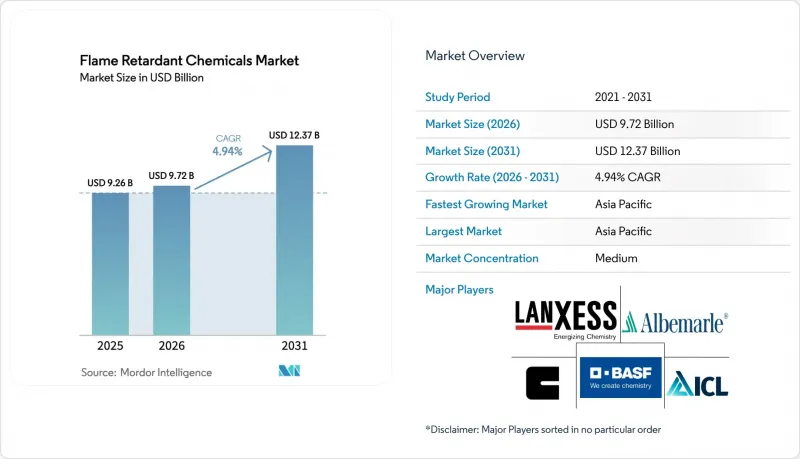
根據 Mordor Intelligence 預測,阻燃化學品市場規模將從 2025 年的 92.6 億美元成長到 2026 年的 97.2 億美元,然後在 2031 年達到 123.7 億美元,2026 年至 2031 年的複合年成長率為 4.94%。
本報告按產品類型(非鹵代和鹵代)、應用領域(聚烯、PVC、環氧樹脂等)、終端用戶行業(電氣電子、建築施工、交通運輸、紡織家具)以及地區(亞太、歐洲、北美、南美、中東和非洲)進行細分。市場預測以美元計價。
全球阻燃化學品市場趨勢與洞察
建築和施工行業嚴格的消防安全法規
2024版《國際消防規範》降低了允許的火焰傳播指數和煙霧指數,迫使設計人員在硬質聚氨酯保溫板中使用膨脹塗層和無鹵添加劑。英國的《建築規範B》自2025年6月起禁止使用超過11公尺高的易燃覆材,這使得市場需求轉向填充三羥基鋁的酚醛發泡體。日本《建築標準法》的修正案增加了多層木結構建築的耐火等級,加快了符合JIS A 1321峰值熱輸出限值的阻燃處理的訂單。韓國於2024年12月效仿,透過符合ISO 5660-1標準,在建築板材中禁用傳統的滷素添加劑。這些監管變化導致認證流程分散,使能夠熟練運用區域測試規程的供應商獲得優勢。
亞太地區的基礎建設快速發展
中國計劃在2024年為鐵路、地鐵和住宅項目撥款17.8兆元人民幣(約2.5兆美元),屆時將消耗210萬噸無鹵聚烯烴聚烯化合物。印度的「國家基礎設施管道計畫」已累計1.4兆美元用於2025年前的基礎設施建設,其電纜和導管規範要求採用基於IS 1554標準的低菸無鹵設計。印尼計劃在2025年為機場和港口建設追加400億美元的投資,並採用符合ASTM E84 A級標準的無鹵環氧鋼塗層。越南計劃在2024年將其地鐵和鐵路預算增加22%,從而推動了對符合IEC 60332標準的電纜的需求成長。這些項目的推進速度超過了歐洲和北美地區的建設週期,抵銷了北美地區開工建設放緩的影響。
對溴化和鹵化化學品的監管限制
歐盟的持久性有機污染物(POPs)法規於2024年將再生聚合物中六溴環十二烷(HBCD)的允許含量降低至十分之一,實際上將傳統的聚苯乙烯泡沫(EPS)隔熱材料從回收循環中剔除。美國環保署(EPA)的《有毒物質管制法》(TSCA)將於2025年3月生效,該法規將從2027年1月起禁止生產十溴二苯醚(Deca-BDE),航太領域除外。加拿大將四溴雙酚A(TBBPA)列入一級管制物質清單,啟動了為期24個月的PCB層壓板逐步淘汰計畫。到2024年底,由於領先採購以確保庫存,溴的現貨價格下降了9%。同時,日本對氯化石蠟的監管導致4,200噸氯化石蠟被轉而使用磷基替代品。
細分市場分析
到2025年,無鹵阻燃系統將佔阻燃劑市場總量的65.08%,預計到2031年,這一佔有率將以5.15%的複合年成長率成長。氫氧化鋁仍然是市場需求的主要驅動力,它透過在180–200 度C的吸熱分解過程中吸收熱量並釋放水蒸氣。 Huber公司的「Martinal OL-107」使電纜中的酸性氣體排放量在2024年降至IEC 60754-2標準的0.5%以下。氫氧化鎂適用於高溫聚烯,Martin Marietta公司的「MagShield 95」兼具抗衝擊性和阻燃性,其中值粒徑為1.8 µm。
無鹵阻燃化學品的市場規模反映了客戶對符合綠色建築認證要求的低毒性材料的偏好。供應商正致力於表面處理以增強與聚合物基體的相容性,而垂直整合的中國製造商則透過控制礬土和磷酸鹽等原料來提升價格競爭力。智慧財產權申請主要集中在用於電動車電池組的磷矽複合材料上,早期使用木質素衍生酚醛樹脂的初步試驗表明,其可使歐洲生命週期法規要求的嵌入碳含量降低30%。
區域分析
預計到2025年,亞太地區將佔全球銷售額的50.65%,複合年成長率(CAGR)為5.69%。中國電池規範「GB 31241」使設備機殼用無鹵聚碳酸酯的需求增加了22%;印度標準「IS 17156」的實施刺激了三大大都會圈地鐵佈線的需求。日本木造建築防火標準的實施擴大了可膨脹塗料的銷售;韓國ISO 5660標準的實施取代了鹵素基板添加劑。越南、印尼和泰國計劃在2024年新增42吉瓦的產能,這三個國家的工業工廠對符合IEC 60332標準的電纜的需求也隨之成長。
在歐洲,由於PFAS禁令迫使發泡材材料配方發生變化,成長速度放緩;同時,十溴二苯醚(Deca-BDE)法規也擾亂了PCB層壓板市場。在德國,強制焚燒包括六溴環十二烷(HBCD)在內的再生聚苯乙烯促進了無鹵原生材料的替代。同時,英國對覆材的禁令使1.4萬噸酚醛發泡的需求轉向了氫氧化鋁(ATH)填充型產品。法國的生命週期法規和義大利的「超級獎勵」(Super Bonus)稅額扣抵計劃促使生物基阻燃劑的使用量增加,也使人們更加關注木質素-酚醛材料的創新。
在北美,預計2025年銷售量將顯著成長,這主要得益於美國資料中心和電動車產能擴張對連接器用二乙基膦酸鋁的需求激增。美國環保署(EPA)對十溴二苯醚(Deca-BDE)的禁令迫使原始設備製造商(OEM)轉向磷基阻燃劑;加拿大修訂後的《國家建築標準法》限制了易燃外牆材料的使用;墨西哥在其12吉瓦可再生能源部署計劃中,要求電纜必須符合IEC 60332-3標準。南美、中東和非洲市場也推動了成長,其中巴西對煙霧偵測器外殼的升級改造採用了ABNT NBR 17240標準,沙烏地阿拉伯的「2030願景」建設項目也強制要求室內裝修符合SASO 2663標準。
其他好處:
- Excel格式的市場預測(ME)表
- 3個月的分析師支持
目錄
第1章:引言
- 研究假設和市場定義
- 調查範圍
第2章:調查方法
第3章執行摘要
第4章 市場狀況
- 市場概覽
- 市場促進因素
- 建築和施工行業嚴格的消防安全法規
- 亞太地區基礎建設快速發展
- 家用電器和電子產品產量增加
- 為符合ESG法規,過渡到無鹵溶液
- 電動汽車電池機殼的耐火標準
- 市場限制因素
- 對溴化/鹵化化學品的監管限制
- 原料成本波動
- 奈米金屬氫氧化物毒性的新研究
- 價值鏈分析
- 技術展望
- 波特五力模型
第5章 市場規模與成長預測
- 依產品類型
- 無鹵阻燃劑
- 無機物
- 氫氧化鋁
- 氫氧化鎂
- 硼化合物
- 磷
- 氮基
- 其他產品類型
- 無機物
- 鹵素阻燃劑
- 溴化合物
- 氯代化合物
- 無鹵阻燃劑
- 透過使用
- 聚烯
- PVC
- 環氧樹脂
- 工程熱塑性塑膠(PA、PBT、PEEK 等)
- 不飽和聚酯樹脂
- 聚氨酯
- 按最終用戶行業分類
- 電氣和電子設備
- 建築/施工
- 運輸
- 紡織品和家具
- 按地區
- 亞太地區
- 中國
- 印度
- 日本
- 韓國
- 其他亞太國家
- 歐洲
- 德國
- 英國
- 法國
- 義大利
- 其他歐洲國家
- 北美洲
- 美國
- 加拿大
- 墨西哥
- 南美洲
- 巴西
- 阿根廷
- 其他南美國家
- 中東和非洲
- 沙烏地阿拉伯
- 南非
- 其他中東和非洲國家
- 亞太地區
第6章 競爭情勢
- 市場集中度
- 策略趨勢
- 市佔率和排名分析
- 公司簡介
- Adeka Corporation
- Albemarle Corporation
- Avient Corporation
- BASF
- Clariant AG
- DIC Corporation
- Dow Inc.
- Eti Maden
- ICL Group
- Italmatch Chemicals SpA
- JM Huber Corp.(Huber Engineered Materials)
- LANXESS AG
- Martin Marietta
- MPI Chemie BV
- Nabaltec AG
- Nyacol Nano Technologies Inc.
- RIN KAGAKU KOGYO Co. Ltd
- RTP Company
- Sanwa Chemical Co. Ltd
- Showa Denko KK
- Sibelco NV(Specialty Alumina)
- Thor Group
- Tosoh Corporation
- UFP Industries Inc.
第7章 市場機會與未來展望
According to Mordor Intelligence, the flame retardant chemicals market size is expected to grow from USD 9.26 billion in 2025 to USD 9.72 billion in 2026 and is forecast to reach USD 12.37 billion by 2031 at 4.94% CAGR over 2026-2031.
This report is Segmented by Product Type (Non-Halogenated and Halogenated), Application (Polyolefins, PVC, Epoxy Resins, and More), End-User Industry (Electrical and Electronics, Building and Construction, Transportation, and Textiles and Furniture), and Geography (Asia-Pacific, Europe, North America, South America, and Middle East and Africa). Market Forecasts are Provided in Terms of Value (USD).
Global Flame Retardant Chemicals Market Trends and Insights
Stringent Fire-Safety Regulations in Building and Construction
The 2024 International Fire Code lowered permissible flame-spread and smoke-development indices, compelling specifiers to adopt intumescent coatings and halogen-free additives in rigid polyurethane insulation boards. The United Kingdom's Approved Document B ban on combustible cladding above 11 meters, effective June 2025, shifted demand toward aluminum-trihydrate-filled phenolic foams. Japan's Building Standard Law revision added a fire-resistance class for multistory timber, accelerating orders for flame-retardant treatments that meet JIS A 1321 peak heat-release limits. South Korea followed in December 2024 by aligning with ISO 5660-1, removing legacy halogenated additives from building boards. Collectively, the rule changes fragmented certification pathways and rewarded suppliers adept at navigating local test protocols.
Rapid Infrastructure Build-Out Across Asia-Pacific
China allocated CNY 17.8 trillion (USD 2.5 trillion) to rail, metro, and housing projects in 2024, consuming 2.1 million t of halogen-free polyolefin cable compounds. India's National Infrastructure Pipeline earmarked USD 1.4 trillion through 2025, with cable and conduit specs mandating low-smoke zero-halogen designs under IS 1554. Indonesia added airport and seaport builds worth USD 40 billion in 2025, adopting non-halogenated epoxy steel coatings that pass ASTM E84 Class A. Vietnam boosted metro-rail budgets by 22% in 2024, raising IEC 60332 cable demand. These projects outstripped Western construction cycles, offsetting slower North American starts.
Regulatory Curbs on Brominated and Halogenated Chemistries
The EU's POPs Regulation cut allowable HBCD in recycled polymers tenfold in 2024, effectively removing legacy EPS insulation from circular loops. EPA's March 2025 TSCA rule bans deca-BDE manufacture after January 2027, except in aerospace. Canada added TBBPA to Schedule 1, initiating a 24-month PCB laminate phase-out. Inventory pre-buys depressed bromine spot prices 9% in late-2024, while Japanese controls on chlorinated paraffins diverted 4,200 t toward phosphorus alternatives.
Other drivers and restraints analyzed in the detailed report include:
- Rising Output of Consumer Electronics and Electrical Goods
- Shift Toward Non-Halogenated Solutions for ESG Compliance
- Raw-Material Cost Volatility
For complete list of drivers and restraints, kindly check the Table Of Contents.
Segment Analysis
Non-halogenated systems commanded 65.08% of the flame retardant chemicals market in 2025, and this share will expand at a 5.15% CAGR through 2031. Aluminum hydroxide remains the volume backbone, decomposing endothermically at 180-200°C to quench heat while releasing water vapor; Huber's Martinal OL-107 enabled IEC 60754-2 acid-gas emissions below 0.5% for cables in 2024. Magnesium hydroxide covers higher-temperature polyolefins, with Martin Marietta's MagShield 95 balancing impact and flame properties at 1.8 µm median size.
The flame retardant chemicals market size for non-halogenated products is reflecting customer preference for lower-toxicity materials that support green-building certifications. Suppliers focus on surface treatments that boost polymer-matrix compatibility, while vertically integrated Chinese producers sharpen price competition by controlling bauxite and phosphate feedstocks. Intellectual-property filings concentrate on phosphorus-silicon hybrids for EV battery packs, and early pilots for lignin-derived phenolics demonstrate 30% embodied-carbon cuts sought under Europe's life-cycle mandates.
Complete Report Scope:
- By Product Type
- Non-Halogenated Flame Retardants
- Inorganic
- Aluminum Hydroxide
- Magnesium Hydroxide
- Boron Compounds
- Phosphorus
- Nitrogen
- Other Product Types
- Inorganic
- Halogenated Flame Retardants
- Brominated Compounds
- Chlorinated Compounds
- Non-Halogenated Flame Retardants
- By Application
- Polyolefins
- PVC
- Epoxy Resins
- Engineering Thermoplastics (PA, PBT, PEEK, etc.)
- Unsaturated Polyester Resins
- Polyurethane
- By End-User Industry
- Electrical and Electronics
- Building and Construction
- Transportation
- Textiles and Furniture
- By Geography
- Asia-Pacific
- China
- India
- Japan
- South Korea
- Rest of Asia-Pacific
- Europe
- Germany
- United Kingdom
- France
- Italy
- Rest of Europe
- North America
- United States
- Canada
- Mexico
- South America
- Brazil
- Argentina
- Rest of South America
- Middle East and Africa
- Saudi Arabia
- South Africa
- Rest of Middle East and Africa
- Asia-Pacific
Geography Analysis
Asia-Pacific generated 50.65% of 2025 revenue and is forecast to grow at a 5.69% CAGR. China's GB 31241 battery regulations boosted halogen-free polycarbonate by 22% for device housings, and India's IS 17156 unlocked metro-rail wiring demand across three megacities. Japan's timber-building fire codes expanded intumescent-coating sales, and South Korea's ISO 5660 alignment displaced halogenated board additives. Vietnam, Indonesia, and Thailand, which together added 42 GW of new manufacturing in 2024, intensified the need for IEC 60332-compliant cables across industrial plants.
Europe lagged in growth as PFAS bans forced foam reformulations and deca-BDE restrictions disrupted PCB laminates. Germany directed HBCD-laden recycled polystyrene to incineration only, spurring virgin non-halogenated replacements, while the UK cladding ban steered 14,000 t of phenolic-foam demand to ATH-filled grades. France's life-cycle mandates and Italy's Superbonus tax credits mobilized bio-based flame retardants, pointing toward lignin-phenol innovations.
North America delivered a significant 2025 turnover, with U.S. data-center and EV ramps soaking up aluminum diethylphosphinate for connectors. EPA's deca-BDE ban pushes OEMs toward phosphorus solutions, Canada's updated National Building Code limits combustible cladding and Mexico's 12 GW of renewables requests IEC 60332-3 cables. South America and the Middle East & Africa also contributed, led by Brazil's smoke-detector housing upgrades under ABNT NBR 17240 and Saudi Arabia's Vision 2030 construction program that specifies SASO 2663-compliant interiors.
- Adeka Corporation
- Albemarle Corporation
- Avient Corporation
- BASF
- Clariant AG
- DIC Corporation
- Dow Inc.
- Eti Maden
- ICL Group
- Italmatch Chemicals SpA
- J.M. Huber Corp. (Huber Engineered Materials)
- LANXESS AG
- Martin Marietta
- MPI Chemie BV
- Nabaltec AG
- Nyacol Nano Technologies Inc.
- RIN KAGAKU KOGYO Co. Ltd
- RTP Company
- Sanwa Chemical Co. Ltd
- Showa Denko K.K.
- Sibelco NV (Specialty Alumina)
- Thor Group
- Tosoh Corporation
- UFP Industries Inc.
Additional Benefits:
- The market estimate (ME) sheet in Excel format
- 3 months of analyst support
TABLE OF CONTENTS
1 Introduction
- 1.1 Study Assumptions & Market Definition
- 1.2 Scope of the Study
2 Research Methodology
3 Executive Summary
4 Market Landscape
- 4.1 Market Overview
- 4.2 Market Drivers
- 4.2.1 Stringent fire-safety regulations in building and construction
- 4.2.2 Rapid infrastructure build-out across Asia-Pacific
- 4.2.3 Rising output of consumer electronics and electrical goods
- 4.2.4 Shift toward non-halogenated solutions for ESG compliance
- 4.2.5 EV-battery enclosure fire-performance standards
- 4.3 Market Restraints
- 4.3.1 Regulatory curbs on brominated / halogenated chemistries
- 4.3.2 Raw-material cost volatility
- 4.3.3 Emerging toxicity scrutiny on nano-metal hydroxides
- 4.4 Value Chain Analysis
- 4.5 Technological Outlook
- 4.6 Porter's Five Forces
- 4.6.1 Bargaining Power of Suppliers
- 4.6.2 Bargaining Power of Buyers
- 4.6.3 Threat of New Entrants
- 4.6.4 Threat of Substitutes
- 4.6.5 Degree of Competition
5 Market Size & Growth Forecasts (Value)
- 5.1 By Product Type
- 5.1.1 Non-Halogenated Flame Retardants
- 5.1.1.1 Inorganic
- 5.1.1.1.1 Aluminum Hydroxide
- 5.1.1.1.2 Magnesium Hydroxide
- 5.1.1.1.3 Boron Compounds
- 5.1.1.2 Phosphorus
- 5.1.1.3 Nitrogen
- 5.1.1.4 Other Product Types
- 5.1.1.1 Inorganic
- 5.1.2 Halogenated Flame Retardants
- 5.1.2.1 Brominated Compounds
- 5.1.2.2 Chlorinated Compounds
- 5.1.1 Non-Halogenated Flame Retardants
- 5.2 By Application
- 5.2.1 Polyolefins
- 5.2.2 PVC
- 5.2.3 Epoxy Resins
- 5.2.4 Engineering Thermoplastics (PA, PBT, PEEK, etc.)
- 5.2.5 Unsaturated Polyester Resins
- 5.2.6 Polyurethane
- 5.3 By End-User Industry
- 5.3.1 Electrical and Electronics
- 5.3.2 Building and Construction
- 5.3.3 Transportation
- 5.3.4 Textiles and Furniture
- 5.4 By Geography
- 5.4.1 Asia-Pacific
- 5.4.1.1 China
- 5.4.1.2 India
- 5.4.1.3 Japan
- 5.4.1.4 South Korea
- 5.4.1.5 Rest of Asia-Pacific
- 5.4.2 Europe
- 5.4.2.1 Germany
- 5.4.2.2 United Kingdom
- 5.4.2.3 France
- 5.4.2.4 Italy
- 5.4.2.5 Rest of Europe
- 5.4.3 North America
- 5.4.3.1 United States
- 5.4.3.2 Canada
- 5.4.3.3 Mexico
- 5.4.4 South America
- 5.4.4.1 Brazil
- 5.4.4.2 Argentina
- 5.4.4.3 Rest of South America
- 5.4.5 Middle East and Africa
- 5.4.5.1 Saudi Arabia
- 5.4.5.2 South Africa
- 5.4.5.3 Rest of Middle East and Africa
- 5.4.1 Asia-Pacific
6 Competitive Landscape
- 6.1 Market Concentration
- 6.2 Strategic Moves
- 6.3 Market Share(%)/Ranking Analysis
- 6.4 Company Profiles (includes Global level Overview, Market level overview, Core Segments, Financials as available, Strategic Information, Market Rank/Share for key companies, Products & Services, and Recent Developments)
- 6.4.1 Adeka Corporation
- 6.4.2 Albemarle Corporation
- 6.4.3 Avient Corporation
- 6.4.4 BASF
- 6.4.5 Clariant AG
- 6.4.6 DIC Corporation
- 6.4.7 Dow Inc.
- 6.4.8 Eti Maden
- 6.4.9 ICL Group
- 6.4.10 Italmatch Chemicals SpA
- 6.4.11 J.M. Huber Corp. (Huber Engineered Materials)
- 6.4.12 LANXESS AG
- 6.4.13 Martin Marietta
- 6.4.14 MPI Chemie BV
- 6.4.15 Nabaltec AG
- 6.4.16 Nyacol Nano Technologies Inc.
- 6.4.17 RIN KAGAKU KOGYO Co. Ltd
- 6.4.18 RTP Company
- 6.4.19 Sanwa Chemical Co. Ltd
- 6.4.20 Showa Denko K.K.
- 6.4.21 Sibelco NV (Specialty Alumina)
- 6.4.22 Thor Group
- 6.4.23 Tosoh Corporation
- 6.4.24 UFP Industries Inc.
7 Market Opportunities & Future Outlook
- 7.1 White-space & Unmet-need Assessment
- 7.2 Active R&D into Non-halogenated Flame Retardants

 歐洲阻燃劑市場:市場佔有率分析、行業趨勢、統計數據和成長預測(2026-2031 年)
 阻燃化學品市場規模、佔有率和成長分析(按產品類型、最終用戶產業、應用和地區分類)—產業預測(2026-2033 年)
 阻燃化學品:技術與全球市場