


 |
市場調查報告書
商品編碼
2121869
啤酒包裝:市場佔有率分析、產業趨勢與統計、成長預測(2026-2031)Beer Packaging - Market Share Analysis, Industry Trends & Statistics, Growth Forecasts (2026 - 2031) |
||||||

※ 本網頁內容可能與最新版本有所差異。詳細情況請與我們聯繫。
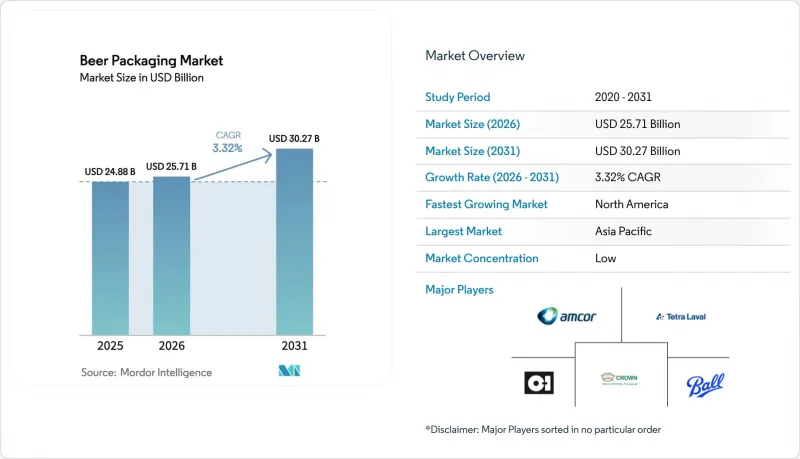
據 Mordor Intelligence 稱,啤酒包裝市場預計到 2026 年價值 257.1 億美元,高於 2025 年的 248.8 億美元,預計到 2031 年將達到 302.7 億美元,2026 年至 2031 年的複合年成長率為 3.32%。
本報告按包裝材料(玻璃、金屬、PET、紙)、包裝形式(瓶、罐、桶、袋)、容量(330毫升以下、331-650毫升、650毫升以上)、分銷管道(直銷、間接銷售)和地區(北美、歐洲、亞太、中東和非洲、南美)進行細分。市場預測以美元計價。
全球啤酒包裝市場趨勢及洞察
在北美,精釀啤酒廠的激增正在推動小批量罐裝啤酒設計的趨勢。
精釀酒廠的蓬勃發展正在重塑包裝產業的經濟格局。這是因為像Ball公司的Dynamark Advanced Pro這樣的數位印刷技術,可以在單一托盤上印製多種圖案,從而打破了傳統包裝的最低訂購量限制。靈活的罐裝生產線使釀酒商能夠更好地管理庫存、測試新產品,並在無需大量採購玻璃瓶的情況下推出季節性產品。雖然數位印刷的成本比平版印刷高出近3倍,但其帶來的周轉率成長和展示效果提升,足以抵銷這項成本優勢,尤其是在該全部區域9,000多家啤酒廠。
歐盟的押金和返還制度促進了輕便可回收玻璃瓶的廣泛應用。
在德國,強制押金制度實現了98%的回收率,催生了Vetropack公司「Echovai」等創新產品。這些強化玻璃瓶比傳統產品輕30%,同時又夠堅固耐用,可多次循環使用。法國也引進了該制度,建立了一個年處理能力達6,000萬個瓶子的集中清洗中心,成本結構正從一次性使用轉向循環資產管理。
歐洲對一次性塑膠製品的法律禁令正在遏制PET的使用。
歐盟的《包裝和包裝廢棄物條例》規定,到 2030 年,包裝材料中必須含有 30% 的再生材料,並從 2025 年開始分階段淘汰適用的產品形式。生產者延伸責任制 (EPR) 的費用推高了 PET 的成本,使其高於可無限循環利用的鋁,導致產品組合轉向金屬和輕質可回收玻璃。
細分市場分析
玻璃憑藉其不影響口感和香氣的特性以及在消費者心中樹立的良好形象,預計到2025年將保持80.25%的市場佔有率。然而,鋁材優異的可回收性和更低的運輸成本正在推動銷售量成長,而2030年實現包裝100%可回收的政策目標也進一步促進了其發展。 PET包裝正以5.52%的複合年成長率成長,如今,其成長得益於滿足啤酒二氧化碳阻隔需求的阻隔塗層瓶,而紙質包裝仍主要局限於二次包裝。
能源成本上漲和碳排放稅的實施進一步擴大了鋁相對於爐燒玻璃的整體成本優勢。同時,諸如利用廢棄食用油生產的生物對二甲苯PET等創新技術,正在提升品牌信譽,並預示著聚合物的更廣泛應用。儘管啤酒製造商仍保留一些用於高級產品的玻璃包裝產品,但啤酒包裝市場的新增產能正日益轉向更輕的材料。
到2025年,瓶裝飲料將佔全球整體銷售量的74.64%。然而,受精釀啤酒熱潮、便利商店購物和戶外消費等趨勢的推動,罐裝飲料正以6.38%的複合年成長率快速成長,這些趨勢都青睞金屬容器。由於新興地區對衛生系統的資本投入,桶裝飲料的成長依然緩慢,而袋裝飲料的市佔率仍然很小。
數位印刷技術使小規模啤酒廠也能達到與跨國公司相同的包裝品質水平,從而加快產品週轉,避免浪費性過度生產。正如巴西的例子所示,對區域罐裝生產線的投資進一步擴大了規模經濟,降低了單位成本,並提高了供應穩定性。
同時,玻璃容器製造商正透過壓花和錐形等技術來提升其產品在商店中的感知價值,從而應對這種情況。
區域分析
亞太地區人口眾多、收入不斷成長,且快速的都市化有利於包裝產品的銷售,預計到2025年,該地區將以38.05%的市場佔有率佔據榜首。越南和印尼冷鏈的擴張正在推動PET瓶的普及,而中國精釀啤酒市場預計到2024年將成長至331億元人民幣,這兩方面都將推動對精品罐裝設計和禮品型玻璃瓶的需求。
預計北美將維持最高的成長率,到2031年複合年成長率將達到6.08%。超過9000家精釀啤酒廠對小批量罐裝啤酒的需求穩定,但關稅和鋁板短缺推高了成本。諸如Ball公司收購佛羅裡達州等投資項目正在最佳化供應鏈網路並增加永續產能,從而鞏固該地區作為鋁業成長引擎的地位。
歐洲仍然是高階啤酒市場的中心,但人均啤酒消費量卻停滯不前。歐盟強制回收政策正推動資本轉向可回收的強化玻璃瓶和易回收易拉罐。德國啤酒廠正在引進壓花生產線,這些生產線在滿足循環經濟關鍵績效指標的同時,也能達到工業級的生產速度,並展示其高階包裝。
其他好處:
- Excel格式的市場預測(ME)表
- 3個月的分析師支持
目錄
第1章:引言
- 研究假設和市場定義
- 調查範圍
第2章:調查方法
第3章執行摘要
第4章 市場狀況
- 市場概覽
- 市場促進因素
- 在北美,精釀啤酒廠的激增正在推動短期罐裝啤酒設計趨勢。
- 歐盟的押金返還制度正在推動輕便可回收玻璃瓶的普及。
- 冷鏈的快速擴張正在推動亞洲啤酒市場採用PET瓶。
- 在德國啤酒產業,品牌的優質化正在推動壓紋、特殊設計的瓶子的流行。
- 鋁關稅降低正在促使南美洲的罐體材料轉變。
- 在英國,電子商務的多件裝產品正在加速瓦楞紙板二次包裝的需求。
- 市場限制因素
- 歐洲關於一次性塑膠的法律法規正在抑制對PET的需求。
- 美國鋁板供應緊張,導致精釀啤酒釀造商的罐裝成本上升。
- 在澳大利亞,消費者對硬蘇打水的需求轉變導致玻璃瓶裝飲料的消費量下降。
- 新興市場對酒桶維修所需的大量資本投入限制了其回報能力。
- 供應鏈分析
- 監理展望
- 波特五力分析
第5章 市場規模與成長預測
- 透過包裝材料
- 玻璃
- 金屬
- PET
- 紙
- 按包裝類型
- 瓶子
- 能
- 桶
- 小袋
- : 英語
- 少於 330 毫升
- 331~650 ml
- 超過 650 毫升
- 透過分銷管道
- 直銷
- 間接銷售
- 按地區
- 北美洲
- 美國
- 加拿大
- 墨西哥
- 歐洲
- 德國
- 英國
- 法國
- 義大利
- 西班牙
- 俄羅斯
- 其他歐洲國家
- 亞太地區
- 中國
- 印度
- 日本
- 韓國
- 澳洲和紐西蘭
- 其他亞太國家
- 中東和非洲
- 中東
- 阿拉伯聯合大公國
- 沙烏地阿拉伯
- 土耳其
- 其他中東國家
- 非洲
- 南非
- 奈及利亞
- 埃及
- 其他非洲國家
- 中東
- 南美洲
- 巴西
- 阿根廷
- 其他南美國家
- 北美洲
第6章 競爭情勢
- 市場集中度
- 策略趨勢
- 市佔率分析
- 公司簡介
- Amcor Ltd.
- Ardagh Group SA
- Crown Holdings Inc.
- Ball Corporation
- Tetra Laval International SA
- OI Glass Inc.
- Canpack Group
- Silgan Holdings Inc.
- Vidrala SA
- Allied Glass Containers Ltd.
- Plastipak Holdings Inc.
- Nampak Ltd.
- Orora Limited
- Graphic Packaging International
- Toyo Seikan Group Holdings Ltd.
- Envases Universales
- Berlin Packaging LLC
- Sidel(Sidel Group)
- Krones AG
第7章 市場機會與未來展望
According to Mordor Intelligence, beer packaging market size in 2026 is estimated at USD 25.71 billion, growing from 2025 value of USD 24.88 billion with 2031 projections showing USD 30.27 billion, growing at 3.32% CAGR over 2026-2031.
This report is Segmented by Packaging Material (Glass, Metal, PET, Paper), Packaging Type (Bottle, Can, Keg, Pouches), Pack Size (Less Than Equal To 330 Ml, 331-650 Ml, More Than 650 Ml), Distribution Channel (Direct Sales, Indirect Sales), and Geography (North America, Europe, Asia-Pacific, Middle East and Africa, South America). The Market Forecasts are Provided in Terms of Value (USD).
Global Beer Packaging Market Trends and Insights
Surge in Craft Breweries Driving Short-Run Can Designs in North America
Craft brewery growth reshapes packaging economics as digital printing such as Ball's Dynamark Advanced Pro lets multiple graphics run on one pallet, eliminating historic minimum-order barriers. Flexible can lines help brewers manage inventory, pilot new SKUs, and execute seasonal launches without excess glass bottle purchases. Though digital print premiums approach 300% over offset, the cost is offset by faster sell-through rates and stronger shelf appeal at more than 9,000 breweries across the region.
Rising Adoption of Lightweight Returnable Glass Bottles Backed by EU Deposit-Return Schemes
Mandated deposit systems achieve 98% return rates in Germany, prompting innovations like Vetropack's Echovai tempered bottle that is 30% lighter yet rugged across multiple cycles. France's rollout adds centralized washing hubs capable of 60 million bottles per year, shifting cost structures from one-way disposal toward circular asset management.
Legislative Bans on Single-Use Plastics Curtailing PET in Europe
The EU Packaging and Packaging Waste Regulation enforces 30% recycled content by 2030 and phases out targeted formats from 2025. Extended Producer Responsibility fees raise PET costs relative to infinitely recyclable aluminum, prompting portfolio shifts toward metal and lightweight returnable glass.
Other drivers and restraints analyzed in the detailed report include:
- Rapid Cold-Chain Expansion Enabling PET Penetration in Asian Beer
- Brand Premiumization Fueling Embossed Specialty Bottles Among German Breweries
- Tight U.S. Aluminum Slab Supply Elevating Can Costs for Craft Brewers
For complete list of drivers and restraints, kindly check the Table Of Contents.
Segment Analysis
Glass preserved an 80.25% share in 2025 due to sensory neutrality and entrenched consumer associations. Yet aluminum's recyclability edge and transportation savings peel away volume, aided by policy targets for 100% recyclable packaging by 2030. PET, advancing at 5.52% CAGR, draws on barrier-coated bottles that now satisfy beer's carbonation needs, while paper remains confined to secondary packs.
Rising energy costs and carbon levies widen aluminum's total-cost edge over furnace-fired glass. Meanwhile, innovations like bio-paraxylene PET from used cooking oil improve brand credentials and foreshadow broader polymer adoption. Brewers keep niche glass SKUs for premium variants, but the Beer packaging market increasingly redirects new capacity toward lighter substrates.
Bottles supplied 74.64% of global volume in 2025. Still, cans are accelerating at a 6.38% CAGR as dynamism in craft beer, convenience shopping, and outdoor consumption tips formats in favor of metal. Keg growth remains muted by cleaning-system cap-ex in emerging regions, and pouches stay marginal.
Digital printing lets small brewers match multinational packaging quality, increasing SKU churn without wasteful overruns. Investment in regional can lines, as seen in Brazil, further scales economies that shrink per-unit costs and enhance availability.
Glass manufacturers counter with embossing and tapered profiles that lift perceived value on-premise.
Complete Report Scope:
- By Packaging Material
- Glass
- Metal
- PET
- Paper
- By Packaging Type
- Bottle
- Can
- Keg
- Pouches
- By Pack Size
- Less than 330 ml
- 331-650 ml
- More than 650 ml
- By Distribution Channel
- Direct Sales
- Indirect Sales
- By Geography
- North America
- United States
- Canada
- Mexico
- Europe
- Germany
- United Kingdom
- France
- Italy
- Spain
- Russia
- Rest of Europe
- Asia-Pacific
- China
- India
- Japan
- South Korea
- Australia and New Zealand
- Rest of Asia-Pacific
- Middle East and Africa
- Middle East
- United Arab Emirates
- Saudi Arabia
- Turkey
- Rest of Middle East
- Africa
- South Africa
- Nigeria
- Egypt
- Rest of Africa
- Middle East
- South America
- Brazil
- Argentina
- Rest of South America
- North America
Geography Analysis
Asia-Pacific led with 38.05% share in 2025, underpinned by population scale, climbing incomes, and rapid urbanization that favor packaged formats. Cold-chain expansion in Vietnam and Indonesia supports PET penetration, while China's craft segment grew to CNY 33.1 billion in 2024, fostering boutique can designs and gift-oriented glass bottles alike.
North America posts the fastest 6.08% CAGR through 2031. More than 9,000 craft breweries generate steady demand for short-run cans, though tariff and slab shortages inflate costs. Investments such as Ball's Florida acquisition streamline supply networks and add sustainable capacity, reinforcing aluminum's role as the region's growth engine.
Europe remains a premium stronghold but confronts flat per-capita beer intake. The EU's recyclability mandate triggers capital shifts into tempered, returnable glass and high-recycled-content cans. German breweries showcase premium packaging by installing embossed lines that hit industrial speeds while meeting circular-economy KPIs.
- Amcor Ltd.
- Ardagh Group SA
- Crown Holdings Inc.
- Ball Corporation
- Tetra Laval International SA
- O-I Glass Inc.
- Canpack Group
- Silgan Holdings Inc.
- Vidrala SA
- Allied Glass Containers Ltd.
- Plastipak Holdings Inc.
- Nampak Ltd.
- Orora Limited
- Graphic Packaging International
- Toyo Seikan Group Holdings Ltd.
- Envases Universales
- Berlin Packaging LLC
- Sidel (Sidel Group)
- Krones AG
Additional Benefits:
- The market estimate (ME) sheet in Excel format
- 3 months of analyst support
TABLE OF CONTENTS
1 INTRODUCTION
- 1.1 Study Assumptions and Market Definition
- 1.2 Scope of the Study
2 RESEARCH METHODOLOGY
3 EXECUTIVE SUMMARY
4 MARKET LANDSCAPE
- 4.1 Market Overview
- 4.2 Market Drivers
- 4.2.1 Surge in Craft Breweries Driving Short-Run Can Designs in North America
- 4.2.2 Rising Adoption of Lightweight Returnable Glass Bottles Backed by EU Deposit-Return Schemes
- 4.2.3 Rapid Cold-Chain Expansion Enabling PET Penetration in Asian Beer
- 4.2.4 Brand Premiumization Fueling Embossed Specialty Bottles Among German Breweries
- 4.2.5 Aluminum Tariff Cuts Triggering Can Conversions in South America
- 4.2.6 E-commerce Multipacks Accelerating Corrugated Secondary Packaging Demand in the UK
- 4.3 Market Restraints
- 4.3.1 Legislative Bans on Single-Use Plastics Curtailing PET in Europe
- 4.3.2 Tight U.S. Aluminum Slab Supply Elevating Can Costs for Craft Brewers
- 4.3.3 Consumer Shift to Hard Seltzers Reducing Glass Volumes in Australia
- 4.3.4 High Cap-Ex for Keg Refurbishment Limiting Returnability in Emerging Markets
- 4.4 Supply-Chain Analysis
- 4.5 Regulatory Outlook
- 4.6 Porter's Five Forces Analysis
- 4.6.1 Threat of New Entrants
- 4.6.2 Bargaining Power of Buyers/Consumers
- 4.6.3 Bargaining Power of Suppliers
- 4.6.4 Threat of Substitute Products
- 4.6.5 Intensity of Competitive Rivalry
5 MARKET SIZE AND GROWTH FORECASTS (VALUE)
- 5.1 By Packaging Material
- 5.1.1 Glass
- 5.1.2 Metal
- 5.1.3 PET
- 5.1.4 Paper
- 5.2 By Packaging Type
- 5.2.1 Bottle
- 5.2.2 Can
- 5.2.3 Keg
- 5.2.4 Pouches
- 5.3 By Pack Size
- 5.3.1 Less than 330 ml
- 5.3.2 331-650 ml
- 5.3.3 More than 650 ml
- 5.4 By Distribution Channel
- 5.4.1 Direct Sales
- 5.4.2 Indirect Sales
- 5.5 By Geography
- 5.5.1 North America
- 5.5.1.1 United States
- 5.5.1.2 Canada
- 5.5.1.3 Mexico
- 5.5.2 Europe
- 5.5.2.1 Germany
- 5.5.2.2 United Kingdom
- 5.5.2.3 France
- 5.5.2.4 Italy
- 5.5.2.5 Spain
- 5.5.2.6 Russia
- 5.5.2.7 Rest of Europe
- 5.5.3 Asia-Pacific
- 5.5.3.1 China
- 5.5.3.2 India
- 5.5.3.3 Japan
- 5.5.3.4 South Korea
- 5.5.3.5 Australia and New Zealand
- 5.5.3.6 Rest of Asia-Pacific
- 5.5.4 Middle East and Africa
- 5.5.4.1 Middle East
- 5.5.4.1.1 United Arab Emirates
- 5.5.4.1.2 Saudi Arabia
- 5.5.4.1.3 Turkey
- 5.5.4.1.4 Rest of Middle East
- 5.5.4.2 Africa
- 5.5.4.2.1 South Africa
- 5.5.4.2.2 Nigeria
- 5.5.4.2.3 Egypt
- 5.5.4.2.4 Rest of Africa
- 5.5.4.1 Middle East
- 5.5.5 South America
- 5.5.5.1 Brazil
- 5.5.5.2 Argentina
- 5.5.5.3 Rest of South America
- 5.5.1 North America
6 COMPETITIVE LANDSCAPE
- 6.1 Market Concentration
- 6.2 Strategic Moves
- 6.3 Market Share Analysis
- 6.4 Company Profiles (includes Global level Overview, Market level overview, Core Segments, Financials as available, Strategic Information, Market Rank/Share for key companies, Products and Services, and Recent Developments)
- 6.4.1 Amcor Ltd.
- 6.4.2 Ardagh Group SA
- 6.4.3 Crown Holdings Inc.
- 6.4.4 Ball Corporation
- 6.4.5 Tetra Laval International SA
- 6.4.6 O-I Glass Inc.
- 6.4.7 Canpack Group
- 6.4.8 Silgan Holdings Inc.
- 6.4.9 Vidrala SA
- 6.4.10 Allied Glass Containers Ltd.
- 6.4.11 Plastipak Holdings Inc.
- 6.4.12 Nampak Ltd.
- 6.4.13 Orora Limited
- 6.4.14 Graphic Packaging International
- 6.4.15 Toyo Seikan Group Holdings Ltd.
- 6.4.16 Envases Universales
- 6.4.17 Berlin Packaging LLC
- 6.4.18 Sidel (Sidel Group)
- 6.4.19 Krones AG
7 MARKET OPPORTUNITIES AND FUTURE OUTLOOK
- 7.1 White-space and Unmet-Need Assessment

 啤酒包裝市場:2026-2032年全球市場預測(按包裝類型、材料、包裝尺寸、瓶蓋類型和最終用戶分類)
 啤酒桶市場規模、佔有率和趨勢分析報告:按材質、銷售、應用、地區和細分市場預測(2026-2033 年)
 啤酒包裝市場規模、佔有率、趨勢和預測:按材料類型、包裝類型、形式和地區分類,2026-2034 年
 全球啤酒包裝市場:市場規模、佔有率、成長和行業分析:按材料類型、產品類型和區域預測(至2034年)
 2026年全球啤酒包裝市場報告
 啤酒桶市場 - 全球產業規模、佔有率、趨勢、機會和預測(按材料、應用、產能、地區、競爭格局分類,2021-2031年)
 啤酒包裝市場規模、佔有率及成長分析(按類型、材料、啤酒類型及地區分類)-2026-2033年產業預測美國啤酒包裝市場規模、佔有率、趨勢分析報告:按材料、產品、最終用途、細分市場預測,2025-2030 年啤酒包裝市場規模、佔有率、趨勢分析報告:按材料、產品、最終用途、地區、細分市場預測,2025-2030 年
 2032 年啤酒桶市場預測:按類型、材料、容量、分銷管道、最終用戶和地區進行的全球分析