


 |
市場調查報告書
商品編碼
2121755
合成橡膠:市場佔有率分析、產業趨勢與統計、成長預測(2026-2031)Synthetic Rubber - Market Share Analysis, Industry Trends & Statistics, Growth Forecasts (2026 - 2031) |
||||||

※ 本網頁內容可能與最新版本有所差異。詳細情況請與我們聯繫。
根據 Mordor Intelligence 預測,合成橡膠市場規模預計在 2025 年達到 348.2 億美元,2026 年達到 363 億美元,到 2031 年達到 446.9 億美元,2026 年至 2031 年的複合年成長率為 4.25%。
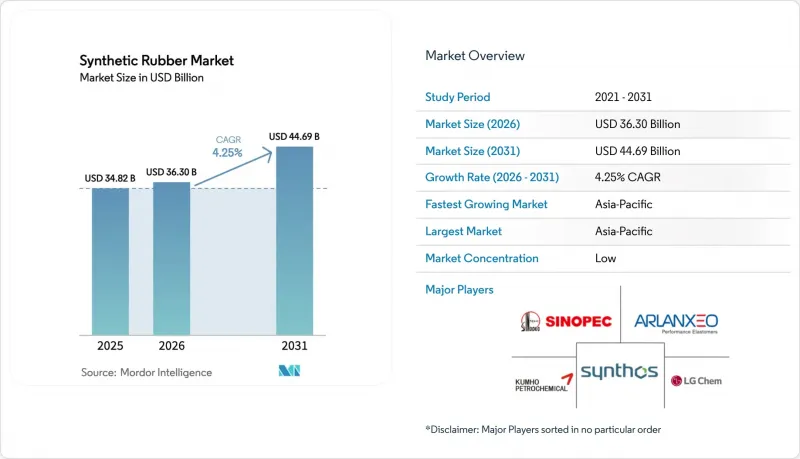
本報告按類型(苯乙烯-丁二烯橡膠(SBR)、聚丁二烯橡膠 (BR)、其他)、製造流程(乳液聚合、其他)、原料(丁二烯、異戊二烯、苯乙烯、其他)、應用(輪胎及輪胎零件、非輪胎汽車應用、其他)和地區(亞太地區、北美地區、歐洲、其他)進行細分。市場預測以美元 (USD) 為單位。
全球合成橡膠市場趨勢及洞察
電動車製造商對高性能輪胎的需求激增。
電動車扭力和電池重量的增加導致胎面磨損高達20-30%,迫使汽車製造商轉向S-SBR配方。 S-SBR配方與二氧化矽填料結合使用,可將滾動阻力降低高達20%。隨著特斯拉2024年的供貨合約以及比亞迪2025年實現自主配方,製造商們正在推進向連續溶液反應器的維修,即使這需要5000萬至8000萬美元的資本投資。預計到2027年,電動車將佔全球輕型車銷量的20%,因此,沒有功能化等級的一級供應商將面臨失去合約的風險。更薄的胎側帶來的空氣動力學性能提升,進一步將輪胎化學成分與車輛續航里程聯繫起來,鞏固了合成橡膠市場作為汽車製造商戰略工具的地位。
用於可再生能源設備的工業橡膠製品成長
風力發電機機艙的溫度波動範圍在-40 度C至+60 度C之間,因此需要耐臭氧性能超越天然橡膠的EPDM密封件。陶氏化學的「NORDEL REN EPDM」含有50%的生物碳,將於2025年上市,目前已獲得維斯塔斯和西門子歌美颯的認證。同時,鋰礦的輸送機需要能夠耐受鹽水和零下環境的丁腈橡膠。這些高附加價值細分市場支撐著合成橡膠市場工業產品領域預計4.58%的複合年成長率。
丁二烯原料價格波動
由於裂解裝置的運作,2024年至2025年間亞洲丁二烯現貨價格上漲了67%,輪胎製造商抵制價格上漲,擠壓了乳化型丁苯橡膠(SBR)的利潤空間。溶液級丁二烯工廠被收取每噸100至150美元的純度溢價,削弱了其成本優勢。儘管沙烏地阿美和沙烏地基礎工業公司(SABIC)的垂直整合確保了自身的供應來源,但印度的獨立生產商仍然脆弱,被迫增加庫存並加劇營運資金緊張。
細分市場分析
預計到2025年,苯乙烯-丁二烯橡膠(SBR)將佔合成橡膠市場40.89%的佔有率,這主要得益於其在替換輪胎領域的成本優勢。乙丙橡膠(EPDM)預計將以5.81%的複合年成長率(CAGR)實現最高成長,這主要得益於屋頂維修和NVH(噪音、振動和聲振粗糙度)措施的日益普及。聚丁二烯共混物可增強冬季輪胎的柔軟性,而丁基橡膠則在醫藥瓶塞領域保持較高的價格。預計到2031年,由EPDM驅動的合成橡膠市場規模將顯著擴大,反映了其優異的耐候性。隨著電動車(EV)的日益普及,以及LG化學和錦湖石化等公司的投資,溶液型SBR產品正在超高性能輪胎市場佔據主導地位。
維修連續反應器的成本為每10萬噸生產線5000萬至8000萬美元,使得現有企業擁有低成本資金籌措方案的優勢。阿朗新科(ARLANXEO)將於2025年推出的「Keltan ECO EPDM」含有70%的生物碳,將有助於汽車OEM廠商減少範圍3排放。特種丁腈橡膠和氯丁橡膠在油田密封件和阻燃電纜護套領域仍然備受青睞,儘管產量不高,但仍享有溢價。隨著電動車銷量在2027年超過20%,預計產品結構將轉向溶液聚合SBR,這將進一步加劇合成橡膠市場的競爭格局。
2025年,乳化佔總產能的61.67%,但由於分子量控制精度提高和溶劑循環效率提升,溶液聚合製程預計將以5.66%的複合年成長率成長。在LG化學麗水工廠的擴建工程中,引入了自動化加料系統以確保黏度均勻性,並將黏度波動降低了40%。雖然開放式氣相聚合技術目前僅限於一種特殊的高順式聚丁二烯,但其能耗強度已降至2.5吉焦/噸以下,優於傳統的間歇式反應器。
2010 年前建造的間歇式乳化裝置耗蒸氣量高出 20-30%,且產生的乳膠廢水化學需氧量 (COD) 值高,迫使業者花費大量資金維修廢水處理設施。錦湖石化公司計劃於 2027 年運作的 4 萬噸溶液法 SBR 項目,目標市場是北美電動車輪胎市場,該市場免徵反傾銷稅。這種製程配置的轉變凸顯了影響合成橡膠市場的永續性壓力。
區域分析
預計到2025年,亞太地區將佔全球合成橡膠市場銷售額的57.89%,並將在2031年之前以4.46%的複合年成長率持續成長。印度子午線輪胎生產線和中國電動車產業的蓬勃發展,正抵銷丁二烯價格飆升至每噸1,400美元以上所帶來的利潤壓力。東協正憑藉對澳洲和日本的免稅優勢,吸引外國直接投資,進一步實現該地區供應來源的多元化。
北美對合成橡膠的需求主要受美墨加協定(USMCA)和美國能源局資助的生物單體示範計畫的推動。Bridgestone的乙醇製丁二烯轉化示範計畫以及固特異與維索利斯公司的合作,使該地區在可再生原料商業化方面處於領先地位。
歐洲佔了很大的需求佔有率,但由於REACH法規中的微塑膠規定和PFAS監測,橡膠生產商面臨著向非氟化化學品轉型的壓力。然而,歐洲老舊的屋頂材料推動了EPDM維修工程的發展,這些工程利潤豐厚。在中東,沙烏地阿美公司的合成橡膠資產和沙烏地基礎工業公司(SABIC)的福建工廠正在推進與下游產業的整合,目標是向亞洲和歐洲出口。在南美洲,合成橡膠的需求主要集中在巴西的輪胎替換市場,但預計奈及利亞新興的組裝產業將從2027年起逐步增加需求。
其他好處
- Excel格式的市場預測(ME)表
- 3個月的分析師支持
目錄
第1章:引言
- 研究假設和市場定義
- 調查範圍
第2章:調查方法
第3章執行摘要
第4章 市場狀況
- 市場概覽
- 市場促進因素
- 電動車製造商對高性能輪胎的需求激增。
- 用於可再生能源設備的工業橡膠製品成長
- 醫療和保健應用領域的技術進步
- 北美向生物基單體的過渡
- 5G基礎設施的擴展正在推動EPDM密封材料的消費。
- 市場限制因素
- 丁二烯原料價格波動
- 用於密封件和墊圈的高性能聚氨酯替代品
- 與 PFAS 相關的氟橡膠混合物面臨的監管壓力
- 價值鏈分析
- 波特五力模型
第5章 市場規模與成長預測
- 按類型
- 苯乙烯-丁二烯橡膠(SBR)
- 聚丁二烯橡膠(BR)
- 三元乙丙橡膠(EPDM)
- 異丁烯異戊二烯橡膠(IIR)
- 聚異戊二烯橡膠(IR)
- 其他(NBR、CR、ACM、HNBR 等)
- 透過製造程序
- 乳液聚合(E-SBR)
- 溶液聚合(S-SBR)
- 高水平連續聚合
- 按原料
- 丁二烯
- 異戊二烯
- 苯乙烯
- 乙烯丙烯
- 其他特殊單體(乙腈、氯丁二烯)
- 透過使用
- 輪胎及輪胎配件
- 輪胎以外的汽車應用
- 工業產品
- 鞋類
- 其他
- 按地區
- 亞太地區
- 中國
- 印度
- 日本
- 韓國
- 馬來西亞
- 泰國
- 越南
- 印尼
- 其他亞太國家
- 北美洲
- 美國
- 加拿大
- 墨西哥
- 歐洲
- 德國
- 英國
- 法國
- 義大利
- 西班牙
- 俄羅斯
- 北歐的
- 土耳其
- 其他歐洲國家
- 南美洲
- 巴西
- 阿根廷
- 哥倫比亞
- 其他南美國家
- 中東和非洲
- 沙烏地阿拉伯
- 阿拉伯聯合大公國
- 卡達
- 南非
- 埃及
- 奈及利亞
- 其他中東和非洲國家
- 亞太地區
第6章 競爭情勢
- 市場集中度
- 策略趨勢
- 市佔率和排名分析
- 公司簡介
- Apcotex Industries
- Arlanxeo
- Asahi Kasei Corporation
- China Petrochemical Corporation
- Dow
- ENEOS Corporation
- Exxon Mobil Corporation
- Indian Synthetic Rubber Private Limited
- Jiangsu Sailboat Petrochemical Co. Ltd.
- Kumho Petrochemical
- LANXESS
- LG Chem
- Mitsubishi Chemical Group Corporation
- Reliance Industries Limited
- SABIC
- Saudi Arabian Oil Co.
- SIBUR Holding PJSC
- Synthos
- The Goodyear Tire & Rubber Company
- Trinseo
- TSRC
- Versalis SpA
- Zeon Corporation
第7章 市場機會與未來展望
According to Mordor Intelligence, the synthetic rubber market size is projected to be USD 34.82 billion in 2025, USD 36.30 billion in 2026, and reach USD 44.69 billion by 2031, growing at a CAGR of 4.25% from 2026 to 2031.
This report is Segmented by Type (Styrene-Butadiene Rubber (SBR), Polybutadiene Rubber (BR), and More), Manufacturing Process (Emulsion Polymerization, and More), Raw Material (Butadiene, Isoprene, Styrene, and More), Application (Tire and Tire Components, Non-Tire Automobile Applications, and More), and Geography (Asia-Pacific, North America, Europe, and More). Market Forecasts are Provided in Value (USD).
Global Synthetic Rubber Market Trends and Insights
Surging Demand for High-Performance Tires from EV OEMs
Electric-vehicle torque and battery mass raise tread wear by 20-30%, driving OEMs toward S-SBR formulations that bond to silica fillers and cut rolling resistance up to 20%. Tesla's 2024 supply contracts and BYD's 2025 in-house compounding push producers to retrofit continuous solution reactors despite USD 50-80 million capital outlays. Tier-1 suppliers without functionalized grades risk contract losses as EV sales head toward 20% of global light-vehicle volume in 2027. Aerodynamic gains from thinner sidewalls further link tire chemistry to vehicle range, cementing the synthetic rubber market as a strategic lever for automakers.
Growth of Industrial Rubber Goods for Renewable-Energy Installations
Wind-turbine nacelles cycle between -40 °C and +60 °C, requiring EPDM seals with ozone resistance beyond natural rubber limits. Dow's 2025 launch of NORDEL REN EPDM with 50% bio-carbon secured approvals at Vestas and Siemens Gamesa, while lithium-mine conveyor belts specify nitrile grades that withstand brine and sub-zero exposure. These high-value niches underpin the 4.58% CAGR forecast for industrial goods inside the synthetic rubber market.
Volatility in Butadiene Feedstock Prices
Spot butadiene in Asia climbed 67% from 2024-2025 on cracker outages, squeezing emulsion-SBR margins when tire makers resisted price hikes. Solution-grade plants faced USD 100-150 t purity premiums, eroding their cost advantage. Vertical integration by Saudi Aramco and SABIC secures captive streams, yet independent producers in India remain exposed, forcing higher inventories that strain working capital.
Other drivers and restraints analyzed in the detailed report include:
- Advancements in Medical and Healthcare Applications
- Shift Toward Bio-Based Monomers in North America
- Substitution by High-Performance Polyurethanes in Seals and Gaskets
For complete list of drivers and restraints, kindly check the Table Of Contents.
Segment Analysis
Styrene-butadiene rubber commanded 40.89% of the synthetic rubber market share in 2025, benefiting from replacement-tire cost advantages. Ethylene-Propylene-Diene Monomer (EPDM) is projected to post the fastest 5.81% CAGR as roofing retrofits and NVH upgrades proliferate. Polybutadiene blends enhance winter-tire flexibility, while butyl retains premium pricing in pharmaceutical stoppers. The synthetic rubber market size attributed to EPDM is anticipated to expand significantly by 2031, reflecting its versatile weathering profile. Solution-SBR grades dominate ultra-high-performance tires as EV adoption ramps, aided by investments at LG Chem and Kumho Petrochemical.
Continuous reactor retrofits cost USD 50-80 million per 100 kt line, favoring incumbents with access to low-cost finance. ARLANXEO's Keltan ECO EPDM, launched in 2025, embeds 70% bio-carbon and helps automotive OEMs reduce Scope 3 emissions. Specialty nitrile and chloroprene remain valuable in oil-field seals and flame-retardant cable jackets, capturing price premiums despite modest volumes. As EVs cross the 20% sales threshold in 2027, type-mix will tilt toward solution-grade SBR, tightening competitive dynamics inside the synthetic rubber market.
Emulsion polymerization represented 61.67% of capacity in 2025, yet solution processes will grow at a 5.66% CAGR due to tighter molecular-weight control and solvent-loop efficiency. LG Chem's Yeosu expansion adds automated dosing for viscosity uniformity, trimming variance by 40%. Continuous gas-phase technology remains confined to specialty high-cis polybutadiene but reduces energy intensity below 2.5 GJ t, beating older batch reactors.
Batch emulsion units built pre-2010 consume 20-30% more steam and generate high-COD latex effluent, pushing operators toward costly wastewater retrofits. Kumho Petrochemical's 40 kt solution-SBR project, slated for 2027, targets North American EV tire demand exempt from anti-dumping duties. The process mix shift underlines sustainability pressures shaping the synthetic rubber market.
Complete Report Scope:
- By Type
- Styrene-Butadiene Rubber (SBR)
- Polybutadiene Rubber (BR)
- Ethylene-Propylene-Diene Monomer (EPDM)
- Isobutylene-Isoprene Rubber (IIR)
- Polyisoprene Rubber (IR)
- Others (NBR, CR, ACM, HNBR, etc.)
- By Manufacturing Process
- Emulsion Polymerization (E-SBR)
- Solution Polymerization (S-SBR)
- Advanced Continuous Polymerization
- By Raw Material
- Butadiene
- Isoprene
- Styrene
- Ethylene and Propylene
- Other Specialty Monomers (ACN, Chloroprene)
- By Application
- Tire and Tire Components
- Non-Tire Automobile Applications
- Industrial Goods
- Footwear
- Other Applications
- By Geography
- Asia-Pacific
- China
- India
- Japan
- South Korea
- Malaysia
- Thailand
- Vietnam
- Indonesia
- Rest of Asia-Pacific
- North America
- United States
- Canada
- Mexico
- Europe
- Germany
- United Kingdom
- France
- Italy
- Spain
- Russia
- Nordics
- Turkey
- Rest of Europe
- South America
- Brazil
- Argentina
- Colombia
- Rest of South America
- Middle East and Africa
- Saudi Arabia
- United Arab Emirates
- Qatar
- South Africa
- Egypt
- Nigeria
- Rest of Middle East and Africa
- Asia-Pacific
Geography Analysis
Asia-Pacific commanded 57.89% of the synthetic rubber market revenue in 2025 and is projected to advance at a 4.46% CAGR through 2031. India's radial-tire lines and China's EV boom offset margin pressure from butadiene spikes above USD 1,400 per ton. ASEAN nations gain FDI as tariff-free hubs into Australia and Japan, diversifying regional supply.
North America's synthetic rubber demand is driven by USMCA reshoring and DOE-funded bio-monomer pilots. Bridgestone's ethanol-to-butadiene demo and Goodyear's Visolis tie-up position the region at the forefront of renewable feedstock commercialization.
Europe accounts for significant demand but faces REACH microplastic rules and PFAS scrutiny, nudging formulators toward non-fluorinated chemistries. However, the continent's aged roofing stock drives EPDM retrofits at attractive margins. The Middle East integrates downstream via Saudi Aramco's synthetic-rubber assets and SABIC's Fujian complex, targeting export sales into Asia and Europe. South America's synthetic rubber demand concentrates in Brazil's replacement-tire segment, while Nigeria's nascent assembly industry promises incremental demand post-2027.
- Apcotex Industries
- Arlanxeo
- Asahi Kasei Corporation
- China Petrochemical Corporation
- Dow
- ENEOS Corporation
- Exxon Mobil Corporation
- Indian Synthetic Rubber Private Limited
- Jiangsu Sailboat Petrochemical Co. Ltd.
- Kumho Petrochemical
- LANXESS
- LG Chem
- Mitsubishi Chemical Group Corporation
- Reliance Industries Limited
- SABIC
- Saudi Arabian Oil Co.
- SIBUR Holding PJSC
- Synthos
- The Goodyear Tire & Rubber Company
- Trinseo
- TSRC
- Versalis S.p.A.
- Zeon Corporation
Additional Benefits:
- The market estimate (ME) sheet in Excel format
- 3 months of analyst support
TABLE OF CONTENTS
1 Introduction
- 1.1 Study Assumptions and Market Definition
- 1.2 Scope of the Study
2 Research Methodology
3 Executive Summary
4 Market Landscape
- 4.1 Market Overview
- 4.2 Market Drivers
- 4.2.1 Surging demand for high-performance tires from EV OEMs
- 4.2.2 Growth of industrial rubber goods for renewable-energy installations
- 4.2.3 Advancements in medical and healthcare applications
- 4.2.4 Shift toward bio-based monomers in North America
- 4.2.5 Expansion of 5G infrastructure driving EPDM seal consumption
- 4.3 Market Restraints
- 4.3.1 Volatility in butadiene feedstock prices
- 4.3.2 Substitution by high-performance polyurethanes in seals and gaskets
- 4.3.3 PFAS-linked regulatory pressure on fluoro-elastomer blends
- 4.4 Value Chain Analysis
- 4.5 Porter's Five Forces
- 4.5.1 Bargaining Power of Suppliers
- 4.5.2 Bargaining Power of Buyers
- 4.5.3 Threat of New Entrants
- 4.5.4 Threat of Substitutes
- 4.5.5 Degree of Competition
5 Market Size and Growth Forecasts (Value)
- 5.1 By Type
- 5.1.1 Styrene-Butadiene Rubber (SBR)
- 5.1.2 Polybutadiene Rubber (BR)
- 5.1.3 Ethylene-Propylene-Diene Monomer (EPDM)
- 5.1.4 Isobutylene-Isoprene Rubber (IIR)
- 5.1.5 Polyisoprene Rubber (IR)
- 5.1.6 Others (NBR, CR, ACM, HNBR, etc.)
- 5.2 By Manufacturing Process
- 5.2.1 Emulsion Polymerization (E-SBR)
- 5.2.2 Solution Polymerization (S-SBR)
- 5.2.3 Advanced Continuous Polymerization
- 5.3 By Raw Material
- 5.3.1 Butadiene
- 5.3.2 Isoprene
- 5.3.3 Styrene
- 5.3.4 Ethylene and Propylene
- 5.3.5 Other Specialty Monomers (ACN, Chloroprene)
- 5.4 By Application
- 5.4.1 Tire and Tire Components
- 5.4.2 Non-Tire Automobile Applications
- 5.4.3 Industrial Goods
- 5.4.4 Footwear
- 5.4.5 Other Applications
- 5.5 By Geography
- 5.5.1 Asia-Pacific
- 5.5.1.1 China
- 5.5.1.2 India
- 5.5.1.3 Japan
- 5.5.1.4 South Korea
- 5.5.1.5 Malaysia
- 5.5.1.6 Thailand
- 5.5.1.7 Vietnam
- 5.5.1.8 Indonesia
- 5.5.1.9 Rest of Asia-Pacific
- 5.5.2 North America
- 5.5.2.1 United States
- 5.5.2.2 Canada
- 5.5.2.3 Mexico
- 5.5.3 Europe
- 5.5.3.1 Germany
- 5.5.3.2 United Kingdom
- 5.5.3.3 France
- 5.5.3.4 Italy
- 5.5.3.5 Spain
- 5.5.3.6 Russia
- 5.5.3.7 Nordics
- 5.5.3.8 Turkey
- 5.5.3.9 Rest of Europe
- 5.5.4 South America
- 5.5.4.1 Brazil
- 5.5.4.2 Argentina
- 5.5.4.3 Colombia
- 5.5.4.4 Rest of South America
- 5.5.5 Middle East and Africa
- 5.5.5.1 Saudi Arabia
- 5.5.5.2 United Arab Emirates
- 5.5.5.3 Qatar
- 5.5.5.4 South Africa
- 5.5.5.5 Egypt
- 5.5.5.6 Nigeria
- 5.5.5.7 Rest of Middle East and Africa
- 5.5.1 Asia-Pacific
6 Competitive Landscape
- 6.1 Market Concentration
- 6.2 Strategic Moves
- 6.3 Market Share(%)/Ranking Analysis
- 6.4 Company Profiles (includes Global level Overview, Market level Overview, Core Segments, Financials as available, Strategic Information, Market Rank/Share for key companies, Products and Services, Recent Developments)
- 6.4.1 Apcotex Industries
- 6.4.2 Arlanxeo
- 6.4.3 Asahi Kasei Corporation
- 6.4.4 China Petrochemical Corporation
- 6.4.5 Dow
- 6.4.6 ENEOS Corporation
- 6.4.7 Exxon Mobil Corporation
- 6.4.8 Indian Synthetic Rubber Private Limited
- 6.4.9 Jiangsu Sailboat Petrochemical Co. Ltd.
- 6.4.10 Kumho Petrochemical
- 6.4.11 LANXESS
- 6.4.12 LG Chem
- 6.4.13 Mitsubishi Chemical Group Corporation
- 6.4.14 Reliance Industries Limited
- 6.4.15 SABIC
- 6.4.16 Saudi Arabian Oil Co.
- 6.4.17 SIBUR Holding PJSC
- 6.4.18 Synthos
- 6.4.19 The Goodyear Tire & Rubber Company
- 6.4.20 Trinseo
- 6.4.21 TSRC
- 6.4.22 Versalis S.p.A.
- 6.4.23 Zeon Corporation
7 Market Opportunities and Future Outlook
- 7.1 White-Space and Unmet-Need Assessment
- 7.2 Development of Bio-Based Synthetic Rubbers

 合成橡膠市場-2026-2032年全球市場預測
 2026年全球合成橡膠市場報告
 合成橡膠市場規模、佔有率、趨勢和預測:按類型、形態、應用和地區分類(2026-2034 年)2026年全球鹵代丁基橡膠市場報告
 合成橡膠市場規模、佔有率、成長及全球產業分析:按類型、應用和地區分類,並預測至2026-2034年全球氯丁橡膠市場規模、佔有率、趨勢和成長分析報告(2026-2034)2026年全球合成橡膠和纖維市場報告
 合成橡膠市場-全球產業規模、佔有率、趨勢、機會及按類型、應用、地區和競爭格局分類的預測(2021-2031年)
 2026-2030年全球合成橡膠市場按車輛類型、聚合物等級、輪胎結構和分銷管道分類的輪胎丁基橡膠市場—2026-2032年全球預測