


 |
市場調查報告書
商品編碼
2121745
穿戴式科技:市場佔有率分析、產業趨勢與統計、成長預測(2026-2031)Wearable Technology - Market Share Analysis, Industry Trends & Statistics, Growth Forecasts (2026 - 2031) |
||||||

※ 本網頁內容可能與最新版本有所差異。詳細情況請與我們聯繫。
根據 Mordor Intelligence 預測,穿戴式科技市場規模將從 2025 年的 2,193 億美元成長到 2026 年的 2,573.5 億美元,然後在 2031 年達到 5,727.3 億美元,2026 年至 2031 年的複合年成長率為 17.35%。
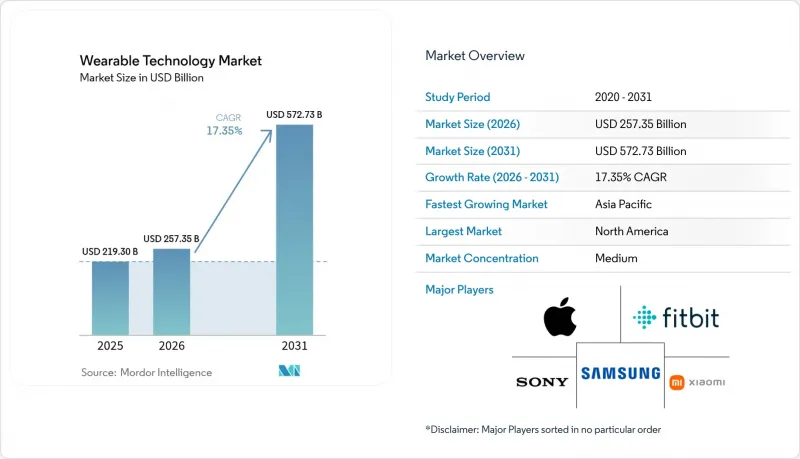
本報告按裝置類型(智慧型手錶、耳戴式裝置、頭戴式顯示器及其他)、組件(處理器/記憶體、感測器、顯示器、電池及其他)、連接技術(藍牙/BLE、蜂窩網路(LTE/5G)及其他)、終端用戶產業(消費電子、醫療保健及其他)和地區進行細分。市場預測以美元計價。
全球穿戴式科技市場趨勢及洞察
人工智慧驅動的臨床級感測器
監管機構正在加快核准人工智慧驅動的生物感測器,將穿戴式裝置定位為預防醫學中的決策工具。美國食品藥物管理局(FDA)的數位健康卓越中心正在簡化審查流程,而像Trinity BIoTech這樣的創新公司正在將結合代謝數據和預測分析的連續血糖監測儀推向市場。韓國科學技術院(KAIST)和香港大學的學術團隊正在將無袖帶血壓測量模組和可在本地處理數據的有機電晶體陣列商業化,從而降低延遲並保護隱私。這些進步正在縮小消費級健身設備與臨床診斷之間的差距,保險公司也越來越有信心報銷遠距監測服務。醫院將這項技術視為早期療育和降低成本的途徑,這進一步擴大了穿戴式科技市場的潛在客戶群。
現場員工的企業級擴增實境技術
工業擴增實境(AR) 頭戴設備可提高危險環境和分散工作場所的效率。高露潔棕欖公司已進行 63 次虛擬協作,有效降低了差旅費用和停機時間。同時,殼牌公司已在 12 個國家部署本質安全型 AR 穿戴式設備,以支援爆炸危險區域的維護工作。富士通公司在整合 AR 指導後,組裝工作量減少了 19%;鋼鐵製造商 KSP 透過頭盔式視覺化技術,生產效率提高了 40%。投資回收期通常不到一年,因此營運團隊很容易採用。隨著遠端專家支援的應用日益廣泛,企業正在大規模採用這項技術,從而推動了穿戴式技術市場的成長。
資料隱私合規負擔
穿戴式裝置收集的生物識別資料受到諸如GDPR和伊利諾州BIPA等嚴格法規的約束。製造商必須在設備中整契約意管理和匿名化功能,這增加了開發成本並延緩了產品上市時間。跨境資料傳輸的限制進一步加劇了雲端分析的複雜性。法律資源有限的小規模供應商面臨高昂的合規成本,這降低了新進入者進入穿戴式科技市場的速度,並抑制了該市場的成長。
細分市場分析
預計2026年至2031年間,頭戴式顯示器將以19.02%的複合年成長率(CAGR)領先穿戴式技術市場,但截至2025年,智慧型手錶仍將佔據穿戴式技術市場45.60%的最大佔有率。隨著企業採用免持顯示器進行維護、培訓和物流等工作,這一成長動能正推動整個穿戴式科技市場的發展。自2023年底以來,Meta已售出200萬副Ray-Ban智慧眼鏡,並計劃將年銷量提升至1,000萬副。這凸顯了消費者對低調眼鏡產品的普及。
耳塞領域也呈現多元化趨勢,蘋果的專利表明,入耳式健康監測功能有望減少人們對腕戴式裝置的依賴。智慧服飾仍處於早期階段,但約翰霍普金斯大學的纖維電池技術展現了可水洗儲能技術的潛力,並有望推動電子紡織品走向主流市場。隨著智慧型手錶平均售價的下降,腕帶面臨商品化的風險,但神經輸入腕帶在擴增實境控制方面仍保持著一定的市場需求。這些變化共同豐富了穿戴式科技市場。
第二代智慧眼鏡整合了蜂窩網路連接和微型LED顯示螢幕,無需連接智慧型手機即可實現通知優先排序、導航疊加和即時翻譯等功能。原始設備製造商(OEM)正致力於減輕重量並提高與近視鏡鏡片的兼容性,以擴大目標用戶群。預計該品類的快速擴張將保持設備的高度多樣性,從而確保穿戴式科技市場的持續成長。
到2025年,感測器將佔據穿戴式科技市場28.70%的最大佔有率,這反映了對多模態資料流的需求。同時,固態電池預計將以19.85%的複合年成長率超越所有其他組件,成為先進應用情境的能源基礎。 TDK的晶片級電池和三星為期一周的原型測試表明,更安全的化學成分如何實現更薄的機殼。處理器和記憶體正乘著3D堆疊技術的潮流發展,台積電計畫推出面板級封裝,將CPU、GPU和記憶體整合到單一基板上。
顯示器正朝著軟性OLED和microLED方向發展,從而實現曲面和透明表面,並與眼鏡產品無縫整合。連接IC透過將藍牙、Wi-Fi和UWB整合到單一封裝中,簡化了基板佈局並縮小了天線面積。軟體和服務佔據了利潤最豐厚的層面,平台所有者擴大將功能存取權限限制在訂閱模式中,這增強了生態系統,並提高了轉換的成本。因此,穿戴式科技市場的利潤率和銷售額都在持續成長。
區域分析
預計到2025年,北美將佔全球銷售額的31.70%,反映了其在研發領域的領先地位、強勁的創業投資資金以及有利的還款政策。 2023年,FDA批准了124種新的醫療設備,創下單年批准數量最高紀錄,縮短了產品上市時間。美國跨國公司開展的企業級AR先導計畫有助於維持穩定的硬體更新周期。然而,高流失率表明,在推動消費者接受度和實現價值交付方面仍然面臨挑戰。
預計亞太地區在2026年至2031年間將以20.25%的複合年成長率成長,並有望成為穿戴式科技市場銷售成長的主要驅動力。中國對數位醫療政策的支持,以及韓國在3奈米晶圓代工廠和固態電池領域的領先地位,正在加速該地區供應鏈的自給自足。印度健康意識日益增強的中產階級和日本人口老化進一步擴大了市場需求。台積電在亞利桑那州和熊本縣新建的工廠,在增強市場韌性的同時,也保留了該地區的關鍵製程技術。
在歐洲,嚴格的隱私和永續發展法規與強勁的工業自動化需求之間正尋求平衡。雖然GDPR和WEEE指令增加了合規負擔,但也為擁有完善管治的供應商提供了競爭優勢。德國的智慧工廠計畫和英國國家醫療服務體系(NHS)的遠端監控試點計畫為企業提供了穩定的客戶來源。中東、非洲和南美洲的市場規模相對小規模,基礎設施和可支配收入也相對落後,但隨著通訊成本的降低和本地應用生態系統的成熟,這些市場蘊藏著巨大的未來潛力。
其他好處
- Excel格式的市場預測(ME)表
- 3個月的分析師支持
目錄
第1章:引言
- 研究假設和市場定義
- 調查範圍
第2章:調查方法
第3章執行摘要
第4章 市場狀況
- 市場概覽
- 市場促進因素
- 人工智慧驅動的臨床級感測器
- 現場員工的企業級擴增實境技術
- 醫療穿戴裝置的保險覆蓋範圍
- 邊緣人工智慧和低功耗晶片組
- 固體電池
- 對身臨其境型遊戲和電子競技的需求
- 市場限制因素
- 資料隱私合規負擔
- 先進包裝領域的供應瓶頸
- 電子廢棄物及其對永續性的壓力
- 使用者疲勞和設備棄用
- 產業價值鏈分析
- 監理情勢
- 技術展望
- 波特五力分析
第5章 市場規模與成長預測
- 依設備類型
- 智慧型手錶
- 耳戴式裝置
- 頭戴式顯示器
- 智慧服裝
- 腕帶
- 按組件
- 處理器記憶體
- 感應器
- 展示
- 電池
- 連接積體電路
- 軟體服務
- 透過連接技術
- 藍牙/BLE
- 蜂窩網路(LTE/5G)
- Wi-Fi
- NFC/UWB
- 衛星通訊/低功耗廣域網
- 按最終用戶行業分類
- 家用電子產品
- 醫療保健
- 行業和公司
- 國防/公共安全
- 按地區
- 北美洲
- 美國
- 加拿大
- 墨西哥
- 歐洲
- 英國
- 德國
- 法國
- 義大利
- 其他歐洲國家
- 亞太地區
- 中國
- 日本
- 印度
- 韓國
- 其他亞洲國家
- 中東
- 以色列
- 沙烏地阿拉伯
- 阿拉伯聯合大公國
- 土耳其
- 其他中東國家
- 非洲
- 南非
- 埃及
- 其他非洲國家
- 南美洲
- 巴西
- 阿根廷
- 南美洲其他地區
- 北美洲
第6章 競爭情勢
- 市場集中度
- 策略趨勢
- 市佔率分析
- 公司簡介
- Apple Inc.
- Samsung Electronics Co., Ltd.
- Alphabet Inc.(Google LLC)
- Meta Platforms, Inc.(Oculus)
- Sony Group Corporation
- Xiaomi Corporation
- Huawei Technologies Co., Ltd.
- Garmin Ltd.
- Fitbit LLC(Google)
- Microsoft Corporation
- HTC Corporation
- BOE Technology Group Co., Ltd.
- Qualcomm Technologies, Inc.
- Corning Incorporated
- Valencell, Inc.
- Zepp Health Corporation
- Fossil Group, Inc.
- Vuzix Corporation
- Magic Leap, Inc.
- Mobvoi Information Technology Co. Ltd.
第7章 市場機會與未來展望
According to Mordor Intelligence, the wearable technology market size is expected to grow from USD 219.30 billion in 2025 to USD 257.35 billion in 2026 and is forecast to reach USD 572.73 billion by 2031 at 17.35% CAGR over 2026-2031.
This report is Segmented by Device Type (Smart Watches, Ear-Wearables, Head-Mounted Displays, and More), Component (Processors and Memory, Sensors, Displays, Batteries, and More), Connectivity Technology (Bluetooth and BLE, Cellular LTE/5G, and More), End-User Industry (Consumer Electronics, Healthcare and Medical, and More), and Geography. The Market Forecasts are Provided in Terms of Value (USD).
Global Wearable Technology Market Trends and Insights
AI-Enabled Clinical-Grade Sensors
Regulators continue to fast-track AI-driven biosensors, positioning wearables as decision-support tools in preventive medicine. FDA's Digital Health Center of Excellence has streamlined review pathways, and innovators such as Trinity Biotech have launched continuous glucose monitors that fuse metabolic data with predictive analytics. Academic groups at KAIST and the University of Hong Kong are commercializing cuff-less blood-pressure modules and organic transistor arrays that process data locally, reducing latency and safeguarding privacy. These advances narrow the gap between consumer fitness gadgets and clinical diagnostics, giving payers confidence to reimburse remote monitoring services. Hospitals view the technology as a route to earlier intervention and cost avoidance, further enlarging the addressable base for the wearable technology market.
Enterprise AR for Frontline Workforce
Industrial augmented reality headsets improve efficiency in hazardous or distributed settings. Colgate-Palmolive logged 63 virtual collaborations that trimmed travel expenses and downtime, while Shell deployed intrinsically safe AR wearables across 12 countries to support maintenance in explosive zones. Fujitsu cut assembly tasks by 19% after integrating AR guidance, and steelmaker KSP achieved 40% productivity gains through helmet-mounted visualization. The payback period often falls below one year, making procurement straightforward for operations teams. As remote-expert applications expand, enterprises are ordering at scale, propelling the wearable technology market.
Data-Privacy Compliance Burden
Wearables harvest biometrics that fall under stringent rules such as GDPR and Illinois BIPA. Manufacturers must embed consent management and on-device anonymization, raising development costs and delaying launch schedules. Cross-border data-transfer limits further complicate cloud analytics. Small vendors lacking legal resources face a higher cost-of-compliance hurdle, tempering new-entry rates and trimming growth for the wearable technology market.
Other drivers and restraints analyzed in the detailed report include:
- Reimbursement Inclusion for Medical Wearables
- Edge AI and Low-Power Chipsets
- User Fatigue and Device Abandonment
For complete list of drivers and restraints, kindly check the Table Of Contents.
Segment Analysis
Head-mounted displays posted the fastest 19.02% CAGR over 2026-2031, yet smartwatches retained the largest 45.60% slice of the wearable technology market share in 2025. This momentum lifts the overall wearable technology market as enterprises adopt hands-free displays for maintenance, training, and logistics. Meta sold 2 million Ray-Ban smart glasses since late 2023 and is scaling to 10 million units annually, validating consumer appetite for discreet eyewear. Google's USD 150 million partnership with Warby Parker expands style options, lowering the fashion barrier to adoption.
Diversification is also visible in ear-wearables, where Apple patents point to in-ear health diagnostics that could reduce reliance on wrist devices. Although smart clothing remains nascent, Johns Hopkins' fiber batteries hint at washable energy storage that could mainstream e-textiles. Wristbands risk commoditization as smartwatch ASPs fall, but neural-input bands maintain niche demand for AR control. Collectively, these shifts enrich the wearable technology market.
Second-generation smart glasses integrate cellular radios and micro-LED displays, allowing notification triage, navigation overlays, and real-time translation without tethering to phones. OEMs focus on weight reduction and prescription-lens support to widen the addressable audience. The category's rapid scale will keep device diversity high, ensuring the wearable technology market continues to grow.
Sensors captured the largest 28.70% contribution to the wearable technology market size in 2025, reflecting the need for multi-modal data streams. At the same time, solid-state batteries are forecast to outpace all components with a 19.85% CAGR, providing the energy foundation for advanced use cases. TDK's chip-scale cells and Samsung's week-long prototypes illustrate how safer chemistries unlock slimmer enclosures. Processors and memory ride the 3D-stacking wave, with TSMC planning panel-level packaging that blends CPUs, GPUs, and memory on a single substrate.
Displays are shifting to flexible OLED and micro-LED formats, enabling curved and transparent surfaces that merge with eyewear. Connectivity ICs co-package Bluetooth, Wi-Fi, and UWB to simplify board layouts and shrink antenna footprints. Software and services represent the highest margin layer, and platform owners increasingly gate features behind subscriptions, cementing ecosystems and elevating switching costs. Both margin pools and unit volumes, therefore, continue to widen for the wearable technology market.
Complete Report Scope:
- By Device Type
- Smart Watches
- Ear-wearables
- Head-Mounted Displays
- Smart Clothing
- Wristbands
- By Component
- Processors and Memory
- Sensors
- Displays
- Batteries
- Connectivity ICs
- Software and Services
- By Connectivity Technology
- Bluetooth and BLE
- Cellular (LTE/5G)
- Wi-Fi
- NFC and UWB
- Satellite and LP-WAN
- By End-User Industry
- Consumer Electronics
- Healthcare and Medical
- Industrial and Enterprise
- Defense and Public Safety
- By Geography
- North America
- United States
- Canada
- Mexico
- Europe
- United Kingdom
- Germany
- France
- Italy
- Rest of Europe
- Asia-Pacific
- China
- Japan
- India
- South Korea
- Rest of Asia
- Middle East
- Israel
- Saudi Arabia
- United Arab Emirates
- Turkey
- Rest of Middle East
- Africa
- South Africa
- Egypt
- Rest of Africa
- South America
- Brazil
- Argentina
- Rest of South America
- North America
Geography Analysis
North America generated 31.70% of 2025 revenue, reflecting R&D leadership, venture funding depth, and favourable reimbursement policy. The FDA authorized 124 novel devices in 2023, its highest annual total, shortening commercialization timelines. Enterprise AR pilots run by U.S. multinationals contribute to steady hardware refresh cycles. Nonetheless, elevated abandonment rates reveal ongoing gaps in consumer onboarding and value delivery.
Asia-Pacific is projected to expand at a 20.25% CAGR over 2026-2031, making it the primary volume engine for the wearable technology market. China's policy support for digital health and Korea's leadership in 3 nm foundry and solid-state batteries accelerate regional supply-chain self-sufficiency. India's fitness-aware middle class and Japan's aging population further stretch demand curves. TSMC's new fabs in Arizona and Kumamoto add resilience yet keep key process know-how in the region.
Europe balances strict privacy and sustainability rules with strong industrial automation demand. GDPR and the WEEE directive increase compliance burden but also create competitive moats for vendors with robust governance. Germany's smart-factory programs and the U.K.'s National Health Service pilots on remote monitoring offer stable enterprise pipelines. Smaller markets in the Middle East, Africa, and South America trail in infrastructure and discretionary income, yet they represent option value as connectivity costs fall, and local app ecosystems mature.
- Apple Inc.
- Samsung Electronics Co., Ltd.
- Alphabet Inc. (Google LLC)
- Meta Platforms, Inc. (Oculus)
- Sony Group Corporation
- Xiaomi Corporation
- Huawei Technologies Co., Ltd.
- Garmin Ltd.
- Fitbit LLC (Google)
- Microsoft Corporation
- HTC Corporation
- BOE Technology Group Co., Ltd.
- Qualcomm Technologies, Inc.
- Corning Incorporated
- Valencell, Inc.
- Zepp Health Corporation
- Fossil Group, Inc.
- Vuzix Corporation
- Magic Leap, Inc.
- Mobvoi Information Technology Co. Ltd.
Additional Benefits:
- The market estimate (ME) sheet in Excel format
- 3 months of analyst support
TABLE OF CONTENTS
1 INTRODUCTION
- 1.1 Study Assumptions and Market Definition
- 1.2 Scope of the Study
2 RESEARCH METHODOLOGY
3 EXECUTIVE SUMMARY
4 MARKET LANDSCAPE
- 4.1 Market Overview
- 4.2 Market Drivers
- 4.2.1 AI-enabled clinical-grade sensors
- 4.2.2 Enterprise AR for frontline workforce
- 4.2.3 Reimbursement inclusion for medical wearables
- 4.2.4 Edge AI and low-power chipsets
- 4.2.5 Solid-state micro-batteries
- 4.2.6 Immersive gaming and e-sports demand
- 4.3 Market Restraints
- 4.3.1 Data-privacy compliance burden
- 4.3.2 Advanced-packaging supply bottlenecks
- 4.3.3 E-waste and sustainability pressure
- 4.3.4 User fatigue / device abandonment
- 4.4 Industry Value-Chain Analysis
- 4.5 Regulatory Landscape
- 4.6 Technological Outlook
- 4.7 Porter's Five Forces Analysis
- 4.7.1 Bargaining Power of Suppliers
- 4.7.2 Bargaining Power of Consumers
- 4.7.3 Threat of New Entrants
- 4.7.4 Threat of Substitute Products
- 4.7.5 Intensity of Competitive Rivalry
5 MARKET SIZE AND GROWTH FORECASTS (VALUE)
- 5.1 By Device Type
- 5.1.1 Smart Watches
- 5.1.2 Ear-wearables
- 5.1.3 Head-Mounted Displays
- 5.1.4 Smart Clothing
- 5.1.5 Wristbands
- 5.2 By Component
- 5.2.1 Processors and Memory
- 5.2.2 Sensors
- 5.2.3 Displays
- 5.2.4 Batteries
- 5.2.5 Connectivity ICs
- 5.2.6 Software and Services
- 5.3 By Connectivity Technology
- 5.3.1 Bluetooth and BLE
- 5.3.2 Cellular (LTE/5G)
- 5.3.3 Wi-Fi
- 5.3.4 NFC and UWB
- 5.3.5 Satellite and LP-WAN
- 5.4 By End-User Industry
- 5.4.1 Consumer Electronics
- 5.4.2 Healthcare and Medical
- 5.4.3 Industrial and Enterprise
- 5.4.4 Defense and Public Safety
- 5.5 By Geography
- 5.5.1 North America
- 5.5.1.1 United States
- 5.5.1.2 Canada
- 5.5.1.3 Mexico
- 5.5.2 Europe
- 5.5.2.1 United Kingdom
- 5.5.2.2 Germany
- 5.5.2.3 France
- 5.5.2.4 Italy
- 5.5.2.5 Rest of Europe
- 5.5.3 Asia-Pacific
- 5.5.3.1 China
- 5.5.3.2 Japan
- 5.5.3.3 India
- 5.5.3.4 South Korea
- 5.5.3.5 Rest of Asia
- 5.5.4 Middle East
- 5.5.4.1 Israel
- 5.5.4.2 Saudi Arabia
- 5.5.4.3 United Arab Emirates
- 5.5.4.4 Turkey
- 5.5.4.5 Rest of Middle East
- 5.5.5 Africa
- 5.5.5.1 South Africa
- 5.5.5.2 Egypt
- 5.5.5.3 Rest of Africa
- 5.5.6 South America
- 5.5.6.1 Brazil
- 5.5.6.2 Argentina
- 5.5.6.3 Rest of South America
- 5.5.1 North America
6 COMPETITIVE LANDSCAPE
- 6.1 Market Concentration
- 6.2 Strategic Moves
- 6.3 Market Share Analysis
- 6.4 Company Profiles (includes Global level Overview, Market level overview, Core Segments, Financials as available, Strategic Information, Market Rank/Share for key companies, Products and Services, and Recent Developments)
- 6.4.1 Apple Inc.
- 6.4.2 Samsung Electronics Co., Ltd.
- 6.4.3 Alphabet Inc. (Google LLC)
- 6.4.4 Meta Platforms, Inc. (Oculus)
- 6.4.5 Sony Group Corporation
- 6.4.6 Xiaomi Corporation
- 6.4.7 Huawei Technologies Co., Ltd.
- 6.4.8 Garmin Ltd.
- 6.4.9 Fitbit LLC (Google)
- 6.4.10 Microsoft Corporation
- 6.4.11 HTC Corporation
- 6.4.12 BOE Technology Group Co., Ltd.
- 6.4.13 Qualcomm Technologies, Inc.
- 6.4.14 Corning Incorporated
- 6.4.15 Valencell, Inc.
- 6.4.16 Zepp Health Corporation
- 6.4.17 Fossil Group, Inc.
- 6.4.18 Vuzix Corporation
- 6.4.19 Magic Leap, Inc.
- 6.4.20 Mobvoi Information Technology Co. Ltd.
7 MARKET OPPORTUNITIES AND FUTURE OUTLOOK
- 7.1 White-space and Unmet-Need Assessment

 英國穿戴式科技:市場佔有率分析、產業趨勢與統計及成長預測(2026-2031)
 穿戴式科技市場:2026-2032年全球市場預測(按設備類型、組件、操作方式、應用、最終用戶和分銷管道分類)
 全球穿戴式科技市場:依科技、連結方式、產業、分銷通路、作業系統、組件、產品、營運模式、類型、應用和地區分類-預測至2032年
 穿戴式科技市場:依產品、產品類型、應用、技術、國家及地區分類-全球產業分析、市場規模、市場佔有率及2026年至2033年預測
 穿戴式科技市場-全球產業規模、佔有率、趨勢、機會和預測:按產品、技術、組件、應用、地區和競爭格局分類,2021-2031年
 全球穿戴式科技市場課堂穿戴科技市場:依產品類型、應用、最終用戶和分銷管道分類-2026-2032年全球市場預測
 2026年全球穿戴式科技市場報告
 全球穿戴式科技市場:市場規模、佔有率和趨勢分析(按產品、應用和地區分類),細分市場預測(2026-2033 年)全球穿戴式科技市場規模、佔有率、趨勢和成長分析報告(2026-2034年)