


 |
市場調查報告書
商品編碼
2121735
水凝膠:市場佔有率分析、產業趨勢與統計、成長預測(2026-2031)Hydrogel - Market Share Analysis, Industry Trends & Statistics, Growth Forecasts (2026 - 2031) |
||||||

※ 本網頁內容可能與最新版本有所差異。詳細情況請與我們聯繫。
根據 Mordor Intelligence 預測,水凝膠市場規模預計將在 2025 年達到 265.8 億美元,2026 年達到 284.7 億美元,到 2031 年達到 401.6 億美元,2026 年至 2031 年的複合年成長率為 7.12%。
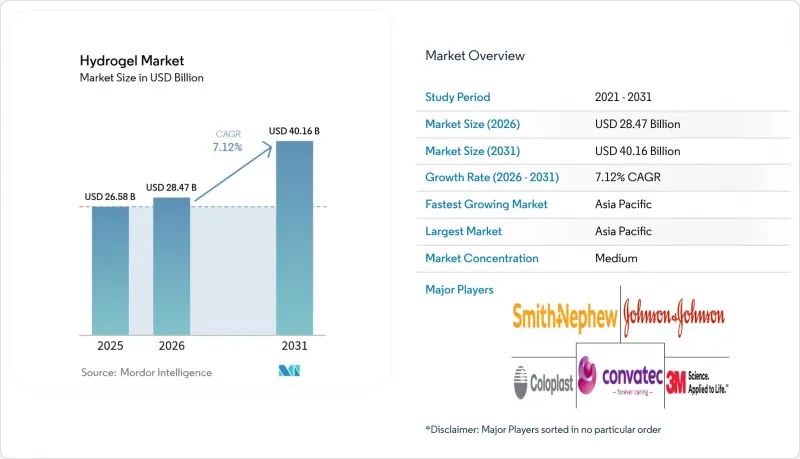
本報告按結構(半結晶質、結晶質、結晶質)、材料(聚丙烯酸酯、聚丙烯醯胺、矽及其他)、終端用戶產業(個人護理和衛生用品、醫藥、食品、農業及其他)以及地區(亞太、北美、歐洲及其他)進行細分。市場預測以美元計價。
全球水凝膠市場趨勢與洞察
擴大在一次性衛生用品中的使用
全球水凝膠消費主要由尿布和女性用衛生用品推動。亞太地區尤其佔據了這一消費量的很大一部分,這得益於收入的成長以及消費者對高階超薄產品的偏好。作為一項策略性舉措,中國製造商透過提高交聯密度成功降低了紙張重量。這項創新使得芯材更薄,從而降低了包裝成本並提高了舒適度。在北京提出的「健康中國2030」舉措下,目標是確保農村家庭能夠獲得衛生的女性衛生用品。為實現這一目標,中國正大力投資建造新的聚丙烯酸酯生產線。同時,歐洲的生產者延伸責任制(EPR)法規正在加速向纖維素-水凝膠混合材料的轉變。這些可在90天內分解的混合材料正在為生物基供應商未來的收入成長奠定基礎。受這些趨勢的影響,衛生水凝膠的需求呈現強勁成長。儘管由於中國產能過剩導致單價下降,但這種成長動能仍持續。
市場對矽水凝膠隱形眼鏡的需求正在成長。
2025年,矽水凝膠鏡片在軟式鏡片的配製中佔據了很大比例。這反映了處方醫師對透氧滲透性超過100 Dk/t的鏡片的重視。推動銷售成長的是“水分梯度技術”,該技術通過嵌入矽膠通道並保持表面水分含量,從而在長時間佩戴時保持舒適。在日本,兩種具有紫外線防護功能的矽水凝膠拋棄式隱形眼鏡於2025年獲得批准,在兒童和近視進展控制領域穩步發展出不斷成長的細分市場。 ISO 18369標準強制要求揭露有關透氧滲透性、彈性模量和脂質沉積的指標,加速了傳統水凝膠產品退出市場。同時,在中國,兒童角膜塑形術越來越受歡迎,矽水凝膠角膜塑形鏡片在兒童處方中已佔據相當大的佔有率,凸顯了其跨區域推廣的潛力。
與泡沫藻酸鹽敷料的競爭
到了2025年,聚氨酯泡棉已超越水凝膠,佔據高級創傷護理市場的重要佔有率。臨床醫生更傾向於使用泡沫來治療滲出液較多的潰瘍。同時,具有凝血時間短優勢的海藻酸鈣影響了手術室的實踐,並在止血領域獲得了認可。一項綜述指出,泡沫和水凝膠的治療率相當,削弱了水凝膠的價格優勢。矽膠包邊的泡棉只需每五天進行一次護理,這在人手不足的情況下具有顯著優勢。添加銀或碘以增強感染控制的水凝膠生產商面臨成本增加的問題,這限制了它們的競爭力,尤其是在燒燙傷中心和腫瘤病房以外的領域。
細分市場分析
半結晶質級水凝膠憑藉其從傷口敷料的低拉伸模量到軟骨支架的高拉伸模量,在2025年佔據了45.56%的銷售額。這些優勢源自於交聯密度和晶疇尺寸的精確調控。同時,結晶質水凝膠的複合年成長率(CAGR)為8.01%。這是因為藥物遞送領域的專家正在尋求快速擴散,而半結晶質基質的擴散速度較慢。在水凝膠市場,經皮貼片中對結晶質製劑的需求預計將顯著成長。同時,半結晶質水凝膠在農業領域保持領先地位,在持續數日釋放水分方面優於結晶質產品。結晶質水凝膠由於其脆性導致的高排斥率,市場佔有率有限,因此仍屬於小眾產品。監管部門的批准正在加速結晶質凝膠的普及應用,並刺激對非侵入性療法開發平臺的投資。
在商業領域,供應商正策略性地混合不同結構,將結晶質區與微晶區結合,以提高滲透性並增強承載能力。這些混合產品在整形外科植入市場售價較高。亞洲供應商正在擴大產能,他們意識到機械性能在快速成長的創傷護理領域至關重要。相較之下,非洲農藝師更傾向於使用半結晶質粉末進行滴灌,因為他們重視其較長的使用壽命。這種多樣化的結構格局創造了清晰的價值來源,使供應商即使在商品價格波動的情況下也能維持利潤率。
區域分析
預計到2025年,亞太地區將佔全球需求的41.10%,並在2031年之前以8.02%的複合年成長率持續成長。中國正大力投資江蘇和廣東兩省的聚丙烯酸酯和矽水凝膠產業叢集,以增強供應穩定性並建立成本優勢。在印度,尿布需求激增,吸引了大型企業的大規模工廠投資,有效規避了進口關稅。日本的隱形眼鏡產業正響應新的健康指南,將重心轉向日拋型矽水凝膠隱形眼鏡。同時,韓國正在研發用於智慧型手錶心電圖(ECG)功能的導電水凝膠電極。在東協,政府為乾旱稻米產區提供水凝膠補貼,以促進其在區域市場的普及。
2025年,北美在FDA核准多款採用510(k)快速核准程序的水凝膠醫療設備後,就佔了相當大的銷售佔有率。醫療保險對先進傷口敷料的報銷正在推動醫院採用此類產品。然而,加拿大引入了以金額為準競標系統,促使供應商檢驗臨床療效。在墨西哥,政府為使用水凝膠的酪梨種植戶提供稅額扣抵,這不僅有助於保護水資源匱乏的地下水,也為北美自由貿易協定(北美自由貿易組織(NAFTA)地區的農業水凝膠開闢了新的市場。
歐洲的需求量很大,其嚴格的生物分解標準是一大特點,推動了纖維素和澱粉接枝材料的採購。歐盟醫療設備法規放寬了合規門檻,有利於在創傷護理領域擁有監管經驗的成熟企業。英國脫歐後,企業被迫向英國藥品和保健產品監管署 (MHRA) 提交兩份申請,延緩了新參與企業的市場准入。在北歐國家,公共產業正在測試用於區域供熱的水凝膠相變系統,這表明該系統在儲熱方面具有更廣泛的應用潛力。
在市佔率不大的南美洲,巴西以甘蔗為基礎的節水計畫每年可顯著節約用水。同時,在阿根廷,價格飆升且缺乏補貼阻礙了節水技術的推廣,但一項政府主導的試點計畫有望挖掘這一潛在需求。中東和非洲的市場佔有率合計較小,但沙烏地阿拉伯利用水凝膠的溫室計畫以及向南非遭受乾旱的玉米種植者分發土壤調節劑的舉措正引起關注(儘管物流方面仍存在挑戰)。
其他好處
- Excel格式的市場預測(ME)表
- 3個月的分析師支持
目錄
第1章:引言
- 研究假設和市場定義
- 調查範圍
第2章:調查方法
第3章執行摘要
第4章 市場狀況
- 市場概覽
- 市場促進因素
- 擴大在一次性衛生用品中的使用
- 市場對矽水凝膠隱形眼鏡的需求正在成長。
- 透過法規推廣節水農業材料
- 導電水凝膠感測器在穿戴式電子設備中的廣泛應用。
- 用於微創治療的4D列印智慧水凝膠植入
- 市場限制因素
- 與泡沫藻酸鹽敷料的競爭
- 對微塑膠釋放和掩埋處置的影響進行監管監測。
- 環境、社會與治理(ESG)壓力對高耗能水凝膠製造的影響
- 價值鏈分析
- 波特五力模型
第5章 市場規模與成長預測
- 按結構
- 半結晶質
- 結晶質
- 結晶質
- 材料
- 聚丙烯酸酯
- 聚丙烯醯胺
- 矽
- 其他
- 按最終用戶行業分類
- 個人護理和衛生用品
- 藥品和醫療保健
- 食物
- 農業
- 其他
- 按地區
- 亞太地區
- 中國
- 印度
- 日本
- 韓國
- ASEAN
- 其他亞太國家
- 北美洲
- 美國
- 加拿大
- 墨西哥
- 歐洲
- 德國
- 英國
- 法國
- 義大利
- 俄羅斯
- 北歐國家
- 其他歐洲國家
- 南美洲
- 巴西
- 阿根廷
- 其他南美國家
- 中東和非洲
- 沙烏地阿拉伯
- 南非
- 其他中東和非洲國家
- 亞太地區
第6章 競爭情勢
- 市場集中度
- 策略趨勢
- 市佔率和排名分析
- 公司簡介
- 3M
- Alcon
- Ashland
- Axelgaard Manufacturing Co., Ltd.
- Cardinal Health
- Coloplast Ltd
- Convatec
- CooperVision
- DSM
- Essity Health & Medical
- Hannox International Corp.
- HOYA Corporation
- Johnson and Johnson
- Molnlycke Health Care AB
- PAUL HARTMANN AG
- Sekisui Kasei
- Smith+Nephew
第7章 市場機會與未來展望
According to Mordor Intelligence, the hydrogel market size is projected to be USD 26.58 billion in 2025, USD 28.47 billion in 2026, and reach USD 40.16 billion by 2031, growing at a CAGR of 7.12% from 2026 to 2031.
This report is Segmented by Structure (Semi-Crystalline, Amorphous, and Crystalline), Material (Polyacrylate, Polyacrylamide, Silicone, and Other Materials), End-User Industry (Personal Care and Hygiene, Pharmaceuticals and Healthcare, Food, Agriculture, and Other End-User Industries), and Geography (Asia-Pacific, North America, Europe, and More). The Market Forecasts are Provided in Terms of Value (USD).
Global Hydrogel Market Trends and Insights
Expanding Use in Disposable Hygiene Products
Global consumption of hydrogels was primarily driven by diaper and feminine-care products. Notably, the Asia-Pacific region accounted for a significant portion of this volume, fueled by rising incomes and a shift towards premium ultra-thin formats. In a strategic move, Chinese manufacturers achieved a reduction in basis weight by increasing crosslink density. This innovation led to thinner cores, resulting in reduced packaging costs and enhanced comfort. Under Beijing's Healthy China 2030 initiative, a target has been set for rural households to have access to hygienic menstrual products. To support this goal, significant investments are being funneled into new polyacrylate production lines. Meanwhile, Europe's Extended Producer Responsibility regulations are accelerating a shift towards cellulose-hydrogel blends. These blends, which decompose within 90 days, position bio-based suppliers advantageously for future gains. As a result of these dynamics, the demand for hygiene-grade hydrogels is witnessing robust growth. This growth persists despite a slip in unit prices, a consequence of overcapacity in China.
Growing Demand for Silicone-Hydrogel Contact Lenses
Silicone-hydrogel designs represented a significant portion of the soft lenses dispensed in 2025, reflecting prescriber preference for oxygen transmissibility over 100 Dk/t. Revenue momentum rests on water-gradient technology that preserves surface water content while embedding silicone channels to maintain comfort during extended wear. Japan cleared two UV-blocking silicone-hydrogel disposables in 2025, tapping pediatric and myopia-control niches that grow steadily. ISO 18369 now requires public disclosure of oxygen permeability, modulus, and lipid-deposition metrics, accelerating the retirement of legacy hydrogels. China is simultaneously expanding orthokeratology for children; silicone-hydrogel ortho-k lenses already own a notable share of pediatric prescriptions, underlining cross-regional adoption potential.
Competition from Foam and Alginate Dressings
In 2025, polyurethane foams secured a significant share of the advanced wound-care market, surpassing hydrogels. Clinicians leaned towards foams for treating heavily exuding ulcers. Meanwhile, calcium alginates gained traction in hemostasis, benefiting from faster clotting times that influenced operating-room practices. A review highlighted comparable healing rates between foams and hydrogels, diminishing the latter's price advantage. Silicone-border foams, requiring nursing attention only once every five days, offered a significant edge amid prevalent staffing shortages. Hydrogel manufacturers, incorporating silver or iodine for enhanced infection control, face a tighter competitive margin, especially outside burn centers and oncology wards, due to the added costs.
Other drivers and restraints analyzed in the detailed report include:
- Regulatory Push for Water-Saving Agricultural Inputs
- Proliferation of Conductive Hydrogel Sensors for Wearable Electronics
- Regulatory Scrutiny on Micro-Plastic Shedding and Landfill Impact
For complete list of drivers and restraints, kindly check the Table Of Contents.
Segment Analysis
Semi-crystalline grades generated 45.56% of 2025 revenue, leveraging tensile moduli ranging from low values in wound dressings to higher values in cartilage scaffolds. These advantages stemmed from precise adjustments in crosslink density and crystalline domain size. Meanwhile, amorphous variants clock an 8.01% CAGR, as drug-delivery experts pursue the rapid diffusion rates that semi-crystalline matrices hinder. The hydrogel market is set to see a significant uptick for amorphous formulations in transdermal patches. At the same time, semi-crystalline compositions maintain their foothold in agriculture, where they outperform their amorphous counterparts by releasing water over a span of several days. Crystalline hydrogels remain a niche player, as their brittleness leads to high rejection rates, limiting their market share. Regulatory endorsements are boosting the adoption of amorphous variants, spurring investments in non-invasive therapeutic pipelines.
On the commercial front, suppliers are strategically blending structures, merging amorphous domains for enhanced permeability with micro-crystalline regions for superior load-bearing capabilities. This blend commands a premium in the orthopedic implant market. Asian suppliers are ramping up capacity, recognizing the paramount importance of mechanical performance in the burgeoning wound-care sector. In contrast, African agronomists favor semi-crystalline powders for drip irrigation, valuing their extended field life. This diverse structural landscape creates distinct value pools, allowing vendors to safeguard their margins even amidst commodity price fluctuations.
Complete Report Scope:
- By Structure
- Semi-crystalline
- Amorphous
- Crystalline
- By Material
- Polyacrylate
- Polyacrylamide
- Silicone
- Other Materials
- By End-user Industry
- Personal Care and Hygiene
- Pharmaceuticals and Healthcare
- Food
- Agriculture
- Other End-user Industries
- By Geography
- Asia-Pacific
- China
- India
- Japan
- South Korea
- ASEAN Countries
- Rest of Asia-Pacific
- North America
- United States
- Canada
- Mexico
- Europe
- Germany
- United Kingdom
- France
- Italy
- Russia
- NORDIC Countries
- Rest of Europe
- South America
- Brazil
- Argentina
- Rest of South America
- Middle East and Africa
- Saudi Arabia
- South Africa
- Rest of Middle East and Africa
- Asia-Pacific
Geography Analysis
Asia-Pacific anchored 41.10% of global demand in 2025 and is projected to expand at an 8.02% CAGR through 2031. China invests heavily in polyacrylate and silicone-hydrogel clusters in Jiangsu and Guangdong, bolstering supply security and asserting cost leadership. India witnesses a diaper boom, attracting substantial plant investments from major companies, effectively sidestepping import duties. Japan's contact-lens sector pivots to daily disposable silicone-hydrogels in light of new health guidelines. Meanwhile, South Korea advances conductive hydrogel electrodes for smartwatch ECG functionalities. ASEAN initiatives are subsidizing hydrogels in drought-stricken rice regions, boosting regional market adoption.
North America accounted for a significant share of revenue in 2025, driven by the FDA's nod to multiple hydrogel devices leveraging the expedited 510(k) pathway. Medicare's reimbursement for advanced dressings spurs hospital uptake. However, Canada introduces value-based tenders emphasizing cost-per-healed-wound, steering suppliers towards clinical outcome validation. In Mexico, state tax credits for avocado producers using hydrogels not only conserve stressed aquifers but also carve out an agri-hydrogel niche in the NAFTA region.
Europe, holding a notable share of demand, is characterized by stringent biodegradability standards, pushing purchases towards cellulose and starch-grafted chemistries. The EU's Medical Device Regulation eases compliance hurdles, favoring established players with regulatory acumen in wound care. Post-Brexit, companies face dual filings under MHRA, elongating market entry for newcomers. In the Nordics, utilities are testing hydrogel-based phase-change systems for district heating, hinting at a broader thermal-storage potential.
South America, with a modest share, sees Brazil's sugarcane initiative conserving significant volumes of water annually. While Argentina grapples with higher unsubsidized prices dampening uptake, government-led pilots might tap into this dormant demand. The Middle East and Africa, together contributing a small share, spotlight Saudi Arabia's boost to hydrogel-driven greenhouse projects and South Africa's distribution of conditioners to drought-stricken maize farmers, albeit with logistical challenges.
- 3M
- Alcon
- Ashland
- Axelgaard Manufacturing Co., Ltd.
- Cardinal Health
- Coloplast Ltd
- Convatec
- CooperVision
- DSM
- Essity Health & Medical
- Hannox International Corp.
- HOYA Corporation
- Johnson and Johnson
- Molnlycke Health Care AB
- PAUL HARTMANN AG
- Sekisui Kasei
- Smith+Nephew
Additional Benefits:
- The market estimate (ME) sheet in Excel format
- 3 months of analyst support
TABLE OF CONTENTS
1 Introduction
- 1.1 Study Assumptions and Market Definition
- 1.2 Scope of the Study
2 Research Methodology
3 Executive Summary
4 Market Landscape
- 4.1 Market Overview
- 4.2 Market Drivers
- 4.2.1 Expanding use in disposable hygiene products
- 4.2.2 Growing demand for silicone-hydrogel contact lenses
- 4.2.3 Regulatory push for water-saving agricultural inputs
- 4.2.4 Proliferation of conductive hydrogel sensors for wearable electronics
- 4.2.5 4D-printed smart hydrogel implants for minimally-invasive therapies
- 4.3 Market Restraints
- 4.3.1 Competition from foam and alginate dressings
- 4.3.2 Regulatory scrutiny on micro-plastic shedding and landfill impact
- 4.3.3 ESG pressure over high energy-intensity hydrogel manufacturing
- 4.4 Value Chain Analysis
- 4.5 Porter's Five Forces
- 4.5.1 Bargaining Power of Buyers
- 4.5.2 Bargaining Power of Suppliers
- 4.5.3 Threat of New Entrants
- 4.5.4 Threat of Substitutes
- 4.5.5 Competitive Rivalry
5 Market Size and Growth Forecasts (Value)
- 5.1 By Structure
- 5.1.1 Semi-crystalline
- 5.1.2 Amorphous
- 5.1.3 Crystalline
- 5.2 By Material
- 5.2.1 Polyacrylate
- 5.2.2 Polyacrylamide
- 5.2.3 Silicone
- 5.2.4 Other Materials
- 5.3 By End-user Industry
- 5.3.1 Personal Care and Hygiene
- 5.3.2 Pharmaceuticals and Healthcare
- 5.3.3 Food
- 5.3.4 Agriculture
- 5.3.5 Other End-user Industries
- 5.4 By Geography
- 5.4.1 Asia-Pacific
- 5.4.1.1 China
- 5.4.1.2 India
- 5.4.1.3 Japan
- 5.4.1.4 South Korea
- 5.4.1.5 ASEAN Countries
- 5.4.1.6 Rest of Asia-Pacific
- 5.4.2 North America
- 5.4.2.1 United States
- 5.4.2.2 Canada
- 5.4.2.3 Mexico
- 5.4.3 Europe
- 5.4.3.1 Germany
- 5.4.3.2 United Kingdom
- 5.4.3.3 France
- 5.4.3.4 Italy
- 5.4.3.5 Russia
- 5.4.3.6 NORDIC Countries
- 5.4.3.7 Rest of Europe
- 5.4.4 South America
- 5.4.4.1 Brazil
- 5.4.4.2 Argentina
- 5.4.4.3 Rest of South America
- 5.4.5 Middle East and Africa
- 5.4.5.1 Saudi Arabia
- 5.4.5.2 South Africa
- 5.4.5.3 Rest of Middle East and Africa
- 5.4.1 Asia-Pacific
6 Competitive Landscape
- 6.1 Market Concentration
- 6.2 Strategic Moves
- 6.3 Market Share(%)/Ranking Analysis
- 6.4 Company Profiles (includes Global Overview, Market Overview, Core Segments, Financials, Strategic Information, Products and Services, Recent Developments)
- 6.4.1 3M
- 6.4.2 Alcon
- 6.4.3 Ashland
- 6.4.4 Axelgaard Manufacturing Co., Ltd.
- 6.4.5 Cardinal Health
- 6.4.6 Coloplast Ltd
- 6.4.7 Convatec
- 6.4.8 CooperVision
- 6.4.9 DSM
- 6.4.10 Essity Health & Medical
- 6.4.11 Hannox International Corp.
- 6.4.12 HOYA Corporation
- 6.4.13 Johnson and Johnson
- 6.4.14 Molnlycke Health Care AB
- 6.4.15 PAUL HARTMANN AG
- 6.4.16 Sekisui Kasei
- 6.4.17 Smith+Nephew
7 Market Opportunities and Future Outlook
- 7.1 White-space and Unmet-Need Assessment

 水凝膠敷料市場規模、佔有率、成長、全球產業分析、區域洞察與2026年至2034年預測。
 水凝膠敷料市場-2026-2032年全球市場預測
 水凝膠敷料:市場佔有率分析、產業趨勢與統計、成長預測(2026-2031)
 水凝膠市場:依產品類型、應用、結構、成分、國家及地區分類-全球產業分析、市場規模、市場佔有率及2026年至2033年預測
 水凝膠敷料市場規模、佔有率和成長分析:按產品類型、傷口類型、最終用戶、通路和地區分類-2026-2033年產業預測
 水凝膠敷料市場預測至2034年—按產品、材料、應用、最終用戶和地區分類的全球分析
 水凝膠市場報告:按原料類型、形態、成分、應用和地區分類(2026-2034 年)水凝膠敷料市場規模、佔有率、趨勢和預測:按產品、材料、應用、最終用戶和地區分類,2026-2034年
 全球醫用導電水凝膠市場規模、製造商、供應鏈、銷售管道與客戶:2026-2032年
 2026年全球土壤耕作市場報告