


 |
市場調查報告書
商品編碼
2097384
水凝膠敷料:市場佔有率分析、產業趨勢與統計、成長預測(2026-2031)Hydrogel Dressing - Market Share Analysis, Industry Trends & Statistics, Growth Forecasts (2026 - 2031) |
||||||

※ 本網頁內容可能與最新版本有所差異。詳細情況請與我們聯繫。
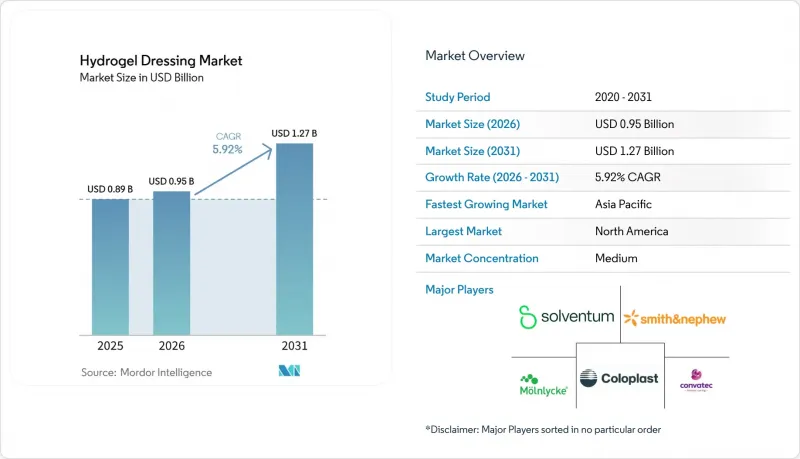
根據 Mordor Intelligence 預測,水凝膠敷料市場預計將從 2025 年的 8.9 億美元成長到 2026 年的 9.5 億美元,到 2031 年達到 12.7 億美元,2026 年至 2031 年的複合年成長率預計為 5.98%。
本報告按產品類型(無定形水凝膠敷料、浸漬水凝膠敷料、片狀水凝膠敷料)、原料(合成水凝膠、天然水凝膠、半合成水凝膠)、應用領域(慢性傷口和急性傷口)、終端用戶(醫院、居家醫療等)以及地區(北美等)進行細分。市場預測以美元(USD)計價。
全球水凝膠敷料市場趨勢及洞察
慢性傷口盛行率增加
目前,全球有超過4,000萬人患有糖尿病足潰瘍、壓瘡和靜脈性下肢潰瘍,光是在美國,每年的治療費用就超過500億美元。 2024年,國際糖尿病足工作小組指出,糖尿病足潰瘍確診後的一年死亡率與某些癌症相當。然而,目前只有不到一半的高風險患者使用能夠維持水分平衡的敷料。水凝膠透過維持濕潤環境促進自溶解清創,從而將換藥頻率從每天一次降低到每三天一次。用水凝膠取代紗布可以降低醫療機構的人事費用,並推動其在固定收費計畫中的應用。這些因素共同推動了對水凝膠敷料的根本需求。
從紗布過渡到基於實證醫學的先進敷料
英國國家衛生與臨床最佳化研究所 (NICE) 和日本創傷治療學會的指南強調濕性癒合和促進上皮化,但成本方面的考慮減緩了這些指南在一些醫院的推廣應用。在打包支付模式下,敷料費用已納入治療編碼,因此採購部門優先考慮能夠縮短住院時間和減少再入院率的方案。水凝膠敷料尤其適用於滲出量少或中等的傷口,但對於滲出量大的潰瘍,仍需使用可吸收泡棉敷料。這些報銷方案的改變正在推動全部區域水凝膠敷料市場的發展。
與傳統敷料相比,單價和製造成本更高
水凝膠的零售價為每單位3至15美元,遠高於紗布0.10至0.50美元的價格,後者在低收入地區可能是一筆不小的開銷。醫用級玻尿酸等特殊聚合物的價格可高達每公斤500美元,因此原料成本是最大的支出因素。滅菌包裝又會增加每單位0.50至2美元的成本,而這些成本在治療慢性傷口時累積,因為需要大量使用水凝膠。儘管如此,2024年發表在《傷口護理雜誌》(Journal of Wound Care)上的一項研究表明,水凝膠敷料的總治療成本仍比紗布低18%,因為更換敷料和減少感染的風險抵消了較高的材料成本。然而,價格仍然是印度和東南亞的一大障礙,限制了水凝膠敷料在都市區醫院以外的市場滲透。
細分市場分析
到2025年,非晶態配方將佔據水凝膠敷料市場64.55%的佔有率,這反映了其能夠填充不規則空腔和隧道狀傷口的能力。同時,片狀產品的複合年成長率為8.25%。這是因為在燒傷治療領域,預成型敷料因其能夠冷卻組織並減少護理時間而更受青睞。非晶態凝膠需要二次固定,這增加了操作難度,但臨床醫生可以在精確控制水分含量的同時填充脫落的組織。片狀水凝膠能夠保持均勻的厚度並輕柔地黏附於皮膚,從而將換藥頻率降低至每週最多兩次,並提高患者的舒適度。
各項法規的合規性要求非常嚴格,光是ISO 10993測試一項,每種配方的成本就高達10萬美元。美國食品藥物管理局(FDA)於2025年批准了一種羊膠原蛋白片狀水凝膠,這證實瞭如果能夠證明其等效性,新型生物材料也可以透過510(k)途徑獲得批准。片狀水凝膠面臨來自矽泡沫的競爭,後者在滲出液管理方面表現更佳,但在需要自溶解清創時,片狀水凝膠仍然是首選。這兩種形式的水凝膠敷料在水凝膠敷料市場中都不可或缺。
到2025年,合成聚合物將佔水凝膠敷料市場60.53%的佔有率,其中聚乙二醇和聚丙烯醯胺具有高度可重複的機械性能和良好的滅菌相容性。將合成骨架與幾丁聚醣和透明質酸等生物活性成分結合的混合材料正以8.85%的複合年成長率快速成長。早期研究表明,天然成分能夠改善細胞訊號傳導和生長因子保留,從而加速傷口癒合。儘管批次間差異和高成本仍然限制了純天然凝膠的廣泛應用,但混合產品透過保持合成材料的耐久性來緩解這些問題。
供應鏈風險正在影響企業策略。中國在透明質酸市場的主導地位使製造商面臨地緣政治波動的風險,因此需要實現貨源多元化。雖然ISO 13485審核會增加管理成本,但它可以防止因批次污染而導致的產品召回。因此,隨著企業越來越重視產品的韌性和生物活性,混合型產品在水凝膠敷料市場的銷售佔有率預計將會擴大。
區域分析
到2025年,北美將佔據水凝膠敷料市場40.13%的佔有率。這主要得益於強力的保險報銷政策和智慧敷料的早期試點計畫。雖然水凝膠敷料目前仍由聯邦醫療保險(Medicare Code)覆蓋,但一次性付款的引入正在將成本壓力轉移到醫療服務提供者身上,並推動數據驅動的採購。加拿大各省的處方藥清單各不相同。在安大略省,用於居家照護的水凝膠敷料由公共資金資助,而在亞伯達,則需要事先獲得批准,導致其普及程度不一。墨西哥受益於醫療旅遊和社會保險覆蓋範圍的擴大,導致其從美國供應商的進口量增加。
歐洲市場規模依然龐大,但嚴格遵守2017/745號醫療設備法規。在德國,列入「輔助器具清單」(Hilfsmittelverzeichnis)的敷料可獲得報銷,而未列入清單的產品則需逐案核准。在英國,採購透過NHS(英國國家醫療服務系統)供應鏈集中進行,由於NICE(英國國家衛生與臨床最佳化研究所)2024年的評估認為,優先考慮水凝膠敷料的理由不足,因此其推廣速度有所放緩。在法國,藥品高價政策(LPPR)的核准流程可能需要長達18個月,導致全額報銷延遲。在南歐國家,由於預算限制,其推廣速度也正在放緩。
亞太地區,以中國、印度、日本、澳洲和韓國為主導,正以9.51%的複合年成長率(CAGR)領先市場。中國已將II類產品的核准週期縮短至約12-15個月,使得Winner Medical等國內大型企業得以實現出口年增12.6%。印度的B類註冊制度允許跨國公司無需進行強制性臨床試驗即可進入市場,而日本的PMDA(藥品和醫療器材管理局)則允許透過其上市許可持有人(MAH)制度進行II類產品的申報。澳洲人均創傷護理支出較高,而韓國的核准流程也較為快捷,這使得兩國成為高級產品極具吸引力的市場,推動了水凝膠敷料市場向東轉移的趨勢。
在海灣國家,高檔敷料主要進口給接收醫療遊客的私人醫院,但紗布產品仍主導公共競標。南非的公私合營模式分割了市場,巴西國家衛生監督局(ANVISA)雖然能夠快速批准低風險醫療設備,但預算限制了其在全國範圍內的推廣。由於外匯波動和其他國家的價格管制,阿根廷的市場滲透率並不均衡,但糖尿病盛行率的上升持續推動對水凝膠敷料的需求。
其他好處:
- Excel格式的市場預測(ME)表
- 3個月的分析師支持
目錄
第1章:引言
- 研究假設和市場定義
- 調查範圍
第2章:調查方法
第3章執行摘要
第4章 市場狀況
- 市場概覽
- 市場促進因素
- 慢性傷口盛行率增加
- 從紗布敷料過渡到實證敷料
- 抗菌和抗刺激水凝膠的創新
- 全球外科手術和燒傷病例數量不斷增加
- 改革門診報銷制度,以支持傷口敷料,減輕護理人員的負擔。
- 內建感測器的智慧水凝膠可實現遠端創傷護理。
- 市場限制因素
- 與傳統敷料相比,單價和製造成本更高
- 大量滲出液傷口的吸收能力受限。
- 特種聚合物供應鏈的可變性
- 對藥品和醫療設備用水凝膠的其他監管障礙
- 供應鏈分析
- 監理情勢
- 技術展望
- 波特五力模型
第5章 市場規模與成長預測
- 依產品類型
- 無定形水凝膠敷料
- 浸漬水凝膠敷料
- 片狀水凝膠敷料
- 按成分
- 合成水凝膠
- 天然水凝膠
- 半合成/混合水凝膠
- 透過使用
- 慢性傷口
- 糖尿病足潰瘍
- 壓瘡
- 下肢靜脈潰瘍
- 急性傷口
- 燒傷
- 手術與創傷性傷口
- 慢性傷口
- 最終用戶
- 醫院
- 家庭醫療保健
- 門診手術中心
- 其他最終用戶
- 按地區
- 北美洲
- 美國
- 加拿大
- 墨西哥
- 歐洲
- 德國
- 英國
- 法國
- 義大利
- 西班牙
- 其他歐洲國家
- 亞太地區
- 中國
- 印度
- 日本
- 澳洲
- 韓國
- 其他亞太國家
- 中東和非洲
- GCC
- 南非
- 其他中東和非洲國家
- 南美洲
- 巴西
- 阿根廷
- 其他南美國家
- 北美洲
第6章 競爭情勢
- 市場集中度
- 市佔率分析
- 公司簡介
- Advanced Medical Solutions Group
- Alliqua BioMedical/NEXGEL Inc.
- Axelgaard Manufacturing
- B. Braun Melsungen AG
- BSN Medical(Essity)
- Cardinal Health Inc.
- Coloplast A/S
- ConvaTec Group PLC
- DermaRite Industries LLC
- Hollister Incorporated
- Integra LifeSciences Holdings
- Johnson & Johnson(Ethicon)
- Medline Industries, Inc.
- Molnlycke Health Care AB
- Paul Hartmann AG
- Procyon Corp.(AMERX)
- Smith & Nephew plc
- Solventum Corporation
- Winner Medical Co. Ltd
- Zhende Medical Co. Ltd
第7章 市場機會與未來展望
According to Mordor Intelligence, the hydrogel dressing market size is expected to increase from USD 0.89 billion in 2025 to USD 0.95 billion in 2026 and reach USD 1.27 billion by 2031, growing at a CAGR of 5.98% over 2026-2031.
This report is Segmented by Product Type (Amorphous Hydrogel Dressings, Impregnated Hydrogel Dressings, and Sheet Hydrogel Dressings), Raw Material (Synthetic Hydrogels, Natural Hydrogels, and Semi-Synthetic Hydrogels), Application (Chronic Wounds and Acute Wounds), End User (Hospitals, Home Healthcare, and More), and Geography (North America, and More). The Market Forecasts are Provided in Terms of Value (USD).
Global Hydrogel Dressing Market Trends and Insights
Rising Prevalence of Chronic Wounds
Diabetic foot ulcers, pressure ulcers, and venous leg ulcers now affect more than 40 million people worldwide, and United States treatment costs exceed USD 50 billion annually. The International Working Group on the Diabetic Foot noted in 2024 that 1-year mortality after a diabetic foot ulcer diagnosis matches some cancers. Yet, fewer than half of high-risk patients receive moisture-balanced dressings. Hydrogels maintain moist environments that accelerate autolytic debridement and lower nursing frequency from daily changes to three-day intervals. Skilled-nursing facilities experience labor reductions when hydrogel replaces gauze, supporting its adoption in capitated payment systems. These factors collectively raise baseline demand in the hydrogel dressing market
Shift from Gauze to Evidence-Based Advanced Dressings
Guidelines from NICE and the Wound Healing Society emphasize moist healing and faster epithelialization, but cost sensitivity slows uptake in some hospitals. Bundled payments fold dressing costs into procedure codes, prompting procurement to favor options that shorten stays and cut readmissions. Hydrogels prove particularly valuable in low-to-moderate exudate wounds, though high-exudate ulcers still require absorbent foams. These reimbursement shifts add momentum to the hydrogel dressing market across developed regions.
High Unit and Manufacturing Cost Versus Conventional Dressings
Hydrogels retail at USD 3-15 per unit, far above the USD 0.10-0.50 for gauze, causing sticker shock in low-income settings. Specialty polymers like medical-grade hyaluronic acid cost up to USD 500 per kilogram, making materials the most significant expense driver. Sterile packaging adds another USD 0.50-2.00 per unit, and these costs compound across high-volume chronic-wound regimens. A 2024 Journal of Wound Care study still showed an 18% lower total episode cost than gauze, because fewer changes and infections offset the material premium. Yet price remains a barrier in India and Southeast Asia, limiting penetration of the hydrogel dressing market outside urban hospitals.
Other drivers and restraints analyzed in the detailed report include:
- Innovation in Antimicrobial & Stimuli-Responsive Hydrogels
- Growing Surgical & Burn Caseloads
- Limited Absorption for Heavy-Exudate Wounds
For complete list of drivers and restraints, kindly check the Table Of Contents.
Segment Analysis
Amorphous formulations held 64.55% of the hydrogel dressing market share in 2025, reflecting their ability to fill irregular cavities and tunnel wounds. Sheet variants, however, are growing at 8.25% CAGR because burn units prefer pre-formed pads that cool tissue and reduce nursing time. Amorphous gels require secondary retention, which increases labor, but they permit clinicians to pack undermined tissue with precise moisture control. Sheet hydrogels deliver a uniform thickness and adhere gently, reducing dressing changes by up to 2 per week and improving patient comfort.
Regulatory compliance is strict across formats: ISO 10993 testing adds up to USD 100,000 per formulation. The FDA cleared a sheep-collagen sheet hydrogel in 2025, confirming that novel biomaterials can pass through the 510(k) pathway when equivalence is demonstrated. Sheet hydrogels face competition from silicone foams with better exudate handling, yet remain favored where autolytic debridement is required, keeping both formats integral to the hydrogel dressing market.
Synthetic polymers accounted for 60.53% of the hydrogel dressing market in 2025, as polyethylene glycol and polyacrylamide offer reproducible mechanical properties and sterilization compatibility. Hybrid blends of synthetic backbones with bioactive chitosan or hyaluronic acid are advancing at an 8.85% CAGR. Natural components improve cell signaling and growth-factor retention, leading to faster healing in early studies. Batch variability and higher costs still constrain pure natural gels, yet hybrids mitigate these issues by keeping synthetic durability.
Supply-chain risks shape strategy. China's dominance in hyaluronic acid exposes producers to geopolitical swings, prompting multisource procurement. ISO 13485 audits add overhead yet prevent recalls from contaminated lots. The resulting emphasis on resilience and bioactivity will likely expand hybrid revenue share within the hydrogel dressing market.
Complete Report Scope:
- By Product Type
- Amorphous Hydrogel Dressings
- Impregnated Hydrogel Dressings
- Sheet Hydrogel Dressings
- By Raw Material
- Synthetic Hydrogels
- Natural Hydrogels
- Semi-synthetic / Hybrid Hydrogels
- By Application
- Chronic Wounds
- Diabetic Foot Ulcers
- Pressure Ulcers
- Venous Leg Ulcers
- Acute Wounds
- Burns
- Surgical & Traumatic Wounds
- Chronic Wounds
- By End User
- Hospitals
- Home Healthcare
- Ambulatory Surgical Centers
- Other End Users
- By Geography
- North America
- United States
- Canada
- Mexico
- Europe
- Germany
- United Kingdom
- France
- Italy
- Spain
- Rest of Europe
- Asia-Pacific
- China
- India
- Japan
- Australia
- South Korea
- Rest of Asia-Pacific
- Middle East and Africa
- GCC
- South Africa
- Rest of Middle East and Africa
- South America
- Brazil
- Argentina
- Rest of South America
- North America
Geography Analysis
North America accounted for 40.13% of the hydrogel dressing market in 2025, driven by robust reimbursement and early smart-dressing pilots. Medicare codes still cover hydrogels, yet bundled payments pass cost pressure to providers, prompting data-backed purchasing. Canada's provincial formularies vary; Ontario funds hydrogels in home care, whereas Alberta requires prior authorization, creating uneven uptake. Mexico benefits from medical tourism and expanding social-insurance coverage, boosting imports from United States suppliers.
Europe remains sizable but governed by strict Medical Device Regulation 2017/745 processes. Germany reimburses listed dressings through the Hilfsmittelverzeichnis, while unlisted products need case approvals. The United Kingdom purchases centrally through NHS Supply Chain, and NICE's 2024 review found insufficient evidence to prefer hydrogels, which has slowed adoption. France's LPPR process can take up to 18 months, delaying full reimbursement. Southern Europe shows slower uptake due to tighter budgets.
Asia-Pacific posts the highest CAGR of 9.51%, driven by China, India, Japan, Australia, and South Korea. China reduced Class II approval timelines to about 12-15 months, letting domestic leaders such as Winner Medical raise exports 12.6% year-on-year. India's Class B registration system welcomes multinationals without mandated clinical trials, while Japan's PMDA allows Class II notifications through a Marketing Authorization Holder structure. Australia's high per-capita wound-care spend and South Korea's accelerating approvals make both countries attractive launch pads for premium offerings, reinforcing the hydrogel dressing market's pivot eastward.
Gulf states import premium dressings for private hospitals serving medical tourists, yet public tenders remain gauze-heavy. South Africa's dual public-private system creates a split market, while Brazil's ANVISA fast-tracks low-risk devices yet budget constraints limit nationwide roll-out. Currency volatility in Argentina and price controls elsewhere keep penetration uneven, but rising diabetes rates still add incremental volumes to the hydrogel dressing market.
- Advanced Medical Solutions Group
- Alliqua BioMedical / NEXGEL Inc.
- Axelgaard Manufacturing
- B. Braun
- BSN Medical
- Cardinal Health
- Coloplast
- Convatec
- DermaRite Industries
- Hollister
- Integra LifeSciences Holdings
- Johnson & Johnson
- Medline Industries
- Molnlycke Health Care
- Hartmann Group
- Procyon Corp. (AMERX)
- Smiths Group
- Solventum Corporation
- Winner Medical Co. Ltd
- Zhende Medical Co. Ltd
Additional Benefits:
- The market estimate (ME) sheet in Excel format
- 3 months of analyst support
TABLE OF CONTENTS
1 Introduction
- 1.1 Study Assumptions & Market Definition
- 1.2 Scope of the Study
2 Research Methodology
3 Executive Summary
4 Market Landscape
- 4.1 Market Overview
- 4.2 Market Drivers
- 4.2.1 Rising Prevalence of Chronic Wounds
- 4.2.2 Shift from Gauze to Evidence-Based Dressings
- 4.2.3 Innovation in Antimicrobial & Stimuli-Responsive Hydrogels
- 4.2.4 Growing Surgical & Burn Cases Worldwide
- 4.2.5 Outpatient-care Payment Reforms Favoring Low-Nurse-Time Dressings
- 4.2.6 Sensor-Integrated Smart Hydrogels Enabling Tele-Wound Care
- 4.3 Market Restraints
- 4.3.1 High Unit & Manufacturing Cost Versus Conventional Dressings
- 4.3.2 Limited Absorption for Heavy-Exudate Wounds
- 4.3.3 Supply-Chain Volatility for Specialty Polymers
- 4.3.4 Extra Regulatory Hurdles for Drug-Device Combination Hydrogels
- 4.4 Supply-Chain Analysis
- 4.5 Regulatory Landscape
- 4.6 Technological Outlook
- 4.7 Porter's Five Forces
- 4.7.1 Threat of New Entrants
- 4.7.2 Bargaining Power of Suppliers
- 4.7.3 Bargaining Power of Buyers
- 4.7.4 Threat of Substitutes
- 4.7.5 Intensity of Competitive Rivalry
5 Market Size & Growth Forecasts (Value, USD)
- 5.1 By Product Type
- 5.1.1 Amorphous Hydrogel Dressings
- 5.1.2 Impregnated Hydrogel Dressings
- 5.1.3 Sheet Hydrogel Dressings
- 5.2 By Raw Material
- 5.2.1 Synthetic Hydrogels
- 5.2.2 Natural Hydrogels
- 5.2.3 Semi-synthetic / Hybrid Hydrogels
- 5.3 By Application
- 5.3.1 Chronic Wounds
- 5.3.1.1 Diabetic Foot Ulcers
- 5.3.1.2 Pressure Ulcers
- 5.3.1.3 Venous Leg Ulcers
- 5.3.2 Acute Wounds
- 5.3.2.1 Burns
- 5.3.2.2 Surgical & Traumatic Wounds
- 5.3.1 Chronic Wounds
- 5.4 By End User
- 5.4.1 Hospitals
- 5.4.2 Home Healthcare
- 5.4.3 Ambulatory Surgical Centers
- 5.4.4 Other End Users
- 5.5 By Geography
- 5.5.1 North America
- 5.5.1.1 United States
- 5.5.1.2 Canada
- 5.5.1.3 Mexico
- 5.5.2 Europe
- 5.5.2.1 Germany
- 5.5.2.2 United Kingdom
- 5.5.2.3 France
- 5.5.2.4 Italy
- 5.5.2.5 Spain
- 5.5.2.6 Rest of Europe
- 5.5.3 Asia-Pacific
- 5.5.3.1 China
- 5.5.3.2 India
- 5.5.3.3 Japan
- 5.5.3.4 Australia
- 5.5.3.5 South Korea
- 5.5.3.6 Rest of Asia-Pacific
- 5.5.4 Middle East and Africa
- 5.5.4.1 GCC
- 5.5.4.2 South Africa
- 5.5.4.3 Rest of Middle East and Africa
- 5.5.5 South America
- 5.5.5.1 Brazil
- 5.5.5.2 Argentina
- 5.5.5.3 Rest of South America
- 5.5.1 North America
6 Competitive Landscape
- 6.1 Market Concentration
- 6.2 Market Share Analysis
- 6.3 Company Profiles (includes Global level Overview, Market level overview, Core Segments, Financials as available, Strategic Information, Market Rank/Share for key companies, Products & Services, and Recent Developments)
- 6.3.1 Advanced Medical Solutions Group
- 6.3.2 Alliqua BioMedical / NEXGEL Inc.
- 6.3.3 Axelgaard Manufacturing
- 6.3.4 B. Braun Melsungen AG
- 6.3.5 BSN Medical (Essity)
- 6.3.6 Cardinal Health Inc.
- 6.3.7 Coloplast A/S
- 6.3.8 ConvaTec Group PLC
- 6.3.9 DermaRite Industries LLC
- 6.3.10 Hollister Incorporated
- 6.3.11 Integra LifeSciences Holdings
- 6.3.12 Johnson & Johnson (Ethicon)
- 6.3.13 Medline Industries, Inc.
- 6.3.14 Molnlycke Health Care AB
- 6.3.15 Paul Hartmann AG
- 6.3.16 Procyon Corp. (AMERX)
- 6.3.17 Smith & Nephew plc
- 6.3.18 Solventum Corporation
- 6.3.19 Winner Medical Co. Ltd
- 6.3.20 Zhende Medical Co. Ltd
7 Market Opportunities & Future Outlook
- 7.1 White-space & Unmet-need Assessment

 水凝膠敷料市場規模、佔有率、成長、全球產業分析、區域洞察與2026年至2034年預測。
 水凝膠敷料市場-2026-2032年全球市場預測
 水凝膠:市場佔有率分析、產業趨勢與統計、成長預測(2026-2031)
 水凝膠市場:依產品類型、應用、結構、成分、國家及地區分類-全球產業分析、市場規模、市場佔有率及2026年至2033年預測
 水凝膠敷料市場規模、佔有率和成長分析:按產品類型、傷口類型、最終用戶、通路和地區分類-2026-2033年產業預測
 水凝膠敷料市場預測至2034年—按產品、材料、應用、最終用戶和地區分類的全球分析
 水凝膠市場報告:按原料類型、形態、成分、應用和地區分類(2026-2034 年)水凝膠敷料市場規模、佔有率、趨勢和預測:按產品、材料、應用、最終用戶和地區分類,2026-2034年
 全球醫用導電水凝膠市場規模、製造商、供應鏈、銷售管道與客戶:2026-2032年
 2026年全球土壤耕作市場報告