


 |
市場調查報告書
商品編碼
2121728
矽基液晶(LCoS)顯示器:市場佔有率分析、行業趨勢和統計數據以及成長預測(2026-2031 年)Liquid Crystal On Silicon (LCoS) Display - Market Share Analysis, Industry Trends & Statistics, Growth Forecasts (2026 - 2031) |
||||||

※ 本網頁內容可能與最新版本有所差異。詳細情況請與我們聯繫。
根據 Mordor Intelligence 預測,矽基液晶 (LCoS) 顯示器市場規模預計將在 2026 年達到 32.6 億美元,到 2031 年達到 51.6 億美元,2026 年至 2031 年的複合年成長率為 9.62%。
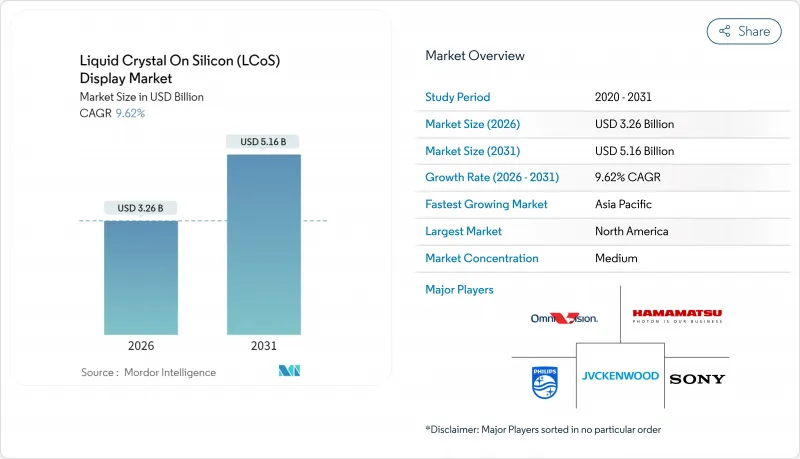
本報告按產品(頭戴式顯示器、投影機及其他)、技術(鐵電LCoS、向列相LCoS及其他)、最終用戶(消費電子、汽車及其他)、應用(顯示應用、非顯示應用)、解析度(高清、全高清 (1080p) 及其他)和地區進行細分。市場預測以美元計價。
全球矽液晶顯示器市場趨勢與洞察
高解析度顯示器產品的需求不斷成長
在專業模擬器、手術顯微鏡和家庭劇院愛好者中,4K 和 8K 解析度的需求正逐漸成為主流,而基於矽的液晶顯示器市場正以 3微米或更小的像素間距來滿足這一需求。索尼的 VPL-GTZ380 透過堆疊三個 1.38 英吋的面板,實現了原生 8K 影像,即使是血管的細微之處也能清晰呈現,非常適合外科手術訓練。面板製造商正在採用身臨其境型式微影技術來提高良率,雖然增加了資本投入,但也提高了進入門檻。價格限制減緩了 4K 技術在消費級投影機中的普及,但企業和教育客戶正在更快地升級設備,以滿足精細文字的可讀性標準。因此,預計高解析度面板將在未來的收入中佔據越來越大的佔有率。
在消費性電子設備和頭戴式顯示器中引入擴增實境/虛擬實境技術
更薄的頭戴式顯示器需要更高的像素密度,以消除從伸直手臂觀看時出現的紗窗效應。 OmniVision 於 2025 年 12 月發布的 OP03021 晶片,將 1920 x 1080 像素整合到 0.39 吋對角線螢幕上,並實現了 120Hz 的刷新率,使混合實境眼鏡的重量低於 100 克。隨後,Himax 採用了雙側前照式照明系統,將光程縮短了 30%,讓設計師能夠設計出更薄的鏡腳。這些進步推動了整個 LCoS(矽基液晶)顯示市場中頭戴式顯示器出貨量的複合年成長率達到 10.22%。此外,切換時間小於 1 毫秒的鐵電模式對於將「運動到光子」延遲(確保使用者舒適度的閾值)保持在 10 毫秒以下至關重要。
技術研發和製造高成本
用於製造尺寸小於3微米顯示器的圖形化設備,每台成本超過1億美元,若液晶排列出現偏差,初始良率損失可高達20%。為了減輕這筆資本投資的負擔,JAPAN DISPLAY於2025年10月將其汽車微顯示器業務分拆為AutoTech公司。此外,消費性電子產品買家不斷要求逐年降價,阻礙了利潤率的復甦。這些經濟因素抑制了新企業的進入,目前高解析度顯示器產能主要集中在日本、韓國和台灣地區。
細分市場分析
到2025年,該細分市場將在投影機領域佔據LCoS(矽基液晶)顯示市場的最大佔有率,投影機的銷售額將佔46.06%。然而,頭戴式顯示器預計將以每年10.22%的更快速度成長。微型投影機正將重點轉向智慧家庭介面,將控制螢幕投射到牆上。同時,儘管空間燈光調變器(SLM)面板屬於小眾市場,但由於研究機構認知到其相位精度的高價值,因此其價格仍然處於最高水平。
OmniVision 的 OP03021 晶片在 0.39 吋的對角線上實現了視網膜解析度像素,使消費級 AR 眼鏡的重量低於 100 克,進一步推動了頭戴式顯示器 (HMD) 的發展勢頭。同時,專業影院營運商繼續投資 8 萬美元購買 8K 投影機,這有助於維持傳統供應商的現金流。這種雙重趨勢意味著 LCoS 顯示市場正在努力平衡以成本為導向的消費級產品和高階投影解決方案。
到2025年,向列相液晶顯示器仍將佔60.11%的銷售額,但鐵電顯示器的成長速度最快,年複合成長率達10.54%,超過了矽基液晶(LCoS)顯示器市場的整體表現。鐵電液晶的切換時間小於100微秒,使其成為全像雷達和可變焦擴增實境(AR)光學元件的關鍵材料。
弗勞恩霍夫IPMS研究所展示了一種用於汽車雷射雷達即時光束重建的鐵電面板。由於自發極化引起的取向敏感性,成品率仍面臨挑戰,缺陷率超過15%。儘管如此,國防和光電領域的買家願意為降低延遲支付30%的溢價,這確保了掌握該製程的供應商能夠獲得可觀的利潤。
區域分析
2025年,北美地區佔總銷售額的34.38%,這主要得益於企業級投影機的強勁銷售、國防頭盔的訂單以及外科手術和物流領域早期AR演示項目的開展。此外,包括國家實驗室在內的研究機構採購了大部分相位型空間燈光調變器,進一步提振了當地需求。儘管《晶片與科學法案》有望加速國內晶圓廠的建設,但截至2026年初,尚未有新的生產線動工。
亞太地區預計將以10.94%的複合年成長率成長,成長率位居全球之首。日本現有企業正將老舊的液晶顯示器生產線改造為微型顯示器生產線;韓國多家企業正投資AR組件;中國則在整合液晶化學品供應鏈。 Slichem收購DIC的流體業務後,中國面板製造商得以自行採購關鍵材料;同時,歐美主要國防企業正更加嚴格地審查供應鏈。
歐洲在汽車抬頭顯示器(HUD)專案的支持下,處於中等水平。隨著歐洲新車安全評估協會(Euro NCAP)2025年評估標準修訂,將擴增實境(AR)顯示器納入其中,德國汽車製造商正在將全景HUD作為新車的標準配備。歐洲地平線計畫(Horizon Europe)已撥款12億歐元(約13億美元)用於光電領域,部分資金將用於資助空間燈光調變器(LCoS)的研究,目標是在2027年前實現這一目標。雖然LCoS系統已在中東市場應用於飛行模擬,但非洲和南美市場仍處於發展初期。
其他好處
- Excel格式的市場預測(ME)表
- 3個月的分析師支持
目錄
第1章:引言
- 研究假設和市場定義
- 調查範圍
第2章:調查方法
第3章執行摘要
第4章 市場狀況
- 市場概覽
- 市場促進因素
- 高解析度顯示器產品的需求不斷成長
- 在消費性電子設備和頭戴式顯示器中引入擴增實境/虛擬實境技術
- 汽車產業抬頭顯示器(HUD)的普及應用日益廣泛
- 推出適用於高亮度投影機的雷射照明LCoS。
- LCoS空間燈光調變器在量子光電研究的應用
- 政府資助先進微型顯示器的生產
- 市場限制因素
- 技術研發和製造高成本
- 透過OLED和MicroLED等替代技術展開競爭。
- 對特殊液晶材料供應鏈的依賴
- 高亮度LCoS面板的溫度控管挑戰
- 產業價值鏈分析
- 監理情勢
- 技術展望
- 宏觀經濟因素對市場的影響
- 波特五力分析
- 投資分析
第5章 市場規模與成長預測
- 依產品
- 頭戴式顯示器(HMD)
- 投影儀
- 抬頭顯示器(HUD)
- 微型投影儀
- 空間燈光調變器面板
- 透過技術
- 鐵電LCoS(FLCoS)
- 向列相液晶系統(NLCoS)
- 波長選擇性開關(WSS)
- 反射式LCoS
- 透明LCoS
- 最終用戶
- 家用電子產品
- 車
- 航空
- 光學3D測量
- 醫療保健
- 軍隊
- 工業與科學
- 透過使用
- 顯示應用程式
- 投影儀
- 用於AR/VR頭戴式顯示器的微型顯示器
- 抬頭顯示器
- 除了展示之外的其他用途
- 光纖通訊中的波長選擇開關
- 光束控制/LiDAR
- 用於全像術和3D列印的空間燈光調變器
- 顯示應用程式
- 通過決議
- 高清(720p 或更低)
- 全高清 (1080p)
- WQHD(1440p)
- 4K 或更高
- 按地區
- 北美洲
- 美國
- 加拿大
- 墨西哥
- 歐洲
- 英國
- 德國
- 法國
- 義大利
- 其他歐洲國家
- 亞太地區
- 中國
- 日本
- 印度
- 韓國
- 其他亞洲國家
- 中東
- 以色列
- 沙烏地阿拉伯
- 阿拉伯聯合大公國
- 土耳其
- 其他中東國家
- 非洲
- 南非
- 埃及
- 其他非洲國家
- 南美洲
- 巴西
- 阿根廷
- 南美洲其他地區
- 北美洲
第6章 競爭情勢
- 市場集中度
- 策略趨勢
- 市佔率分析
- 公司簡介
- Sony Corporation
- JVC Kenwood Corporation
- Himax Technologies Inc.
- OmniVision Technologies Inc.
- HOLOEYE Photonics AG
- Meadowlark Optics Inc.
- Hamamatsu Photonics KK
- Syndiant Inc.
- Canon Inc.
- Epson Corporation
- Kopin Corporation
- Forth Dimension Displays Ltd.
- Raontech Inc.
- AAXA Technologies Inc.
- MicroVision Inc.
- Magic Leap Inc.
- Google LLC
- Microsoft Corporation
- Koninklijke Philips NV
- May Co. Ltd.
第7章 市場機會與未來展望
According to Mordor Intelligence, the liquid crystal on silicon (LCoS) display market size stood at USD 3.26 billion in 2026 and is projected to reach USD 5.16 billion by 2031, expanding at a 9.62% CAGR over 2026-2031.
This report is Segmented by Product (Head-Mounted Display, Projector, and More), Technology (Ferroelectrics LCoS, Nematics LCoS, and More), End User (Consumer Electronics, Automotive, and More), Application (Display Applications, and Non-Display Applications), Resolution (HD, Full HD (1080p), and More), and Geography. The Market Forecasts are Provided in Terms of Value (USD).
Global Liquid Crystal On Silicon (LCoS) Display Market Trends and Insights
Increasing Demand for High-Resolution Display Products
Professional simulators, surgical microscopes, and home-theater enthusiasts are converging on 4K and 8K requirements, and the Liquid Crystal On Silicon (LCoS) display market is answering with sub-3 micrometer pixel pitches. Sony's VPL-GTZ380 stacks three 1.38-inch panels to achieve native 8K images that replicate vascular detail for surgical training. Panel makers are adopting immersion photolithography to maintain yields, which raises capex but fortifies entry barriers. While price limits slow 4K adoption in mainstream consumer projectors, corporate and education customers are upgrading faster to meet fine-text readability standards. As a result, high-resolution panels are expected to corner an ever-larger slice of future revenue.
Deployment of AR and VR in Consumer Devices and HMDs
Slimmer headsets need pixel densities that eliminate the screen-door effect at arm's-length viewing. OmniVision's December 2025 OP03021 chip integrates 1920 X 1080 pixels on a 0.39-inch diagonal and drives 120 Hz refresh, allowing mixed-reality glasses to weigh under 100 g. Himax followed with a dual-edge front-lit architecture that cuts optical-path length by 30%, letting designers carve thinner temple arms. Such gains underpin a 10.22% CAGR for HMD shipments within the wider Liquid Crystal On Silicon (LCoS) display market. Ferroelectric modes that switch in under a millisecond are also critical to reduce motion-to-photon latency below 10 ms, a threshold for user comfort.
High Cost of Technology Development and Manufacturing
Sub-3 micrometer patterning tools cost upward of USD 100 million each, and initial yield losses can hit 20% when liquid-crystal alignment drifts. Japan Display spun off its automotive micro display assets into AutoTech in October 2025 to ring-fence this capex pressure. Consumer-electronics buyers also demand annual price cuts, squeezing margin recovery. These economics discourage new entrants and keep most high-resolution capacity clustered in Japan, South Korea, and Taiwan.
Other drivers and restraints analyzed in the detailed report include:
- Growing Automotive Adoption of HUDs
- Emergence of Laser-Illuminated LCoS for High-Brightness Projectors
- Competition From OLED and MicroLED Alternatives
For complete list of drivers and restraints, kindly check the Table Of Contents.
Segment Analysis
The segment generated the largest slice of the Liquid Crystal On Silicon (LCoS) display market size from projectors in 2025, with projectors holding 46.06% revenue. However, head-mounted displays are set to grow faster at 10.22% annually. Pico projectors are pivoting toward smart-home interfaces that project controls on walls, while spatial-light-modulator panels, though niche, command the highest prices because laboratories pay for phase accuracy.
OmniVision's OP03021 enabled retinal-resolution pixels within a 0.39-inch diagonal, allowing consumer AR glasses to weigh under 100 g and reinforcing HMD momentum. At the same time, professional cinema owners continue to invest in USD 80,000 8K projectors, preserving cash flow for legacy vendors. This dual narrative keeps the LCoS display market balanced between cost-sensitive consumer products and premium projection solutions.
Nematic modes still dominated 60.11% of 2025 revenue, yet the ferroelectric share is expanding fastest, supported by a 10.54% CAGR that outstrips the overall Liquid Crystal On Silicon (LCoS) display market. Ferroelectric liquid crystals switch in under 100 µs, essential for holographic LiDAR and varifocal AR optics.
Fraunhofer IPMS demonstrated binary ferroelectric panels that reconfigure automotive LiDAR beams in real time. Yield hurdles persist because spontaneous polarization makes alignment sensitive, lifting defect rates above 15%. Even so, buyers in defense and photonics tolerate 30% price premiums for latency gains, ensuring healthy margins for suppliers able to master the process.
Complete Report Scope:
- By Product
- Head-Mounted Display (HMD)
- Projector
- Head-Up Display (HUD)
- Pico Projector
- Spatial Light Modulator Panel
- By Technology
- Ferroelectrics LCoS (FLCoS)
- Nematics LCoS (NLCoS)
- Wavelength Selective Switching (WSS)
- Reflective LCoS
- Transmissive LCoS
- By End User
- Consumer Electronics
- Automotive
- Aviation
- Optical 3D Measurement
- Medical
- Military
- Industrial and Scientific
- By Application
- Display Applications
- Projectors
- Microdisplays for AR/VR HMDs
- Head-Up Displays
- Non-Display Applications
- Wavelength Selective Switching in Optical Telecom
- Beam Steering and LiDAR
- Spatial Light Modulators for Holography and 3D Printing
- Display Applications
- By Resolution
- HD (Less than equal to 720p)
- Full HD (1080p)
- WQHD (1440p)
- 4K and Above
- By Geography
- North America
- United States
- Canada
- Mexico
- Europe
- United Kingdom
- Germany
- France
- Italy
- Rest of Europe
- Asia-Pacific
- China
- Japan
- India
- South Korea
- Rest of Asia
- Middle East
- Israel
- Saudi Arabia
- United Arab Emirates
- Turkey
- Rest of Middle East
- Africa
- South Africa
- Egypt
- Rest of Africa
- South America
- Brazil
- Argentina
- Rest of South America
- North America
Geography Analysis
North America commanded 34.38% of 2025 revenue thanks to strong enterprise projector sales, defense helmet orders, and early AR pilots in surgery and logistics. Research institutes such as national laboratories purchased the bulk of phase-only spatial light modulators, reinforcing local demand. The CHIPS and Science Act is expected to seed domestic fabs, though new lines had not broken ground by early 2026.
Asia-Pacific is forecast to expand at a 10.94% CAGR, the fastest rate worldwide. Japanese incumbents are repurposing older LCD fabs for micro displays, South Korean groups are investing in AR components, and China is consolidating liquid-crystal chemical supply. Slichem's acquisition of DIC's fluids allows Chinese panel makers to internalize key materials, but Western defense primes now vet supply chains more closely.
Europe sits mid-pack, buoyed by automotive HUD programs. Euro NCAP's 2025 scoring revisions reward augmented-reality displays, prompting German OEMs to standardize panoramic HUDs on new models. Horizon Europe earmarked EUR 1.2 billion (USD 1.3 billion) for photonics through 2027, part of which funds LCoS spatial-light-modulator research. Middle East markets buy LCoS systems for flight simulation, while Africa and South America remain nascent.
- Sony Corporation
- JVC Kenwood Corporation
- Himax Technologies Inc.
- OmniVision Technologies Inc.
- HOLOEYE Photonics AG
- Meadowlark Optics Inc.
- Hamamatsu Photonics KK
- Syndiant Inc.
- Canon Inc.
- Epson Corporation
- Kopin Corporation
- Forth Dimension Displays Ltd.
- Raontech Inc.
- AAXA Technologies Inc.
- MicroVision Inc.
- Magic Leap Inc.
- Google LLC
- Microsoft Corporation
- Koninklijke Philips NV
- May Co. Ltd.
Additional Benefits:
- The market estimate (ME) sheet in Excel format
- 3 months of analyst support
TABLE OF CONTENTS
1 INTRODUCTION
- 1.1 Study Assumptions and Market Definition
- 1.2 Scope of the Study
2 RESEARCH METHODOLOGY
3 EXECUTIVE SUMMARY
4 MARKET LANDSCAPE
- 4.1 Market Overview
- 4.2 Market Drivers
- 4.2.1 Increasing Demand for High-Resolution Display Products
- 4.2.2 Deployment of AR and VR in Consumer Devices and HMDs
- 4.2.3 Growing Automotive Adoption of HUDs
- 4.2.4 Emergence of Laser-Illuminated LCoS for High-Brightness Projectors
- 4.2.5 Integration of LCoS Spatial Light Modulators in Quantum and Photonics Research
- 4.2.6 Government Funding for Advanced Microdisplay Manufacturing
- 4.3 Market Restraints
- 4.3.1 High Cost of Technology Development and Manufacturing
- 4.3.2 Competition From OLED and MicroLED Alternatives
- 4.3.3 Supply Chain Dependence on Specialized Liquid Crystal Materials
- 4.3.4 Thermal Management Challenges in High-Brightness LCoS Panels
- 4.4 Industry Value-Chain Analysis
- 4.5 Regulatory Landscape
- 4.6 Technological Outlook
- 4.7 Impact of Macroeconomic Factors on the Market
- 4.8 Porter's Five Forces Analysis
- 4.8.1 Threat of New Entrants
- 4.8.2 Bargaining Power of Buyers
- 4.8.3 Bargaining Power of Suppliers
- 4.8.4 Threat of Substitute Products
- 4.8.5 Intensity of Competitive Rivalry
- 4.9 Investment Analysis
5 MARKET SIZE AND GROWTH FORECASTS (VALUE)
- 5.1 By Product
- 5.1.1 Head-Mounted Display (HMD)
- 5.1.2 Projector
- 5.1.3 Head-Up Display (HUD)
- 5.1.4 Pico Projector
- 5.1.5 Spatial Light Modulator Panel
- 5.2 By Technology
- 5.2.1 Ferroelectrics LCoS (FLCoS)
- 5.2.2 Nematics LCoS (NLCoS)
- 5.2.3 Wavelength Selective Switching (WSS)
- 5.2.4 Reflective LCoS
- 5.2.5 Transmissive LCoS
- 5.3 By End User
- 5.3.1 Consumer Electronics
- 5.3.2 Automotive
- 5.3.3 Aviation
- 5.3.4 Optical 3D Measurement
- 5.3.5 Medical
- 5.3.6 Military
- 5.3.7 Industrial and Scientific
- 5.4 By Application
- 5.4.1 Display Applications
- 5.4.1.1 Projectors
- 5.4.1.2 Microdisplays for AR/VR HMDs
- 5.4.1.3 Head-Up Displays
- 5.4.2 Non-Display Applications
- 5.4.2.1 Wavelength Selective Switching in Optical Telecom
- 5.4.2.2 Beam Steering and LiDAR
- 5.4.2.3 Spatial Light Modulators for Holography and 3D Printing
- 5.4.1 Display Applications
- 5.5 By Resolution
- 5.5.1 HD (Less than equal to 720p)
- 5.5.2 Full HD (1080p)
- 5.5.3 WQHD (1440p)
- 5.5.4 4K and Above
- 5.6 By Geography
- 5.6.1 North America
- 5.6.1.1 United States
- 5.6.1.2 Canada
- 5.6.1.3 Mexico
- 5.6.2 Europe
- 5.6.2.1 United Kingdom
- 5.6.2.2 Germany
- 5.6.2.3 France
- 5.6.2.4 Italy
- 5.6.2.5 Rest of Europe
- 5.6.3 Asia-Pacific
- 5.6.3.1 China
- 5.6.3.2 Japan
- 5.6.3.3 India
- 5.6.3.4 South Korea
- 5.6.3.5 Rest of Asia
- 5.6.4 Middle East
- 5.6.4.1 Israel
- 5.6.4.2 Saudi Arabia
- 5.6.4.3 United Arab Emirates
- 5.6.4.4 Turkey
- 5.6.4.5 Rest of Middle East
- 5.6.5 Africa
- 5.6.5.1 South Africa
- 5.6.5.2 Egypt
- 5.6.5.3 Rest of Africa
- 5.6.6 South America
- 5.6.6.1 Brazil
- 5.6.6.2 Argentina
- 5.6.6.3 Rest of South America
- 5.6.1 North America
6 COMPETITIVE LANDSCAPE
- 6.1 Market Concentration
- 6.2 Strategic Moves
- 6.3 Market Share Analysis
- 6.4 Company Profiles (includes Global Level Overview, Market Level Overview, Core Segments, Financials as Available, Strategic Information, Market Rank/Share for Key Companies, Products and Services, and Recent Developments)
- 6.4.1 Sony Corporation
- 6.4.2 JVC Kenwood Corporation
- 6.4.3 Himax Technologies Inc.
- 6.4.4 OmniVision Technologies Inc.
- 6.4.5 HOLOEYE Photonics AG
- 6.4.6 Meadowlark Optics Inc.
- 6.4.7 Hamamatsu Photonics KK
- 6.4.8 Syndiant Inc.
- 6.4.9 Canon Inc.
- 6.4.10 Epson Corporation
- 6.4.11 Kopin Corporation
- 6.4.12 Forth Dimension Displays Ltd.
- 6.4.13 Raontech Inc.
- 6.4.14 AAXA Technologies Inc.
- 6.4.15 MicroVision Inc.
- 6.4.16 Magic Leap Inc.
- 6.4.17 Google LLC
- 6.4.18 Microsoft Corporation
- 6.4.19 Koninklijke Philips NV
- 6.4.20 May Co. Ltd.
7 MARKET OPPORTUNITIES AND FUTURE OUTLOOK
- 7.1 White-Space and Unmet-Need Assessment

 矽基液晶顯示器市場:2026-2032年全球市場預測(依技術、面板解析度、光源、終端用戶產業及應用分類)
 MEMS微顯示器市場分析及預測(至2035年):依類型、產品、技術、應用、組件、材料類型、裝置、最終用戶及功能分類
 2026年全球矽基基板抬頭顯示器(HUD)市場報告
 矽基液晶顯示器市場-全球產業規模、佔有率、趨勢、機會、預測:按產品、技術、應用、地區和競爭格局分類,2021-2031年LCD顯示器目標市場按技術、面板尺寸、解析度、應用和最終用戶分類-2026年至2032年全球預測
 矽基液晶 (LCoS) 市場機會、成長動力、產業趨勢分析及 2025 - 2034 年預測