


 |
市場調查報告書
商品編碼
2121715
商業分析:市場佔有率分析、產業趨勢與統計、成長預測(2026-2031)Business Analytics - Market Share Analysis, Industry Trends & Statistics, Growth Forecasts (2026 - 2031) |
||||||

※ 本網頁內容可能與最新版本有所差異。詳細情況請與我們聯繫。
據 Mordor Intelligence 稱,2025 年商業分析市值為 910 億美元,預計到 2031 年將達到 1,494.7 億美元,而 2026 年為 988.4 億美元,預測期(2026-2031 年)的複合年成長率為 8.62%。
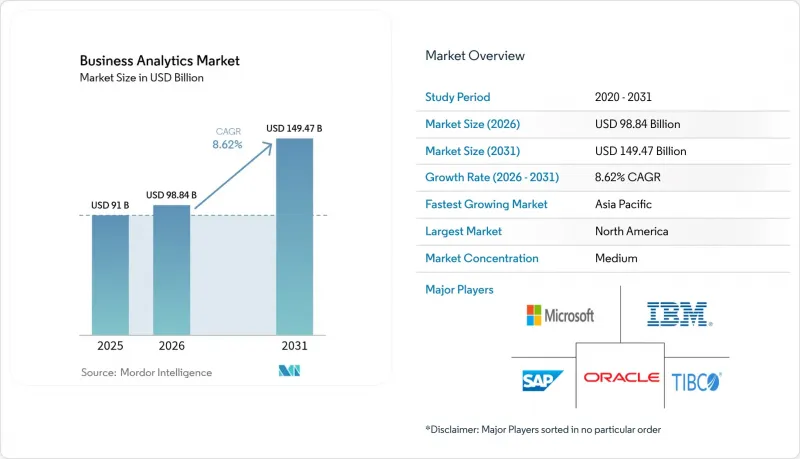
本報告按部署模式(本地部署、雲端部署)、分析類型(說明分析、診斷性分析等)、組織規模(大型企業、中小企業)、最終用戶產業(銀行、金融服務和保險、醫療保健和生命科學等)以及地區進行細分。市場預測以美元計價。
全球商業分析市場趨勢與洞察
將人工智慧和機器學習整合到分析平台中
人工智慧已從商業分析平台的附加功能轉變為核心功能。諸如 Snowflake Cortex 和 Microsoft 365 Copilot 中的 Analyst 代理程式等新版本能夠解讀自然語言、自動生成 SQL,並提供以往需要資料科學家才能實現的預測性洞察。採用這些功能的公司報告稱,其行銷、供應鏈和財務團隊的生產力提高了 30% 到 50%。隨著模型訓練成本的降低,供應商正在整合生成式人工智慧、擴展存取權限並實現資料準備自動化。這開啟了「基於代理的分析」時代,在這個時代,自主代理無需人工編碼即可協調複雜的分析流程。
巨量資料快速成長和雲端運算的普及
資料量、速度和多樣性持續成長。每周有超過 6000 家機構在 BigQuery 上交換超過 275 Petabyte的數據,這清楚地表明,高彈性的雲端儲存和運算正逐漸成為分析的基礎,並成為行業標準。諸如 ClickHouse 和 AWS 之間為期五年的合作協議等聯合創新項目,正在加速開發金融和電子商務工作負載的解決方案。此外,雲端框架使企業能夠將本地物聯網資料處理與集中式儀表板結合,從而在各行業中將設備效率提高 10%,並將意外停機時間減少 30%。
關於數據主權的法規
由於 GDPR、《雲端法案》和新頒布的國家法律之間存在衝突,跨國公司被迫建構特定區域的資料堆疊。實施這些堆疊需要確保本地處理、加密傳輸和可審計的授權,這增加了成本和複雜性。雖然來自超大規模資料中心業者服務供應商和區域性雲端服務供應商的「主權雲端」服務可以解決這個問題,但企業仍需要巧妙地協調多個供應商和控制結構,才能在不影響分析一致性的前提下滿足監管要求。
細分市場分析
到2025年,雲端運算領域將佔總營收的64.72%,並以10.18%的複合年成長率(CAGR)預計到2031年將佔據更大的商業分析市場。資本支出減少、彈性擴展以及與資料湖和人工智慧服務的快速整合,正鞏固其吸引力。安全認證和自動化合規功能如今已滲透到金融、醫療保健和政府等行業的各種工作負載中,逐漸侵蝕著本地部署的最後堡壘。
本地部署仍適用於對延遲要求嚴格、需要與舊有系統整合或受監管要求等情況,但其市場佔有率正在逐年萎縮。混合方案將敏感工作負載保留在防火牆後,同時將突發處理遷移到雲端,為遷移提供了一條途徑。服務供應商正透過結合遷移工具包、託管服務和付費使用制模式,鞏固雲端作為市場領導和成長引擎的地位,以鼓勵猶豫不決的客戶遷移到雲端。
到2025年,說明分析將佔總收入的32.05%,繼續保持其在商業分析市場中的最大佔有率,但預測性分析技術正以8.74%的複合年成長率超越所有其他類別。企業正在從展示「發生了什麼事」的儀錶板,轉向能夠預警客戶流失風險、最佳化庫存並在故障發生前派遣維護人員的前瞻性模型。生成式人工智慧透過自動編碼複雜的時間序列模型,並為不具備技術專長的使用者呈現場景模擬,從而增強了預測工作流程。
診斷分析充當橋樑,揭示根本原因並為預測演算法提供特徵。處方分析工具則透過在預算和人員配置等限制條件下推薦最佳行動方案,完善了整個流程。一些早期成功案例,例如某消費品製造商透過最佳化生產計劃每週節省高達 20 萬美元,正在推動該技術的更廣泛應用。隨著工具包的不斷改進,預測分析層和處方分析層將協同工作,將歷史資料轉化為跨職能、情境感知的自動化決策。
區域分析
北美擁有成熟的技術生態系統、豐富的人才儲備以及對雲端運算的早期應用,預計到2025年將佔全球收入的26.98%。各公司正利用人工智慧加速器、串流管道和自動化管治等技術來改善現有平台,以進一步提升現有資料資產的效率。美國在雲端運算領域的支出領先,而加拿大則在自然資源和金融服務等垂直市場中運用分析技術。墨西哥正在採用雲端平台來支援出口導向製造業和跨境物流。
亞太地區是成長最快的地區,複合年成長率達10.12%,這主要得益於政府人工智慧策略、行動裝置的廣泛普及以及待開發區雲端部署專案。中國佔該地區商業分析市場37.5%的佔有率,這得益於其大規模的數位支付生態系統和產業升級計畫。越南和菲律賓等高成長經濟體的中小企業正在採用基於SaaS的分析解決方案,以跨越舊有系統,年成長率超過19%。印度、日本、韓國和泰國預計將為平台供應商創造沃土,這些國家正利用公共部門津貼來提升勞動力技能並發展數據生態系統。
在嚴格的隱私法規和工業數位化資金的支持下,歐洲正穩步推動數位轉型。在德國、法國和英國,分析技術正被應用於提升製造效率和財務合規性,而南歐國家則在旅遊和零售領域看到了分析技術應用場景的不斷擴展。主權雲端框架和隱私增強技術正在滿足GDPR帶來的要求。中東和非洲正受益於智慧城市計劃,尤其是在海灣國家。同時,在南美洲,巴西和阿根廷的雲端運算應用正在加速發展,但基礎設施差異和外匯波動正在減緩其普及速度。
其他好處:
- Excel格式的市場預測(ME)表
- 3個月的分析師支持
目錄
第1章:引言
- 研究假設和市場定義
- 調查範圍
第2章:調查方法
第3章執行摘要
第4章 市場狀況
- 市場概覽
- 市場促進因素
- 巨量資料和雲端運算的普及
- 即時決策的必要性
- 將人工智慧/機器學習引入分析平台
- 監理機關推動數據驅動型合規
- 面向物聯網密集型產業的邊緣分析
- 保護隱私的資料無塵室
- 市場限制因素
- 前期成本高,投資報酬率不確定性
- 高級分析領域人員短缺
- 關於數據主權的法規
- ESG數據品質差距
- 供應鏈分析
- 監理情勢
- 技術展望
- 波特五力分析
- 對影響市場的宏觀經濟因素進行評估
第5章 市場規模與成長預測
- 按部署模式
- 現場
- 雲
- 按分析類型
- 說明的
- 診斷
- 預測
- 處方
- 按組織規模
- 大公司
- 中小企業
- 按最終用戶行業分類
- 銀行、金融服務和保險(BFSI)
- 醫療保健和生命科學
- 製造業
- 零售與電子商務
- 通訊/IT
- 政府/公共部門
- 能源公用事業
- 其他
- 按地區
- 北美洲
- 美國
- 加拿大
- 墨西哥
- 南美洲
- 巴西
- 阿根廷
- 其他南美國家
- 歐洲
- 德國
- 英國
- 法國
- 義大利
- 西班牙
- 其他歐洲國家
- 亞太地區
- 中國
- 日本
- 印度
- 韓國
- 東南亞
- 其他亞太國家
- 中東和非洲
- 中東
- 沙烏地阿拉伯
- 阿拉伯聯合大公國
- 土耳其
- 其他中東國家
- 非洲
- 南非
- 奈及利亞
- 埃及
- 其他非洲國家
- 中東
- 北美洲
第6章 競爭情勢
- 市場集中度
- 策略性舉措與資金籌措趨勢
- 市佔率分析
- 公司簡介
- Microsoft Corp.
- SAP SE
- Oracle Corp.
- IBM Corp.
- Salesforce Inc.(Tableau)
- SAS Institute Inc.
- TIBCO Software Inc.
- Qlik Tech Intl.
- MicroStrategy Inc.
- Infor Inc.
- Google LLC(Looker)
- Amazon Web Services(QuickSight)
- Domo Inc.
- Sisense Ltd.
- ThoughtSpot Inc.
- Alteryx Inc.
- Zoho Corp.(Zoho Analytics)
- Board International
- GoodData Corp.
- Yellowfin BI
- Pyramid Analytics
- Logi Analytics(InsightSoftware)
- Teradata Corp.
- Informatica Inc.
- Palantir Technologies
- Snowflake Inc.
- Databricks Inc.
第7章 市場機會與未來展望
According to Mordor Intelligence, the business analytics market size was valued at USD 91 billion in 2025 and estimated to grow from USD 98.84 billion in 2026 to reach USD 149.47 billion by 2031, at a CAGR of 8.62% during the forecast period (2026-2031).
This report is Segmented by Deployment Model (On-Premises, Cloud), Analytics Type (Descriptive, Diagnostic, and More), Organization Size (Large Enterprises, Smes), End-User Industry (BFSI, Healthcare and Life Sciences, and More), and Geography. The Market Forecasts are Provided in Terms of Value (USD).
Global Business Analytics Market Trends and Insights
AI and ML infusion into analytics platforms
Artificial intelligence has shifted from a bolt-on feature to a core capability within business analytics platforms. New releases such as Snowflake Cortex and Microsoft 365 Copilot's Analyst agent interpret natural language, auto-generate SQL, and surface predictive insights that once required a data scientist. Companies adopting these capabilities report 30-50% productivity lifts in marketing, supply-chain, and finance teams. As model training costs fall, platform vendors embed generative AI to widen access and automate data preparation, ushering in an era of "agentic analytics" where autonomous agents orchestrate complex analysis pipelines without human coding.
Proliferation of big data and cloud adoption
Volume, velocity, and variety of data keep rising. More than 6,000 organizations exchange upward of 275 petabytes each week on BigQuery, highlighting how elastic cloud storage and compute have become the default substrate for analytics. Joint innovation programs, such as the five-year agreement between ClickHouse and AWS, accelerate purpose-built solutions for finance and e-commerce workloads. Cloud frameworks also let firms pair localized IoT data processing with centralized dashboards, delivering 10% gains in equipment efficiency and 30% reductions in unplanned downtime in industrial settings.
Data-sovereignty restrictions
Conflicting rules among GDPR, the CLOUD Act, and emerging national laws force multinationals to architect region-specific data stacks. Deployments must ensure local processing, encrypted transfers, and auditable consent, adding cost and complexity.Sovereign-cloud offerings from hyperscalers and regional providers address the issue, yet organizations still juggle multiple vendors and controls to satisfy regulators without fracturing analytical coherence.
Other drivers and restraints analyzed in the detailed report include:
- Need for real-time decision-making
- Edge analytics for IoT-heavy industries
- Talent shortage in advanced analytics
For complete list of drivers and restraints, kindly check the Table Of Contents.
Segment Analysis
The cloud segment accounts for 64.72% of 2025 revenue, and its 10.18% CAGR means it will command an even larger slice of the business analytics market size by 2031. Lower capital expenditure, elastic scaling, and rapid integration with data lakes and AI services cement its appeal. Security certifications and automated compliance features now cover finance, healthcare, and government workloads, eroding the last strongholds of on-premise advocates.
On-premise deployments persist where strict latency, legacy integration, or regulatory mandates prevail, but their share recedes every year. Hybrid blueprints, in which sensitive workloads stay behind the firewall while burst processing moves to the cloud, offer a transitional path. Providers bundle migration toolkits, managed services, and consumption-based pricing to nudge hesitant customers toward the cloud, reinforcing its position as both market leader and growth engine.
Descriptive analytics retained 32.05% of 2025 revenue, the largest slice of the business analytics market, yet predictive techniques outpace all categories with an 8.74% CAGR. Organizations evolve from "what happened" dashboards to forward-looking models that flag churn risk, optimize inventory, and route maintenance crews before breakdowns occur. Generative AI enhances predictive workflows by auto-coding complex time-series models and surfacing scenario simulations for non-technical users.
Diagnostic analytics serves as a bridge, explaining root causes and feeding features into forecasting algorithms. Prescriptive tools close the loop by recommending the best action under constraints such as budget or staffing. Early success stories like a consumer-products maker saving up to USD 200,000 weekly through optimized production schedules fuel wider adoption. As toolkits mature, predictive and prescriptive layers will jointly convert historical data into automated, context-aware decisions across functions.
Complete Report Scope:
- By Deployment Model
- On-Premise
- Cloud
- By Analytics Type
- Descriptive
- Diagnostic
- Predictive
- Prescriptive
- By Organisation Size
- Large Enterprises
- Small and Mid-sized Enterprises (SMEs)
- By End-user Industry
- Banking, Financial Services and Insurance (BFSI)
- Healthcare and Life Sciences
- Manufacturing
- Retail and E-commerce
- Telecom and IT
- Government and Public Sector
- Energy and Utilities
- Others
- By Geography
- North America
- United States
- Canada
- Mexico
- South America
- Brazil
- Argentina
- Rest of South America
- Europe
- Germany
- United Kingdom
- France
- Italy
- Spain
- Rest of Europe
- Asia-Pacific
- China
- Japan
- India
- South Korea
- Southeast Asia
- Rest of Asia-Pacific
- Middle East and Africa
- Middle East
- Saudi Arabia
- United Arab Emirates
- Turkey
- Rest of Middle East
- Africa
- South Africa
- Nigeria
- Egypt
- Rest of Africa
- Middle East
- North America
Geography Analysis
North America holds 26.98% of 2025 revenue thanks to a mature technology ecosystem, abundant talent, and early cloud adoption. Enterprises refine existing platforms with AI accelerators, streaming pipelines, and automated governance, squeezing incremental efficiency from established data assets. The United States leads spending, and Canada leverages analytics in natural-resources and financial-services verticals. Mexico adopts cloud platforms to support export-oriented manufacturing and cross-border logistics.
Asia Pacific is the fastest-growing region at a 10.12% CAGR, fueled by government AI strategies, widespread mobile adoption, and greenfield cloud deployments. China commands 37.5% of the regional business analytics market, backed by large-scale digital payment ecosystems and industrial upgrade programs. High-growth economies such as Vietnam and the Philippines exceed 19% annual expansion as SMEs embrace SaaS analytics to leapfrog legacy systems. India, Japan, South Korea, and Thailand channel public-sector grants into workforce upskilling and data-ecosystem development, creating fertile ground for platform vendors.
Europe advances steadily underpinned by strong privacy regulations and industry digitization funding. Germany, France, and the United Kingdom deploy analytics for manufacturing efficiency and financial compliance, while southern nations expand tourism and retail analytics use cases. Sovereign-cloud frameworks and privacy-enhancing technologies address GDPR-driven demands. The Middle East and Africa benefit from smart-city agendas, especially in the Gulf states, whereas South America gains traction through cloud uptake in Brazil and Argentina, although infrastructure gaps and currency volatility temper the slope of adoption
- Microsoft Corp.
- SAP SE
- Oracle Corp.
- IBM Corp.
- Salesforce Inc. (Tableau)
- SAS Institute Inc.
- TIBCO Software Inc.
- Qlik Tech Intl.
- MicroStrategy Inc.
- Infor Inc.
- Google LLC (Looker)
- Amazon Web Services (QuickSight)
- Domo Inc.
- Sisense Ltd.
- ThoughtSpot Inc.
- Alteryx Inc.
- Zoho Corp. (Zoho Analytics)
- Board International
- GoodData Corp.
- Yellowfin BI
- Pyramid Analytics
- Logi Analytics (InsightSoftware)
- Teradata Corp.
- Informatica Inc.
- Palantir Technologies
- Snowflake Inc.
- Databricks Inc.
Additional Benefits:
- The market estimate (ME) sheet in Excel format
- 3 months of analyst support
TABLE OF CONTENTS
1 INTRODUCTION
- 1.1 Study Assumptions and Market Definition
- 1.2 Scope of the Study
2 RESEARCH METHODOLOGY
3 EXECUTIVE SUMMARY
4 MARKET LANDSCAPE
- 4.1 Market Overview
- 4.2 Market Drivers
- 4.2.1 Proliferation of big data and cloud adoption
- 4.2.2 Need for real-time decision-making
- 4.2.3 AI/ML infusion into analytics platforms
- 4.2.4 Regulatory push for data-driven compliance
- 4.2.5 Edge analytics for IoT-heavy industries
- 4.2.6 Privacy-preserving data clean rooms
- 4.3 Market Restraints
- 4.3.1 High upfront cost and ROI uncertainty
- 4.3.2 Talent shortage in advanced analytics
- 4.3.3 Data-sovereignty restrictions
- 4.3.4 ESG-data quality gaps
- 4.4 Supply-Chain Analysis
- 4.5 Regulatory Landscape
- 4.6 Technological Outlook
- 4.7 Porter's Five Forces Analysis
- 4.7.1 Bargaining Power of Suppliers
- 4.7.2 Bargaining Power of Buyers
- 4.7.3 Threat of New Entrants
- 4.7.4 Threat of Substitutes
- 4.7.5 Intensity of Competitive Rivalry
- 4.8 Assesment of Macroeconomic Factors on the Market
5 MARKET SIZE AND GROWTH FORECASTS (VALUE)
- 5.1 By Deployment Model
- 5.1.1 On-Premise
- 5.1.2 Cloud
- 5.2 By Analytics Type
- 5.2.1 Descriptive
- 5.2.2 Diagnostic
- 5.2.3 Predictive
- 5.2.4 Prescriptive
- 5.3 By Organisation Size
- 5.3.1 Large Enterprises
- 5.3.2 Small and Mid-sized Enterprises (SMEs)
- 5.4 By End-user Industry
- 5.4.1 Banking, Financial Services and Insurance (BFSI)
- 5.4.2 Healthcare and Life Sciences
- 5.4.3 Manufacturing
- 5.4.4 Retail and E-commerce
- 5.4.5 Telecom and IT
- 5.4.6 Government and Public Sector
- 5.4.7 Energy and Utilities
- 5.4.8 Others
- 5.5 By Geography
- 5.5.1 North America
- 5.5.1.1 United States
- 5.5.1.2 Canada
- 5.5.1.3 Mexico
- 5.5.2 South America
- 5.5.2.1 Brazil
- 5.5.2.2 Argentina
- 5.5.2.3 Rest of South America
- 5.5.3 Europe
- 5.5.3.1 Germany
- 5.5.3.2 United Kingdom
- 5.5.3.3 France
- 5.5.3.4 Italy
- 5.5.3.5 Spain
- 5.5.3.6 Rest of Europe
- 5.5.4 Asia-Pacific
- 5.5.4.1 China
- 5.5.4.2 Japan
- 5.5.4.3 India
- 5.5.4.4 South Korea
- 5.5.4.5 Southeast Asia
- 5.5.4.6 Rest of Asia-Pacific
- 5.5.5 Middle East and Africa
- 5.5.5.1 Middle East
- 5.5.5.1.1 Saudi Arabia
- 5.5.5.1.2 United Arab Emirates
- 5.5.5.1.3 Turkey
- 5.5.5.1.4 Rest of Middle East
- 5.5.5.2 Africa
- 5.5.5.2.1 South Africa
- 5.5.5.2.2 Nigeria
- 5.5.5.2.3 Egypt
- 5.5.5.2.4 Rest of Africa
- 5.5.5.1 Middle East
- 5.5.1 North America
6 COMPETITIVE LANDSCAPE
- 6.1 Market Concentration
- 6.2 Strategic Moves and Funding Activity
- 6.3 Market Share Analysis
- 6.4 Company Profiles (includes Global level Overview, Market level overview, Core Segments, Financials as available, Strategic Information, Market Rank/Share, Products and Services, Recent Developments)
- 6.4.1 Microsoft Corp.
- 6.4.2 SAP SE
- 6.4.3 Oracle Corp.
- 6.4.4 IBM Corp.
- 6.4.5 Salesforce Inc. (Tableau)
- 6.4.6 SAS Institute Inc.
- 6.4.7 TIBCO Software Inc.
- 6.4.8 Qlik Tech Intl.
- 6.4.9 MicroStrategy Inc.
- 6.4.10 Infor Inc.
- 6.4.11 Google LLC (Looker)
- 6.4.12 Amazon Web Services (QuickSight)
- 6.4.13 Domo Inc.
- 6.4.14 Sisense Ltd.
- 6.4.15 ThoughtSpot Inc.
- 6.4.16 Alteryx Inc.
- 6.4.17 Zoho Corp. (Zoho Analytics)
- 6.4.18 Board International
- 6.4.19 GoodData Corp.
- 6.4.20 Yellowfin BI
- 6.4.21 Pyramid Analytics
- 6.4.22 Logi Analytics (InsightSoftware)
- 6.4.23 Teradata Corp.
- 6.4.24 Informatica Inc.
- 6.4.25 Palantir Technologies
- 6.4.26 Snowflake Inc.
- 6.4.27 Databricks Inc.
7 MARKET OPPORTUNITIES AND FUTURE OUTLOOK
- 7.1 White-space and Unmet-need Assessment

 個人心理表現平台市場:未來預測(至2034年)-按平台類型、目標受眾、關鍵功能、技術整合、經銷模式和區域分類的全球分析
 基於SaaS的商業分析市場-2026-2032年全球市場預測雲端商業分析市場:2026-2032年全球市場預測(按組件、分析類型、資料類型、部署模型、組織規模、應用程式和最終用戶分類)個人化學習分析市場預測至2034年-按組件、部署模式、分析類型、技術、應用、最終用戶和地區分類的全球分析
 2026年全球讀取檢測與分析市場報告
 360度回饋軟體:市佔率分析、產業趨勢與統計、成長預測(2026-2031年)
 商業分析市場報告:按軟體、部署類型、最終用戶、行業和地區分類(2026-2034 年)商業分析市場:按類型、部署模式、應用程式和最終用戶分類-2026-2032年全球市場預測2026年全球商業分析與企業軟體市場報告2026年全球360度回饋軟體市場報告