


 |
市場調查報告書
商品編碼
2121631
苯:市場佔有率分析、產業趨勢和統計數據、成長預測(2026-2031)Benzene - Market Share Analysis, Industry Trends & Statistics, Growth Forecasts (2026 - 2031) |
||||||

※ 本網頁內容可能與最新版本有所差異。詳細情況請與我們聯繫。
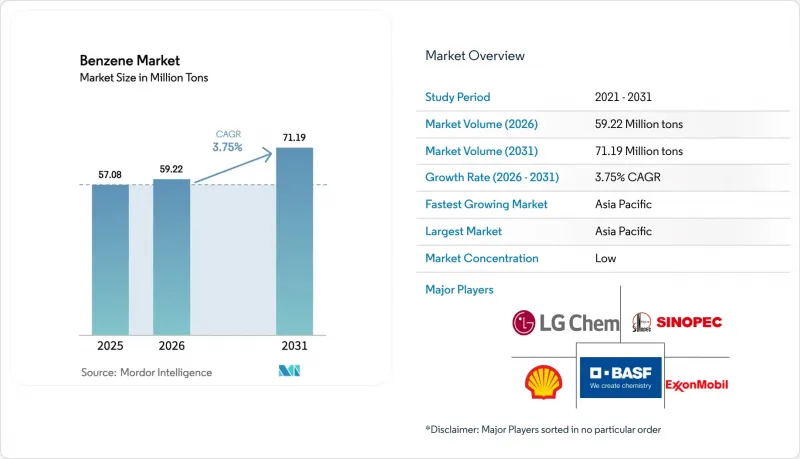
根據 Mordor Intelligence 預測,苯市場將從 2025 年的 5,708 萬噸成長到 2026 年的 5,922 萬噸,到 2031 年將達到 7,119 萬噸,2026 年至 2031 年的複合年成長率為 3.75%。
本報告按衍生物(乙苯、異丙苯、烷基苯、環己烷、硝基苯及其他衍生物)、終端用戶產業(塑膠聚合物、樹脂和黏合劑、農業化學品、藥品、油漆、塗料和溶劑)以及地區(亞太地區、北美地區、歐洲地區、南美地區以及中東和非洲地區)進行細分。市場預測以噸為單位。
全球苯市場趨勢及洞察
包裝和汽車行業對苯乙烯聚合物的需求增加。
到2025年,苯乙烯單體消耗量將佔全球苯供應量的約51%,從而支撐聚苯乙烯包裝市場和用於汽車內裝的丙烯腈-丁二烯-苯乙烯(ABS)樹脂市場。在亞太地區,受電子商務物流和冷鏈擴張的推動,聚苯乙烯消費量正以每年4-5%的速度成長;而在北美和歐洲,由於一次性塑膠製品的相關法規,需求成長被限制在2%以下。隨著汽車重量的減輕,ABS和苯乙烯-丙烯腈樹脂被廣泛應用於儀錶板和外飾件,即使包裝行業的需求放緩,也能維持苯的加工量。BASF在湛江上興建的年產100萬噸的苯乙烯裂解聯合裝置(將於2025年11月運作)等綜合性投資項目,是策略性協同佈局的典範,能夠確保利潤並降低價格波動。包裝和汽車行業的庫存週期同時帶來供應鏈風險,因此,對於參與企業,靈活的生產計劃至關重要。
亞洲一體化生產商正在提高下游化學品的生產能力。
2023年至2025年間,亞洲芳烴綜合體新增產能約1,200萬噸/年,主要集中在中石化阿美投資100億美元的福建工程及信實業投資97.5億美元的原油製化學品轉化裝置。與歐洲石腦油裂解法相比,原油直接製芳烴技術可將苯的現金成本降低50至80美元/噸,進一步擴大了競爭優勢。隨著2025年4月在延布簽署的年產150萬噸芳烴裝置的協議,該模式將擴展到波斯灣地區,使該地區成為歐洲和非洲的重要出口市場。亞洲現貨價格從2025年1月的每噸900美元跌至2025年7月的每噸728美元,反映出供應過剩的週期性波動。因此,非一體化生產商被迫降低運轉率或以損益平衡點出口,凸顯了苯市場與下游產業合作的必要性。
嚴格的職業暴露限值和訴訟風險
美國職業安全與健康管理局 (OSHA) 已將苯暴露的時間加權平均限值設定為 1 ppm,歐盟的 REACH 法規也設定了類似的閾值。這需要持續的空氣監測、使用個人防護設備和健康監測。在成熟地區,合規要求會使每噸苯的生產成本增加 5 至 10 美元。法院判決,包括與煉油廠員工達成的和解協議,推高了責任責任險,並加速了工廠關閉,例如英力士 (INEOS) 計劃於 2026 年 6 月關閉其位於薩尼亞的工廠。中國監管機構也開始加強執法力度,一些亞洲地區傳統的成本優勢正在縮小。高昂的合規支出,加上當地對苯衍生物需求疲軟,正在推動一波合理化浪潮,將苯市場產能重新分配到一體化、低成本的地區。
細分市場分析
到2025年,乙苯將佔全球需求的51.40%,透過作為聚苯乙烯、ABS和丁苯橡膠的苯乙烯單體,成為苯市場的基石。儘管苯市場整體呈現小幅擴張,但已開發國家的包裝相關法律限制了聚苯乙烯的成長。異丙苯作為苯酚-丙酮生產線的重要原料,在建築板材和聚碳酸酯玻璃的生產中發揮關鍵作用。硝基苯雖然目前市場規模較小,但其複合年成長率高達4.48%,這主要得益於聚氨酯隔熱材料的日益普及和汽車輕量化趨勢的推動。烷基苯為界面活性劑提供了穩定的需求,而環己烷則是尼龍6的基礎原料。馬來酸酐和氯苯等特殊應用市場整體上仍然有限。能夠靈活切換不同衍生物產量的綜合混合工廠,尤其是在苯乙烯市場景氣衰退,能夠獲得單一衍生物工廠無法實現的多元化優勢。
儘管乙苯憑藉其在苯市場佔據的主導地位而擁有強大的定價權,但利潤豐厚的產品正日益轉向硝基苯和藥用苯胺,而通過ISO認證的供應鏈能夠確保這些產品的溢價。歐洲通用乙苯工廠的價差正在縮小,而與當地MDI工廠相連的亞洲硝基苯生產設施則能產生穩定的利潤。隨著苯乙烯價差的縮小,靈活地在不同衍生物之間切換,例如將苯從乙苯重新分配到硝基苯,正成為一體化生產商的戰術性手段。沒有下游業務的通用供應商被迫依賴出口套利,這使他們面臨運費、外匯和現貨價格波動的風險。
區域分析
預計到2025年,亞太地區將佔全球苯產量的55.80%,並將在2031年之前維持4.32%的複合年成長率。僅中國就擁有超過1800萬噸/年的產能,此外,中石化多個廠址的擴建以及目前正在建設中、計劃於2027年運作的福建聯合裝置預計將進一步提高產能。印度信實集團的原油製化學品轉換中心將新增350萬噸/年的BTX產能,預計將推動印度在2028年實現淨出口。日本和韓國正致力於最佳化產率和生產特殊衍生物,並將剩餘苯出口到台灣。泰國和馬來西亞分別透過PTT Global Chemical(年產能242萬噸)和Chem1(年產能65.6萬噸)的專案來填補區域物流缺口。低現金成本、靈活的原料組合以及專有衍生產品的組合鞏固了主導地位。
在北美,美國墨西哥灣沿岸的煉油廠和乙烯裂解裝置是該產業的核心,但隨著乙烷作為原料的普及,苯的副產品產量下降,迫使苯乙烯生產商依賴進口。由於美國職業安全與健康管理局 (OSHA) 設定的 1 ppm 暴露限值以及不斷上漲的訴訟成本,固定成本不斷攀升,導致工廠進行合理化調整,例如英力士 (INEOS)關閉計畫其位於薩尼亞的工廠。加拿大和墨西哥的苯乙烯產能小規模,在維護和應對意外停機時依賴進口。
在歐洲,能源價格上漲、REACH法規合規以及設備老化等因素正在擠壓利潤空間。BASF旗下的Verband網路正透過整合來維持競爭力,而獨立公司則在考慮剝離或關閉等方案。隨著中東和亞洲出口商將目光投向安特衛普、鹿特丹和阿姆斯特丹的碼頭,歐洲對進口的依賴日益加深。諸如沙烏地阿拉伯基礎工業公司(SABIC)在荷蘭的電暖爐專案旨在減少排放並提高營運柔軟性。
南美苯市場由巴西布拉什姆公司營運的大型化學系統主導。該公司於2025年停產,導致苯出口下降,並對區域價格造成負面影響。 「南方轉型」(Transforma Sul)和「裡約轉型」(Transforma Rio)計畫將提高氣態原料的比例,未來可能減少苯的聯產,並導致供應趨緊。由於阿根廷等國的苯產量非常有限,新增需求可能需要透過進口來滿足。
在中東和非洲,沙烏地阿美和中石化的延布計畫以及朱拜勒的阿米拉爾綜合體正在擴大波斯灣地區芳烴化合物的綜合生產。透過紅海和波斯灣的碼頭進行出口,該地區已成為歐洲和非洲的重要供應地。南非的需求仍然嚴重依賴進口。由於持續存在的物流風險,例如紅海航線中斷,苯市場的買家正在分散其合約組合。
其他好處:
- Excel格式的市場預測(ME)表
- 3個月的分析師支持
目錄
第1章:引言
- 研究假設和市場定義
- 調查範圍
第2章:調查方法
第3章執行摘要
第4章 市場狀況
- 市場概覽
- 市場促進因素
- 包裝和汽車產業對苯乙烯聚合物的需求不斷成長。
- 亞洲一體化生產商正在提高下游化工產品的產能。
- 建築業的復甦帶動了苯酚和己內醯胺相關產業的發展。
- 新興市場對烷基苯基界面活性劑的應用日益廣泛
- 製藥業對苯的需求不斷成長
- 市場限制因素
- 嚴格的職業暴露限值和訴訟風險
- 與原油價格相關的原物料價格波動
- 用於下游衍生物的C4芳香族化合物生產路線的競爭
- 價值鏈分析
- 監理情勢
- 技術展望
- 價格分析
- 波特五力模型
第5章 市場規模與成長預測
- 導數
- 乙苯
- 孜然
- 烷基苯
- 環己烷
- 硝基苯
- 其他衍生物(苯胺、馬來酸酐等)
- 按最終用戶行業分類
- 塑膠和聚合物
- 樹脂和黏合劑
- 農業化學品
- 製藥
- 油漆、塗料、溶劑
- 按地區
- 亞太地區
- 中國
- 印度
- 日本
- 韓國
- 東南亞國協
- 其他亞太國家
- 北美洲
- 美國
- 加拿大
- 墨西哥
- 歐洲
- 德國
- 英國
- 法國
- 義大利
- 西班牙
- 俄羅斯
- 北歐國家
- 其他歐洲國家
- 南美洲
- 巴西
- 阿根廷
- 其他南美國家
- 中東和非洲
- 沙烏地阿拉伯
- 南非
- 其他中東和非洲國家
- 亞太地區
第6章 競爭情勢
- 市場集中度
- 策略趨勢
- 市佔率和排名分析
- 公司簡介
- BASF
- Braskem SA
- Chevron Phillips Chemical Co. LLC
- China Petrochemical Corporation
- Eastman Chemical Company
- Exxon Mobil Corporation
- Formosa Chemicals & Fibre Corporation
- INEOS
- LG Chem
- LyondellBasell Industries NV
- Marathon Petroleum Corp.
- Maruzen Petrochemical
- Mitsubishi Chemical Group Corporation.
- PTT Global Chemical PCL
- Reliance Industries Limited
- SABIC
- Shell
- SIBUR
- TotalEnergies
第7章 市場機會與未來展望
According to Mordor Intelligence, the benzene market size is expected to grow from 57.08 million tons in 2025 to 59.22 million tons in 2026 and is forecast to reach 71.19 million tons by 2031 at a 3.75% CAGR over 2026-2031.
This report is Segmented by Derivative (Ethylbenzene, Cumene, Alkylbenzene, Cyclohexane, Nitrobenzene, and Other Derivatives), End-User Industry (Plastics & Polymers, Resins & Adhesives, Agrochemicals, Pharmaceuticals, Paints, and Coatings & Solvents), and Geography (Asia-Pacific, North America, Europe, South America, and Middle East and Africa). The Market Forecasts are Provided in Terms of Volume (Tons).
Global Benzene Market Trends and Insights
Increasing Demand for Styrene-Based Polymers in Packaging & Automotive
Styrene monomer consumed about 51% of global benzene supply in 2025, underpinning polystyrene markets for packaging and acrylonitrile-butadiene-styrene resins for automotive interiors. Asia-Pacific registers 4-5% annual growth in polystyrene consumption, supported by e-commerce logistics and cold-chain expansion, while North American and European demand grows below 2% amid single-use plastics restrictions. Automotive lightweighting pushes ABS and styrene-acrylonitrile resins into dashboards and exterior trim, sustaining benzene throughput even when packaging moderates. Integrated investments such as BASF's 1 million tpa cracker-styrene complex in Zhanjiang, started in November 2025, exemplify strategic co-location that captures margin and mitigates price volatility. Inventory cycles in both packaging and automotive impose simultaneous supply-chain risks, making flexible production scheduling critical for benzene market participants.
Capacity Additions for Downstream Chemicals by Integrated Producers in Asia
Between 2023 and 2025, Asian complexes added about 12 million tpa of aromatics, anchored by Sinopec-Aramco's USD 10 billion Fujian project and Reliance's USD 9.75 billion crude-to-chemicals facility. Direct crude-to-aromatics technology trims benzene cash costs by USD 50-80 per ton versus European naphtha cracker routes, widening the competitiveness gap. The April 2025 framework for a 1.5 million tpa aromatics plant in Yanbu extends this model to the Gulf, positioning the region as a swing exporter to Europe and Africa. Spot prices in Asia fell from USD 900 per ton in January 2025 to USD 728 per ton in July 2025, reflecting the oversupply cycle. Non-integrated producers consequently curtailed run rates or exported at breakeven, underscoring the necessity of downstream linkages within the benzene market.
Stringent Occupational Exposure Limits & Litigation Risk
OSHA caps benzene exposure at 1 ppm time-weighted average, with similar thresholds under the European Union's REACH framework, compelling continuous air monitoring, personal protective equipment, and medical surveillance. Compliance adds USD 5-10 per ton to production costs in mature regions. Litigation precedents, including refinery worker settlements, elevate liability premiums and accelerate plant closures such as INEOS's scheduled Sarnia exit in June 2026. Regulators in China have begun tightening enforcement, narrowing historical cost advantages for some Asian sites. High compliance spending, combined with muted local derivative demand, underpins a wave of rationalization that redistributes benzene market capacity toward integrated low-cost hubs.
Other drivers and restraints analyzed in the detailed report include:
- Recovery of Construction Sector Boosting Phenol & Caprolactam Chains
- Growing Adoption of Alkylbenzene-Based Surfactants in Emerging Markets
- Volatility of Crude-Oil-Linked Feedstock Prices
For complete list of drivers and restraints, kindly check the Table Of Contents.
Segment Analysis
Ethylbenzene held 51.40% of global demand in 2025, anchoring the benzene market through styrene monomer for polystyrene, ABS, and styrene-butadiene rubber. While the overall benzene market sees slight expansion, growth in polystyrene is tempered by packaging legislation in developed economies. Cumene plays a pivotal role, feeding into phenol-acetone chains associated with construction panels and polycarbonate glazing. Nitrobenzene, while smaller today, records the highest 4.48% CAGR, supported by the polyurethane insulation push and automotive lightweighting. Alkylbenzene contributes to steady surfactant demand, and cyclohexane underpins nylon-6. Specialty outlets such as maleic anhydride and chlorobenzenes collectively remain limited. Integrated complexes, able to swing output among these derivatives, capture diversification benefits unavailable to single-derivative plants, especially during styrene down-cycles.
The benzene market share leadership gives ethylbenzene pricing influence, yet margin resilience increasingly gravitates toward nitrobenzene and pharmaceutical aniline, where ISO-certified supply chains secure premiums. Commodity ethylbenzene plants in Europe face tightening spreads, while Asian nitrobenzene units linked to local MDI facilities post stable earnings. Cross-derivative optionality, such as reallocating benzene from ethylbenzene to nitrobenzene when styrene spreads compress, emerges as a tactical lever for integrated producers. Merchant suppliers without downstream capture must rely on export arbitrage, exposing them to freight, currency, and spot volatility.
Complete Report Scope:
- By Derivative
- Ethylbenzene
- Cumene
- Alkylbenzene
- Cyclohexane
- Nitrobenzene
- Other Derivatives (Aniline, Maleic Anhydride, and more)
- By End-user Industry
- Plastics and Polymers
- Resins & Adhesives
- Agrochemicals
- Pharmaceuticals
- Paints, Coatings, and Solvents
- Geography
- Asia-Pacifc
- China
- India
- Japan
- South Korea
- ASEAN Countries
- Rest of Asia-Pacific
- North America
- United States
- Canada
- Mexico
- Europe
- Germany
- United Kingdom
- France
- Italy
- Spain
- Russia
- NORDIC Countries
- Rest of Europe
- South America
- Brazil
- Argentina
- Rest of South America
- Middle East and Africa
- Saudi Arabia
- South Africa
- Rest of Middle East and Africa
- Asia-Pacifc
Geography Analysis
Asia-Pacific retained 55.80% of global volume in 2025 and is set to post a 4.32% CAGR through 2031. China alone runs more than 18 million tpa of capacity, augmented by Sinopec's multi-site expansions and the Fujian complex under construction for a 2027 start-up. India's Reliance crude-to-chemicals hub adds 3.5 million tpa BTX capability, elevating the country to net-export status by 2028. Japan and South Korea emphasize yield optimization and specialty derivatives, exporting surplus benzene to Taiwan. Thailand and Malaysia fill regional logistics gaps through PTT Global Chemical's 2.42 million tpa and ChemOne's 656 thousand tpa projects, respectively. Lower cash costs, flexible feed slates, and captive derivatives collectively anchor Asia-Pacific leadership in the benzene market.
In North America, US Gulf Coast refineries and ethylene crackers form the backbone, yet the pivot toward ethane feed reduces benzene co-product output, forcing styrene makers to import. OSHA's 1 ppm exposure limit and litigation premiums raise fixed costs, prompting plant rationalization exemplified by INEOS's Sarnia closure plan. Canada and Mexico contribute modest capacity, relying on imports during maintenance or unplanned outages.
In Europe, energy pricing, REACH compliance, and aging assets compress margins. BASF's Verbund network maintains competitiveness through integration, while independent units review divestment or shutdown options. Import reliance deepens as Middle Eastern and Asian exporters target Antwerp-Rotterdam-Amsterdam terminals. Projects such as SABIC's electrically heated furnace in the Netherlands aim to cut emissions and enhance operational flexibility.
South America's benzene market is dominated by Braskem's main chemicals system in Brazil. Operational disruptions in 2025 trimmed exports and weighed on regional prices. The Transforma Sul and Transforma Rio programs will raise gas feedstock share, likely lowering future benzene co-production and tightening supply. Argentina and other producers contribute minor volumes, so incremental demand may be met by imports.
In the Middle East and Africa, Aramco-Sinopec's Yanbu project and the Amiral complex at Jubail expand integrated aromatics in the Gulf. Export optionality through Red Sea and Gulf terminals positions the region as a swing supplier to Europe and Africa. South African demand remains import-oriented. Logistics risks, such as Red Sea transit disruptions, persist, encouraging buyers to diversify contract portfolios within the benzene market.
- BASF
- Braskem S.A.
- Chevron Phillips Chemical Co. LLC
- China Petrochemical Corporation
- Eastman Chemical Company
- Exxon Mobil Corporation
- Formosa Chemicals & Fibre Corporation
- INEOS
- LG Chem
- LyondellBasell Industries N.V.
- Marathon Petroleum Corp.
- Maruzen Petrochemical
- Mitsubishi Chemical Group Corporation.
- PTT Global Chemical PCL
- Reliance Industries Limited
- SABIC
- Shell
- SIBUR
- TotalEnergies
Additional Benefits:
- The market estimate (ME) sheet in Excel format
- 3 months of analyst support
TABLE OF CONTENTS
1 Introduction
- 1.1 Study Assumptions & Market Definition
- 1.2 Scope of the Study
2 Research Methodology
3 Executive Summary
4 Market Landscape
- 4.1 Market Overview
- 4.2 Market Drivers
- 4.2.1 Increasing demand for styrene-based polymers in packaging and automotive
- 4.2.2 Capacity additions for downstream chemicals by integrated producers in Asia
- 4.2.3 Recovery of construction sector boosting phenol and caprolactam chains
- 4.2.4 Growing adoption of alkylbenzene-based surfactants in emerging markets
- 4.2.5 Growing demand for benzene from pharmaceutical industry
- 4.3 Market Restraints
- 4.3.1 Stringent occupational exposure limits and litigation risk
- 4.3.2 Volatility of crude-oil-linked feedstock prices
- 4.3.3 Competing C4 aromatics routes for downstream derivatives
- 4.4 Value Chain Analysis
- 4.5 Regulatory Landscape
- 4.6 Technological Outlook
- 4.7 Price Analysis
- 4.8 Porter's Five Forces
- 4.8.1 Bargaining Power of Suppliers
- 4.8.2 Bargaining Power of Buyers
- 4.8.3 Threat of New Entrants
- 4.8.4 Threat of Substitutes
- 4.8.5 Degree of Competition
5 Market Size & Growth Forecasts (Volume)
- 5.1 By Derivative
- 5.1.1 Ethylbenzene
- 5.1.2 Cumene
- 5.1.3 Alkylbenzene
- 5.1.4 Cyclohexane
- 5.1.5 Nitrobenzene
- 5.1.6 Other Derivatives (Aniline, Maleic Anhydride, and more)
- 5.2 By End-user Industry
- 5.2.1 Plastics and Polymers
- 5.2.2 Resins & Adhesives
- 5.2.3 Agrochemicals
- 5.2.4 Pharmaceuticals
- 5.2.5 Paints, Coatings, and Solvents
- 5.3 Geography
- 5.3.1 Asia-Pacifc
- 5.3.1.1 China
- 5.3.1.2 India
- 5.3.1.3 Japan
- 5.3.1.4 South Korea
- 5.3.1.5 ASEAN Countries
- 5.3.1.6 Rest of Asia-Pacific
- 5.3.2 North America
- 5.3.2.1 United States
- 5.3.2.2 Canada
- 5.3.2.3 Mexico
- 5.3.3 Europe
- 5.3.3.1 Germany
- 5.3.3.2 United Kingdom
- 5.3.3.3 France
- 5.3.3.4 Italy
- 5.3.3.5 Spain
- 5.3.3.6 Russia
- 5.3.3.7 NORDIC Countries
- 5.3.3.8 Rest of Europe
- 5.3.4 South America
- 5.3.4.1 Brazil
- 5.3.4.2 Argentina
- 5.3.4.3 Rest of South America
- 5.3.5 Middle East and Africa
- 5.3.5.1 Saudi Arabia
- 5.3.5.2 South Africa
- 5.3.5.3 Rest of Middle East and Africa
- 5.3.1 Asia-Pacifc
6 Competitive Landscape
- 6.1 Market Concentration
- 6.2 Strategic Moves
- 6.3 Market Share(%)/Ranking Analysis
- 6.4 Company Profiles (includes Global level Overview, Market level overview, Core Segments, Financials as available, Strategic Information, Market Rank/Share for key companies, Products & Services, and Recent Developments)
- 6.4.1 BASF
- 6.4.2 Braskem S.A.
- 6.4.3 Chevron Phillips Chemical Co. LLC
- 6.4.4 China Petrochemical Corporation
- 6.4.5 Eastman Chemical Company
- 6.4.6 Exxon Mobil Corporation
- 6.4.7 Formosa Chemicals & Fibre Corporation
- 6.4.8 INEOS
- 6.4.9 LG Chem
- 6.4.10 LyondellBasell Industries N.V.
- 6.4.11 Marathon Petroleum Corp.
- 6.4.12 Maruzen Petrochemical
- 6.4.13 Mitsubishi Chemical Group Corporation.
- 6.4.14 PTT Global Chemical PCL
- 6.4.15 Reliance Industries Limited
- 6.4.16 SABIC
- 6.4.17 Shell
- 6.4.18 SIBUR
- 6.4.19 TotalEnergies
7 Market Opportunities & Future Outlook
- 7.1 White-space and Unmet-need Assessment
- 7.2 Increasing focus on the production of bio-based benzene

 苯全球市場
 對苯醌二肟市場:全球市場預測,2026-2032年
 2026年全球苯市場報告苯市場:2026-2032年全球市場預測(依產品類型、製造流程、終端用戶產業及通路分類)
 苯市場規模、佔有率和成長分析:按等級、製造流程、應用、終端用戶產業、分銷管道和地區分類-2026-2033年產業預測
 苯市場-全球產業規模、佔有率、趨勢、機會、預測:按衍生物、最終用途、地區和競爭對手分類,2021-2031年
 2026 年至 2035 年美國衍生產品的市場機會、成長要素、產業趨勢分析與預測。叔戊基苯市場成長機會、成長要素、產業趨勢分析及2026年至2035年預測。
 苯及其衍生物市場分析及預測(至2035年):依類型、產品類型、應用、技術、最終用戶及製程分類
 全球苯市場:按生產製程、衍生物、最終用途、應用和地區分類-市場規模、產業趨勢、機會分析和未來預測(2026-2035 年)