


 |
市場調查報告書
商品編碼
2121614
發泡聚丙烯(EPP):市場佔有率分析、產業趨勢與統計、成長預測(2026-2031)Expanded Polypropylene (EPP) Foam - Market Share Analysis, Industry Trends & Statistics, Growth Forecasts (2026 - 2031) |
||||||

※ 本網頁內容可能與最新版本有所差異。詳細情況請與我們聯繫。
根據 Mordor Intelligence 預測,發泡聚丙烯市場規模預計將從 2025 年的 12.4 億美元成長到 2026 年的 13.2 億美元,並將從 2026 年到 2031 年以 6.68% 的複合年成長率成長,到 2031 億美元達到 18.33 億美元。
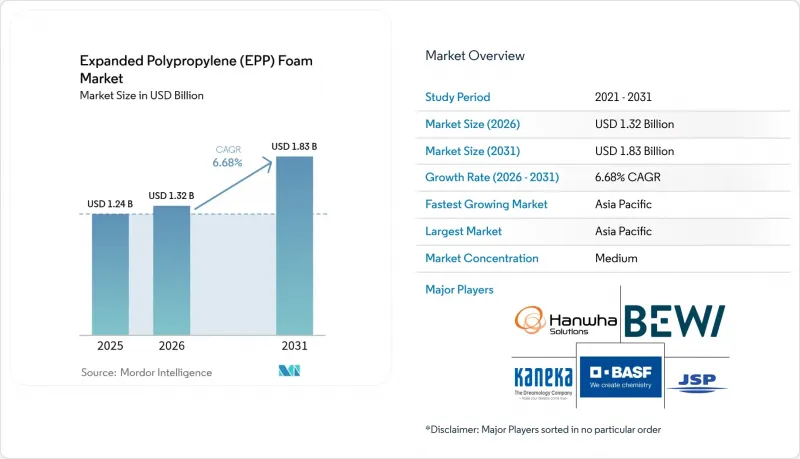
本報告按原料(合成聚丙烯和生物基聚丙烯)、發泡體類型(加工EPP、模塑EPP和其他發泡體)、應用領域(汽車、食品包裝、暖通空調、運動休閒等)以及地區(亞太地區、北美地區、歐洲地區、南美地區以及中東和非洲地區)進行細分。市場預測以美元計價。
全球發泡聚丙烯(EPP)市場趨勢與洞察
對更輕、更安全的汽車的需求
汽車製造商的目標是到2030年將車身重量減輕10%至20%,而2024年後推出的日本乘用車平台中,有65%指定使用發泡聚丙烯(EPP)。歐洲將於2025年修訂的聯合國ECE R94側面碰撞法規將能量吸收閾值提高15%,這將加速B柱加強件中以發泡體取代厚重的聚氨酯材料。電動車計畫進一步強化了這一趨勢。由於EPP兼具衝擊保護和隔熱性能,因此擴大被用作鋰離子電池組的內襯材料,而鋰離子電池組的減重空間非常有限。
電子商務防護包裝材料快速成長
2024年至2025年間,跨國小包裹處理量增加了一倍。此外,可重複使用的發泡聚丙烯(EPP)緩衝材料與纖維板相比,破損率降低了30-50%,這使得發泡聚丙烯市場成為履約中心不可或缺的一部分。 Sonoco公司於2024年推出的「EnviroFlex」托盤可堆疊用於退貨,可承受10-15次運輸,同時降低20%的逆向物流成本。成本仍是一大障礙;其單價比EPS高出20-30%,因此目前僅適用於高價電子產品。
與價格低廉的EPS和其他發泡材競爭。
在通用應用中,發泡聚苯乙烯 (EPS) 比發泡聚丙烯 (EPP) 具有 20-30% 的成本優勢。在食品包裝和家具行業,儘管 EPP 具有更優異的可重複使用性,但價格敏感度仍然很高,使得轉換難度較高。冷鏈食品包裝就很好地體現了這種權衡。 EPP 保溫容器可以承受 10-15 次重複使用循環,而 EPS 只能承受 2-3 次。然而,EPS 的初始單價為 3-5 美元,而 EPP 的初始單價為 8-12 美元,這對於逆向物流有限的小規模經銷商來說構成了障礙。原型仍處於商業化前的階段,但它凸顯瞭如果生物基聚丙烯原料的大規模生產被推遲,類似材料可能會削弱 EPP 的永續性地位的風險。
細分市場分析
至2025年,合成聚丙烯將佔發泡聚丙烯市場原料規模的91.78%,預計到2031年將以6.89%的複合年成長率成長。儘管生物基含量仍然很低,但隨著Neste和LyondellBasell擴大可再生原料的生產規模,預計到2029年,生物基材料將在全球生質塑膠產能中佔據相當大的佔有率。由於嚴格的成本控制和對結晶度的嚴格要求,合成聚丙烯在汽車和包裝應用領域繼續保持主導地位。在運動頭盔等消費品領域,生物基發泡聚丙烯的價格溢價為15-20%,導致其複合年成長率放緩。
為了減少碳足跡,品牌所有者正在美國和歐洲等待監管部門的批准,同時在食品接觸領域試點使用生物基聚丙烯-EPP複合材料。因此,發泡的聚丙烯市場在一個利潤豐厚的細分市場中,力求在穩定的化石燃料供應鏈和以永續發展為導向的品牌建立之間取得平衡。
區域分析
預計到2025年,亞太地區將佔發泡聚丙烯(EPP)市場佔有率的42.22%,複合年成長率(CAGR)為7.15%。中國每年生產2800萬輛汽車,其中55%的新車平台使用EPP。日本的JSP、 KANEKA和積水化學公司將60%的產品出口到海外,其垂直整合的樹脂供應鏈和低廉的蒸氣能源成本使其擁有15-20%的成本優勢。
由於美國環保署(EPA)燃油效率法規帶來的減重壓力,積水塑膠在北美的市佔率預計將穩定成長。積水塑膠位於俄亥俄州的工廠計劃於2026年運作,預計將使運往底特律的前置作業時間縮短40%。加拿大禁止使用一次性塑膠製品的政策正在推動對可重複使用包裝材料的需求,而墨西哥每年350萬輛汽車的產量也帶動了當地對射出成型的需求。
受能源價格波動和微塑膠法規的影響,歐洲市場佔有率預計將保持名義成長。北歐國家淨零能耗建築標準的實施預計將使BEWi的地工磚隔熱材料需求在2025年增加35%。南美洲和中東/非洲合計構成了一個佔8%的新興市場,這主要得益於巴西和沙烏地阿拉伯的綠建築法規。
其他好處:
- Excel格式的市場預測(ME)表
- 3個月的分析師支持
目錄
第1章:引言
- 研究假設和市場定義
- 調查範圍
第2章:調查方法
第3章執行摘要
第4章 市場狀況
- 市場概覽
- 市場促進因素
- 對更輕、更安全的汽車的需求
- 電子商務防護包裝材料需求激增。
- 3D蒸汽箱成型技術能夠製造複雜的汽車零件。
- 電動車電池溫度控管包中的應用
- 透過使用EPP地工磚隔熱材料實現淨零能耗建築。
- 市場限制因素
- 與價格低廉的EPS和其他發泡材競爭。
- 亞洲蒸汽箱成型產能短缺
- 針對微塑膠顆粒排放的監管規定正在加強。
- 價值鏈分析
- 波特五力模型
- 價格分析
第5章 市場規模與成長預測
- 按成分
- 合成聚丙烯
- 生物基聚丙烯
- 發泡體類型
- 聚丙烯發泡
- 模壓發泡聚丙烯
- 其他發泡體
- 透過使用
- 車
- 墊材/工業包裝材料
- 家具
- 食品包裝
- HVAC
- 運動休閒
- 其他用途
- 按地區
- 亞太地區
- 中國
- 印度
- 日本
- 韓國
- 東南亞國協
- 其他亞太國家
- 北美洲
- 美國
- 加拿大
- 墨西哥
- 歐洲
- 德國
- 英國
- 法國
- 義大利
- 西班牙
- 俄羅斯
- 其他歐洲國家
- 南美洲
- 巴西
- 阿根廷
- 其他南美國家
- 中東和非洲
- 沙烏地阿拉伯
- 南非
- 其他中東和非洲國家
- 亞太地區
第6章 競爭情勢
- 市場集中度
- 策略趨勢
- 市佔率和排名分析
- 公司簡介
- ALPLA
- Armacell
- BASF
- BEWi(IZOBLOK)
- Clark Foam Products Corporation
- Foampartner
- Furukawa Electric Co., Ltd.
- Hanwha Solutions
- JSP
- KK Nag Pvt. Ltd
- Kaneka Corporation
- Knauf Industries
- Polyfoam Australia Pty Ltd
- Sekisui Plastics Co.
- Signode Industrial Group Llc
- Sonoco Products Company
- SSW PearlFoam GmbH
- Woodbridge
- Zotefoams Plc
第7章 市場機會與未來展望
According to Mordor Intelligence, the expanded polypropylene foam market size is expected to grow from USD 1.24 billion in 2025 to USD 1.32 billion in 2026 and is forecast to reach USD 1.83 billion by 2031 at a 6.68% CAGR over 2026-2031.
This report is Segmented Into Raw Material (Synthetic Polypropylene and Bio-Based Polypropylene), Foam (Fabricated EPP, Molded EPP, and Other Foams), Application (Automotive, Food Packaging, HVAC, Sports and Leisure, and More), and Geography (Asia-Pacific, North America, Europe, South America, and the Middle East and Africa). The Market Forecasts are Provided in Terms of Value (USD).
Global Expanded Polypropylene (EPP) Foam Market Trends and Insights
Automotive Lightweighting and Safety Demand
Vehicle makers target 10-20% mass reduction by 2030 and have specified expanded polypropylene foam in 65% of the Japanese passenger-car platforms launched since 2024. Europe's 2025 update to UN ECE R94 side-impact rules raised energy-absorption thresholds by 15%, accelerating foam substitution for heavier polyurethane in B-pillar reinforcements. EV programs intensify this pull; EPP combines impact protection with thermal insulation, so it increasingly lines lithium-ion packs where weight offsets are scarce.
Boom in E-commerce Protective Packaging
Cross-border parcels doubled between 2024 and 2025, and reusable EPP dunnage lowers damage rates by 30-50% versus fiberboard, making the expanded polypropylene foam market indispensable to fulfillment centers. Sonoco's 2024 EnviroFlex trays nest for return shipping, cutting reverse-logistics costs 20% while surviving 10-15 trips. Cost remains the friction point: units are 20-30% pricier than EPS, limiting uptake to high-value electronics.
Competition from Cheaper EPS and Other Foams
Expanded polystyrene maintains a 20-30% cost advantage over EPP in commodity applications, and food packaging and furniture segments remain price-sensitive enough to resist switching despite EPP's superior reusability. Cold-chain food packaging illustrates the trade-off: EPP insulated containers survive 10-15 reuse cycles versus 2-3 for EPS, but the initial unit cost of USD 8-12 for EPP versus USD 3-5 for EPS deters small-scale distributors with limited reverse-logistics infrastructure. The prototype remains pre-commercial, yet it underscores the risk that adjacent materials will erode EPP's sustainability positioning if bio-based polypropylene feedstock scales slowly.
Other drivers and restraints analyzed in the detailed report include:
- 3D Steam-chest Molding Enables Complex Auto Parts
- Adoption in Electric-Vehicle Battery Thermal Management Packs
- Limited Steam-chest Molding Capacity Ex-Asia
For complete list of drivers and restraints, kindly check the Table Of Contents.
Segment Analysis
Synthetic polypropylene accounted for 91.78% of the expanded polypropylene foam market size for raw materials in 2025, expanding at a 6.89% CAGR to 2031. Bio-based content remains very low but is forecast to reach a decent share of global bioplastics capacity by 2029 as Neste and LyondellBasell scale renewable feedstocks. Cost discipline and tight crystallinity tolerances keep synthetic grades in pole position for automotive and dunnage. Consumer-facing goods such as sports helmets accept the 15-20% premium for bio-EPP, underpinning slower CAGR growth.
Brand owners seeking lower carbon footprints are piloting bio-PP EPP in food-contact trials pending regulatory clearance in the United States and Europe. The expanded polypropylene foam market, therefore, balances secure fossil-based supply chains against sustainability branding in high-margin niches.
Complete Report Scope:
- By Raw Material
- Synthetic Polypropylene
- Bio-based Polypropylene
- By Foam Type
- Fabricated EPP
- Molded EPP
- Other Foams
- By Application
- Automotive
- Dunnage/Industrial Packaging
- Furniture
- Food Packaging
- HVAC
- Sports and Leisure
- Other Applications
- By Geography
- Asia-Pacific
- China
- India
- Japan
- South Korea
- ASEAN Countries
- Rest of Asia-Pacific
- North America
- United States
- Canada
- Mexico
- Europe
- Germany
- United Kingdom
- France
- Italy
- Spain
- Russia
- Rest of Europe
- South America
- Brazil
- Argentina
- Rest of South America
- Middle-East and Africa
- Saudi-Arabia
- South Africa
- Rest of Middle-East and Africa
- Asia-Pacific
Geography Analysis
Asia-Pacific held 42.22% of the expanded polypropylene foam market in 2025 and will increase at a 7.15% CAGR. China produced 28 million vehicles and specified EPP in 55% of new car platforms. Japan's JSP, Kaneka, and Sekisui ship 60% of output overseas, proving that vertically integrated resin supply plus low steam energy costs confer a 15-20% cost advantage.
North America's market share is poised for decent growth, as EPA mileage rules force lightweighting. Sekisui Plastics' Ohio plant goes live in 2026, trimming Detroit lead times 40%. Canada's single-use plastics ban drives reusable dunnage, and Mexico's 3.5-million-unit auto output boosts local molding.
Europe's market share is about experience nominal growth, checked by energy volatility and microplastics rules. Net-zero building codes in the Nordics lifted geo-foam insulation demand 35% for BEWi in 2025. South America and the Middle East-Africa together form an emerging 8% slice, stimulated by Brazil's and Saudi Arabia's green-building ordinances.
- ALPLA
- Armacell
- BASF
- BEWi (IZOBLOK)
- Clark Foam Products Corporation
- Foampartner
- Furukawa Electric Co., Ltd.
- Hanwha Solutions
- JSP
- K K Nag Pvt. Ltd
- Kaneka Corporation
- Knauf Industries
- Polyfoam Australia Pty Ltd
- Sekisui Plastics Co.
- Signode Industrial Group Llc
- Sonoco Products Company
- SSW PearlFoam GmbH
- Woodbridge
- Zotefoams Plc
Additional Benefits:
- The market estimate (ME) sheet in Excel format
- 3 months of analyst support
TABLE OF CONTENTS
1 Introduction
- 1.1 Study Assumptions and Market Definition
- 1.2 Scope of the Study
2 Research Methodology
3 Executive Summary
4 Market Landscape
- 4.1 Market Overview
- 4.2 Market Drivers
- 4.2.1 Automotive lightweighting and safety demand
- 4.2.2 Boom in e-commerce protective packaging
- 4.2.3 3-D steam-chest molding enables complex auto parts
- 4.2.4 Adoption in Electric vehicle battery thermal management packs
- 4.2.5 Net-zero buildings using EPP geo-foam insulation
- 4.3 Market Restraints
- 4.3.1 Competition from cheaper EPS and other foams
- 4.3.2 Limited steam-chest molding capacity ex-Asia
- 4.3.3 Micro-plastics pellet-loss regulations tightening
- 4.4 Value Chain Analysis
- 4.5 Porter's Five Forces
- 4.5.1 Bargaining Power of Suppliers
- 4.5.2 Bargaining Power of Buyers
- 4.5.3 Threat of New Entrants
- 4.5.4 Threat of Substitutes
- 4.5.5 Degree of Competition
- 4.6 Price Analysis
5 Market Size and Growth Forecasts (Value)
- 5.1 By Raw Material
- 5.1.1 Synthetic Polypropylene
- 5.1.2 Bio-based Polypropylene
- 5.2 By Foam Type
- 5.2.1 Fabricated EPP
- 5.2.2 Molded EPP
- 5.2.3 Other Foams
- 5.3 By Application
- 5.3.1 Automotive
- 5.3.2 Dunnage/Industrial Packaging
- 5.3.3 Furniture
- 5.3.4 Food Packaging
- 5.3.5 HVAC
- 5.3.6 Sports and Leisure
- 5.3.7 Other Applications
- 5.4 By Geography
- 5.4.1 Asia-Pacific
- 5.4.1.1 China
- 5.4.1.2 India
- 5.4.1.3 Japan
- 5.4.1.4 South Korea
- 5.4.1.5 ASEAN Countries
- 5.4.1.6 Rest of Asia-Pacific
- 5.4.2 North America
- 5.4.2.1 United States
- 5.4.2.2 Canada
- 5.4.2.3 Mexico
- 5.4.3 Europe
- 5.4.3.1 Germany
- 5.4.3.2 United Kingdom
- 5.4.3.3 France
- 5.4.3.4 Italy
- 5.4.3.5 Spain
- 5.4.3.6 Russia
- 5.4.3.7 Rest of Europe
- 5.4.4 South America
- 5.4.4.1 Brazil
- 5.4.4.2 Argentina
- 5.4.4.3 Rest of South America
- 5.4.5 Middle-East and Africa
- 5.4.5.1 Saudi-Arabia
- 5.4.5.2 South Africa
- 5.4.5.3 Rest of Middle-East and Africa
- 5.4.1 Asia-Pacific
6 Competitive Landscape
- 6.1 Market Concentration
- 6.2 Strategic Moves
- 6.3 Market Share(%)/Ranking Analysis
- 6.4 Company Profiles (includes Global Overview, Market Overview, Core Segments, Financials, Strategic Information, Products and Services, Recent Developments)
- 6.4.1 ALPLA
- 6.4.2 Armacell
- 6.4.3 BASF
- 6.4.4 BEWi (IZOBLOK)
- 6.4.5 Clark Foam Products Corporation
- 6.4.6 Foampartner
- 6.4.7 Furukawa Electric Co., Ltd.
- 6.4.8 Hanwha Solutions
- 6.4.9 JSP
- 6.4.10 K K Nag Pvt. Ltd
- 6.4.11 Kaneka Corporation
- 6.4.12 Knauf Industries
- 6.4.13 Polyfoam Australia Pty Ltd
- 6.4.14 Sekisui Plastics Co.
- 6.4.15 Signode Industrial Group Llc
- 6.4.16 Sonoco Products Company
- 6.4.17 SSW PearlFoam GmbH
- 6.4.18 Woodbridge
- 6.4.19 Zotefoams Plc
7 Market Opportunities and Future Outlook
- 7.1 White-space and unmet-need assessment

 北美地區發泡聚苯乙烯:市佔率分析、產業趨勢與統計、成長預測(2026-2031)
 發泡聚丙烯市場:依產品類型、製程、原料、密度及最終用戶分類-2026-2032年全球市場預測
 全球發泡聚丙烯市場規模、佔有率、趨勢和成長分析報告(2026-2034)聚丙烯硬質泡棉市場按產品類型、製造流程、密度、終端用途產業和應用分類-全球預測,2026-2032年
 2026年全球閉孔泡棉市場報告2026-2034年全球閉孔聚氨酯泡棉市場規模、佔有率、趨勢與成長分析報告
 發泡聚丙烯市場規模、佔有率及成長分析(按產品、應用及地區分類)-2026-2033年產業預測
 發泡聚丙烯(EPP)市場規模、佔有率和成長分析(按類型、最終用途產業、應用和地區分類)-2026-2033年產業預測
 全球EPP泡沫市場、市場規模及預測分析(2018-2034)
 全球 EPP 泡棉市場(按類型、應用和地區)預測(至 2030 年)