


 |
市場調查報告書
商品編碼
2119076
北美地區發泡聚苯乙烯:市佔率分析、產業趨勢與統計、成長預測(2026-2031)North America Expanded Polypropylene Foam - Market Share Analysis, Industry Trends & Statistics, Growth Forecasts (2026 - 2031) |
||||||

※ 本網頁內容可能與最新版本有所差異。詳細情況請與我們聯繫。
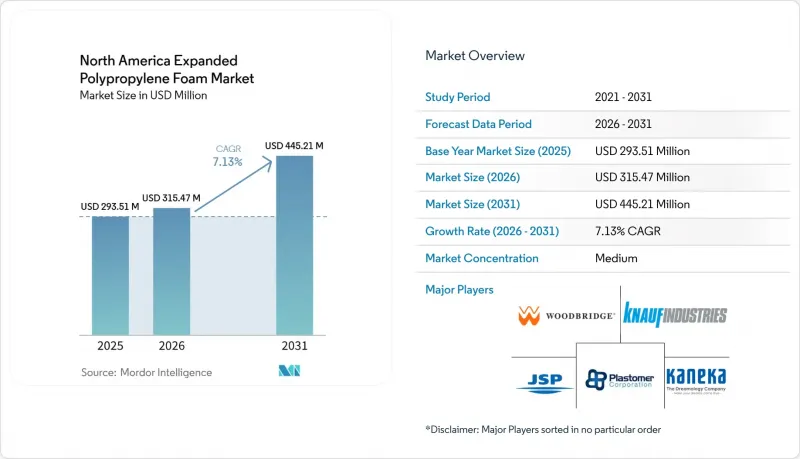
據 Mordor Intelligence 稱,2025 年北美發泡聚苯乙烯泡沫市值為 2.9351 億美元,預計到 2031 年將達到 4.4521 億美元,而 2026 年為 3.1547 億美元,預測期(2026-2031 年)的複合年成長率為 7.3%。
本報告按原料(合成聚丙烯、生物基聚丙烯)、泡棉類型(模塑EPP、加工EPP及其他泡棉類型)、應用領域(汽車、墊材/工業包裝、家具、食品包裝、暖通空調、運動休閒等)和地區(美國、加拿大、墨西哥)進行細分。市場預測以美元計價。
北美發泡聚苯乙烯(EPP)市場趨勢與洞察
汽車和運輸機械領域對輕量化材料的需求日益成長。
北美發泡聚苯乙烯泡沫(EPP)市場正受益於汽車行業旨在減輕零件重量而不影響碰撞安全性的項目。企業平均燃油經濟性(CAFE)法律規範要求汽車製造商透過車輛設計和零件選擇來提高車隊的燃油效率。與傳統的能量吸收材料相比,EPP 可以使每輛車的保險桿系統減重 1.2 至 1.8 公斤。其在重複碰撞後仍能恢復原狀的特性,也促使其被用作貨車裝載面板和隔板的緩衝材料。這種應用減少了車輛頻繁撞擊碼頭等情況下更換零件的需求。此外,美國南部汽車生產的擴張也推動了對 EPP 的需求,使其不再局限於傳統的以密西根州為中心的供應鏈。
EPP泡棉在電動車電池保護和溫度控管的應用日益廣泛。
電池組需要能夠吸收振動、耐受電解腐蝕並在動作溫度下保持穩定的材料。 EPP(發泡聚苯乙烯)滿足電池模組外殼的這些要求,從而減少了對額外保護襯墊的需求。為了滿足北美汽車市場的需求,JSP公司於2025年12月在墨西哥拉莫斯阿里斯佩建造了ARPRO EPP工廠。該工廠將成為汽車製造商及其供應商的EPP組件本地供應商。這些產能將使北美發泡聚苯乙烯市場能夠超越傳統的保險桿和頭枕應用,提高其在電動車平台上的應用率。
丙烯價格波動及其對原物料的依賴性
北美發泡聚苯乙烯泡沫市場持續受到聚合級丙烯價格波動的影響。供應集中在德克薩斯州的四家丙烷脫氫工廠,因此價格極易受到運作、丙烷成本和運輸中斷的影響。 2026年3月的分析報告也提到,貿易相關的壓力會影響丙烷價格和北美液化石油氣(LPG)出口。在汽車供應合約中,如果價格調整條款落後於現貨價格波動一到兩個季度,加工商可能面臨價格波動風險。由於丙烯是合成聚丙烯珠粒的核心原料,這種風險會直接影響利潤率。
細分市場分析
至2025年,合成聚丙烯將佔北美發泡聚苯乙烯泡沫市場88.62%的佔有率。這一細分市場受益於成熟的石化基礎設施以及傳統丙烯供應所帶來的規模經濟效益。汽車和包裝行業的客戶需要大批量且穩定的供應,因此他們繼續使用合成材料。其原料基礎與現有的區域丙烯生產和加工網路緊密相連。這種關係解釋了為什麼化石基聚丙烯仍然是北美發泡聚丙烯產業的主要原料。正如「阻礙因素」部分所述,這種關係也使生產商面臨原物料價格波動的風險。
預計2026年至2031年間,生物基聚丙烯的複合年成長率將達到11.25%。 Braschem和「I'm green PP」等公司對生物基聚丙烯技術的投資,為生物基EPP(增強型聚丙烯)提供了潛在的原料供應管道。目前,其高昂的成本限制了其應用範圍,主要集中在高階汽車內部裝潢建材、消費性電子產品機殼和某些包裝形式。生物基聚丙烯的成本可能比化石基聚丙烯高出三倍。隨著供應商尋求低碳原料,汽車製造商的範圍3採購目標正在推動對這些材料的興趣。
其他好處:
- Excel格式的市場預測(ME)表
- 3個月的分析師支持
目錄
第1章:引言
- 市場分析與定義的前提條件
- 分析範圍
第2章 分析方法
第3章執行摘要
第4章 市場狀況
- 市場概覽
- 市場促進因素
- 汽車和交通運輸領域對輕量化材料的需求日益成長。
- EPP泡棉在電動車電池保護和溫度控管的應用日益廣泛。
- 擴大可重複使用保護性包裝材料和工業緩衝解決方案的使用範圍。
- 汽車製造中閉合迴路回收和珠粒回收系統的擴展
- 用於客製化、複雜EPP零件的蒸汽箱成型技術的進步
- 市場限制因素
- 丙烯價格波動及其對原物料的依賴性
- 低成本替代品:EPS、EPE 和聚氨酯泡棉。
- 減少顆粒損失的措施和分散的EPP回收基礎設施
- 價值鍊和供應鏈分析
- 波特五力分析
第5章:預測市場規模與成長率
- 按成分
- 合成聚丙烯
- 生物基聚丙烯
- 依表單類型
- 模壓EPP
- 加工 EPP
- 其他形式
- 透過使用
- 車
- 墊材/工業包裝材料
- 家具
- 食品包裝
- HVAC
- 運動休閒
- 其他用途
- 按地區
- 美國
- 加拿大
- 墨西哥
第6章 競爭情勢
- 市場集中度
- 策略趨勢
- 市佔率和排名分析
- 公司簡介
- Bradford Company
- DS Smith plc
- Foam Products Corporation
- JSP
- Kaneka Corporation
- Knauf Industries
- Plastomer Corporation
- SEKISUI AMERICA CORPORATION
- Signode Industrial Group LLC
- UFP Technologies, Inc.
- Woodbridge
- Zotefoams plc
第7章 市場機會與未來展望
According to Mordor Intelligence, the North America expanded polypropylene foam market size was valued at USD 293.51 million in 2025 and estimated to grow from USD 315.47 million in 2026 to reach USD 445.21 million by 2031, at a CAGR of 7.13% during the forecast period (2026-2031).
This report is Segmented by Raw Material (Synthetic Polypropylene and Bio-Based Polypropylene), Foam Type (Molded EPP, Fabricated EPP, and Other Foam Types), Application (Automotive, Dunnage/Industrial Packaging, Furniture, Food Packaging, HVAC, Sports and Leisure, and More), and Geography (United States, Canada, and Mexico). The Market Forecasts are Provided in Terms of Value (USD).
North America Expanded Polypropylene Foam Market Trends and Insights
Growing Demand for Lightweight Materials in Automotive and Transportation Applications
The North America expanded polypropylene foam market benefits from vehicle programs that seek lower component mass without reducing crash protection. The Corporate Average Fuel Economy framework sets requirements that encourage manufacturers to improve fleet efficiency through vehicle design and component selection. EPP can reduce bumper-system weight by 1.2-1.8 kg per vehicle when compared with conventional energy-absorbing materials. Its ability to recover after repeated impacts also supports use in delivery-vehicle loading panels and bulkhead padding. This use can reduce replacement needs where vehicles face frequent dock contact. Automotive production in the southern United States also broadens demand beyond the traditional Michigan-centered supply base.
Increasing Adoption of EPP Foam for Electric Vehicle Battery Protection and Thermal Management
Battery packs need materials that absorb vibration, resist electrolyte exposure, and remain stable at operating temperatures. EPP meets these needs in battery module housings and can reduce the need for separate protective liners. JSP Corporation completed an ARPRO EPP plant in Ramos Arizpe, Mexico, in December 2025 to serve North American automotive demand. The facility provides a local source for EPP components used by vehicle manufacturers and their suppliers. This performance allows the North America expanded polypropylene foam market to gain content in electric vehicle platforms beyond traditional bumper and headrest uses.
Propylene Price Volatility and Feedstock Dependence
The North America expanded polypropylene foam market remains exposed to changes in polymer-grade propylene pricing. Supply is concentrated in 4 Texas-based propane dehydrogenation units, which makes values sensitive to outages, propane costs, and transport disruptions. A March 2026 analysis also described trade-related pressure on propane costs and North American Liquefied Petroleum Gas (LPG) exports. Automotive supply agreements can leave converters exposed when price-adjustment clauses lag spot movements by 1-2 quarters. This risk directly affects margins because propylene is the core feedstock for synthetic polypropylene beads.
Other drivers and restraints analyzed in the detailed report include:
- Rising Use of Reusable Protective Packaging and Industrial Dunnage Solutions
- Expansion of Closed-Loop Recycling and Bead Recovery Systems in Automotive Manufacturing
- Substitution by Lower-Cost EPS, EPE, and Polyurethane Foams
For complete list of drivers and restraints, kindly check the Table Of Contents.
Segment Analysis
Synthetic polypropylene accounted for 88.62% of the North America expanded polypropylene foam market share in 2025. The segment benefits from established petrochemical infrastructure and the cost-volume economics of conventional propylene supply. Synthetic material continues to serve automotive and packaging customers who need a dependable supply at large volumes. Its feedstock base is closely linked to existing regional propylene production and processing networks. This relationship explains why fossil-derived polypropylene remains the dominant raw material for the North America expanded polypropylene industry. It also leaves producers exposed to the feedstock volatility described in the restraints section.
Bio-based polypropylene is forecast to grow at an 11.25% CAGR between 2026 and 2031. Braskem, I'm green PP, and investment in bio-propylene technologies provides a potential feedstock path for bio-based EPP. Higher prices currently limit use to premium automotive interiors, consumer electronics housings, and selected packaging formats. The bio-based polypropylene can cost up to 3 times fossil-derived polypropylene. Automaker Scope 3 procurement goals support interest in these materials as suppliers seek lower-carbon feedstock options.
Complete Report Scope:
- By Raw Material
- Synthetic Polypropylene
- Bio-based Polypropylene
- By Foam Type
- Molded EPP
- Fabricated EPP
- Other Foam Types
- By Application
- Automotive
- Dunnage/Industrial Packaging
- Furniture
- Food Packaging
- HVAC
- Sports and Leisure
- Other Applications
- By Geography
- United States
- Canada
- Mexico
List of Companies Covered in this Report:
- Bradford Company
- DS Smith plc
- Foam Products Corporation
- JSP
- Kaneka Corporation
- Knauf Industries
- Plastomer Corporation
- SEKISUI AMERICA CORPORATION
- Signode Industrial Group LLC
- UFP Technologies, Inc.
- Woodbridge
- Zotefoams plc
Additional Benefits:
- The market estimate (ME) sheet in Excel format
- 3 months of analyst support
TABLE OF CONTENTS
1 Introduction
- 1.1 Study Assumptions and Market Definition
- 1.2 Scope of the Study
2 Research Methodology
3 Executive Summary
4 Market Landscape
- 4.1 Market Overview
- 4.2 Market Drivers
- 4.2.1 Growing Demand for Lightweight Materials in Automotive and Transportation Applications
- 4.2.2 Increasing Adoption of EPP Foam for Electric Vehicle Battery Protection and Thermal Management
- 4.2.3 Rising Use of Reusable Protective Packaging and Industrial Dunnage Solutions
- 4.2.4 Expansion of Closed-Loop Recycling and Bead Recovery Systems in Automotive Manufacturing
- 4.2.5 Advancements in Steam-Chest Molding Technologies for Customized and Complex EPP Components
- 4.3 Market Restraints
- 4.3.1 Propylene Price Volatility and Feedstock Dependence
- 4.3.2 Substitution by Lower-Cost EPS, EPE, and Polyurethane Foams
- 4.3.3 Pellet-Loss Controls and Fragmented EPP Collection Infrastructure
- 4.4 Value Chain Analysis
- 4.5 Porter's Five Forces Analysis
- 4.5.1 Threat of New Entrants
- 4.5.2 Bargaining Power of Suppliers
- 4.5.3 Bargaining Power of Buyers
- 4.5.4 Threat of Substitutes
- 4.5.5 Competitive Rivalry
5 Market Size and Growth Forecasts (Value)
- 5.1 By Raw Material
- 5.1.1 Synthetic Polypropylene
- 5.1.2 Bio-based Polypropylene
- 5.2 By Foam Type
- 5.2.1 Molded EPP
- 5.2.2 Fabricated EPP
- 5.2.3 Other Foam Types
- 5.3 By Application
- 5.3.1 Automotive
- 5.3.2 Dunnage/Industrial Packaging
- 5.3.3 Furniture
- 5.3.4 Food Packaging
- 5.3.5 HVAC
- 5.3.6 Sports and Leisure
- 5.3.7 Other Applications
- 5.4 By Geography
- 5.4.1 United States
- 5.4.2 Canada
- 5.4.3 Mexico
6 Competitive Landscape
- 6.1 Market Concentration
- 6.2 Strategic Moves
- 6.3 Market Share (%)/Ranking Analysis
- 6.4 Company Profiles (includes Global Overview, Market Overview, Core Segments, Financials as available, Strategic Information, Products and Services, and Recent Developments)
- 6.4.1 Bradford Company
- 6.4.2 DS Smith plc
- 6.4.3 Foam Products Corporation
- 6.4.4 JSP
- 6.4.5 Kaneka Corporation
- 6.4.6 Knauf Industries
- 6.4.7 Plastomer Corporation
- 6.4.8 SEKISUI AMERICA CORPORATION
- 6.4.9 Signode Industrial Group LLC
- 6.4.10 UFP Technologies, Inc.
- 6.4.11 Woodbridge
- 6.4.12 Zotefoams plc
7 Market Opportunities and Future Outlook
- 7.1 White-Space and Unmet-Need Assessment

 發泡聚丙烯(EPP):市場佔有率分析、產業趨勢與統計、成長預測(2026-2031)
 發泡聚丙烯市場:依產品類型、製程、原料、密度及最終用戶分類-2026-2032年全球市場預測
 全球發泡聚丙烯市場規模、佔有率、趨勢和成長分析報告(2026-2034)聚丙烯硬質泡棉市場按產品類型、製造流程、密度、終端用途產業和應用分類-全球預測,2026-2032年
 2026年全球閉孔泡棉市場報告2026-2034年全球閉孔聚氨酯泡棉市場規模、佔有率、趨勢與成長分析報告
 發泡聚丙烯市場規模、佔有率及成長分析(按產品、應用及地區分類)-2026-2033年產業預測
 發泡聚丙烯(EPP)市場規模、佔有率和成長分析(按類型、最終用途產業、應用和地區分類)-2026-2033年產業預測
 全球EPP泡沫市場、市場規模及預測分析(2018-2034)
 全球 EPP 泡棉市場(按類型、應用和地區)預測(至 2030 年)