


 |
市場調查報告書
商品編碼
2121559
3D混凝土列印:市場佔有率分析、產業趨勢與統計、成長預測(2026-2031年)3D Concrete Printing - Market Share Analysis, Industry Trends & Statistics, Growth Forecasts (2026 - 2031) |
||||||

※ 本網頁內容可能與最新版本有所差異。詳細情況請與我們聯繫。
根據 Mordor Intelligence 預測,3D 混凝土列印市場將從 2025 年的 7.1 億美元成長到 2026 年的 14.9 億美元,然後在 2031 年達到 172.7 億美元,2026 年至 2031 年的複合年成長率為 63.23%。
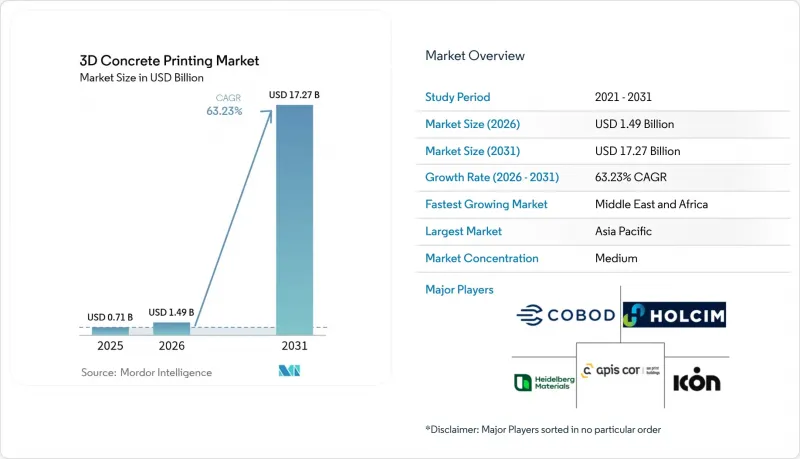
本報告按混凝土類型(預拌混凝土、高性能混凝土、預製混凝土、噴射混凝土)、產品類型(牆體、樓板/屋頂、面板/過梁、樓梯及其他產品類型)、最終用途領域(住宅、商業、基礎設施、建築結構)和地區(亞太地區、北美、歐洲等)進行細分。市場預測以美元計價。
全球3D混凝土列印市場趨勢及洞察
自動化施工可降低成本並縮短時間。
建設產業的勞動生產力幾十年來一直停滯不前,但層壓結構系統正在徹底改變這一領域。這些系統不僅無需模板,還能大幅縮短工時並最大限度地減少廢棄物。 ICON公司在德克薩斯州沃爾夫牧場建造的100套住宅項目就是一個絕佳的例子,該項目展示了一種精簡高效的施工方法。具體來說,牆體只需兩天即可列印完成,之後再進行傳統的屋頂和機電(機械、電氣和管道)安裝。軍事領域的評估也證實了這些經濟效益,結果表明,一個四人團隊只需48小時即可為遠徵基地建造堅固的營房。這種效率在日本等市場尤其重要,因為預計這些市場在2015年至2025年間將出現勞動力下降。
亞太地區的基礎建設熱潮和對經濟適用住宅的需求
印度雄心勃勃的「總理住房計畫」(Pradhan Mantri Awas Yojana)旨在到2030年提供新的都市區住宅。然而,目前的產能無法滿足需求。在清奈,Tvasta公司的3D列印原型縮短了施工時間。預計到2027年,中國將強制要求在一流住宅項目的建設中使用預製構件,這將導致工廠對3D列印板材的大訂單激增。同時,亞洲開發銀行(亞銀)強而有力的基礎建設發展計畫也凸顯了對3D列印人行天橋和涵洞的持續需求。
印表機及周邊設備的大量資本投資
購買一台跨度達 14.6 公尺的 COBOD BOD2 龍門架是一項重大投資。然而,還需要進一步投資來為其配備必要的泵浦、攪拌機、發電機和其他設備。此類設備的租賃市場有限,而且租賃利率高昂,這主要是因為金融機構缺乏折舊免稅額數據。此外,印度對進口機器人徵收的高額關稅可能相當可觀,這對新興市場構成重大挑戰。
細分市場分析
到2025年,預拌混凝土將佔據3D混凝土列印市場99.20%的佔有率,這得益於其作為承包商熟悉的材料以及廣泛的供應鏈優勢。大多數施工現場使用本地採購的預拌混凝土,並在現場添加黏度調節劑。同時,高性能混凝土正以78.77%的複合年成長率加速成長。這是因為其超過100兆帕的抗壓強度允許建造50毫米厚的牆體,從而釋放寶貴的占地面積。美國混凝土學會(ACI)的研究表明,超高性能混凝土混合料可以在滿足相同承載能力的同時減少材料用量。在許多低層建築應用中,纖維增強可以取代鋼筋。然而,一旦纖維含量超過一定閾值,噴嘴堵塞就會成為一個問題,需要反覆測試。
多樣化趨勢仍在持續。矽酸鈉活化的無機聚合物混合物可以將嵌入碳含量降低至接近零,但需要在 60 度C下養護,這限制了其在工廠環境中的應用。預製工作流程利用工廠控制系統來成型牆板和樓板,最大限度地減少了現場成型中常見的受天氣影響的延誤。噴射混凝土的各種變體也被引入隧道修復應用中,在這些應用中,快速硬化和黏結至關重要。這些趨勢表明,隨著第二代採用者優先考慮設計靈活性和永續性,通用混凝土混合物正逐漸轉變為工程混凝土混合物。
區域分析
2025年,亞太地區在全球3D混凝土列印市場中佔據55.54%的佔有率。中國力推2027年前強制預製構件的政策,推動了工廠訂單的成長。同時,盈創建築在蘇州成功建造了一棟五層多用戶住宅大樓,證明了訂單高層建築的可行性。面臨都市區住宅短缺的印度正將目光投向3D列印,將其視為經濟高效的解決方案。日本面臨勞動力短缺的困境,正在加速引入機器人列印技術,使得兩人團隊完成一棟獨棟住宅的建造。 2024年,韓國為公共住宅先導計畫撥出了大量預算。此外,東協地區正在進行的基礎建設項目也增加了對3D列印涵洞和公車站候車區的需求。
在北美,該公司正充分利用其領先優勢。 AC509 和 UL 3401 標準的採用消除了授權的不確定性,從而加快了貸款機構和保險公司的核准速度。 2024 年,ICON 的大規模資金籌措加速了 Vulcan 3D 列印機在住宅、軍事和商業領域的應用。為了應對寒冷氣候帶來的挑戰,加拿大在渥太華建立了一個寒冷氣候測試中心,專注於測試其耐凍融性能。在墨西哥塔巴斯科州,INFONAVIT 公司正以驚人的速度進行 3D 列印住宅,從而實現了快速建造,並取得了顯著進展。
3D混凝土列印技術在歐洲的普及應用深受嚴格的碳排放政策以及預製構件產業對這項新技術的積極響應所推動。德國批准PERI公司的3D列印牆體開創了先例,並為其他歐盟國家鋪平了道路。海德堡材料公司正積極調整其混凝土混合料配方,以減少水泥熟料用量,為即將於2026年實施的歐盟碳關稅做好準備。法國和荷蘭走在前列,大力推動大規模基礎設施項目,例如XtreeE公司設計的巴黎人行天橋,這些天橋旨在承受高流量環境。同時,英國正透過其「建築創新中心」推進標準化工作,但其速度明顯落後於歐洲大陸國家。
南美洲3D混凝土列印技術的應用仍處於起步階段。巴西在聖保羅開展了先導計畫,旨在利用該技術生產住宅,作為社會住宅舉措的一部分,並取得了一定進展。而阿根廷則面臨經濟挑戰,通貨膨脹波動和貨幣不穩定阻礙了大規模的資本投資。因此,目前大部分相關活動僅限於大學實驗室,研究人員主要致力於利用回收塑膠纖維進行實驗。
中東和非洲地區是各大洲中成長速度最快的地區,年複合成長率高達77.64%。沙烏地阿拉伯的ROSHN公司製定了一項雄心勃勃的計劃,目標是在2030年前實現快速生產週期的3D列印住宅交付。杜拜走在前列,已宣布一項政策,強制要求到2030年所有新建建築的部分結構採用積層製造技術。作為這項計劃的一部分,該地區已經推出了專為抵禦惡劣沙漠環境和沙塵暴而設計的3D列印公車站。在南非,CSIR正在研究創新的黏土基3D列印混合物,旨在解決非正式居民區的住宅難題。
其他好處:
- Excel格式的市場預測(ME)表
- 3個月的分析師支持
目錄
第1章:引言
- 市場分析與定義的前提條件
- 分析範圍
第2章 分析方法
第3章執行摘要
第4章 市場狀況
- 市場概覽
- 市場促進因素
- 自動化施工可降低成本並縮短時間。
- 亞太地區基礎建設熱潮及對經濟適用住宅的需求
- 促進永續發展,建造低廢棄物、低碳建築
- 在國防和災害救援領域引入印刷避難所
- 監管動態(ICC-ES AC509、UL 3401 ESRs)
- 市場限制因素
- 印表機及周邊設備的大量資本投資
- 非標準化的印刷配方和代碼
- 都市區大型龍門架系統的物流限制
- 價值鏈分析
- 波特五力分析
第5章:預測市場規模與成長率
- 混凝土的類型
- 預拌混凝土(預拌混凝土)
- 高效能
- 預製件
- 噴射混凝土
- 依產品類型
- 牆面
- 地板和屋頂
- 面板過梁
- 樓梯
- 其他產品類型
- 按最終用途行業分類
- 住宅
- 商業
- 基礎設施
- 結構
- 按地區
- 亞太地區
- 中國
- 印度
- 日本
- 韓國
- 東南亞國協
- 其他亞太國家
- 北美洲
- 美國
- 加拿大
- 墨西哥
- 歐洲
- 德國
- 英國
- 法國
- 義大利
- 北歐國家
- 其他歐洲國家
- 南美洲
- 巴西
- 阿根廷
- 其他南美國家
- 中東和非洲
- 海灣合作理事會國家
- 南非
- 其他中東和非洲國家
- 亞太地區
第6章 競爭情勢
- 市場集中度
- 策略趨勢
- 市佔率(%)/排名分析
- 公司簡介
- Apis Cor
- Balfour Beatty
- Bemore3D
- Black Buffalo 3D Corporation
- COBOD International A/S
- Constructions-3D
- Contour Crafting Corporation
- CyBe Construction
- Heidelberg Materials AG
- HOLCIM
- Hyperion
- ICON Technology Inc.
- Mighty Buildings Inc.(a LUMUS Inc. Brand)
- MUDBOTS 3D CONCRETE PRINTING LLC
- PERI 3D Construction
- Sika AG
- Skanska
- SQ4D LLC
- Vertico
- WASP Srl-Via Castelletto
- XtreeE
- Yingchuang Building Technique(Shanghai)Co. Ltd(WinSun)
第7章 市場機會與未來展望
According to Mordor Intelligence, the 3D concrete printing market size is expected to grow from USD 0.71 billion in 2025 to USD 1.49 billion in 2026 and is forecast to reach USD 17.27 billion by 2031 at 63.23% CAGR over 2026-2031.
This report is Segmented by Concrete Type (Ready-Mix, High-Performance, Pre-Cast, and Shotcrete), Product Type (Walls, Floors and Roofs, Panels and Lintels, Staircases, and Other Product Types), End-Use Sector (Residential, Commercial, Infrastructure, and Architectural), and Geography (Asia-Pacific, North America, Europe, and More). The Market Forecasts are Provided in Terms of Value (USD).
Global 3D Concrete Printing Market Trends and Insights
Cost- and Time-Efficient Automated Construction
While labor productivity in construction has remained stagnant for decades, additive systems are revolutionizing the industry. These systems not only eliminate the need for formwork but also significantly reduce labor hours and minimize waste. A prime example is ICON's 100-home project at Wolf Ranch in Texas, which showcases a streamlined approach: a two-day wall printing followed by conventional roofing and MEP fit-out. Military assessments echo these economic benefits, demonstrating that four-person teams can set up robust shelters in just 48 hours for expeditionary bases. Such efficiencies are particularly crucial in markets like Japan, which experienced a workforce decline between 2015 and 2025.
Infrastructure Boom and Affordable-Housing Demand in Asia-Pacific
India's ambitious Pradhan Mantri Awas Yojana targets new urban homes by 2030. However, current capacities reveal a shortfall. In Chennai, Tvasta's printed prototype achieved a reduction in build time. By 2027, China is set to require prefabricated components to make up tier-1 residential projects, leading to a surge in bulk orders for factory-printed slabs. Meanwhile, the Asian Development Bank's robust infrastructure pipeline underscores a consistent demand for printed pedestrian bridges and culverts.
High Capital Expenditure for Printers and Ancillaries
Purchasing a COBOD BOD2 gantry, which boasts a 14.6 m span, comes with a significant price tag. However, to fully equip it with essential pumps, mixers, and generators, an additional investment is required. The leasing market for such equipment is limited, and those who do venture into it face a steep interest rate. This is largely due to financiers' lack of depreciation data. Furthermore, in India, duties on imported robotics can accumulate to a hefty percentage, posing a significant challenge in the emerging market.
Other drivers and restraints analyzed in the detailed report include:
- Sustainability Push for Low-Waste/Low-Carbon Building
- Defense and Disaster-Relief Adoption of Printed Shelters
- Non-Standardized Printable-Mix Formulations and Codes
For complete list of drivers and restraints, kindly check the Table Of Contents.
Segment Analysis
Ready-mix secured 99.20% of the 3D concrete printing market in 2025, riding on ubiquitous supply chains and contractor familiarity. Most sites adapt local ready-mix with viscosity-modifying admixtures dosed on site. High-performance concrete, however, is accelerating at a 78.77% CAGR as compressive strengths above 100 MPa enable 50 mm-thick walls that free valuable floor area. ACI studies show that ultra-high-performance formulations cut material volume while meeting identical load ratings. In many low-rise applications, fiber reinforcement has replaced the need for rebar. However, when fiber content exceeds a certain threshold, nozzle clogging becomes an issue, necessitating iterative testing.
The diversification continues: geopolymer mixes activated by sodium silicate offer near-zero embodied carbon but require 60 °C curing, limiting them to factory settings. Pre-cast workflows leverage factory control to print wall panels and floor slabs, minimizing weather delays prevalent in on-site printing. Shotcrete variants are entering tunnel-repair use cases where rapid setting and adhesion matter most. These trends signal a gradual migration from commodity to engineered mixes as second-wave adopters prioritize design freedom and sustainability.
Complete Report Scope:
- By Concrete Type
- Ready-Mix
- High-Performance
- Pre-Cast
- Shotcrete
- By Product Type
- Walls
- Floors and Roofs
- Panels and Lintels
- Staircases
- Other Product Types
- By End-Use Sector
- Residential
- Commercial
- Infrastructure
- Architectural
- By Geography
- Asia-Pacific
- China
- India
- Japan
- South Korea
- ASEAN Countries
- Rest of Asia-Pacific
- North America
- United States
- Canada
- Mexico
- Europe
- Germany
- United Kingdom
- France
- Italy
- NORDIC Countries
- Rest of Europe
- South America
- Brazil
- Argentina
- Rest of South America
- Middle-East and Africa
- GCC Countries
- South Africa
- Rest of Middle-East and Africa
- Asia-Pacific
Geography Analysis
Asia-Pacific maintained 55.54% of global 3D concrete printing market share in 2025. China's push for a prefabrication mandate by 2027 is fueling a surge in factory orders. Meanwhile, WinSun's successful five-story apartment block in Suzhou has validated the feasibility of mid-rise constructions. With an urban housing deficit, India is turning to 3D printing as a cost-effective solution. Japan, grappling with a dwindling labor force, is hastening the adoption of robotic printing, enabling two-person teams to complete detached homes. In 2024, South Korea allocated a substantial amount for public-housing pilot projects. Additionally, the ASEAN region's ongoing infrastructure projects are bolstering the demand for printed culverts and bus shelters.
North America is capitalizing on its early regulatory advantages. The introduction of AC509 and UL 3401 has eliminated uncertainties in permitting, enabling swift approvals from lenders and insurers. In 2024, a significant funding round for ICON facilitated the expansion of its Vulcan printer, catering to residential, military, and commercial sectors. To tackle the challenges of northern climates, Canada has set up a cold-weather test facility in Ottawa, focusing on freeze-thaw durability. In Tabasco, Mexico, INFONAVIT is making strides by printing homes at an impressive rate, achieving rapid build times.
Europe's embrace of 3D concrete printing is largely influenced by stringent carbon policies and a precast industry keen on integrating this new technology. Germany's endorsement of PERI's printed walls has set a precedent, guiding other EU nations. Heidelberg Materials is proactively aligning its clinker-reduced mix with the EU's impending carbon tariffs, set to roll out in 2026. France and the Netherlands are at the forefront, championing major infrastructure initiatives like XtreeE's Paris footbridge, designed to endure heavy traffic. While the UK is making strides in standardization through its Construction Innovation Hub, it's evident that its pace lags behind its continental counterparts.
South America's journey in 3D concrete printing is still in its infancy. Brazil is taking a step forward with a pilot project in Sao Paulo, aiming to produce homes under its social-housing initiative. On the other hand, Argentina grapples with economic challenges; its fluctuating inflation and currency instability have stymied significant capital investments. As a result, most activities are confined to university laboratories, where researchers are delving into experiments with recycled-plastic fibers.
The Middle-East and Africa post the fastest continental growth at a 77.64% CAGR. Saudi Arabia's ROSHN has ambitious plans, targeting printed units by 2030, with a swift production cycle. Dubai is setting the pace with a mandate that a portion of all new constructions must adopt additive techniques by 2030. They've already showcased this commitment with a printed bus shelter, engineered to endure the region's extreme desert conditions and sandstorms. In South Africa, the CSIR is exploring innovative clay-based printable mixes, aiming to address housing challenges in informal settlements.
- Apis Cor
- Balfour Beatty
- Bemore3D
- Black Buffalo 3D Corporation
- COBOD International A/S
- Constructions-3D
- Contour Crafting Corporation
- CyBe Construction
- Heidelberg Materials AG
- HOLCIM
- Hyperion
- ICON Technology Inc.
- Mighty Buildings Inc.(a LUMUS Inc. Brand)
- MUDBOTS 3D CONCRETE PRINTING LLC
- PERI 3D Construction
- Sika AG
- Skanska
- SQ4D LLC
- Vertico
- WASP Srl - Via Castelletto
- XtreeE
- Yingchuang Building Technique (Shanghai) Co. Ltd (WinSun)
Additional Benefits:
- The market estimate (ME) sheet in Excel format
- 3 months of analyst support
TABLE OF CONTENTS
1 Introduction
- 1.1 Study Assumptions and Market Definition
- 1.2 Scope of the Study
2 Research Methodology
3 Executive Summary
4 Market Landscape
- 4.1 Market Overview
- 4.2 Market Drivers
- 4.2.1 Cost- and time-efficient automated construction
- 4.2.2 Infrastructure boom and affordable-housing demand in Asia-Pacific
- 4.2.3 Sustainability push for low-waste / low-carbon building
- 4.2.4 Defense and disaster-relief adoption of printed shelters
- 4.2.5 Regulatory breakthroughs (ICC-ES AC509, UL 3401 ESRs)
- 4.3 Market Restraints
- 4.3.1 High capital expenditure for printers and ancillaries
- 4.3.2 Non-standardized printable-mix formulations and codes
- 4.3.3 Urban-site logistics limits for large gantry systems
- 4.4 Value Chain Analysis
- 4.5 Porter's Five Forces
- 4.5.1 Bargaining Power of Suppliers
- 4.5.2 Bargaining Power of Buyers
- 4.5.3 Threat of New Entrants
- 4.5.4 Threat of Substitutes
- 4.5.5 Degree of Competition
5 Market Size and Growth Forecasts (Value)
- 5.1 By Concrete Type
- 5.1.1 Ready-Mix
- 5.1.2 High-Performance
- 5.1.3 Pre-Cast
- 5.1.4 Shotcrete
- 5.2 By Product Type
- 5.2.1 Walls
- 5.2.2 Floors and Roofs
- 5.2.3 Panels and Lintels
- 5.2.4 Staircases
- 5.2.5 Other Product Types
- 5.3 By End-Use Sector
- 5.3.1 Residential
- 5.3.2 Commercial
- 5.3.3 Infrastructure
- 5.3.4 Architectural
- 5.4 By Geography
- 5.4.1 Asia-Pacific
- 5.4.1.1 China
- 5.4.1.2 India
- 5.4.1.3 Japan
- 5.4.1.4 South Korea
- 5.4.1.5 ASEAN Countries
- 5.4.1.6 Rest of Asia-Pacific
- 5.4.2 North America
- 5.4.2.1 United States
- 5.4.2.2 Canada
- 5.4.2.3 Mexico
- 5.4.3 Europe
- 5.4.3.1 Germany
- 5.4.3.2 United Kingdom
- 5.4.3.3 France
- 5.4.3.4 Italy
- 5.4.3.5 NORDIC Countries
- 5.4.3.6 Rest of Europe
- 5.4.4 South America
- 5.4.4.1 Brazil
- 5.4.4.2 Argentina
- 5.4.4.3 Rest of South America
- 5.4.5 Middle-East and Africa
- 5.4.5.1 GCC Countries
- 5.4.5.2 South Africa
- 5.4.5.3 Rest of Middle-East and Africa
- 5.4.1 Asia-Pacific
6 Competitive Landscape
- 6.1 Market Concentration
- 6.2 Strategic Moves
- 6.3 Market Share(%)/ Ranking Analysis
- 6.4 Company Profiles (includes Global level Overview, Market level overview, Core Segments, Financials as available, Strategic Information, Products and Services, Recent Developments)
- 6.4.1 Apis Cor
- 6.4.2 Balfour Beatty
- 6.4.3 Bemore3D
- 6.4.4 Black Buffalo 3D Corporation
- 6.4.5 COBOD International A/S
- 6.4.6 Constructions-3D
- 6.4.7 Contour Crafting Corporation
- 6.4.8 CyBe Construction
- 6.4.9 Heidelberg Materials AG
- 6.4.10 HOLCIM
- 6.4.11 Hyperion
- 6.4.12 ICON Technology Inc.
- 6.4.13 Mighty Buildings Inc.(a LUMUS Inc. Brand)
- 6.4.14 MUDBOTS 3D CONCRETE PRINTING LLC
- 6.4.15 PERI 3D Construction
- 6.4.16 Sika AG
- 6.4.17 Skanska
- 6.4.18 SQ4D LLC
- 6.4.19 Vertico
- 6.4.20 WASP Srl - Via Castelletto
- 6.4.21 XtreeE
- 6.4.22 Yingchuang Building Technique (Shanghai) Co. Ltd (WinSun)
7 Market Opportunities and Future Outlook
- 7.1 White-space and Unmet-Need Assessment

 3D混凝土列印市場:依產品類型、混凝土類型、軟體、最終用途產業及地區分類
 3D混凝土列印市場:按技術、材料、印表機、服務模式、應用和最終用戶分類-2026-2032年全球市場預測
 3D混凝土列印市場-全球產業規模、佔有率、趨勢、機會、預測:依列印類型、技術、產品、最終用途產業、地區和競爭格局分類,2021-2031年
 全球3D混凝土列印市場(至2040年):產業趨勢與預測
 2026-2030年全球3D混凝土列印市場
 2026年全球3D混凝土列印市場報告混凝土探地雷達市場:依設備類型、應用、最終用戶、產品類型、頻率範圍和通路分類,全球預測,2026-2032年
 2026-2034年全球3D混凝土列印市場規模、佔有率、趨勢和成長分析報告
 3D混凝土列印市場報告:依產品類型、混凝土類型、列印類型、最終用途和地區分類,2026-2034年
 3D混凝土列印市場規模、佔有率和趨勢分析報告:按場地類型、列印系統、元件類型、應用、最終用途、地區和細分市場預測(2026-2033年)