


 |
市場調查報告書
商品編碼
2121541
中國壓力感測器:市場佔有率分析、產業趨勢與統計及成長預測(2026-2031)China Pressure Sensors - Market Share Analysis, Industry Trends & Statistics, Growth Forecasts (2026 - 2031) |
||||||

※ 本網頁內容可能與最新版本有所差異。詳細情況請與我們聯繫。
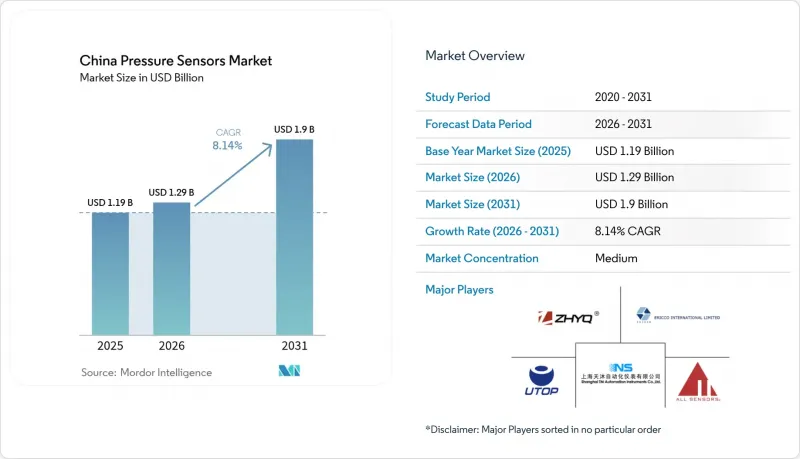
據 Mordor Intelligence 稱,2025 年中國壓力感測器市場價值 11.9 億美元,預計到 2031 年將達到 19 億美元,而 2026 年為 12.9 億美元,預測期(2026-2031 年)複合年成長率為 8.14%。
本報告依產品類型(MEMS、電容式、壓電等)、壓力測量方法(表壓、絕對壓力、差壓、真空壓力、密封參考壓力)、終端用戶產業(汽車、航太與國防、化學與石化、醫療設備等)及技術平台(壓電式、電容式MEMS等)分類。市場預測以美元計價。
中國壓力感測器市場趨勢與洞察
基於MEMS技術的微型感測器在電動車中的應用正在加速。
隨著中國在電動車領域佔據主導地位,符合汽車標準的緊湊型壓力感測器的需求正以前所未有的速度成長。國內製造廠目前每年可生產數百萬個MEMS單元,降低對進口的依賴,並確保供應穩定。每輛電動車通常配備15至20個感測器,用於溫度控管、煞車和ADAS(高級駕駛輔助系統)功能,隨著自動駕駛和電氣化的融合,每輛車的感測器數量還在增加。堅固耐用的設計能夠承受-40 度C至150 度C的溫度波動和劇烈振動,滿足AEC-Q103的可靠性要求。電池組的快速技術創新進一步提升了對高精度差壓感測器的需求,這些感測器用於監測電池單體壓力,以確保安全。隨著汽車製造商實現零件在地化採購,國產MEMS在價格和性能之間實現了理想的平衡,既滿足全球標準,又維持了更低的整體成本。
政府獎勵促進國內半導體自給自足和感測器本地化。
國家和省級計畫為感測器製造廠和研發中心提供大量津貼、稅收優惠和低利率貸款。光是在無錫高新技術產業開發區,2024年就為四家壓力感測器新創公司籌集了數億元人民幣,用於無塵室擴建和後端封裝生產線建設。目前,感測器中試生產線受益於共用測量實驗室,降低了中小企業的進入門檻。 「十四五」規劃優先發展核心製程設備,目標是到2030年將國內生產力提高到70%以上。雄安和深圳的戰略產業叢集提供快速授權程序、土地價格折扣和勞動力補貼,縮短了認證產品的上市時間。
矽晶圓和稀土元素材料價格波動
受全球晶圓製造週期的影響,價格波動劇烈。矽現貨價格在2024年上漲了38%,但在第四季下半段有所回落。中國在稀土元素加工領域的主導地位加劇了不確定性,因為出口配額的調整和地緣政治緊張局勢正在影響釹和镨基化合物的價格。製造商透過從多個供應商購買和增加安全庫存來對沖風險,這佔用了營運資金,並給毛利率帶來了壓力。大規模晶圓廠正在利用期貨合約,而小規模製造商則面臨訂單率低和產能擴張放緩的困境。從2026年起,加速推進的回收計畫可能會在一定程度上緩解供應鏈風險。
細分市場分析
到2025年,MEMS裝置將佔據中國壓力感測器市場42.35%的佔有率,預計到2031年,該類別將以9.34%的複合年成長率成長。採用8吋CMOS生產線製造的MEMS晶片,憑藉著成熟的製造設備,實現了高良率和低單位成本。 ADC和溫度補償邏輯的同步整合,使得即插即用模組成為可能,從而能夠輕鬆替換各行業的現有產品。電容式感測器憑藉其卓越的過載容限,在工業氣壓設備領域佔據著穩固的地位;壓電感測器則滿足航太領域的振動要求。應變式感測器應用於需要可靠機械耦合的重型機械中。光學壓力感測器則在電磁干擾(EMI)較高的區域,例如電廠開關站,佔據一個細分市場。將MEMS核心與BLE或Wi-Fi微控制器結合的混合智慧模組,代表著從單一參數測量向全面狀態監控的演進。
中國MEMS壓力感測器市場正受益於汽車和醫療產業的協同效應,這兩個產業對小型化、低功耗和快速反應的需求相融合。國內IDM廠商正投資晶圓級晶片封裝(WLCSP)技術,以降低智慧型手錶和穿戴式耳機等產品的Z軸高度。與ASIC設計公司的策略合作正在降低物料清單成本,並加速市場競爭。展望2027年後,隨著晶圓廠推進12吋MEMS設備的認證,預計每片晶圓的晶片產量將增加,成本曲線將進一步下降,價格敏感型消費性電子產品的應用也將擴大。
到2025年,用於空氣煞車、暖通空調和液壓迴路的表壓式壓力感知器將佔中國壓力感知器市場48.25%的銷售額,成為推動中國壓力感知器市場成長的主要動力。然而,差壓式壓力感測器預計將以9.68%的複合年成長率(CAGR)實現最高成長,這主要得益於智慧建築中的流量測量、過濾器監控和變風量(VAV)控制等應用。真空密封式壓力感測器則應用於半導體製造設備和實驗室測量儀器,這些應用對精度要求極高,精度需達到10 mTorr以下。無線差壓模組的睡眠電流僅1µA,解析度可達亞帕斯卡級,因此非常適合電池供電的維修專案。
中國差壓感測器市場的擴張反映了油田數位化計畫的發展以及高層建築能源審計的日益普及。隨著建築規範對建築氣密性標準的提高,氣流平衡已成為強制性要求,導致每層樓的感測器搭載率不斷上升。製造商透過採用絕緣體上矽(SOI)隔膜和專有的微孔參考腔來提高感測器的長期穩定性,將漂移控制在每年0.1%以下。生技工廠中湧現的微流體管線採用毫巴級差壓感測技術來確保加藥精度。
其他好處:
- Excel格式的市場預測(ME)表
- 3個月的分析師支持
目錄
第1章:引言
- 研究假設和市場定義
- 調查範圍
第2章:調查方法
第3章執行摘要
第4章 市場狀況
- 市場概覽
- 市場促進因素
- 基於MEMS技術的微型感測器在電動車中的應用正在加速。
- 政府支持措施,以實現國內半導體自給自足和感測器國產化。
- 中國工業園區「工業4.0」智慧製造的擴張
- 對高精度醫療設備和穿戴式健康監測設備的需求不斷成長。
- 由於暖通空調系統和智慧建築的維修,對無線壓力感測器的需求正在擴大。
- 開發需要在惡劣環境下進行壓力檢測的數位化油氣天然氣田。
- 市場限制因素
- 矽晶圓和稀土元素材料的價格波動
- 汽車感光元件高可靠性認證的進入門檻
- 智慧財產權糾紛限制了出口機會
- 由於消費性感測器的產品生命週期短,它們正迅速被淘汰。
- 產業價值鏈分析
- 監理情勢
- 技術展望
- 波特五力分析
第5章 市場規模與成長預測
- 依產品類型
- MEMS壓力感測器
- 電容式壓力感測器
- 壓電壓力感測器
- 應變式壓力感測器
- 光壓感測器
- 其他產品類型
- 按類型測量壓力
- 壓力感測器
- 絕對壓力感測器
- 差壓感知器
- 真空壓力感知器
- 密封參考壓力感測器
- 按最終用戶行業分類
- 車
- 航太/國防
- 化工/石油化工
- 醫療器材
- 暖通空調和建築自動化
- 發電
- 工業製造
- 石油和天然氣
- 家用電子產品
- 其他行業
- 透過技術平台
- 壓阻式
- 電容式微機電系統
- 光纖
- 共振固體
- 電磁學
- 奈米軟性材料
第6章 競爭情勢
- 市場集中度
- 策略趨勢
- 市佔率分析
- 公司簡介
- Honeywell International Inc.
- Robert Bosch GmbH
- Infineon Technologies AG
- TE Connectivity Ltd.
- Siemens Aktiengesellschaft
- Emerson Electric Co.
- ABB Ltd.
- Sensata Technologies Holding plc
- Panasonic Holdings Corporation
- STMicroelectronics NV
- NXP Semiconductors NV
- First Sensor AG
- All Sensors Corporation
- Shanghai Zhaohui Pressure Apparatus Co., Ltd.
- Ericco International Limited
- Xi'an UTOP Measurement Instrument Co., Ltd.
- TM Automation Instruments Co., Ltd.
- Ninghai Sendo Sensor Co., Ltd.
- Suzhou Memsensor Technology Co., Ltd.
- Hunan Firstrate Sensor Co., Ltd.
- Jiangsu Hanwei Electronics Co., Ltd.
- WIKA Alexander Wiegand SE and Co. KG
- Keller Druckmesstechnik AG
第7章 市場機會與未來展望
According to Mordor Intelligence, the China pressure sensors market size was valued at USD 1.19 billion in 2025 and estimated to grow from USD 1.29 billion in 2026 to reach USD 1.9 billion by 2031, at a CAGR of 8.14% during the forecast period (2026-2031).
This report is Segmented by Product Type (MEMS, Capacitive, Piezoelectric, and More), Pressure Measurement (Gauge, Absolute, Differential, Vacuum, and Sealed Reference), End-User Industry (Automotive, Aerospace and Defense, Chemical and Petrochemical, Medical Devices, and More), Technology Platform (Piezoresistive, Capacitive MEMS, and More). The Market Forecasts are Provided in Terms of Value (USD).
China Pressure Sensors Market Trends and Insights
Accelerating Adoption of MEMS-Based Miniaturized Sensors in Electric Vehicles
China's electric-vehicle leadership pushes unprecedented volumes for compact, automotive-qualified pressure sensors. Domestic fabs now deliver millions of MEMS units annually, lowering import dependence and ensuring supply resilience. Each EV integrates 15-20 sensing points for thermal management, braking, and ADAS functions, and the convergence of autonomy with electrification multiplies sensor content per car. Robust designs withstand -40 °C to 150 °C temperature swings and high vibration, meeting AEC-Q103 reliability demands. Rapid battery-pack innovation further fuels demand for high-accuracy differential sensors that monitor cell pressure for safety. As automakers localize component sourcing, price-performance dynamics favor homegrown MEMS that match global specifications at lower landed cost.
Government Incentives for Domestic Semiconductor Self-Sufficiency and Sensor Localization
National and provincial programs earmark substantial grants, tax incentives, and low-interest loans for sensor fabs and R&D centers. Wuxi High-tech Zone alone raised several hundred million RMB for four pressure-sensor start-ups in 2024, funding cleanroom expansion and backend packaging lines. Sensor pilot lines now benefit from shared metrology labs, lowering entry barriers for small firms. The 14th Five-Year Plan prioritizes core process equipment, aiming to lift domestic content above 70% by 2030. Strategic clusters in Xiong'an and Shenzhen offer expedited permitting, discounted land, and workforce subsidies, accelerating time-to-market for qualified devices.
Volatility in Silicon-Wafer and Rare-Earth Material Prices
Global wafer-fab cycles create sharp price swings; 2024 spot silicon rose 38% before softening in late Q4. China's dominance in rare-earth processing introduces additional uncertainty, as export-quota adjustments and geopolitical tensions influence Nd- and Pr-based compound pricing. Manufacturers hedge by multi-sourcing and holding higher safety stocks, tying up working capital and pressuring gross margins. Larger fabs leverage forward contracts, but smaller houses face squeezed book-to-bill ratios, delaying capacity upgrades. Accelerated recycling programs may partly ease supply-chain risk after 2026.
Other drivers and restraints analyzed in the detailed report include:
- Expansion of Industry 4.0 Smart Manufacturing Across Chinese Industrial Parks
- Rising Demand for High-Precision Medical Devices and Wearable Health Monitoring
- High Reliability-Certification Barriers for Automotive-Grade Sensors
For complete list of drivers and restraints, kindly check the Table Of Contents.
Segment Analysis
MEMS devices accounted for 42.35% of the China pressure sensors market share in 2025, and this category is projected to grow at a 9.34% CAGR to 2031. MEMS dies fabricated on 8-inch CMOS lines leverage mature tooling, delivering high yield and low unit cost. Simultaneous integration of ADCs and temperature compensation logic enables plug-and-play modules, supporting drop-in replacement across industries. Capacitive sensors maintain a loyal base in industrial pneumatics thanks to superior overload tolerance, whereas piezoelectric variants meet aerospace vibration needs. Strain-gauge sensors serve heavy machinery requiring rugged mechanical bonding. Optical pressure sensors occupy small niches in high-EMI zones such as power-generation switchyards. Hybrid smart modules that pair MEMS cores with BLE or Wi-Fi microcontrollers illustrate an evolution from single-parameter measurement toward holistic condition monitoring.
The China pressure sensors market size for MEMS designs benefits from automotive and medical synergies, where miniaturization, low power, and fast response converge. Domestic IDMs invest in wafer-level chip-scale packaging to shrink Z-height for smartwatches and hearables. Strategic partnerships with ASIC design houses reduce BOM cost, quickening competitive cycles. As fabs qualify 12-inch MEMS tooling after 2027, die output per wafer will rise, further lowering cost curves and widening adoption into price-sensitive appliances.
Gauge variants led the China pressure sensors market with 48.25% revenue in 2025, serving air-brake, HVAC, and hydraulic circuits. However, differential devices will record the highest 9.68% CAGR, propelled by flow metering, filter monitoring, and smart-building VAV control. Vacuum and sealed-reference devices supply semiconductor tools and laboratory instrumentation where absolute accuracy below 10 mTorr is mandatory. Wireless differential modules achieve sub-Pascal resolution at 1 µA sleep currents, aligning with battery-powered retrofit projects.
China pressure sensors market size gains in differential configurations mirror expanding digital oilfield programs and high-rise energy audits. As construction codes tighten envelope-leakage limits, air-flow balancing becomes mandatory, lifting sensor attach rates per floor. Manufacturers improve long-term stability via silicon-on-insulator diaphragms and proprietary micro-porous reference cavities, curbing drift below 0.1% per year. Emerging micro-fluidic dosing lines in biotech plants adopt millibar-range differential sensing to assure dosing accuracy.
Complete Report Scope:
- By Product Type
- MEMS Pressure Sensors
- Capacitive Pressure Sensors
- Piezoelectric Pressure Sensors
- Strain Gauge Pressure Sensors
- Optical Pressure Sensors
- Other Product Types
- By Pressure Measurement
- Gauge Pressure Sensors
- Absolute Pressure Sensors
- Differential Pressure Sensors
- Vacuum Pressure Sensors
- Sealed Reference Pressure Sensors
- By End-user Industry
- Automotive
- Aerospace and Defense
- Chemical and Petrochemical
- Medical Devices
- HVAC and Building Automation
- Power Generation
- Industrial Manufacturing
- Oil and Gas
- Consumer Electronics
- Other Industries
- By Technology Platform
- Piezoresistive
- Capacitive MEMS
- Optical Fiber
- Resonant Solid State
- Electromagnetic
- Nano and Flexible
List of Companies Covered in this Report:
- Honeywell International Inc.
- Robert Bosch GmbH
- Infineon Technologies AG
- TE Connectivity Ltd.
- Siemens Aktiengesellschaft
- Emerson Electric Co.
- ABB Ltd.
- Sensata Technologies Holding plc
- Panasonic Holdings Corporation
- STMicroelectronics N.V.
- NXP Semiconductors N.V.
- First Sensor AG
- All Sensors Corporation
- Shanghai Zhaohui Pressure Apparatus Co., Ltd.
- Ericco International Limited
- Xi'an UTOP Measurement Instrument Co., Ltd.
- TM Automation Instruments Co., Ltd.
- Ninghai Sendo Sensor Co., Ltd.
- Suzhou Memsensor Technology Co., Ltd.
- Hunan Firstrate Sensor Co., Ltd.
- Jiangsu Hanwei Electronics Co., Ltd.
- WIKA Alexander Wiegand SE and Co. KG
- Keller Druckmesstechnik AG
Additional Benefits:
- The market estimate (ME) sheet in Excel format
- 3 months of analyst support
TABLE OF CONTENTS
1 INTRODUCTION
- 1.1 Study Assumptions and Market Definition
- 1.2 Scope of the Study
2 RESEARCH METHODOLOGY
3 EXECUTIVE SUMMARY
4 MARKET LANDSCAPE
- 4.1 Market Overview
- 4.2 Market Drivers
- 4.2.1 Accelerating adoption of MEMS-based miniaturized sensors in electric vehicles
- 4.2.2 Government incentives for domestic semiconductor self-sufficiency and sensor localization
- 4.2.3 Expansion of Industry 4.0 smart manufacturing across Chinese industrial parks
- 4.2.4 Rising demand for high-precision medical devices and wearable health monitoring
- 4.2.5 HVAC and smart-building retrofits boosting demand for wireless pressure sensors
- 4.2.6 Digital oil and gas field development requiring harsh-environment pressure sensing
- 4.3 Market Restraints
- 4.3.1 Volatility in silicon-wafer and rare-earth material prices
- 4.3.2 High reliability-certification barriers for automotive-grade sensors
- 4.3.3 Intellectual-property disputes limiting export opportunities
- 4.3.4 Short product lifecycles causing rapid obsolescence for consumer-grade sensors
- 4.4 Industry Value Chain Analysis
- 4.5 Regulatory Landscape
- 4.6 Technological Outlook
- 4.7 Porter's Five Forces Analysis
- 4.7.1 Threat of New Entrants
- 4.7.2 Bargaining Power of Buyers
- 4.7.3 Bargaining Power of Suppliers
- 4.7.4 Threat of Substitutes
- 4.7.5 Intensity of Competitive Rivalry
5 MARKET SIZE AND GROWTH FORECASTS (VALUE)
- 5.1 By Product Type
- 5.1.1 MEMS Pressure Sensors
- 5.1.2 Capacitive Pressure Sensors
- 5.1.3 Piezoelectric Pressure Sensors
- 5.1.4 Strain Gauge Pressure Sensors
- 5.1.5 Optical Pressure Sensors
- 5.1.6 Other Product Types
- 5.2 By Pressure Measurement
- 5.2.1 Gauge Pressure Sensors
- 5.2.2 Absolute Pressure Sensors
- 5.2.3 Differential Pressure Sensors
- 5.2.4 Vacuum Pressure Sensors
- 5.2.5 Sealed Reference Pressure Sensors
- 5.3 By End-user Industry
- 5.3.1 Automotive
- 5.3.2 Aerospace and Defense
- 5.3.3 Chemical and Petrochemical
- 5.3.4 Medical Devices
- 5.3.5 HVAC and Building Automation
- 5.3.6 Power Generation
- 5.3.7 Industrial Manufacturing
- 5.3.8 Oil and Gas
- 5.3.9 Consumer Electronics
- 5.3.10 Other Industries
- 5.4 By Technology Platform
- 5.4.1 Piezoresistive
- 5.4.2 Capacitive MEMS
- 5.4.3 Optical Fiber
- 5.4.4 Resonant Solid State
- 5.4.5 Electromagnetic
- 5.4.6 Nano and Flexible
6 COMPETITIVE LANDSCAPE
- 6.1 Market Concentration
- 6.2 Strategic Moves
- 6.3 Market Share Analysis
- 6.4 Company Profiles (includes Global-level Overview, Market-level Overview, Core Segments, Financials as available, Strategic Information, Market Rank/Share, Products and Services, Recent Developments)
- 6.4.1 Honeywell International Inc.
- 6.4.2 Robert Bosch GmbH
- 6.4.3 Infineon Technologies AG
- 6.4.4 TE Connectivity Ltd.
- 6.4.5 Siemens Aktiengesellschaft
- 6.4.6 Emerson Electric Co.
- 6.4.7 ABB Ltd.
- 6.4.8 Sensata Technologies Holding plc
- 6.4.9 Panasonic Holdings Corporation
- 6.4.10 STMicroelectronics N.V.
- 6.4.11 NXP Semiconductors N.V.
- 6.4.12 First Sensor AG
- 6.4.13 All Sensors Corporation
- 6.4.14 Shanghai Zhaohui Pressure Apparatus Co., Ltd.
- 6.4.15 Ericco International Limited
- 6.4.16 Xi'an UTOP Measurement Instrument Co., Ltd.
- 6.4.17 TM Automation Instruments Co., Ltd.
- 6.4.18 Ninghai Sendo Sensor Co., Ltd.
- 6.4.19 Suzhou Memsensor Technology Co., Ltd.
- 6.4.20 Hunan Firstrate Sensor Co., Ltd.
- 6.4.21 Jiangsu Hanwei Electronics Co., Ltd.
- 6.4.22 WIKA Alexander Wiegand SE and Co. KG
- 6.4.23 Keller Druckmesstechnik AG
7 MARKET OPPORTUNITIES AND FUTURE OUTLOOK
- 7.1 White-space and Unmet-need Assessment

 流體壓力感測器市場:按類型、最終用途、技術、應用、國家和地區分類-全球產業分析、市場規模、市場佔有率及2026年至2033年預測
 全球壓力感測器市場規模、佔有率、趨勢和成長分析報告(2026-2034年)
 2026年全球無塵室差壓表市場報告壓阻式壓力感測器市場報告:趨勢、預測及競爭分析(至2035年)
 光纖壓力感測器:市場佔有率分析、產業趨勢與統計、成長預測(2026-2031)
 壓力感測器市場-2026-2032年全球市場預測
 壓力感測器市場規模、佔有率、趨勢和預測:按產品、類型、技術、應用和地區分類,2026-2034年2026年全球壓電壓力感測器市場報告差壓密度計市場:依產品類型、通訊協定、精確度等級及最終用途產業分類-全球預測,2026-2032年差壓式線上密度計市場:按安裝類型、精度等級、輸出類型、最終用戶產業和應用分類-全球預測,2026-2032年