

 |
市場調查報告書
商品編碼
2121504
汽車半導體:市場佔有率分析、產業趨勢與統計、成長預測(2026-2031)Automotive Semiconductor - Market Share Analysis, Industry Trends & Statistics, Growth Forecasts (2026 - 2031) |
||||||

※ 本網頁內容可能與最新版本有所差異。詳細情況請與我們聯繫。
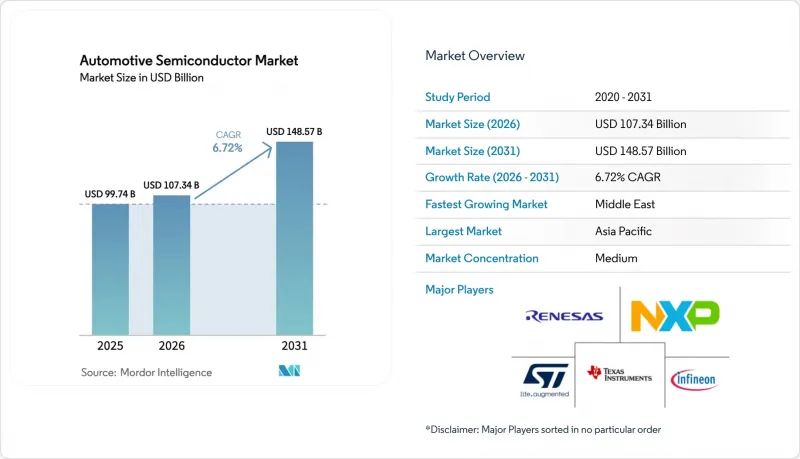
預計汽車半導體市場將從 2025 年的 997.4 億美元和 2026 年的 1073.4 億美元成長到 2031 年的 1485.7 億美元,2026 年至 2031 年的複合年成長率為 6.72%。
本報告按裝置類型(離散半導體、光電子裝置等)、車輛驅動系統(內燃機、混合動力等)、應用領域(動力傳動系統和電氣化、ADAS和自動駕駛等)、經營模式(IDM、無晶圓廠、晶圓代工廠)以及地區(北美、南美等)進行細分。市場預測以美元計價。
全球汽車半導體市場趨勢與洞察
新興國家汽車產量增加
預計到2025年,印度輕型汽車產量將達到580萬輛,年增9%,東南亞的組裝量將超過320萬輛。這將推動入門級車型對半導體的需求,因為穩定性控制和基本互聯功能如今已成為標配。在印度生產連結獎勵計畫計劃(PLI)的支持下,新的組裝和測試產能擴張正在實現本地化供應並降低進口成本。墨西哥和海灣國家也出現了類似的獎勵投資,反映了這個趨勢。這些發展正在縮短供應鏈,留住本地設計人才,並縮短認證時間。隨著新興市場消費者對以往僅限於高階車型的安全功能的需求不斷成長,每輛車所需的半導體數量也持續增加。因此,汽車半導體市場正經歷持續的結構性成長,其成長速度遠超全球汽車產量成長。
對先進安全和舒適系統的需求日益成長
歐盟通用安全法規(General Safety Regulations)強制要求自2024年7月起,所有新車型認證必須配備智慧速度輔助系統、高級緊急煞車系統和駕駛員監控系統,這實際上將雷達和攝影機作為主流車型的標配。美國的事故減少數據也支持這項商業論點,使得保險公司能夠降低配備自動緊急煞車系統的車輛的保費,從而鼓勵消費者採用這些系統。中國新車安全評鑑協會(C-NCAP)將於2025年提升其五星評等標準,鼓勵國內品牌採用能偵測100公尺外行人的高解析度感光元件。這些法規正在向成本敏感地區推廣,推高了半導體材料的平均物料清單(BOM)成本,即使是小型車也不例外。由於ISO 26262標準更傾向於成熟的平台,因此在功能安全領域擁有良好口碑的一級供應商處於有利地位。
配備先進功能的車輛成本很高
為主流車型配備L2級駕駛輔助功能,將使美國平均售價超過48,000美元,比同級標準價格高出22%。這些功能包中包含的半導體裝置通常成本超過1,000美元,迫使汽車製造商大幅提高售價以彌補研發和檢驗成本。這種影響在新興市場尤其顯著,這些市場對價格的彈性較高,且此類功能的普及僅限於高配車型。此外,監管機構為確保行人安全而強制要求的「故障運行」設計中的冗餘感測器配置,進一步增加了成本。供應商正在探索成本較低的感測器融合方案,以減少對雷射雷達的依賴,但功能安全的限制仍然阻礙了成本的快速降低。
細分市場分析
在汽車半導體市場,積體電路將在2025年成為最大的細分市場,佔據43.32%的銷售額,這主要得益於微控制器、SoC以及支援分區和集中式架構的記憶體。由於計算密度的提高、嵌入式硬體安全性的增強以及空中下載(OTA)更新的普及,這些裝置正變得至關重要。據市場參與企業稱,最新的SoC整合了異質CPU叢集、圖形引擎和神經網路處理器,使其能夠在單一封裝中處理駕駛座、互聯和低速自動駕駛等工作負載。隨著地圖資料和神經網路權重的不斷增加,對嵌入式記憶體的需求也持續成長。
感測器和微機電系統 (MEMS) 預計將成為裝置類別中成長最快的,複合年成長率 (CAGR) 為 17.61%。雷達、LiDAR、攝影機、超音波和慣性感測器目前正以冗餘陣列的形式出貨,以實現 360 度全方位感知,滿足法律規定的安全功能。德克薩斯(TI) 的角雷達晶片將射頻前端和訊號處理整合在單一晶片上,正是這種整合趨勢的典型例證。同時,寬能隙功率分離式元件元件正向多晶片模組方向發展,雖然分立元件的成長速度有所放緩,但平均售價卻在上漲。未來,能夠將感測、處理和執行功能整合到統一平台上的供應商將更具優勢,從而進一步增強汽車半導體市場的規模經濟效益。
電池式電動車)的單車半導體價值仍然最高,預計到2025年將佔半導體銷售額的54.19%。由於增加了轉換器和控制器,即使在完全電氣化之前,輕度混合動力48V系統也出現了晶片負載增加的情況。相較之下,受電池式電動車平台電子元件日益增多的影響,與內燃機汽車相關的汽車半導體市場預計將以17.49%的複合年成長率成長。光是電力電子元件在純電動車上的價值就高達600至800美元,遠遠超過內燃機汽車。
混合動力配置提供了一種過渡方案,需要雙電源管理架構,這使得每輛車的半導體成本高達約 700 美元。燃料電池汽車目前仍屬於小眾市場,需要專用的高壓轉換器,但隨著氫基礎設施的成熟,預計未來將實現成長。比亞迪和 Stellantis 等汽車製造商已推出標準化的 400 伏特和 800 伏特平台,這些平台大量依賴碳化矽模組,進一步強化了動力系統選擇與半導體組件成本之間的關聯性。這些數據支持了這樣一種觀點:儘管預計內燃機在短期內仍將繼續主導生產,但價值成長將由電動動力系統驅動。
區域分析
預計到2025年,亞太地區將佔全球銷售額的45.87%,這主要得益於中國900萬輛電動車的銷量以及新能源汽車25%的國產化零件需求。靠近晶圓代工廠和組裝廠的地理接近性,加快了成本最佳化的設計週期,並加快了客製化裝置的認證速度,從而提升了該地區在半導體發展藍圖中的影響力。韓國主要記憶體企業已承諾在2027年將其300毫米晶圓產能的15%分配給汽車客戶,進一步加深了供應鏈的集中度。
北美和歐洲合計約佔全球半導體銷售額的35%。儘管積極的安全和脫碳目標持續推動半導體市場的高需求,但得益於美國《晶片與科學法案》和歐盟《晶片法案》等公共獎勵,數十億美元正被投資於國內晶圓廠。由於這些工廠要到2027-2028年才能全面運作,因此在可預見的未來,該地區仍將依賴從亞洲進口半導體。
中東地區雖然目前規模較小,但預計到2031年將維持18.12%的複合年成長率。阿拉伯聯合大公國和沙烏地阿拉伯的主權財富基金正在推動電動車(EV)的強制採用和本地組裝,這些電動車配備高級駕駛輔助系統(ADAS)和電池管理功能,這吸引了全球一級供應商參與待開發區專案。非洲和南美洲仍然是入門級汽車的大市場,但電子穩定控制系統(ESC)和胎壓監測系統相關法規的推出正在逐步提升對晶片的需求。
其他好處:
- Excel格式的市場預測(ME)表
- 3個月的分析師支持
目錄
第1章:引言
- 研究假設和市場定義
- 調查範圍
第2章:調查方法
第3章執行摘要
第4章 市場狀況
- 市場概覽
- 市場促進因素
- 新興國家汽車產量增加
- 對先進安全和舒適系統的需求日益成長
- 電氣化正在增加每輛車可安裝的半導體數量。
- 區域電子電氣架構和軟體定義車輛正在推動對高階處理器的需求。
- 政府激勵措施鼓勵擴大汽車級晶圓代工廠鑄造產能
- 在電動動力傳動系統中採用SiC和GaN功率裝置
- 市場限制因素
- 高性能車輛的高成本
- 持續的供應鏈瓶頸和半導體短缺
- 寬能隙基板的供不應求和成本
- 汽車產業漫長的認證週期延緩了產品上市時間。
- 產業價值鏈分析
- 監理情勢
- 技術展望
- 自動駕駛汽車對射頻設備的需求
- 波特五力分析
- 投資分析
- 宏觀經濟因素對市場的影響
第5章 市場規模與成長預測
- 依設備類型
- 法令半導體
- 二極體
- 電晶體
- 功率電晶體
- 整流器和閘流體
- 其他分立元件
- 光電子學
- 發光二極體(LED)
- 雷射二極體
- 影像感測器
- 歐普託卡普拉
- 其他光電裝置
- 感測器和微機電系統
- 壓力感測器
- 磁場感測器
- 執行器
- 加速感應器和偏航率感測器
- 溫度感測器和其他感測器
- 積體電路
- 依積體電路類型
- 模擬
- 微
- 微處理器(MPU)
- 微控制器(MCU)
- 數位訊號處理器
- 邏輯
- 記憶
- 按技術節點(不適用出貨數量)
- 小於3奈米
- 3 nm
- 5 nm
- 7 nm
- 16 nm
- 28 nm
- >28 奈米
- 依積體電路類型
- 法令半導體
- 車輛推進類型
- 內燃機車
- 混合動力汽車
- 電池式電動車
- 燃料電池電動車
- 透過使用
- 動力傳動系統和電氣化
- 高級駕駛輔助系統 (ADAS) 和自動駕駛
- 車輛電子設備及舒適性設備
- 資訊娛樂和互聯
- 安全系統
- 按經營模式
- 整合裝置製造商 (IDM)
- 設計/無晶圓廠供應商
- 晶圓代工廠服務提供者
- 按地區
- 北美洲
- 美國
- 加拿大
- 墨西哥
- 南美洲
- 巴西
- 阿根廷
- 其他南美國家
- 歐洲
- 德國
- 英國
- 法國
- 義大利
- 西班牙
- 俄羅斯
- 其他歐洲國家
- 亞太地區
- 中國
- 日本
- 韓國
- 印度
- 澳洲
- 紐西蘭
- 其他亞太國家
- 中東
- 阿拉伯聯合大公國
- 沙烏地阿拉伯
- 土耳其
- 其他中東國家
- 非洲
- 南非
- 奈及利亞
- 肯亞
- 其他非洲國家
- 北美洲
第6章 競爭情勢
- 市場集中度
- 策略趨勢
- 市佔率分析
- 公司簡介
- NXP Semiconductors NV
- Infineon Technologies AG
- Renesas Electronics Corporation
- STMicroelectronics NV
- Texas Instruments Inc.
- Toshiba Electronic Devices and Storage Corporation
- Micron Technology Inc.
- onsemi
- Analog Devices Inc.
- Robert Bosch GmbH, Semiconductor Division
- ROHM Co., Ltd.
- NVIDIA Corporation
- Qualcomm Technologies Inc.
- Intel Corporation(Mobileye)
- Samsung Electronics Co., Ltd., System LSI
- MediaTek Inc.
- BYD Semiconductor Co. Ltd.
- Semtech Corporation
- Diodes Incorporated
- Microchip Technology Inc.
- Melexis NV
- Elmos Semiconductor SE
- Allegro Microsystems, Inc.
- Skyworks Solutions, Inc.
- Ambarella Inc.
- Wolfspeed Inc.
第7章 市場機會與未來展望
According to Mordor Intelligence, the automotive semiconductor market size is projected to expand from USD 99.74 billion in 2025 and USD 107.34 billion in 2026 to USD 148.57 billion by 2031, registering a CAGR of 6.72% between 2026 to 2031.
This report is Segmented by Device Type (Discrete Semiconductors, Optoelectronics, and More), Vehicle Propulsion (Internal Combustion Engine, Hybrid, and More), Application (Powertrain and Electrification, ADAS and Autonomous Driving, and More), Business Model (IDM, Fabless, and Foundry), and Geography (North America, South America, and More). The Market Forecasts are Provided in Terms of Value (USD).
Global Automotive Semiconductor Market Trends and Insights
Increasing Vehicle Production in Emerging Economies
Light-vehicle output in India reached 5.8 million units in 2025, a 9% annual rise, while Southeast Asian assembly topped 3.2 million units, pushing semiconductor demand for entry-level models that now ship with stability control and basic connectivity as standard. New assembly and test capacity under India's Production-Linked Incentive scheme is localizing supply and trimming import costs, a shift mirrored by incentive-backed investments in Mexico and the Gulf states. These moves shorten supply chains, anchor design talent regionally, and accelerate time to qualification. As emerging-market buyers demand safety features once reserved for premium segments, chip volumes per vehicle continue to climb. The result is sustained structural expansion for the automotive semiconductor market well beyond global vehicle growth rates.
Rising Demand for Advanced Safety and Comfort Systems
The European Union's General Safety Regulation mandated intelligent speed assistance, advanced emergency braking, and driver monitoring for all new type approvals after July 2024, effectively standardizing radar and camera content across mainstream models. U.S. crash-reduction data have reinforced the business case, enabling insurers to lower premiums for vehicles fitted with automated emergency braking, which, in turn, spurs consumer uptake. China's New Car Assessment Program raised its five-star standard in 2025, prompting domestic brands to incorporate higher-resolution sensors capable of detecting pedestrians up to 100 meters away. These mandates are spreading to cost-sensitive regions, lifting average semiconductor bill-of-materials values for even compact cars. Tier-one suppliers with deep functional-safety pedigrees are well positioned, as ISO 26262 barriers favor proven platforms.
High Cost of Advanced-Feature Vehicles
Equipping a mainstream vehicle with Level 2 driver assistance pushes average transaction prices above USD 48,000 in the United States, making such cars 22% costlier than segment norms. Semiconductor content for these feature packs often exceeds USD 1,000, and automakers apply significant mark-ups to recover R&D and validation costs. Emerging markets with high price elasticity feel the effect most acutely, limiting penetration to upper trims. Redundant sensor architectures raise costs further because regulators insist on fail-operational designs for pedestrian safety. Although suppliers are exploring lower-cost sensor fusion that reduces lidar reliance, functional-safety ceilings still restrain rapid cost downs.
Other drivers and restraints analyzed in the detailed report include:
- Electrification Boosting Semiconductor Content per Vehicle
- Zonal E/E Architectures and Software-Defined Vehicles Spur High-End Processors
- Persistent Supply-Chain Constraints and Chip Shortages
For complete list of drivers and restraints, kindly check the Table Of Contents.
Segment Analysis
The automotive semiconductor market size for integrated circuits stood highest in 2025, capturing 43.32% revenue thanks to microcontrollers, SoCs, and memory that underpin zonal and centralized architectures. Growing compute density, embedded hardware security, and over-the-air update readiness make these devices indispensable. Market participants note that the latest SoCs combine heterogeneous CPU clusters, graphics engines, and neural processors, allowing a single package to handle cockpit, connectivity, and low-speed autonomy workloads. Demand for embedded memory continues to surge as map data and neural network weights expand.
Sensors and microelectromechanical systems are forecast to post a 17.61% CAGR, the fastest pace among device categories. Radar, lidar, camera, ultrasonic, and inertial units now ship in redundant arrays to deliver 360-degree perception for mandated safety functions. Texas Instruments' corner-radar chip, which integrates an RF front-end and signal processing on one die, typifies this consolidation trend. Meanwhile, wide-bandgap power discretes are migrating into multichip modules, slightly tempering discrete unit growth but lifting average selling prices. The pathway ahead favors suppliers that can blend sensing, processing, and actuation into integrated platforms, reinforcing scale advantages in the automotive semiconductor market.
Battery electric vehicles still deliver the highest semiconductor value per vehicle, giving them 54.19% of 2025 semiconductor revenue. Mild-hybrid 48-volt systems add converters and controllers, nudging chip content upward even before full electrification. In contrast, the automotive semiconductor market size tied to internal-combustion vehicles will expand at a projected 17.49% CAGR, influenced by increasing electronic content even in conventional platforms. Each battery electric car carries USD 600-USD 800 of power electronics alone, dwarfing combustion counterparts.
Hybrid configurations offer a bridge solution, demanding dual power-management architectures that lift per-vehicle chip value to roughly USD 700. Fuel-cell variants remain niche but command specialized high-voltage converters, hinting at future upside should hydrogen infrastructure mature. Automakers such as BYD and Stellantis have announced standardized 400-volt and 800-volt platforms that rely heavily on silicon-carbide modules, tightening the link between propulsion choice and semiconductor bill of materials. The data confirm that value growth will hinge on electrified drivetrains, even as combustion engines dominate production counts through the near term.
Complete Report Scope:
- By Device Type
- Discrete Semiconductors
- Diodes
- Transistors
- Power Transistors
- Rectifiers and Thyristors
- Other Discrete Devices
- Optoelectronics
- Light-Emitting Diodes (LEDs)
- Laser Diodes
- Image Sensors
- Optocouplers
- Other Optoelectronic Devices
- Sensors and MEMS
- Pressure Sensors
- Magnetic Field Sensors
- Actuators
- Acceleration and Yaw-Rate Sensors
- Temperature and Other Sensors
- Integrated Circuits
- By Integrated Circuit Type
- Analog
- Micro
- Microprocessors (MPU)
- Microcontrollers (MCU)
- Digital Signal Processors
- Logic
- Memory
- By Technology Node (Shipment Volume Not Applicable)
- < 3 nm
- 3 nm
- 5 nm
- 7 nm
- 16 nm
- 28 nm
- > 28 nm
- By Integrated Circuit Type
- Discrete Semiconductors
- By Vehicle Propulsion
- Internal Combustion Engine Vehicles
- Hybrid Vehicles
- Battery Electric Vehicles
- Fuel-Cell Electric Vehicles
- By Application
- Powertrain and Electrification
- Advanced Driver-Assistance Systems (ADAS) and Autonomous Driving
- Body Electronics and Comfort
- Infotainment and Connectivity
- Safety Systems
- By Business Model
- Integrated Device Manufacturer (IDM)
- Design / Fabless Vendor
- Foundry Service Provider
- By Geography
- North America
- United States
- Canada
- Mexico
- South America
- Brazil
- Argentina
- Rest of South America
- Europe
- Germany
- United Kingdom
- France
- Italy
- Spain
- Russia
- Rest of Europe
- Asia Pacific
- China
- Japan
- South Korea
- India
- Australia
- New Zealand
- Rest of Asia Pacific
- Middle East
- United Arab Emirates
- Saudi Arabia
- Turkey
- Rest of Middle East
- Africa
- South Africa
- Nigeria
- Kenya
- Rest of Africa
- North America
Geography Analysis
Asia Pacific generated 45.87% of 2025 revenue, anchored by China's 9 million electric-vehicle sales and its 25% domestic-content mandate for new-energy vehicles. Proximity to foundries and assembly houses enables faster design-for-cost loops and the prompt qualification of custom devices, thereby strengthening the region's influence on semiconductor roadmaps. South Korea's memory giants have pledged to dedicate 15% of their 300-millimeter wafer output to automotive customers by 2027, thereby deepening the supply-chain cluster.
North America and Europe combined for roughly 35% of revenue. Aggressive safety and decarbonization targets continue to drive high semiconductor intensity, while public incentives under the United States CHIPS and Science Act and the European Union Chips Act channel billions of dollars into domestic fabs. Those plants will not fully ramp up until 2027-2028, leaving the regions reliant on Asian imports in the interim.
The Middle East, although a small base today, is expected to log an 18.12% CAGR through 2031. Sovereign funds in the United Arab Emirates and Saudi Arabia are backing electric fleet mandates and local assembly that specify advanced driver-assistance and battery-management features, pulling global tier-one suppliers into greenfield partnerships. Africa and South America remain volume markets for entry-level vehicles, yet regulatory adoption of electronic stability control and tire-pressure monitoring is gradually lifting chip demand.
- NXP Semiconductors N.V.
- Infineon Technologies AG
- Renesas Electronics Corporation
- STMicroelectronics N.V.
- Texas Instruments Inc.
- Toshiba Electronic Devices and Storage Corporation
- Micron Technology Inc.
- onsemi
- Analog Devices Inc.
- Robert Bosch GmbH, Semiconductor Division
- ROHM Co., Ltd.
- NVIDIA Corporation
- Qualcomm Technologies Inc.
- Intel Corporation (Mobileye)
- Samsung Electronics Co., Ltd., System LSI
- MediaTek Inc.
- BYD Semiconductor Co. Ltd.
- Semtech Corporation
- Diodes Incorporated
- Microchip Technology Inc.
- Melexis NV
- Elmos Semiconductor SE
- Allegro Microsystems, Inc.
- Skyworks Solutions, Inc.
- Ambarella Inc.
- Wolfspeed Inc.
Additional Benefits:
- The market estimate (ME) sheet in Excel format
- 3 months of analyst support
TABLE OF CONTENTS
1 INTRODUCTION
- 1.1 Study Assumptions and Market Definition
- 1.2 Scope of the Study
2 RESEARCH METHODOLOGY
3 EXECUTIVE SUMMARY
4 MARKET LANDSCAPE
- 4.1 Market Overview
- 4.2 Market Drivers
- 4.2.1 Increasing Vehicle Production in Emerging Economies
- 4.2.2 Rising Demand for Advanced Safety and Comfort Systems
- 4.2.3 Electrification Boosting Semiconductor Content per Vehicle
- 4.2.4 Zonal E/E Architectures and Software-Defined Vehicles Spur High-End Processors
- 4.2.5 Government Incentives for Auto-Grade Foundry Capacity Expansion
- 4.2.6 Adoption of SiC and GaN Power Devices in Electric Powertrains
- 4.3 Market Restraints
- 4.3.1 High Cost of Advanced-Feature Vehicles
- 4.3.2 Persistent Supply-Chain Constraints and Chip Shortages
- 4.3.3 Scarcity and Cost of Wide-Bandgap Substrates
- 4.3.4 Lengthy Automotive Qualification Cycles Slow Time-to-Market
- 4.4 Industry Value Chain Analysis
- 4.5 Regulatory Landscape
- 4.6 Technological Outlook
- 4.7 RF Device Demand in Autonomous Vehicles
- 4.8 Porter's Five Forces Analysis
- 4.8.1 Bargaining Power of Suppliers
- 4.8.2 Bargaining Power of Buyers
- 4.8.3 Threat of New Entrants
- 4.8.4 Threat of Substitute Products
- 4.8.5 Intensity of Competitive Rivalry
- 4.9 Investment Analysis
- 4.10 Impact of Macroeconomic Factors on the Market
5 MARKET SIZE AND GROWTH FORECASTS (VALUE)
- 5.1 By Device Type
- 5.1.1 Discrete Semiconductors
- 5.1.1.1 Diodes
- 5.1.1.2 Transistors
- 5.1.1.3 Power Transistors
- 5.1.1.4 Rectifiers and Thyristors
- 5.1.1.5 Other Discrete Devices
- 5.1.2 Optoelectronics
- 5.1.2.1 Light-Emitting Diodes (LEDs)
- 5.1.2.2 Laser Diodes
- 5.1.2.3 Image Sensors
- 5.1.2.4 Optocouplers
- 5.1.2.5 Other Optoelectronic Devices
- 5.1.3 Sensors and MEMS
- 5.1.3.1 Pressure Sensors
- 5.1.3.2 Magnetic Field Sensors
- 5.1.3.3 Actuators
- 5.1.3.4 Acceleration and Yaw-Rate Sensors
- 5.1.3.5 Temperature and Other Sensors
- 5.1.4 Integrated Circuits
- 5.1.4.1 By Integrated Circuit Type
- 5.1.4.1.1 Analog
- 5.1.4.1.2 Micro
- 5.1.4.1.2.1 Microprocessors (MPU)
- 5.1.4.1.2.2 Microcontrollers (MCU)
- 5.1.4.1.2.3 Digital Signal Processors
- 5.1.4.1.3 Logic
- 5.1.4.1.4 Memory
- 5.1.4.2 By Technology Node (Shipment Volume Not Applicable)
- 5.1.4.2.1 < 3 nm
- 5.1.4.2.2 3 nm
- 5.1.4.2.3 5 nm
- 5.1.4.2.4 7 nm
- 5.1.4.2.5 16 nm
- 5.1.4.2.6 28 nm
- 5.1.4.2.7 > 28 nm
- 5.1.4.1 By Integrated Circuit Type
- 5.1.1 Discrete Semiconductors
- 5.2 By Vehicle Propulsion
- 5.2.1 Internal Combustion Engine Vehicles
- 5.2.2 Hybrid Vehicles
- 5.2.3 Battery Electric Vehicles
- 5.2.4 Fuel-Cell Electric Vehicles
- 5.3 By Application
- 5.3.1 Powertrain and Electrification
- 5.3.2 Advanced Driver-Assistance Systems (ADAS) and Autonomous Driving
- 5.3.3 Body Electronics and Comfort
- 5.3.4 Infotainment and Connectivity
- 5.3.5 Safety Systems
- 5.4 By Business Model
- 5.4.1 Integrated Device Manufacturer (IDM)
- 5.4.2 Design / Fabless Vendor
- 5.4.3 Foundry Service Provider
- 5.5 By Geography
- 5.5.1 North America
- 5.5.1.1 United States
- 5.5.1.2 Canada
- 5.5.1.3 Mexico
- 5.5.2 South America
- 5.5.2.1 Brazil
- 5.5.2.2 Argentina
- 5.5.2.3 Rest of South America
- 5.5.3 Europe
- 5.5.3.1 Germany
- 5.5.3.2 United Kingdom
- 5.5.3.3 France
- 5.5.3.4 Italy
- 5.5.3.5 Spain
- 5.5.3.6 Russia
- 5.5.3.7 Rest of Europe
- 5.5.4 Asia Pacific
- 5.5.4.1 China
- 5.5.4.2 Japan
- 5.5.4.3 South Korea
- 5.5.4.4 India
- 5.5.4.5 Australia
- 5.5.4.6 New Zealand
- 5.5.4.7 Rest of Asia Pacific
- 5.5.5 Middle East
- 5.5.5.1 United Arab Emirates
- 5.5.5.2 Saudi Arabia
- 5.5.5.3 Turkey
- 5.5.5.4 Rest of Middle East
- 5.5.6 Africa
- 5.5.6.1 South Africa
- 5.5.6.2 Nigeria
- 5.5.6.3 Kenya
- 5.5.6.4 Rest of Africa
- 5.5.1 North America
6 COMPETITIVE LANDSCAPE
- 6.1 Market Concentration
- 6.2 Strategic Moves
- 6.3 Market Share Analysis
- 6.4 Company Profiles (includes Global Level Overview, Market Level Overview, Core Segments, Financials as Available, Strategic Information, Market Rank/Share for Key Companies, Products and Services, and Recent Developments)
- 6.4.1 NXP Semiconductors N.V.
- 6.4.2 Infineon Technologies AG
- 6.4.3 Renesas Electronics Corporation
- 6.4.4 STMicroelectronics N.V.
- 6.4.5 Texas Instruments Inc.
- 6.4.6 Toshiba Electronic Devices and Storage Corporation
- 6.4.7 Micron Technology Inc.
- 6.4.8 onsemi
- 6.4.9 Analog Devices Inc.
- 6.4.10 Robert Bosch GmbH, Semiconductor Division
- 6.4.11 ROHM Co., Ltd.
- 6.4.12 NVIDIA Corporation
- 6.4.13 Qualcomm Technologies Inc.
- 6.4.14 Intel Corporation (Mobileye)
- 6.4.15 Samsung Electronics Co., Ltd., System LSI
- 6.4.16 MediaTek Inc.
- 6.4.17 BYD Semiconductor Co. Ltd.
- 6.4.18 Semtech Corporation
- 6.4.19 Diodes Incorporated
- 6.4.20 Microchip Technology Inc.
- 6.4.21 Melexis NV
- 6.4.22 Elmos Semiconductor SE
- 6.4.23 Allegro Microsystems, Inc.
- 6.4.24 Skyworks Solutions, Inc.
- 6.4.25 Ambarella Inc.
- 6.4.26 Wolfspeed Inc.
7 MARKET OPPORTUNITIES AND FUTURE OUTLOOK
- 7.1 White-Space and Unmet-Need Assessment

 2026-2034年全球汽車半導體市場規模、佔有率、趨勢和成長分析報告
 汽車人工智慧半導體市場預測至2034年—全球分析(按半導體類型、車輛類型、人工智慧功能、銷售管道、應用、最終用戶和地區分類)汽車半導體市場預測至2034年:按組件、半導體材料、感測器類型、銷售管道、最終用戶、應用和地區分類的全球分析
 汽車半導體市場:2026-2032年全球市場預測(按產品類型、半導體材料、動力類型、應用、車輛類型和最終用戶分類)汽車功率半導體市場預測至2034年-全球分析(按元件類型、材料、車輛類型、驅動系統、電壓範圍、封裝類型、應用、銷售管道和地區分類)
 汽車半導體市場機會、成長要素、產業趨勢分析及2026-2035年預測。汽車半導體市場預測至2034年:按組件、車輛類型、應用和地區分類的全球分析汽車功率半導體市場:策略性洞察與預測(2026-2031年)
 汽車半導體市場:按應用和地區分類
 汽車半導體矽晶圓:市場佔有率分析、產業趨勢與統計及成長預測(2026-2031)