


 |
市場調查報告書
商品編碼
2121492
主動式智慧包裝:市場佔有率分析、產業趨勢與統計、成長預測(2026-2031)Active And Intelligent Packaging - Market Share Analysis, Industry Trends & Statistics, Growth Forecasts (2026 - 2031) |
||||||

※ 本網頁內容可能與最新版本有所差異。詳細情況請與我們聯繫。
預計到 2026 年,主動式智慧包裝市場規模將達到 164 億美元,從 2025 年的 154.3 億美元成長到 2031 年的 222.9 億美元。
預計從 2026 年到 2031 年,其複合年成長率將達到 6.31%。
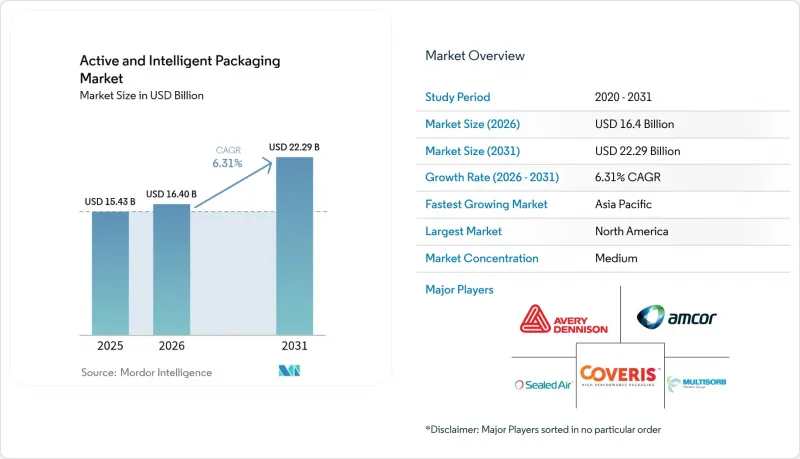
本報告按包裝功能(供應鏈管理等)、包裝技術(活性包裝、智慧包裝)、活性包裝類型(氣體吸收劑/釋放劑等)、智慧包裝類型(編碼和標誌等)、終端用戶產業(食品、飲料等)以及地區進行細分。市場預測以美元計價。
全球主動智慧包裝市場趨勢與洞察
超級市場對保存期限長的生鮮食品的需求
大型連鎖超市報告稱,使用氧氣和水分吸收劑後,商品變質率降低了15%至25%,提高了利潤率並減少了缺貨。酵素吸收劑僅在有氧環境下才會被激活,因此能夠在整個配送過程中保持包裝頂部空間的平衡。一些零售商目前正在使用智慧指示器,當吸收劑失效時,指示器會改變顏色,為門市員工提供存貨周轉的視覺訊號。美國食品藥物管理局 (FDA) 和歐洲食品安全局 (EFSA) 對新型鐵聚合物複合材料的批准加快了其商業化進程,而線上小袋插入裝置的引入則縮短了高速生產線的換線時間。雖然這些優勢在北美等配送距離較長的地區最為顯著,但隨著零售商努力實現其減少廢棄物的目標,歐洲和亞洲的都市區也正在擴大應用範圍。
品牌擁有者為即時可視化冷鏈所做的努力
精度為±0.5 度C的RFID溫度記錄器每5分鐘記錄一次數據,為疫苗和生技藥品提供詳細的溫度歷史記錄。製藥公司正在將這些記錄與雲端平台整合,以便在累積溫度暴露達到警告閾值時自動發出警報。冷凍甜點和水產品產業的食品品牌也紛紛效仿,利用預測分析在品質劣化之前重新安排高風險托盤的運輸路線。隨著標籤成本降至0.05美元以下,資本投入減少,即使是高價值SKU也能進行單品級部署。此商業案例不僅著眼於最佳化物流,更著眼於避免產品召回,即使在保守的品質劣化假設下,投資報酬率仍然可觀。
高昂的初始設備和改造成本
中型加工業者正斥資200萬至800萬美元,用於增設多通道氧氣吸收劑插入系統、視覺檢測設備及RFID編碼站。小規模企業往往會推遲投資,因為產量仍然有限,投資回報期可能超過四年。在新興市場,由於商業金融機構將智慧包裝相關資產視為小眾抵押品,資金籌措選擇仍有限。培訓成本進一步增加了資本支出,因為技術人員需要掌握包裝機制和電子故障排除方法。為此,原始設備製造商(OEM)正在提供可連接到現有成型-填充-封口(FFS)機器的模組化維修解決方案,從而降低准入門檻,但巨額資金負擔仍然是一大障礙。
細分市場分析
到2025年,保鮮應用將佔主動式智慧包裝市場45.90%的佔有率,凸顯了零售商對延長生鮮食品保存期限的重視。這一市場主導地位反映了氧氣清除劑、乾燥劑和乙烯抑制劑的廣泛效用,這些產品無需電力,且易於整合到現有生產線中。受北美和歐洲更嚴格的減廢棄物目標推動,預計到2031年,保鮮解決方案的主動式智慧包裝市場規模將達到102.3億美元。隨著零售商對損耗率進行基準評估,主動式包裝帶來的直接成本節約效益正吸引著希望成為首選供應商的生鮮產品包裝商加大投資。研究表明,新鮮度是整個冷藏食品類別中影響消費者重複購買的首要因素,而消費者的行為也與此優先事項相符。
成長最快的功能性細分市場是品牌保護,複合年成長率高達 8.42%,主要得益於藥品和奢侈化妝品領域假冒偽劣產品風險的增加。嵌入防篡改封條下方的 NFC 標籤可實現一觸式認證,而紫外線反應油墨則增添了一層隱形的安全保障。隨著全球執法部門查獲假藥,合法製造商面臨越來越大的壓力,需要保護其供應鏈。將序列化標識符與雲端控制面板整合,使企業能夠即時掌握非法分銷情況,並深入了解灰色市場趨勢。這些趨勢共同推動了產品新鮮度和安全性成為功能性需求的兩大支柱,從而為解決方案供應商帶來多元化的收入來源。
預計到2025年,主動式包裝技術將佔據62.70%的市場佔有率,這主要得益於其被動式運作模式,非常適合大規模生產的產品。這些技術無需電池,且對價值鏈的改動極小,因此推廣門檻較低。鐵基除塵器成本優勢仍顯著,每袋成本低於0.02美元,並正被烘焙產品和休閒食品等對成本較為敏感的領域所採用。主動式和智慧包裝市場正在經歷混合發展,主動式薄膜現在整合了印刷溫度條,當累積曝光量超過閾值時,溫度條會變暗。智慧包裝技術雖然目前市場規模仍然較小,但由於5G連接帶來的單位規模經濟效益提升和數據傳輸成本降低,其複合年成長率(CAGR)正以7.56%的速度成長。
新興的印刷電子平台正在模糊這兩個領域之間的界線。卷對卷凹版印刷機可以在一次印刷過程中同時形成導電線和吸氣化學物質,從而製造出具有自調節功能的包裝,一旦發酵開始,包裝就會釋放二氧化碳。 ISO 15378 等標準化機構正在更新其指南,以涵蓋這些多功能結構,為先行企業提供明確的監管指導。這種融合進一步增強了同時具備化學和電子技術專長的加工商的競爭優勢,並強化了綜合性企業在智慧包裝市場的競爭優勢。
區域分析
預計到2025年,北美將引領智慧包裝市場,佔34.00%的市場。這主要得益於FDA序列化法規的初期推動以及成熟的冷鏈體系。零售商正在採用嵌入式新鮮度指示器來檢驗供應商的績效,創業投資也持續為結合物聯網和軟性包裝的新創公司提供資金。到2025年底,美國冷藏肉包裝上的智慧標籤使用率將超過18%,顯示用戶參與度不斷提高。
歐洲依然是科技的搖籃,永續性法規推動快速創新。 《一次性塑膠指令》促進了可堆肥NFC標籤和無溶劑複合材料的研發。在德國,用於自動化包裝分類的數位浮水印技術已投入試點,並在市政試驗中實現了95%的檢測準確率。在法國,根據可回收性和再生材料含量分級徵收的生產者責任延伸(EPR)費用,間接鼓勵加工商轉向使用單一材料的智慧薄膜。
亞太地區正經歷最快的成長,複合年成長率高達9.45%,這主要得益於中國食品標籤法規的修訂以及印度的「印度製造」計劃,該計劃已使該地區成為RFID晶片的主要生產中心。如果目前的資本投資計畫得以實現,亞太地區的智慧包裝市場可望在2028年超越歐洲。在日本,便利商店產業正在試驗在高檔便當盒中引入時間和溫度記錄裝置;而在韓國,某些生物製藥被強制要求進行序列化,這進一步推動了智慧技術在醫療領域的應用。
其他好處:
- Excel格式的市場預測(ME)表
- 3個月的分析師支持
目錄
第1章:引言
- 研究假設和市場定義
- 調查範圍
第2章:調查方法
第3章執行摘要
第4章 市場狀況
- 市場概覽
- 產業價值鏈分析
- 產業吸引力—五力分析
- 新進入者的威脅
- 買方的議價能力
- 供應商的議價能力
- 替代品的威脅
- 競爭公司之間的競爭
- 市場促進因素
- 超級市場對保存期限長的生鮮食品的需求
- 品牌擁有者為即時可視化冷鏈所做的努力
- 旨在減少一次性塑膠使用的監管轉變
- 電子商務的快速發展為最後一公里配送的保鮮帶來了挑戰。
- 印刷電子技術在軟性薄膜中的整合(未公開)
- 藥品強制序列化 2.0(此趨勢尚未引起太多關注)
- 市場限制因素
- 設備安裝和維修的初始成本較高。
- 清除劑化學物質引發的人類毒理學問題
- 智慧標籤回收基礎設施碎片化
- RFID嵌體所用半導體的供應瓶頸(未公開通報)
- 宏觀經濟因素對市場的影響
- 監理情勢
- 技術展望
第5章 市場規模與成長預測
- 透過包裝功能
- 供應鏈管理
- 產品新鮮度
- 消費者便利性
- 品牌保護
- 產品資訊
- 產品技術
- 活性包裝
- 智慧包裝
- 活性包裝的類型
- 氣體淨化劑/發送器
- 乾燥劑
- 微波基座
- 其他活性包裝技術
- 按智慧包類型
- 編碼和標記
- 天線(RFID 和 NFC)
- 感測器和輸出設備
- 其他智慧包裝技術
- 按最終用戶行業分類
- 食物
- 飲料
- 製藥
- 產業
- 物流
- 其他終端用戶產業
- 按地區
- 北美洲
- 美國
- 加拿大
- 墨西哥
- 南美洲
- 巴西
- 阿根廷
- 其他南美國家
- 歐洲
- 英國
- 德國
- 法國
- 義大利
- 西班牙
- 其他歐洲國家
- 亞太地區
- 中國
- 印度
- 日本
- 韓國
- 澳洲
- 其他亞太國家
- 中東和非洲
- 中東
- 沙烏地阿拉伯
- 阿拉伯聯合大公國
- 土耳其
- 其他中東國家
- 非洲
- 南非
- 奈及利亞
- 其他非洲國家
- 中東
- 北美洲
第6章 競爭情勢
- 市場集中度
- 策略趨勢
- 市佔率分析
- 公司簡介
- Amcor plc
- Sealed Air Corporation
- Avery Dennison Corporation
- Crown Holdings Inc.
- Ball Corporation
- Coveris Holding SA
- Smurfit WestRock plc
- Honeywell International Inc.
- Graphic Packaging International LLC
- Desiccare Inc.
- Timestrip UK Ltd.
- Multisorb Technologies Inc.
- Tetra Pak International SA
- Thinfilm Electronics ASA
- PakSense Inc.
- Insignia Technologies Ltd.
- Printpack Inc.
第7章 市場機會與未來展望
According to Mordor Intelligence, the active and intelligent packaging market size in 2026 is estimated at USD 16.4 billion, growing from 2025 value of USD 15.43 billion with 2031 projections showing USD 22.29 billion, growing at 6.31% CAGR over 2026-2031.
This report is Segmented by Packaging Function (Supply Chain Management, and More), Packaging Technology (Active Packaging, and Intelligent Packaging), Active Packaging Type (Gas Scavengers/Emitters, and More), Intelligent Packaging Type (Coding and Markings, and More), End-User Industry (Food, Beverages, and More), and Geography. The Market Forecasts are Provided in Terms of Value (USD).
Global Active And Intelligent Packaging Market Trends and Insights
Supermarket Demand for Longer Shelf-Life Fresh Produce
Large grocery chains reported 15-25% spoilage reduction after adopting oxygen and moisture scavengers, translating into better margins and fewer out-of-stocks. Enzymatic scavengers activate only in the presence of oxygen, so the package headspace remains balanced throughout distribution. Multiple retailers are now integrating smart indicators that change color once scavenger capacity is exhausted, giving store associates a visual cue for stock rotation. FDA and EFSA approvals of newer iron-polymer composites accelerated commercial launch schedules, while in-line sachet placement equipment lowered changeover time on high-speed lines. The benefit is most pronounced in regions with long distribution distances, such as North America, yet adoption is expanding in Europe and urban Asia as retailers target waste reduction mandates.
Brand-Owner Push for Real-Time Cold-Chain Visibility
RFID-enabled temperature loggers capable of +-0.5 °C accuracy record data every five minutes, providing granular thermal histories for vaccines and biologics. Pharmaceutical companies integrate these logs with cloud platforms that send automatic alerts when cumulative thermal exposure reaches warning thresholds. Food brands are following suit in frozen desserts and seafood, leveraging predictive analytics to reroute at-risk pallets before quality deteriorates. Capital outlays are declining as tag costs fall below USD 0.05, making item-level deployment feasible for high-value SKUs. The business case hinges on recall avoidance rather than pure logistics optimization, so ROI remains compelling even under conservative spoilage assumptions.
High Initial Equipment and Retrofit Costs
A mid-sized converter spends USD 2-8 million to add multilane oxygen-scavenger insertion systems, vision inspection, and RFID encoding stations. Payback stretches past four years if output volumes stay modest, so small firms often postpone investment. Financing options remain limited in emerging markets, where commercial lenders perceive smart-pack assets as niche collateral. Training expenses further inflate capital outlays because technicians must master both packaging mechanics and electronics troubleshooting. OEMs are responding with modular retrofits that clip onto existing form-fill-seal machines, lowering entry thresholds but still leaving a sizable cash hurdle.
Other drivers and restraints analyzed in the detailed report include:
- Regulatory Shift Toward Single-Use Plastic Reduction
- E-Commerce Boom Creating Last-Mile Freshness Challenges
- Human Toxicology Concerns around Scavenger Chemistries
For complete list of drivers and restraints, kindly check the Table Of Contents.
Segment Analysis
Product freshness applications captured 45.90% share of the active and intelligent packaging market in 2025, underscoring the premium retailers' place on extending perishable shelf life. This dominance reflects the broad utility of oxygen scavengers, moisture absorbers, and ethylene inhibitors that operate without power and integrate easily into existing lines. The active and intelligent packaging market size for freshness solutions is forecast to grow toward USD 10.23 billion by 2031, propelled by stricter waste-reduction targets in North America and Europe. Retailers' benchmarking shrink rates are assigning cost savings directly to active formats, drawing follow-on investment from produce packers seeking preferred-supplier status. Consumer behavior aligns with this priority as surveys indicate freshness is the top driver of repeat purchase across refrigerated categories.
The fastest-growing functional segment is brand protection at an 8.42% CAGR, buoyed by counterfeit risks in pharmaceuticals and luxury cosmetics. NFC tags embedded under tamper-evident seals enable one-tap authentication, while UV-responsive inks add covert security layers. Global authorities confiscated fake drugs, intensifying pressure on legitimate manufacturers to safeguard supply chains. By integrating serialized identifiers with cloud dashboards, companies gain real-time diversion alerts and market intelligence on gray-market flows. These combined dynamics position freshness and security as dual pillars of functional demand, ensuring diversified revenue streams for solution providers.
Active technologies held a 62.70% share in 2025 as its passive mode of action suits high-volume commodities. They require no batteries and minimal supply-chain modification, reducing implementation friction. Iron-based scavengers remain cost leaders at less than USD 0.02 per sachet, sustaining uptake in value-driven segments such as bakery and snack foods. The active and intelligent packaging market is witnessing hybridization, with active films now incorporating printed temperature strips that darken after cumulative exposure thresholds. Intelligent technologies, although on a smaller base, are advancing at a 7.56% CAGR as unit economics improve and 5G connectivity lowers data-transmission costs.
Emerging printed-electronics platforms blur the lines between the two camps. Roll-to-roll gravure presses can deposit conductive traces alongside gas-absorbing chemistries in a single pass, creating self-regulating packs that vent CO2 when fermentation begins. Standards bodies like ISO 15378 are updating guidance to cover such multifunctional constructs, giving early movers regulatory clarity. This convergence widens the moat for converters with both chemistry and electronics expertise, reinforcing the competitive advantage of integrated players in the active and intelligent packaging market.
Complete Report Scope:
- By Packaging Function
- Supply Chain Management
- Product Freshness
- Consumer Convenience
- Brand Protection
- Product Information
- By Packaging Technology
- Active Packaging
- Intelligent Packaging
- By Active Packaging Type
- Gas Scavengers/Emitters
- Moisture Scavengers
- Microwave Susceptors
- Other Active Packaging Technologies
- By Intelligent Packaging Type
- Coding and Markings
- Antenna (RFID and NFC)
- Sensors and Output Devices
- Other Intelligent Packaging Technologies
- By End-user Industry
- Food
- Beverages
- Pharmaceuticals
- Industrial
- Logistics
- Other End-user Industries
- By Geography
- North America
- United States
- Canada
- Mexico
- South America
- Brazil
- Argentina
- Rest of South America
- Europe
- United Kingdom
- Germany
- France
- Italy
- Spain
- Rest of Europe
- Asia-Pacific
- China
- India
- Japan
- South Korea
- Australia
- Rest of Asia-Pacific
- Middle East and Africa
- Middle East
- Saudi Arabia
- United Arab Emirates
- Turkey
- Rest of Middle East
- Africa
- South Africa
- Nigeria
- Rest of Africa
- Middle East
- North America
Geography Analysis
North America led the active and intelligent packaging market with 34.00% share in 2025 as FDA serialization and mature cold chains gave early impetus. Retailers employ embedded freshness indicators to verify supplier performance, and venture capital continues funding start-ups that merge IoT with flexible packaging. Smart-label penetration surpassed 18% of chilled meat packs in the United States by late 2025, cementing user familiarity.
Europe remains a technology crucible where sustainability legislation drives rapid iteration. The Single-Use Plastics Directive stimulated R&D into compostable NFC tags and solvent-free laminations. Germany piloted digital watermarks for automatic pack sorting, achieving 95% detection accuracy during municipal trials. France's extended producer responsibility fees, tiered by recyclability and recycled content, indirectly nudge converters toward mono-material smart films.
Asia-Pacific is the fastest grower at a 9.45% CAGR, powered by China's upgraded food labeling law and India's "Make in India" push that now hosts regional RFID chip production. The active and intelligent packaging market size in Asia-Pacific could overtake Europe by 2028 if current capital expenditure plans materialize. Japan's convenience-store channel is piloting time-temperature integrators on premium bento boxes, while South Korea mandates serialization for select biologics, pushing intelligent adoption deeper into healthcare.
- Amcor plc
- Sealed Air Corporation
- Avery Dennison Corporation
- Crown Holdings Inc.
- Ball Corporation
- Coveris Holding SA
- Smurfit WestRock plc
- Honeywell International Inc.
- Graphic Packaging International LLC
- Desiccare Inc.
- Timestrip UK Ltd.
- Multisorb Technologies Inc.
- Tetra Pak International SA
- Thinfilm Electronics ASA
- PakSense Inc.
- Insignia Technologies Ltd.
- Printpack Inc.
Additional Benefits:
- The market estimate (ME) sheet in Excel format
- 3 months of analyst support
TABLE OF CONTENTS
1 INTRODUCTION
- 1.1 Study Assumptions and Market Definition
- 1.2 Scope of the Study
2 RESEARCH METHODOLOGY
3 EXECUTIVE SUMMARY
4 MARKET LANDSCAPE
- 4.1 Market Overview
- 4.2 Industry Value Chain Analysis
- 4.3 Industry Attractiveness - Porter's Five Forces Analysis
- 4.3.1 Threat of New Entrants
- 4.3.2 Bargaining Power of Buyers
- 4.3.3 Bargaining Power of Suppliers
- 4.3.4 Threat of Substitutes
- 4.3.5 Intensity of Competitive Rivalry
- 4.4 Market Drivers
- 4.4.1 Supermarket Demand for Longer Shelf-Life Fresh Produce
- 4.4.2 Brand-Owner Push for Real-Time Cold-Chain Visibility
- 4.4.3 Regulatory Shift Toward Single-Use Plastic Reduction
- 4.4.4 E-Commerce Boom Creating Last-Mile Freshness Challenges
- 4.4.5 Integration of Printed Electronics in Flexible Films (UNDER-RADAR)
- 4.4.6 Pharmaceutical Serialization 2.0 Mandates (UNDER-RADAR)
- 4.5 Market Restraints
- 4.5.1 High Initial Equipment and Retrofit Costs
- 4.5.2 Human Toxicology Concerns around Scavenger Chemistries
- 4.5.3 Fragmented Recycling Infrastructure for Smart Labels
- 4.5.4 Semiconductor Supply Bottlenecks for RFID Inlays (UNDER-RADAR)
- 4.6 Impact of Macroeconomic Factors on the Market
- 4.7 Regulatory Landscape
- 4.8 Technological Outlook
5 MARKET SIZE AND GROWTH FORECASTS (VALUE)
- 5.1 By Packaging Function
- 5.1.1 Supply Chain Management
- 5.1.2 Product Freshness
- 5.1.3 Consumer Convenience
- 5.1.4 Brand Protection
- 5.1.5 Product Information
- 5.2 By Packaging Technology
- 5.2.1 Active Packaging
- 5.2.2 Intelligent Packaging
- 5.3 By Active Packaging Type
- 5.3.1 Gas Scavengers/Emitters
- 5.3.2 Moisture Scavengers
- 5.3.3 Microwave Susceptors
- 5.3.4 Other Active Packaging Technologies
- 5.4 By Intelligent Packaging Type
- 5.4.1 Coding and Markings
- 5.4.2 Antenna (RFID and NFC)
- 5.4.3 Sensors and Output Devices
- 5.4.4 Other Intelligent Packaging Technologies
- 5.5 By End-user Industry
- 5.5.1 Food
- 5.5.2 Beverages
- 5.5.3 Pharmaceuticals
- 5.5.4 Industrial
- 5.5.5 Logistics
- 5.5.6 Other End-user Industries
- 5.6 By Geography
- 5.6.1 North America
- 5.6.1.1 United States
- 5.6.1.2 Canada
- 5.6.1.3 Mexico
- 5.6.2 South America
- 5.6.2.1 Brazil
- 5.6.2.2 Argentina
- 5.6.2.3 Rest of South America
- 5.6.3 Europe
- 5.6.3.1 United Kingdom
- 5.6.3.2 Germany
- 5.6.3.3 France
- 5.6.3.4 Italy
- 5.6.3.5 Spain
- 5.6.3.6 Rest of Europe
- 5.6.4 Asia-Pacific
- 5.6.4.1 China
- 5.6.4.2 India
- 5.6.4.3 Japan
- 5.6.4.4 South Korea
- 5.6.4.5 Australia
- 5.6.4.6 Rest of Asia-Pacific
- 5.6.5 Middle East and Africa
- 5.6.5.1 Middle East
- 5.6.5.1.1 Saudi Arabia
- 5.6.5.1.2 United Arab Emirates
- 5.6.5.1.3 Turkey
- 5.6.5.1.4 Rest of Middle East
- 5.6.5.2 Africa
- 5.6.5.2.1 South Africa
- 5.6.5.2.2 Nigeria
- 5.6.5.2.3 Rest of Africa
- 5.6.5.1 Middle East
- 5.6.1 North America
6 COMPETITIVE LANDSCAPE
- 6.1 Market Concentration
- 6.2 Strategic Moves
- 6.3 Market Share Analysis
- 6.4 Company Profiles {(includes Global level Overview, Market level overview, Core Segments, Financials as available, Strategic Information, Market Rank/Share for key companies, Products and Services, and Recent Developments)}
- 6.4.1 Amcor plc
- 6.4.2 Sealed Air Corporation
- 6.4.3 Avery Dennison Corporation
- 6.4.4 Crown Holdings Inc.
- 6.4.5 Ball Corporation
- 6.4.6 Coveris Holding SA
- 6.4.7 Smurfit WestRock plc
- 6.4.8 Honeywell International Inc.
- 6.4.9 Graphic Packaging International LLC
- 6.4.10 Desiccare Inc.
- 6.4.11 Timestrip UK Ltd.
- 6.4.12 Multisorb Technologies Inc.
- 6.4.13 Tetra Pak International SA
- 6.4.14 Thinfilm Electronics ASA
- 6.4.15 PakSense Inc.
- 6.4.16 Insignia Technologies Ltd.
- 6.4.17 Printpack Inc.
7 MARKET OPPORTUNITIES AND FUTURE OUTLOOK
- 7.1 White-space and Unmet-need Assessment

 主動式智慧玻璃市場:全球市場預測,2026-2032年
 主動式智慧包裝技術市場預測至2034年—按技術類型、材料、功能、應用、最終用戶和地區分類的全球分析
 南美洲主動式和智慧包裝:市場佔有率分析、行業趨勢和統計數據以及成長預測(2026-2031 年)2034年智慧包裝市場預測-全球技術、材料、包裝形式、功能、最終用戶與區域分析主動式、智慧式和智慧式包裝市場:2026-2032年全球市場預測(按材料、包裝形式、技術、包裝層級和最終用途產業分類)主動式溫控包裝市場預測至2034年-按包裝類型、材料類型、技術、應用、最終用戶和地區分類的全球分析智慧產品包裝市場預測至2034年-按包裝類型、材料類型、技術組件、應用、最終用戶和地區分類的全球分析智慧食品包裝市場預測至2034年—全球技術、組件、材料、包裝形式、食品類別、最終用戶和區域分析智慧包裝市場預測至2034年:按組件、包裝類型、材料、功能、技術、最終用戶和地區分類的全球分析
 2026年全球主動式智慧包裝市場報告