


 |
市場調查報告書
商品編碼
2121489
零售業分析:市場佔有率分析、產業趨勢與統計、成長預測(2026-2031)Retail Analytics - Market Share Analysis, Industry Trends & Statistics, Growth Forecasts (2026 - 2031) |
||||||

※ 本網頁內容可能與最新版本有所差異。詳細情況請與我們聯繫。
據 Mordor Intelligence 稱,零售分析市場預計到 2026 年價值 68.8 億美元,高於 2025 年的 66 億美元,預計到 2031 年將達到 84.4 億美元。
預計從 2026 年到 2031 年,其複合年成長率將達到 4.18%。
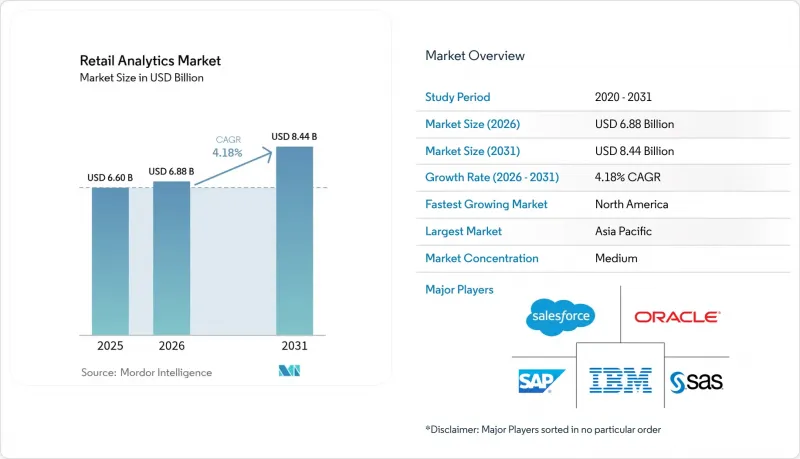
本報告按解決方案(軟體和服務)、部署模式(雲端、本地部署、混合部署)、功能(客戶管理、供應鏈管理等)、零售業態(實體店、純電商、全通路零售商)和地區(北美、南美、歐洲等)進行細分。市場預測以美元計價。
全球零售分析市場趨勢與洞察
全通路環境下資料量的爆炸性成長
如今,零售商正在接收大量的交易數據、行為數據和社交訊號——遠超往年——這使得可擴展的分析平台至關重要。數據成長的迅猛勢頭推動了對統一數據湖的投資,這些數據湖整合了門市、電商和第三方數據源,以支援近乎即時的報告。掌握快速模式識別能力的企業可以提高定價彈性、提升需求預測準確性並加快存貨周轉,所有這些都有助於提高毛利率。因應資料激增也加速了雲端需求的成長,因為彈性基礎設施可以防止尖峰時段出現效能瓶頸。因此,分析成熟度正成為衡量企業韌性的指標。
人工智慧/機器學習技術的進步使得即時、指導性洞察成為可能。
機器學習驅動的需求預測正在減少價值鏈各環節的錯誤和銷售機會損失,而電腦視覺應用則將智慧延伸至銷售點。零售商將人工智慧整合到建議引擎中,隨著產出從說明儀錶板轉向自動化決策,他們正在獲得新的交叉銷售收入來源並提升客戶終身價值。融合語言、視覺和結構化資料的多模態模型創造了一個整合的智慧層,打破了不同功能之間的障礙。這些變化正在重新定義零售商所需的人才類型,並重塑供應商選擇標準,預先建構的、可解釋的模型越來越受到重視。
資料隱私法規和合規成本
GDPR和CCPA等隱私法規的日益嚴格迫使零售商重組資料管道,以符合資料同意和資料最小化規則。目前,現代化預算擴大用於加密和管理敏感資訊的安全工具,導致用於分析技術創新的資金減少。跨境零售商面臨複雜的合規要求,這延長了其在全球擴張過程中採用引進週期。雖然「隱私設計」框架有助於降低監管風險,但也限制了資料粒度,可能會縮小高度監管市場中高階分析的應用範圍。因此,保護義務與分析意願之間的平衡仍然是一項關鍵的策略挑戰。
細分市場分析
到2025年,61.55%的專案將採用雲端部署,預計到2031年將以9.22%的複合年成長率成長。訂閱式定價模式最大限度地降低了資本支出,而強大的運算能力使零售商能夠應對促銷宣傳活動帶來的流量高峰,而不會出現效能下降。雖然一些連鎖企業為了滿足資料主權和延遲要求,仍然將敏感資料保留在本地,但將本地資料儲存與雲端運算結合的混合架構正逐漸成為一種策略性的折衷方案。這些混合設計可以縮短詐欺偵測等關鍵任務工作負載的往返時間,同時利用雲端運算的成本效益來訓練分析模型。因此,部署選擇正從統一的「雲端優先」或「本地部署」模式轉向基於工作負載特性的模式。
到2025年,純電商零售商將佔到分析工具採用率的59.30%,預計將繼續以8.85%的複合年成長率成長,超越其他類型的企業。這些公司採用的數位化原生架構能夠快速部署預測模型,無需整合舊有系統,從而最佳化每一次點擊的客戶體驗。實體零售企業正在透過部署感測器、RFID和電腦視覺技術來填補資料空白,並將店內行為轉化為可執行的資料。全通路連鎖企業正在採用統一商務分析來整合線上和線下洞察,並改善跨通路庫存分配和履約路線。這些不同的優先事項表明,儘管經營模式塑造了分析藍圖,但所有類型的企業都通用需要更快、更精細的洞察。
區域分析
預計到2025年,北美將引領零售分析市場,佔據38.05%的市場佔有率,這得益於其強大的雲端基礎設施、高電子商務滲透率以及與主要分析供應商的地理位置接近性。美國零售商計劃在2025年增加技術預算,並將最大佔有率分配給客戶數據平台和基於人工智慧的決策引擎。加拿大略微落後,但正在大力投資客戶分析,以期在成熟市場中脫穎而出;而墨西哥則專注於供應鏈最佳化,以應對物流波動。
亞太地區預計將保持最高成長率,到2031年複合年成長率將達到6.09%,這主要得益於電子商務的爆炸式成長、智慧型手機的廣泛普及以及雄心勃勃的數位轉型(DX)計劃。中國是社交電商分析領域的先驅,整合支付、配送和社區互動數據,建構端到端的洞察閉迴路。印度多元化的消費市場促使零售商採用預測模型,最佳化都市區地區的產品組合。日本和韓國正著重發展以門市為中心的分析,例如基於電腦視覺的客流量測量,以重振實體店。歐洲依然佔有重要地位,這得益於英國、德國和法國成熟的零售系統。嚴格的隱私法規推動了混合部署模式的普及,這種模式兼顧了資料居住和雲端擴充性。隨著零售商利用環境指標指南採購和包裝決策,永續性分析正日益受到關注。拉丁美洲的成長主要集中在巴西和阿根廷,分析技術正幫助兩國應對外匯波動並最佳化區域性促銷活動。中東和非洲的市場規模仍然較小,但以色列和阿拉伯聯合大公國等市場正呈現活躍態勢,奢侈品零售和旅遊業正在加速採用客戶體驗分析技術。
其他好處:
- Excel格式的市場預測(ME)表
- 3個月的分析師支持
目錄
第1章:引言
- 研究假設和市場定義
- 調查範圍
第2章:調查方法
第3章執行摘要
第4章 市場狀況
- 市場概覽
- 市場促進因素
- 全通路環境下資料量的爆炸性成長
- 人工智慧/機器學習技術的進步使得即時預測性洞察成為可能。
- 雲端分析技術的應用降低了擁有成本。
- 高度個人化購物體驗的需求
- 市場限制因素
- 資料隱私法規和合規成本
- 傳統IT架構和缺乏分析技能
- 供應鏈分析
- 監理情勢
- 技術展望
- 波特五力分析
- 評估宏觀經濟趨勢對市場的影響
第5章 市場規模與成長預測
- 透過解決方案
- 軟體
- 服務
- 按部署模式
- 雲
- 現場
- 混合
- 按功能
- 客戶管理
- 門市營運 - 庫存管理
- 門市營運 - 績效管理
- 供應鏈管理
- 行銷與商品行銷- 定價/利潤率
- 其他職能 - 運輸管理
- 其他功能 -訂單管理
- 按零售業態
- 實體店面
- 純電子商務
- 全通路零售商
- 按地區
- 北美洲
- 美國
- 加拿大
- 墨西哥
- 歐洲
- 英國
- 德國
- 法國
- 義大利
- 其他歐洲國家
- 亞太地區
- 中國
- 日本
- 印度
- 韓國
- 其他亞太國家
- 中東
- 以色列
- 沙烏地阿拉伯
- 阿拉伯聯合大公國
- 土耳其
- 其他中東國家
- 非洲
- 南非
- 埃及
- 其他非洲國家
- 南美洲
- 巴西
- 阿根廷
- 其他南美國家
- 北美洲
第6章 競爭情勢
- 市場集中度
- 策略趨勢
- 市佔率分析
- 公司簡介
- SAP SE
- IBM Corporation
- Oracle Corporation
- Salesforce Inc.(Tableau)
- SAS Institute Inc.
- QlikTech International AB
- Microsoft Corp.(Power BI, Dynamics 365)
- Amazon Web Services Inc.(QuickSight)
- Google LLC(Looker)
- Blue Yonder Inc.
- Dunnhumby Ltd.
- Teradata Corp.
- RetailNext Inc.
- Zebra Technologies Corp.
- Altair Engineering Inc.
- Alteryx Inc.
- MicroStrategy Inc.
- ThoughtSpot Inc.
- Fujitsu Ltd.
- Infor Inc.
第7章 市場機會與未來展望
According to Mordor Intelligence, the retail analytics market size in 2026 is estimated at USD 6.88 billion, growing from 2025 value of USD 6.60 billion with 2031 projections showing USD 8.44 billion, growing at 4.18% CAGR over 2026-2031.
This report is Segmented by Solutions (Software, and Services), Deployment (Cloud, On-Premises, and Hybrid), Function (Customer Management, Supply Chain Management, and More), Retail Format (Brick-And-Mortar Stores, Pure-Play E-Commerce, and Omnichannel Retailers), Geography (North America, South America, Europe, and More). The Market Forecasts are Provided in Terms of Value (USD).
Global Retail Analytics Market Trends and Insights
Omnichannel data-volume explosion
Retailers now ingest vast pools of transaction, behavioural, and social signals that dwarf prior years and mandate scalable analytics platforms. The pace of data growth is prompting investments in unified data lakes that consolidate store, e-commerce, and third-party feeds to support near real-time reporting. Operators that master rapid pattern recognition improve pricing agility, sharpen demand forecasts, and raise inventory turns, which collectively push gross-margin lift. Managing this surge also accelerates cloud demand because elastic infrastructure prevents performance bottlenecks during peak events. Consequently, analytic maturity becomes a barometer for commercial resilience.
AI/ML advances enabling real-time prescriptive insights
Machine-learning-powered demand sensing is reducing supply-chain errors and missed sales opportunities, while computer vision applications extend intelligence to the sales floor. Retailers that embed AI into recommendation engines capture new cross-sell revenue streams and improve lifetime customer value as output moves from descriptive dashboards to automated decisions. Multimodal models that blend language, vision, and structured data produce unified intelligence layers that break down functional silos. These shifts are redefining the talent profiles retailers seek and are reshaping vendor selection criteria, with emphasis now on pre-built, explainable models.
Data-privacy regulation and compliance costs
Tightening privacy laws such as GDPR and CCPA compel retailers to re-engineer data pipelines to uphold consent and minimisation rules. Modernisation budgets now allocate growing shares to security tooling that encrypts and governs sensitive information, diverting funds from analytics innovation. Cross-border retailers face complex compliance matrices that elongate deployment cycles for global rollouts. Privacy-by-design frameworks help reduce regulatory exposure but also limit data granularity, which may curb the scope of advanced analytics in high-stringency markets. The interplay between protection mandates and analytics ambitions, therefore, remains a key strategic balancing act.
Other drivers and restraints analyzed in the detailed report include:
- Uptake of cloud analytics lowering TCO
- Demand for hyper-personalised shopping journeys
- Legacy IT stacks and analytics skills gap
For complete list of drivers and restraints, kindly check the Table Of Contents.
Segment Analysis
Cloud deployments captured 61.55% of projects in 2025 and will grow at a 9.22% CAGR to 2031. Subscription pricing minimises capital commitments, and elastic compute equips retailers to handle promotional peaks without performance dips. Although some chains retain sensitive data on-site to satisfy sovereignty and latency requirements, hybrid architectures that blend local data storage with cloud compute are emerging as a strategic middle ground. These hybrid designs reduce round-trip times for mission-critical workloads such as fraud detection while leveraging cloud economics for analytics model training. As a result, deployment choices increasingly hinge on workload characteristics rather than a blanket cloud-first or on-premises stance.
Pure-play e-commerce retailers captured 59.30% of deployments in 2025 and will continue to outgrow other formats at a 8.85% CAGR. Their digital-native architectures enable rapid adoption of predictive models without legacy integration hurdles, allowing them to refine experiences at every click. Brick-and-mortar operators are bridging the data gap by adding sensors, RFID, and computer vision to convert in-store behaviour into actionable data. Omnichannel chains adopt unified commerce analytics that merge online and store insights to improve cross-channel stock allocation and fulfilment routing. These varied priorities illustrate that business model dictates analytics roadmaps, yet all formats converge on the need for faster, more granular insights.
Complete Report Scope:
- By Solution
- Software
- Services
- By Deployment Model
- Cloud
- On-premise
- Hybrid
- By Function
- Customer Management
- In-store Operation - Inventory Management
- In-store Operation - Performance Management
- Supply Chain Management
- Marketing and Merchandising - Pricing/Yield
- Other Functions - Transportation Management
- Other Functions - Order Management
- By Retail Format
- Brick-and-Mortar Stores
- Pure-play E-commerce
- Omnichannel Retailers
- By Geography
- North America
- United States
- Canada
- Mexico
- Europe
- United Kingdom
- Germany
- France
- Italy
- Rest of Europe
- Asia-Pacific
- China
- Japan
- India
- South Korea
- Rest of Asia-Pacific
- Middle East
- Israel
- Saudi Arabia
- United Arab Emirates
- Turkey
- Rest of Middle East
- Africa
- South Africa
- Egypt
- Rest of Africa
- South America
- Brazil
- Argentina
- Rest of South America
- North America
Geography Analysis
North America led the retail analytics market with 38.05% revenue share in 2025, supported by robust cloud infrastructure, deep e-commerce penetration, and proximity to leading analytics vendors. United States retailers plan to raise technology budgets in 2025, directing the largest allocations to customer-data platforms and AI-based decision engines. Canada trails slightly yet invests heavily in customer analytics to differentiate in a mature market, while Mexico emphasises supply-chain optimisation to address logistics volatility.
Asia-Pacific is set to post the fastest CAGR at 6.09% through 2031, propelled by explosive e-commerce growth, increasing smartphone adoption, and ambitious digital transformation programs. China pioneers social-commerce analytics that integrate payment, delivery, and community engagement data, producing end-to-end insight loops. India's diverse consumer landscape encourages retailers to deploy predictive models that tailor assortments across urban and rural zones. Japan and South Korea emphasise store-centric analytics such as computer-vision footfall measurement to revitalise physical outlets. Europe retains a meaningful footprint anchored by sophisticated retail systems in the United Kingdom, Germany, and France. Stringent privacy rules drive adoption of hybrid deployments that balance data residency with cloud scalability. Sustainability analytics is gaining traction as retailers use environmental metrics to guide sourcing and packaging decisions. Latin American growth concentrates in Brazil and Argentina, where analytics helps manage currency volatility and optimise localised promotions. Middle East and Africa remain smaller but active in markets such as Israel and the United Arab Emirates, where luxury retail and tourism accelerate the adoption of customer experience analytics.
- SAP SE
- IBM Corporation
- Oracle Corporation
- Salesforce Inc. (Tableau)
- SAS Institute Inc.
- QlikTech International AB
- Microsoft Corp. (Power BI, Dynamics 365)
- Amazon Web Services Inc. (QuickSight)
- Google LLC (Looker)
- Blue Yonder Inc.
- Dunnhumby Ltd.
- Teradata Corp.
- RetailNext Inc.
- Zebra Technologies Corp.
- Altair Engineering Inc.
- Alteryx Inc.
- MicroStrategy Inc.
- ThoughtSpot Inc.
- Fujitsu Ltd.
- Infor Inc.
Additional Benefits:
- The market estimate (ME) sheet in Excel format
- 3 months of analyst support
TABLE OF CONTENTS
1 INTRODUCTION
- 1.1 Study Assumptions and Market Definition
- 1.2 Scope of the Study
2 RESEARCH METHODOLOGY
3 EXECUTIVE SUMMARY
4 MARKET LANDSCAPE
- 4.1 Market Overview
- 4.2 Market Drivers
- 4.2.1 Omnichannel data-volume explosion
- 4.2.2 AI/ML advances for real-time prescriptive insights
- 4.2.3 Uptake of cloud analytics lowering ownership costs
- 4.2.4 Demand for hyper-personalised shopping journeys
- 4.3 Market Restraints
- 4.3.1 Data-privacy regulation and compliance costs
- 4.3.2 Legacy IT stacks and analytics skills gap
- 4.4 Supply Chain Analysis
- 4.5 Regulatory Landscape
- 4.6 Technological Outlook
- 4.7 Porter's Five Forces Analysis
- 4.7.1 Threat of New Entrants
- 4.7.2 Bargaining Power of Buyers
- 4.7.3 Bargaining Power of Suppliers
- 4.7.4 Threat of Substitute Products
- 4.7.5 Intensity of Competitive Rivalry
- 4.8 Assessment of the Impact of Macroeconomic Trends on the Market
5 MARKET SIZE AND GROWTH FORECASTS (VALUE)
- 5.1 By Solution
- 5.1.1 Software
- 5.1.2 Services
- 5.2 By Deployment Model
- 5.2.1 Cloud
- 5.2.2 On-premise
- 5.2.3 Hybrid
- 5.3 By Function
- 5.3.1 Customer Management
- 5.3.2 In-store Operation - Inventory Management
- 5.3.3 In-store Operation - Performance Management
- 5.3.4 Supply Chain Management
- 5.3.5 Marketing and Merchandising - Pricing/Yield
- 5.3.6 Other Functions - Transportation Management
- 5.3.7 Other Functions - Order Management
- 5.4 By Retail Format
- 5.4.1 Brick-and-Mortar Stores
- 5.4.2 Pure-play E-commerce
- 5.4.3 Omnichannel Retailers
- 5.5 By Geography
- 5.5.1 North America
- 5.5.1.1 United States
- 5.5.1.2 Canada
- 5.5.1.3 Mexico
- 5.5.2 Europe
- 5.5.2.1 United Kingdom
- 5.5.2.2 Germany
- 5.5.2.3 France
- 5.5.2.4 Italy
- 5.5.2.5 Rest of Europe
- 5.5.3 Asia-Pacific
- 5.5.3.1 China
- 5.5.3.2 Japan
- 5.5.3.3 India
- 5.5.3.4 South Korea
- 5.5.3.5 Rest of Asia-Pacific
- 5.5.4 Middle East
- 5.5.4.1 Israel
- 5.5.4.2 Saudi Arabia
- 5.5.4.3 United Arab Emirates
- 5.5.4.4 Turkey
- 5.5.4.5 Rest of Middle East
- 5.5.5 Africa
- 5.5.5.1 South Africa
- 5.5.5.2 Egypt
- 5.5.5.3 Rest of Africa
- 5.5.6 South America
- 5.5.6.1 Brazil
- 5.5.6.2 Argentina
- 5.5.6.3 Rest of South America
- 5.5.1 North America
6 COMPETITIVE LANDSCAPE
- 6.1 Market Concentration
- 6.2 Strategic Moves
- 6.3 Market Share Analysis
- 6.4 Company Profiles (includes Global level Overview, Market level overview, Core Segments, Financials as available, Strategic Information, Market Rank/Share for key companies, Products & Services, and Recent Developments)
- 6.4.1 SAP SE
- 6.4.2 IBM Corporation
- 6.4.3 Oracle Corporation
- 6.4.4 Salesforce Inc. (Tableau)
- 6.4.5 SAS Institute Inc.
- 6.4.6 QlikTech International AB
- 6.4.7 Microsoft Corp. (Power BI, Dynamics 365)
- 6.4.8 Amazon Web Services Inc. (QuickSight)
- 6.4.9 Google LLC (Looker)
- 6.4.10 Blue Yonder Inc.
- 6.4.11 Dunnhumby Ltd.
- 6.4.12 Teradata Corp.
- 6.4.13 RetailNext Inc.
- 6.4.14 Zebra Technologies Corp.
- 6.4.15 Altair Engineering Inc.
- 6.4.16 Alteryx Inc.
- 6.4.17 MicroStrategy Inc.
- 6.4.18 ThoughtSpot Inc.
- 6.4.19 Fujitsu Ltd.
- 6.4.20 Infor Inc.
7 MARKET OPPORTUNITIES AND FUTURE OUTLOOK
- 7.1 White-space and Unmet-Need Assessment

 全球零售分析市場規模、佔有率、趨勢和成長分析報告(2026-2034)
 零售分析市場:按組件、功能、組織規模、最終用戶和部署方法分類-2026-2032年全球市場預測
 零售分析市場報告:按功能、組件、部署模式、最終用戶和地區分類(2026-2034 年)
 零售分析市場:按組件、部署模式、應用和區域分類
 2026年全球零售分析軟體與服務市場報告2026年全球零售分析市場報告零售分析市場規模、佔有率、成長率和全球行業分析:按類型、應用和地區分類的洞察,2026-2034 年預測
 歐洲零售業分析:市場佔有率分析、產業趨勢與統計、成長預測(2026-2031)
 零售分析市場分析及預測(至 2035 年):按類型、產品類型、服務、技術、組件、應用、最終用戶、部署類型、功能和解決方案分類
 零售分析市場 - 全球產業規模、佔有率、趨勢、機會、預測(按組件、部署模式、應用、地區和競爭格局分類),2021-2031年