


 |
市場調查報告書
商品編碼
2121479
歐洲行銷自動化軟體:市場佔有率分析、產業趨勢與統計及成長預測(2026-2031 年)Europe Marketing Automation Software - Market Share Analysis, Industry Trends & Statistics, Growth Forecasts (2026 - 2031) |
||||||

※ 本網頁內容可能與最新版本有所差異。詳細情況請與我們聯繫。
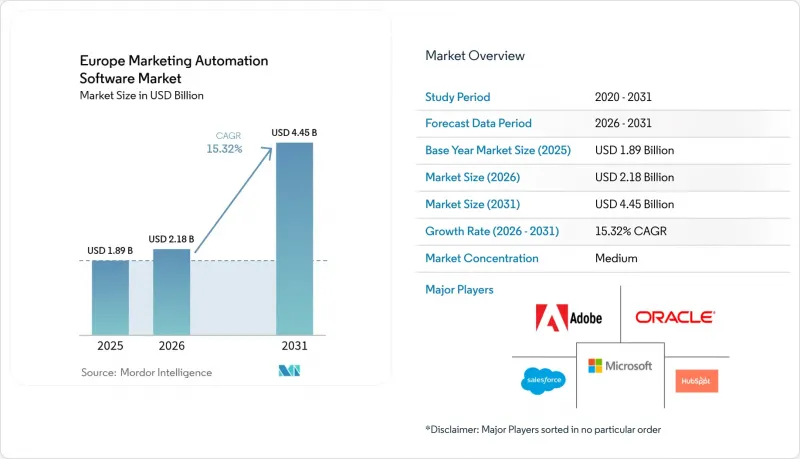
據 Mordor Intelligence 稱,2025 年歐洲行銷自動化軟體市場價值 18.9 億美元,預計到 2031 年將從 2026 年的 21.8 億美元成長至 44.5 億美元,預測期(2026-2031 年)複合年成長率為 15.32%。
[1] 歐盟委員會,“數字歐洲計劃”,europa.eu。歐盟正持續努力,力爭2030年達到75%的雲端運算採用率。為此,歐盟推出了79億歐元(約85.5億美元)的“數位歐洲計畫”,旨在透過津貼中小企業採用SaaS服務,促進短期市場擴張。本報告按元件(軟體、服務)、部署類型(雲端、本地部署)、組織規模(中小企業、大型企業)、管道/功能(電子郵件行銷、社群媒體行銷、宣傳活動管理等)、最終用戶產業(零售和電子商務、銀行、金融服務和保險等)以及國家/地區進行細分。市場預測以美元計價。
歐洲行銷自動化軟體市場的趨勢與洞察
德國、奧地利、瑞士以及其他北歐國家電子商務中人工智慧驅動的個人化服務激增,正在推動市場發展。
人工智慧引擎正在滲透到德語區(德國、奧地利和瑞士)以及北歐的零售業,65%的高階主管認為人工智慧是2025年的核心成長驅動力。行銷人員正在利用該地區先進的雲端基礎設施和較高的資料共用授權率來部署建議模型,從而提高轉換率。 Telmore在實施人工智慧驅動的個人化策略後,銷售額成長了11%,展現了可量化的投資報酬率,並正在加速其同業採用此技術。雖然80%的公司計劃增加人工智慧預算,但只有12%的公司證明了投資回報率,而擁有完善衡量框架的早期採用者則獲得了競爭優勢。德國的負責人正在使用生成式人工智慧來簡化宣傳活動創建和報告流程,減少重複性工作,並將員工重新分配到分析工作中。因此,德語區和北歐地區正在成為下一代個人化功能的試驗場,這些功能隨後將在歐洲推廣。
歐盟的數位單一市場舉措正在促進中小企業對SaaS的採用。
總額達79億歐元(約85.5億美元)的「數位歐洲計畫」透過協調雲端運算法規並資助「歐洲數位創新中心」(提供實用指導),降低了中小企業進入雲端運算領域的門檻。標準化API提高了資料可移植性,促進了不同行銷應用之間的整合,並降低了供應商鎖定風險。目前歐盟企業的雲端運算採用率為41%,預計2030年將達到75%。這代表著基於SaaS的行銷自動化系統將獲得大規模新客戶。這些政策利好因素正在降低中型買家的合規複雜性,並擴大歐洲行銷自動化軟體市場的潛在需求。
具備 GDPR 專業知識的行銷自動化架構師短缺
由於只有少數專業人士同時具備行銷技術(MarTech)的專業知識和法律知識,實施專案日益停滯不前。 2007年至2022年間,傳統銀行業就業人數下降了21%,銀行業重組凸顯了跨產業對數據專家的競爭。中小企業受到的衝擊尤其嚴重,它們對外部管理服務的依賴也隨之增加。這解釋了服務業16.1%的複合年成長率。儘管歐洲數位創新中心的認證計畫有所幫助,但短期人才短缺限制了小規模經濟體對行銷技術的應用。
細分市場分析
2025年,軟體仍佔歐洲行銷自動化軟體市場收入的71.30%,但託管服務表現較佳,到2031年複合年成長率將達到15.92%,凸顯了企業對合規專業知識外包的偏好。服務需求的激增表明,企業對技術執行和監管檢驗的重視程度與對核心功能的重視程度相當。在軟體領域,由於買家需要資料隱私審計和人工智慧模型管治的“單一資料資訊來源”,因此整合套件的表現優於獨立工具。專業服務蓬勃發展,主要集中在舊有系統整合和GDPR差距分析,顧問公司和系統整合商在供應商選擇中扮演著安全隔離網閘。
隨著人工智慧法規的實施,監管力道加大,從設計階段就融入可審計性的解決方案藍圖變得日益重要。供應商透過將軟體包與諮詢協議結合,創造了年度收入來源。因此,歐洲行銷自動化軟體產業很可能會出現混合經營模式,將軟體獲利與綜合服務相結合,以應對涵蓋 GDPR、PSD2 和特定產業監管要求的動態規則集。
到2025年,雲端解決方案將佔據歐洲行銷自動化軟體市場77.20%的佔有率。這得歸功於歐盟對主權可靠雲端框架的支持。隨著平台持續更新,客戶無需大幅增加資本支出即可滿足新的數據處理需求,雲端採用率正以15.62%的複合年成長率快速成長。行銷團隊正受益於利用彈性運算運行人工智慧模型並即時個人化客戶體驗。只有當公共部門和國防相關客戶有嚴格的資料居住要求時,才會保留本地部署環境。
監管機構傾向於支援自動化授權記錄、資料外洩通知和加密管理的集中式雲端管理平台。這種監管一致性降低了用戶感知到的風險,並促進了更廣泛的雲端遷移。例如, Oracle和 Palantir 合作為歐盟建立安全雲端區域,就體現了超大規模雲端服務供應商如何透過在地化其技術堆疊來滿足主權要求。隨著雲端技術的成熟,雲端供應商將在零信任架構和預先認證的 AI 沙箱等加值服務層展開競爭。
其他好處:
- Excel格式的市場預測(ME)表
- 3個月的分析師支持
目錄
第1章:引言
- 研究假設和市場定義
- 調查範圍
第2章:調查方法
第3章執行摘要
第4章 市場狀況
- 市場概覽
- 市場促進因素
- 在德國、奧地利和北歐地區的電子商務市場中,人工智慧驅動的個人化服務激增,正在推動市場發展。
- 歐盟的數位單一市場舉措正在推動中小企業採用SaaS技術。
- B2B技術中心採用帳戶為基礎的行銷方式正在推動市場發展。
- 歐洲金融服務領域對開放銀行API的整合正在推動市場發展。
- 在細分市場中整合多語言客戶體驗
- 市場限制因素
- 具備 GDPR 專業知識的行銷自動化架構師短缺
- 多語言個人化模組的總擁有成本 (TCO) 較高。
- 歐盟嚴格的反垃圾郵件法規正在影響電子郵件的送達率。
- 價值鏈分析
- 監理展望
- 技術展望
- 市場宏觀經濟趨勢的評估
- 波特五力分析
第5章 市場規模與成長預測
- 按組件
- 軟體
- 整合平台
- 獨立工具
- 線索管理
- 社群媒體
- 電子郵件和分析
- 服務
- 專業服務
- 託管服務
- 軟體
- 部署模式
- 基於雲端的
- 現場
- 按組織規模
- 小型企業
- 大公司
- 通道/功能
- 電子郵件行銷
- 社群媒體行銷
- 宣傳活動管理
- 行動/簡訊行銷
- 入境行銷和內容行銷
- 其他頻道
- 按最終用戶行業分類
- 零售與電子商務
- 銀行、金融服務、保險業 (BFSI)
- IT/通訊
- 製造業
- 醫療保健和生命科學
- 媒體與娛樂
- 政府/公共部門
- 其他終端用戶產業
- 國家
- 英國
- 德國
- 法國
- 義大利
- 西班牙
- 荷蘭
- 北歐的
- 其他歐洲國家
第6章 競爭情勢
- 市場集中度
- 策略趨勢
- 市佔率分析
- 公司簡介
- Salesforce, Inc.
- Adobe Inc.(Marketo Inc.)
- HubSpot Inc.
- Oracle Corporation
- Microsoft Corporation
- SAP SE
- SAS Institute Inc.
- Act-On Software, Inc.
- Dotdigital Group PLC
- Force24 Ltd.
- ActiveCampaign LLC
- Mailchimp(Intuit Inc.)
- Sendinblue SAS(Brevo)
- GetResponse Sp. z oo
- Zoho Corporation
- Pipedrive OU
- SugarCRM Inc.
- Acoustic LP
- Iterable Inc.
- Klaviyo Inc.
第7章 市場機會與未來展望
According to Mordor Intelligence, the Europe marketing automation software market size was valued at USD 1.89 billion in 2025 and estimated to grow from USD 2.18 billion in 2026 to reach USD 4.45 billion by 2031, at a CAGR of 15.32% during the forecast period (2026-2031).
[1] European Commission, "The Digital Europe Programme," europa.eu Ongoing EU Digital Single Market measures that target 75% cloud adoption by 2030, together with the EUR 7.9 billion (USD 8.55 billion) Digital Europe Programme, underpin near-term expansion by subsidizing SaaS adoption among small and medium-sized enterprises. This report is Segmented by Component (Software, Services), Deployment Mode (Cloud-Based, On-Premise), Organisation Size (Small and Medium Enterprises, Large Enterprises), Channel / Function (Email Marketing, Social Media Marketing, Campaign Management, and More), End-User Industry (Retail and E-Commerce, BFSI, and More), and Country. The Market Forecasts are Provided in Terms of Value (USD).
Europe Marketing Automation Software Market Trends and Insights
AI-Powered Personalisation Surge in DACH and Nordics E-commerce Drives the Market
AI-enabled engines have permeated DACH and Nordic retail, with 65% of executives naming AI a core growth lever in 2025. Marketers exploit the regions' advanced cloud infrastructure and high data-sharing consent rates to roll out recommendation models that elevate conversion. Telmore recorded an 11% uplift in sales after adopting AI-driven personalization, illustrating quantifiable ROI that accelerates peer adoption. As 80% of companies earmark higher AI budgets yet only 12% prove ROI, early adopters with strong measurement frameworks gain competitive distance. German practitioners use generative AI to streamline campaign production and reporting, cutting repetitive tasks and redeploying staff toward analytics. Consequently, the DACH-Nordic corridor functions as a test bed for next-wave personalization capabilities that subsequently diffuse across Europe.
EU Digital Single-Market Initiatives Boosting SME SaaS Uptake
The EUR 7.9 billion (USD 8.55 billion) Digital Europe Programme lowers barriers for SMEs by harmonizing cloud regulations and funding European Digital Innovation Hubs that provide hands-on guidance. Standardized APIs improve data portability, easing integration among disparate marketing applications and mitigating vendor lock-in risks. Cloud adoption among EU enterprises stands at 41% and is slated to reach 75% by 2030, translating into a sizeable new customer pool for SaaS-based marketing automation. These policy tailwinds curtail compliance complexity for mid-market buyers and amplify addressable demand within the Europe marketing automation software market.
Scarcity of GDPR-Fluent Marketing-Automation Architects
Implementation projects increasingly stall because only a narrow cadre of professionals combines martech proficiency with legal insight. Banking workforce realignment illustrates cross-industry competition for data specialists after a 21% employment contraction in traditional roles between 2007 and 2022. SMEs are disproportionately affected, leading to a reliance on external managed services, which explains their 16.1% CAGR within the services component. Certification initiatives by European Digital Innovation Hubs provide relief, but near-term talent gaps constrain uptake within smaller economies.
Other drivers and restraints analyzed in the detailed report include:
- Account-Based Marketing Adoption in B2B Tech Hubs Drives the Market
- Open-Banking API Integration in European Financial Services Drives the Market
- High TCO for Multi-Language Personalisation Modules
For complete list of drivers and restraints, kindly check the Table Of Contents.
Segment Analysis
Software continued to generate 71.30% of Europe marketing automation software market revenue in 2025, though managed services outpaced with a 15.92% CAGR to 2031, underscoring corporates' preference for outsourced compliance know-how. The services surge signals that enterprises consider technical execution and regulatory validation equally critical as core functionality. Within software, integrated suites eclipse point tools because buyers demand one source of truth for data privacy audits and AI model governance. Professional services thrive on legacy-system integration and GDPR gap analysis, positioning consultancies and system integrators as gatekeepers for vendor selection.
Heightened AI Act scrutiny places a premium on solution blueprints that embed auditability by design. Vendors combine packaged software with advisory retainers, generating annuity-style revenue. The Europe marketing automation software industry will therefore see blended business models, where software margins pair with high-touch services to address dynamic rule-sets spanning GDPR, PSD2, and sector-specific mandates.
Cloud options owned 77.20% of the Europe marketing automation software market in 2025, bolstered by EU backing for sovereign and trusted cloud frameworks. Cloud deployments are expanding at 15.62% CAGR because continuous platform updates help clients absorb new data-handling obligations without capex spikes. Marketing teams benefit from elastic compute to run AI models that personalize journeys in real time. On-premise persists only where public-sector or defense clients demand strict data residency.
Regulators favor cloud's centralized control planes that support automated consent logging, breach notification, and encryption management. This regulatory alignment reduces perceived risk, spurring broader cloud migration. Partnerships, such as Oracle's tie-up with Palantir for secure EU cloud regions, illustrate how hyperscale providers localize stacks to satisfy sovereignty narratives. As uptake matures, cloud vendors will compete on value-add layers like zero-trust architectures and pre-certified AI sandboxing.
Complete Report Scope:
- By Component
- Software
- Integrated Platforms
- Stand-Alone Tools
- Lead Management
- Social Media
- Email and Analytics
- Services
- Professional Services
- Managed Services
- Software
- By Deployment Mode
- Cloud-Based
- On-Premise
- By Organisation Size
- Small and Medium Enterprises
- Large Enterprises
- By Channel / Function
- Email Marketing
- Social Media Marketing
- Campaign Management
- Mobile / SMS Marketing
- Inbound and Content Marketing
- Other Channels
- By End-user Industry
- Retail and E-commerce
- BFSI (Banking, FinServ and Insurance)
- IT and Telecom
- Manufacturing
- Healthcare and Life-Sciences
- Media and Entertainment
- Government and Public Sector
- Other End-user Industries
- By Country
- United Kingdom
- Germany
- France
- Italy
- Spain
- Netherlands
- Nordics
- Rest of Europe
List of Companies Covered in this Report:
- Salesforce, Inc.
- Adobe Inc.(Marketo Inc.)
- HubSpot Inc.
- Oracle Corporation
- Microsoft Corporation
- SAP SE
- SAS Institute Inc.
- Act-On Software, Inc.
- Dotdigital Group PLC
- Force24 Ltd.
- ActiveCampaign LLC
- Mailchimp (Intuit Inc.)
- Sendinblue SAS (Brevo)
- GetResponse Sp. z o.o.
- Zoho Corporation
- Pipedrive OU
- SugarCRM Inc.
- Acoustic LP
- Iterable Inc.
- Klaviyo Inc.
Additional Benefits:
- The market estimate (ME) sheet in Excel format
- 3 months of analyst support
TABLE OF CONTENTS
1 INTRODUCTION
- 1.1 Study Assumptions and Market Definition
- 1.2 Scope of the Study
2 RESEARCH METHODOLOGY
3 EXECUTIVE SUMMARY
4 MARKET LANDSCAPE
- 4.1 Market Overview
- 4.2 Market Drivers
- 4.2.1 AI-Powered Personalisation Surge in DACH and Nordics E-commerce Drives the Market
- 4.2.2 EU Digital Single-Market Initiatives Boosting SME SaaS Uptake
- 4.2.3 Account-Based Marketing Adoption in B2B Tech Hubs Drives the Market
- 4.2.4 Open-Banking API Integration in European Financial Services Drives the Market
- 4.2.5 Multi-Lingual Journey Orchestration Across Fragmented Markets
- 4.3 Market Restraints
- 4.3.1 Scarcity of GDPR-Fluent Marketing-Automation Architects
- 4.3.2 High TCO for Multi-Language Personalisation Modules
- 4.3.3 Stringent EU Anti-Spam Rules Impacting Email Deliverability
- 4.4 Value Chain Analysis
- 4.5 Regulatory Outlook
- 4.6 Technological Outlook
- 4.7 Assessment of Macro Economic Trends on the Market
- 4.8 Porter's Five Forces Analysis
- 4.8.1 Bargaining Power of Suppliers
- 4.8.2 Bargaining Power of Buyers
- 4.8.3 Threat of New Entrants
- 4.8.4 Threat of Substitutes
- 4.8.5 Competitive Rivalry
5 MARKET SIZE AND GROWTH FORECASTS (VALUES)
- 5.1 By Component
- 5.1.1 Software
- 5.1.1.1 Integrated Platforms
- 5.1.1.2 Stand-Alone Tools
- 5.1.1.2.1 Lead Management
- 5.1.1.2.2 Social Media
- 5.1.1.2.3 Email and Analytics
- 5.1.2 Services
- 5.1.2.1 Professional Services
- 5.1.2.2 Managed Services
- 5.1.1 Software
- 5.2 By Deployment Mode
- 5.2.1 Cloud-Based
- 5.2.2 On-Premise
- 5.3 By Organisation Size
- 5.3.1 Small and Medium Enterprises
- 5.3.2 Large Enterprises
- 5.4 By Channel / Function
- 5.4.1 Email Marketing
- 5.4.2 Social Media Marketing
- 5.4.3 Campaign Management
- 5.4.4 Mobile / SMS Marketing
- 5.4.5 Inbound and Content Marketing
- 5.4.6 Other Channels
- 5.5 By End-user Industry
- 5.5.1 Retail and E-commerce
- 5.5.2 BFSI (Banking, FinServ and Insurance)
- 5.5.3 IT and Telecom
- 5.5.4 Manufacturing
- 5.5.5 Healthcare and Life-Sciences
- 5.5.6 Media and Entertainment
- 5.5.7 Government and Public Sector
- 5.5.8 Other End-user Industries
- 5.6 By Country
- 5.6.1 United Kingdom
- 5.6.2 Germany
- 5.6.3 France
- 5.6.4 Italy
- 5.6.5 Spain
- 5.6.6 Netherlands
- 5.6.7 Nordics
- 5.6.8 Rest of Europe
6 COMPETITIVE LANDSCAPE
- 6.1 Market Concentration
- 6.2 Strategic Moves
- 6.3 Market Share Analysis
- 6.4 Company Profiles (includes Global-level Overview, Market-level Overview, Core Segments, Financials as available, Strategic Information, Market Rank/Share, Products and Services, Recent Developments)
- 6.4.1 Salesforce, Inc.
- 6.4.2 Adobe Inc.(Marketo Inc.)
- 6.4.3 HubSpot Inc.
- 6.4.4 Oracle Corporation
- 6.4.5 Microsoft Corporation
- 6.4.6 SAP SE
- 6.4.7 SAS Institute Inc.
- 6.4.8 Act-On Software, Inc.
- 6.4.9 Dotdigital Group PLC
- 6.4.10 Force24 Ltd.
- 6.4.11 ActiveCampaign LLC
- 6.4.12 Mailchimp (Intuit Inc.)
- 6.4.13 Sendinblue SAS (Brevo)
- 6.4.14 GetResponse Sp. z o.o.
- 6.4.15 Zoho Corporation
- 6.4.16 Pipedrive OU
- 6.4.17 SugarCRM Inc.
- 6.4.18 Acoustic LP
- 6.4.19 Iterable Inc.
- 6.4.20 Klaviyo Inc.
7 MARKET OPPORTUNITIES AND FUTURE OUTLOOK
- 7.1 White-Space and Unmet-Need Assessment

 2026-2030年全球行銷自動化軟體市場
 2026年全球行銷自動化軟體市場報告
 全球行銷自動化軟體市場:市場規模、佔有率、成長率、產業分析、依類型、應用和地區劃分的分析及預測(2026-2034年)
 行銷自動化軟體市場 - 全球產業規模、佔有率、趨勢、機會及預測(按應用、部署模式、企業類型、最終用戶、地區和競爭格局分類,2021-2031 年)
 行銷自動化軟體 - 全球市場佔有率和排名、總收入和需求預測(2025-2031 年)
 亞太地區西方行銷自動化軟體市場 -市場佔有率分析、產業趨勢/統計、成長預測(2025-2030)北美行銷自動化軟體:市場佔有率分析、產業趨勢與統計、成長預測(2025-2030 年)