


 |
市場調查報告書
商品編碼
2121474
汽車網路安全:市場佔有率分析、產業趨勢與統計及成長預測(2026-2031 年)Cybersecurity For Cars - Market Share Analysis, Industry Trends & Statistics, Growth Forecasts (2026 - 2031) |
||||||

※ 本網頁內容可能與最新版本有所差異。詳細情況請與我們聯繫。
據估計,到 2026 年,汽車網路安全市場價值將達到 47.5 億美元,高於 2025 年的 40.9 億美元,預計到 2031 年將達到 100.3 億美元。
預計從 2026 年到 2031 年,其複合年成長率將達到 16.12%。
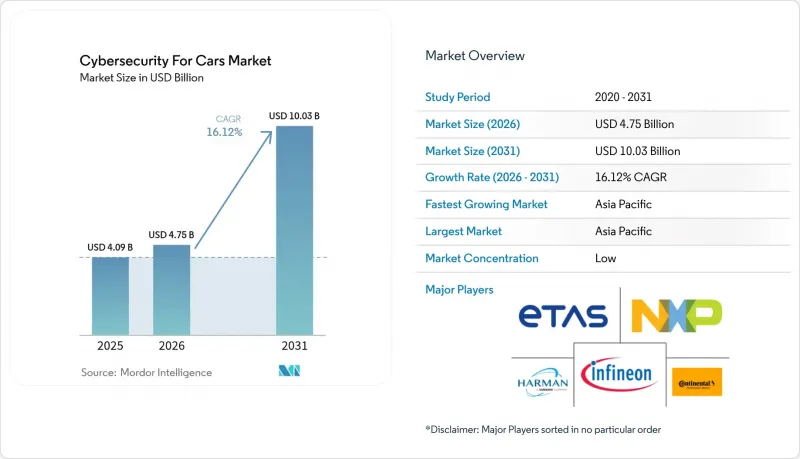
本報告按解決方案類型(軟體解決方案、硬體解決方案等)、安全類型(網路安全、應用安全等)、車輛類型(乘用車、輕型商用車等)、應用領域(資訊娛樂、遠端資訊處理和互聯等)、形式(車載服務和外部雲端服務)以及地區進行細分。市場預測以美元計價。
全球汽車網路安全市場趨勢及洞察
監管要求正在推動根本性變革。
目前,全球型式認證的關鍵在於證明端到端的安全性。光是聯合國歐洲經濟委員會R155標準一項,到2030年就將創造21億美元的合規相關商機,因為原始設備製造商(OEM)必須追蹤69種攻擊途徑,並證明其在車輛的整個生命週期內進行持續監控。 IS/SAE 21434標準明確定義了概念階段和報廢階段的網路安全工程,迫使汽車製造商擴充其專業團隊。日本和美國也正在引入類似的法規,從而消除先發劣勢,並實現全球標準的統一。
聯網汽車數量的不斷增加正在擴大攻擊面。
現代汽車包含多達150個ECU和1億行程式碼,到2030年這數字可能會成長三倍,對傳統防禦帶來巨大壓力。目前,43%的安全事件發生在後端伺服器,95%的攻擊是遠端攻擊。基於5G的V2X通訊增加了高頻寬攻擊途徑,暴露了遠端資訊處理閘道;而針對經銷商IT系統的勒索軟體攻擊則凸顯了車輛邊界之外的供應鏈漏洞。
整合到傳統架構中的成本阻礙了其普及應用。
在傳統平台上增加超過150個ECU可能會使車輛開發預算增加15%至20%。大陸集團2022年遭遇的資料外洩事件凸顯了其供應商網路的脆弱性,迫使其進行代價高昂的架構改造。儘管合規期限臨近,但這項財務負擔正在延緩這些ECU在大規模生產品牌中的應用。
細分市場分析
到了2025年,基於軟體的平台將佔總收入的40.55%,凸顯其在「軟體定義汽車」時代的核心地位。在這個時代,嵌入式防火牆、安全韌體和運行時入侵偵測技術正在融合。然而,隨著原始設備製造商(OEM)將差距分析、威脅建模和審計準備工作外包給專家顧問,諮詢主導服務正以19.1%的複合年成長率快速成長。在汽車網路安全市場,能夠將持續監控與UNECE R155文件支援相結合的供應商正日益受到認可,哈曼的端對端WP.29軟體包就充分體現了這一能力。
此外,當硬體安全模組、PKI 套件和雲端 SOC 平台必須在緊迫的開發週期內實現互通時,專業服務在協調多供應商整合方面發揮著至關重要的作用。這種跨領域協調使得服務供應商成為合規藍圖的關鍵安全隔離網閘,其收入來源也轉向了定期評估和託管檢測合約。因此,汽車網路安全市場正在經歷一場包含服務保留條款的合作關係的激增,從而確保軟體授權人的終身利潤。
2025年,端點控制仍將維持29.62%的市場佔有率,加密金鑰、安全啟動和ECU級防火牆仍是其基礎。然而,隨著汽車製造商將資料湖、OTA編配和車隊分析遷移到車外,雲端保護正以20.6%的複合年成長率快速成長。在Upstream與Google雲端等合作專案的推動下,汽車網路安全市場中雲端保護的市場規模正逐季擴大。 2024年大眾汽車資料外洩事件的教訓表明,遙測加密不足會導致聲譽受損。
網路層分段和TLS v1.3升級與雲端運算的發展並進,但隨著車輛每週下載微服務,以應用程式為中心的安全性增強變得至關重要。無線安全仍然是“最後一公里”,保護著如今支撐車隊編組和V2I信令的5G鏈路。隨著虛擬ECU將任務卸載到邊緣,結合車載安全措施和遠端AI輔助分析的混合架構正成為整個汽車網路安全市場的新藍圖。
區域分析
預計到2025年,亞太地區將佔全球汽車網路安全銷售額的35.12%,複合年成長率達19.5%,成為該市場成長最快的地區。中國互聯電動車產量的增加推動了對支持V2G的PKI和ECU加固套件的大規模採購,而日本提前遵守聯合國歐洲經濟委員會(UNECE)的相關規定,加速了供應商認證進程。韓國5G高速公路的建設提升了對即時無線修補技術的需求,而印度不斷成長的出口需求則推動了對符合ISO 21434標準的工具的投資。這些趨勢共同促使區域供應商提供低延遲的雲端SOC服務,這些服務託管在符合資料居住要求的區域內。
北美是一個成熟但仍在不斷發展的市場,高階汽車和健全的保險體係正在推動網路安全的商業化。美國互聯汽車法規將於2025年3月生效,該法規要求原始設備製造商(OEM)對其供應鏈進行審核,確保零件符合監管規定,這將促使採購轉向國產晶片組和安全模組。加拿大的一級供應商正利用其地理位置接近性和監管一致性來整合安全的乙太網路骨幹。同時,墨西哥的組裝廠正在實施資安管理服務,以應對針對即時物流的勒索軟體攻擊。歐洲仍然是監管趨勢的領導者和研發中心。德國擁有博世、ETAS和大陸集團等主要供應商,但大陸集團過去發生的資料外洩事件凸顯了其集中式架構的漏洞。法國和英國正投入公共津貼研發抗量子汽車密碼技術,ENX VCS 審核架構正以 ISO 21434 為基礎,規範供應商評估。雖然東歐工程中心擁有極具競爭力的人才,但與戰爭相關的網路制裁正迫使人們重新評估籌資策略。
其他好處:
- Excel格式的市場預測(ME)表
- 3個月的分析師支持
目錄
第1章:引言
- 研究假設和市場定義
- 調查範圍
第2章:調查方法
第3章執行摘要
第4章 市場狀況
- 市場概覽
- 市場促進因素
- 一波符合監管要求(UNECE R155/R156、ISO 21434)的浪潮
- 聯網汽車數量的快速成長和5G/V2X部署的擴展
- ADAS和自動駕駛功能的普及增加了網路安全風險。
- 車網雙向充電(V2G)帶來了一個新的攻擊面。
- 根據使用情況提供保險折扣,並與經認證的網路安全增強措施掛鉤。
- 軟體定義車輛中 OEM 對 OTA 安全性更新的商業化
- 市場限制因素
- 高昂的整合成本和傳統的電子電氣架構
- 標準的碎片化和對認證的過度依賴
- 汽車業嚴重缺乏網路安全人員。
- 長壽命車輛保固期過後的責任問題令人擔憂
- 產業價值鏈分析
- 監理情勢
- 技術展望
- 產業吸引力—五力分析
- 供應商的議價能力
- 買方的議價能力
- 新進入者的威脅
- 替代品的威脅
- 競爭公司之間的競爭
- 宏觀經濟因素對市場的影響
第5章 市場規模與成長預測
- 按解決方案類型
- 基於軟體
- 基於硬體
- 專業服務
- 一體化
- 其他解決方案
- 按安全類型
- 網路安全
- 應用程式安全
- 雲端安全
- 端點安全
- 無線安全
- 車輛類型
- 搭乘用車
- 輕型商用車
- 大型商用車輛
- 電動車(純電動車/油電混合車/插電式油電混合車)
- 透過使用
- 資訊娛樂
- 遠端資訊處理和連接
- 動力傳動系統/推進控制
- ADAS及安全性
- 充電基礎設施和V2G
- 依表單類型
- 汽車(嵌入式)
- 外部雲端服務
- 按地區
- 北美洲
- 美國
- 加拿大
- 墨西哥
- 南美洲
- 巴西
- 阿根廷
- 智利
- 其他南美國家
- 歐洲
- 德國
- 英國
- 法國
- 義大利
- 西班牙
- 俄羅斯
- 其他歐洲國家
- 亞太地區
- 中國
- 印度
- 日本
- 韓國
- 馬來西亞
- 新加坡
- 澳洲
- 其他亞太國家
- 中東和非洲
- 中東
- 阿拉伯聯合大公國
- 沙烏地阿拉伯
- 土耳其
- 其他中東國家
- 非洲
- 南非
- 奈及利亞
- 其他非洲國家
- 中東
- 北美洲
第6章 競爭情勢
- 市場集中度
- 策略趨勢
- 市佔率分析
- 公司簡介
- Continental AG
- Harman International(Samsung)
- Bosch ETAS GmbH
- Infineon Technologies AG
- NXP Semiconductors NV
- Cisco Systems Inc.
- DENSO Corporation
- Visteon Corporation
- Delphi Technologies plc
- Honeywell International Inc.
- Argus Cyber Security Ltd.
- Karamba Security Ltd.
- Arilou Technologies Ltd.
- Escrypt GmbH
- Secunet Security Networks AG
- Upstream Security Ltd.
- VicOne Inc.(Trend Micro)
- GuardKnox Cyber-Technologies Ltd.
- BlackBerry QNX
- SafeRide Technologies Ltd.
- Cybellum Technologies Ltd.
- Trillium Secure Inc.
- Vector Informatik GmbH
- Comsec Automotive Ltd.
- GuardSquare NV
- AutoCrypt Co. Ltd.
第7章 市場機會與未來趨勢
- 評估閒置頻段和未滿足的需求
According to Mordor Intelligence, cybersecurity for cars market size in 2026 is estimated at USD 4.75 billion, growing from 2025 value of USD 4.09 billion with 2031 projections showing USD 10.03 billion, growing at 16.12% CAGR over 2026-2031.
This report is Segmented by Solution Type (Software-Based, Hardware-Based, and More), Security Type (Network Security, Application Security, and More), Vehicle Type (Passenger Cars, Light Commercial Vehicles, and More), Application (Infotainment, Telematics and Connectivity, and More), Form Type (In-Vehicle and External Cloud Services), and Geography. The Market Forecasts are Provided in Terms of Value (USD).
Global Cybersecurity For Cars Market Trends and Insights
Regulatory mandates drive fundamental change
Global homologation now hinges on demonstrating end-to-end security. UNECE R155 alone creates a USD 2.1 billion compliance opportunity by 2030 as OEMs must track 69 attack vectors and prove continuous monitoring throughout vehicle lifecycles. ISO/SAE 21434 hardcodes cybersecurity engineering into concept and decommission phases, prompting carmakers to expand specialist teams. Similar rules emerge in Japan and the United States, eliminating first-mover disadvantages and standardizing baselines worldwide.
Connected-vehicle fleet expansion multiplies attack surfaces
Modern cars host up to 150 ECUs and 100 million lines of code-volumes that could triple by 2030, stressing legacy defenses. Backend servers already account for 43% of incidents, and 95% of attacks originate remotely. 5G-based V2X exchanges add high-bandwidth vectors exposing telematics gateways, while ransomware targeting dealership IT highlights supply-chain vulnerabilities beyond the vehicle perimeter.
Legacy architecture integration costs constrain adoption
Retrofitting 150-plus ECUs in legacy platforms can add 15-20% to vehicle development budgets. Continental's 2022 breach illustrated supplier-network exposure and forced expensive architecture reviews. Such financial drag delays roll-outs among volume brands, even as compliance deadlines loom.
Other drivers and restraints analyzed in the detailed report include:
- ADAS proliferation elevates safety-critical risks
- Vehicle-to-Grid integration creates bidirectional pathways
- Automotive cybersecurity talent shortage limits execution
For complete list of drivers and restraints, kindly check the Table Of Contents.
Segment Analysis
Software-based platforms held 40.55% of 2025 revenue, underscoring their centrality in a software-defined vehicle era where embedded firewalls, secure firmware, and runtime intrusion detection converge. Consulting-led offerings, however, are on a 19.1% CAGR ascent as OEMs outsource gap analyses, threat modeling, and audit preparation to specialist advisors. The cybersecurity for cars market increasingly rewards vendors capable of bundling continuous monitoring with UNECE R155 documentation support, a capability visible in HARMAN's end-to-end WP.29 packages.
Professional services also orchestrate multi-vendor integration when hardware security modules, PKI suites, and cloud SOC platforms must interoperate inside tight development timelines. Such cross-domain coordination positions service providers as primary gatekeepers of compliance roadmaps, shifting revenue toward recurring assessment and managed-detection contracts. Consequently, the cybersecurity for cars market is witnessing alliances where software licensors embed service retainer clauses to secure lifetime margins.
Endpoint controls retained a 29.62% share in 2025 because cryptographic keys, secure boot, and ECU-level firewalls remain foundational. Yet cloud defenses are racing ahead at 20.6% CAGR as automakers shift data lakes, OTA orchestration, and fleet analytics off-board. The cybersecurity for cars market size for cloud protection is swelling each quarter, buoyed by collaborations such as Upstream's tie-up with Google Cloud. Incident lessons from the 2024 Volkswagen data breach showed that insufficient encryption of telemetry can cascade into reputational damage.
Network-layer segmentation and TLS v1.3 upgrades ride parallel with cloud growth, while application-centric hardening becomes imperative as vehicles download microservices weekly. Wireless security remains the final mile, guarding 5G links that now underpin platooning and V2I signalling. As virtual ECUs offload tasks to the edge, hybrid architectures combining in-vehicle enforcement with remote AI-assisted analytics form the emerging blueprint across the cybersecurity for cars market.
Complete Report Scope:
- By Solution Type
- Software-Based
- Hardware-Based
- Professional Services
- Integration
- Other Solutions
- By Security Type
- Network Security
- Application Security
- Cloud Security
- Endpoint Security
- Wireless Security
- By Vehicle Type
- Passenger Cars
- Light Commercial Vehicles
- Heavy Commercial Vehicles
- Electric Vehicles (BEV/HEV/PHEV)
- By Application
- Infotainment
- Telematics and Connectivity
- Powertrain/Propulsion Control
- ADAS and Safety
- Charging Infrastructure and V2G
- By Form Type
- In-Vehicle (Embedded)
- External Cloud Services
- By Geography
- North America
- United States
- Canada
- Mexico
- South America
- Brazil
- Argentina
- Chile
- Rest of South America
- Europe
- Germany
- United Kingdom
- France
- Italy
- Spain
- Russia
- Rest of Europe
- Asia-Pacific
- China
- India
- Japan
- South Korea
- Malaysia
- Singapore
- Australia
- Rest of Asia-Pacific
- Middle East and Africa
- Middle East
- United Arab Emirates
- Saudi Arabia
- Turkey
- Rest of Middle East
- Africa
- South Africa
- Nigeria
- Rest of Africa
- Middle East
- North America
Geography Analysis
Asia-Pacific commanded 35.12% revenue in 2025 and is projected to grow at 19.5% CAGR, making it the fastest-advancing geography within the cybersecurity for cars market. China's scaling of connected-EV production fuels large-scale procurement of V2G-ready PKI and ECU hardening suites, while Japan's early alignment with UNECE rules accelerates supplier certification programs. South Korea's 5G highways amplify demand for real-time over-the-air patching technologies, and India's emergent export ambitions trigger investments in ISO 21434 compliance tooling. Collectively, these dynamics push regional vendors to deliver low-latency cloud SOC services hosted within data-residency-compliant zones.
North America represents a mature yet evolving arena where premium vehicle trims and robust insurance ecosystems encourage cybersecurity monetization. The United States Connected Vehicles Rule, effective March 2025, forces OEMs to audit supply chains for sanctioned components, redirecting procurement toward domestic chipsets and security modules. Canada's tier-one suppliers leverage proximity and regulatory alignment to integrate secure Ethernet backbones, while Mexico's assembly plants adopt managed-security services to counter rising ransomware aimed at just-in-time logistics. Europe remains a regulatory trendsetter and R&D hub. Germany hosts flagship suppliers such as Bosch ETAS and Continental, although the latter's prior breach highlighted vulnerabilities in centralized architecture. France and the United Kingdom channel public grants into quantum-safe automotive cryptography, while the ENX VCS audit framework overlays ISO 21434 to standardize supplier assessments. Eastern European engineering hubs contribute competitive talent, though war-related cyber sanctions reshape sourcing strategies.
- Continental AG
- Harman International (Samsung)
- Bosch ETAS GmbH
- Infineon Technologies AG
- NXP Semiconductors NV
- Cisco Systems Inc.
- DENSO Corporation
- Visteon Corporation
- Delphi Technologies plc
- Honeywell International Inc.
- Argus Cyber Security Ltd.
- Karamba Security Ltd.
- Arilou Technologies Ltd.
- Escrypt GmbH
- Secunet Security Networks AG
- Upstream Security Ltd.
- VicOne Inc. (Trend Micro)
- GuardKnox Cyber-Technologies Ltd.
- BlackBerry QNX
- SafeRide Technologies Ltd.
- Cybellum Technologies Ltd.
- Trillium Secure Inc.
- Vector Informatik GmbH
- Comsec Automotive Ltd.
- GuardSquare NV
- AutoCrypt Co. Ltd.
Additional Benefits:
- The market estimate (ME) sheet in Excel format
- 3 months of analyst support
TABLE OF CONTENTS
1 INTRODUCTION
- 1.1 Study Assumptions and Market Definition
- 1.2 Scope of the Study
2 RESEARCH METHODOLOGY
3 EXECUTIVE SUMMARY
4 MARKET LANDSCAPE
- 4.1 Market Overview
- 4.2 Market Drivers
- 4.2.1 Regulatory mandates (UNECE R155/R156, ISO 21434) compliance wave
- 4.2.2 Rapid growth in connected-vehicle fleet and 5G/V2X roll-outs
- 4.2.3 ADAS/autonomous feature proliferation elevating cyber-risk
- 4.2.4 Vehicle-to-Grid (V2G) bidirectional charging introduces new attack surface
- 4.2.5 Usage-based-insurance discounts tied to certified cyber-hardening
- 4.2.6 OEM monetisation of OTA security updates in software-defined cars
- 4.3 Market Restraints
- 4.3.1 High integration cost and legacy E/E architectures
- 4.3.2 Fragmented standards and certification overload
- 4.3.3 Acute shortage of automotive-grade cyber-talent
- 4.3.4 Post-warranty liability concerns for long-life vehicles
- 4.4 Industry Value Chain Analysis
- 4.5 Regulatory Landscape
- 4.6 Technological Outlook
- 4.7 Industry Attractiveness - Porter's Five Forces Analysis
- 4.7.1 Bargaining Power of Suppliers
- 4.7.2 Bargaining Power of Buyers
- 4.7.3 Threat of New Entrants
- 4.7.4 Threat of Substitutes
- 4.7.5 Intensity of Competitive Rivalry
- 4.8 Impact of Macroeconomic Factors on the Market
5 MARKET SIZE AND GROWTH FORECASTS (VALUES)
- 5.1 By Solution Type
- 5.1.1 Software-Based
- 5.1.2 Hardware-Based
- 5.1.3 Professional Services
- 5.1.4 Integration
- 5.1.5 Other Solutions
- 5.2 By Security Type
- 5.2.1 Network Security
- 5.2.2 Application Security
- 5.2.3 Cloud Security
- 5.2.4 Endpoint Security
- 5.2.5 Wireless Security
- 5.3 By Vehicle Type
- 5.3.1 Passenger Cars
- 5.3.2 Light Commercial Vehicles
- 5.3.3 Heavy Commercial Vehicles
- 5.3.4 Electric Vehicles (BEV/HEV/PHEV)
- 5.4 By Application
- 5.4.1 Infotainment
- 5.4.2 Telematics and Connectivity
- 5.4.3 Powertrain/Propulsion Control
- 5.4.4 ADAS and Safety
- 5.4.5 Charging Infrastructure and V2G
- 5.5 By Form Type
- 5.5.1 In-Vehicle (Embedded)
- 5.5.2 External Cloud Services
- 5.6 By Geography
- 5.6.1 North America
- 5.6.1.1 United States
- 5.6.1.2 Canada
- 5.6.1.3 Mexico
- 5.6.2 South America
- 5.6.2.1 Brazil
- 5.6.2.2 Argentina
- 5.6.2.3 Chile
- 5.6.2.4 Rest of South America
- 5.6.3 Europe
- 5.6.3.1 Germany
- 5.6.3.2 United Kingdom
- 5.6.3.3 France
- 5.6.3.4 Italy
- 5.6.3.5 Spain
- 5.6.3.6 Russia
- 5.6.3.7 Rest of Europe
- 5.6.4 Asia-Pacific
- 5.6.4.1 China
- 5.6.4.2 India
- 5.6.4.3 Japan
- 5.6.4.4 South Korea
- 5.6.4.5 Malaysia
- 5.6.4.6 Singapore
- 5.6.4.7 Australia
- 5.6.4.8 Rest of Asia-Pacific
- 5.6.5 Middle East and Africa
- 5.6.5.1 Middle East
- 5.6.5.1.1 United Arab Emirates
- 5.6.5.1.2 Saudi Arabia
- 5.6.5.1.3 Turkey
- 5.6.5.1.4 Rest of Middle East
- 5.6.5.2 Africa
- 5.6.5.2.1 South Africa
- 5.6.5.2.2 Nigeria
- 5.6.5.2.3 Rest of Africa
- 5.6.5.1 Middle East
- 5.6.1 North America
6 COMPETITIVE LANDSCAPE
- 6.1 Market Concentration
- 6.2 Strategic Moves
- 6.3 Market Share Analysis
- 6.4 Company Profiles (includes Global level Overview, Market level overview, Core Segments, Financials as available, Strategic Information, Market Rank/Share for key companies, Products and Services, and Recent Developments)
- 6.4.1 Continental AG
- 6.4.2 Harman International (Samsung)
- 6.4.3 Bosch ETAS GmbH
- 6.4.4 Infineon Technologies AG
- 6.4.5 NXP Semiconductors NV
- 6.4.6 Cisco Systems Inc.
- 6.4.7 DENSO Corporation
- 6.4.8 Visteon Corporation
- 6.4.9 Delphi Technologies plc
- 6.4.10 Honeywell International Inc.
- 6.4.11 Argus Cyber Security Ltd.
- 6.4.12 Karamba Security Ltd.
- 6.4.13 Arilou Technologies Ltd.
- 6.4.14 Escrypt GmbH
- 6.4.15 Secunet Security Networks AG
- 6.4.16 Upstream Security Ltd.
- 6.4.17 VicOne Inc. (Trend Micro)
- 6.4.18 GuardKnox Cyber-Technologies Ltd.
- 6.4.19 BlackBerry QNX
- 6.4.20 SafeRide Technologies Ltd.
- 6.4.21 Cybellum Technologies Ltd.
- 6.4.22 Trillium Secure Inc.
- 6.4.23 Vector Informatik GmbH
- 6.4.24 Comsec Automotive Ltd.
- 6.4.25 GuardSquare NV
- 6.4.26 AutoCrypt Co. Ltd.
7 MARKET OPPORTUNITIES AND FUTURE TRENDS
- 7.1 White-Space and Unmet-Need Assessment

 汽車網路安全和資料保護市場預測至2034年-全球分析(按交付類型、連接方式、車輛架構、動力系統、安全類型、部署模式、網路安全解決方案、應用程式、最終用戶和地區分類)
 全球汽車網路安全人工智慧市場規模、佔有率和成長預測(2026-2031 年)汽車網路安全市場預測至2034年-全球分析(按安全領域、解決方案、產品/服務、車輛類型、動力類型、自動駕駛等級、應用、連接技術、部署、最終用戶和地區分類)聯網汽車網路安全市場預測至2034年:按產品、車輛類型、應用和區域分類的全球分析
 聯網汽車安全市場機會、成長要素、產業趨勢分析及2026-2035年預測
 全球汽車網路安全市場:按應用、安全類型、車輛自動化等級、車輛類型、動力系統、部署類型、產品/服務、電動車應用、方法、車輛架構和地區分類-預測至2033年
 汽車網路安全與資料安全市場(2026 年)Frost Radar™:汽車產品安全與合規解決方案,2026 年
 北美汽車網路安全:市場佔有率分析、產業趨勢與統計及成長預測(2026-2031 年)
 汽車LiDAR安全市場分析及至2035年的預測:類型、產品、服務、技術、組件、應用、部署模式、最終用戶、功能、解決方案