


 |
市場調查報告書
商品編碼
2100559
北美汽車網路安全:市場佔有率分析、產業趨勢與統計及成長預測(2026-2031 年)North America Cybersecurity of Cars - Market Share Analysis, Industry Trends & Statistics, Growth Forecasts (2026 - 2031) |
||||||

※ 本網頁內容可能與最新版本有所差異。詳細情況請與我們聯繫。
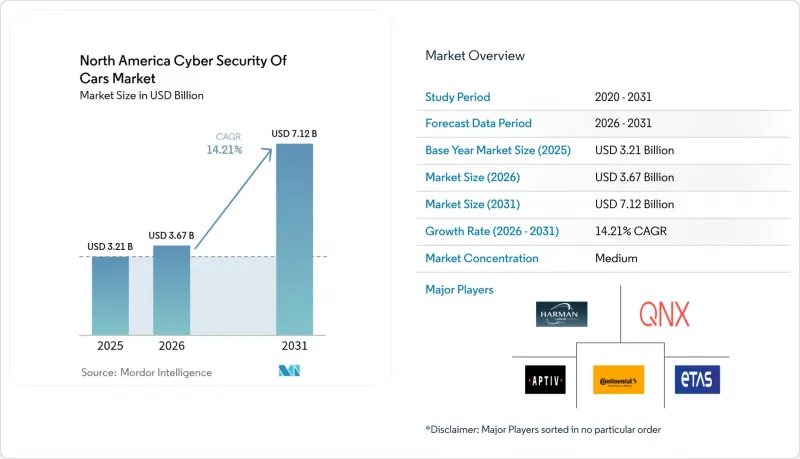
據 Mordor Intelligence 稱,2025 年北美汽車網路安全市場價值為 32.1 億美元,預計到 2031 年將從 2026 年的 36.7 億美元成長至 71.2 億美元,預測期(2026-2031 年)的複合年成長率為 14.21%。
本報告按解決方案類型(軟體解決方案、硬體解決方案等)、安全領域(網路安全、應用安全等)、車輛類型(乘用車、輕型商用車等)、應用領域(銀行、金融服務和保險等)、部署模式(車載邊緣、外部/雲端)和地區進行細分。市場預測以美元計價。
北美汽車網路安全市場趨勢與洞察
符合聯合國R155/ISO 21434標準的最後期限
這項於2024年7月強制執行的法規要求汽車製造商對其網路安全管理系統、軟體更新流程和持續漏洞監控進行認證。作為回應,汽車製造商已在其一級供應商網路中推行「安全設計」採購政策,從而加速了對第三方審計和管理服務合約的需求。無法證明流程成熟度的供應商將面臨被排除在新車專案之外的風險,這推動了北美汽車網路安全市場對專業服務的廣泛應用。
OTA軟體更新的採用率大幅上升。
預計到2025年,將有超過2.5億輛汽車支援OTA功能,召回措施正從店內服務宣傳活動轉向安全的遠端修補程式。汽車製造商正依靠加密認證和雙鏡像故障保護技術來確保更新的安全性。軟體發布頻率的不斷提高加劇了終端漏洞,導致北美汽車網路安全市場對終端保護代理和基於雲端的威脅情報聚合服務的需求日益成長。
極度分散的軟體供應鏈
一輛典型的汽車包含數百個供應商生產的模組,每個模組都有其獨特的韌體版本。由於缺乏全面的軟體材料清單(BOM),修補程式修復變得複雜,並導致多個電子控制單元 (ECU) 存在潛在漏洞。勒索軟體攻擊者利用第三方閘道器,使得北美地區報告的汽車供應鏈攻擊比例在 2024 年第二季上升至 58%。
細分市場分析
隨著防火牆、入侵偵測系統和基於人工智慧的分析成為聯網汽車的標配,以軟體為中心的平台在2025年佔據了39.65%的收入佔有率。同時,隨著原始設備製造商(OEM)將威脅監控和事件回應能力外包,超出其內部能力範圍,預計到2031年,專業服務和託管服務將以每年15.33%的速度成長。北美汽車網路安全市場的專業服務市場規模預計到2031年將成長近一倍。嚴重的人才短缺迫使汽車製造商轉向訂閱模式,將安全營運中心的存取權與合規性報告結合。
整合諮詢服務也推動了託管服務的發展勢頭,使供應商能夠統一其異質ECU堆疊中的安全控制。 Upstream Security的雲端監控服務已支援超過2500萬輛汽車,展現了一種可擴展的模式,其他供應商正在效仿。 NXP和英飛凌的硬體安全模組增加了「信任根」功能,降低了車載運算成本,但整合的成功仍取決於外部合作夥伴提供的全面漏洞管理工作流程。
到2025年,網路安全將以34.78%的市佔率引領市場,因為OEM廠商正在加強CAN-FD和汽車乙太網路的安全性,以抵禦封包欺騙攻擊。雲端/後端安全預計將以15.92%的複合年成長率成長,成為成長最快的領域,因為集中式資料湖每小時可收集高達Terabyte的車輛遙測數據,用於即時異常檢測。隨著網域控制器將日誌傳輸到為AI分析提供彈性運算的超大規模資料中心業者環境,雲端安全在北美汽車網路安全市場的佔有率正在不斷成長。
隨著第三方資訊娛樂和保險應用滲透到車載生態系統中,應用層級安全措施變得日益重要。沙盒和代碼簽名技術保護著 HARMAN Ignite Store 之類的駕駛座應用市場,而終端 ECU 安全則繼續專注於車身控制和安全執行器的輕量級加密。隨著數位服務組合的擴展,對身分和存取管理子網域的需求日益成長,儘管目前仍處於早期階段。
其他好處:
- Excel格式的市場預測(ME)表
- 3個月的分析師支持
目錄
第1章:引言
- 市場定義與研究假設
- 調查範圍
第2章:調查方法
第3章執行摘要
第4章 市場狀況
- 市場概覽
- 市場促進因素
- 符合聯合國法規 R155/ISO 21434 的最後期限
- OTA軟體更新的普及率正在迅速提高。
- 聯網汽車數量的不斷成長以及5G/V2X技術的部署
- 車載數位鑰匙生態系的快速擴張。
- 擴大電動車充電站的攻擊面
- OEM廠商針對「軟體定義車輛(SDV)」的收入模式
- 市場限制因素
- 極度分散的軟體供應鏈
- 威脅情勢的變化速度超過了標準化的速度
- AUTOSAR在網路安全領域面臨人才短缺的問題。
- 限制CAN-FD頻寬以用於安全有效載荷
- 價值鏈分析
- 重要法規結構的評估
- 技術展望
- 波特五力分析
- 宏觀經濟因素的影響
第5章 市場規模與成長預測
- 按解決方案類型
- 基於軟體
- 基於硬體
- 專業服務及託管服務
- 一體化
- 其他解決方案
- 現場安全
- 網路安全
- 應用程式安全
- 雲端/後端安全
- 端點ECU安全
- 其他領域
- 車輛類型
- 搭乘用車
- 輕型商用車
- 大型商用車輛
- 自動駕駛汽車和無人駕駛計程車
- 透過使用
- 遠端資訊處理和連接控制單元
- 資訊娛樂系統和數位駕駛座
- 進階駕駛輔助系統與自動駕駛系統
- 動力傳動系統/電動車充電介面
- 車身及舒適性ECU
- 部署模式
- 板載(邊緣)
- 離線/雲端
- 國家
- 美國
- 加拿大
- 墨西哥
第6章 競爭情勢
- 市場集中度
- 策略趨勢
- 市佔率分析
- 公司簡介
- Harman International Industries Inc.(Samsung Electronics Co. Ltd.)
- BlackBerry Ltd.(QNX Software Systems)
- Continental AG
- Robert Bosch GmbH(ETAS/ESCRYPT)
- Aptiv PLC
- IBM Corporation
- Cisco Systems Inc.
- NXP Semiconductors NV
- Infineon Technologies AG
- Qualcomm Inc.
- Honeywell International Inc.
- Visteon Corporation
- Argus Cyber Security Ltd.
- Karamba Security Ltd.
- Upstream Security Ltd.
- VicOne Inc.
- Cybellum Technologies Ltd.
- Secunet Security Networks AG
- ETAS GmbH
- Trend Micro Inc.
第7章 市場機會與未來趨勢
- 評估未開發的領域和未滿足的需求
According to Mordor Intelligence, the North America cybersecurity of Cars Market size was valued at USD 3.21 billion in 2025 and estimated to grow from USD 3.67 billion in 2026 to reach USD 7.12 billion by 2031, at a CAGR of 14.21% during the forecast period (2026-2031).
This report is Segmented by Solution Type (Software-Based, Hardware-Based, and More), Security Domain (Network Security, Application Security, and More), Vehicle Type (Passenger Cars, Light Commercial Vehicles, and More), Application (BFSI and More), Deployment Mode (On-Board Edge, Off-board/Cloud), and Geography. The Market Forecasts are Provided in Terms of Value (USD).
North America Cybersecurity of Cars Market Trends and Insights
UN R155 / ISO 21434 compliance deadlines
Mandatory enforcement beginning July 2024 forced OEMs to certify cybersecurity management systems, software-update processes, and continuous vulnerability monitoring. Automakers responded by embedding "security-by-design" procurement across their tier-one supply networks, accelerating demand for third-party audits and managed-service contracts . Suppliers unable to demonstrate process maturity face exclusion from new-vehicle programs, pushing professional-service uptake across the North America Cybersecurity of Cars Market.
Surge in OTA software-update adoption
More than 250 million vehicles are expected to support OTA functions by 2025, shifting recall mitigation from physical service campaigns to secure remote patching . Automakers rely on cryptographic authentication and dual-image fail-safe techniques to safeguard updates. The heightened cadence of software releases amplifies endpoint exposure, thereby elevating demand for endpoint-protection agents and cloud-based threat-intelligence aggregation throughout the North America Cybersecurity of Cars Market.
Highly fragmented software supply chain
Typical vehicles integrate hundreds of supplier modules, each with its own firmware lineage. The absence of comprehensive software bills of materials complicates patch orchestration, leaving latent vulnerabilities across multiple ECUs. Ransomware actors exploited third-party gateways, pushing North America's disclosed automotive supply-chain-attack share to 58% in Q2 2024.
Other drivers and restraints analyzed in the detailed report include:
- Growth of connected-car parc and 5G / V2X roll-out
- Rapid expansion of in-vehicle digital-key ecosystems
- Evolving threat landscape outpacing standards
For complete list of drivers and restraints, kindly check the Table Of Contents.
Segment Analysis
Software-centric platforms captured 39.65% of 2025 revenue as firewalls, intrusion-detection systems, and AI-based analytics became default requirements for connected vehicles. Professional and managed services, however, are forecast to grow 15.33% each year to 2031 as OEMs outsource threat monitoring and incident response functions that outpace in-house capability gaps. The North America Cybersecurity of Cars Market size for professional services is projected to nearly double by 2031. Severe workforce shortages push automakers toward subscription models that bundle security operations center access with compliance reporting.
Momentum in managed services also supports integration consulting, allowing suppliers to harmonize security controls across heterogeneous ECU stacks. Upstream Security's cloud surveillance service already supports more than 25 million vehicles, illustrating a scalable blueprint that other providers emulate . Hardware security modules from NXP and Infineon add root-of-trust features that reduce on-vehicle compute costs, but integration success still depends on holistic vulnerability-management workflows delivered by external partners.
Network security led the market with a 34.78% share in 2025 as OEMs hardened CAN-FD and automotive Ethernet against packet spoofing. Cloud/backend security is expected to post the fastest 15.92% CAGR as centralized data lakes collect up to 40 terabytes per hour of fleet telemetry for real-time anomaly detection. The North America Cybersecurity of Cars Market share for cloud security climbs as domain controllers forward logs to hyperscaler environments that offer elastic compute for AI analytics.
Application-level countermeasures gain relevance as third-party infotainment and insurance applications penetrate in-vehicle ecosystems. Sandboxing and code-signing functionalities protect cockpit marketplaces such as HARMAN Ignite Store, while endpoint ECU security continues to address lightweight encryption for body-control and safety actuators. Identity-and-access-management subdomains show early traction as digital-service portfolios expand.
Complete Report Scope:
- By Solution Type
- Software-based
- Hardware-based
- Professional and Managed Services
- Integration
- Other Solutions
- By Security Domain
- Network Security
- Application Security
- Cloud/Backend Security
- Endpoint ECU Security
- Other Domains
- By Vehicle Type
- Passenger Cars
- Light Commercial Vehicles
- Heavy Commercial Vehicles
- Autonomous and Robo-Taxis
- By Application
- Telematics and Connectivity Control Units
- Infotainment and Digital Cockpit
- ADAS and Autonomous Driving Systems
- Powertrain / EV Charging Interfaces
- Body and Comfort ECUs
- By Deployment Mode
- On-board (Edge)
- Off-board / Cloud
- By Country
- United States
- Canada
- Mexico
List of Companies Covered in this Report:
- Harman International Industries Inc. (Samsung Electronics Co. Ltd.)
- BlackBerry Ltd. (QNX Software Systems)
- Continental AG
- Robert Bosch GmbH (ETAS / ESCRYPT)
- Aptiv PLC
- IBM Corporation
- Cisco Systems Inc.
- NXP Semiconductors N.V.
- Infineon Technologies AG
- Qualcomm Inc.
- Honeywell International Inc.
- Visteon Corporation
- Argus Cyber Security Ltd.
- Karamba Security Ltd.
- Upstream Security Ltd.
- VicOne Inc.
- Cybellum Technologies Ltd.
- Secunet Security Networks AG
- ETAS GmbH
- Trend Micro Inc.
Additional Benefits:
- The market estimate (ME) sheet in Excel format
- 3 months of analyst support
TABLE OF CONTENTS
1 INTRODUCTION
- 1.1 Market Definition and Study Assumptions
- 1.2 Scope of the Study
2 RESEARCH METHODOLOGY
3 EXECUTIVE SUMMARY
4 MARKET LANDSCAPE
- 4.1 Market Overview
- 4.2 Market Drivers
- 4.2.1 UN Regulation R155/ISO 21434 compliance deadlines
- 4.2.2 Surge in OTA software-update adoption
- 4.2.3 Growth of connected-car parc and 5G/V2X roll-out
- 4.2.4 Rapid expansion of in-vehicle digital-key ecosystems
- 4.2.5 Rise of EV-charging-station attack surface
- 4.2.6 OEM "software-defined vehicle" revenue models
- 4.3 Market Restraints
- 4.3.1 Highly fragmented software supply-chain
- 4.3.2 Evolving threat landscape outpacing standards
- 4.3.3 Scarcity of AUTOSAR-cyber-skilled talent
- 4.3.4 Limited CAN-FD bandwidth for security payloads
- 4.4 Value Chain Analysis
- 4.5 Evaluation of Critical Regulatory Framework
- 4.6 Technological Outlook
- 4.7 Porter's Five Forces Analysis
- 4.7.1 Bargaining Power of Suppliers
- 4.7.2 Bargaining Power of Consumers
- 4.7.3 Threat of New Entrants
- 4.7.4 Threat of Substitutes
- 4.7.5 Intensity of Competitive Rivalry
- 4.8 Impact of Macro-economic Factors
5 MARKET SIZE AND GROWTH FORECASTS (VALUE)
- 5.1 By Solution Type
- 5.1.1 Software-based
- 5.1.2 Hardware-based
- 5.1.3 Professional and Managed Services
- 5.1.4 Integration
- 5.1.5 Other Solutions
- 5.2 By Security Domain
- 5.2.1 Network Security
- 5.2.2 Application Security
- 5.2.3 Cloud/Backend Security
- 5.2.4 Endpoint ECU Security
- 5.2.5 Other Domains
- 5.3 By Vehicle Type
- 5.3.1 Passenger Cars
- 5.3.2 Light Commercial Vehicles
- 5.3.3 Heavy Commercial Vehicles
- 5.3.4 Autonomous and Robo-Taxis
- 5.4 By Application
- 5.4.1 Telematics and Connectivity Control Units
- 5.4.2 Infotainment and Digital Cockpit
- 5.4.3 ADAS and Autonomous Driving Systems
- 5.4.4 Powertrain / EV Charging Interfaces
- 5.4.5 Body and Comfort ECUs
- 5.5 By Deployment Mode
- 5.5.1 On-board (Edge)
- 5.5.2 Off-board / Cloud
- 5.6 By Country
- 5.6.1 United States
- 5.6.2 Canada
- 5.6.3 Mexico
6 COMPETITIVE LANDSCAPE
- 6.1 Market Concentration
- 6.2 Strategic Moves
- 6.3 Market Share Analysis
- 6.4 Company Profiles (includes Global level Overview, Market level overview, Core Segments, Financials as available, Strategic Information, Market Rank/Share for key companies, Products and Services, and Recent Developments)
- 6.4.1 Harman International Industries Inc. (Samsung Electronics Co. Ltd.)
- 6.4.2 BlackBerry Ltd. (QNX Software Systems)
- 6.4.3 Continental AG
- 6.4.4 Robert Bosch GmbH (ETAS / ESCRYPT)
- 6.4.5 Aptiv PLC
- 6.4.6 IBM Corporation
- 6.4.7 Cisco Systems Inc.
- 6.4.8 NXP Semiconductors N.V.
- 6.4.9 Infineon Technologies AG
- 6.4.10 Qualcomm Inc.
- 6.4.11 Honeywell International Inc.
- 6.4.12 Visteon Corporation
- 6.4.13 Argus Cyber Security Ltd.
- 6.4.14 Karamba Security Ltd.
- 6.4.15 Upstream Security Ltd.
- 6.4.16 VicOne Inc.
- 6.4.17 Cybellum Technologies Ltd.
- 6.4.18 Secunet Security Networks AG
- 6.4.19 ETAS GmbH
- 6.4.20 Trend Micro Inc.
7 MARKET OPPORTUNITIES AND FUTURE TRENDS
- 7.1 White-space and Unmet-need Assessment

 全球汽車網路安全市場:按應用、安全類型、車輛自動化等級、車輛類型、動力系統、部署類型、產品/服務、電動車應用、方法、車輛架構和地區分類-預測至2033年
 汽車網路安全與資料安全市場(2026 年)
 汽車網路安全:市場佔有率分析、產業趨勢與統計及成長預測(2026-2031 年)
 Frost Radar™:汽車產品安全與合規解決方案,2026 年
 汽車網路安全市場:依安全類型、組件類型、車輛類型、部署模式和最終用戶分類-2026-2032年全球市場預測
 汽車LiDAR安全市場分析及至2035年的預測:類型、產品、服務、技術、組件、應用、部署模式、最終用戶、功能、解決方案
 2026-2030年全球聯網汽車安全市場
 汽車網路安全市場:按產品、應用、形式、安全類型、方法、車輛類型、國家和地區分類-全球產業分析、市場規模、市場佔有率及2026年至2033年預測
 互聯社區安全生態系統市場預測至2034年:按組件、部署模式、最終用戶和地區分類的全球分析
 汽車網路安全市場規模、佔有率和趨勢分析報告:按安全類型、車輛類型、服務、應用、地區和細分市場預測(2026-2033 年)