


 |
市場調查報告書
商品編碼
2121457
工業酵素:市場佔有率分析、產業趨勢與統計、成長預測(2026-2031)Industrial Enzymes - Market Share Analysis, Industry Trends & Statistics, Growth Forecasts (2026 - 2031) |
||||||

※ 本網頁內容可能與最新版本有所差異。詳細情況請與我們聯繫。
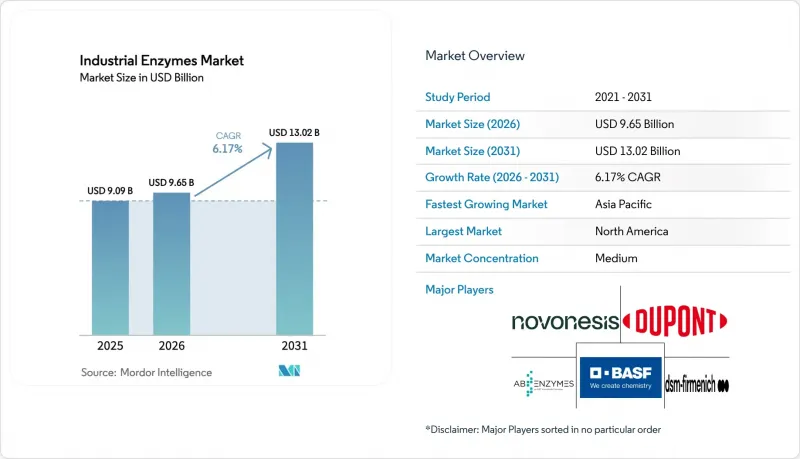
工業酵素市場預計將從 2025 年的 90.9 億美元和 2026 年的 96.5 億美元成長到 2031 年的 130.2 億美元,2026 年至 2031 年的年複合成長率(CAGR)為 6.17%。
本報告按類型(碳水化合物消化酶、蛋白質消化酶、脂肪分解酶及其他)、應用領域(食品加工、動物飼料、醫療保健、清潔劑和清潔劑、生質燃料加工、生物燃料、紡織品、紙漿和造紙、化妝品等)以及地區(亞太地區、北美地區、歐洲地區、南美地區、中東和非洲)進行細分。市場預測以美元計價。
全球工業酵素市場趨勢與洞察
強制使用生質燃料正在提振需求,特別是澱粉基乙醇和纖維素乙醇的需求。
諸如美國可再生燃料標準(RFS)等法規的目標是到2027年實現360億加侖可再生燃料的目標,其中160億加侖必須是纖維素燃料,這推動了對能將葡萄糖產率提高到85%以上的多酶混合物的需求。巴西的RenovaBio計劃獎勵那些減少生命週期排放的乙醇工廠,並推廣能夠減輕預處理負擔的酵素配方。國際能源總署(IEA)預測,2024年至2030年間,全球生質燃料產量將成長28%,酵素成本預計將維持在轉化成本的10-15%。美國玉米帶地區的生產商已經開始添加耐熱α-澱粉酶,這種酶能夠承受95 度C以上的高溫,從而降低每加侖酶的成本。綜合生物製程(CCP)計畫的目標是到2028年將酵素成本減半,從而促進纖維素生質燃料的更廣泛應用。
工業用酵素在食品加工上的應用日益廣泛
歐盟《消費者食品資訊法規》強制要求對加工助劑進行清楚標註,迫使麵包師、釀酒師和乳製品生產商轉向使用「天然」酵素製劑。澱粉酶和木聚醣酶在西歐超過70%的麵包配方中都有應用,無需乳化劑即可將保存期限延長至多三天。果膠酶可將果汁澄清時間縮短40%,進而降低薄膜處理設備的資本投入。在優格中使用轉谷氨醯胺酶可以取代鹿角菜膠,同時保持優格的質地,滿足「成分精簡」的需求。美國FDA正在加速酵素製劑的商業化進程,計畫在2024年至2025年間授予30種新型酵素製劑GRAS(公認安全)認證。
市面上大多數酵素的適用pH值和溫度範圍都很窄。
蛋白酶、脂肪酶和碳水化合物分解酶在pH值超出4.5-8.5範圍以及溫度高於65 度C時活性迅速下降,這限制了它們在100 度C棉織物精煉和pH值低於3的皮革酸洗中的應用。被迫降低溫度的紡織廠在重新使用苛性鈉時,將面臨更長的生產週期和更高的能源成本。定向進化已成功開發出在80 度C下半衰期為2小時的酶,但其價格比野生型酶高出30-50%,這阻礙了對價格敏感的工廠採用這些酶。固定化可以延長酵素的壽命,但會增加反應器成本,並在固定化過程中導致10-20%的活性損失。為了更廣泛地應用這些酶,需要開發出成本相當、不受規模影響且耐熱的配方。
細分市場分析
2025年,碳水化合物分解酶的銷售額佔比達到47.50%,成為工業酵素市場中佔有率最大的產品,預計到2031年將以6.96%的複合年成長率成長。美國乙醇生產設施採用耐熱α-澱粉酶,實現了高溫液化,降低了蒸氣成本和污染風險。對於第二代生質燃料,每克乾生質能添加15-25 FPU的纖維素酶仍然至關重要,預計到2028年,現場生產將使成本降低一半。烘焙師依靠澱粉酶、木聚醣酶和葡萄糖氧化酵素來延長麵包的保存期限並減少化學乳化劑的使用,這些酶在歐洲70%以上的麵包生產線中得到應用,符合潔淨標示標準。
蛋白酶在工業酵素市場中佔據第二大佔有率。它們被用於高階清潔劑和皮革軟化劑的配方中,而藥用級胰蛋白酶則佔據著盈利的細分市場,價格超過每公斤5000美元。脂肪酶在生物柴油酯交換反應和嬰兒配方奶粉結構脂質的生產中日益受到關注。聚合酵素、漆酶和氧化酶等規模較小但成長迅速的酶類正被應用於分子診斷、紙漿漂白和環保丹寧布料整理等領域,這表明該領域正日益多元化。
區域分析
到2025年,北美將佔據工業酵素市場35.91%的佔有率,這主要得益於美國乙醇工廠的推動,光是乙醇工廠就佔全部區域銷售量的40%以上。美國食品藥物管理局(FDA)的GRAS(公認安全)快速核准流程已促成2024年至2025年間30種新型酵素的獲批,該地區在新產品上市方面持續保持領先地位。儘管加拿大紙漿和造紙廠以及墨西哥畜牧養殖戶也對需求成長做出了貢獻,但它們合計僅佔全部區域的不到10%。美國農業部的BioPreferred採購計畫正進一步推動清潔劑配方轉型為酵素體系。
亞太地區是成長最快的地區,預計到2031年複合年成長率將達到6.91%。中國和印度的原料和勞動力結構具有競爭力,使得酵素的生產成本比其他地區低20-30%。中國將於2024年實施更嚴格的廢水排放標準,將促進浙江和廣東兩省紡織皮革產業對酵素的應用。在印度,為減少收穫後損失,乳製品、烘焙和飲料工廠正在大力推廣酵素的使用。日本和韓國人均消費量高,主要受醫療保健和高階清潔劑產業需求的驅動;而東南亞國協的市場則透過棕櫚油加工和飼料應用不斷擴張。
在歐洲,德國、法國和英國引領清潔劑和烘焙行業的消費,而斯堪地那維亞國家則在開發紙漿漂白酶方面處於領先地位,這些酶可將二氧化氯的使用量減少30%。歐盟在其循環經濟行動計畫中提出的30%可再生化學品目標,鞏固了長期需求的跡象。南美洲(以巴西的乙醇計畫為驅動)以及中東和非洲(以南非的食品加工業為基礎)構成了全球市場,但不同地區的普及程度取決於基礎設施和政策支持。
其他好處:
- Excel格式的市場預測(ME)表
- 3個月的分析師支持
目錄
第1章:引言
- 研究假設和市場定義
- 調查範圍
第2章:調查方法
第3章執行摘要
第4章 市場狀況
- 市場概覽
- 市場促進因素
- 強制使用生質燃料導致需求增加,特別是對澱粉基乙醇和纖維素乙醇的需求。
- 擴大工業酵素在食品加工上的應用
- 更嚴格的環境法規以支持生物基加工助劑
- 精準發酵成本降低的突破性進展使得小批量客製化酵素的生產成為可能。
- 為了符合感染控制標準,醫療機構正逐步採用多酵素清潔劑。
- 市場限制因素
- 市面上大多數酵素的適用pH值和溫度範圍都很窄。
- 上游工程生產成本高,下游製程精煉成本高
- 全球各地對原物料供應的擔憂
- 價值鏈分析
- 波特五力模型
第5章 市場規模與成長預測
- 按類型
- 碳水化合物消化酶
- 澱粉酶
- 纖維素酶
- 蛋白酶
- 胰蛋白酶(API 和非 API)
- 其他蛋白酶
- 脂肪酶
- 其他類型(聚合酵素、氧化酶等)
- 碳水化合物消化酶
- 透過使用
- 食品加工
- 動物飼料
- 衛生保健
- 清潔劑和清潔劑
- 皮革加工
- 生質燃料
- 紡織品
- 紙漿和造紙
- 化妝品
- 其他用途
- 按地區
- 亞太地區
- 中國
- 印度
- 日本
- 韓國
- 東南亞國協
- 澳洲和紐西蘭
- 其他亞太國家
- 北美洲
- 美國
- 加拿大
- 墨西哥
- 歐洲
- 德國
- 英國
- 法國
- 義大利
- 俄羅斯
- 其他歐洲國家
- 南美洲
- 巴西
- 阿根廷
- 其他南美國家
- 中東和非洲
- 沙烏地阿拉伯
- 阿拉伯聯合大公國
- 南非
- 其他中東和非洲國家
- 亞太地區
第6章 競爭情勢
- 市場集中度
- 策略性舉措(併購、合資、合作)
- 市佔率和排名分析
- 公司簡介
- AB Enzymes
- Adisseo
- Advanced Enzyme Technologies
- Amano Enzyme Inc.
- Aumgene Biosciences
- BASF
- Biocatalysts
- Boli Bioproducts
- Codexis
- DuPont
- DSM-Firmenich NV
- Dyadic Applied Biosolutions
- Enzyme Development Corporation
- Kemin Industries, Inc.
- Kerry Group, plc
- Novozymes A/S
第7章 市場機會與未來展望
According to Mordor Intelligence, the industrial enzymes market size is projected to expand from USD 9.09 billion in 2025 and USD 9.65 billion in 2026 to USD 13.02 billion by 2031, registering a CAGR of 6.17% between 2026 to 2031.
This report is Segmented by Type (Carbohydrases, Proteases, Lipases, and Other Types), Application (Food Processing, Animal Feed, Healthcare, Detergents and Cleaners, Leather Processing, Biofuels, Textiles, Pulp and Paper, Cosmetics, and More), and Geography (Asia-Pacific, North America, Europe, South America, and Middle East and Africa). The Market Forecasts are Provided in Terms of Value (USD).
Global Industrial Enzymes Market Trends and Insights
Biofuel Mandates Boosting Demand, Especially in Starch and Cellulosic Ethanol
Legislation such as the U.S. Renewable Fuel Standard targets 36 billion gallons of renewable fuel by 2027, of which 16 billion must be cellulosic, driving multi-enzyme cocktails that push glucose yields beyond 85%. Brazil's RenovaBio program rewards ethanol plants that cut lifecycle emissions, encouraging enzyme formulations that lower pretreatment severity. The International Energy Agency expects global biofuel output to climb 28% between 2024 and 2030, keeping enzymes at 10-15% of conversion costs. U.S. Corn Belt producers already dose thermostable alpha-amylases that tolerate >=95 °C, trimming enzyme spend per gallon. Consolidated bioprocessing initiatives aim to halve enzyme costs by 2028, supporting wider cellulosic rollout.
Increasing Adoption for Industrial Enzymes in Food Processing
The EU Food Information to Consumers Regulation obliges clear labeling of processing aids, nudging bakeries, breweries, and dairies toward "natural" enzyme solutions. Amylases and xylanases appear in more than 70% of Western European bread recipes, extending shelf life by up to three days without emulsifiers. Pectinases shorten juice clarification times by 40%, easing capital on membrane equipment. Transglutaminase use in yogurt replaces carrageenan while preserving texture, meeting minimal-ingredient expectations. The US FDA granted GRAS status to 30 new enzyme preparations during 2024-2025, accelerating commercialization.
Narrow Operating pH and Temperature Windows for Most Commercial Enzymes
Proteases, lipases, and carbohydrases rapidly lose activity outside pH 4.5-8.5 and above 65°C, limiting use in cotton scouring at 100°C and leather pickling below pH 3. Textile mills forced to drop temperature extend cycle times and face higher energy bills when reverting to caustic soda. Directed evolution has produced enzymes with two-hour half-lives at 80°C, yet premiums of 30-50% over wild-type variants hinder uptake in price-sensitive plants. Immobilization extends enzyme life but adds reactor cost and 10-20% activity loss during bonding. Broader deployment awaits scale-neutral thermostable formulations that meet cost parity.
Other drivers and restraints analyzed in the detailed report include:
- Stricter Environmental Regulations Favoring Bio-Based Processing Aids
- Precision-Fermentation Cost Breakthroughs Enabling Smaller-Batch Customized Enzymes
- High Upstream Production and Downstream Purification Costs
For complete list of drivers and restraints, kindly check the Table Of Contents.
Segment Analysis
Carbohydrases represented 47.50% of 2025 revenue, the highest share within the industrial enzymes market, and will grow at a 6.96% CAGR to 2031. Thermostable alpha-amylase adoption in US ethanol facilities supports high-temperature liquefaction that lowers steam costs and contamination risk. Cellulase loadings of 15-25 FPU g-1 dry biomass remain vital for second-generation biofuels, with on-site production forecasts aiming to halve costs by 2028. Bakery manufacturers rely on amylases, xylanases, and glucose oxidases to extend freshness and eliminate chemical emulsifiers, meeting clean-label rules in Europe where usage tops 70% of bread lines.
Proteases follow as the second-largest contributor to the industrial enzymes market. They drive premium detergent formulations and leather bating, while pharma-grade trypsin fills a lucrative niche at prices above USD 5,000 kg-1. Lipases gain traction in biodiesel transesterification and structured-lipid production for infant formula. Smaller but rapidly expanding categories such as polymerases, laccases, and oxidases serve molecular diagnostics, pulp bleaching, and eco-friendly denim finishing, illustrating the segment's diversification path.
Complete Report Scope:
- By Type
- Carbohydrases
- Amylases
- Cellulases
- Proteases
- Trypsins (API and Non-API)
- Other Proteases
- Lipases
- Other Types (Polymerases, Oxidases, etc.)
- Carbohydrases
- By Application
- Food Processing
- Animal Feed
- Healthcare
- Detergents and Cleaners
- Leather Processing
- Biofuels
- Textiles
- Pulp and Paper
- Cosmetics
- Other Applications
- By Geography
- Asia-Pacifc
- China
- India
- Japan
- South Korea
- ASEAN Countries
- Australia and New-Zealand
- Rest of Asia-Pacific
- North America
- United States
- Canada
- Mexico
- Europe
- Germany
- United Kingdom
- France
- Italy
- Russia
- Rest of Europe
- South America
- Brazil
- Argentina
- Rest of South America
- Middle East and Africa
- Saudi Arabia
- United Arab Emirates
- South Africa
- Rest of Middle East and Africa
- Asia-Pacifc
Geography Analysis
North America captured 35.91% of the Industrial Enzymes market revenue in 2025, led by US ethanol plants that alone absorb more than 40% of regional volume. The FDA's expedited GRAS pathway saw 30 new enzyme approvals over 2024-2025, keeping the region at the forefront of novel launches. Canada's pulp-and-paper mills and Mexico's livestock producers contribute incremental demand, yet together remain below 10% of regional totals. USDA BioPreferred procurement preferences further nudge detergent reformulations toward enzyme systems.
Asia-Pacific is the fastest-growing region at 6.91% CAGR through 2031. China and India benefit from 20-30% lower enzyme production costs due to competitive feedstock and labor structures. China's 2024 wastewater limits spurred enzyme adoption in the textile and leather sectors in Zhejiang and Guangdong. India's push to cut post-harvest losses fosters enzyme use in dairy, bakery, and beverage plants. High per-capita consumption in Japan and South Korea stems from healthcare and premium detergent demand, while ASEAN nations grow through palm-oil processing and feed applications.
In Europe, Germany, France, and the United Kingdom lead detergent and bakery consumption, while Scandinavia pioneers pulp-bleaching enzymes that reduce chlorine dioxide by 30%. The EU Circular Economy Action Plan's 30% renewable chemical target secures long-term demand signals. South America, driven by Brazil's ethanol program, and the Middle East & Africa, anchored by South African food processing, round out the global landscape, though adoption levels vary with infrastructure and policy support.
- AB Enzymes
- Adisseo
- Advanced Enzyme Technologies
- Amano Enzyme Inc.
- Aumgene Biosciences
- BASF
- Biocatalysts
- Boli Bioproducts
- Codexis
- DuPont
- DSM-Firmenich N.V.
- Dyadic Applied Biosolutions
- Enzyme Development Corporation
- Kemin Industries, Inc.
- Kerry Group, plc
- Novozymes A/S
Additional Benefits:
- The market estimate (ME) sheet in Excel format
- 3 months of analyst support
TABLE OF CONTENTS
1 Introduction
- 1.1 Study Assumptions and Market Definition
- 1.2 Scope of the Study
2 Research Methodology
3 Executive Summary
4 Market Landscape
- 4.1 Market Overview
- 4.2 Market Drivers
- 4.2.1 Biofuel mandates boosting demand, especially in starch and cellulosic ethanol
- 4.2.2 Increasing Adoption for Industrial Enzymes in Food Processing
- 4.2.3 Stricter environmental regulations favouring bio-based processing aids
- 4.2.4 Precision-fermentation cost breakthroughs enabling smaller-batch customised enzymes
- 4.2.5 Healthcare shift to multi-enzymatic cleaners for infection-control compliance
- 4.3 Market Restraints
- 4.3.1 Narrow operating pH and temperature windows for most commercial enzymes
- 4.3.2 High upstream production and downstream purification costs
- 4.3.3 Feedstock-supply concerns across various geographies
- 4.4 Value Chain Analysis
- 4.5 Porter's Five Forces
- 4.5.1 Bargaining Power of Suppliers
- 4.5.2 Bargaining Power of Consumers
- 4.5.3 Threat of New Entrants
- 4.5.4 Threat of Substitute Products and Services
- 4.5.5 Degree of Competition
5 Market Size and Growth Forecasts (Value)
- 5.1 By Type
- 5.1.1 Carbohydrases
- 5.1.1.1 Amylases
- 5.1.1.2 Cellulases
- 5.1.2 Proteases
- 5.1.2.1 Trypsins (API and Non-API)
- 5.1.2.2 Other Proteases
- 5.1.3 Lipases
- 5.1.4 Other Types (Polymerases, Oxidases, etc.)
- 5.1.1 Carbohydrases
- 5.2 By Application
- 5.2.1 Food Processing
- 5.2.2 Animal Feed
- 5.2.3 Healthcare
- 5.2.4 Detergents and Cleaners
- 5.2.5 Leather Processing
- 5.2.6 Biofuels
- 5.2.7 Textiles
- 5.2.8 Pulp and Paper
- 5.2.9 Cosmetics
- 5.2.10 Other Applications
- 5.3 By Geography
- 5.3.1 Asia-Pacifc
- 5.3.1.1 China
- 5.3.1.2 India
- 5.3.1.3 Japan
- 5.3.1.4 South Korea
- 5.3.1.5 ASEAN Countries
- 5.3.1.6 Australia and New-Zealand
- 5.3.1.7 Rest of Asia-Pacific
- 5.3.2 North America
- 5.3.2.1 United States
- 5.3.2.2 Canada
- 5.3.2.3 Mexico
- 5.3.3 Europe
- 5.3.3.1 Germany
- 5.3.3.2 United Kingdom
- 5.3.3.3 France
- 5.3.3.4 Italy
- 5.3.3.5 Russia
- 5.3.3.6 Rest of Europe
- 5.3.4 South America
- 5.3.4.1 Brazil
- 5.3.4.2 Argentina
- 5.3.4.3 Rest of South America
- 5.3.5 Middle East and Africa
- 5.3.5.1 Saudi Arabia
- 5.3.5.2 United Arab Emirates
- 5.3.5.3 South Africa
- 5.3.5.4 Rest of Middle East and Africa
- 5.3.1 Asia-Pacifc
6 Competitive Landscape
- 6.1 Market Concentration
- 6.2 Strategic Moves (M&A, JVs, Partnerships)
- 6.3 Market Share(%)/Ranking Analysis
- 6.4 Company Profiles (includes Global level Overview, Market level overview, Core Segments, Financials as available, Strategic Information, Market Rank/Share, Products and Services, Recent Developments)
- 6.4.1 AB Enzymes
- 6.4.2 Adisseo
- 6.4.3 Advanced Enzyme Technologies
- 6.4.4 Amano Enzyme Inc.
- 6.4.5 Aumgene Biosciences
- 6.4.6 BASF
- 6.4.7 Biocatalysts
- 6.4.8 Boli Bioproducts
- 6.4.9 Codexis
- 6.4.10 DuPont
- 6.4.11 DSM-Firmenich N.V.
- 6.4.12 Dyadic Applied Biosolutions
- 6.4.13 Enzyme Development Corporation
- 6.4.14 Kemin Industries, Inc.
- 6.4.15 Kerry Group, plc
- 6.4.16 Novozymes A/S
7 Market Opportunities and Future Outlook
- 7.1 White-space and Unmet-Need Assessment
- 7.2 Increasing Product Innovation and Expansion of Application Base

 工業用酵素市場:全球市場預測(2026-2032 年)
 工業用酵素市場:依產品、原料、應用和地區分類
 工業鼠李醣脂市場機會、成長要素、產業趨勢分析及2026-2035年預測
 全球工業酵素市場規模、佔有率、趨勢和成長分析報告(2026-2034年)
 2026年全球工業酵素市場報告
 工業酵素市場規模、佔有率和趨勢分析報告:按產品、原料、應用、地區和細分市場預測(2026-2033 年)
 全球工業酵素市場,2026-2030年工業聚乙烯亞胺市場依形態、分子量、反應等級及應用分類-2026-2032年全球預測
 工業生物樹脂市場預測至2032年:按樹脂類型、原料、形態、加工方法、應用、最終用戶和地區分類的全球分析
 日本工業酵素市場報告(按產品、來源、應用和地區分類,2026-2034年)