


 |
市場調查報告書
商品編碼
2121454
特種石墨:市場佔有率分析、產業趨勢與統計、成長預測(2026-2031)Special Graphite - Market Share Analysis, Industry Trends & Statistics, Growth Forecasts (2026 - 2031) |
||||||

※ 本網頁內容可能與最新版本有所差異。詳細情況請與我們聯繫。
根據 Mordor Intelligence 預測,特種石墨市場規模預計將在 2025 年達到 11.3 億美元,2026 年達到 11.9 億美元,到 2031 年達到 15.2 億美元,2026 年至 2031 年的複合年成長率為 5.02%。
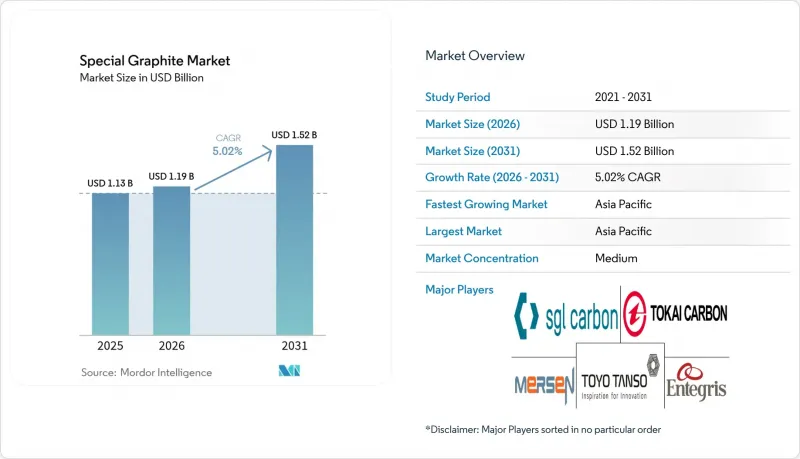
本報告按產品類型(等向性石墨、擠壓石墨、模製石墨及其他產品類型)、終端用戶行業(鑄造冶金、電子、太陽能及其他終端用戶行業)和地區(亞太地區、北美地區、歐洲地區、南美地區以及中東和非洲地區)進行細分。市場預測以美元計價。
全球特種石墨市場趨勢與洞察
政府的脫碳政策正在提振對太陽能電池片的需求。
各國採取的氣候變遷因應措施直接導致多晶矽和晶圓產能的提升,進而引發對特種石墨的需求激增。中國計畫在2024年新增400吉瓦太陽能發電生產線,預計需要12萬噸石墨用於柴可拉斯基法和定向凝固製程的坩堝。美國《通貨膨脹控制法案》促使First Solar和Qcells等公司投資40億美元建設國內晶圓廠,這兩家工廠都需要即使在度C1450度高溫下也不會變形的等向性基座。印度的生產連結獎勵計畫計畫(PLI)已累計2,400億盧比用於太陽能電池組件,但該國仍依賴進口超過90%的特種材料,導致運作啟動延遲3至6個月。在歐洲,2024年至2026年間產量增加了8-10個百分點。然而,矛盾的是,隨著晶圓厚度從180微米減少到130微米,每吉瓦的石墨用量反而增加。這是因為較薄的晶圓需要更嚴格的熱控制,導致坩堝更換頻率更高。
美國和歐盟電動車電池供應鏈的本地化正在推動對特種石墨的需求。
根據美國“外國關注企業(FEOC)”法規和歐盟“基本原料法案”,儘管中國在2024年精煉了150萬噸球形石墨,但從2027年起,汽車製造商必須從中國以外的地區採購石墨。通用汽車(GM)和Stellantis已與Cyra位於路易斯安那州維達利亞的工廠以及Novonix位於田納西州的工廠簽訂了多年供應協議,並支付15-20%的溢價以確保合格《通貨膨脹控制法案》(IRA)的資格。寶馬和福斯已向波蘭一家合成石墨合資企業撥款12億歐元,但由於該工廠依賴石油衍生的針狀焦,因此極易受到原料價格飆升的影響,例如2025年初出現的每噸750美元的價格。 FEOC的免稅政策將於2027年到期,這意味著歐美汽車製造商必須在有限的時間內確保原料供應,否則將失去每輛車7,500美元的稅額扣抵。韓國耗資9兆韓元的「K-Battery」計畫旨在2028年實現負極材料20萬噸的產能,但該計畫目前仍依賴從中國進口片狀石墨,而且「本地化」往往止步於提煉階段。
LTO 和鈉離子化學的突破減少了石墨的使用。
鈦酸鋰(LTO)負極材料擁有2萬次循環壽命,已成為中國電動公車電池組的主流材料,預計僅2025年就將取代約1.5萬噸石墨。寧德時代(CATL)商業化的鈉離子電池,例如比亞迪「海鷗」電動車所使用的電池,在2025年銷量就達到了20萬套,且未使用石墨負極。如果能量密度達到200瓦時/公斤,石墨的應用範圍可能僅限於高等級石墨,2028年後需求量可能下降高達15%。這種威脅主要集中在天然石墨片上,對利潤率較高的合成石墨影響相對較小,儘管預計歐洲和美國新煉廠的銷售量將會下降。
細分市場分析
預計到2025年,等向性石墨將佔據特種石墨市場47.98%的佔有率,並在半導體、氫氣和高矽含量負極材料需求的推動下,以5.51%的複合年成長率成長至2031年。東海碳素和東洋炭素正在日本和美國聯合擴建產能,但由於各向同性石墨的成型和石墨化製程需要數週時間,限制了產能擴張的速度,因此仍需18個月的前置作業時間。
擠壓石墨用於電火花加工 (EDM) 和鑄造模具,在這些應用中,單次循環成本比絕對純度更為重要。成型石墨是鋼鐵和非鐵金屬連鑄生產線的基礎材料,但由於中國鋼鐵產量趨於穩定,其成長速度正在放緩。柔軟性和膨脹石墨等小眾產品受益於電動車溫度控管系統的需求,這些系統要求導熱係數達到 300-400 W/m*K,即使在成長緩慢的通用產品領域,這些產品也呈現出兩位數的成長。價格差距依然很大,等向性石墨的價格是擠壓石墨的兩到三倍。這是因為高精度特種石墨市場是基於 0.1% 的孔隙率規格,形成了溢價。
區域分析
預計到2025年,亞太地區將佔據特種石墨市場45.78%的佔有率,並在2031年之前以每年6.57%的速度成長。這主要得益於中國太陽能晶片產能擴大至每年400吉瓦,以及球墨鑄鐵年產量達150萬噸。由於中國在2023年加強了出口許可管理,西方買家已被迫為來自其他國家的原料支付15-20%的溢價。韓國計劃在其「K-Battery」舉措下,到2028年將其國內負極材料產能提高到20萬噸,但由於其對中國石墨片的依賴程度較高,真正實現自主生產仍有很長的路要走。日本憑藉其在超高純度等向性領域的長期領先地位,並利用其在晶圓廠認證方面的悠久歷史作為一道堅固的護城河。印度將在 2024 年開採 35,000 噸天然石墨,並將投資 600 億印度盧比用於將其轉化為特種應用,但管道供應仍然小規模。
北美正受惠於《通膨削減法案》,該法案將石墨採購價格降至每輛車7,500美元,成為非此即彼的選擇。 Syrah公司位於維達利亞的生產線預計將於2024年達到1萬噸的產量,並在2027年擴大至4.5萬噸。同時,Novonix公司位於田納西州的工廠計劃在2025年底前實現1.6萬噸的產量。加拿大比塞特溪工廠已於2024年恢復運營,並向魁北克省的一家球墨鑄鐵合資企業供應原料(年產量2.5萬噸)。此外,符合美墨加協定(USMCA)規定的墨西哥供應商目前正在向特斯拉位於奧斯汀的工廠供應原料。
在歐洲,SGL Carbon在瑞典投資2億歐元的擴建計畫正受惠於歐盟的《基本原物料法案》。該法案規定,到2030年,40%的原料消費必須在本地加工。目前,只有坩堝和Mersen兩家公司供應坩堝用石墨,這使它們擁有8-10個百分點的價格優勢。由於制裁,俄羅斯的出口量下降,導致歐洲買家轉向從土耳其和印度採購原料。在中東和非洲,由於NEOM對電解槽4吉瓦的需求,市場呈現集中成長,而南美洲的計畫仍處於規劃階段。
其他好處:
- Excel格式的市場預測(ME)表
- 3個月的分析師支持
目錄
第1章:引言
- 研究假設和市場定義
- 調查範圍
第2章:調查方法
第3章執行摘要
第4章 市場狀況
- 市場概覽
- 市場促進因素
- 政府的脫碳政策正在提振對太陽能電池片的需求。
- 歐盟和美國電動車電池供應鏈的本地化正在推動對特種石墨的需求。
- 過渡到需要高純度石墨的大直徑富矽陽極。
- 複雜合金鑄造方法中從金屬模具到石墨模具的過渡
- 利用等向性石墨快速製備用於綠色氫氣的電解槽板
- 市場限制因素
- LTO和鈉離子電池技術的進步正在減少石墨的使用。
- 歐盟 REACH 法規對石墨粉塵排放的更嚴格限制導致資本支出 (CAPEX) 增加。
- 最先進的半導體製造廠中等靜壓石墨的認證週期越來越長。
- 價值鏈分析
- 波特五力模型
第5章 市場規模與成長預測
- 依產品類型
- 等向性石墨
- 擠壓石墨
- 模壓石墨
- 其他產品類型
- 按最終用戶行業分類
- 鑄造與冶金
- 電子設備
- 太陽能
- 其他終端用戶產業
- 按地區
- 亞太地區
- 中國
- 印度
- 日本
- 韓國
- 其他亞太國家
- 北美洲
- 美國
- 加拿大
- 墨西哥
- 歐洲
- 德國
- 英國
- 法國
- 義大利
- 俄羅斯
- 其他歐洲國家
- 南美洲
- 巴西
- 阿根廷
- 其他南美國家
- 中東和非洲
- 沙烏地阿拉伯
- 南非
- 阿拉伯聯合大公國
- 其他中東和非洲國家
- 亞太地區
第6章 競爭情勢
- 市場集中度
- 策略趨勢
- 市佔率和排名分析
- 公司簡介
- Entegris
- Fangda Carbon New Material Co. Ltd
- GCM CORPORATION Ltd
- GrafTech International
- Graphite India Limited
- Mersen Property
- Morgan Advanced Materials Plc
- Nippon Carbon Co. Ltd
- Pingdingshan City Kaiyuan Specialty Graphite Ltd
- Schunk Carbon Technology
- SEC CARBON, Limited
- SGL Carbon
- Tokai Carbon Co., Ltd.
- Toyo Tanso Co., Ltd.
- Yichang Xincheng Graphite Co., Ltd.
第7章 市場機會與未來展望
According to Mordor Intelligence, the special graphite market size is projected to be USD 1.13 billion in 2025, USD 1.19 billion in 2026, and reach USD 1.52 billion by 2031, growing at a CAGR of 5.02% from 2026 to 2031.
This report is Segmented by Product Type (Isotropic Graphite, Extruded Graphite, Molded Graphite, and Other Product Types), End-User Industry (Foundry and Metallurgy, Electronics, Photovoltaic, and Other End-User Industries), and Geography (Asia-Pacific, North America, Europe, South America, and Middle-East and Africa). The Market Forecasts are Provided in Terms of Value (USD).
Global Special Graphite Market Trends and Insights
Government Decarbonization Policies Boosting Solar-Wafer Demand
National climate mandates are translating directly into polysilicon and wafer capacity that sharply lifts special graphite market demand. China added 400 GW of solar manufacturing lines in 2024, which required an estimated 120,000 tonnes of crucible-grade graphite for Czochralski and directional-solidification processes. The U.S. Inflation Reduction Act pushed First Solar and Qcells to commit USD 4 billion to domestic wafer plants that each need isotropic susceptors able to survive 1,450 °C without warping. India's Production-Linked Incentive program set aside INR 240 billion for solar components, yet the country still imports more than 90% of specialty grades, creating commissioning delays of three to six months. Europe's rose eight to ten percentage points between 2024 and 2026. Falling wafer thickness from 180 µm to 130 µm paradoxically raises graphite intensity per gigawatt because thinner wafers need tighter thermal-profile control and more rapid crucible replacement.
EV-Battery Supply-Chain Localization in United States and European Union Spurring Special Graphite Offtake
Foreign Entity of Concern rules in the United States and the EU Critical Raw Materials Act obligate automakers to secure non-Chinese graphite after 2027, even though China refined 1.5 million tonnes of spherical graphite in 2024. General Motors and Stellantis signed multi-year offtakes with Syrah's Vidalia plant in Louisiana and Novonix's Tennessee facility, paying 15-20% price premiums to lock in IRA eligibility. BMW and Volkswagen earmarked EUR 1.2 billion for a synthetic-graphite venture in Poland, but the plant's dependence on petroleum needle coke makes it vulnerable to feedstock spikes such as the USD 750-per-tonne price seen in early 2025. The FEOC exemption sunsets in 2027, creating a narrow window in which Western OEMs either secure supply or forfeit USD 7,500 per vehicle in tax credits. South Korea's KRW 9 trillion K-Battery program aims for 200,000 tonnes of anode capacity by 2028, yet still leans on imported Chinese flake, showing that "localization" often stops at refining.
Breakthroughs in LTO and Sodium-Ion Chemistries Lowering Graphite Intensity
Lithium-titanate-oxide anodes offer 20,000-cycle lifespans and already dominate Chinese e-bus packs, displacing about 15,000 tonnes of graphite in 2025 alone. Sodium-ion batteries commercialized by CATL and deployed in BYD's Seagull sold 200,000 units in 2025 without graphite anodes, and the upcoming 200 Wh/kg milestones could restrict graphite to premium trims, trimming demand by up to 15% post-2028. The threat skews toward natural flake, leaving higher-margin synthetic grades less affected yet eroding volume that supports new Western refineries.
Other drivers and restraints analyzed in the detailed report include:
- Shift to Large-Format Si-Rich Anodes Needing Higher-Purity Graphite
- Foundry Migration from Metal to Graphite Molds for Complex Alloys
- Stricter EU-REACH Limits on Graphite-Dust Emissions Increase CAPEX
For complete list of drivers and restraints, kindly check the Table Of Contents.
Segment Analysis
Isotropic graphite held 47.98% of the special graphite market share in 2025 and is forecast to expand at a 5.51% CAGR through 2031, supported by semiconductor, hydrogen, and silicon-rich anode demand. Tokai Carbon and Toyo Tanso together are adding capacity across Japan and the United States, yet 18-month lead times persist because isostatic pressing and multi-week graphitization limit ramp speed.
Extruded graphite is serving EDM and foundry molds where cost per cycle matters more than absolute purity. Molded graphite anchors continuous-casting lines for steel and non-ferrous metals, but growth is muted as Chinese steel output plateaus. Niche products such as flexible and expandable graphite benefit from EV thermal-management systems that need 300-400 W/m*K conductivity, creating double-digit growth pockets even within a slower commodity tier. Price differentials remain wide: isotropic sells for two to three times extruded because the special graphite market size for high-precision grades commands premiums tied to 0.1% porosity specs.
Complete Report Scope:
- By Product Type
- Isotropic Graphite
- Extruded Graphite
- Molded Graphite
- Other Product Types
- By End-user Industry
- Foundry and Metallurgy
- Electronics
- Photovoltaic
- Other End-user Indsutries
- By Geography
- Asia-Pacific
- China
- India
- Japan
- South Korea
- Rest of Asia-Pacific
- North America
- United States
- Canada
- Mexico
- Europe
- Germany
- United Kingdom
- France
- Italy
- Russia
- Rest of Europe
- South America
- Brazil
- Argentina
- Rest of South America
- Middle-East and Africa
- Saudi Arabia
- South Africa
- United Arab Emirates
- Rest of Middle-East and Africa
- Asia-Pacific
Geography Analysis
Asia-Pacific commanded 45.78% of the special graphite market share in 2025 and is growing at 6.57% to 2031, anchored by China's 400 GW annual solar-wafer expansions and 1.5 million-tonne spherical-graphite output. Chinese export-permit rules, tightened in 2023, already prompt Western offtakers to pay 15-20% premiums for non-Chinese feedstock. South Korea plans 200,000 tonnes of local anode capacity by 2028 under the K-Battery initiative, but heavy reliance on Chinese flake means real autonomy remains distant. Japan keeps its niche leadership in ultra-pure isotropic grades, leveraging multi-year fab qualifications as a protective moat. India mined 35,000 tonnes of natural graphite in 2024 and is channeling INR 60 billion into specialty conversions, yet pipeline volumes remain small.
North America benefits from the Inflation Reduction Act, which turns graphite sourcing into a USD 7,500-per-vehicle binary. Syrah's Vidalia line hit 10,000 tonnes in 2024 and is scaling to 45,000 tonnes by 2027, while Novonix's Tennessee plant targets 16,000 tonnes by late 2025. Canada's Bissett Creek restarted in 2024 and feeds a 25,000-tonne Quebec spherical-graphite partnership, and Mexico's USMCA-compliant suppliers now feed Tesla's Austin complex.
In Europe, SGL Carbon's EUR 200 million Swedish expansion rides the EU Critical Raw Materials Act, which requires 40% of consumption to be processed locally by 2030. Only SGL and Mersen currently supply crucible-grade graphite, giving them an 8-10 point margin. Russia's exports dipped under sanctions, moving European buyers toward Turkish and Indian feedstock. The Middle-East and Africa show focused growth tied to 4 GW of NEOM electrolyser demand, while South American projects remain at the exploration stage.
- Entegris
- Fangda Carbon New Material Co. Ltd
- GCM CORPORATION Ltd
- GrafTech International
- Graphite India Limited
- Mersen Property
- Morgan Advanced Materials Plc
- Nippon Carbon Co. Ltd
- Pingdingshan City Kaiyuan Specialty Graphite Ltd
- Schunk Carbon Technology
- SEC CARBON, Limited
- SGL Carbon
- Tokai Carbon Co., Ltd.
- Toyo Tanso Co., Ltd.
- Yichang Xincheng Graphite Co., Ltd.
Additional Benefits:
- The market estimate (ME) sheet in Excel format
- 3 months of analyst support
TABLE OF CONTENTS
1 Introduction
- 1.1 Study Assumptions and Market Definition
- 1.2 Scope of the Study
2 Research Methodology
3 Executive Summary
4 Market Landscape
- 4.1 Market Overview
- 4.2 Market Drivers
- 4.2.1 Government decarbonisation policies boosting solar-wafer demand
- 4.2.2 EV-battery supply-chain localisation in United States and European Union spurring special graphite offtake
- 4.2.3 Shift to large-format Si-rich anodes needing higher-purity graphite
- 4.2.4 Foundry migration from metal to graphite molds for complex alloys
- 4.2.5 Rapid expansion of green-hydrogen electrolyser plates using isostatic graphite
- 4.3 Market Restraints
- 4.3.1 Breakthroughs in LTO and sodium-ion chemistries lowering graphite intensity
- 4.3.2 Stricter EU-REACH limits on graphite-dust emissions increase CAPEX
- 4.3.3 Slow qualification cycles for isostatic graphite in advanced semiconductor fabs
- 4.4 Value Chain Analysis
- 4.5 Porter's Five Forces
- 4.5.1 Bargaining Power of Suppliers
- 4.5.2 Bargaining Power of Buyers
- 4.5.3 Threat of New Entrants
- 4.5.4 Threat of Substitutes
- 4.5.5 Degree of Competition
5 Market Size and Growth Forecasts (Value)
- 5.1 By Product Type
- 5.1.1 Isotropic Graphite
- 5.1.2 Extruded Graphite
- 5.1.3 Molded Graphite
- 5.1.4 Other Product Types
- 5.2 By End-user Industry
- 5.2.1 Foundry and Metallurgy
- 5.2.2 Electronics
- 5.2.3 Photovoltaic
- 5.2.4 Other End-user Indsutries
- 5.3 By Geography
- 5.3.1 Asia-Pacific
- 5.3.1.1 China
- 5.3.1.2 India
- 5.3.1.3 Japan
- 5.3.1.4 South Korea
- 5.3.1.5 Rest of Asia-Pacific
- 5.3.2 North America
- 5.3.2.1 United States
- 5.3.2.2 Canada
- 5.3.2.3 Mexico
- 5.3.3 Europe
- 5.3.3.1 Germany
- 5.3.3.2 United Kingdom
- 5.3.3.3 France
- 5.3.3.4 Italy
- 5.3.3.5 Russia
- 5.3.3.6 Rest of Europe
- 5.3.4 South America
- 5.3.4.1 Brazil
- 5.3.4.2 Argentina
- 5.3.4.3 Rest of South America
- 5.3.5 Middle-East and Africa
- 5.3.5.1 Saudi Arabia
- 5.3.5.2 South Africa
- 5.3.5.3 United Arab Emirates
- 5.3.5.4 Rest of Middle-East and Africa
- 5.3.1 Asia-Pacific
6 Competitive Landscape
- 6.1 Market Concentration
- 6.2 Strategic Moves
- 6.3 Market Share(%)/Ranking Analysis
- 6.4 Company Profiles (includes Global level Overview, Market level overview, Core Segments, Financials as available, Strategic Information, Products and Services, and Recent Developments)
- 6.4.1 Entegris
- 6.4.2 Fangda Carbon New Material Co. Ltd
- 6.4.3 GCM CORPORATION Ltd
- 6.4.4 GrafTech International
- 6.4.5 Graphite India Limited
- 6.4.6 Mersen Property
- 6.4.7 Morgan Advanced Materials Plc
- 6.4.8 Nippon Carbon Co. Ltd
- 6.4.9 Pingdingshan City Kaiyuan Specialty Graphite Ltd
- 6.4.10 Schunk Carbon Technology
- 6.4.11 SEC CARBON, Limited
- 6.4.12 SGL Carbon
- 6.4.13 Tokai Carbon Co., Ltd.
- 6.4.14 Toyo Tanso Co., Ltd.
- 6.4.15 Yichang Xincheng Graphite Co., Ltd.
7 Market Opportunities and Future Outlook
- 7.1 White-space and Unmet-need Assessment

 石墨回收市場規模、佔有率和成長分析:按來源、回收製程、最終產品、最終用途產業、供應管道和地區分類-2026-2033年產業預測
 石墨:市場佔有率分析、產業趨勢和統計數據、成長預測(2026-2031)
 鋪路磚市場規模、佔有率和成長分析:按材料、產品類型、應用、表面處理、最終用戶和地區分類-2026-2033年產業預測
 等向性石墨市場規模、佔有率和成長分析:按等級、製造流程、應用、終端用戶產業和地區分類-2026-2033年產業預測
 石墨市場:依類型、純度、形態、應用和終端用戶產業分類-2026-2032年全球市場預測
 石墨:科技與全球市場
 等靜壓石墨市場規模、佔有率和成長分析:按等級、應用、終端用戶產業、通路和地區分類-2026-2033年產業預測
 等向性及擠壓石墨市場規模、佔有率及成長分析:依產品類型、純度、應用、終端用戶產業、密度等級、通路及地區分類-2026-2033年產業預測
 水性膠體石墨市場:按應用和地區分類石墨坩堝市場:依材質、應用、終端用戶產業、產能、銷售管道、價格範圍、產品壽命、客製化程度、熱源和地區分類