


 |
市場調查報告書
商品編碼
2121430
沸石分類分子篩:市場佔有率分析、產業趨勢與統計、成長預測(2026-2031)Zeolite Molecular Sieves - Market Share Analysis, Industry Trends & Statistics, Growth Forecasts (2026 - 2031) |
||||||

※ 本網頁內容可能與最新版本有所差異。詳細情況請與我們聯繫。
沸石分類分子篩市場預計到 2026 年價值 39.8 億美元,高於 2025 年的 37.8 億美元,預計到 2031 年將達到 51.4 億美元。
預計從 2026 年到 2031 年,其複合年成長率將達到 5.28%。
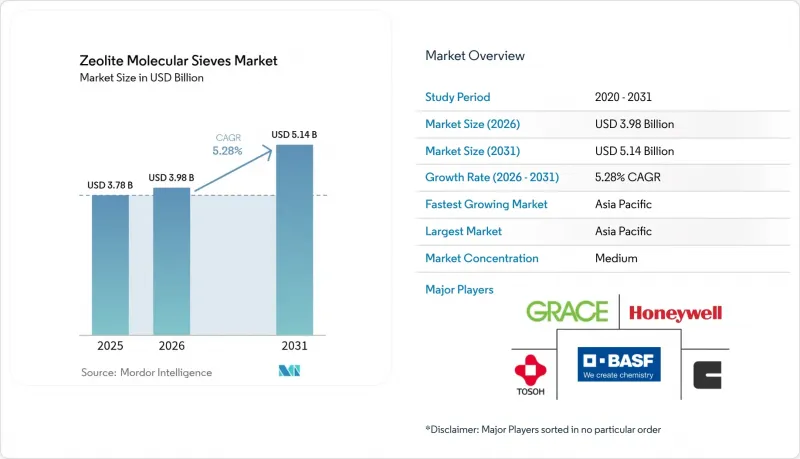
本報告按原料(天然沸石和合成沸石)、終端用戶產業(清潔劑、石油化學和煉油、工業氣體生產、廢棄物和水處理、空氣淨化和暖通空調、農業和動物飼料以及其他終端用戶產業)和地區(亞太地區、北美、歐洲、南美洲以及中東和非洲)進行分類。
全球沸石分類分子篩市場趨勢及洞察
禁用磷酸鹽作為清潔劑,導致建築商轉而使用沸石。
由於磷酸鹽有富營養化風險,全球清潔劑法規禁止使用磷酸鹽,使得助劑的需求轉向沸石4A。歐盟2017年的禁令使磷酸鹽的年消耗量減少了250萬噸,目前粉狀和液體洗滌劑配方中約60%的磷酸鹽已被沸石取代。北美類似的法規,以及印度和巴西分階段實施的監管措施,都維持了可預測的需求成長。在法規的推動下,沸石4A具有比碳酸鹽更高的鈣結合能力,即使在硬水地區也能確保清潔效果。跨國清潔劑品牌正在其全球產品線中採用沸石基助劑,而且這種趨勢在技術上或商業性不太可能逆轉。預計2027年,新興市場將擴大無磷酸鹽法規的範圍,進一步鞏固沸石分子篩的長期需求趨勢。
石化產業的脫水和氣體純化蓬勃發展
中國、印度和沙烏地阿拉伯新建乙烯-丙烯聯合裝置的投資總額超過500億美元,推動了對3A和4A分子篩的需求,這些分子篩用於對裂解氣體進行脫水,並將二氧化碳去除至ppm級。在全球範圍內,每個乙烯裂解裝置在初始填充和年度補充過程中消耗500至800噸分子篩。北美頁岩氣的擴張正在加速這一趨勢,因為傳統型原料的含水量和酸性氣體含量較高。合成技術的最新進展使得生產具有更優異傳質性能的大尺寸沸石晶體成為可能,不僅可以減少25%的再生能源消耗,還能降低石化企業的生命週期成本。因此,沸石分級分子篩市場可望從待開發區案和旨在實現更高純度規格的維修項目中獲得更多需求。
洗衣配方中的酵素和化學替代品
高階清潔劑品牌越來越傾向於使用蛋白酶和脂肪酶等酵素類物質,即使減少助洗劑用量也能達到類似的去污效果,從而使液體清潔劑中沸石的含量降低高達20%。聚羧酸鹽和磷酸酯類助洗劑易於分散在濃縮液體中,而沸石不溶於水,導致加工和填充困難。由於液體清潔劑是已開發市場成長最快的類別,高階產品中沸石用量減少的風險仍然存在。然而,尤其是在新興市場,粉狀清潔劑和低價產品仍依賴4A型沸石來調節水硬度,減輕了沸石分級分子篩市場的整體影響。
細分市場分析
合成A型沸石憑藉其精確的矽鋁比控制,可獲得適用於石油化學產品脫水和分離的孔徑,預計到2025年將佔全球銷售量的57.12%。成本最佳化的水熱法、微波輔助法和無模板法等合成方法不斷提高產品純度,同時降低35%的能耗。相較之下,天然斜發沸石和絲光沸石的年複合成長率為5.84%,其主要應用領域為農業、除臭和低壓水處理,在這些領域,性價比比晶體完整性更為重要。土耳其和保加利亞的天然礦床生產的礦石只需進行極少的離子交換處理即可滿足規格要求,從而帶來30-40%的成本優勢。歐盟「綠色新政」等監管因素也在推動非合成礦物的發展,並進一步加速其應用。未來,合成沸石有望繼續在高壓脫水和催化劑應用領域保持主導地位,而天然沸石將在環境和農業領域不斷開發利基市場,為沸石分類分子篩市場的互補成長鋪平道路。
區域分析
預計到2025年,亞太地區將佔全球銷售額的37.12%,年複合成長率達6.02%。中國在乙烯裂解裝置和煤化工聯合裝置領域的投資主導,這兩項工程都需要數百噸分子篩用於脫水。在亞太地區,不斷擴大的生產規模、日益嚴格的環境標準以及大規模的消費群共同促成了該地區的主導地位。中國浙江和廣東兩省的乙烯計畫需要使用分子篩脫水設備,以將水分含量降低至1ppm以下;同時,當地污水排放標準對氨排放的限制也推動了採用沸石三級處理系統的應用。
在北美,市場已趨於成熟,但對技術含量高的解決方案仍有需求。在德克薩斯州,頁岩氣加工廠正在使用3A分子篩在低溫液化天然氣回收前去除水分,以追求更高的效率和更長的填料床壽命。美國環保署(EPA)提出的PFAS排放法規正在加速高矽沸石的試點部署,這種沸石能夠捕獲兆分之一濃度的全氟烷基化合物,從而為特種產品製造商創造新的收入來源。
在歐洲,永續性和循環經濟正成為優先事項。德國和荷蘭的工廠正在展示飛灰衍生沸石的商業化應用,與使用未經處理的礦物相比,可減少40%的碳排放。在中東和非洲,石化產業的多元化和水資源短缺正在創造機會。
沙烏地阿拉伯在其「2030願景」框架下,依靠大型分子篩塔進行原料製備,從而提升其樹脂產能。南非採礦業則利用斜發沸石淨化酸性礦山廢水,透過利用國內天然礦床降低進口成本。
這些區域趨勢總體上凸顯了沸石分類分子篩市場地域範圍的不斷擴大。
其他好處:
- Excel格式的市場預測(ME)表
- 3個月的分析師支持
目錄
第1章:引言
- 研究假設和市場定義
- 調查範圍
第2章:調查方法
第3章執行摘要
第4章 市場狀況
- 市場概覽
- 市場促進因素
- 由於清潔劑中禁用磷酸鹽,建築商開始改用沸石。
- 石化產業的脫水和氣體純化蓬勃發展
- 嚴格的廢水標準
- 新興國家衛生意識的提高推動了清潔劑。
- 隨著生物煉製的發展,對形狀選擇性催化劑的需求不斷成長。
- 市場限制因素
- 洗衣組合藥物中的酵素和化學替代品
- 氧化鋁/二氧化矽原料的價格趨勢,其價格波動劇烈。
- ESG投資者對其高能耗表示擔憂。
- 價值鏈分析
- 波特五力模型
第5章 市場規模與成長預測
- 按成分
- 天然沸石
- 合成沸石
- 按最終用戶行業分類
- 清潔劑
- 石油化工和煉油
- 工業氣體生產
- 廢棄物和水處理
- 空氣淨化及暖通空調
- 農業和動物飼料
- 其他終端用戶產業
- 按地區
- 亞太地區
- 中國
- 印度
- 日本
- 韓國
- 其他亞太國家
- 北美洲
- 美國
- 加拿大
- 墨西哥
- 歐洲
- 德國
- 英國
- 法國
- 義大利
- 俄羅斯
- 其他歐洲國家
- 南美洲
- 巴西
- 阿根廷
- 其他南美國家
- 中東和非洲
- 沙烏地阿拉伯
- 南非
- 中東和非洲其他地區
- 亞太地區
第6章 競爭情勢
- 市場集中度
- 策略趨勢
- 市佔率分析
- 公司簡介
- Arkema
- Axens
- BASF
- CLARIANT
- CWK Chemiewerk Bad Kostritz GmbH
- HengYe Inc.
- Honeywell International Inc.
- JIUZHOU CHEMICALS
- KMI Zeolite Inc.
- KNT Group
- KURARAY CO., LTD.
- Luoyang Jalon Micro-Nano New Material
- Sorbchem India Pvt Ltd.
- Tosoh Corporation
- WR Grace & Co.
- Zeochem
- Zeolyst International
第7章 市場機會與未來展望
According to Mordor Intelligence, zeolite molecular sieves market size in 2026 is estimated at USD 3.98 billion, growing from 2025 value of USD 3.78 billion with 2031 projections showing USD 5.14 billion, growing at 5.28% CAGR over 2026-2031.
This report is Segmented by Raw Material (Natural Zeolite and Synthetic Zeolite), End-User Industry (Detergents, Petrochemical and Refining, Industrial Gas Production, Waste and Water Treatment, Air Purification and HVAC, and Agriculture and Animal Feed, Other End-User Industries), and Geography (Asia-Pacific, North America, Europe, South America, and Middle-East and Africa).
Global Zeolite Molecular Sieves Market Trends and Insights
Phosphate Bans in Detergents Shifting Builders to Zeolites
Global detergent regulations prohibit phosphates because of eutrophication risks, redirecting builder demand toward zeolite 4A. The European Union's 2017 ban eliminated 2.5 million tons of phosphate consumption annually, and zeolites now replace roughly 60% of that volume in both powder and liquid formulations. Similar mandates in North America, along with phased restrictions in India and Brazil, sustain predictable volume growth. Performance advantages compound the regulatory pull: zeolite 4A exhibits higher calcium-binding capacity than carbonates, securing wash performance in hard-water regions. Multinational detergent brands have embedded zeolite builders across their global portfolios, making a reversal technically and commercially unlikely. Emerging economies are poised to expand phosphate-free regulations through 2027, reinforcing the long-run demand trajectory for the zeolite molecular sieve market.
Petrochemical Dehydration and Gas-Purification Boom
Investment exceeding USD 50 billion in new ethylene and propylene complexes across China, India, and Saudi Arabia is elevating demand for 3A and 4A molecular sieves that dehydrate cracked gas and strip CO2 to parts-per-million levels. A single world-scale ethylene cracker consumes 500-800 tons of sieves in initial charging and annual top-ups. Shale-gas growth in North America accelerates the trend, because unconventional feedstocks carry higher moisture and acid-gas loads. Recent synthesis advances have produced larger zeolite crystals with enhanced mass-transfer characteristics, cutting regeneration energy by 25% and reducing lifecycle cost for petrochemical operators. Consequently, the zeolite molecular sieve market is poised to capture incremental offtake from greenfield projects and from revamps that target higher purity specifications.
Enzyme and Chemical Substitutes in Laundry Formulations
Premium detergent brands increasingly favor protease and lipase enzymes that deliver comparable soil removal at lower builder dosage, cutting zeolite content by up to 20% in liquid formats. Polycarboxylate and phosphonate builders disperse easily in concentrated liquids, where zeolite's insolubility complicates processing and packaging. As liquid detergents represent the fastest-growing category in developed markets, zeolite volumes risk erosion in the top-tier segment. Yet powder detergents and value-priced products, particularly in emerging economies, still depend on zeolite 4A for hardness control, mitigating the overall impact on the zeolite molecular sieve market.
Other drivers and restraints analyzed in the detailed report include:
- Stringent Wastewater Discharge Norms
- Hygiene-Driven Detergent Demand in Emerging Economies
- Volatile Alumina/Silica Feedstock Pricing
For complete list of drivers and restraints, kindly check the Table Of Contents.
Segment Analysis
Synthetic zeolite A captured 57.12% of global volume in 2025 thanks to precise Si/Al control that engineers pore size for petrochemical dehydration and separation tasks. Cost-optimized hydrothermal, microwave-assisted, and template-free syntheses continue to elevate product purity while trimming energy consumption by 35%. In contrast, natural clinoptilolite and mordenite grades are growing at 5.84% CAGR, primarily in agriculture, odor control, and low-pressure water treatment applications where the performance-to-price ratio outranks crystal perfection. Natural deposits in Turkey and Bulgaria deliver ore that requires minimal ion-exchange to reach specification, offering a 30-40% cost edge. Regulatory drivers such as the EU's Green Deal favor non-synthetic minerals, further stimulating adoption. Looking forward, synthetic grades maintain their hold in high-pressure dehydration and catalysis, but natural zeolites increasingly claim environmental and agricultural niches, carving a complementary growth lane within the zeolite molecular sieve market.
Complete Report Scope:
- By Raw Material
- Natural Zeolite
- Synthetic Zeolite
- By End-user Industry
- Detergents
- Petrochemical and Refining
- Industrial Gas Production
- Waste and Water Treatment
- Air Purification and HVAC
- Agriculture and Animal Feed
- Other End-user Industries
- By Geography
- Asia-Pacific
- China
- India
- Japan
- South Korea
- Rest of Asia-Pacific
- North America
- United States
- Canada
- Mexico
- Europe
- Germany
- United Kingdom
- France
- Italy
- Russia
- Rest of Europe
- South America
- Brazil
- Argentina
- Rest of South America
- Middle-East and Africa
- Saudi Arabia
- South Africa
- Rest of Middle-East Africa
- Asia-Pacific
Geography Analysis
Asia Pacific generated 37.12% of global sales in 2025 and is set to grow at a 6.02% CAGR. China spearheads investment in ethylene crackers and coal-to-chemicals complexes, each requiring hundreds of tons of molecular sieves for dehydration duty. Asia Pacific's convergence of production scale, tightening environmental norms, and large consumer bases drives the region's leadership. China's Zhejiang and Guangdong ethylene projects require molecular-sieve dehydration units that remove moisture to below 1 ppm, while local wastewater standards enforce ammonia limits that spur zeolite tertiary systems.
North America exhibits mature but technology-rich demand. Shale-gas processing plants in Texas deploy 3A molecular sieves to strip moisture before cryogenic NGL recovery, seeking higher efficiency and longer bed life. EPA PFAS discharge proposals accelerate trials of high-silica zeolites that capture perfluoro-alkyl compounds at parts-per-trillion levels, an emerging revenue stream for specialty producers.
Europe prioritizes sustainability and circularity. Plants in Germany and the Netherlands validate fly-ash-derived zeolites at commercial scale, delivering 40% embodied-carbon reduction relative to virgin mineral routes. Middle-East and Africa capitalize on petrochemical diversification and water scarcity.
Saudi Arabia's Vision 2030 resin capacities rely on large-format molecular-sieve towers for feedstock preparation. South Africa's mining sector adopts clinoptilolite for acid-mine drainage remediation, benefitting from domestic natural deposits that eliminate import costs.
Collectively, these regional developments underscore the expanding geographic canvas for the zeolite molecular sieve market.
- Arkema
- Axens
- BASF
- CLARIANT
- CWK Chemiewerk Bad Kostritz GmbH
- HengYe Inc.
- Honeywell International Inc.
- JIUZHOU CHEMICALS
- KMI Zeolite Inc.
- KNT Group
- KURARAY CO., LTD.
- Luoyang Jalon Micro-Nano New Material
- Sorbchem India Pvt Ltd.
- Tosoh Corporation
- W. R. Grace & Co.
- Zeochem
- Zeolyst International
Additional Benefits:
- The market estimate (ME) sheet in Excel format
- 3 months of analyst support
TABLE OF CONTENTS
1 Introduction
- 1.1 Study Assumptions and Market Definition
- 1.2 Scope of the Study
2 Research Methodology
3 Executive Summary
4 Market Landscape
- 4.1 Market Overview
- 4.2 Market Drivers
- 4.2.1 Phosphate Bans in Detergents Shifting Builders to Zeolites
- 4.2.2 Petrochemical Dehydration and Gas-Purification Boom
- 4.2.3 Stringent Wastewater Discharge Norms
- 4.2.4 Hygiene-Driven Detergent Demand in Emerging Economies
- 4.2.5 Bio-Refinery Shift Demanding Shape-Selective Catalysts
- 4.3 Market Restraints
- 4.3.1 Enzyme And Chemical Substitutes in Laundry Formulations
- 4.3.2 Volatile Alumina/Silica Feedstock Pricing
- 4.3.3 High Energy Footprint Questioned by ESG Investors
- 4.4 Value Chain Analysis
- 4.5 Porter's Five Forces
- 4.5.1 Bargaining Power of Suppliers
- 4.5.2 Bargaining Power of Buyers
- 4.5.3 Threat of New Entrants
- 4.5.4 Threat of Substitutes
- 4.5.5 Degree of Competition
5 Market Size and Growth Forecasts (Value)
- 5.1 By Raw Material
- 5.1.1 Natural Zeolite
- 5.1.2 Synthetic Zeolite
- 5.2 By End-user Industry
- 5.2.1 Detergents
- 5.2.2 Petrochemical and Refining
- 5.2.3 Industrial Gas Production
- 5.2.4 Waste and Water Treatment
- 5.2.5 Air Purification and HVAC
- 5.2.6 Agriculture and Animal Feed
- 5.2.7 Other End-user Industries
- 5.3 By Geography
- 5.3.1 Asia-Pacific
- 5.3.1.1 China
- 5.3.1.2 India
- 5.3.1.3 Japan
- 5.3.1.4 South Korea
- 5.3.1.5 Rest of Asia-Pacific
- 5.3.2 North America
- 5.3.2.1 United States
- 5.3.2.2 Canada
- 5.3.2.3 Mexico
- 5.3.3 Europe
- 5.3.3.1 Germany
- 5.3.3.2 United Kingdom
- 5.3.3.3 France
- 5.3.3.4 Italy
- 5.3.3.5 Russia
- 5.3.3.6 Rest of Europe
- 5.3.4 South America
- 5.3.4.1 Brazil
- 5.3.4.2 Argentina
- 5.3.4.3 Rest of South America
- 5.3.5 Middle-East and Africa
- 5.3.5.1 Saudi Arabia
- 5.3.5.2 South Africa
- 5.3.5.3 Rest of Middle-East Africa
- 5.3.1 Asia-Pacific
6 Competitive Landscape
- 6.1 Market Concentration
- 6.2 Strategic Moves
- 6.3 Market Share Analysis
- 6.4 Company Profiles (includes Global level Overview, Market level overview, Core Segments, Financials as available, Strategic Information, Market Rank/Share for key companies, Products and Services, and Recent Developments)
- 6.4.1 Arkema
- 6.4.2 Axens
- 6.4.3 BASF
- 6.4.4 CLARIANT
- 6.4.5 CWK Chemiewerk Bad Kostritz GmbH
- 6.4.6 HengYe Inc.
- 6.4.7 Honeywell International Inc.
- 6.4.8 JIUZHOU CHEMICALS
- 6.4.9 KMI Zeolite Inc.
- 6.4.10 KNT Group
- 6.4.11 KURARAY CO., LTD.
- 6.4.12 Luoyang Jalon Micro-Nano New Material
- 6.4.13 Sorbchem India Pvt Ltd.
- 6.4.14 Tosoh Corporation
- 6.4.15 W. R. Grace & Co.
- 6.4.16 Zeochem
- 6.4.17 Zeolyst International
7 Market Opportunities and Future Outlook
- 7.1 White-space and Unmet-need Assessmen
- 7.2 Increasing Demand for Using Green Technologies

 沸石分子篩市場:依類型、應用、最終用戶、孔徑、國家及地區分類-全球產業分析、市場規模、市場佔有率及2026年至2033年預測
 沸石分子篩市場:依形態、純度等級、功能、再生方法、應用及終端用戶產業分類-2026-2032年全球市場預測
 沸石分子篩市場報告:依材料、等級、應用、終端用戶產業及地區分類(2026-2034 年)分子篩市場:依形態、孔徑、終端用戶產業及應用分類-2026-2032年全球預測
 歐洲分子篩市場:市場佔有率分析、產業趨勢與統計及成長預測(2026-2031)分子篩市場規模、佔有率、趨勢及預測(按類型、材料類型、應用、形狀、尺寸、最終用途產業及地區分類),2026-2034年
 全球分子篩市場,2026-2030年分子篩市場在PSA制氫的應用:按吸附劑類型、工廠產能、純度等級、應用和終端用戶產業分類的全球預測(2026-2032年)環境催化分子篩市場按類型、形狀、應用、終端用戶產業及通路分類,全球預測(2026-2032年)石油化學催化分子篩市場按類型、等級、形狀、合成方法和應用分類,全球預測(2026-2032年)