


 |
市場調查報告書
商品編碼
2043843
歐洲分子篩市場:市場佔有率分析、產業趨勢與統計及成長預測(2026-2031)Europe Molecular Sieves - Market Share Analysis, Industry Trends & Statistics, Growth Forecasts (2026 - 2031) |
||||||

※ 本網頁內容可能與最新版本有所差異。詳細情況請與我們聯繫。
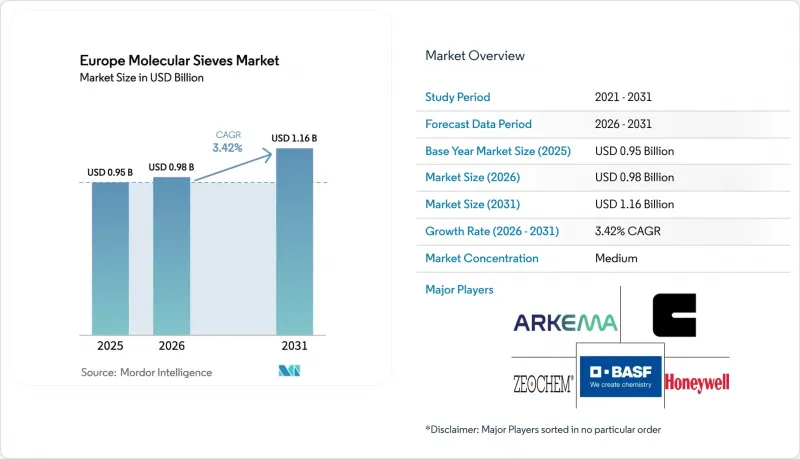
歐洲分子篩市場預計將從 2025 年的 9.5 億美元成長到 2026 年的 9.8 億美元,然後在 2031 年達到 11.6 億美元,2026 年至 2031 年的複合年成長率為 3.42%。
隨著電解槽園區的擴建,對超乾氫的需求日益成長;新冠疫情后醫院製氧廠的投資加速;以及碳邊境調節機制(CBAM)推動的工業氣體管網全面升級,吸附劑的應用範圍正在不斷擴大。碳分子篩因其在沼氣純化和直接空氣回收(DAC)專案中優異的低溫再生性能,正逐漸取代傳統沸石。吸附劑的形態偏好也在改變:粉狀吸附劑在無磷清潔劑領域日益普及,而顆粒狀吸附劑則在大型空氣分離系統中佔據主導地位。目前,競爭策略主要集中在無黏結劑沸石技術、節能再生技術以及能夠降低營運成本的薄膜-吸附劑混合產品。
歐洲分子篩市場趨勢與洞察
REACH 和 CBAM 法規帶來的優良:更嚴格的水分和 VOC 標準。
REACH法規(化學品註冊、評估、授權和限制)的更新以及從2026年起分階段實施的CBAM(碳基材料吸附法)降低了工業氣體、石化和製藥廠允許的水分和揮發性有機化合物(VOC)的閾值,迫使運營商轉向使用反應速率經過驗證的高性能沸石層。歐洲工業氣體協會預計,2025年該產業的銷售額將達到212億歐元,並指出CBAM帶來的能源成本風險,這提升了高效能吸附製程的價值。液化空氣集團正在德國德勒斯登投資超過2.5億歐元新建一座空氣分離工廠,並計畫與奧羅比斯公司合作在保加利亞建造一座價值1億歐元的工廠,兩座工廠都將採用符合CBAM標準的分子篩裝置。擁有ISO 9001認證製程且能夠實現低於2 ppm(百萬分之二)水分滲透率的供應商正在贏得早期續約合約。
歐盟老舊醫院和小型工廠對PSA制氧的需求激增。
疫情後醫院的維修和人口老化促使PSA氧合系統應用日益廣泛,推動了德國、法國和英國對沸石的區域需求,年複合成長率達5.8%至7.8%。HoneywellUOP的OXYSIV系列產品在2021年疫情爆發期間為義大利醫院提供了緊急補給,凸顯了戰略位置和接近性優勢的重要性。區域診所和護理機構更傾向於緊湊型珠狀填料,這種填料的維護週期可長達18個月甚至更長,進一步擴大了歐洲分子篩市場。
歐盟碳價上漲導致高能耗再生能源成本上升
真空溫度循環或熱力循環裝置每解吸一噸二氧化碳,需消耗高達 90 千瓦時的電力和 2.9 吉焦的熱量,隨著歐盟排放交易體系 (EU-ETS) 配額的增加,營運成本也隨之上升。資金有限的小規模沼氣和變壓吸附 (PSA) 制氧機營運商正面臨經濟挑戰,這可能會延遲床層更換,並抑制短期需求。
細分市場分析
到2025年,顆粒狀分子篩將佔歐洲分子篩市場39.71%的佔有率,這得益於其機械強度,能夠承受煉油廠空氣分離和變壓式吸附(PSA)塔中的壓力循環。雖然改變產品形態需要大量的資本投入,但歐洲分子篩市場正在分階段進行維修,以低壓損擠壓產品取代顆粒狀產品,以降低鼓風機的能耗。
預計在預測期(2026-2031年)內,粉末狀分子篩的複合年成長率將達到3.90%,憑藉其高比表面積,在清潔劑和快速循環吸附等細分市場佔據一席之地,其易用性優勢得以彌補。這一趨勢與無磷法規相符,鞏固了A型沸石的市場主導地位。珠狀分子篩的市佔率較小,主要用於小型醫用氧氣濃縮機,透過抑製粉塵來延長過濾器壽命。
至2025年,微孔材料將佔據歐洲分子篩市場64.57%的佔有率,預計在預測期(2026-2031年)內將以3.99%的複合年成長率成長。這反映了市場對空氣分離的持續需求。例如,液化空氣集團在德勒斯登投資2.5億歐元建造的空氣分離裝置(ASU)項目,需要將床層容量提高13倍才能滿足碳邊境調節機制(CBAM)的能源效率標準。
介孔和大孔材料廣泛應用於催化劑和特殊層析法領域。 Zeopore公司計劃於2025年5月推出介孔產品,顯示其在加氫裂解和生質燃料領域發展勢頭強勁,但與該公司主力產品——微孔材料相比,其產量仍然小規模。微孔材料主要應用於乾燥、純化和二氧化碳捕捉等領域。
歐洲分子篩市場按形狀(顆粒、珠子、粉末)、尺寸(微孔、中孔、粗孔)、產品類型(碳、黏土、多孔玻璃、矽膠、沸石和其他產品類型)、最終用戶產業(農業、空氣淨化、汽車產業、化妝品等)和地區(德國、英國、義大利、法國、西班牙、俄羅斯和其他歐洲國家)進行細分。
其他好處:
- Excel格式的市場預測(ME)表
- 3個月的分析師支持
目錄
第1章:引言
- 研究假設和市場定義
- 調查範圍
第2章:調查方法
第3章執行摘要
第4章 市場狀況
- 市場概覽
- 市場促進因素
- REACH 和 CBAM 法規下更嚴格的水分和 VOC 標準帶來的監管利多。
- 歐盟老舊醫院和小規模工廠對PSA制氧的需求激增(新冠疫情後)
- 綠色氫氣電解廠建設激增,需要超乾氫氣流。
- 維修煉油廠以符合歐盟7燃油標準
- 禁止在清潔劑中使用磷酸鹽,導致 4A 沸石的需求增加。
- 市場限制因素
- 歐盟不斷上漲的碳價正在推高能源密集型再生能源的成本。
- 在沼氣氣體純化,混合薄膜和吸附劑撬裝系統面臨競爭。
- 原料(堿灰、矽酸鈉)價格波動
- 價值鏈分析
- 波特五力模型
- 供應商的議價能力
- 消費者議價能力
- 新進入者的威脅
- 替代品的威脅
- 競爭程度
第5章 市場規模與成長預測
- 按形狀
- 顆粒狀
- 珠狀
- 粉末
- 尺寸
- 微孔(小於2奈米)
- 介孔(2–50 nm)
- 大孔(>50 nm)
- 依產品類型
- 碳
- 黏土
- 多孔玻璃
- 矽膠
- 沸石
- 其他
- 按最終用戶行業分類
- 農產品
- 空氣淨化
- 汽車產業
- 清潔劑產業
- 化妝品
- 暖氣、冷氣和冷藏行業
- 工業氣體製造
- 核能工業
- 石油煉製/石油化工
- 製藥業
- 塑膠和聚合物工業
- 廢棄物和水處理
- 其他
- 按地區
- 德國
- 英國
- 法國
- 義大利
- 西班牙
- 俄羅斯
- 其他歐洲地區
第6章 競爭情勢
- 市場集中度
- 策略趨勢
- 市佔率(%)/排名分析
- 公司簡介
- Arkema Group
- Axens
- BASF SE
- Bear River Zeolite Co.
- Bete Ceramics Co. Ltd.
- Cabot Corporation
- CARBOTECH AC GMBH
- Clariant
- Dalian absorbent Co., Ltd
- Desicca Chemicals Pvt. Ltd.
- Graver Technologies
- Honeywell International Inc.
- KNT Group
- Merck KGaA
- Shanghai Hengye Molecular Sieve Co. Ltd
- SHOWA DENKO KK
- Solvay
- Tosoh Corporation
- WR Grace & Co.-Conn.
- Zeolyst International
- Zeochem
第7章 市場機會與未來展望
The Europe Molecular Sieves Market size is expected to grow from USD 0.95 billion in 2025 to USD 0.98 billion in 2026 and is forecast to reach USD 1.16 billion by 2031 at a 3.42% CAGR over 2026-2031.
Surging demand for ultra-dry hydrogen in expanding electrolyzer parks, accelerated post-COVID investments in hospital oxygen plants, and Carbon Border Adjustment Mechanism (CBAM)-driven upgrades across industrial gas networks are widening the application base for adsorbents. Carbon molecular sieves are edging ahead of traditional zeolites as biogas upgrading and direct air-capture projects prefer their lower-temperature regeneration profiles. Format preferences are also shifting: powdered grades are gaining ground in phosphate-free detergents while pellets retain primacy in large air-separation units. Competitive strategy now pivots on binder-free zeolite technologies, energy-efficient regeneration, and hybrid membrane-adsorber offerings that blunt operating-cost headwinds.
Europe Molecular Sieves Market Trends and Insights
Regulatory Tail-Winds From REACH and CBAM Tightening Moisture/VOC Specs
REACH (Registration, Evaluation, Authorisation and Restriction of Chemicals) updates and the phased CBAM roll-out from 2026 are lowering allowable moisture and VOC (Volatile Organic Compound) thresholds across industrial gas, petrochemical, and pharmaceutical plants, pushing operators toward high-performance zeolite beds with documented kinetics. The European Industrial Gases Association put 2025 industry revenue at EUR 21.2 billion and flagged energy-cost exposure under CBAM, heightening the value of efficient adsorption trains. Air Liquide earmarked over EUR 250 million for new air-separation capacity in Dresden, Germany, and partnered with Aurubis on a EUR 100 million Bulgarian unit, both specifying CBAM-compliant molecular sieve packages. Suppliers able to certify ISO 9001 processes and deliver moisture breakthroughs below 2 ppm (parts per million) are winning early replacement contracts.
Explosive PSA Oxygen Demand From Ageing EU Hospitals and Mini-Plants
Post-pandemic hospital retrofits and an aging population have lifted PSA oxygen installations, sending regional zeolite demand higher at 5.8-7.8% CAGR in Germany, France, and the United Kingdom. Honeywell UOP's OXYSIV range supplied emergency volumes to Italian hospitals during the 2021 surges, underscoring strategic proximity benefits. Rural clinics and nursing homes favor compact beaded beds that stretch service intervals beyond 18 months, further widening the Europe Molecular Sieves market.
Energy-Intensive Regeneration Costs Amid EU Carbon Price Escalation
Vacuum-temperature swing or thermal swing cycles consume up to 90 kWh of electricity and 2.9 GJ of heat per tonne of CO2 desorbed, inflating operating costs as EU-ETS (European Union Emissions Trading System) allowances rise. Smaller biogas and PSA oxygen operators with limited capital find the economics challenging and may defer bed replacements, dampening short-term volumes.
Other drivers and restraints analyzed in the detailed report include:
- Surge in Green-Hydrogen Electrolyzer Build-Outs Requiring Ultra-Dry H2 Streams
- Petro-Refinery Revamps to Meet Euro 7 Fuel Standards
- Competition From Hybrid Membrane-Adsorber Skids in Biogas Upgrading
For complete list of drivers and restraints, kindly check the Table Of Contents.
Segment Analysis
Pelleted grades represented 39.71% of the Europe Molecular Sieves market size in 2025, benefiting from mechanical strength that withstands pressure cycles in air-separation and refinery PSA (Pressure Swing Adsorption) towers. Although format changeovers are capital-heavy, the Europe Molecular Sieves market is witnessing incremental retrofits in which pellets are swapped for low-pressure-drop extrudates to trim blower energy.
Powdered molecular sieves, forecast to grow at a 3.90% CAGR during the forecast period (2026-2031), are penetrating detergent and rapid-cycle adsorption niches, where high surface area overrides handling convenience. The trend aligns with phosphate-free mandates that solidify Zeolite A dominance. Beaded variants occupy a smaller share, mainly in compact medical oxygen concentrators, where dust control extends filter life.
Microporous materials held 64.57% of the Europe Molecular Sieves market share in 2025 and will rise at a 3.99% CAGR during the forecast period (2026-2031), reflecting sustained air-separation demand. Investments such as Air Liquide's EUR 250 million Dresden ASU lean on 13X beds to meet CBAM efficiency thresholds.
Mesoporous and macroporous grades serve catalyst and specialty chromatographic uses. Zeopore's May 2025 mesoporized launch demonstrates momentum in hydrocracking and biofuel routes, but volumes remain modest against microporous workhorses that dominate drying, purification, and CO2 capture.
The Europe Molecular Sieves Market is Segmented by Shape (Pelleted, Beaded, and Powdered), Size (Microporous, Mesoporous, and Macroporous), Product Type (Carbon, Clay, Porous Glass, Silica Gel, Zeolite, and Other Product Types), End-User Industry (Agricultural Products, Air Purification, Automotive Industry, Cosmetics, and More), and Geography (Germany, United Kingdom, Italy, France, Spain, Russia, and Rest of Europe)
List of Companies Covered in this Report:
- Arkema Group
- Axens
- BASF SE
- Bear River Zeolite Co.
- Bete Ceramics Co. Ltd.
- Cabot Corporation
- CARBOTECH AC GMBH
- Clariant
- Dalian absorbent Co., Ltd
- Desicca Chemicals Pvt. Ltd.
- Graver Technologies
- Honeywell International Inc.
- KNT Group
- Merck KGaA
- Shanghai Hengye Molecular Sieve Co. Ltd
- SHOWA DENKO K.K.
- Solvay
- Tosoh Corporation
- W. R. Grace & Co.-Conn.
- Zeolyst International
- Zeochem
Additional Benefits:
- The market estimate (ME) sheet in Excel format
- 3 months of analyst support
TABLE OF CONTENTS
1 Introduction
- 1.1 Study Assumptions & Market Definition
- 1.2 Scope of the Study
2 Research Methodology
3 Executive Summary
4 Market Landscape
- 4.1 Market Overview
- 4.2 Market Drivers
- 4.2.1 Regulatory tail-winds from REACH and CBAM tightening moisture/VOC specs
- 4.2.2 Explosive PSA oxygen demand from ageing European Union hospitals and mini-plants (post-COVID)
- 4.2.3 Surge in green-hydrogen electrolyser build-outs requiring ultra-dry H2 streams
- 4.2.4 Petro-refinery revamps to meet Euro 7 fuel standards
- 4.2.5 Detergent phosphate bans boosting 4A zeolite uptake
- 4.3 Market Restraints
- 4.3.1 Energy-intensive regeneration costs amid European Union carbon price escalation
- 4.3.2 Competition from hybrid membrane-adsorber skids in biogas upgrading
- 4.3.3 Raw-material (soda-ash, sodium-silicate) price volatility
- 4.4 Value Chain Analysis
- 4.5 Porter's Five Forces
- 4.5.1 Bargaining Power of Suppliers
- 4.5.2 Bargaining Power of Consumers
- 4.5.3 Threat of New Entrants
- 4.5.4 Threat of Substitutes
- 4.5.5 Degree of Competition
5 Market Size & Growth Forecasts (Value)
- 5.1 By Shape
- 5.1.1 Pelleted
- 5.1.2 Beaded
- 5.1.3 Powdered
- 5.2 By Size
- 5.2.1 Microporous (< 2 nm)
- 5.2.2 Mesoporous (2-50 nm)
- 5.2.3 Macroporous (> 50 nm)
- 5.3 By Product Type
- 5.3.1 Carbon
- 5.3.2 Clay
- 5.3.3 Porous Glass
- 5.3.4 Silica Gel
- 5.3.5 Zeolite
- 5.3.6 Others
- 5.4 By End-user Industry
- 5.4.1 Agricultural Products
- 5.4.2 Air Purification
- 5.4.3 Automotive Industry
- 5.4.4 Detergents Industry
- 5.4.5 Cosmetics
- 5.4.6 Heating and Refrigeration Industry
- 5.4.7 Industrial Gas Production
- 5.4.8 Nuclear Industry
- 5.4.9 Petroleum Refining and Petrochemicals
- 5.4.10 Pharmaceutical Industry
- 5.4.11 Plastics and Polymers Industry
- 5.4.12 Waste and Water Treatment
- 5.4.13 Others
- 5.5 By Geography
- 5.5.1 Germany
- 5.5.2 United Kingdom
- 5.5.3 France
- 5.5.4 Italy
- 5.5.5 Spain
- 5.5.6 Russia
- 5.5.7 Rest of Europe
6 Competitive Landscape
- 6.1 Market Concentration
- 6.2 Strategic Moves
- 6.3 Market Share(%)/Ranking Analysis
- 6.4 Company Profiles (includes Global Overview, Market Overview, Core Segments, Financials, Strategic Information, Products and Services, Recent Developments)
- 6.4.1 Arkema Group
- 6.4.2 Axens
- 6.4.3 BASF SE
- 6.4.4 Bear River Zeolite Co.
- 6.4.5 Bete Ceramics Co. Ltd.
- 6.4.6 Cabot Corporation
- 6.4.7 CARBOTECH AC GMBH
- 6.4.8 Clariant
- 6.4.9 Dalian absorbent Co., Ltd
- 6.4.10 Desicca Chemicals Pvt. Ltd.
- 6.4.11 Graver Technologies
- 6.4.12 Honeywell International Inc.
- 6.4.13 KNT Group
- 6.4.14 Merck KGaA
- 6.4.15 Shanghai Hengye Molecular Sieve Co. Ltd
- 6.4.16 SHOWA DENKO K.K.
- 6.4.17 Solvay
- 6.4.18 Tosoh Corporation
- 6.4.19 W. R. Grace & Co.-Conn.
- 6.4.20 Zeolyst International
- 6.4.21 Zeochem
7 Market Opportunities and Future Outlook
- 7.1 White-space and Unmet-need Assessment

 沸石分子篩市場:依類型、應用、最終用戶、孔徑、國家及地區分類-全球產業分析、市場規模、市場佔有率及2026年至2033年預測
 沸石分類分子篩:市場佔有率分析、產業趨勢與統計、成長預測(2026-2031)
 沸石分子篩市場:依形態、純度等級、功能、再生方法、應用及終端用戶產業分類-2026-2032年全球市場預測
 沸石分子篩市場報告:依材料、等級、應用、終端用戶產業及地區分類(2026-2034 年)分子篩市場:依形態、孔徑、終端用戶產業及應用分類-2026-2032年全球預測分子篩市場規模、佔有率、趨勢及預測(按類型、材料類型、應用、形狀、尺寸、最終用途產業及地區分類),2026-2034年
 全球分子篩市場,2026-2030年分子篩市場在PSA制氫的應用:按吸附劑類型、工廠產能、純度等級、應用和終端用戶產業分類的全球預測(2026-2032年)環境催化分子篩市場按類型、形狀、應用、終端用戶產業及通路分類,全球預測(2026-2032年)石油化學催化分子篩市場按類型、等級、形狀、合成方法和應用分類,全球預測(2026-2032年)