


 |
市場調查報告書
商品編碼
2121413
電氣外殼:市場佔有率分析、行業趨勢和統計數據、成長預測(2026-2031)Electrical Enclosures - Market Share Analysis, Industry Trends & Statistics, Growth Forecasts (2026 - 2031) |
||||||

※ 本網頁內容可能與最新版本有所差異。詳細情況請與我們聯繫。
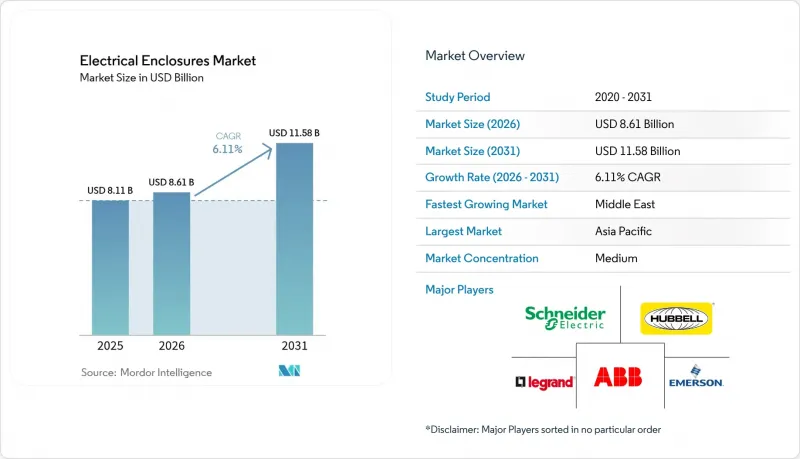
根據 Mordor Intelligence 預測,電氣外殼市場預計將從 2025 年的 81.1 億美元成長到 2026 年的 86.1 億美元,到 2031 年達到 115.8 億美元,2026 年至 2031 年的複合年成長率預計為 6.11%。
本報告材質(金屬和非金屬)、安裝類型(壁掛式、桿式)、外形規格(小型(小於10公升)、緊湊型(10-50公升)、其他)、終端用戶行業(石油天然氣、工業製造和機器人、交通運輸、資料中心和通訊、食品飲料、製藥、其他)以及地區進行細分。市場預測以美元(USD)為單位。
全球電氣外殼市場趨勢與洞察
擴大可再生能源的引入
公用事業規模的太陽能和離岸風力發電專案對匯流箱、逆變器外殼和變壓器箱體均有IP65或更高防護等級的要求,即必須能夠抵抗腐蝕性噴濺、紫外線輻射以及長達25年的溫度波動。雖然316L不銹鋼在北海風電場中佔據主導地位,但在阿拉伯半島高達50°C的酷熱環境下,帶有被動橡膠的粉末塗層鋁材能夠更好地保護設備。與太陽能電池陣列並置的電池能源儲存系統需要進行額外的防火測試,並且必須獲得UL 9540A認證才能確保資金籌措可行性。由於可再生能源發電容量分佈在數千個小規模裝置中,而非少數幾個集中式電廠,物流負責人必須協調各種小型外殼SKU的準時交付,這迫使傳統的按訂單生產工廠訂單模組化生產模式。
工業自動化和工業4.0的擴展
德國一項20億歐元(約22.6億美元)的工廠數位化津貼計畫將於2024年啟動,該計畫將津貼每個生產單元需要5至20個機櫃的感測器網路。中國和墨西哥的汽車生產線正在將協作機器人控制器安裝在IP65防護等級的不銹鋼外殼中,以防止伺服驅動器的電磁干擾。食品加工商傾向於採用符合FDA衛生標準的傾斜屋頂和連續鉸鏈設計。同時,製藥業的無塵室指定使用聚碳酸酯窗戶,以便在不破壞無菌區域的情況下進行目視檢查。隨著操作技術(OT)和資訊技術(IT)的日益融合,符合NEMA TS-2和IEC 62443標準的鎖具、防篡改感測器和入侵警報器正從資料中心轉移到工廠車間,這鞏固了電氣外殼市場作為網路安全關鍵相關人員的地位。
原物料價格波動
2024年,倫敦金屬交易所(LME)鋁期貨價格全年波動幅度達10%,對淨價差8-12%的機櫃製造商的利潤率帶來壓力。在中國,運作限產和鐵礦石供應意外中斷導致冷軋鋼價格飆升,迫使那些受固定價格採購訂單約束的製造商重新談判契約,否則將遭受損失。與鎳和鉬相關的鋼價附加費上漲了15-20%,導致離岸風力發電變電站訂單停滯不前。買家現在在競標中加入商品指數條款,但這帶來的行政負擔使電氣機櫃行業的採購和需求預測變得更加複雜。
細分市場分析
到2025年,金屬外殼將佔電氣外殼市場佔有率的63.78%。這反映了軋延鋼板的價格優勢以及鋁材在電線杆頂部設備中的輕量化優勢。非金屬外殼預計到2031年將以每年6.57%的速度成長,這主要得益於離岸風力發電、沿海變電站和化工廠等產業對玻璃纖維增強聚酯材料的逐步採用。這種材質即使經過3000小時的ASTM B117鹽霧試驗也不會生鏽。聚碳酸酯蓋板在無塵室中也逐漸成為主流,因為技術人員需要在不破壞無菌邊界的情況下進行目視檢查。
混合式設計也日益普及。鋼框架搭配聚碳酸酯門和鋁製背板,在成本、接地和耐腐蝕性之間取得了平衡。 316L不鏽鋼仍是危險區域的主流材料,符合NEMA 4X和IP66標準,並耐酸鹼腐蝕。同時,環氧塗層碳鋼仍然是室內應用的主要材料,但隨著複合材料成本的降低和阻燃等級達到UL 94 V-0,工廠正在重新考慮對傳統金屬材料的投資。因此,電氣外殼市場正在轉向更環保、生命週期經濟性更佳的複合材料解決方案。
到2025年,壁掛式機殼將佔出貨量的43.67%,成為高效利用垂直空間的控制室和機房的基礎。隨著電信業者新增數萬個5G小型基地台,預計到2031年,桿式安裝機殼的出貨量將成長6.88%。每個小型基地台都需要一個IP65防護等級的機殼來容納整流器、熔接盤和備用電池。電力業者也正在維修架空輸電線路的自動重合閘和故障指示器,將農村地區的停電時間縮短了40%。
地面安裝式和地下安裝式變壓器符合城市景觀和公共安全法規,既能隱藏變壓器,又能防止土壤潮氣和囓齒動物入侵。落地式機櫃仍用於對電纜安裝深度要求極高的重工業馬達中心和伺服器機房。隨著發電、感測和運算能力向外部位置轉移,電氣外殼市場正朝著更小巧、容錯性更高的電線杆安裝外殼發展,這些外殼必須能夠承受風和雷電的侵襲,儘管壁掛式裝置仍將繼續用於空調室內環境。
區域分析
預計到2025年,亞太地區將佔全球銷售額的35.67%。這主要得益於中國對電網的5,200億元人民幣(約730億美元)投資,其中包括安裝180萬個智慧電錶和1.2萬個自動饋線開關,所有這些設備都將安裝在防塵外殼內。在印度,政府正投入3,000億盧比(約36億美元)的維修資金,安裝能夠抵禦季風噴濺的防篡改聚碳酸酯電錶箱。在日本和韓國,核能和燃煤發電廠的控制設備正在進行維修,採用能夠承受7級地震的抗震機櫃。在東南亞,新加坡的資料中心核定容量將於2024年達到400兆瓦,相當於約1.8萬個附後門熱交換器的機架式機櫃。因此,電氣機櫃市場反映了該地區能源和數位基礎設施的擴張。
預計到2031年,中東地區的經濟成長率將達到7.13%。光是沙烏地阿拉伯的NEOM計畫就需要約8萬個適用於50°C高溫沙質環境的逆變器和變壓器機殼。阿拉伯聯合大公國的巴拉卡核電廠指定使用1.2萬個具備消弧功能的不銹鋼機櫃,為核能專案樹立了高標準。卡達的諾斯菲爾德液化天然氣擴建工程為1區訂購了5000個防爆外殼。在波斯灣地區,對沙漠環境的耐受性推動了對不銹鋼或粉末塗層鋁製產品的投資,從而提升了電氣外殼市場的平均訂單價值。
北美和歐洲合計約佔全球銷售額的45%。美國的「電網韌性」計畫資助配備固態冷卻器的NEMA 3R戶外機櫃,以減輕野火和颶風的影響。歐洲的「能源轉型」政策已撥款18億歐元(20.3億美元)用於離岸風力發電的IP67防護等級海底接線盒和轉換器外殼。雖然在這些成熟地區,設備更換週期較長,但由於電弧閃光和網路安全方面的標準更加嚴格,維修正在穩步推進。因此,儘管成長速度有所放緩,但規範的複雜性使得電氣外殼市場的現有供應商能夠保持健康的利潤率。
其他好處:
- Excel格式的市場預測(ME)表
- 3個月的分析師支持
目錄
第1章:引言
- 研究假設和市場定義
- 調查範圍
第2章:調查方法
第3章執行摘要
第4章 市場狀況
- 市場概覽
- 市場促進因素
- 加速可再生能源的普及應用
- 工業自動化和工業4.0的擴展
- 輸電網路現代化改造與變電站維修
- 更嚴格的全球安全標準和防塵/防水規格。
- 在戶外部署 5G小型基地台需要符合 IP 標準的機殼。
- 用於預測性維護的智慧物聯網機櫃
- 市場限制因素
- 原物料價格(鋼鐵、鋁)波動
- 密封完整性不足和溫度控管問題
- 網路機櫃中的網路攻擊風險
- 客製化製造業技術純熟勞工短缺
- 產業價值鏈分析
- 監理情勢
- 技術展望
- 宏觀經濟因素對市場的影響
- 波特五力分析
第5章 市場規模與成長預測
- 材料
- 金屬
- 非金屬
- 按安裝類型
- 壁掛式
- 落地式/自主型
- 地下安裝類型/地面安裝類型
- 桿式安裝型
- 按外形規格
- 小型(小於10公升)
- 小型(10-50公升)
- 均碼/大尺寸(50公升或以上)
- 模組化/可配置系統
- 按最終用戶行業分類
- 能源與電力
- 石油和天然氣
- 工業製造和機器人
- 金屬和採礦
- 運輸
- 資料中心和通訊
- 食品/飲料
- 製藥
- 按地區
- 北美洲
- 美國
- 加拿大
- 南美洲
- 巴西
- 阿根廷
- 其他南美國家
- 歐洲
- 德國
- 英國
- 法國
- 義大利
- 西班牙
- 其他歐洲國家
- 亞太地區
- 中國
- 日本
- 印度
- 韓國
- 其他亞太國家
- 中東和非洲
- 中東
- 阿拉伯聯合大公國
- 沙烏地阿拉伯
- 土耳其
- 其他中東國家
- 非洲
- 南非
- 埃及
- 其他非洲國家
- 中東
- 北美洲
第6章 競爭情勢
- 市場集中度
- 策略趨勢
- 市佔率分析
- 公司簡介
- Schneider Electric SE
- ABB Ltd.
- Eaton Corporation plc
- nVent Electric plc
- Rittal GmbH and Co. KG
- Emerson Electric Company
- Hubbell Incorporated
- Pentair plc
- Legrand SA
- Hammond Manufacturing Ltd.
- AZZ Inc.
- Scott Fetzer Company
- Allied Moulded Products Inc.
- Fibox Oy Ab
- Eldon Holding AB
- Siemens AG
- General Electric Company
- Saginaw Control and Engineering
- BOXCO Co. Ltd.
- Nitto Kogyo Corp.
- Socomec Group SA
- Bison ProFab Inc.
- Integra Enclosures Inc.
- Austin Electrical Enclosures
第7章 市場機會與未來展望
According to Mordor Intelligence, the electrical enclosures market size is expected to increase from USD 8.11 billion in 2025 to USD 8.61 billion in 2026 and reach USD 11.58 billion by 2031, growing at a CAGR of 6.11% over 2026-2031.
This report is Segmented by Material (Metallic, and Non-Metallic), Mounting Type (Wall-Mounted, Pole-Mounted), Form Factor (Small (Below 10 L), Compact (10-50 L), and More), End-User Industry (Oil and Gas, Industrial Manufacturing and Robotics, Transportation, Data Centres and Telecom, Food and Beverage, Pharmaceuticals, and More), and Geography. The Market Forecasts are Provided in Terms of Value (USD).
Global Electrical Enclosures Market Trends and Insights
Accelerating Renewable-Energy Build-Out
Utility-scale solar and offshore wind projects specify IP65 or higher combiner boxes, inverter housings, and transformer kiosks that withstand corrosive spray, ultraviolet radiation, and temperature swings for 25 years. Stainless-steel 316L dominates North Sea farms, while powder-coated aluminum with passive louvers protects equipment in the Arabian Peninsula's 50 °C heat. Battery-energy-storage systems co-located with solar arrays add a fire-test layer, as UL 9540A certification becomes non-negotiable for bankability. Because renewable capacity is deployed across thousands of micro-sites rather than a few centralized stations, logisticians must orchestrate just-in-time deliveries of smaller, varied enclosure SKUs, pressuring traditional build-to-order plants to embrace modular production.
Industrial Automation and Industry 4.0 Expansion
Factory digitalization programs funded by Germany's EUR 2 billion (USD 2.26 billion) 2024 grant scheme subsidize sensor networks that each consume five to twenty cabinets per cell. Automotive lines in China and Mexico mount collaborative-robot controllers inside IP65 stainless enclosures that prevent electromagnetic interference from servo drives. Food processors prefer sloped-roof, continuous-hinge designs that comply with FDA sanitary codes, while pharmaceutical clean rooms specify polycarbonate windows to enable visual checks without breaching sterile zones. As operational technology integrates with information technology, NEMA TS-2 and IEC 62443 locks, tamper sensors, and intrusion alarms migrate from data centers to plant floors, cementing the electrical enclosures market as a cybersecurity stakeholder.
Raw-Material Price Volatility
London Metal Exchange aluminum contracts fluctuated 10% intra-year during 2024, eroding margins for enclosure makers that operate on 8-12% net spreads. Chinese cold-rolled steel soared when blast-furnace curbs coincided with unexpected iron-ore outages, forcing contract renegotiations or losses for fabricators tied to fixed-price purchase orders. Stainless-steel surcharges linked to nickel and molybdenum spiked 15-20%, stalling offshore wind substation awards. Buyers now write commodity-index clauses into tenders, but the administrative burden complicates procurement and forecasting in the electrical enclosures industry.
Other drivers and restraints analyzed in the detailed report include:
- Grid-Modernization and Substation Retrofits
- Stricter Global Safety and Ingress-Protection Codes
- Cyber-Attack Risk in Connected Enclosures
For complete list of drivers and restraints, kindly check the Table Of Contents.
Segment Analysis
Metallic units accounted for 63.78% of the electrical enclosures market share in 2025, reflecting cold-rolled steel's price advantage and aluminum's weight savings for pole-top gear. Non-metallic cabinets are expected to grow 6.57% annually through 2031 as offshore wind, coastal substations, and chemical plants shift toward fiberglass-reinforced polyester, which shows no rust after 3,000 hours of ASTM B117 salt spray testing. Polycarbonate lids dominate clean rooms where technicians need visual confirmation without breaking the sterile boundary.
Hybrid designs are multiplying: steel frames with polycarbonate doors or aluminum backplates balance cost, grounding, and corrosion resistance. Stainless-steel 316L still owns hazardous zones, meeting NEMA 4X and IP66 while resisting acid and chlorine attack. Meanwhile, carbon steel with epoxy coatings remains the indoor workhorse, but as composite costs fall and flame-retardant ratings reach UL 94 V-0, even factories are questioning legacy metal spend. The electrical enclosures market thus moves toward a mixed-material toolkit tailored to the environment and lifecycle economics.
Wall-mounted boxes delivered 43.67% of 2025 shipments, anchoring control rooms and machine cells where vertical real estate is cheap. Pole-mounted designs are forecast to expand 6.88% through 2031 as telecom operators add tens of thousands of 5G small cells, each requiring IP65-rated housings for rectifiers, splice trays, and backup batteries. Distribution utilities also retrofit auto-reclosers and fault indicators on overhead feeders, cutting rural outage minutes by 40%.
Pad-mounted and underground units serve urban aesthetics and public-safety rules, hiding transformers out of view while resisting soil moisture and rodent ingress. Floor-standing cabinets remain in heavy-industry motor centers and server rooms where cable depth matters. The outward shift in generation, sensing, and compute power is pushing the electrical enclosures market toward smaller, resilient pole-top shells that must withstand wind and lightning, while wall-mounts will persist in climatized interiors.
Complete Report Scope:
- By Material
- Metallic
- Non-Metallic
- By Mounting Type
- Wall-Mounted
- Floor-Mounted / Free-Standing
- Underground / Pad-Mounted
- Pole-Mounted
- By Form Factor
- Small (Below 10 L)
- Compact (10-50 L)
- Free-Size / Full-Size (Above 50 L)
- Modular / Configurable Systems
- By End-User Industry
- Energy and Power
- Oil and Gas
- Industrial Manufacturing and Robotics
- Metals and Mining
- Transportation
- Data Centres and Telecom
- Food and Beverage
- Pharmaceuticals
- By Geography
- North America
- United States
- Canada
- South America
- Brazil
- Argentina
- Rest of South America
- Europe
- Germany
- United Kingdom
- France
- Italy
- Spain
- Rest of Europe
- Asia Pacific
- China
- Japan
- India
- South Korea
- Rest of Asia Pacific
- Middle East and Africa
- Middle East
- United Arab Emirates
- Saudi Arabia
- Turkey
- Rest of Middle East
- Africa
- South Africa
- Egypt
- Rest of Africa
- Middle East
- North America
Geography Analysis
Asia Pacific generated 35.67% of 2025 revenue, buoyed by China's CNY 520 billion (USD 73 billion) grid spend that deployed 1.8 million smart meters and 12,000 automated feeder switches, all nestled inside dust-tight housings. India's INR 300 billion (USD 3.6 billion) revamp funds tamper-proof polycarbonate meter boxes resilient against monsoon splash. Japan and South Korea retrofit nuclear and coal controls into seismic-rated cabinets that sustain magnitude-7 shocks. Southeast Asian data-center approvals in Singapore reached 400 MW in 2024, translating to roughly 18,000 rack enclosures with rear-door heat exchangers. The electrical enclosures market thus tracks the region's dual energy and digital build-out.
The Middle East is projected to grow 7.13% through 2031. Saudi Arabia's NEOM program alone will need about 80,000 inverter and transformer housings suited for 50 °C air laden with sand. The UAE's Barakah plant specified 12,000 stainless cabinets with arc venting, setting a high bar for nuclear projects. Qatar's North Field LNG expansion ordered 5,000 explosion-proof shells for Zone 1. Across the Persian Gulf, desert resilience drives stainless or powder-coated aluminum spend, stretching average order values in the electrical enclosures market.
North America and Europe together hold roughly 45% of global sales. The U.S. Grid Resilience program finances NEMA 3R outdoor cabinets with solid-state coolers to mitigate the impacts of wildfires and hurricanes. Europe's Energiewende funnels EUR 1.8 billion (USD 2.03 billion) into IP67 subsea junction and converter housings for offshore wind. Replacement cycles lengthen in these mature zones, but stricter arc-flash and cybersecurity standards sustain a steady retrofit cadence. Consequently, while growth moderates, specification complexity keeps margins healthy for established vendors in the electrical enclosures market.
- Schneider Electric SE
- ABB Ltd.
- Eaton Corporation plc
- nVent Electric plc
- Rittal GmbH and Co. KG
- Emerson Electric Company
- Hubbell Incorporated
- Pentair plc
- Legrand SA
- Hammond Manufacturing Ltd.
- AZZ Inc.
- Scott Fetzer Company
- Allied Moulded Products Inc.
- Fibox Oy Ab
- Eldon Holding AB
- Siemens AG
- General Electric Company
- Saginaw Control and Engineering
- BOXCO Co. Ltd.
- Nitto Kogyo Corp.
- Socomec Group SA
- Bison ProFab Inc.
- Integra Enclosures Inc.
- Austin Electrical Enclosures
Additional Benefits:
- The market estimate (ME) sheet in Excel format
- 3 months of analyst support
TABLE OF CONTENTS
1 INTRODUCTION
- 1.1 Study Assumptions and Market Definition
- 1.2 Scope of the Study
2 RESEARCH METHODOLOGY
3 EXECUTIVE SUMMARY
4 MARKET LANDSCAPE
- 4.1 Market Overview
- 4.2 Market Drivers
- 4.2.1 Accelerating Renewable-Energy Build-Out
- 4.2.2 Industrial Automation and Industry 4.0 Expansion
- 4.2.3 Grid-Modernization and Substation Retrofits
- 4.2.4 Stricter Global Safety and Ingress-Protection Codes
- 4.2.5 Outdoor 5G Small-Cell Rollout Needing IP-Rated Housings
- 4.2.6 Smart IoT-Enabled Enclosures for Predictive Maintenance
- 4.3 Market Restraints
- 4.3.1 Raw-Material Price Volatility (Steel, Aluminium)
- 4.3.2 Seal-Integrity and Thermal-Management Failures
- 4.3.3 Cyber-Attack Risk in Connected Enclosures
- 4.3.4 Skilled-Labour Shortage for Custom Fabrication
- 4.4 Industry Value Chain Analysis
- 4.5 Regulatory Landscape
- 4.6 Technological Outlook
- 4.7 Impact of Macroeconomic Factors on the Market
- 4.8 Porter's Five Forces Analysis
- 4.8.1 Threat of New Entrants
- 4.8.2 Bargaining Power of Buyers
- 4.8.3 Bargaining Power of Suppliers
- 4.8.4 Threat of Substitute Products
- 4.8.5 Intensity of Competitive Rivalry
5 MARKET SIZE AND GROWTH FORECASTS (VALUE)
- 5.1 By Material
- 5.1.1 Metallic
- 5.1.2 Non-Metallic
- 5.2 By Mounting Type
- 5.2.1 Wall-Mounted
- 5.2.2 Floor-Mounted / Free-Standing
- 5.2.3 Underground / Pad-Mounted
- 5.2.4 Pole-Mounted
- 5.3 By Form Factor
- 5.3.1 Small (Below 10 L)
- 5.3.2 Compact (10-50 L)
- 5.3.3 Free-Size / Full-Size (Above 50 L)
- 5.3.4 Modular / Configurable Systems
- 5.4 By End-User Industry
- 5.4.1 Energy and Power
- 5.4.2 Oil and Gas
- 5.4.3 Industrial Manufacturing and Robotics
- 5.4.4 Metals and Mining
- 5.4.5 Transportation
- 5.4.6 Data Centres and Telecom
- 5.4.7 Food and Beverage
- 5.4.8 Pharmaceuticals
- 5.5 By Geography
- 5.5.1 North America
- 5.5.1.1 United States
- 5.5.1.2 Canada
- 5.5.2 South America
- 5.5.2.1 Brazil
- 5.5.2.2 Argentina
- 5.5.2.3 Rest of South America
- 5.5.3 Europe
- 5.5.3.1 Germany
- 5.5.3.2 United Kingdom
- 5.5.3.3 France
- 5.5.3.4 Italy
- 5.5.3.5 Spain
- 5.5.3.6 Rest of Europe
- 5.5.4 Asia Pacific
- 5.5.4.1 China
- 5.5.4.2 Japan
- 5.5.4.3 India
- 5.5.4.4 South Korea
- 5.5.4.5 Rest of Asia Pacific
- 5.5.5 Middle East and Africa
- 5.5.5.1 Middle East
- 5.5.5.1.1 United Arab Emirates
- 5.5.5.1.2 Saudi Arabia
- 5.5.5.1.3 Turkey
- 5.5.5.1.4 Rest of Middle East
- 5.5.5.2 Africa
- 5.5.5.2.1 South Africa
- 5.5.5.2.2 Egypt
- 5.5.5.2.3 Rest of Africa
- 5.5.5.1 Middle East
- 5.5.1 North America
6 COMPETITIVE LANDSCAPE
- 6.1 Market Concentration
- 6.2 Strategic Moves
- 6.3 Market Share Analysis
- 6.4 Company Profiles (includes Global Level Overview, Market Level Overview, Core Segments, Financials as Available, Strategic Information, Market Rank/Share for Key Companies, Products and Services, and Recent Developments)
- 6.4.1 Schneider Electric SE
- 6.4.2 ABB Ltd.
- 6.4.3 Eaton Corporation plc
- 6.4.4 nVent Electric plc
- 6.4.5 Rittal GmbH and Co. KG
- 6.4.6 Emerson Electric Company
- 6.4.7 Hubbell Incorporated
- 6.4.8 Pentair plc
- 6.4.9 Legrand SA
- 6.4.10 Hammond Manufacturing Ltd.
- 6.4.11 AZZ Inc.
- 6.4.12 Scott Fetzer Company
- 6.4.13 Allied Moulded Products Inc.
- 6.4.14 Fibox Oy Ab
- 6.4.15 Eldon Holding AB
- 6.4.16 Siemens AG
- 6.4.17 General Electric Company
- 6.4.18 Saginaw Control and Engineering
- 6.4.19 BOXCO Co. Ltd.
- 6.4.20 Nitto Kogyo Corp.
- 6.4.21 Socomec Group SA
- 6.4.22 Bison ProFab Inc.
- 6.4.23 Integra Enclosures Inc.
- 6.4.24 Austin Electrical Enclosures
7 MARKET OPPORTUNITIES AND FUTURE OUTLOOK
- 7.1 White-Space and Unmet-Need Assessment

 印度電氣外殼市場:市場佔有率分析、產業趨勢與統計及成長預測(2026-2031)
 電氣外殼市場-全球市場預測(2026-2032年)
 電氣外殼市場:按產品類型、應用、最終用戶產業和地區分類電氣櫃及外殼市場:依材質、防護等級、額定電壓、產品類型及最終用戶產業分類-2026-2032年全球市場預測全球機櫃冷卻器市場按類型、冷卻能力、機櫃類型、安裝方式、最終用途產業和分銷管道分類,2026-2032年預測美國電氣機殼:市場佔有率分析、產業趨勢與統計、成長預測(2026-2031)
 電氣外殼市場規模、佔有率、成長及全球產業分析:按類型、應用和地區的洞察,2026-2034年預測
 2026年全球電氣外殼市場報告不銹鋼烘乾櫃市場按產品類型、材質等級、容量、價格範圍、應用、終端用戶產業和分銷管道分類-2026-2032年全球預測電池外殼及機櫃市場(依產品類型、安裝類型、材料、電池類型、最終用戶和應用分類)-全球預測,2026-2032年