


 |
市場調查報告書
商品編碼
2121400
亞太地區行動雲:市場佔有率分析、產業趨勢與統計及成長預測(2026-2031)Asia-Pacific Mobile Cloud - Market Share Analysis, Industry Trends & Statistics, Growth Forecasts (2026 - 2031) |
||||||

※ 本網頁內容可能與最新版本有所差異。詳細情況請與我們聯繫。
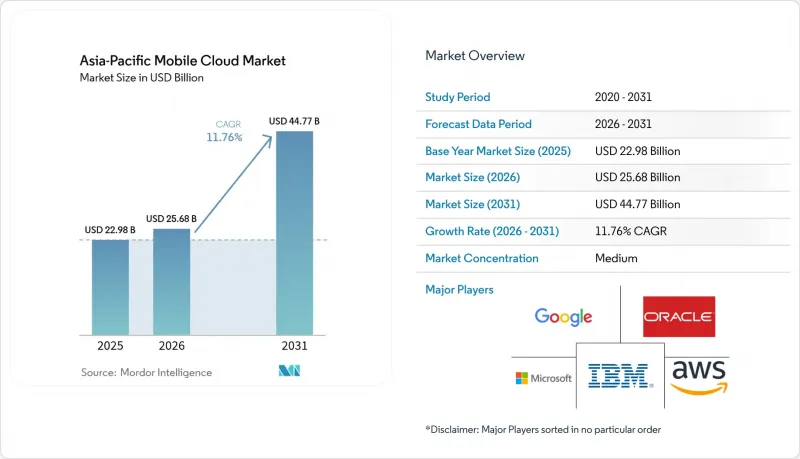
據 Mordor Intelligence 稱,亞太地區行動雲市場預計到 2026 年價值 256.8 億美元,高於 2025 年的 229.8 億美元,預計到 2031 年將達到 447.7 億美元。
預計2026年至2031年複合年成長率將達11.76%。
本報告按服務類型(行動平台即服務、行動裝置管理整合雲、行動內容傳送/邊緣CDN等)、部署模式(公共雲端、私有雲端、混合雲端、多重雲端)、使用者類型(企業、消費者)、產業領域(遊戲、教育等)和地區進行細分。市場預測以美元計價。
亞太地區移動雲市場趨勢及洞察。
在亞太地區主要經濟區快速部署5G網路。
在中國,到2024年底,已部署368萬個5G基地台,實現了行動雲工作負載低於15毫秒的延遲。韓國電信業者在2024年投資84億美元,擴大毫米波覆蓋範圍,進而實現電商應用的即時庫存同步。印度電信業者將在2025年中期前投入運作45萬個5G基地台,使金融科技平台能夠實現對雲端後端API呼叫低於50毫秒的延遲。在日本,NTT Docomo將獨立組網的5G與邊緣節點結合,與4G相比,遊戲延遲降低了40%。新加坡監管機構強制要求在2025年前實現全國的5G部署,並敦促企業重構行動應用,使其能夠原生支援邊緣運算。
日益成長的「純行動端」消費者群體對裝置內雲端儲存的需求不斷成長。
在印度,預計到2024年,僅使用行動裝置網路用戶將達到7.8億,佔線上用戶的68%,這使得基於行動電話的雲端備份變得至關重要。在印尼770億美元的數位經濟中,92%的交易是透過智慧型手機完成的,零售商依賴雲端後端實現一鍵支付。在菲律賓,8,900萬行動上網用戶每月使用18GB的資料流量,推動了對基於雲端的影片快取的需求。在越南,超級應用文化的興起意味著叫車服務、支付和電子商務都透過雲端規模的API進行處理,這些API必須具備跨行動平台的彈性和可擴展性。這些市場的消費者比桌面用戶更願意為高級儲存方案付費,這增強了行動雲端供應商的持續收入來源。
亞太地區資料主權面臨的持續跨境障礙
中國的《個人資料保護法》規定雲端服務供應商必須在國內儲存個人數據,這要求他們建造城市級資料中心,從而推高了營運成本。印度的《數位個人資料保護法》也強制要求類似的在地化,迫使超大規模超大規模資料中心業者投入數十億美元建設基礎設施以滿足合規要求。印尼的《第71號規則》和越南的《網路安全法》都阻礙了跨境資料複製,導致區域架構分散化。這些法規正在減緩多重雲端的普及,因為企業在部署覆蓋整個亞洲地區的平台之前,必須驗證是否符合相關司法管轄區的法規。目前,已營運自主雲的國內服務供應商佔據主導地位,這使得亞太地區行動雲端市場的競爭格局更加複雜。
細分市場分析
行動後端即服務 (MBaaS) 透過提供承包的認證、資料庫和推播通知模組,縮短了開發週期,預計到 2025 年將佔據亞太地區行動雲端市場 38.10% 的收入佔有率,成為該地區行動雲端市場最大的佔有率。邊緣行動內容分發(Edge-based mobile 內容傳送) 滿足了遊戲和串流應用程式對延遲的要求,預計到 2031 年將以 11.79% 的複合年成長率成長。隨著開發者將運算資源部署在距離用戶 10 毫秒以內,在邊緣 CDN 服務的推動下,亞太地區行動雲市場規模預計將在 2026 年至 2031 年間成長一倍以上。騰訊雲的 180 個邊緣節點已將微信小程式的影片載入時間縮短了三分之一。阿里雲與中國移動合作,透過將微型資料中心與 5G 基地台共址,為擴增實境(AR) 商務提供支援。在東南亞,Google雲端的 Anthos for Mobile 正在協助銀行在本地機架和公共區域部署容器化服務,以滿足資料居住要求。隨著邊緣 CDN 供應商採用無伺服器運算,以及 MBaaS 供應商推出全球文件和媒體發送服務,競爭格局日趨模糊,供應商整合也在加速進行。
企業將成本最佳化列為選擇行動支付即服務 (MBaaS) 的主要原因,並表示與自研技術相比,MBaaS 可將產品上市時間縮短 40-50%。參與印度金融科技沙盒專案的新創公司利用預先建置的身份驗證、分析和通知模組,在八週內即可迭代開發支付 API。邊緣 CDN 的成長與用戶在行動裝置上花費的時間不斷增加密切相關。根據 GSMA 估計,到 2024 年,亞太地區用戶每天使用智慧型手機的時間將達到 5.2 小時,而這種使用習慣正在加速現金需求的成長。隨著影片、遊戲和身臨其境型商務市場佔有率的不斷成長,亞太地區行動雲端產業的細分市場結構預計將會發生變化,這將迫使後端供應商整合輕量級邊緣節點以保持競爭力。
2025年,公共雲端收入佔比將達到63.20%,這得益於其按需定價、最廣泛的地域覆蓋以及強大的開發者生態系統。然而,隨著銀行和醫院在資料保存需求與全球擴充性之間尋求平衡,混合雲和多重雲端配置預計將以11.72%的複合年成長率成長。在亞太地區行動雲端市場,混合架構的市場規模預計將從2026年的93.8億美元成長到2031年的163.3億美元。星展銀行利用AWS進行分析,同時透過私有節點處理交易,進而降低了22%的總成本。澳洲聯邦銀行採用了雙公共雲端策略,在海外訓練人工智慧模型的同時,將客戶資料保留在國內,這展現了該機構如何最佳化合規性和效能。
中國在私有雲端應用方面處於領先地位。在中國,國營企業和大型網路公司都在運作自主主導的行動雲,以符合網路安全指令。像樂天這樣的日本企業集團正在將本地邊緣節點與公共雲端的突發容量相結合,以應對波動較大的行動工作負載。隨著混合環境的擴展,對整合控制平面軟體的需求也在不斷成長。 VMware、Red Hat 和 IBM 等公司正在開發工具,以實現跨叢集安全策略的統一。
其他好處:
- Excel格式的市場預測(ME)表
- 3個月的分析師支持
目錄
第1章:引言
- 研究假設和市場定義
- 調查範圍
第2章:調查方法
第3章執行摘要
第4章 市場狀況
- 市場概覽
- 市場促進因素
- 在亞太地區主要經濟區快速部署5G網路。
- 行動裝置用戶數量的不斷成長正在推動對設備內雲端儲存的需求。
- 政府主導的數位國家計畫(例如,印度的「數位印度」、印尼的「1000家新創企業」計畫)
- 企業向邊緣運算型 MPaaS 遷移,以實現超低延遲應用
- 超級應用程式的激增帶來了巨大的即時數據處理壓力。
- OEM廠商主導的「裝置捆綁雲」訂閱模式正在提升ARPU值。
- 市場限制因素
- 亞太地區跨境資料主權仍有障礙。
- 雲端原生行動 DevSecOps 技能短缺
- 日本和澳洲超大規模資料中心能源成本飆升
- 不斷上漲的頻率使用費正在抑制電信業者對雲端基礎設施的投資。
- 產業價值鏈分析
- 監理情勢
- 技術展望
- 波特五力分析
第5章 市場規模與成長預測
- 按服務類型
- 行動後端即服務 (MBaaS)
- 行動平台即服務 (mPaaS)
- 用於行動裝置管理 (MDM) 的整合雲
- 行動內容傳送/邊緣CDN
- 按部署模式
- 公共雲端
- 私有雲端
- 混合雲端和多重雲端
- 依使用者類型
- 公司
- 一般消費者
- 按行業分類
- 遊戲
- 銀行、金融服務和保險(BFSI)
- 媒體與娛樂
- 教育
- 衛生保健
- 旅遊與飯店
- 零售與電子商務
- 政府/公共部門
- 其他工業部門
- 國家
- 中國
- 日本
- 印度
- 澳洲
- 韓國
- 新加坡
- 印尼
- 馬來西亞
- 菲律賓
- 其他亞太國家
第6章 競爭情勢
- 市場集中度
- 策略趨勢
- 市佔率分析
- 公司簡介
- Amazon Web Services, Inc.
- Microsoft Corporation
- Alibaba Cloud Computing Co., Ltd.
- Google LLC
- Huawei Technologies Co., Ltd.
- IBM Corporation
- Oracle Corporation
- SAP SE
- Tencent Cloud Computing(Beijing)Co., Ltd.
- Fujitsu Limited
- Rakuten Group, Inc.
- NTT Communications Corporation
- Salesforce, Inc.
- Akamai Technologies, Inc.
- VMware, Inc.
- Baidu, Inc.
- HCL Technologies Limited
- Infosys Limited
- ZTE Corporation
- Nokia Corporation
- Ericsson AB
- SoftBank Corp.
- SK Telecom Co., Ltd.
第7章 市場機會與未來展望
According to Mordor Intelligence, Asia-Pacific mobile cloud market size in 2026 is estimated at USD 25.68 billion, growing from 2025 value of USD 22.98 billion with 2031 projections showing USD 44.77 billion, growing at 11.76% CAGR over 2026-2031.
This report is Segmented by Service Type (Mobile Platform-As-A-Service, Mobile Device Management-Integrated Cloud, Mobile Content Delivery/Edge CDN, and More), Deployment Model (Public Cloud, Private Cloud, Hybrid and Multi-Cloud), User Type (Enterprise, and Consumer), Industry Vertical (Gaming, Education, and More), and Geography. The Market Forecasts are Provided in Terms of Value (USD).
Asia-Pacific Mobile Cloud Market Trends and Insights
Rapid Rollout of 5G Networks Across Key Asia-Pacific Economies
China deployed 3.68 million 5G base stations by late 2024, delivering sub-15 millisecond latency for mobile cloud workloads. South Korean carriers invested USD 8.4 billion in 2024 to densify millimeter-wave coverage, enabling real-time inventory sync for e-commerce apps. India's operators activated 450,000 5G sites by mid-2025, enabling fintech platforms to achieve sub-50-millisecond API calls on cloud backends. Japan's NTT Docomo linked standalone 5G with edge nodes, cutting gaming latency by 40% versus 4G. Singapore's regulator mandated nationwide 5G by 2025, spurring enterprises to rebuild mobile apps for edge-native deployment.
Rising Mobile-Only Consumer Base Demanding On-Device Cloud Storage
India counted 780 million mobile-only internet users in 2024, representing 68% of online citizens and making handset-based cloud backup a necessity. Indonesia's USD 77 billion digital economy is 92% smartphone-transacted, so retailers rely on cloud backends for one-tap checkout. The Philippines logged 89 million mobile internet subscribers who consumed 18 GB of data monthly, driving demand for cloud-based video caching. Vietnam's rising super-app culture funnels ride-hailing, payments, and e-commerce through cloud-scale APIs that must elastically scale on mobile platforms. Consumers in these markets are showing higher willingness to pay for premium storage tiers than desktop users, strengthening recurring revenue for mobile cloud vendors.
Persistent Cross-Border Data-Sovereignty Barriers in Asia-Pacific
China's Personal Information Protection Law obliges cloud providers to keep personal data inside national borders, requiring city-level data centers that raise operating costs. India's Digital Personal Data Protection Act enforces similar localization, prompting hyperscalers to commit multi-billion-dollar builds to satisfy compliance. Indonesia's Regulation 71 and Vietnam's Cybersecurity Law both deter cross-border replication, fragmenting regional architectures. These rules slow multi-cloud adoption because enterprises must validate jurisdictional compliance before deploying Asia-wide platforms. Domestic providers that already operate sovereign clouds gain an edge, complicating competitive dynamics in the Asia-Pacific mobile cloud market.
Other drivers and restraints analyzed in the detailed report include:
- Government-Funded Digital-Nation Programs
- Enterprise Shift Toward Edge-Enabled mPaaS for Ultra-Low Latency Apps
- Rising Spectrum-Usage Fees Limiting Telco Cloud CAPEX
For complete list of drivers and restraints, kindly check the Table Of Contents.
Segment Analysis
Mobile Backend-as-a-Service accounted for 38.10% of 2025 revenue, the largest slice of Asia-Pacific mobile cloud market share, by delivering turnkey authentication, database, and push-notification modules that compress development cycles. Edge-anchored Mobile Content Delivery is forecast to grow at an 11.79% CAGR through 2031, mirroring latency needs of gaming and streaming apps. The Asia-Pacific mobile cloud market size derived from edge CDN services is projected to more than double between 2026 and 2031 as developers position compute within 10 milliseconds of users. Tencent Cloud's 180 edge nodes already shave video load times by one-third for WeChat mini-programs. Alibaba Cloud's tie-up with China Mobile co-locates micro-data centers at 5G towers to support augmented reality commerce. In Southeast Asia, Google Cloud's Anthos for Mobile enables banks to deploy containerized services across on-premise racks and public zones, meeting data-residency requirements. Competitive lines are blurring as edge CDN vendors embed serverless compute while MBaaS providers launch global file and media delivery services, intensifying vendor consolidation.
Enterprises cite cost optimization as a key reason for favoring MBaaS, reporting a 40-50% faster time-to-market compared to in-house stacks. Start-ups in India's fintech sandbox iterate payment APIs in under eight weeks by relying on pre-built identity, analytics, and notification modules. Edge CDN growth is tied to rising mobile screen time. GSMA estimates Asia-Pacific users spent 5.2 hours per day on smartphones in 2024, a behavior that accelerates cache demand. The Asia-Pacific mobile cloud industry segment mix is likely to evolve as video, gaming, and immersive commerce gain share, forcing backend providers to integrate lightweight edge nodes to remain competitive.
Public cloud captured 63.20% revenue in 2025 thanks to on-demand pricing, broadest geographic coverage, and rich developer ecosystems. Hybrid and multi-cloud configurations, however, are forecast to expand at an 11.72% CAGR as banks and hospitals balance residency mandates with global scalability. The Asia-Pacific mobile cloud market size attributable to hybrid architectures is expected to rise from USD 9.38 billion in 2026 to USD 16.33 billion in 2031. DBS Bank routes transactions through private nodes while leveraging AWS for analytics, trimming total cost by 22%. Commonwealth Bank uses dual public clouds to keep customer data local but train AI models abroad, demonstrating how organizations optimize compliance and performance.
Private cloud adoption is most prevalent in China, where state-linked enterprises and large internet firms run sovereign mobile clouds to align with cybersecurity directives. Japanese conglomerates such as Rakuten blend on-premise edge nodes with public burst capacity to process fluctuating mobile workloads. As hybrid footprints widen, demand rises for unified control-plane software; VMware, Red Hat, and IBM are tailoring tools to orchestrate security policies across clusters.
Complete Report Scope:
- By Service Type
- Mobile Backend-as-a-Service (MBaaS)
- Mobile Platform-as-a-Service (mPaaS)
- Mobile Device Management-integrated Cloud
- Mobile Content Delivery / Edge CDN
- By Deployment Model
- Public Cloud
- Private Cloud
- Hybrid and Multi-Cloud
- By User Type
- Enterprise
- Consumer
- By Industry Vertical
- Gaming
- Banking, Financial Services and Insurance (BFSI)
- Media and Entertainment
- Education
- Healthcare
- Travel and Hospitality
- Retail and E-commerce
- Government and Public Sector
- Other Industry Verticals
- By Country
- China
- Japan
- India
- Australia
- South Korea
- Singapore
- Indonesia
- Malaysia
- Philippines
- Rest of Asia-Pacific
List of Companies Covered in this Report:
- Amazon Web Services, Inc.
- Microsoft Corporation
- Alibaba Cloud Computing Co., Ltd.
- Google LLC
- Huawei Technologies Co., Ltd.
- IBM Corporation
- Oracle Corporation
- SAP SE
- Tencent Cloud Computing (Beijing) Co., Ltd.
- Fujitsu Limited
- Rakuten Group, Inc.
- NTT Communications Corporation
- Salesforce, Inc.
- Akamai Technologies, Inc.
- VMware, Inc.
- Baidu, Inc.
- HCL Technologies Limited
- Infosys Limited
- ZTE Corporation
- Nokia Corporation
- Ericsson AB
- SoftBank Corp.
- SK Telecom Co., Ltd.
Additional Benefits:
- The market estimate (ME) sheet in Excel format
- 3 months of analyst support
TABLE OF CONTENTS
1 INTRODUCTION
- 1.1 Study Assumptions and Market Definition
- 1.2 Scope of the Study
2 RESEARCH METHODOLOGY
3 EXECUTIVE SUMMARY
4 MARKET LANDSCAPE
- 4.1 Market Overview
- 4.2 Market Drivers
- 4.2.1 Rapid Rollout Of 5G Networks Across Key Asia-Pacific Economies
- 4.2.2 Rising Mobile-Only Consumer Base Demanding On-Device Cloud Storage
- 4.2.3 Government-Funded Digital-Nation Programs (E.G., India's Digital India, Indonesia's 1000 Start-Ups)
- 4.2.4 Enterprise Shift Toward Edge-Enabled Mpaas For Ultra-Low Latency Apps
- 4.2.5 Proliferation Of Super-Apps Generating Massive Real-Time Data Workloads
- 4.2.6 OEM-Driven "Device-Bundled Cloud" Subscriptions Boosting ARPU
- 4.3 Market Restraints
- 4.3.1 Persistent Cross-Border Data-Sovereignty Barriers In Asia-Pacific
- 4.3.2 Skills Shortage In Cloud-Native Mobile DevSecOps
- 4.3.3 Energy-Cost Spikes At Hyperscale Data-Centers In Japan And Australia
- 4.3.4 Rising Spectrum-Usage Fees Limiting Telco Cloud CAPEX
- 4.4 Industry Value Chain Analysis
- 4.5 Regulatory Landscape
- 4.6 Technological Outlook
- 4.7 Porter's Five Forces Analysis
- 4.7.1 Bargaining Power of Suppliers
- 4.7.2 Bargaining Power of Buyers
- 4.7.3 Threat of New Entrants
- 4.7.4 Intensity of Competitive Rivalry
- 4.7.5 Threat of Substitutes
5 MARKET SIZE AND GROWTH FORECASTS (VALUE)
- 5.1 By Service Type
- 5.1.1 Mobile Backend-as-a-Service (MBaaS)
- 5.1.2 Mobile Platform-as-a-Service (mPaaS)
- 5.1.3 Mobile Device Management-integrated Cloud
- 5.1.4 Mobile Content Delivery / Edge CDN
- 5.2 By Deployment Model
- 5.2.1 Public Cloud
- 5.2.2 Private Cloud
- 5.2.3 Hybrid and Multi-Cloud
- 5.3 By User Type
- 5.3.1 Enterprise
- 5.3.2 Consumer
- 5.4 By Industry Vertical
- 5.4.1 Gaming
- 5.4.2 Banking, Financial Services and Insurance (BFSI)
- 5.4.3 Media and Entertainment
- 5.4.4 Education
- 5.4.5 Healthcare
- 5.4.6 Travel and Hospitality
- 5.4.7 Retail and E-commerce
- 5.4.8 Government and Public Sector
- 5.4.9 Other Industry Verticals
- 5.5 By Country
- 5.5.1 China
- 5.5.2 Japan
- 5.5.3 India
- 5.5.4 Australia
- 5.5.5 South Korea
- 5.5.6 Singapore
- 5.5.7 Indonesia
- 5.5.8 Malaysia
- 5.5.9 Philippines
- 5.5.10 Rest of Asia-Pacific
6 COMPETITIVE LANDSCAPE
- 6.1 Market Concentration
- 6.2 Strategic Moves
- 6.3 Market Share Analysis
- 6.4 Company Profiles (includes Global level Overview, Market level overview, Core Segments, Financials as available, Strategic Information, Market Rank/Share for key companies, Products and Services, and Recent Developments)
- 6.4.1 Amazon Web Services, Inc.
- 6.4.2 Microsoft Corporation
- 6.4.3 Alibaba Cloud Computing Co., Ltd.
- 6.4.4 Google LLC
- 6.4.5 Huawei Technologies Co., Ltd.
- 6.4.6 IBM Corporation
- 6.4.7 Oracle Corporation
- 6.4.8 SAP SE
- 6.4.9 Tencent Cloud Computing (Beijing) Co., Ltd.
- 6.4.10 Fujitsu Limited
- 6.4.11 Rakuten Group, Inc.
- 6.4.12 NTT Communications Corporation
- 6.4.13 Salesforce, Inc.
- 6.4.14 Akamai Technologies, Inc.
- 6.4.15 VMware, Inc.
- 6.4.16 Baidu, Inc.
- 6.4.17 HCL Technologies Limited
- 6.4.18 Infosys Limited
- 6.4.19 ZTE Corporation
- 6.4.20 Nokia Corporation
- 6.4.21 Ericsson AB
- 6.4.22 SoftBank Corp.
- 6.4.23 SK Telecom Co., Ltd.
7 MARKET OPPORTUNITIES AND FUTURE OUTLOOK
- 7.1 White-Space and Unmet-Need Assessment


