


 |
市場調查報告書
商品編碼
2120787
歐洲移動雲:市場佔有率分析、產業趨勢與統計及成長預測(2026-2031 年)Europe Mobile Cloud - Market Share Analysis, Industry Trends & Statistics, Growth Forecasts (2026 - 2031) |
||||||

※ 本網頁內容可能與最新版本有所差異。詳細情況請與我們聯繫。
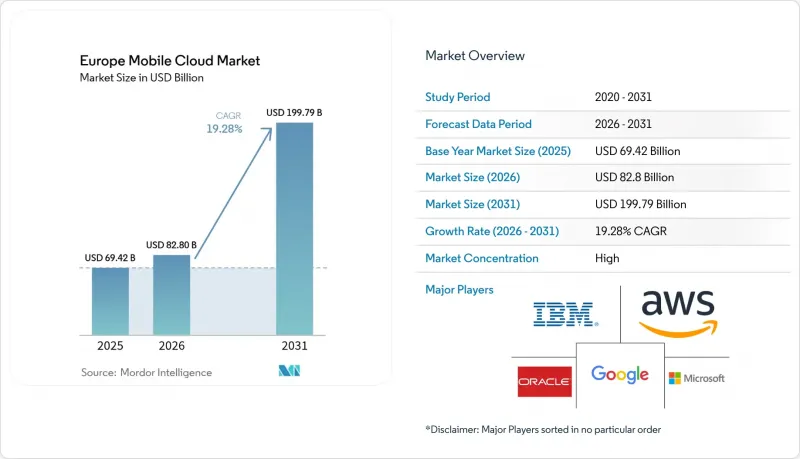
據 Mordor Intelligence 稱,2025 年歐洲行動雲端市場價值 694.2 億美元,預計到 2031 年將達到 1997.9 億美元,而 2026 年為 828 億美元,預測期(2026-2031 年)複合年成長率為 19.28%。
本報告按使用者類型(企業和消費者)、應用程式(遊戲、娛樂、教育等)、服務模式(軟體即服務 (SaaS)、平台即服務 (PaaS) 等)、部署模式(公共雲端、私有雲端等)和國家/地區進行分類。
歐洲移動雲市場的趨勢與洞察
在歐盟27國範圍內部署主權雲區域
歐盟委員會的 EuroStack 計畫旨在 2030 年建構 10,000 個分散式邊緣邊緣雲端節點,創建符合嚴格資料居住要求的本地處理中心。 Orange 和 Capgemini 於 2024 年推出的Bleu 平台,旨在根據 SecNumCloud 法規提供微軟技術,證明了合規優先的服務能夠吸引高度敏感的工作負載。即將推出的歐盟雲端服務計畫將根據主權和安全標準對服務提供者進行認證,加速先前託管在歐盟境外的關鍵產業數據的回歸。同時,歐盟資料法要求供應商在 2027 年 1 月前取消轉換費,以削弱鎖定效應並促進競爭性生態系統的發展。隨著公共機構調整採購規則,歐洲電信業者預計與受監管產業相關的雲端需求將顯著成長。
加速部署 5G SA 可降低移動和雲端延遲。
全球已有超過60家電信營運商,包括德國、英國、義大利和西班牙的營運商,開始供應商用5G SA網路。網路切片技術能夠根據行動和雲端應用的需求,預先定義延遲和頻寬等級,並透過加值服務層級直接獲利。德國電信的「5G+Gaming」先導計畫已證明,雲端遊戲流量的端對端延遲低於10毫秒。 GSMA預測,到2030年,5G將為歐洲帶來1,640億歐元的經濟價值,其中大部分取決於SA部署。核心網路升級,例如O2 Telefónica的雲端原生雙模核心網,進一步減少了維護停機時間,並實現了功能的持續發布。
加強對超大規模資料中心業者市場主導地位的監管(CMA 和 EU DMA)
英國競爭與市場管理局 (CMA) 認定,AWS 和微軟各自控制著英國 30% 至 40% 的雲端支出,並提案其「戰略市場地位」義務,這可能要求其在互通性和定價方面採取糾正措施。 CMA 估計,競爭改革每年可為英國企業節省 4.3 億英鎊。同時,布魯塞爾《數位市場法案》(DMA) 的同步實施進一步加強了對「安全隔離網閘」平台的合規要求,包括限制將軟體授權與雲端使用捆綁銷售。 AWS 和微軟都已主動取消客戶切換供應商時的外呼費用,這表明它們正在最終裁決訂定前協調行動。雖然這些讓步對客戶有利,但可能會擠壓供應商的利潤空間,並減緩短期投資的步伐。
細分市場分析
隨著企業將效能保障和資料主權合規性置於優先地位,預計到2025年,企業工作負載將佔歐洲行動雲市場收入的66.35%。西班牙對外銀行(BBVA)等金融機構強調了遷移到雲端原生資料平台的優勢,指出其顯著縮短了洞察時間(分析速度提升94%)。這些可衡量的成果證明了高昂的合約價格是合理的,並推動了持續的基礎設施投資。儘管消費者市場的普及率仍然較低,但在雲端遊戲訂閱和行動娛樂套餐的推動下,其正以19.62%的複合年成長率快速成長。德國電信(Telefónica Germany)已將其一百萬5G用戶遷移到AWS核心雲,從而整合了其企業和消費者價值鏈。這表明,差異化的網路服務可以在這兩個領域中實現盈利。雖然企業仍然是歐洲行動雲端市場的基礎,但消費者市場的成長正在使收入來源多元化,並減輕企業預算週期帶來的影響。強勁的消費主導成長正在加強與靠近人口密集區域的邊緣運算節點的連接,從而減少圖形密集型遊戲和影片串流的抖動。網路營運商受益於批發流量的逐步成長,而超大規模資料中心業者則在大都會圈區內分發內容快取。同時,企業負責人正在擴展其多重雲端部署以降低廠商鎖定風險,而沃達豐則透過維持其三大主要供應商之間的「商業性張力」來實現成本節約。先進的財務營運(FinOps)儀表板按業務部門追蹤使用情況,確保所有工作負載都在最佳成本績效範圍內運作。這種綜合發展趨勢正在保持歐洲行動雲端產業的韌性。
預計到2025年,遊戲產業將佔總收入的31.35%,年複合成長率達21.68%,這主要得益於計量收費的雲端遊戲服務,該服務打破了本地硬體的限制。德國電信的「5G+Gaming」服務展示了網路切片如何確保在行動寬頻速度下實現穩定的影格速率。金融和商業應用在價值方面位居第二,這主要得益於透過安全、低延遲通訊路徑提供的即時風險分析。位於資本市場中心的各公司需要在演算法交易中實現確定性延遲,而這種需求正轉向邊緣最佳化區域。
隨著遠距學習平台和診斷人工智慧工作負載遷移到雲端,教育和醫療應用的佔有率持續成長。監管機構允許將敏感的醫療資料儲存在國家雲端區域中,使服務提供者能夠在不違反隱私法的情況下部署人工智慧驅動的影像診斷服務。娛樂平台也利用與遊戲相同的邊緣基礎設施,以自適應比特率流暢播放影片,避免緩衝。這些多樣化的應用場景共同推動了歐洲行動雲市場的整體成長,市場對更高容量的需求也必然會持續成長。
其他好處:
- Excel格式的市場預測(ME)表
- 3個月的分析師支持
目錄
第1章:引言
- 研究假設和市場定義
- 調查範圍
第2章:調查方法
第3章執行摘要
第4章 市場狀況
- 市場概覽
- 市場促進因素
- 在歐盟27國範圍內部署主權雲區域
- 5G SA 的部署正在加速,降低了行動網路和雲端之間的延遲。
- 企業級 FinOps 工具在多重雲端成本管理方面的激增
- 透過電信業者與邊緣雲端供應商之間的合作,實現網路 API 的貨幣化。
- AI驅動的行動應用開發和維運(DevOps)縮短了雲端採用時間。
- 德國和北歐國家為綠色資料中心提供稅收優惠
- 市場限制因素
- 加強對超大規模資料中心業者市場主導地位的監管(CMA 和 EU DMA)
- 與跨國資料傳輸相關的合規成本(Schrems II 裁決、GDPR)
- 能源價格波動給資料中心營運成本帶來了壓力。
- 認證雲端安全專業人員短缺
- 價值鏈分析
- 監理情勢
- 科技趨勢(5G SA、Edge、GenAI)
- 波特五力分析
第5章 市場規模與成長預測
- 使用者
- 公司
- 一般消費者
- 透過使用
- 遊戲
- 金融與商業
- 娛樂
- 教育
- 衛生保健
- 旅行
- 按服務模式
- Software-as-a-Service(SaaS)
- Platform-as-a-Service(PaaS)
- Infrastructure-as-a-Service(IaaS)
- 按部署模式
- 公共雲端
- 私有雲端
- 混合雲端
- 國家
- 德國
- 英國
- 法國
- 西班牙
- 義大利
- 其他歐洲國家
第6章 競爭情勢
- 市場集中度
- 策略趨勢
- 市佔率分析
- 公司簡介
- Amazon Web Services
- Microsoft Azure
- Google Cloud
- IBM Corporation
- SAP SE
- Deutsche Telekom(T-Systems)
- Vodafone Group
- Orange Business Services
- Telefonica Tech
- Oracle Corporation
- Salesforce Inc.
- Akamai Technologies
- OVHcloud
- Rackspace Technology
- Cloudflare Inc.
- Alibaba Cloud
- Tencent Cloud
- Huawei Cloud
- Nokia Cloud and Network Services
- Kyndryl Holdings
第7章 市場機會與未來展望
According to Mordor Intelligence, the Europe mobile cloud market size was valued at USD 69.42 billion in 2025 and estimated to grow from USD 82.8 billion in 2026 to reach USD 199.79 billion by 2031, at a CAGR of 19.28% during the forecast period (2026-2031).
This report is Segmented by User (Enterprise and Consumer), Application (Gaming, Entertainment, Education, and More), Service Model (Software-As-A-Service (SaaS), Platform-As-A-Service (PaaS), and More), Deployment Model (Public Cloud, Private Cloud, and More), and Country.
Europe Mobile Cloud Market Trends and Insights
Development of Sovereign-Cloud Zones Across EU-27
The European Commission's EuroStack programme targets 10,000 distributed edge-cloud nodes by 2030, creating local processing points that satisfy strict data-residency statutes. Orange and Capgemini's Bleu platform was launched in 2024 to offer Microsoft technology under SecNumCloud rules, proving that compliance-first offerings can attract sensitive workloads. The forthcoming EU Cloud Services Scheme will certify providers against sovereignty and security standards, accelerating repatriation of critical-sector data previously hosted outside the bloc. Simultaneously, the EU Data Act obliges vendors to abolish switching fees by January 2027, undermining lock-in economics and incentivizing a competitive ecosystem. As public agencies adapt procurement rules, European operators expect a sizeable uplift in cloud demand tied to regulated industries.
Intensifying 5G SA Roll-out Lowers Mobile-Cloud Latency
More than 60 operators worldwide have launched commercial 5G SA networks, including installations across Germany, the UK, Italy, and Spain. Network slicing allows predefined latency and bandwidth classes that match mobile-cloud application requirements, directly monetised through premium service tiers. Deutsche Telekom's 5G+ Gaming pilot has already proven sub-10 millisecond end-to-end latency for cloud gaming traffic. The GSMA projects EUR 164 billion in European economic value from 5G by 2030, most of which depends on SA deployment. Core-network upgrades, such as O2 Telefonica's cloud-native dual-mode core, further cut maintenance downtime and enable continuous feature releases.
Rising Scrutiny of Hyperscaler Market Power (CMA and EU DMA)
The UK Competition and Markets Authority found AWS and Microsoft each control 30-40 % of domestic cloud spend, proposing Strategic Market Status obligations that could force interoperability and pricing remedies. The watchdog estimates competitive reforms might save UK businesses GBP 430 million annually. Parallel Digital Markets Act enforcement in Brussels adds further compliance layers for "gatekeeper" platforms, including limits on tying software licences to cloud consumption. Both AWS and Microsoft have pre-emptively eliminated egress fees for customers switching providers, demonstrating behavioural adjustments ahead of final rulings. While such concessions help clients, they compress provider margins and may reduce near-term investment pace.
Other drivers and restraints analyzed in the detailed report include:
- Surge in Enterprise FinOps Tooling for Multi-Cloud Cost Control
- Telco Edge-Cloud Partnerships Monetising Network APIs
- Cross-Border Data-Transfer Compliance Costs (Schrems II and GDPR)
For complete list of drivers and restraints, kindly check the Table Of Contents.
Segment Analysis
Enterprise workloads produced 66.35% of 2025 Europe mobile cloud market revenue as corporates prioritised performance guarantees and sovereignty compliance. Financial institutions such as BBVA highlighted time-to-insight gains-94% faster analytics-after pivoting to cloud-native data platforms. These measurable outcomes justify premium contract values and spur continued infrastructure investment. Consumer adoption, while smaller, is expanding briskly at a 19.62% CAGR due to cloud gaming subscriptions and mobile entertainment bundles. Telefonica Germany moved 1 million 5G users onto AWS core cloud, blending enterprise and consumer value chains, proving that differentiated network services can monetise both segments. Although enterprises remain the bedrock of the Europe mobile cloud market, consumer growth diversifies revenue and cushions against corporate budget cycles. The consumer-driven upswing is increasingly tied to edge-compute nodes situated near population centres, reducing jitter for graphics-intensive titles and video streaming. Network operators benefit from incremental wholesale traffic, while hyperscalers distribute content caches across metropolitan points of presence. Meanwhile, enterprise buyers widen multi-cloud footprints to mitigate lock-in, with Vodafone registering cost savings by maintaining "commercial tension" across three large providers. Advanced FinOps dashboards track usage by business unit, ensuring every workload runs in the optimal cost-performance zone. This dual-track evolution keeps the Europe mobile cloud industry resilient
Gaming secured a 31.35% slice of 2025 revenue and is projected to expand at 21.68% CAGR, propelled by pay-as-you-go cloud gaming services that remove local hardware constraints. Deutsche Telekom's 5G+ Gaming offer demonstrates how network slicing guarantees frame-rate consistency at mobile broadband speeds. Finance and business applications rank second in value, powered by real-time risk analytics delivered over secure, low-latency pipes. Enterprises in capital-markets hubs depend on deterministic latency for algorithmic trading, steering demand toward edge-optimised zones.
Education and healthcare applications continue gaining share as remote-learning platforms and diagnostic AI workloads migrate to cloud. Regulators permit sensitive health data to reside in sovereign cloud zones, enabling providers to roll out AI-powered imaging without contravening privacy law. Entertainment platforms capitalise on the same edge footprints that gaming uses, streaming adaptive-bitrate video without buffering. Collectively, these diverse use cases reinforce growth across the Europe mobile cloud market, ensuring that incremental capacity finds ready buyers.
Complete Report Scope:
- By User
- Enterprise
- Consumer
- By Application
- Gaming
- Finance and Business
- Entertainment
- Education
- Healthcare
- Travel
- By Service Model
- Software-as-a-Service (SaaS)
- Platform-as-a-Service (PaaS)
- Infrastructure-as-a-Service (IaaS)
- By Deployment Model
- Public Cloud
- Private Cloud
- Hybrid Cloud
- By Country
- Germany
- United Kingdom
- France
- Spain
- Italy
- Rest of Europe
List of Companies Covered in this Report:
- Amazon Web Services
- Microsoft Azure
- Google Cloud
- IBM Corporation
- SAP SE
- Deutsche Telekom (T-Systems)
- Vodafone Group
- Orange Business Services
- Telefonica Tech
- Oracle Corporation
- Salesforce Inc.
- Akamai Technologies
- OVHcloud
- Rackspace Technology
- Cloudflare Inc.
- Alibaba Cloud
- Tencent Cloud
- Huawei Cloud
- Nokia Cloud and Network Services
- Kyndryl Holdings
Additional Benefits:
- The market estimate (ME) sheet in Excel format
- 3 months of analyst support
TABLE OF CONTENTS
1 INTRODUCTION
- 1.1 Study Assumptions and Market Definition
- 1.2 Scope of the Study
2 RESEARCH METHODOLOGY
3 EXECUTIVE SUMMARY
4 MARKET LANDSCAPE
- 4.1 Market Overview
- 4.2 Market Drivers
- 4.2.1 Development of sovereign-cloud zones across EU-27
- 4.2.2 Intensifying 5G SA roll-out lowers mobile-cloud latency
- 4.2.3 Surge in enterprise FinOps tooling for multi-cloud cost control
- 4.2.4 Telco edge-cloud partnerships monetising network APIs
- 4.2.5 AI-assisted mobile app dev-ops shrinks time-to-cloud
- 4.2.6 Green-datacentre tax incentives in Germany and Nordics
- 4.3 Market Restraints
- 4.3.1 Rising scrutiny of hyperscaler market power (CMA and EU DMA)
- 4.3.2 Cross-border data-transfer compliance costs (Schrems II, GDPR)
- 4.3.3 Energy-price volatility squeezing datacentre OPEX
- 4.3.4 Shortage of certified cloud-security professionals
- 4.4 Value Chain Analysis
- 4.5 Regulatory Landscape
- 4.6 Technological Outlook (5G SA, Edge, GenAI)
- 4.7 Porter's Five Forces Analysis
- 4.7.1 Threat of New Entrants
- 4.7.2 Bargaining Power of Suppliers
- 4.7.3 Bargaining Power of Buyers
- 4.7.4 Threat of Substitutes
- 4.7.5 Intensity of Rivalry
5 MARKET SIZE AND GROWTH FORECASTS (VALUE)
- 5.1 By User
- 5.1.1 Enterprise
- 5.1.2 Consumer
- 5.2 By Application
- 5.2.1 Gaming
- 5.2.2 Finance and Business
- 5.2.3 Entertainment
- 5.2.4 Education
- 5.2.5 Healthcare
- 5.2.6 Travel
- 5.3 By Service Model
- 5.3.1 Software-as-a-Service (SaaS)
- 5.3.2 Platform-as-a-Service (PaaS)
- 5.3.3 Infrastructure-as-a-Service (IaaS)
- 5.4 By Deployment Model
- 5.4.1 Public Cloud
- 5.4.2 Private Cloud
- 5.4.3 Hybrid Cloud
- 5.5 By Country
- 5.5.1 Germany
- 5.5.2 United Kingdom
- 5.5.3 France
- 5.5.4 Spain
- 5.5.5 Italy
- 5.5.6 Rest of Europe
6 COMPETITIVE LANDSCAPE
- 6.1 Market Concentration
- 6.2 Strategic Moves
- 6.3 Market Share Analysis
- 6.4 Company Profiles (includes Global-level Overview, Market-level Overview, Core Segments, Financials as available, Strategic Information, Market Rank/Share, Products and Services, Recent Developments)
- 6.4.1 Amazon Web Services
- 6.4.2 Microsoft Azure
- 6.4.3 Google Cloud
- 6.4.4 IBM Corporation
- 6.4.5 SAP SE
- 6.4.6 Deutsche Telekom (T-Systems)
- 6.4.7 Vodafone Group
- 6.4.8 Orange Business Services
- 6.4.9 Telefonica Tech
- 6.4.10 Oracle Corporation
- 6.4.11 Salesforce Inc.
- 6.4.12 Akamai Technologies
- 6.4.13 OVHcloud
- 6.4.14 Rackspace Technology
- 6.4.15 Cloudflare Inc.
- 6.4.16 Alibaba Cloud
- 6.4.17 Tencent Cloud
- 6.4.18 Huawei Cloud
- 6.4.19 Nokia Cloud and Network Services
- 6.4.20 Kyndryl Holdings
7 MARKET OPPORTUNITIES AND FUTURE OUTLOOK
- 7.1 White-space and Unmet-need Assessment


