


 |
市場調查報告書
商品編碼
2121351
葡萄酒包裝:市場佔有率分析、產業趨勢與統計、成長預測(2026-2031)Wine Packaging - Market Share Analysis, Industry Trends & Statistics, Growth Forecasts (2026 - 2031) |
||||||

※ 本網頁內容可能與最新版本有所差異。詳細情況請與我們聯繫。
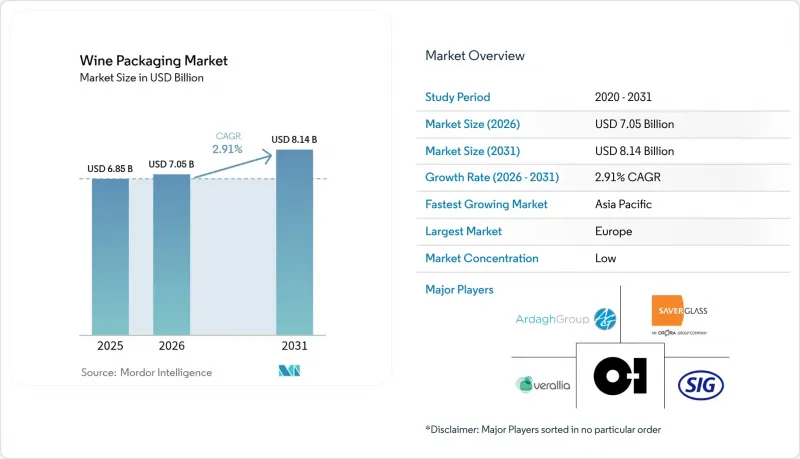
據 Mordor Intelligence 稱,2025 年葡萄酒包裝市場價值為 68.5 億美元,預計到 2031 年將達到 81.4 億美元,高於 2026 年的 70.5 億美元,預測期(2026-2031 年)的複合年成長率為 2.91%。
本報告按材質(玻璃、塑膠等)、產品類型(玻璃瓶、塑膠瓶等)、瓶塞類型(天然軟木塞等)、葡萄酒類型(無氣泡葡萄酒、氣泡酒等)、容量(375毫升以下、375-750毫升、其他)、分銷管道(直銷、間接銷售)和地區進行分類。市場預測以美元(USD)為單位。
全球葡萄酒包裝市場趨勢與洞察
中國葡萄酒的優質化正在推高人們對精美酒瓶的需求。
中國年輕的都市區消費者重視便利性和價格優勢,同時也將精緻的設計視為品質的象徵。華東酒莊的桶裝陳釀葡萄酒和弗朗西亞的盒裝葡萄酒等創新產品,既滿足了休閒聚會的需求,又不影響品牌價值,從而推動了葡萄酒包裝市場高階產品線的擴張。
歐洲葡萄酒廠採用輕質玻璃瓶來減少二氧化碳排放。
勃根地的碳中和藍圖顯示,酒瓶重量是影響碳排放的重要因素。 Velaria 的波爾多氣瓶(300克)證明,輕質酒瓶既能延續傳統,又能減少高達40%的二氧化碳排放,從而促進其在整個葡萄酒包裝市場的普及。
歐盟塑膠包裝稅推高了PET解決方案的成本
強制性再生材料含量和 PFAS 禁令增加了合規成本,降低了 PET 在高級葡萄酒包裝市場的競爭力。
細分市場分析
玻璃憑藉其惰性特性和高階質感,預計到2025年將佔據葡萄酒包裝市場68.05%的佔有率。熔爐升級旨在減輕重量並提高玻璃屑利用率,這有助於玻璃保持市場主導地位,同時減少排放。金屬包裝5.25%的複合年成長率反映了鋁的可回收性和快速冷卻優勢,吸引了戶外愛好者,並塑造了未來葡萄酒包裝市場的整體偏好。隨著監管機構推動100%可回收性,Frugalpac的紙瓶和PET混合產品正在拓展材料選擇。
塑膠和紙張技術的進步正在挑戰長期以來既有的材料等級制度。 Frugalpac 的纖維外殼可減少 77% 的塑膠用量,碳足跡比玻璃低 84%,是葡萄酒包裝行業極具吸引力的替代方案。玻璃製造商正積極應對,試點使用電爐和超輕量設計。鋁瓶透過可重複密封的瓶蓋延長了保鮮期,而生物基 PET 則含有高達 30% 的再生 PET (rPET),但仍在等待再生材料供應量的增加。
到2025年,傳統玻璃瓶和塑膠瓶將佔葡萄酒銷量的71.45%,構成葡萄酒陳釀和品嚐儀式的基礎。然而,盒中袋(BIB)包裝市場正以5.95%的複合年成長率成長,滿足了葡萄酒包裝市場的便利性和監管要求。盒中袋生產線正在實現規模經濟,在瑞典的銷售量佔比高達56%,顯示其正朝著高階產品方向發展。
寶特瓶憑藉ALPLA的隔離層,確保6個月的保存期限,在市場上佔有一席之地。同時,軟包裝袋在節慶市場中的市佔率也不斷擴大。符合歐盟數位監管要求的智慧標籤正被應用於瓶罐包裝,從而提升葡萄酒包裝市場的可追溯性,並強化全通路策略。
區域分析
歐洲和北美仍然是最大的銷售市場。加州強力的直接面對消費者(DtC)法規和不斷擴大的回收利用促使了5美分和10美分押金制度的推出,葡萄酒包裝市場也正朝著便於路邊回收的設計方向發展。歐洲政策要求在2030年實現100%可回收,這推動了對電爐的投資以及袋中袋包裝技術的創新,從而減少了運輸過程中的排放。
亞太地區將引領成長至2031年。在中國,優質化趨勢正將精美玻璃瓶與經濟實惠的包裝相結合;而在澳大利亞,輕質寶特瓶和紙瓶回收的推廣正加速該地區葡萄酒包裝市場的發展勢頭。便利的線上雜貨購物以及環保意識強的行銷方式正吸引著年輕消費者。
中東、非洲和南美洲蘊藏著新的成長機會。在氣候溫暖的地區,輕巧且富含抗氧化劑的包裝更受歡迎,出口商也開始採用既能最大限度降低運輸成本又能符合歐盟法規的包裝。國內生產商正考慮引進再生PET(rPET)包裝和罐裝生產線,以拓展新的消費群體,預示著葡萄酒包裝產業正迎來全球性的創新趨勢。
其他好處:
- Excel格式的市場預測(ME)表
- 3個月的分析師支持
目錄
第1章:引言
- 研究假設和市場定義
- 調查範圍
第2章:調查方法
第3章執行摘要
第4章 市場狀況
- 市場概覽
- 市場促進因素
- 中國葡萄酒品質的不斷提升,帶動了對名牌酒瓶的需求成長。
- 歐洲葡萄酒廠正在引入輕質玻璃瓶以減少二氧化碳排放。
- 「盒中袋」包裝形式在北歐國家的線上食品雜貨銷售管道中迅速普及。
- 美國直接面對消費者 (DtC) 管道的興起正在加速採用可直接出貨的包裝進行店內配送。
- 大洋洲對戶外飲用的單份罐裝和寶特瓶葡萄酒的需求正在激增。
- 葡萄園的永續性認證正在推動生物基瓶塞的採用。
- 市場限制因素
- 歐盟塑膠包裝稅推高了PET解決方案的成本。
- 全球可回收材料供不應求阻礙了rPET葡萄酒瓶的廣泛應用。
- 替代瓶蓋氧氣滲透性高的風險阻礙了它們打入高階葡萄酒市場。
- 堿灰價格波動推高了玻璃瓶的成本。
- 供應鏈分析
- 技術展望
- 監理展望
- 波特五力分析
第5章 市場規模與成長預測
- 材料類型
- 玻璃
- 塑膠
- 金屬
- 紙
- 依產品類型
- 玻璃瓶
- 塑膠瓶
- 盒中袋
- 坎
- 小袋
- 盒子和其他產品
- 透過封閉法
- 天然軟木
- 技術/合成軟木
- 螺帽
- 皇冠帽
- 其他(T型塞、Vino-Lok)
- 按葡萄酒類型
- 無氣泡葡萄酒
- 氣泡酒
- 加烈葡萄酒和甜酒
- 低酒精和無酒精葡萄酒
- 按產能
- 少於 375 毫升
- 375~750 mL
- 751~1,500 mL
- 超過1500毫升
- 透過分銷管道
- 直銷
- 間接銷售
- 按地區
- 北美洲
- 美國
- 加拿大
- 墨西哥
- 歐洲
- 德國
- 英國
- 法國
- 義大利
- 西班牙
- 俄羅斯
- 其他歐洲國家
- 亞太地區
- 中國
- 印度
- 日本
- 韓國
- 澳洲和紐西蘭
- 其他亞太國家
- 中東和非洲
- 中東
- 阿拉伯聯合大公國
- 沙烏地阿拉伯
- 土耳其
- 其他中東國家
- 非洲
- 南非
- 奈及利亞
- 埃及
- 其他非洲國家
- 中東
- 南美洲
- 巴西
- 阿根廷
- 其他南美國家
- 北美洲
第6章 競爭情勢
- 市場集中度
- 策略趨勢
- 市佔率分析
- 公司簡介
- Owens-Illinois Inc.(OI)
- Verallia SA
- Ardagh Group SA
- Saverglass SAS
- Vetropack Holding AG
- BA Glass Group
- Consol Glass Pty Ltd
- Guala Closures Group
- Amorim Cork, SA
- Vinventions LLC(Nomacorc)
- Amcor plc
- Ball Corporation
- TricorBraun Inc.
- Tetra Laval International SA
- SIG Combibloc Group AG
- Scholle IPN(Sealed Air)
- Liqui-Box(Sealed Air)
- International Paper Company
- G3 Enterprises Inc.
- Maverick Enterprises Inc.
- Encore Glass Inc.
- Smurfit WestRock
- Crown Holdings, Inc.
第7章 市場機會與未來展望
According to Mordor Intelligence, the wine packaging market size was valued at USD 6.85 billion in 2025 and estimated to grow from USD 7.05 billion in 2026 to reach USD 8.14 billion by 2031, at a CAGR of 2.91% during the forecast period (2026-2031).
This report is Segmented by Material Type (Glass, Plastic, and More), Product Type (Glass Bottles, Plastic Bottles, and More), Closure Type (Natural Cork, and More), Wine Type (Still Wine, Sparkling Wine, and More), Capacity ( Less Than Equal To 375 ML, 375-750 ML, and More), Distribution Channel (Direct Sales, Indirect Sales), and Geography. The Market Forecasts are Provided in Terms of Value (USD).
Global Wine Packaging Market Trends and Insights
Premiumisation of Wine in China Elevating Demand for Designer Bottles
Young urban consumers in China value convenience and affordability yet still associate sophisticated design with quality. Innovations such as Huadong Winery's keg wine and Franzia's boxed offerings support casual gatherings without diluting brand equity, lifting premium-styled alternatives within the wine packaging market.
Lightweight Glass Bottle Adoption by European Wineries to Cut CO2
Bourgogne's carbon-neutral roadmap exposed bottle weight as a critical emissions driver; Verallia's 300 g Bordeaux Air proves that a lighter bottle can retain tradition while trimming up to 40% of CO2, propelling broader adoption across the wine packaging market.
EU Plastic Packaging Taxes Increasing Cost of PET Solutions
Mandatory recycled-content quotas and PFAS bans inflate compliance costs, making PET less competitive for premium lines within the wine packaging market.
Other drivers and restraints analyzed in the detailed report include:
- Rapid Uptake of Bag-in-Box Formats in the Nordics' E-grocery Channel
- Rise of DtC Channels in the US Accelerating On-premise Ready-to-Ship Packaging
- Global Recyclate Supply Shortages Limiting rPET Wine Bottle Roll-outs
For complete list of drivers and restraints, kindly check the Table Of Contents.
Segment Analysis
Glass accounted for 68.05% of the wine packaging market in 2025 due to its inert nature and premium perception. Lightweight furnace upgrades and higher cullet ratios help maintain leadership while cutting emissions. Metal's 5.25% CAGR reflects aluminum's recyclability and chill-speed advantages, luring outdoor-oriented consumers and shaping future preference across the wine packaging market. Paper bottles from Frugalpac and PET hybrids broaden the material field as regulators push 100% recyclable targets.
Plastic and paper advances test longstanding hierarchies. Frugalpac's fibre shell uses 77% less plastic and holds an 84% lower carbon footprint than glass, making it an attractive alternative in the wine packaging industry. Glass manufacturers counter by piloting electric furnaces and ultra-light designs. Aluminum bottles leverage resealable tops to extend freshness, while bio-based PET integrates up to 30% rPET yet awaits a greater recyclate supply.
Traditional glass and plastic bottles delivered 71.45% of 2025 revenue, an anchor for cellaring and ritual. Still, the bag-in-box segment is growing at a 5.95% CAGR, meeting convenience and regulations within the wine packaging market. Bag-in-box lines achieve scale benefits and hold 56% of Swedish volume, illustrating premium-grade evolution.
PET bottles secure niche roles with a six-month shelf life thanks to ALPLA's barrier layers, while pouches win festival share. Smart labels that satisfy EU digital mandates surface on bottles and cans alike, enriching traceability and reinforcing the wine packaging market's omnichannel strategy.
Complete Report Scope:
- By Material Type
- Glass
- Plastic
- Metal
- Paper
- By Product Type
- Glass Bottles
- Plastic Bottles
- Bag-in-Box
- Cans
- Pouches
- Boxes and Other Products
- By Closure Type
- Natural Cork
- Technical/Synthetic Cork
- Screw Caps
- Crown Caps
- Others (T-stoppers, Vino-Lok)
- By Wine Type
- Still Wine
- Sparkling Wine
- Fortified and Dessert Wine
- Low and No-Alcohol Wine
- By Capacity
- Less than 375 mL
- 375-750 mL
- 751-1,500 mL
- More than 1,500 mL
- By Distribution Channel
- Direct Sales
- Indirect Sales
- By Geography
- North America
- United States
- Canada
- Mexico
- Europe
- Germany
- United Kingdom
- France
- Italy
- Spain
- Russia
- Rest of Europe
- Asia-Pacific
- China
- India
- Japan
- South Korea
- Australia and New Zealand
- Rest of Asia-Pacific
- Middle East and Africa
- Middle East
- United Arab Emirates
- Saudi Arabia
- Turkey
- Rest of Middle East
- Africa
- South Africa
- Nigeria
- Egypt
- Rest of Africa
- Middle East
- South America
- Brazil
- Argentina
- Rest of South America
- North America
Geography Analysis
Europe and North America remain the largest revenue contributors. Robust DtC laws and recycling expansion in California integrate 5- and 10-cent deposits that steer the wine packaging market toward curbside-compatible designs. European policies dictate 100% recyclability by 2030, sparking investment in electric furnaces and bag-in-box innovation that lowers freight emissions.
Asia-Pacific leads growth through 2031. China's premiumisation mixes designer glass with cost-effective boxes, while Australia grants back lightweight PET and paper bottles, accelerating regional momentum for the wine packaging market. E-grocery convenience intertwines with environmental marketing to convert younger consumers.
The Middle East and Africa, and South America, provide emerging pathways. Warmer climates lean toward lighter, oxidation-barrier formats, and exporters deploy packaging that meets EU rules while minimizing freight. Domestic producers explore rPET and canning lines to reach new drinkers, illustrating the global spread of the wine packaging industry's innovations.
- Owens-Illinois Inc. (O-I)
- Verallia SA
- Ardagh Group SA
- Saverglass SAS
- Vetropack Holding AG
- BA Glass Group
- Consol Glass Pty Ltd
- Guala Closures Group
- Amorim Cork, S.A.
- Vinventions LLC (Nomacorc)
- Amcor plc
- Ball Corporation
- TricorBraun Inc.
- Tetra Laval International SA
- SIG Combibloc Group AG
- Scholle IPN (Sealed Air)
- Liqui-Box (Sealed Air)
- International Paper Company
- G3 Enterprises Inc.
- Maverick Enterprises Inc.
- Encore Glass Inc.
- Smurfit WestRock
- Crown Holdings, Inc.
Additional Benefits:
- The market estimate (ME) sheet in Excel format
- 3 months of analyst support
TABLE OF CONTENTS
1 INTRODUCTION
- 1.1 Study Assumptions and Market Definition
- 1.2 Scope of the Study
2 RESEARCH METHODOLOGY
3 EXECUTIVE SUMMARY
4 MARKET LANDSCAPE
- 4.1 Market Overview
- 4.2 Market Drivers
- 4.2.1 Premiumisation of Wine in China Elevating Demand for Designer Bottles
- 4.2.2 Light-weight Glass Bottle Adoption by European Wineries to Cut CO2
- 4.2.3 Rapid Uptake of Bag-in-Box Formats in the Nordics' E-grocery Channel
- 4.2.4 Rise of Direct-to-Consumer (DtC) Channels in the US Accelerating On-premise Ready-to-Ship Packaging
- 4.2.5 Surge in Canned and PET-Single-Serve Wines for Outdoor Consumption in Oceania
- 4.2.6 Vineyard Sustainability Certifications Driving Bio-based Closures Adoption
- 4.3 Market Restraints
- 4.3.1 EU Plastic Packaging Taxes Increasing Cost of PET Solutions
- 4.3.2 Global Recyclate Supply Shortages Limiting rPET Wine Bottle Roll-outs
- 4.3.3 Higher Oxygen Transmission Risk in Alternative Closures Capping Premium-Wine Penetration
- 4.3.4 Volatility in Soda-ash Pricing Inflating Glass Bottle Costs
- 4.4 Supply-Chain Analysis
- 4.5 Technological Outlook
- 4.6 Regulatory Outlook
- 4.7 Porter's Five Forces Analysis
- 4.7.1 Bargaining Power of Suppliers
- 4.7.2 Bargaining Power of Buyers
- 4.7.3 Threat of New Entrants
- 4.7.4 Threat of Substitutes
- 4.7.5 Intensity of Competitive Rivalry
5 MARKET SIZE AND GROWTH FORECASTS (VALUE)
- 5.1 By Material Type
- 5.1.1 Glass
- 5.1.2 Plastic
- 5.1.3 Metal
- 5.1.4 Paper
- 5.2 By Product Type
- 5.2.1 Glass Bottles
- 5.2.2 Plastic Bottles
- 5.2.3 Bag-in-Box
- 5.2.4 Cans
- 5.2.5 Pouches
- 5.2.6 Boxes and Other Products
- 5.3 By Closure Type
- 5.3.1 Natural Cork
- 5.3.2 Technical/Synthetic Cork
- 5.3.3 Screw Caps
- 5.3.4 Crown Caps
- 5.3.5 Others (T-stoppers, Vino-Lok)
- 5.4 By Wine Type
- 5.4.1 Still Wine
- 5.4.2 Sparkling Wine
- 5.4.3 Fortified and Dessert Wine
- 5.4.4 Low and No-Alcohol Wine
- 5.5 By Capacity
- 5.5.1 Less than 375 mL
- 5.5.2 375-750 mL
- 5.5.3 751-1,500 mL
- 5.5.4 More than 1,500 mL
- 5.6 By Distribution Channel
- 5.6.1 Direct Sales
- 5.6.2 Indirect Sales
- 5.7 By Geography
- 5.7.1 North America
- 5.7.1.1 United States
- 5.7.1.2 Canada
- 5.7.1.3 Mexico
- 5.7.2 Europe
- 5.7.2.1 Germany
- 5.7.2.2 United Kingdom
- 5.7.2.3 France
- 5.7.2.4 Italy
- 5.7.2.5 Spain
- 5.7.2.6 Russia
- 5.7.2.7 Rest of Europe
- 5.7.3 Asia-Pacific
- 5.7.3.1 China
- 5.7.3.2 India
- 5.7.3.3 Japan
- 5.7.3.4 South Korea
- 5.7.3.5 Australia and New Zealand
- 5.7.3.6 Rest of Asia-Pacific
- 5.7.4 Middle East and Africa
- 5.7.4.1 Middle East
- 5.7.4.1.1 United Arab Emirates
- 5.7.4.1.2 Saudi Arabia
- 5.7.4.1.3 Turkey
- 5.7.4.1.4 Rest of Middle East
- 5.7.4.2 Africa
- 5.7.4.2.1 South Africa
- 5.7.4.2.2 Nigeria
- 5.7.4.2.3 Egypt
- 5.7.4.2.4 Rest of Africa
- 5.7.4.1 Middle East
- 5.7.5 South America
- 5.7.5.1 Brazil
- 5.7.5.2 Argentina
- 5.7.5.3 Rest of South America
- 5.7.1 North America
6 Competitive Landscape
- 6.1 Market Concentration
- 6.2 Strategic Moves
- 6.3 Market Share Analysis
- 6.4 Company Profiles (includes Global level Overview, Market level overview, Core Segments, Financials as available, Strategic Information, Market Rank/Share for key companies, Products and Services, and Recent Developments)
- 6.4.1 Owens-Illinois Inc. (O-I)
- 6.4.2 Verallia SA
- 6.4.3 Ardagh Group SA
- 6.4.4 Saverglass SAS
- 6.4.5 Vetropack Holding AG
- 6.4.6 BA Glass Group
- 6.4.7 Consol Glass Pty Ltd
- 6.4.8 Guala Closures Group
- 6.4.9 Amorim Cork, S.A.
- 6.4.10 Vinventions LLC (Nomacorc)
- 6.4.11 Amcor plc
- 6.4.12 Ball Corporation
- 6.4.13 TricorBraun Inc.
- 6.4.14 Tetra Laval International SA
- 6.4.15 SIG Combibloc Group AG
- 6.4.16 Scholle IPN (Sealed Air)
- 6.4.17 Liqui-Box (Sealed Air)
- 6.4.18 International Paper Company
- 6.4.19 G3 Enterprises Inc.
- 6.4.20 Maverick Enterprises Inc.
- 6.4.21 Encore Glass Inc.
- 6.4.22 Smurfit WestRock
- 6.4.23 Crown Holdings, Inc.
7 Market Opportunities & Future Outlook
- 7.1 White-space and Unmet-need Assessment

 美國葡萄酒包裝:市場佔有率分析、產業趨勢與統計、成長預測(2026-2031)
 葡萄酒桶市場規模、佔有率和成長分析:按材質、產能、烘焙程度、最終用戶和地區分類-2026-2033年產業預測
 瓦楞紙運輸箱市場規模、佔有率、成長和行業分析:按類型、產品類型、最終用途、地區分類,並預測至2034年
 葡萄酒包裝袋市場 - 全球產業規模、佔有率、趨勢、機會、預測:按類型、應用、分銷管道、地區和競爭格局分類,2021-2031年
 可重複使用桶市場:按材料類型、烘焙類型、最終用途行業和地區分類。葡萄酒包裝盒市場:按類型、分銷管道和地區分類
 葡萄酒及汽水配件市場:商機、成長要素、產業趨勢分析及2026-2035年預測
 葡萄酒包裝市場規模、佔有率、趨勢和預測:按材料、包裝類型和地區分類,2026-2034年
 葡萄酒包裝市場:依包裝類型、瓶蓋類型和瓶身尺寸分類-2026-2032年全球預測
 2026年全球葡萄酒桶市場報告