


 |
市場調查報告書
商品編碼
2121344
粉末塗料:市場佔有率分析、產業趨勢與統計、成長預測(2026-2031)Powder Coatings - Market Share Analysis, Industry Trends & Statistics, Growth Forecasts (2026 - 2031) |
||||||

※ 本網頁內容可能與最新版本有所差異。詳細情況請與我們聯繫。
根據 Mordor Intelligence 預測,粉末塗料市場規模將從 2025 年的 128.5 億美元和 2026 年的 135.9 億美元成長到 2031 年的 179.4 億美元,2026 年至 2031 年的複合年成長率為 5.71%。
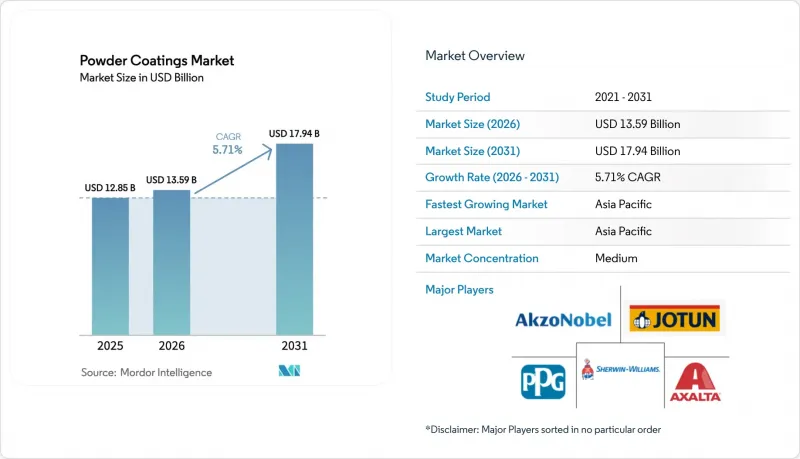
本報告按樹脂類型(環氧樹脂、聚酯樹脂、環氧聚酯樹脂、聚氨酯樹脂、丙烯酸樹脂及其他樹脂)、塗料類型(熱固性塗料和熱塑性塗料)、最終用途行業(建築裝飾、汽車、工業及其他)、基材(金屬、中密度纖維板/木材及其他)和地區(亞太地區、北美及其他)進行細分。市場預測以美元計價。
全球粉末塗料市場趨勢及洞察
嚴格的 VOC 法規和碳定價系統正在加速無溶劑塗料的普及。
法規越來越傾向於採用粉末塗裝生產線而非液體塗裝室,從而降低整體擁有成本。 2024年12月,美國環保署(EPA)將揮發性有機化合物(VOC)的排放限值設定為350克/公升。這項措施迫使加工商權衡減排設備的成本與安裝粉末塗裝室的方案。同時,歐洲的碳邊境調節機制(CBAM)計畫於2026年1月生效,屆時歐盟排放交易體系(EU-ETS)的碳定價機制將適用於進口金屬產品。這促使土耳其和印度的出口商轉向粉末塗裝解決方案以避免關稅。在中國,江蘇省和廣東省的部分粉末塗裝設備成本由省級補貼承擔。這項措施與中國「十四五」規劃中將VOC排放量減少10%的目標一致。由於這些協調一致的努力,中型粉末塗裝設備的投資回收期已顯著縮短。此外,OEM廠商採用無溶劑塗料,加強了企業實現淨零排放目標的努力,並促進了粉末塗料在家具、家電和運輸設備行業的廣泛應用。
低溫固化技術可應用於中密度纖維板和熱敏基材。
一項突破性的配方使其固化溫度範圍可達 110 度C至 130 度C,從而能夠應用於複合板和某些塑膠,而不會造成基材變形。BASF的「Ultradur High Speed」聚酯塗料在 130 度C下即可實現完全交聯,並且在無需底漆的情況下,對中密度纖維板 (MDF) 具有符合 ISO 2409 標準的附著力。同樣,艾仕得的「AquaEC」系統可在 110 度C下應用於聚丙烯保險桿,並通過了 ASTM D3359 膠帶測試。家具製造商正在迅速採用這項技術。宜家已將這種低溫固化粉末塗料應用於櫥櫃框架,強調其節能優勢,同時解決了水性塗料常見的木紋翹起問題。雖然樹脂成本高於標準聚酯塗料,但其顯著降低的能源和人事費用使其成為裝飾面板、辦公家具和汽車內飾領域長期發展的有力候選技術。
薄膜塗層在小於25微米時的局限性
粉末塗料的粒徑限制阻礙了均勻漆膜的形成,從而限制了其在豪華車外飾板和消費性電子機殼等領域的應用。粉末塗料在流動性和靜電方面也面臨挑戰,導致其在汽車產業審核中的缺陷率高於液體塗料。儘管剪切機在2025年實施的樹脂改進措施降低了可用漆膜厚度,但仍未達到汽車製造商設定的目標。在薄膜沉積技術取得進展之前,液體面漆仍將繼續主導A級表面,從而限制了粉末塗料在對外觀要求極高的領域的應用。
細分市場分析
至2025年,聚酯粉末塗料將佔樹脂市場39.18%的佔有率,並在2031年之前保持6.29%的複合年成長率,顯著優於環氧樹脂和丙烯酸塗料。尤其值得一提的是,聚酯-TGIC體系始終符合AAMA 2605耐候性標準,即使在佛羅裡達州的陽光下曝曬10年後,也未出現明顯的粉化(泛白)現象。
建築鋁型材、農業機械和戶外家具都需要具有高紫外線穩定性且價格具競爭力的材料,因此需求最為強勁。環氧樹脂因其防腐蝕而備受青睞,但在陽光下易褪色,因此其應用主要局限於家用電器內部和汽車底盤部件。環氧-聚酯混合樹脂可作為室內金屬家具和暖通空調機櫃的折中之選,提供均衡的性能。聚氨酯是一種用於石油和天然氣管道的特殊材料,具有耐磨性,因此價格較高。丙烯酸粉末可保持裝飾輪轂的光澤,但成本較高。隨著離岸風力發電和太陽能發電廠的增加,符合 ISO 12944 C5-M 標準的環氧底漆和聚酯面漆雙層塗裝系統在惡劣的海洋環境中越來越受歡迎。
預計到2025年,熱固性塗料將佔總銷售額的91.05%,雖然其成長速度將落後於熱塑性塗料,但其絕對銷售優勢預計將持續。由於其不可逆的共用價鍵合,熱固性塗料具有優異的耐溶劑性和耐磨性,使其適用於必須承受清潔劑和鹽類侵蝕的底盤、電池托盤和白色家電機殼。儘管熱塑性粉末塗料的市場規模較小,但隨著電子產品和汽車內裝產業努力實現歐盟循環經濟行動計畫中設定的回收目標,其市場正以6.17%的複合年成長率快速成長。
BASF旗下Relest公司的測試表明,聚烯熱塑性塑膠可以重新研磨並循環利用。然而,這些熱塑性塑膠硬度和耐化學性較差,限制了其在低應力環境下的應用。BASF與科思創將產品系列拓展至生物基聚酯領域,預示未來性能與永續性將能夠兼得。這一轉變可能會對市場佔有率產生重大影響,尤其是在成本達到平衡的情況下。
區域分析
預計到2025年,亞太地區將佔粉末塗料市場銷售額的55.65%,並在2031年之前以5.91%的複合年成長率成長。越南家用電器出口顯著提升了白色家電機殼對粉末塗料的年需求。在泰國汽車生產中,粉末塗料被用於底盤塗裝,使汽車製造商能夠滿足第四階段排放氣體標準。為了在2025年前提高粉末塗料在家具和家用電器行業的市場滲透率,中國正透過補貼江蘇和廣東兩省的粉末塗料生產設施來支持這一目標。同時,印度為了擴大汽車生產規模,正在提高其國內粉末塗料產能,尤其是在浦那和清奈地區。
在北美,電動車生產線回歸美國以及美墨加協定(USMCA)原產地規則的實施已初見成效。通用汽車、福特和Stellantis等公司已對其美國和加拿大的工廠進行了大量投資,尤其注重在電池機殼和框架上使用粉末塗裝工藝。在墨西哥,粉末塗裝工藝的應用顯著增加,而加拿大擠壓型材製造商也已開始在幕牆產品上採用粉末塗裝工藝,以確保符合AAMA 2605標準。
工業排放指令對歐洲粉末塗料市場產生了重大影響,並強制推行循環經濟。為了符合CAFE標準,一家德國汽車製造商在其電池托盤上採用了粉末塗裝工藝。一家法國建築公司為了符合RE2020低碳法規,在其大部分鋁製框架上使用粉末塗裝。英國2021年《環境法》鼓勵家電製造商過渡到使用不含揮發性有機化合物(VOC)的塗料。在義大利,Lombardia的一家家具製造商透過過渡到粉末塗裝工藝,減少了溶劑的使用,並取得了顯著的成就。
儘管規模較小,但粉末塗料市場在南美洲、中東和非洲地區正經歷快速成長。在巴西,受鼓勵低排放製造的稅收優惠政策推動,商用車領域粉末塗料的應用日益普及。沙烏地阿拉伯雄心勃勃的「超級工廠」計畫也顯著增加了粉末塗料的進口量。在阿拉伯聯合大公國(阿拉伯聯合大公國),綠建築標準強制要求在大部分幕牆上使用粉末塗料。南非的汽車工廠(主要面向出口)正在轉型採用粉末塗料,以滿足相當於歐6排放標準的要求。
其他好處:
- Excel格式的市場預測(ME)表
- 3個月的分析師支持
目錄
第1章:引言
- 研究假設和市場定義
- 調查範圍
第2章:調查方法
第3章執行摘要
第4章 市場狀況
- 市場概覽
- 市場促進因素
- 嚴格的 VOC 法規和碳定價規則正在加速無溶劑塗料的普及。
- 低溫化學技術拓展了中密度纖維板和熱敏基材的應用可能性。
- 受外國直接投資(FDI)推動,東協地區家電生產基地不斷擴張。
- 將汽車OEM生產線遷回日本
- 海灣合作理事會的超級項目正在推動建築用鋁的需求。
- 市場限制因素
- 薄膜(小於25微米)應用的局限性
- UV固化粉末在形狀方面仍有限制。
- 聚酯/環氧樹脂原料價格波動
- 價值鏈分析
- 波特五力模型
第5章 市場規模與成長預測
- 依樹脂類型
- 環氧樹脂
- 聚酯纖維
- 環氧聚酯
- 聚氨酯
- 丙烯酸纖維
- 其他樹脂種類(聚氯乙烯、聚烯)
- 按塗層類型
- 熱固性粉末塗料
- 熱塑性粉末塗料
- 按最終用途行業分類
- 建築與裝飾
- 車
- 產業
- 其他物品(家具、家用電器等)
- 按基礎材料
- 金屬
- 中密度纖維板和木材
- 塑膠和複合材料
- 玻璃及其他非導電基板
- 按地區
- 亞太地區
- 中國
- 印度
- 日本
- 韓國
- 其他亞太國家
- 北美洲
- 美國
- 加拿大
- 墨西哥
- 歐洲
- 德國
- 法國
- 英國
- 義大利
- 其他歐洲國家
- 南美洲
- 巴西
- 阿根廷
- 其他南美國家
- 中東和非洲
- 沙烏地阿拉伯
- 南非
- 其他中東和非洲國家
- 亞太地區
第6章 競爭情勢
- 市場集中度
- 策略趨勢
- 市佔率和排名分析
- 公司簡介
- Advanced Powder Coatings
- Akzo Nobel NV
- Asian Paints PPG Pvt. Ltd.
- Axalta Coating Systems, LLC
- BASF
- Berger Paints India
- Cardinal
- Hempel A/S
- IFS Coatings
- IGP Pulvertechnik AG
- Jotun
- Kansai Paint Co.,Ltd.
- NATIONAL PAINTS FACTORIES CO. LTD.
- Nippon Paint Holdings Co., Ltd.
- PPG Industries, Inc.
- RPM International Inc.(TCI Powder Coatings)
- SAK Coat
- ST POWDER COATINGS SPA
- Teknos Group
- The Sherwin-Williams Company
- TIGER Coatings GmbH & Co. KG
第7章 市場機會與未來展望
According to Mordor Intelligence, the powder coatings market size is projected to expand from USD 12.85 billion in 2025 and USD 13.59 billion in 2026 to USD 17.94 billion by 2031, registering a CAGR of 5.71% between 2026 to 2031.
This report is Segmented by Resin Type (Epoxy, Polyester, Epoxy-Polyester, Polyurethane, Acrylic, and Other Resin Types), Coating Type (Thermoset and Thermoplastic), End-Use Industry (Architecture and Decorative, Automotive, Industrial, and Others), Substrate (Metal, MDF and Wood, and More), and Geography (Asia-Pacific, North America, and More). The Market Forecasts are Provided in Terms of Value (USD).
Global Powder Coatings Market Trends and Insights
Stringent VOC And Carbon-Pricing Rules Accelerating Solvent-Free Finishes
Regulations are increasingly favoring powder lines over liquid booths, leading to a reduced total cost of ownership. In December 2024, the U.S. EPA set a VOC content cap at 350 g/L. This move has forced converters to evaluate the cost of abatement hardware against the option of installing powder booths. Meanwhile, in Europe, the Carbon Border Adjustment Mechanism, set to take effect in January 2026, will apply the EU-ETS carbon price to imported metal goods. This has led exporters in Turkey and India to pivot towards powder solutions to sidestep tariffs. In China, provincial subsidies in Jiangsu and Guangdong are covering a portion of powder equipment costs. This initiative aligns with China's 10% VOC-reduction goal under its 14th Five-Year Plan. Thanks to these concerted efforts, the payback period for mid-scale powder installations has been significantly reduced. Additionally, OEMs are adopting solvent-free finishes, bolstering their corporate net-zero commitments and driving the uptake of powder coatings in the furniture, appliance, and transportation industries.
Low-Temperature Chemistries Unlocking MDF And Heat-Sensitive Substrates
Breakthrough formulations now cure at temperatures between 110 °C and 130 °C, enabling their application on engineered wood and select plastics without causing substrate distortion. BASF's Ultradur High Speed polyester achieves full cross-linking at 130 °C, adhering to ISO 2409 standards on MDF without the need for primers. Similarly, Axalta's AquaEC system performs on polypropylene bumpers at 110 °C, successfully passing ASTM D3359 tape tests. Furniture manufacturers are quick to adapt: IKEA utilized the low-bake powder on its cabinet frames, highlighting energy savings and resolving grain-raising challenges typical of water-borne liquids. While resin costs are higher than standard polyesters, the significant energy and labor savings make a strong case for the technology's long-term growth in decorative panels, office furniture, and automotive interiors.
Thin-Film Application Limits Below 25 Microns
Particle size constraints hinder the production of uniform films, preventing the use of powder in premium exterior auto panels and shells of consumer electronics. Powders face challenges with fluidization and electrostatic charge, leading to higher reject rates in automotive audits compared to their liquid counterparts. Sherwin-Williams' resin upgrade in 2025 pushed the viable build down but still falls short of the targets set by automakers. Until advancements are made in thin-film deposition, liquid topcoats will continue to dominate Class-A surfaces, limiting powder's application in categories where appearance is paramount.
Other drivers and restraints analyzed in the detailed report include:
- ASEAN Appliance Build-Out Fueled By FDI
- Re-Shoring Of Auto OEM Lines
- UV-Cure Powders Still Geometry-Restricted
For complete list of drivers and restraints, kindly check the Table Of Contents.
Segment Analysis
Polyester powders generated 39.18% of the powder coatings market size for resins in 2025 and are enjoying a 6.29% CAGR through 2031, well ahead of epoxies and acrylics. Notably, polyester-TGIC systems consistently achieve AAMA 2605 weatherability standards, enduring a decade of Florida's sun without significant chalking.
Architectural aluminum extrusions, agricultural equipment, and outdoor furniture, all demanding high UV stability at competitive prices, drive the strongest demand. While epoxies are valued for their corrosion protection, their use is largely limited to appliance interiors and underbody auto parts due to their tendency to discolor in sunlight. Hybrid epoxy-polyesters serve as a middle ground for indoor metal furniture and HVAC cabinets, where a balanced performance is adequate. Niche polyurethanes, catering to oil-and-gas pipelines, offer abrasion resistance that commands a price premium. Acrylic powders, while maintaining gloss for decorative wheels, face cost constraints. With the rise of offshore wind and solar farms, dual-layer epoxy primers topped with polyester systems, compliant with ISO 12944 C5-M, are increasingly favored in challenging marine environments.
Thermoset grades dominated revenue at 91.05% in 2025, and although their growth trails thermoplastics, the absolute volume advantage will persist. Superior solvent and abrasion resistance from irreversible covalent bonding suits chassis, battery trays, and white-goods casings that must survive detergent and salt exposure. The powder coatings market size for thermoplastic grades is smaller but rising at a 6.17% CAGR as electronics and automotive interiors pursue recyclability targets outlined in the EU Circular Economy Action Plan.
BASF's Relest trials demonstrate that polyolefin thermoplastics can be reground and reapplied. However, these thermoplastics lag in hardness and chemical durability, limiting their applications to low-stress scenarios. The move by BASF and Covestro to expand their portfolios into bio-based polyesters hints at a future where performance meets sustainability. This shift could lead to a significant market share change, especially once cost parity is realized.
Complete Report Scope:
- By Resin Type
- Epoxy
- Polyester
- Epoxy-Polyester
- Polyurethane
- Acrylic
- Other Resin Types (Polyvinyl Chloride, Polyolefins)
- By Coating Type
- Thermoset Powder Coatings
- Thermoplastic Powder Coatings
- By End-use Industry
- Architecture and Decorative
- Automotive
- Industrial
- Others (Furniture, Appliances, etc.)
- By Substrate
- Metal
- MDF and Wood
- Plastics and Composites
- Glass and Other Non-conductive Substrates
- By Geography
- Asia-Pacific
- China
- India
- Japan
- South Korea
- Rest of Asia-Pacific
- North America
- United States
- Canada
- Mexico
- Europe
- Germany
- France
- United Kingdom
- Italy
- Rest of Europe
- South America
- Brazil
- Argentina
- Rest of South America
- Middle-East and Africa
- Saudi Arabia
- South Africa
- Rest of Middle-East and Africa
- Asia-Pacific
Geography Analysis
Asia-Pacific commanded 55.65% of the powder coatings market revenue in 2025 and is tracking a 5.91% CAGR to 2031. Vietnamese appliance exports necessitated a significant annual draw of powder for white-goods casings. Thailand's automotive production relied on powder for underbodies, enabling OEMs to comply with Phase 4 emissions standards. In a bid to achieve higher market penetration in furniture and appliances by 2025, China is backing its target with subsidies for powder equipment in Jiangsu and Guangdong. Meanwhile, India's ambition to increase vehicle production is driving an expansion of domestic powder capacity, particularly near Pune and Chennai.
North America is reaping the rewards of re-shored EV lines and the stipulations of USMCA origin rules. GM, Ford, and Stellantis invested heavily in their U.S. and Canadian facilities, with a focus on using powder for battery enclosures and frames. Mexico's adoption of powder coatings increased significantly, while Canadian extruders utilized powder for curtain walls, ensuring compliance with AAMA 2605 standards.
The Industrial Emissions Directive heavily influences Europe's powder coatings market and mandates promoting a circular economy. To align with CAFE targets, German automakers turned to powder coatings for battery trays. French builders, adhering to the RE2020 low-carbon regulations, used powder on a majority of their aluminum frames. The UK's Environmental Act 2021 is pushing appliance manufacturers towards zero-VOC coatings. In Italy, furniture producers in Lombardy achieved a significant milestone, reducing solvent use through a shift towards powder coatings.
Though smaller in scale, South America and the Middle East-Africa regions are witnessing rapid growth in the powder coatings market. Brazil boosted powder usage in commercial vehicles, spurred by tax incentives promoting low-emission manufacturing. Thanks to Saudi Arabia's ambitious giga-projects, imports surged significantly. In the UAE, green-building codes mandated the use of powder coatings on a majority of curtain walls. South Africa's auto plants, primarily focused on exports, are transitioning to powder coatings to meet Euro 6-equivalent standards.
- Advanced Powder Coatings
- Akzo Nobel N.V.
- Asian Paints PPG Pvt. Ltd.
- Axalta Coating Systems, LLC
- BASF
- Berger Paints India
- Cardinal
- Hempel A/S
- IFS Coatings
- IGP Pulvertechnik AG
- Jotun
- Kansai Paint Co.,Ltd.
- NATIONAL PAINTS FACTORIES CO. LTD.
- Nippon Paint Holdings Co., Ltd.
- PPG Industries, Inc.
- RPM International Inc. (TCI Powder Coatings)
- SAK Coat
- ST POWDER COATINGS S.P.A.
- Teknos Group
- The Sherwin-Williams Company
- TIGER Coatings GmbH & Co. KG
Additional Benefits:
- The market estimate (ME) sheet in Excel format
- 3 months of analyst support
TABLE OF CONTENTS
1 Introduction
- 1.1 Study Assumptions and Market Definition
- 1.2 Scope of the Study
2 Research Methodology
3 Executive Summary
4 Market Landscape
- 4.1 Market Overview
- 4.2 Market Drivers
- 4.2.1 Stringent VOC and carbon-pricing rules accelerating solvent-free finishes
- 4.2.2 Low-temperature chemistries unlocking MDF and heat-sensitive substrates
- 4.2.3 ASEAN appliance build-out fuelled by FDI
- 4.2.4 Re-shoring of auto OEM lines
- 4.2.5 GCC giga-projects spurring architectural aluminium demand
- 4.3 Market Restraints
- 4.3.1 Thin-film (less than 25 µm) application limits
- 4.3.2 UV-cure powders still geometry-restricted
- 4.3.3 Polyester/epoxy feedstock price volatility
- 4.4 Value Chain Analysis
- 4.5 Porter's Five Forces
- 4.5.1 Bargaining Power of Suppliers
- 4.5.2 Bargaining Power of Buyers
- 4.5.3 Threat of New Entrants
- 4.5.4 Threat of Substitutes
- 4.5.5 Intensity of Competitive Rivalry
5 Market Size and Growth Forecasts (Value)
- 5.1 By Resin Type
- 5.1.1 Epoxy
- 5.1.2 Polyester
- 5.1.3 Epoxy-Polyester
- 5.1.4 Polyurethane
- 5.1.5 Acrylic
- 5.1.6 Other Resin Types (Polyvinyl Chloride, Polyolefins)
- 5.2 By Coating Type
- 5.2.1 Thermoset Powder Coatings
- 5.2.2 Thermoplastic Powder Coatings
- 5.3 By End-use Industry
- 5.3.1 Architecture and Decorative
- 5.3.2 Automotive
- 5.3.3 Industrial
- 5.3.4 Others (Furniture, Appliances, etc.)
- 5.4 By Substrate
- 5.4.1 Metal
- 5.4.2 MDF and Wood
- 5.4.3 Plastics and Composites
- 5.4.4 Glass and Other Non-conductive Substrates
- 5.5 By Geography
- 5.5.1 Asia-Pacific
- 5.5.1.1 China
- 5.5.1.2 India
- 5.5.1.3 Japan
- 5.5.1.4 South Korea
- 5.5.1.5 Rest of Asia-Pacific
- 5.5.2 North America
- 5.5.2.1 United States
- 5.5.2.2 Canada
- 5.5.2.3 Mexico
- 5.5.3 Europe
- 5.5.3.1 Germany
- 5.5.3.2 France
- 5.5.3.3 United Kingdom
- 5.5.3.4 Italy
- 5.5.3.5 Rest of Europe
- 5.5.4 South America
- 5.5.4.1 Brazil
- 5.5.4.2 Argentina
- 5.5.4.3 Rest of South America
- 5.5.5 Middle-East and Africa
- 5.5.5.1 Saudi Arabia
- 5.5.5.2 South Africa
- 5.5.5.3 Rest of Middle-East and Africa
- 5.5.1 Asia-Pacific
6 Competitive Landscape
- 6.1 Market Concentration
- 6.2 Strategic Moves
- 6.3 Market Share(%)/Ranking Analysis
- 6.4 Company Profiles (includes Global level Overview, Market level overview, Core Segments, Financials as available, Strategic Information, Market Rank/Share for key companies, Products and Services, and Recent Developments)
- 6.4.1 Advanced Powder Coatings
- 6.4.2 Akzo Nobel N.V.
- 6.4.3 Asian Paints PPG Pvt. Ltd.
- 6.4.4 Axalta Coating Systems, LLC
- 6.4.5 BASF
- 6.4.6 Berger Paints India
- 6.4.7 Cardinal
- 6.4.8 Hempel A/S
- 6.4.9 IFS Coatings
- 6.4.10 IGP Pulvertechnik AG
- 6.4.11 Jotun
- 6.4.12 Kansai Paint Co.,Ltd.
- 6.4.13 NATIONAL PAINTS FACTORIES CO. LTD.
- 6.4.14 Nippon Paint Holdings Co., Ltd.
- 6.4.15 PPG Industries, Inc.
- 6.4.16 RPM International Inc. (TCI Powder Coatings)
- 6.4.17 SAK Coat
- 6.4.18 ST POWDER COATINGS S.P.A.
- 6.4.19 Teknos Group
- 6.4.20 The Sherwin-Williams Company
- 6.4.21 TIGER Coatings GmbH & Co. KG
7 Market Opportunities and Future Outlook
- 7.1 White-space and Unmet-need Assessment

 2026年全球靜電粉末塗料市場報告
 歐洲粉末塗料:市場佔有率分析、產業趨勢與統計及成長預測(2026-2031)
 低溫粉末塗料市場-2026-2032年全球市場預測粉末塗料市場:2026-2032年全球市場預測(按類型、基材、表面處理、固化方法、應用和分銷管道分類)
 2026-2030年全球工業粉末塗料市場
 全球粉末塗料市場(至2031年):依樹脂類型(熱固性樹脂、熱塑性樹脂)、終端用戶產業(家電、汽車、一般工業、建築、家具)及地區分類
 粉末塗料市場報告:按樹脂類型、塗裝方法、應用和地區分類(2026-2034 年)
 粉末塗料市場:依樹脂類型、塗裝方法、終端用戶產業及地區分類抗菌粉末塗料市場:2026-2032年全球市場預測(按技術、抗菌劑類型、固化方法、配方類型、最終用途行業、應用和分銷管道分類)
 粉末塗料市場規模、佔有率和趨勢分析報告:按樹脂、應用、地區和細分市場分類(2026-2033 年)