


 |
市場調查報告書
商品編碼
2119855
歐洲粉末塗料:市場佔有率分析、產業趨勢與統計及成長預測(2026-2031)Europe Powder Coatings - Market Share Analysis, Industry Trends & Statistics, Growth Forecasts (2026 - 2031) |
||||||

※ 本網頁內容可能與最新版本有所差異。詳細情況請與我們聯繫。
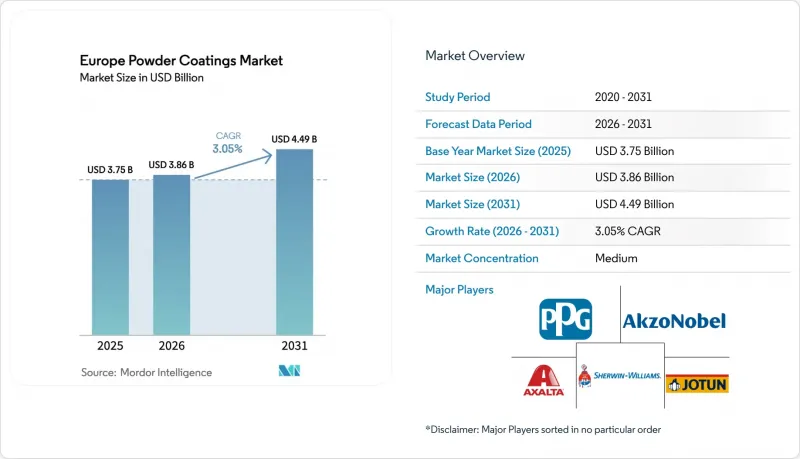
據 Mordor Intelligence 稱,2025 年歐洲粉末塗料市場價值為 37.5 億美元,預計到 2031 年將達到 44.9 億美元,而 2026 年為 38.6 億美元,預測期(2026-2031 年)複合年成長率為 3.05%。
本報告按樹脂類型(環氧樹脂、聚酯樹脂、環氧聚酯(混合型)、聚氨酯樹脂、丙烯酸樹脂及其他)、終端用戶行業(建築裝飾、汽車、工業及其他終端用戶行業)和地區(德國、英國、法國、義大利、西班牙、比荷盧經濟聯盟、北歐國家及其他歐洲國家)進行細分。市場預測以美元計價。
歐洲粉末塗料市場趨勢與洞察
歐盟嚴格的揮發性有機化合物(VOC)法規和碳中和法規
工業排放指令和歐盟綠色交易的結合,將多種表面處理類別中廢氣揮發性有機化合物(VOC)的排放量限制在20毫克/立方米以內,從而有效地優先發展無溶劑粉末塗裝製程。年溶劑排放量超過200噸的工廠必須在四年內達到法規要求,這加速了對封閉式粉末塗裝室和節能固化爐的投資。針對食品接觸塗料的新的全氟烷基和多氟烷基物質(PFAS)基準值以及對REACH法規附件XVII的修訂(對許多液體系統中常用的含氟化學品施加處罰)進一步加速了這一轉型。在汽車噴漆市場,VOC標籤現已成為強制性要求,丹麥已採取政策,將清潔劑中的VOC含量限制在200克/公升,將特種塗料中的VOC含量限制在840克/公升,其他北歐國家也正在迅速效仿這一做法。 ISO 14001審核擴大要求採用粉末塗裝作為“最佳可行技術”,從而將轉型目標納入公司的環境藍圖。
汽車OEM廠商和售後市場對粉末塗料的需求不斷成長。
電氣化正在改變塗裝要求。電池外殼、冷卻板和高壓外殼需要兼具電絕緣性和導熱性的塗層。因此,汽車製造商正在採用低溫烘烤粉末塗料,其固化溫度從傳統的 140 度C循環降低至 80 度C,這不僅能降低噴漆車間 11-13% 的能耗,還能提高不同基材混合的柔軟性。供應商認證現在取決於其是否符合 AAMA 耐候性標準和 OEM A 級表面處理標準,這降低了現有液體塗料供應商的競爭力。同樣,由於粉末塗料具有耐磨性和更長的使用壽命,車輪翻新商、商用車改裝商和農業機械再製造商也開始轉向使用粉末塗料。
形成厚度小於30微米的平滑塗層的難度很高。
高階汽車內裝和家用電器機殼對塗層厚度小於30微米時的表面形貌要求近乎完美。目前的粉末塗料配方依賴窄粒徑分佈和專用流動改質劑,但如何在複雜的形貌中保持均勻性仍然是一個挑戰。 Allnex的超低溫混合產品可在125 度C下固化並改善流平性,但需要更嚴格的濕度控制和先進的施工設備。贏創的球形顏料「SPHERILEX AC 45」提高了分散性,但需要對整個價值鏈的配方進行重新評估。在市場上出現成熟的承包解決方案之前,液體塗料系統在某些高光澤領域仍將保持技術優勢。
細分市場分析
預計到2025年,聚酯粉末塗料將維持42.01%的歐洲粉末塗料市場佔有率,成為歐洲粉末塗料市場中佔比最大的產品。其受歡迎的原因在於其成本效益高、色域廣,以及成熟的供應鏈,可同時服務外牆面板和通用工業機械。複合材料製造商透過推出符合AAMA 2604和Qualicoat 2級標準的超耐久等級產品,進一步提升了產品的性能極限。同時,隨著汽車製造商追求更輕量化的結構和更長的防腐蝕保護期,聚氨酯粉末塗料預計將以3.62%的複合年成長率成長。此外,低溫胺甲酸乙酯化學技術的應用使得中密度纖維板(MDF)家具的塗裝成為可能,為歐洲家具產業創造了新的商機。
目前,技術創新的重點在於提高固化效率。阿克蘇諾貝爾的Interpon D2525低輻射聚酯塗料只需150 度C即可固化,從而將噴漆室的停留時間縮短20%,並將其應用範圍擴展至熱敏合金。 Allnex的CRYLCOAT 4488-0在佛羅裡達州可維持10年的耐候性,而由於即將進行的毒理學重新分類,不含TGIC的體係正在主導新的產能。環氧樹脂仍然是管道閥門和化學反應器的基礎材料。混合樹脂兼具裝飾性和功能性,而丙烯酸樹脂則專注於高耐候性標誌。一些小眾熱塑性樹脂也被應用於家用電器和防塗鴉領域。在整體這些化學材料領域,粉末塗料供應商正日益積極地發布環境產品聲明(EPD),並使配方與客戶的碳排放審計保持一致。
其他好處
- Excel格式的市場預測(ME)表
- 3個月的分析師支持
目錄
第1章:引言
- 研究假設和市場定義
- 調查範圍
第2章:調查方法
第3章執行摘要
第4章 市場狀況
- 市場概覽
- 市場促進因素
- 歐盟嚴格的揮發性有機化合物(VOC)法規和碳中和法規
- 汽車OEM廠商和售後市場對粉末塗料的需求不斷成長。
- 建築用鋁擠型材料需求成長
- 優異的可回收性和初始轉移效率
- 採用低溫固化粉末塗料對中密度纖維板和塑膠進行塗佈處理。
- 市場限制因素
- 形成厚度小於30微米的平滑塗層的難度很高。
- 將設備從液體塗料維修為粉末塗料需要較高的資本支出(CAPEX)。
- 歐盟的反傾銷稅推高了環氧樹脂的價格。
- 價值鏈分析
- 波特五力模型
第5章 市場規模與成長預測
- 依樹脂類型
- 環氧樹脂
- 聚酯纖維
- 環氧聚酯(混合型)
- 聚氨酯
- 丙烯酸纖維
- 其他樹脂種類(熱塑性樹脂(聚氯乙烯、聚烯等))
- 按最終用戶行業分類
- 建築與裝飾
- 車
- 產業
- 其他終端用戶產業(家具、家用電器等)
- 按地區
- 德國
- 英國
- 法國
- 義大利
- 西班牙
- 比荷盧經濟聯盟
- 北歐國家
- 其他歐洲國家
第6章 競爭情勢
- 市場集中度
- 策略趨勢
- 市佔率和排名分析
- 公司簡介
- Akzo Nobel NV
- Allnex GMBH
- Axalta Coating Systems, LLC
- BASF SE
- Beckers Group
- CWS Powder Coatings GmbH
- DSM
- IFS Coatings
- IGP Pulvertechnik AG
- Jotun
- Kansai Paint Co., Ltd.
- Nippon Paint Holdings Co., Ltd.
- PPG Industries Inc.
- Protech Group
- Pulverit SpA
- Sika AG
- Teknos Group
- The Sherwin-Williams Company
- Tiger Coatings GmbH & Co KG
第7章 市場機會與未來展望
According to Mordor Intelligence, the Europe powder coatings market size was valued at USD 3.75 billion in 2025 and estimated to grow from USD 3.86 billion in 2026 to reach USD 4.49 billion by 2031, at a CAGR of 3.05% during the forecast period (2026-2031).
This report is Segmented by Resin Type (Epoxy, Polyester, Epoxy-Polyester Hybrid, Polyurethane, Acrylic, and More), End-User Industry (Architecture and Decorative, Automotive, Industrial, and Other End-User Industries), and Geography (Germany, United Kingdom, France, Italy, Spain, Benelux, NORDIC Countries, and Rest of Europe). The Market Forecasts are Provided in Terms of Value (USD).
Europe Powder Coatings Market Trends and Insights
Stringent EU VOC and carbon-neutrality regulations
The Industrial Emissions Directive and the EU Green Deal combine to cap VOC stack emissions at 20 mg/m3 for several surface-treatment categories, effectively prioritizing solvent-free powder processes. Facilities emitting more than 200 tonnes of solvent annually must achieve compliance within four years, accelerating capital deployment toward closed-loop powder booths and energy-efficient curing ovens. New PFAS thresholds for food-contact coatings and revised REACH Annex XVII restrictions reinforce the transition by penalizing fluorinated chemistries typical in many liquid systems. Automotive refinish markets now require VOC labeling, with Denmark limiting cleaners to 200 g/L and specialty finishes to 840 g/L, a policy stance that has been quickly mirrored in other Nordic states. ISO 14001 audits are increasingly mandating the use of powder as the "best available technique," thereby embedding conversion objectives into corporate environmental roadmaps.
Rising automotive OEM and aftermarket powder usage
Electrification reshapes finishing requirements: battery enclosures, cooling plates, and high-voltage casings demand electrically insulative yet thermally conductive coatings. Automakers are therefore adopting low-bake powders that cure at 80 °C-down from legacy 140 °C cycles-cutting paint-shop energy consumption by 11-13% and improving mixed-substrate processing flexibility. Supplier qualification hinges on meeting AAMA standards for weatherability and OEM Class A finish criteria, eroding the competitive position of incumbent liquid suppliers. Wheel refurbishers, commercial-vehicle upfitters, and agricultural equipment remanufacturers likewise migrate toward powders for their abrasion resistance and long service life.
Difficulty in achieving less than 30 µm smooth films
Premium automotive interiors and consumer electronics housings require near-perfect surface topography at film builds of less than 30 µm. Current powder formulations rely on narrow particle-size distributions and specialty flow modifiers, yet maintaining uniformity on complex geometries remains challenging. Allnex's ultra-low-temperature hybrids cure at 125 °C and improve leveling, but they necessitate tighter humidity control and advanced application hardware. Evonik's spherical SPHERILEX AC 45 pigments enhance dispersion but require reformulation work across the value chain. Until turnkey solutions reach market maturity, liquid systems retain a technical edge in select high-gloss sectors.
Other drivers and restraints analyzed in the detailed report include:
- Growth of architectural aluminum extrusion demand
- Superior recyclability and first-pass transfer efficiency
- High retrofit CAPEX for liquid-to-powder conversion
For complete list of drivers and restraints, kindly check the Table Of Contents.
Segment Analysis
Polyester maintained 42.01% of the Europe Powder Coatings market share in 2025, translating to the largest slice of the Europe Powder Coatings market size. Its popularity stems from favorable economics, broad color latitude, and established supply chains that serve both facade panels and general industrial machinery. Formulators have extended performance envelopes by introducing super-durable grades that meet AAMA 2604 and Qualicoat Class 2 specifications. Conversely, polyurethane grades are projected to grow at a 3.62% CAGR, as automotive manufacturers pursue lighter structures and extended corrosion warranties. Low-temperature urethane chemistries also enable coating of medium-density fiberboard (MDF) fixtures, opening incremental opportunities in European furniture hubs.
Technological advancements now center on curing efficiency. AkzoNobel's Interpon D2525 Low-E polyester requires just 150°C, cutting booth dwell times by 20% and widening applicability to heat-sensitive alloys. Allnex's CRYLCOAT 4488-0 offers decade-long Florida exposure resistance, while TGIC-free systems dominate new capacity due to impending toxicological re-classifications. Epoxy resins continue to underpin pipeline valves and chemical reactors; hybrids bridge decorative and functional needs; acrylics target ultra-weatherable signage; and niche thermoplastics serve household-appliance and anti-graffiti segments. Across these chemistries, powder suppliers increasingly tout Environmental Product Declarations (EPDs), aligning formulations with customer carbon audits.
Complete Report Scope:
- By Resin Type
- Epoxy
- Polyester
- Epoxy-Polyester (Hybrid)
- Polyurethane
- Acrylic
- Other Resin Type (Thermoplastic (Polyvinyl Chloride, Polyolefins,etc.))
- By End-user Industry
- Architecture and Decorative
- Automotive
- Industrial
- Other End-user Industries (Furniture, Appliances, etc.)
- By Geography
- Germany
- United Kingdom
- France
- Italy
- Spain
- Benelux
- NORDIC Countries
- Rest of Europe
List of Companies Covered in this Report:
- Akzo Nobel N.V.
- Allnex GMBH
- Axalta Coating Systems, LLC
- BASF SE
- Beckers Group
- CWS Powder Coatings GmbH
- DSM
- IFS Coatings
- IGP Pulvertechnik AG
- Jotun
- Kansai Paint Co., Ltd.
- Nippon Paint Holdings Co., Ltd.
- PPG Industries Inc.
- Protech Group
- Pulverit S.p.A.
- Sika AG
- Teknos Group
- The Sherwin-Williams Company
- Tiger Coatings GmbH & Co KG
Additional Benefits:
- The market estimate (ME) sheet in Excel format
- 3 months of analyst support
TABLE OF CONTENTS
1 Introduction
- 1.1 Study Assumptions and Market Definition
- 1.2 Scope of the Study
2 Research Methodology
3 Executive Summary
4 Market Landscape
- 4.1 Market Overview
- 4.2 Market Drivers
- 4.2.1 Stringent EU VOC and carbon-neutrality regulations
- 4.2.2 Rising automotive OEM and aftermarket powder usage
- 4.2.3 Growth of architectural aluminium extrusion demand
- 4.2.4 Superior recyclability and first-pass transfer efficiency
- 4.2.5 Low-temperature cure powders enable MDF and plastics
- 4.3 Market Restraints
- 4.3.1 Difficulty in achieving <30 µm smooth films
- 4.3.2 High retrofit CAPEX for liquid-to-powder conversion
- 4.3.3 EU anti-dumping duties inflating epoxy resin prices
- 4.4 Value Chain Analysis
- 4.5 Porter's Five Forces
- 4.5.1 Bargaining Power of Suppliers
- 4.5.2 Bargaining Power of Buyers
- 4.5.3 Threat of New Entrants
- 4.5.4 Threat of Substitutes
- 4.5.5 Degree of Competition
5 Market Size & Growth Forecasts (Value)
- 5.1 By Resin Type
- 5.1.1 Epoxy
- 5.1.2 Polyester
- 5.1.3 Epoxy-Polyester (Hybrid)
- 5.1.4 Polyurethane
- 5.1.5 Acrylic
- 5.1.6 Other Resin Type (Thermoplastic (Polyvinyl Chloride, Polyolefins,etc.))
- 5.2 By End-user Industry
- 5.2.1 Architecture and Decorative
- 5.2.2 Automotive
- 5.2.3 Industrial
- 5.2.4 Other End-user Industries (Furniture, Appliances, etc.)
- 5.3 By Geography
- 5.3.1 Germany
- 5.3.2 United Kingdom
- 5.3.3 France
- 5.3.4 Italy
- 5.3.5 Spain
- 5.3.6 Benelux
- 5.3.7 NORDIC Countries
- 5.3.8 Rest of Europe
6 Competitive Landscape
- 6.1 Market Concentration
- 6.2 Strategic Moves
- 6.3 Market Share**/Ranking Analysis
- 6.4 Company Profiles (includes Global level Overview, Market level overview, Core Segments, Financials as available, Strategic Information, Market Rank/Share for key companies, Products & Services, and Recent Developments)
- 6.4.1 Akzo Nobel N.V.
- 6.4.2 Allnex GMBH
- 6.4.3 Axalta Coating Systems, LLC
- 6.4.4 BASF SE
- 6.4.5 Beckers Group
- 6.4.6 CWS Powder Coatings GmbH
- 6.4.7 DSM
- 6.4.8 IFS Coatings
- 6.4.9 IGP Pulvertechnik AG
- 6.4.10 Jotun
- 6.4.11 Kansai Paint Co., Ltd.
- 6.4.12 Nippon Paint Holdings Co., Ltd.
- 6.4.13 PPG Industries Inc.
- 6.4.14 Protech Group
- 6.4.15 Pulverit S.p.A.
- 6.4.16 Sika AG
- 6.4.17 Teknos Group
- 6.4.18 The Sherwin-Williams Company
- 6.4.19 Tiger Coatings GmbH & Co KG
7 Market Opportunities & Future Outlook
- 7.1 White-Space and Unmet-Need Assessment

 2026年全球靜電粉末塗料市場報告
 粉末塗料:市場佔有率分析、產業趨勢與統計、成長預測(2026-2031)
 低溫粉末塗料市場-2026-2032年全球市場預測粉末塗料市場:2026-2032年全球市場預測(按類型、基材、表面處理、固化方法、應用和分銷管道分類)
 2026-2030年全球工業粉末塗料市場
 全球粉末塗料市場(至2031年):依樹脂類型(熱固性樹脂、熱塑性樹脂)、終端用戶產業(家電、汽車、一般工業、建築、家具)及地區分類
 粉末塗料市場報告:按樹脂類型、塗裝方法、應用和地區分類(2026-2034 年)
 粉末塗料市場:依樹脂類型、塗裝方法、終端用戶產業及地區分類抗菌粉末塗料市場:2026-2032年全球市場預測(按技術、抗菌劑類型、固化方法、配方類型、最終用途行業、應用和分銷管道分類)
 粉末塗料市場規模、佔有率和趨勢分析報告:按樹脂、應用、地區和細分市場分類(2026-2033 年)