


 |
市場調查報告書
商品編碼
2121326
3D感測器:市場佔有率分析、產業趨勢與統計、成長預測(2026-2031年)3D Sensor - Market Share Analysis, Industry Trends & Statistics, Growth Forecasts (2026 - 2031) |
||||||

※ 本網頁內容可能與最新版本有所差異。詳細情況請與我們聯繫。
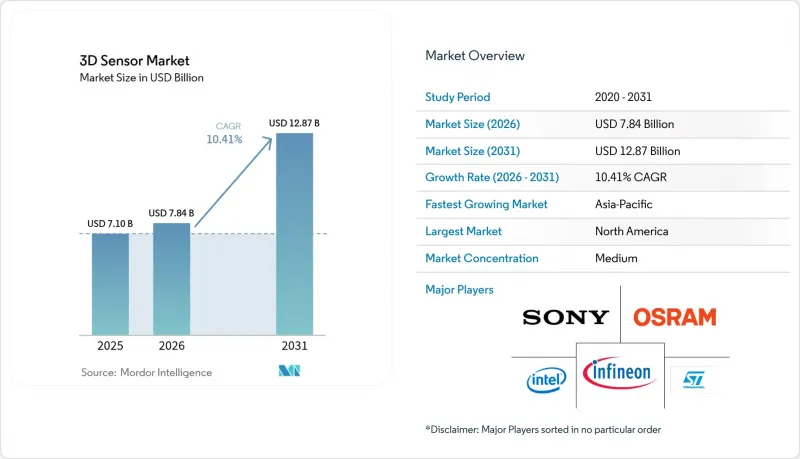
根據 Mordor Intelligence 預測,3D 感測器市場將從 2025 年的 71 億美元成長到 2026 年的 78.4 億美元,然後在 2031 年達到 128.7 億美元,2026 年至 2031 年的複合年成長率為 10.41%。
本報告按產品(位置感測器、影像感測器等)、技術(結構光、飛行時間法等)、終端用戶產業(家用電子電器、汽車等)、組件(紅外線VCSEL發送器等)和地區(北美、歐洲、亞洲等)進行細分。市場預測以美元計價。
全球3D感測器市場趨勢與洞察
智慧型手機臉部認證的廣泛應用,正提升各地區的主導地位。
在亞洲,預計2026年,高階智慧型手機中3D人臉部認證的搭載率將超過65%,鞏固其作為3D感測器市場最大單一應用平台的地位。結構光和飛行時間(ToF)模組即使在各種光照條件下也能產生可靠的亞毫米級深度圖,從而實現安全支付、虛擬形象創建和個性化用戶介面。亞洲的原始設備製造商(OEM)已開始將感測器放置在螢幕下方,以節省前端空間,同時又不影響其可靠性。智慧型手機製造規模的不斷擴大正在降低穿戴式裝置和智慧家居設備等相關領域的零件成本,從而形成良性循環的需求驅動機制。
汽車LiDAR正在革新車輛安全標準。
歐洲汽車製造商正搶在NCAP關於行人自動緊急煞車的新規則生效前,部署基於雷射雷達(LiDAR)的高級駕駛輔助系統(ADAS)。該新規將於2026年生效。固態LiDAR設計可在200公尺範圍內達到公分級精度,滿足嚴格的汽車可靠性測試要求,同時降低組件成本。歐洲的監管措施也體現在北美地區的自願性努力中,共同製定統一的要求標準,這將使全球一級感測器供應商受益。隨著成本的下降,LiDAR的應用預計將從高階車型擴展到中端車型,從而擴大3D感測器市場的潛在規模。
熱問題是實現VCSEL陣列小型化面臨的一大挑戰。
為了在越來越小的空間內實現更高的光輸出,VCSEL發射器採用高密度封裝,這意味著陣列中心的溫度可能比環境溫度高出50 度C。這種結區溫度的升高會降低效率並增加災難性故障的風險。裝置製造商正在嘗試採用分段驅動電路和先進的封裝技術,將熱量橫向引導至銅層,然後再使其到達對熱敏感的光學元件。採用這些創新技術將有助於在緊湊型消費性電子設備中維持效能,並緩解目前3D感測器市場成長受限的現狀。
細分市場分析
預計到2025年,影像感測器將佔3D感測器市場銷售額的61.35%,凸顯其在3D感測器市場中的基礎性地位。智慧型手機、工業檢測和機器人等應用領域對高解析度深度圖的需求強勁,這些應用需要涵蓋5公尺範圍且精度達到亞毫米級的深度圖。得益於多層背照式架構及片上HDR流水線,訊號雜訊比(SNR)持續提升。領先的供應商正在轉向300毫米晶圓生產線,良率的提高降低了每百萬像素的成本。手勢姿態辨識感測器的成長速度最快,預計到2031年將以14.21%的複合年成長率成長,因為非接觸式介面在資訊娛樂主機、互動式資訊亭和醫療設備中的應用日益普及。新型模組將飛行時間(ToF)深度測量、毫米波雷達和人工智慧推理整合到單一基板上,即使在不同的光照條件下也能識別複雜的手勢。亞太地區 OEM 設計團隊技能的提高進一步縮短了開發週期,幫助該領域在 3D 感測器市場中獲得了更高的市場佔有率。
位置感測器、慣性測量單元 (IMU) 和熱電堆元件完善了產品線,各自針對光學方法受限的特定精度和環境要求進行最佳化。供應商之間的交叉授權整合了智慧財產權 (IP),使系統設計人員能夠使用多供應商的產品。影像感測器子類別將成為最大的細分市場,預計到 2025 年將達到 43.6 億美元,並預計在 2031 年前以中等個位數的複合年成長率成長。在該類別中,背照式堆疊 CMOS 架構約佔出貨量的 50%,其發展趨勢顯著轉向低功耗和高動態範圍。手勢姿態辨識模組雖然尺寸較小,但預計到 2031 年將創造 17.2 億美元的收入成長,這主要得益於人們希望減少在公共和私人空間與共用表面接觸的需求。這一成長表明,多樣化的外形規格正在推動 3D 感測器市場的整體成長勢頭。
預計到2025年,飛行時間(ToF)感測器將佔總收入的45.55%,這反映了其在成本和精度方面的出色平衡。由於VCSEL發射器技術的成熟和單光子崩潰式二極體(SPAD)接收器的簡化,間接ToF正逐漸成為消費性電子設備的主流。另一方面,直接ToF憑藉其皮秒級的時間解析度,在需要更遠工作距離的機器人和工業自動化領域佔據主導地位。將電容式深度運算引擎整合到與光電二極體相同的晶片上,可顯著降低延遲,從而使資料能夠直接提供給邊緣AI模型,而無需與主機處理器進行往返通訊。
儘管目前的LiDAR(LiDAR)出貨量仍然較小,但在汽車自動駕駛項目和基礎設施數位孿生項目的推動下,預計到2031年,LiDAR解決方案將以13.22%的複合年成長率成長。固態掃描、微電子機械光束控制和調頻連續波(FMCW)架構正在擴大測量範圍,同時減少移動部件的數量。這些進步降低了每個點雲的成本,使3D感測器市場從高階汽車領域擴展到更廣泛的領域。
結構化光學系統仍然是獲取近距離高解析度資料的首選方案,例如臉部認證解鎖和工業測量。立體視覺和超音波在特定的細分市場中也佔有重要地位。立體視覺提供了一種基於鏡頭的替代方案,無需主動照明;而超音波技術即使在光路被灰塵或液體阻擋的情況下也能正常工作。
區域分析
到2025年,亞太地區將佔全球銷售額的37.40%。這反映了該地區半導體晶圓廠的高度集中、熟練光學工程師的聚集以及垂直整合的供應鏈。中國將佔該地區銷售額的約40%,這得益於國內智慧型手機OEM廠商積極採用其自主研發的深度模組。日本在精密玻璃模塑和晶圓級光學技術方面表現卓越,為工業機器人提供高精度感測器。韓國利用先進的封裝技術,將邏輯和感測功能整合到單一基板上,從而提高了緊湊型模組的散熱性能。
儘管基數較低,但預計到2031年,中東地區的複合年成長率將達到12.48%。在各國智慧城市計畫的支持下,資金正投入部署深度感知街道基礎設施、自動販賣亭和人工智慧驅動的醫療影像系統。波灣合作理事會(GCC)成員國的本土系統整合商正與歐洲和亞洲的零件供應商合作,以實現符合當地氣候和語言要求的解決方案。零售業快速的採購週期縮短了從試點到大量生產的時間,為3D感測器市場創造了短期成長機會。
北美仍是雷射雷達研發中心,這得益於其充滿活力的創投生態系統和國防部門主導的研究津貼。該地區的一級汽車供應商正主導著晶片級光束控制技術的研發。在歐洲,儘管資料保護法律嚴格,但汽車和工業自動化領域的需求仍然強勁,推動著邊緣端個人資料處理感測器的設計。南美洲在安防和農業技術領域已開始早期應用雷射雷達技術,而非洲的應用主要局限於需要強大感測解決方案的物流樞紐和採礦作業。
其他好處:
- Excel格式的市場預測(ME)表
- 3個月的分析師支持
目錄
第1章:引言
- 研究假設和市場定義
- 調查範圍
第2章:調查方法
第3章執行摘要
第4章 市場狀況
- 市場概覽
- 市場促進因素
- 智慧型手機中人臉部認證的普及(亞洲)
- 歐洲汽車ADAS系統採用雷射雷達的現狀
- AR/ VR頭戴裝置中深度感知攝影機的廣泛應用(美國)
- 協作機器人在電子設備組裝上的應用(韓國、台灣)
- 將3D感測器整合到安全和監控系統中
- 面向智慧零售的邊緣人工智慧驅動的3D視覺(海灣合作理事會)
- 市場限制因素
- 微型化VCSEL陣列的溫度控管挑戰
- 對注重隱私的深度攝影機的監管審查(歐盟人工智慧法)
- 連續運轉飛行時間測量模組的高功耗
- 收緊氮化鎵雷射半導體供應鏈
- 價值供應鏈分析
- 監管和技術展望
- 波特五力分析
- 專利現狀
第5章 市場規模與成長預測
- 依產品
- 位置感測器
- 影像感測器(3D相機)
- 溫度感測器
- 加速計和慣性測量單元感測器
- 環境光感測器和接近感測器
- 手勢姿態辨識感應器
- 透過技術
- 結構光
- 飛行時間法(dToF 和 iToF)
- 立體視覺
- LiDAR(閃光式和FMCW式)
- 超音波
- 按最終用戶行業分類
- 家用電子產品
- 汽車和運輸業
- 醫療保健和醫療設備
- 工業自動化與機器人技術
- 安全監控
- 航太/國防
- 按組件
- 紅外線VCSEL發射器
- 深度影像感測器
- 系統晶片(SoC)處理器
- 光學元件和濾波器
- 照明模組
- 軟體和演算法
- 按地區
- 北美洲
- 美國
- 加拿大
- 南美洲
- 巴西
- 阿根廷
- 歐洲
- 英國
- 德國
- 法國
- 北歐國家(瑞典、挪威、丹麥、芬蘭)
- 中東
- GCC
- 土耳其
- 非洲
- 南非
- 奈及利亞
- 亞太地區
- 中國
- 日本
- 韓國
- 印度
- 北美洲
第6章 競爭情勢
- 市場集中度
- 策略趨勢
- 市佔率分析
- 公司簡介
- Intel Corp.
- Sony Group Corp.
- ams OSRAM AG
- STMicroelectronics NV
- Infineon Technologies AG
- Lumentum Holdings Inc.
- Apple Inc.(PrimeSense)
- Samsung Electronics Co. Ltd.
- OmniVision Technologies Inc.
- Panasonic Holdings Corp.
- Cognex Corp.
- Sick AG
- LMI Technologies Inc.
- Teledyne e2v
- Qualcomm Inc.
- SoftKinetic(Sony DepthSense)
- Melexis NV
- Himax Technologies Inc.
- Velodyne Lidar Inc.
- XYZ Interactive Technologies
第7章 市場機會與未來展望
According to Mordor Intelligence, the 3D sensor market size is expected to grow from USD 7.10 billion in 2025 to USD 7.84 billion in 2026 and is forecast to reach USD 12.87 billion by 2031 at 10.41% CAGR over 2026-2031.
This report is Segmented by Product (Position Sensors, Image Sensors and More), Technology (Structured Light, Time-Of-Flight and More), End-User Vertical (Consumer Electronics, Automotive and More), Component (IR VCSEL Emitters, and More), and Geography (North America, Europe, Asia and More). The Market Forecasts are Provided in Terms of Value (USD).
Global 3D Sensor Market Trends and Insights
Smartphone facial recognition adoption fuels regional leadership
Premium handsets in Asia are expected to pass a 65% attachment rate for 3D facial recognition by 2026, consolidating the 3D sensor market's largest single application base. Structured-light and Time-of-Flight modules now generate sub-millimeter depth maps reliable under varied lighting, enabling secure payments, avatar creation, and personalized UI. Asian OEMs have moved sensors beneath the display to save frontage without sacrificing robustness. Volume scaling in handset production is lowering component costs for adjacent sectors such as wearables and smart-home devices, reinforcing a virtuous demand cycle.
Automotive LiDAR transforms vehicle-safety benchmarks
European automakers are installing LiDAR-based ADAS ahead of the 2026 NCAP mandate for pedestrian automatic emergency braking. Solid-state designs deliver centimeter-level accuracy at up to 200 m, meeting stringent automotive reliability tests while shrinking bill-of-materials. The regulatory push in Europe is echoed by voluntary commitments in North America, creating a homogeneous requirements profile that benefits global tier-one sensor suppliers. As cost curves decline, LiDAR uptake is expected to cascade from premium models into mid-segment vehicles, enlarging the 3D sensor market addressable volume.
Thermal challenges hinder VCSEL array miniaturization
As VCSEL emitters are packed closer to achieve higher optical power in ever-smaller footprints, central elements in an array can run 50 °C hotter than ambient. Elevated junction temperatures degrade efficiency and risk catastrophic failure. Device makers are experimenting with segmented drive circuits and advanced packaging that routes heat laterally to copper layers before it reaches sensitive optics. Adoption of these innovations will moderate the current drag on the 3D sensor market by preserving performance inside compact consumer devices.
Other drivers and restraints analyzed in the detailed report include:
- Proliferation of depth-sensing cameras in mixed-reality headsets
- Collaborative robots advance precision electronics assembly
- EU AI Act creates compliance burdens for biometric sensing
For complete list of drivers and restraints, kindly check the Table Of Contents.
Segment Analysis
Image Sensors accounted for 61.35% of 2025 revenue, confirming their foundational role in the 3D sensor market. Robust demand arises from smartphones, industrial inspection, and robotics that depend on high-resolution depth maps spanning 5 m ranges with sub-millimeter precision. Multi-stack backside-illuminated architectures and on-chip HDR pipelines continue to improve signal-to-noise ratios. Leading suppliers have shifted to 300 mm wafer lines, driving yield improvements that lower cost per megapixel. Gesture-Recognition Sensors record the fastest expansion, advancing at a 14.21% CAGR to 2031 as touchless interfaces penetrate infotainment consoles, interactive kiosks, and healthcare devices. New modules fuse ToF depth, millimeter-wave radar, and AI inference on a single substrate, enabling recognition of complex hand poses under variable lighting. Upskilled OEM design teams in Asia-Pacific further shorten development cycles, helping this segment accumulate a higher share of the 3D sensor market.
Position Sensors, Inertial Measurement Units, and Thermopile elements round out the portfolio, each addressing specific accuracy or environmental requirements where optical methods face limits. Cross-licensing among suppliers is consolidating IP, ensuring multi-vendor availability for system designers.The image-sensor subcategory represents the largest at USD 4.36 billion in 2025 and is on course for a mid-single-digit CAGR through 2031. Within this category, back-illuminated stacked CMOS architectures commanded roughly 50% of shipments, underscoring the move toward higher dynamic range at lower power. Gesture-recognition modules, despite a smaller base, are set to contribute USD 1.72 billion incremental revenue by 2031 as public and private spaces look to minimize shared-surface contact. This surge illustrates how diversified form factors collectively reinforce growth momentum across the 3D sensor market.
Time-of-Flight sensors generated 45.55% of total revenue in 2025, reflecting their favorable cost-to-accuracy balance. Indirect ToF dominates consumer devices thanks to mature VCSEL emitters and simple single-photon avalanche diode (SPAD) receivers. Direct ToF variants, with picosecond timing resolution, lead in robotics and industrial automation requiring longer working distances. Integration of capacitive depth-computation engines on the same die as photodiodes slashes latency, feeding edge-AI models without round-trips to host processors.
LiDAR solutions, though smaller in today's shipment volumes, are growing at a 13.22% CAGR through 2031, propelled by automotive autonomy programs and infrastructure digital-twin projects. Solid-state scanning, micro-electro-mechanical beam steering, and frequency-modulated continuous-wave architectures are improving range while lowering moving-part counts. These advances reduce cost per point cloud and, by extension, broaden the 3D sensor market beyond premium vehicles.
Structured-light remains a preferred choice for close-range, high-detail capture such as facial unlocking and industrial metrology. Stereo vision and ultrasound maintain footholds in specific niches-stereo offers a lens-based alternative without active illumination, while ultrasound succeeds where optical paths are obstructed by dust or fluid.
Complete Report Scope:
- By Product
- Position Sensors
- Image Sensors (3D Cameras)
- Temperature Sensors
- Accelerometer and IMU Sensors
- Ambient-Light and Proximity Sensors
- Gesture-Recognition Sensors
- By Technology
- Structured Light
- Time-of-Flight (dToF and iToF)
- Stereo Vision
- LiDAR (Flash and FMCW)
- Ultrasound
- By End-User Vertical
- Consumer Electronics
- Automotive and Transportation
- Healthcare and Medical Devices
- Industrial Automation and Robotics
- Security and Surveillance
- Aerospace and Defence
- By Component
- IR VCSEL Emitters
- Depth Image Sensors
- System-on-Chip Processors
- Optics and Filters
- Illumination Modules
- Software and Algorithms
- By Geography
- North America
- United States
- Canada
- South America
- Brazil
- Argentina
- Europe
- United Kingdom
- Germany
- France
- Nordics (Sweden, Norway, Denmark, Finland)
- Middle East
- GCC
- Turkey
- Africa
- South Africa
- Nigeria
- Asia-Pacific
- China
- Japan
- South Korea
- India
- North America
Geography Analysis
Asia-Pacific commanded 37.40% of global revenue in 2025, reflecting the region's dense semiconductor fabs, skilled optics workforce, and vertically integrated supply chains. China accounts for about 40% of regional sales, bolstered by domestic smartphone OEMs that are aggressively adopting in-house depth modules. Japan excels in precision glass molding and wafer-level optics, feeding high-accuracy sensors for industrial robotics. South Korea leverages advanced packaging know-how to integrate logic and sensing into single substrates, improving thermal performance in compact modules.
The Middle East, though starting from a low base, is on course for a 12.48% CAGR through 2031. National smart-city roadmaps fund installations of depth-sensing street furniture, automated retail kiosks, and AI-enabled healthcare imaging suites. Domestic system integrators in the Gulf Cooperation Council are forging partnerships with European and Asian component vendors to localize solutions that meet climatic and linguistic requirements. Rapid procurement cycles in the retail sector are accelerating pilot-to-production timelines, providing near-term upside for the 3D sensor market.
North America remains the epicenter of LiDAR RandD, supported by a vibrant venture ecosystem and defense-driven research grants. Tier-one automotive suppliers here lead the push toward chip-scale beam steering. Europe sustains demand in automotive and industrial automation despite rigorous data-protection laws, spurring sensor designs that process personal data at the edge. South America shows early adoption in security and agritech, while Africa's deployments are mainly confined to logistics hubs and mining operations that require rugged sensing solutions.
- Intel Corp.
- Sony Group Corp.
- ams OSRAM AG
- STMicroelectronics N.V.
- Infineon Technologies AG
- Lumentum Holdings Inc.
- Apple Inc. (PrimeSense)
- Samsung Electronics Co. Ltd.
- OmniVision Technologies Inc.
- Panasonic Holdings Corp.
- Cognex Corp.
- Sick AG
- LMI Technologies Inc.
- Teledyne e2v
- Qualcomm Inc.
- SoftKinetic (Sony DepthSense)
- Melexis N.V.
- Himax Technologies Inc.
- Velodyne Lidar Inc.
- XYZ Interactive Technologies
Additional Benefits:
- The market estimate (ME) sheet in Excel format
- 3 months of analyst support
TABLE OF CONTENTS
1 INTRODUCTION
- 1.1 Study Assumptions and Market Definition
- 1.2 Scope of the Study
2 RESEARCH METHODOLOGY
3 EXECUTIVE SUMMARY
4 MARKET LANDSCAPE
- 4.1 Market Overview
- 4.2 Market Drivers
- 4.2.1 Smartphone Facial Recognition Adoption (Asia)
- 4.2.2 Automotive LiDAR-Assisted ADAS Roll-outs (Europe)
- 4.2.3 Proliferation of Depth-Sensing Cameras in AR/VR Headsets (US)
- 4.2.4 Deployment of Collaborative Robots in Electronics Assembly (South Korea, Taiwan)
- 4.2.5 Integration of 3D Sensors in Security and Surveillance Systems
- 4.2.6 Edge-AI Powered 3D Vision for Smart Retail (GCC)
- 4.3 Market Restraints
- 4.3.1 Thermal Management Challenges in Miniaturised VCSEL Arrays
- 4.3.2 Privacy-Led Regulatory Scrutiny on Depth Cameras (EU AI Act)
- 4.3.3 High Power Consumption in Continuous Time-of-Flight Modules
- 4.3.4 Semiconductor Supply-Chain Tightness for Gallium-Nitride Lasers
- 4.4 Value / Supply-Chain Analysis
- 4.5 Regulatory and Technological Outlook
- 4.6 Porter's Five Forces Analysis
- 4.6.1 Bargaining Power of Suppliers
- 4.6.2 Bargaining Power of Consumers
- 4.6.3 Threat of New Entrants
- 4.6.4 Threat of Substitutes
- 4.6.5 Intensity of Competitive Rivalry
- 4.7 Patent Landscape
5 MARKET SIZE AND GROWTH FORECASTS (VALUE)
- 5.1 By Product
- 5.1.1 Position Sensors
- 5.1.2 Image Sensors (3D Cameras)
- 5.1.3 Temperature Sensors
- 5.1.4 Accelerometer and IMU Sensors
- 5.1.5 Ambient-Light and Proximity Sensors
- 5.1.6 Gesture-Recognition Sensors
- 5.2 By Technology
- 5.2.1 Structured Light
- 5.2.2 Time-of-Flight (dToF and iToF)
- 5.2.3 Stereo Vision
- 5.2.4 LiDAR (Flash and FMCW)
- 5.2.5 Ultrasound
- 5.3 By End-User Vertical
- 5.3.1 Consumer Electronics
- 5.3.2 Automotive and Transportation
- 5.3.3 Healthcare and Medical Devices
- 5.3.4 Industrial Automation and Robotics
- 5.3.5 Security and Surveillance
- 5.3.6 Aerospace and Defence
- 5.4 By Component
- 5.4.1 IR VCSEL Emitters
- 5.4.2 Depth Image Sensors
- 5.4.3 System-on-Chip Processors
- 5.4.4 Optics and Filters
- 5.4.5 Illumination Modules
- 5.4.6 Software and Algorithms
- 5.5 By Geography
- 5.5.1 North America
- 5.5.1.1 United States
- 5.5.1.2 Canada
- 5.5.2 South America
- 5.5.2.1 Brazil
- 5.5.2.2 Argentina
- 5.5.3 Europe
- 5.5.3.1 United Kingdom
- 5.5.3.2 Germany
- 5.5.3.3 France
- 5.5.3.4 Nordics (Sweden, Norway, Denmark, Finland)
- 5.5.4 Middle East
- 5.5.4.1 GCC
- 5.5.4.2 Turkey
- 5.5.5 Africa
- 5.5.5.1 South Africa
- 5.5.5.2 Nigeria
- 5.5.6 Asia-Pacific
- 5.5.6.1 China
- 5.5.6.2 Japan
- 5.5.6.3 South Korea
- 5.5.6.4 India
- 5.5.1 North America
6 COMPETITIVE LANDSCAPE
- 6.1 Market Concentration
- 6.2 Strategic Moves
- 6.3 Market Share Analysis
- 6.4 Company Profiles (includes Global level Overview, Market level overview, Core Segments, Financials as available, Strategic Information, Market Rank/Share for key companies, Products and Services, and Recent Developments)
- 6.4.1 Intel Corp.
- 6.4.2 Sony Group Corp.
- 6.4.3 ams OSRAM AG
- 6.4.4 STMicroelectronics N.V.
- 6.4.5 Infineon Technologies AG
- 6.4.6 Lumentum Holdings Inc.
- 6.4.7 Apple Inc. (PrimeSense)
- 6.4.8 Samsung Electronics Co. Ltd.
- 6.4.9 OmniVision Technologies Inc.
- 6.4.10 Panasonic Holdings Corp.
- 6.4.11 Cognex Corp.
- 6.4.12 Sick AG
- 6.4.13 LMI Technologies Inc.
- 6.4.14 Teledyne e2v
- 6.4.15 Qualcomm Inc.
- 6.4.16 SoftKinetic (Sony DepthSense)
- 6.4.17 Melexis N.V.
- 6.4.18 Himax Technologies Inc.
- 6.4.19 Velodyne Lidar Inc.
- 6.4.20 XYZ Interactive Technologies
7 MARKET OPPORTUNITIES AND FUTURE OUTLOOK
- 7.1 White-Space and Unmet-Need Assessment

 2034年3D感測器市場預測-按感測器類型、技術、應用、終端用戶產業和地區分類的全球分析
 3D感測與影像:市場佔有率分析、產業趨勢與統計、成長預測(2026-2031年)
 3D感測器市場-2026-2032年全球市場預測
 全球3D感測器市場:按類型、技術、應用、終端用戶產業和地區分類-預測至2032年
 全球3D感測技術市場規模、佔有率、趨勢和成長分析報告(2026-2034年)
 3D磁位置感測器IC市場報告:趨勢、預測與競爭分析(至2035年)非接觸式3D霍爾感測器市場報告:趨勢、預測及競爭分析(至2035年)非接觸式磁性位置感測器IC市場報告:趨勢、預測和競爭分析(至2035年)非接觸式磁性位置感測器市場報告:趨勢、預測和競爭分析(至2035年)ToF 3D感測器市場預測至2034年—按產品類型、技術、應用、最終用戶和地區分類的全球分析