


 |
市場調查報告書
商品編碼
2121311
安瓿包裝:市場佔有率分析、產業趨勢與統計、成長預測(2026-2031)Ampoules Packaging - Market Share Analysis, Industry Trends & Statistics, Growth Forecasts (2026 - 2031) |
||||||

※ 本網頁內容可能與最新版本有所差異。詳細情況請與我們聯繫。
據 Mordor Intelligence 稱,安瓿包裝市場預計到 2026 年價值 57.9 億美元,高於 2025 年的 53.8 億美元,預計到 2031 年將達到 83.3 億美元。
預計從 2026 年到 2031 年,其複合年成長率將達到 7.56%。
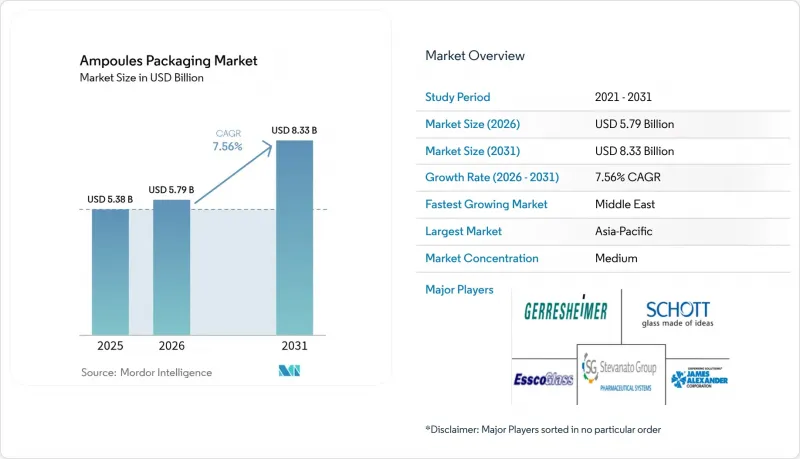
本報告材料類型(玻璃、塑膠)、安瓿類型(直柄、漏斗型、密封型(D型)、其他)、容量(小於2毫升、3-5毫升、大於10毫升)、終端用戶行業(製藥、個人護理/化妝品)、製造技術(傳統管狀成型、吹灌封(BFS)成型、其他)及地區進行細分。市場預測以美元(USD)為單位。
全球安瓿包裝市場趨勢及洞察
對具有防篡改功能的藥品包裝的需求
為了滿足美國FDA 21 CFR 211.132和歐盟《反假藥指令》的要求,製藥公司正大力投資於視覺防篡改功能,並將安瓿瓶的規格轉向使用易折環和刻痕技術,以便清晰地指示是否發生過篡改。肖特製藥的「單點切割」系統預計到2024年將佔據全球易折系統細分市場62%的佔有率,這表明確保患者安全已從「高級」要求轉變為「標準」要求。此外,防篡改功能降低了高價值生技藥品的責任風險,因為產品完整性受損會直接威脅治療效果。醫院擴大將簡化的真偽驗證作為採購標準,敦促供應商優先考慮可靠的易折設計。這種轉變導致對替代材料的合格標準更加嚴格,進一步鞏固了玻璃在重症監護製劑中的主導地位。
I型玻璃的可回收性和循環價值
永續性法規要求相關人員優先考慮可在生產週期中重複使用且不影響品質的容器。 I型硼硼矽酸玻璃滿足此需求。肖特製藥、Corplex和武田製藥於2024年開展的閉合迴路先導計畫,在滿足USP<660>耐化學性標準的前提下,與原生玻璃相比實現了50%的溫室氣體減排。歐洲監管機構目前正將採購獎勵與可回收性評分掛鉤,並鼓勵當地醫療保健系統優先使用玻璃屑玻璃(玻璃廢料)製成的玻璃。 SGS審核已證實,回收的I型玻璃保持了相同的水解穩定性,確保藥品品質標準不受影響。隨著品牌所有者致力於實現範圍3脫碳,能夠保證使用可追溯回收材料的安瓿瓶製造商在供應合約中獲得了優勢。隨著跨國公司將歐盟ESG標準引入其區域競標流程,這一趨勢正在亞太地區蔓延。
預填充式注射器導致銷量下滑
零售生技藥品和病患自用療法正轉向使用預注射注射器,這種注射器兼具給藥精準性和病患便利性。 Stevanat集團2024年的注射器銷量激增15%,而管瓶銷量則下降了34%,這清楚地表明了劑型轉換的壓力。注射器具有更高的利潤率,促使製造商將原本用於安瓿瓶生產的運作時間轉移到注射器生產。重磅GLP-1促效劑的出現加速了這一轉變,而患者自行注射也符合支付方的偏好。對於對矽油和鎢殘留物敏感的藥物(這些殘留物會黏附在注射器塞子上),安瓿瓶仍然不可或缺。這種細分需求迫使安瓿瓶供應商加大行銷投入,強調玻璃純度的優勢,並瞄準那些穩定性至關重要的小眾分子。
細分市場分析
到2025年,玻璃仍將佔據安瓿包裝市場86.30%的佔有率。這反映了監管機構對其的高度信任以及其無與倫比的化學耐久性。同時,受吹灌封(BFS)生產線的推動,塑膠安瓿預計到2031年將以9.65%的複合年成長率成長,該生產線可減少無菌檢驗程序並降低人事費用。在玻璃安瓿中,I型硼矽酸玻璃仍是生物製藥、抗癌藥物和高活性化合物的標準材料。康寧的「Valor」系列玻璃在保持I級水解性能的同時,可防止分層,從而拓展了玻璃在高應力冷鏈環境中的應用範圍。
製造商們正在採用不同的經營模式。肖特製藥預計,其2024年銷售額的55%將來自高價值玻璃製品,這些產品可以溢價銷售;而聚合物專家則致力於拓展疫苗和學名藥領域的銷售。價值鏈的簡化提高了塑膠製品的經濟效益,因為容器的成型、填充和密封在一個流程中完成,減少了對二次包裝的需求。儘管如此,預計到2025年,安瓿包裝市場中玻璃解決方案的市場規模將達到46.4億美元,遠超塑膠的7.394億美元。這一趨勢表明,在治療風險接受度、所需保存期限和永續性考慮等因素的驅動下,玻璃和塑膠將並存,而非被塑膠取代。
預計到2025年,直柄安瓿仍將保持領先地位,佔據安瓿包裝市場62.20%的佔有率,而諸如單點切割(OPC)、划痕和顏色指示環等便捷型包裝形式正以9.05%的複合年成長率成長。醫療保健專業人員越來越重視減少與針刺傷和破損相關的申訴,並將此作為採購標準之一,因此易於開啟的產品在護理機構和居家照護環境中至關重要。同時,漏斗形安瓿因其寬口設計便於高效灌裝,在黏稠製劑和懸浮液的包裝中仍發揮重要作用。
此外,疫苗和美容醫藥領域自我給藥的趨勢也推動了易開啟產品的應用。肖特製藥的「easyOPC」設計可將開啟所需力度的差異降低60%,從而降低給藥準備過程中發生洩漏的風險。隨著破裂系統專利的到期,中型製造商也能夠模仿這些功能,加劇了低利潤治療領域的競爭。在高階生物製藥領域,能夠確保無菌性和可追溯性的專有破裂技術仍然備受青睞,這支撐了創新領先企業的高利潤率。預計到2031年,易開啟安瓿包裝市場規模將超過23.3億美元,主要得益於其符合人體工學的附加價值。
區域分析
預計到2025年,亞太地區將佔全球銷售額的39.40%,主要得益於中國、印度和韓國產能的擴張,以及各國政府在注射劑供應鏈在地化方面的努力。 2024年,中國生物製藥產值達5,653億元人民幣(7,84億美元),預計2029年將超過1.4兆元(1,940億美元)。儘管2024年《反間諜法》實施後,原料藥出口受到零星限制,但對安瓿的需求預計仍將持續。韓國江南區醫美產業叢集推動了小批量玻璃製品訂單的穩定成長,而印度「印度製造」計畫的誘因則促進了疫苗用玻璃瓶產能的提升。同時,東協成員國透過提供稅收優惠和簡化GMP核准程序來吸引合約研發生產企業(CDMO),加劇了區域競爭。
北美市場成長更為穩健,主要得益於生物製藥商業化進程以及《醫療器材安全追蹤法案》(DSCSA) 的合規期限,該法案強制要求使用序列化的初級包裝容器。美國正在推動對符合美國藥典 (USP) <1790> 注射目視檢查建議的 I 型玻璃容器和人工智慧檢測線的高價值訂單。加拿大正在與美國的追溯標準接軌,這促使供應商提供雙語包裝和 GS1 相容條碼。北美內部貿易正在擴張,尤其是在除草劑訴訟和供應鏈中斷的背景下,製藥公司被敦促從墨西哥採購安瓿瓶。
歐洲仍然是一個成熟的市場,擁有高附加價值產品,永續性和循環經濟目標影響著採購決策。修訂後的歐盟包裝和包裝廢棄物法規要求到2030年可回收率達到70%以上,這將推動對閉合迴路I型玻璃的需求。德國醫院於2024年成立了一個採購聯盟,向玻璃屑含量達到50%或以上的供應商授予五年期契約,為未來的採購標準設定了基準。同時,由於天然氣供應中斷導致能源價格波動,引發了人們對熔爐運作的擔憂,導致一些公司囤積硼矽酸玻璃管。然而,歐盟為生命科學基礎設施分配的復甦基金將為下一代檢測設備提供補貼,部分抵銷成本的擔憂。
中東地區到2031年將維持8.90%的年複合成長率(CAGR),位居全球之首,這主要得益於沙烏地阿拉伯和阿拉伯聯合大公國將公共衛生預算用於本地製造業發展。利雅德的「2030願景」醫藥計畫正在共同投資建造一座無菌注射劑生產廠,這將催生對灌裝管和管式填充管的新需求。波灣合作理事會(GCC)的競標規則優先考慮成本效益,這使得印度和歐洲的中型企業在獲取市場佔有率方面處於有利地位。然而,熟練勞動力短缺使得結合設備供應和長期服務合約的技術轉移夥伴關係至關重要。
儘管宏觀經濟不穩定阻礙了拉丁美洲疫苗的普及,但巴西國家衛生監督局(ANVISA)正在推廣符合歐盟口蹄疫疫苗序列化要求的疫苗,從而創造了對可追溯安瓿的需求。除埃及的疫苗生產基地外,非洲其他地區的疫苗生產仍在發展中,但非洲聯盟提出的「到2040年實現60%疫苗本地化生產」的目標,可能會在預測期後半段促進對無疫苗生存系統(BFS)的投資。
其他好處
- Excel格式的市場預測(ME)表
- 3個月的分析師支持
目錄
第1章:引言
- 研究假設和市場定義
- 調查範圍
第2章:調查方法
第3章執行摘要
第4章 市場狀況
- 市場概覽
- 市場促進因素
- 對具有防篡改功能的藥品包裝的需求
- I型玻璃的可回收性和循環價值
- 促進注射劑可追溯性監管。
- CDMO中生物製藥向單一劑量安瓿的過渡
- 人工智慧驅動的零缺陷視覺偵測線
- 亞太地區注射式美容醫學的興起
- 市場限制因素
- 預填充式注射器導致銷量下滑
- 處理廢棄尖銳物品和化學廢棄物。
- 低碳反應器引起的管材供應波動
- 玻璃層剝離導致召回風險
- 價值鏈分析
- 監理情勢
- 技術展望
- 波特五力分析
- 市場宏觀經濟趨勢的評估
第5章 市場規模與成長預測
- 依材料類型
- 玻璃
- 塑膠
- 按安瓿類型
- 直莖
- 漏斗型
- 密封型(泡沫 D)
- 簡易開局(OPC、評分、CBR)
- 以體積(毫升)
- 2毫升或更少
- 3~5mL
- 6~10mL
- 超過10毫升
- 透過製造技術
- 傳統管狀模壓
- 吹塑填充密封(BFS)塑膠
- 高級雷射評分
- 按最終用戶行業分類
- 製藥
- 個人護理和化妝品
- 按地區
- 北美洲
- 美國
- 加拿大
- 墨西哥
- 歐洲
- 英國
- 德國
- 法國
- 義大利
- 西班牙
- 俄羅斯
- 其他歐洲國家
- 亞太地區
- 中國
- 印度
- 日本
- 韓國
- 其他亞太國家
- 南美洲
- 巴西
- 阿根廷
- 其他南美國家
- 中東
- 沙烏地阿拉伯
- 阿拉伯聯合大公國
- 其他中東國家
- 非洲
- 南非
- 奈及利亞
- 其他非洲地區
- 北美洲
第6章 競爭情勢
- 市場集中度
- 策略趨勢
- 市佔率分析
- 公司簡介
- Schott Pharma AG and Co. KGaA
- Gerresheimer AG
- Stevanato Group SpA
- SGD Pharma
- Nipro PharmaPackaging International NV
- Shandong Pharmaceutical Glass Co., Ltd.
- James Alexander Corporation
- Global Pharmatech Pvt. Ltd.
- Essco Glass Pvt. Ltd.
- AAPL Solutions Pvt. Ltd.
- Hindusthan National Glass and Industries Ltd.
- Ardagh Group SA
- PGP Glass Pvt. Ltd.(Piramal)
- Amcor plc(Rigid Plastics)
- Unicep Packaging LLC
- Catalent Pharma Solutions, Inc.
- Recipharm AB(BFS)
- Weiler Engineering, Inc.
- Owens-Illinois, Inc.(OI)
- Vetropack Holding AG
第7章 市場機會與未來展望
According to Mordor Intelligence, ampoules packaging market size in 2026 is estimated at USD 5.79 billion, growing from 2025 value of USD 5.38 billion with 2031 projections showing USD 8.33 billion, growing at 7.56% CAGR over 2026-2031.
This report is Segmented by Material Type (Glass, and Plastic), Ampoule Type (Straight-Stem, Funnel-Type, Closed Form D, and More), Capacity (<=2 ML, 3-5 ML, and Above 10 ML), End-User Industry (Pharmaceutical, and Personal Care and Cosmetics), Manufacturing Technology (Conventional Tubular Forming, Blow-Fill-Seal Plastic, and More), and Geography. The Market Forecasts are Provided in Terms of Value (USD).
Global Ampoules Packaging Market Trends and Insights
Demand for Tamper-Evident Pharmaceutical Packs
Drug manufacturers are investing heavily in visible tamper-evidence to satisfy FDA 21 CFR 211.132 and EU Falsified Medicines Directive requirements, steering ampoule specifications toward break-ring and score-line technologies that produce unmistakable indicators of interference. SCHOTT Pharma's One-Point-Cut system captured 62% of the global break-system sub-market by 2024, demonstrating how patient-safety features have moved from premium to standard expectation. Tamper-evidence also lowers liability risk for high-value biologics because compromised integrity directly threatens therapeutic efficacy. Hospitals increasingly cite simplified authenticity checks as a procurement criterion, encouraging suppliers to prioritise robust break designs. The resulting shift tightens qualification windows for alternative materials, reinforcing glass dominance in critical-care formulations.
Recyclability and Circular Value of Type-I Glass
Sustainability mandates push stakeholders to prefer containers that can re-enter production loops without downgrading quality. Type-I borosilicate satisfies this need: a 2024 closed-loop pilot by SCHOTT Pharma, Corplex and Takeda trimmed greenhouse-gas emissions by 50% versus virgin glass while meeting USP <660> chemical resistance benchmarks. European regulators now tie procurement incentives to recyclability scores, encouraging local health systems to favour glass derived from cullet streams. SGS audits confirm recycled Type-I maintains identical hydrolytic stability, so pharmaceutical-quality thresholds remain intact. As brand owners target Scope 3 decarbonisation, ampoule producers that guarantee traceable recycled content secure supply-agreement advantages. These developments extend to Asia-Pacific as multinationals transplant EU ESG criteria into regional tender processes.
Prefilled Syringes Cannibalising Volumes
Retail-oriented biologics and self-administered therapies are migrating to ready-to-inject syringes that offer dosing accuracy and patient convenience. Stevanato Group's 15% surge in syringe revenue in 2024 coincided with a 34% slump in vial sales, exemplifying format substitution pressure. Syringes carry superior margins, prompting producers to reallocate furnace hours away from ampoules. The shift is accelerated by blockbuster GLP-1 agonists, where self-injection adherence drives payer preference. Nevertheless, ampoules remain vital for drugs sensitive to silicone oil or tungsten residue associated with syringe stoppers. The segmented demand profile obliges ampoule suppliers to target niche, stability-critical molecules and invest in marketing that highlights glass purity advantages.
Other drivers and restraints analyzed in the detailed report include:
- Regulatory Push on Injectable Traceability
- Biologics CDMO Shift Toward Single-Dose Ampoules
- Tubing Supply Volatility from Low-Carbon Furnaces
For complete list of drivers and restraints, kindly check the Table Of Contents.
Segment Analysis
Glass maintained an 86.30% share of the ampoules packaging market in 2025, reflecting entrenched regulatory confidence and unmatched chemical durability. Plastic formats, however, are logging a 9.65% CAGR through 2031, powered by BFS lines that cut sterility validation steps and shrink labor outlays. Within glass, Type-I borosilicate remains the default for biologics, oncology drugs and highly reactive compounds. Corning's Valor composition eliminates delamination while retaining hydrolytic class I properties, widening glass's applicability to high-stress cold-chain environments.
Manufacturers adopt divergent business models: SCHOTT Pharma derived 55% of 2024 revenue from high-value glass offerings that command premium pricing, whereas polymer specialists chase volume in vaccines and generics. Supply-chain simplicity strengthens plastic economics because containers form, fill and seal in one pass, reducing secondary packaging needs. Still, the ampoules packaging market size for glass-based solutions stood at USD 4.64 billion in 2025, dwarfing plastic's USD 739.4 million contribution. The trajectory indicates coexistence rather than displacement, hinging on therapeutic risk tolerance, required shelf-life and sustainability calculus.
Straight-stem ampoules led with 62.20% of ampoules packaging market share in 2025, but user-friendly formats such as One-Point-Cut (OPC), score-ring and color-breakring designs are rising at 9.05% CAGR. Healthcare providers increasingly rank reduced needlestick injuries and breakage complaints as procurement criteria, making easy-open options indispensable for nursing and at-home care settings. In parallel, funnel-type ampoules retain relevance for viscous or suspension formulations where wider necks enable efficient filling.
Easy-open uptake is also fueled by self-administration trends in vaccines and aesthetics. SCHOTT Pharma's easyOPC design cuts opening force variability by 60%, thereby decreasing spillage risk during dose preparation. As break-system patents expire, mid-tier producers can emulate these features, intensifying price competition in lower-margin therapeutic classes. Nonetheless, premium biologics continue to favor proprietary break technologies that guarantee sterility and traceability, reinforcing margin resilience for innovation leaders. The ampoules packaging market size for easy-open variants is projected to surpass USD 2.33 billion by 2031, supported by differentiating ergonomic value.
Complete Report Scope:
- By Material Type
- Glass
- Plastic
- By Ampoule Type
- Straight-stem
- Funnel-type
- Closed (Form D)
- Easy-Open (OPC, Score-Ring, CBR)
- By Capacity (mL)
- <=2 mL
- 3-5 mL
- 6-10 mL
- >10 mL
- By Manufacturing Technology
- Conventional Tubular Forming
- Blow-Fill-Seal Plastic
- Advanced Laser Scoring
- By End-user Industry
- Pharmaceutical
- Personal Care and Cosmetics
- By Geography
- North America
- United States
- Canada
- Mexico
- Europe
- United Kingdom
- Germany
- France
- Italy
- Spain
- Russia
- Rest of Europe
- Asia-Pacific
- China
- India
- Japan
- South Korea
- Rest of Asia-Pacific
- South America
- Brazil
- Argentina
- Rest of South America
- Middle East
- Saudi Arabia
- United Arab Emirates
- Rest of Middle East
- Africa
- South Africa
- Nigeria
- Rest of Africa
- North America
Geography Analysis
Asia-Pacific controlled 39.40% of global revenue in 2025, buoyed by capacity expansions across China, India and South Korea as governments localise injectable drug supply chains. China's biopharmaceutical output hit CNY 565.3 billion (USD 78.4 billion) in 2024 and could eclipse CNY 1.4 trillion (USD 194 billion) by 2029, sustaining demand for ampoules despite sporadic API export restrictions tied to the 2024 Anti-Espionage Law. South Korea's aesthetics cluster in Gangnam fuels consistent small-volume glass orders, while India's "Make in India" incentives support BFS capacity additions for vaccines. Concurrently, ASEAN members court CDMOs by offering tax holidays and streamlined GMP approvals, amplifying regional competitiveness.
North America's growth is steadier, underpinned by biologics commercialisation pipelines and DSCSA compliance deadlines that require serialised primary containers. The United States drives high-value orders for Type-I glass and AI-enabled inspection lines that satisfy USP <1790> recommendations for parenteral visual inspection. Canada works to align with US traceability norms, spurring suppliers to provide bilingual packaging and GS1-compatible codes. Notably, herbicide litigation and supply-chain shocks have encouraged drug makers to dual-source ampoules from Mexico, broadening North American intra-regional trade.
Europe remains a value-rich but mature territory where sustainability and circular-economy targets dictate purchasing. The revised EU Packaging and Packaging Waste Regulation obliges recyclability scores above 70% by 2030, elevating demand for closed-loop Type-I glass streams. German hospitals formed a buying consortium in 2024 that gives 5-year contracts to vendors meeting >=50% cullet content, signalling future procurement norms. Meanwhile, energy-price volatility tied to gas supply cuts heightened concern over furnace downtime, prompting some firms to stockpile borosilicate tubing. Yet EU Recovery Funds earmarked for life-science infrastructure will subsidise next-generation inspection gear, partially offsetting cost fears.
The Middle East recorded the highest regional CAGR at 8.90% through 2031 as Saudi Arabia and the UAE channel public-health budgets into local manufacturing. Riyadh's Vision 2030 pharmaceutical programme co-funds sterile injectables plants, creating greenfield demand for BFS and tubular lines. Gulf Cooperation Council tender rules prioritize cost-effectiveness, positioning Indian and European mid-tier firms to capture share. However, limited skilled labour necessitates technology-transfer partnerships that intertwine equipment supply with long-term service contracts.
Latin America's uptake is hindered by macroeconomic instability, yet Brazil's ANVISA pushes serialization that mirrors EU-FMD requirements, opening opportunities for traceability-enabled ampoules. Africa remains nascent outside Egypt's vaccine complex; nonetheless, the African Union's 2040 target for 60% local vaccine manufacturing may catalyse BFS investments later in the forecast horizon.
- Schott Pharma AG and Co. KGaA
- Gerresheimer AG
- Stevanato Group S.p.A.
- SGD Pharma
- Nipro PharmaPackaging International NV
- Shandong Pharmaceutical Glass Co., Ltd.
- James Alexander Corporation
- Global Pharmatech Pvt. Ltd.
- Essco Glass Pvt. Ltd.
- AAPL Solutions Pvt. Ltd.
- Hindusthan National Glass and Industries Ltd.
- Ardagh Group S.A.
- PGP Glass Pvt. Ltd. (Piramal)
- Amcor plc (Rigid Plastics)
- Unicep Packaging LLC
- Catalent Pharma Solutions, Inc.
- Recipharm AB (BFS)
- Weiler Engineering, Inc.
- Owens-Illinois, Inc. (O-I)
- Vetropack Holding AG
Additional Benefits:
- The market estimate (ME) sheet in Excel format
- 3 months of analyst support
TABLE OF CONTENTS
1 INTRODUCTION
- 1.1 Study Assumptions and Market Definition
- 1.2 Scope of the Study
2 RESEARCH METHODOLOGY
3 EXECUTIVE SUMMARY
4 MARKET LANDSCAPE
- 4.1 Market Overview
- 4.2 Market Drivers
- 4.2.1 Demand for tamper-evident pharma packs
- 4.2.2 Recyclability and circular value of Type-I glass
- 4.2.3 Regulatory push on injectable traceability
- 4.2.4 Biologics CDMO shift toward single-dose ampoules
- 4.2.5 AI-enabled zero-defect visual inspection lines
- 4.2.6 Rise of injectable aesthetics in APAC
- 4.3 Market Restraints
- 4.3.1 Prefilled syringes cannibalising volumes
- 4.3.2 Post-use sharps and chemical waste burden
- 4.3.3 Tubing supply volatility from low-carbon furnaces
- 4.3.4 Glass delamination recall risk
- 4.4 Value Chain Analysis
- 4.5 Regulatory Landscape
- 4.6 Technological Outlook
- 4.7 Porter's Five Forces Analysis
- 4.7.1 Threat of New Entrants
- 4.7.2 Bargaining Power of Buyers
- 4.7.3 Bargaining Power of Suppliers
- 4.7.4 Threat of Substitutes
- 4.7.5 Intensity of Competitive Rivalry
- 4.8 Assessment of Macro Economic Trends on the Market
5 MARKET SIZE AND GROWTH FORECASTS (VALUES)
- 5.1 By Material Type
- 5.1.1 Glass
- 5.1.2 Plastic
- 5.2 By Ampoule Type
- 5.2.1 Straight-stem
- 5.2.2 Funnel-type
- 5.2.3 Closed (Form D)
- 5.2.4 Easy-Open (OPC, Score-Ring, CBR)
- 5.3 By Capacity (mL)
- 5.3.1 <=2 mL
- 5.3.2 3-5 mL
- 5.3.3 6-10 mL
- 5.3.4 >10 mL
- 5.4 By Manufacturing Technology
- 5.4.1 Conventional Tubular Forming
- 5.4.2 Blow-Fill-Seal Plastic
- 5.4.3 Advanced Laser Scoring
- 5.5 By End-user Industry
- 5.5.1 Pharmaceutical
- 5.5.2 Personal Care and Cosmetics
- 5.6 By Geography
- 5.6.1 North America
- 5.6.1.1 United States
- 5.6.1.2 Canada
- 5.6.1.3 Mexico
- 5.6.2 Europe
- 5.6.2.1 United Kingdom
- 5.6.2.2 Germany
- 5.6.2.3 France
- 5.6.2.4 Italy
- 5.6.2.5 Spain
- 5.6.2.6 Russia
- 5.6.2.7 Rest of Europe
- 5.6.3 Asia-Pacific
- 5.6.3.1 China
- 5.6.3.2 India
- 5.6.3.3 Japan
- 5.6.3.4 South Korea
- 5.6.3.5 Rest of Asia-Pacific
- 5.6.4 South America
- 5.6.4.1 Brazil
- 5.6.4.2 Argentina
- 5.6.4.3 Rest of South America
- 5.6.5 Middle East
- 5.6.5.1 Saudi Arabia
- 5.6.5.2 United Arab Emirates
- 5.6.5.3 Rest of Middle East
- 5.6.6 Africa
- 5.6.6.1 South Africa
- 5.6.6.2 Nigeria
- 5.6.6.3 Rest of Africa
- 5.6.1 North America
6 COMPETITIVE LANDSCAPE
- 6.1 Market Concentration
- 6.2 Strategic Moves
- 6.3 Market Share Analysis
- 6.4 Company Profiles (includes Global level Overview, Market level overview, Core Segments, Financials as available, Strategic Information, Market Rank/Share for key companies, Products and Services, and Recent Developments)
- 6.4.1 Schott Pharma AG and Co. KGaA
- 6.4.2 Gerresheimer AG
- 6.4.3 Stevanato Group S.p.A.
- 6.4.4 SGD Pharma
- 6.4.5 Nipro PharmaPackaging International NV
- 6.4.6 Shandong Pharmaceutical Glass Co., Ltd.
- 6.4.7 James Alexander Corporation
- 6.4.8 Global Pharmatech Pvt. Ltd.
- 6.4.9 Essco Glass Pvt. Ltd.
- 6.4.10 AAPL Solutions Pvt. Ltd.
- 6.4.11 Hindusthan National Glass and Industries Ltd.
- 6.4.12 Ardagh Group S.A.
- 6.4.13 PGP Glass Pvt. Ltd. (Piramal)
- 6.4.14 Amcor plc (Rigid Plastics)
- 6.4.15 Unicep Packaging LLC
- 6.4.16 Catalent Pharma Solutions, Inc.
- 6.4.17 Recipharm AB (BFS)
- 6.4.18 Weiler Engineering, Inc.
- 6.4.19 Owens-Illinois, Inc. (O-I)
- 6.4.20 Vetropack Holding AG
7 MARKET OPPORTUNITIES AND FUTURE OUTLOOK
- 7.1 White-space and Unmet-Need Assessment

 2026年全球預填充霧化器市場報告2026年全球預充式霧化器安瓿包裝市場報告
 安瓿包裝市場規模、佔有率和成長分析:按材料、產品類型、產能、終端用戶產業、無菌加工方法、銷售管道和地區分類-2026-2033年產業預測
 安瓿包裝市場:按產品類型、材料、包裝技術、無菌性、應用和最終用戶分類-2026-2032年全球預測
 安瓿包裝市場機會、成長要素、產業趨勢分析及2026-2035年預測
 全球塑膠安瓿瓶市場
 中東和非洲的安瓿包裝:市場佔有率分析、產業趨勢和成長預測(2025-2030)北美安瓿包裝:市場佔有率分析、產業趨勢與成長預測(2025-2030)美國安瓿包裝:市場佔有率分析、產業趨勢、統計數據、成長預測(2025-2030 年)