


 |
市場調查報告書
商品編碼
2121268
農業酵素:市場佔有率分析、產業趨勢與統計、成長預測(2026-2031)Agricultural Enzymes - Market Share Analysis, Industry Trends & Statistics, Growth Forecasts (2026 - 2031) |
||||||

※ 本網頁內容可能與最新版本有所差異。詳細情況請與我們聯繫。
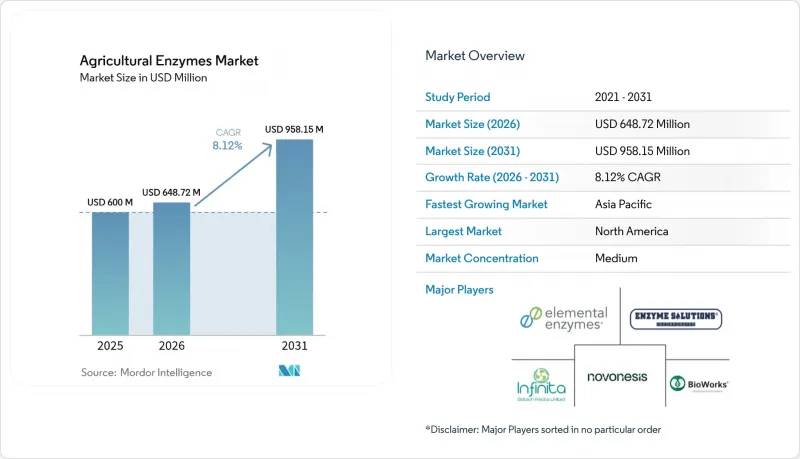
據 Mordor Intelligence 稱,2025 年農業酵素市場價值為 6 億美元,預計到 2031 年將達到 9.5815 億美元,而 2026 年為 6.4872 億美元,預測期(2026-2031 年)的複合年成長率為 8.12%。
本報告按酵素類型(磷酸酶及其他)、劑型(液體及其他)、應用領域(作物保護及其他)、施用方法(種子處理及其他)、作物類型(穀類、油籽、豆類及其他)和地區(北美、歐洲及其他)進行分類。市場預測以美元計價。
全球農業酵素市場趨勢及洞察
有機食品及不含農藥殘留食品的需求
隨著零售商收緊殘留物標準,以及歐盟「從農場到餐桌」戰略要求到2030年將化學農藥的使用量減少50%,全球有機農產品的支出正在成長。農民可以透過認證的有機分銷管道獲得20-30%的溢價,從而抵消引入酶製劑的過渡成本。這些酵素製劑能夠促進養分轉化,且不會留下化學殘留。添加酵素製劑的計畫正在幫助縮小有機農業系統中的產量差距,其原理是透過提高磷和氮的利用效率、增強植物的防禦機制以及改善土壤微生物群的平衡。西班牙一位商業果園主報告稱,在2024年將磷肥換成含有磷酸酶和尿素酶的顆粒肥料後,產量提高了9%,這充分證明了其經濟效益。類似的成果正在推動加拿大溫室蔬菜種植業的推廣,液態纖維素組合藥物透過加速作物輪作間生質能的分解,縮短了種植週期。
生物來源材料的應用正在迅速增加。
在巴西,生物作物保護方案已在相當大比例的耕地上得到應用,其普及率超過了歐盟和美國。作物對合成除草劑和殺菌劑的抗藥性日益增強,加速了人們尋找新的作用機制,而農業酵素正逐漸成為生物防治微生物的協同增效夥伴。馬托格羅索州的農民在2024/25年度引入含有脂肪酶和甘露聚醣酶的種子處理混合物後,玉米產量提高了4.6%。印度也出現了類似的趨勢,各邦政府提供的補貼計畫(最高可達酵素製劑應用成本的30%)刺激了小規模農戶的採用,從而實現了兩位數的市場成長。
監理核准的差異
開發生物來源材料的公司仍需要應對各個地區不同的核准流程。在歐盟,根據產品分類的不同,需要提交多份申請文件。在美國,新推出的統一生物技術監管網站提高了國家層級的透明度,但距離全球法規的統一性仍有很長的路要走。核准延遲導致平均產品上市週期延長了18至24個月,並增加了合規成本,迫使一些公司縮小市場範圍,優先考慮高價值市場。規模小規模的創新企業尤其舉步維艱,它們通常需要與大型農化公司合作以獲得監管支持,這可能會限制它們獨立打入市場策略。
細分市場分析
到2025年,磷酸酶將佔據農業酵素市場36.42%的佔有率,用於釋放土壤中固定的磷,而土壤磷的施用量高達肥料總量的80%。儘管化肥價格持續波動,但穀物和油籽作物對磷活化解決方案的需求仍然強勁。因此,預計到2031年,磷酸酶農業酶市場將繼續保持其銷售主導地位。纖維素酶在CelOCE及其相關創新技術的推動下,以13.05%的複合年成長率領先市場。這些酵素能夠分解作物殘茬,釋放出可作為有益微生物營養的醣類,同時也能改善土壤結構。尿素酶、解離酶和蛋白酶構成了產品線,並且混合酶產品(將具有互補作用的酶結合使用,以應對複雜的田間條件)的趨勢日益成長。
多酶混合物的應用趨勢在高價值園藝領域尤其明顯,種植者希望透過一次施用即可實現精準的養分調動和增強作物的抗逆能力。一些新創公司正在開發農場發酵工具包,使種植者能夠在農場內製備新鮮的富含纖維素酶的混合物,從而避免保存期限問題並降低成本。大型企業則將磷酸酶和尿素酶的協同作用應用於水稻田,以提高氮肥利用效率並減少揮發,這反映出農業酵素市場解決方案的不斷擴展。
到2025年,液態產品將佔農業酵素市場的45.55%,這主要歸功於其與現有噴灑設備的兼容性以及透過葉面高效吸收的特性。然而,由於物流成本高且高度依賴冷鏈,產品負責人正將目光轉向更耐熱的技術。顆粒狀產品目前以11.72%的複合年成長率成長,採用「顆粒內含反應器」的結構,此結構可使酵素穩定長達24個月,並在與土壤接觸後達到緩釋。
粉末製劑雖然價格適中,但需要專門的混合設備。水溶性混合顆粒模糊了這個界限,兼具液體的便利性和顆粒的耐用性。這種製劑的多功能性有望成為一項關鍵的競爭優勢,尤其對於那些旨在亞太和非洲等冷鏈基礎設施低度開發的熱帶地區拓展業務的公司而言更是如此。
區域分析
預計到2025年,北美將佔據農業酵素市場約34.62%的佔有率,這得益於其完善的分銷體系和生物來源材料快速的法規核准流程。上個種植季,加拿大農民種植了1,180萬公頃基改作物,為配套的酵素製劑計畫創造了有利環境。美國的生物促效劑市場同樣蓬勃發展,富含酵素的葉面噴布噴劑在杏仁和番茄種植者中越來越受歡迎。
亞太地區是成長最快的地區,預計到2031年將維持9.56%的複合年成長率。印度的生物農業市場在2023年達到124億美元,目前小規模農戶的採用率正在加速提高,邦政府補貼可涵蓋高達30%的酵素製劑成本。冷鏈短缺仍然是一個主要障礙,印度乳製品行業的冷鏈能力仍不足所需水準的80%,導致生產商專注於供應顆粒狀產品。中國的土地改革正在促進大規模農業生產,從而改善了適用於大規模生產的酵素製劑技術的商業前景。
在歐洲,由於「綠色交易」嚴格的農藥減量目標,市場依然強勁。生物防治活性成分的數量從2011年的120種增加到2022年的近220種,同期銷售額加倍,達到15.49億歐元(17.84億日元)。南美洲市場在巴西的引領下,生物農藥的普及率高達60%,市場仍成熟且持續成長,尤其是在大豆和玉米的酵素強化種子處理領域。中東和非洲市場蘊藏著新的潛力,但其成長取決於更明確的法規和對冷鏈的投資,其中南非和海灣國家在早期應用方面處於領先地位。
其他好處
- Excel格式的市場預測(ME)表
- 3個月的分析師支持
目錄
第1章:引言
- 研究假設和市場定義
- 調查範圍
第2章:調查方法
第3章執行摘要
第4章 市場狀況
- 市場概覽
- 市場促進因素
- 有機食品及不含農藥殘留食品的需求
- 生物來源材料的應用正在迅速增加。
- 加強研發和產品創新
- 透過種子覆蓋進行微量施藥
- 透過再生農業實現排碳權計劃
- 農場酵素發酵系統
- 市場限制因素
- 監理核准的差異
- 土壤和氣候因素造成的產量差異
- 熱帶地區冷鏈面臨的挑戰
- 將不可見的短期投資回報與化學產品進行比較
- 監理情勢
- 技術展望
- 波特五力模型
第5章 市場規模與成長預測
- 依酶類型
- 磷酸酶
- 去氫酶
- 尿素酶
- 蛋白酶
- 解離酶
- 纖維素酶
- 其他酵素類型
- 配方
- 液體
- 粉末
- 顆粒狀
- 透過使用
- 作物保護
- 改善土壤肥力
- 植物生長調節
- 透過應用方法
- 種子處理
- 葉面噴布
- 土壤處理
- 按作物類型
- 穀類和穀類食品
- 油籽/豆類
- 水果和蔬菜
- 草坪和觀賞植物
- 其他
- 按地區
- 北美洲
- 美國
- 加拿大
- 墨西哥
- 其他北美國家
- 歐洲
- 德國
- 英國
- 法國
- 義大利
- 西班牙
- 俄羅斯
- 其他歐洲國家
- 亞太地區
- 中國
- 日本
- 印度
- 澳洲
- 其他亞太國家
- 南美洲
- 巴西
- 阿根廷
- 其他南美國家
- 中東
- 沙烏地阿拉伯
- 阿拉伯聯合大公國
- 土耳其
- 其他中東國家
- 非洲
- 南非
- 肯亞
- 其他非洲地區
- 北美洲
第6章 競爭情勢
- 市場集中度
- 策略趨勢
- 市佔率分析
- 公司簡介
- Novenesis Group
- Elemental Enzymes
- Enzyme Solutions Inc.
- Bioworks Inc.
- Infinita BIoTech Pvt. Ltd.
- Biocatalysts Ltd
- Enzyme Development Corporation
- American Vanguard Corp.
- DSM-Firmenich AG
- Orffa
- GreenLight Biosciences
第7章 市場機會與未來展望
According to Mordor Intelligence, the agricultural enzymes market size was valued at USD 600 million in 2025 and estimated to grow from USD 648.72 million in 2026 to reach USD 958.15 million by 2031, at a CAGR of 8.12% during the forecast period (2026-2031).
This report is Segmented by Enzyme Type (Phosphatases and More), by Formulation (Liquid and More), by Application (Crop Protection and More), by Mode of Application (Seed Treatment and More), by Crop Type (Cereals and Grains, Oil Seeds and Pulses, and More), and by Geography (North America, Europe, and More). The Market Forecasts are Provided in Terms of Value (USD).
Global Agricultural Enzymes Market Trends and Insights
Organic and Residue-free Food Demand
Global spending on organic produce is climbing as retailers tighten residue thresholds, and the EU Farm to Fork Strategy mandates a 50% cut in chemical pesticide use by 2030. Farmers gain 20-30% price premiums in certified organic channels, offsetting the transition costs of adopting enzymes that mobilize nutrients without chemical residues. Enzyme-embedded programs help close yield gaps in organic systems by enhancing phosphorus and nitrogen availability, fortifying plant defense pathways, and improving soil microbiome balance. Commercial orchard operators in Spain reported a 9% yield uplift after switching from phosphate fertilizers to a blended phosphatase-urease granule in 2024, demonstrating clear economic returns. Similar outcomes are now driving uptake in greenhouse vegetables across Canada, where liquid cellulase blends shorten crop cycles by improving biomass breakdown between rotations.
Biological Input Adoption Surge
Brazil has adopted biological crop-protection solutions on a significant portion of its cultivated land, surpassing adoption rates in the European Union and the United States. Mounting resistance to synthetic herbicides and fungicides is accelerating the search for new modes of action, positioning agricultural enzymes as synergistic companions to biocontrol microbes. Row-crop growers in Mato Grosso logged a 4.6% corn-on-corn yield gain in the 2024/25 season after integrating a seed-treatment cocktail containing lipase and mannanase enzymes. Similar momentum is unfolding in India, where state-level subsidy programs cover up to 30% of enzyme input costs, catalyzing smallholder adoption and fueling double-digit market growth.
Fragmented Regulatory Approvals
Biological input developers still navigate divergent approval timelines, with the EU requiring multiple dossiers depending on product classification. The new United States Unified Website for Biotechnology Regulation improves domestic transparency, yet global harmonization remains distant.Delays add 18-24 months to average commercialization cycles, inflating compliance costs and prompting some firms to prioritize fewer, high-value markets. Smaller innovators struggle most, often partnering with larger agrochemical companies for regulatory support, which can limit independent go-to-market strategies.
Other drivers and restraints analyzed in the detailed report include:
- Intensified Research and Development, and Product Innovation
- Seed-coating Micro-dose Delivery
- Cold-chain Gaps in Tropical Regions
For complete list of drivers and restraints, kindly check the Table Of Contents.
Segment Analysis
Phosphatases captured 36.42% of the agricultural enzymes market in 2025 by unlocking immobilized soil phosphorus that otherwise reaches 80% of applied fertilizer. As fertilizer prices remain volatile, demand for phosphorus-mobilizing solutions stays strong across cereals and oilseeds. The agricultural enzymes market size for phosphatases is, therefore, set to maintain a dominant revenue position through 2031. Cellulases, propelled by CelOCE and related innovations, top the growth chart at a 13.05% CAGR. These enzymes deconstruct crop residues, releasing sugars that fuel beneficial microbes and improve soil structure. Ureases, lyases, and proteases round out the portfolio, with cocktail products increasingly combining complementary activities to match complex field conditions.
The shift toward multi-enzyme blends is pronounced in high-value horticulture, where growers demand precise nutrient mobilization and stress-response enhancement in one pass. Start-ups are developing on-farm fermentation kits that allow growers to brew fresh cellulase-rich mixes, avoiding shelf-life concerns and reducing costs. Larger players integrate phosphatase-urease synergies to improve nitrogen use efficiency and mitigate volatilization in paddy fields, reflecting a broadening solution set within the agricultural enzymes market.
Liquid products retained 45.55% of the agricultural enzymes market size in 2025, primarily due to their compatibility with existing spraying equipment and efficient foliar absorption. Yet logistics costs and cold-chain dependency are steering product managers toward more temperature-tolerant technologies. Granular products, advancing at 11.72% CAGR, now embed "bioreactor-in-a-granule" architectures that stabilize enzymes for up to 24 months while enabling timed release after soil contact.
Powder formulations occupy a cost-efficient middle ground, but require dedicated mixing equipment. Hybrid water-dispersible granules blur these lines, providing liquid-like convenience with granular durability. Expect competitive differentiation to hinge on formulation versatility, particularly for companies pursuing growth in the Asia-Pacific and African tropics where cold-chain gaps persist.
Complete Report Scope:
- By Enzyme Type
- Phosphatases
- Dehydrogenases
- Ureases
- Proteases
- Lyases
- Cellulases
- Other Enzyme Types
- By Formulation
- Liquid
- Powder
- Granular
- By Application
- Crop Protection
- Fertility Enhancement
- Plant Growth Regulation
- By Mode of Application
- Seed Treatment
- Foliar Spray
- Soil Treatment
- By Crop Type
- Cereals and Grains
- Oilseeds and Pulses
- Fruits and Vegetables
- Turf and Ornamentals
- Other Crops
- By Geography
- North America
- United States
- Canada
- Mexico
- Rest of North America
- Europe
- Germany
- United Kingdom
- France
- Italy
- Spain
- Russia
- Rest of Europe
- Asia-Pacific
- China
- Japan
- India
- Australia
- Rest of Asia-Pacific
- South America
- Brazil
- Argentina
- Rest of South America
- Middle East
- Saudi Arabia
- United Arab Emirates
- Turkey
- Rest of Middle East
- Africa
- South Africa
- Kenya
- Rest of Africa
- North America
Geography Analysis
North America, holding about 34.62% of the agricultural enzymes market in 2025, benefits from robust distribution infrastructure and rapid regulatory clearance for biological inputs. Canadian growers planted 11.8 million hectare of genetically engineered crops last season, creating a receptive environment for complementary enzyme programs. The United States biostimulant segment is equally vibrant, with enzyme-infused foliar sprays gaining traction among almond and tomato producers.
Asia-Pacific is the fastest-growing region, on track for a 9.56% CAGR through 2031. India's BioAgri segment reached USD 12.4 billion in 2023, and state subsidies now cover up to 30% of enzyme costs, accelerating adoption among smallholders. Cold-chain gaps remain a material hurdle, 80% of the required capacity is still absent across India's dairy sector, prompting manufacturers to emphasize granular products. China's land-transfer reforms encourage larger farm units, improving the business case for enzyme technologies that can be applied at scale.
Europe retains a strong foothold due to stringent pesticide-reduction goals under the Green Deal. Biocontrol active substances climbed from 120 in 2011 to almost 220 in 2022, doubling revenue to EUR 1.549 billion (1.784 billion) in that period. South America, led by Brazil's trail-blazing 60% biological adoption, remains a mature yet expanding arena, particularly for enzyme-enhanced seed treatments in soy and corn. The Middle East and Africa show emerging promise, though growth hinges on regulatory clarity and cold-chain investment, with South Africa and the Gulf states spearheading early adoption.
- Novenesis Group
- Elemental Enzymes
- Enzyme Solutions Inc.
- Bioworks Inc.
- Infinita Biotech Pvt. Ltd.
- Biocatalysts Ltd
- Enzyme Development Corporation
- American Vanguard Corp.
- DSM-Firmenich AG
- Orffa
- GreenLight Biosciences
Additional Benefits:
- The market estimate (ME) sheet in Excel format
- 3 months of analyst support
TABLE OF CONTENTS
1 Introduction
- 1.1 Study Assumptions and Market Definition
- 1.2 Scope of the Study
2 Research Methodology
3 Executive Summary
4 Market Landscape
- 4.1 Market Overview
- 4.2 Market Drivers
- 4.2.1 Organic and Residue-free Food Demand
- 4.2.2 Biological Input Adoption Surge
- 4.2.3 Intensified Research and Development, and Product Innovation
- 4.2.4 Seed-coating Micro-dose Delivery
- 4.2.5 Regenerative-Ag Carbon-Credit Programs
- 4.2.6 On-farm Enzyme Fermentation Units
- 4.3 Market Restraints
- 4.3.1 Fragmented Regulatory Approvals
- 4.3.2 Soil and Climate based Performance Variability
- 4.3.3 Cold-chain Gaps in Tropical Regions
- 4.3.4 Invisible short-term Return on Investment vs chemicals
- 4.4 Regulatory Landscape
- 4.5 Technological Outlook
- 4.6 Porters Five Forces
- 4.6.1 Bargaining Power of Suppliers
- 4.6.2 Bargaining Power of Buyers
- 4.6.3 Threat of New Entrants
- 4.6.4 Threat of Substitutes
- 4.6.5 Intensity of Competitive Rivalry
5 Market Size and Growth Forecasts (Value)
- 5.1 By Enzyme Type
- 5.1.1 Phosphatases
- 5.1.2 Dehydrogenases
- 5.1.3 Ureases
- 5.1.4 Proteases
- 5.1.5 Lyases
- 5.1.6 Cellulases
- 5.1.7 Other Enzyme Types
- 5.2 By Formulation
- 5.2.1 Liquid
- 5.2.2 Powder
- 5.2.3 Granular
- 5.3 By Application
- 5.3.1 Crop Protection
- 5.3.2 Fertility Enhancement
- 5.3.3 Plant Growth Regulation
- 5.4 By Mode of Application
- 5.4.1 Seed Treatment
- 5.4.2 Foliar Spray
- 5.4.3 Soil Treatment
- 5.5 By Crop Type
- 5.5.1 Cereals and Grains
- 5.5.2 Oilseeds and Pulses
- 5.5.3 Fruits and Vegetables
- 5.5.4 Turf and Ornamentals
- 5.5.5 Other Crops
- 5.6 By Geography
- 5.6.1 North America
- 5.6.1.1 United States
- 5.6.1.2 Canada
- 5.6.1.3 Mexico
- 5.6.1.4 Rest of North America
- 5.6.2 Europe
- 5.6.2.1 Germany
- 5.6.2.2 United Kingdom
- 5.6.2.3 France
- 5.6.2.4 Italy
- 5.6.2.5 Spain
- 5.6.2.6 Russia
- 5.6.2.7 Rest of Europe
- 5.6.3 Asia-Pacific
- 5.6.3.1 China
- 5.6.3.2 Japan
- 5.6.3.3 India
- 5.6.3.4 Australia
- 5.6.3.5 Rest of Asia-Pacific
- 5.6.4 South America
- 5.6.4.1 Brazil
- 5.6.4.2 Argentina
- 5.6.4.3 Rest of South America
- 5.6.5 Middle East
- 5.6.5.1 Saudi Arabia
- 5.6.5.2 United Arab Emirates
- 5.6.5.3 Turkey
- 5.6.5.4 Rest of Middle East
- 5.6.6 Africa
- 5.6.6.1 South Africa
- 5.6.6.2 Kenya
- 5.6.6.3 Rest of Africa
- 5.6.1 North America
6 Competitive Landscape
- 6.1 Market Concentration
- 6.2 Strategic Moves
- 6.3 Market Share Analysis
- 6.4 Company Profiles (Includes Global Level Overview, Market Level Overview, Core Segments, Financials as Available, Strategic Information, Market Rank/Share, Products and Services, Recent Developments)
- 6.4.1 Novenesis Group
- 6.4.2 Elemental Enzymes
- 6.4.3 Enzyme Solutions Inc.
- 6.4.4 Bioworks Inc.
- 6.4.5 Infinita Biotech Pvt. Ltd.
- 6.4.6 Biocatalysts Ltd
- 6.4.7 Enzyme Development Corporation
- 6.4.8 American Vanguard Corp.
- 6.4.9 DSM-Firmenich AG
- 6.4.10 Orffa
- 6.4.11 GreenLight Biosciences
7 Market Opportunities and Future Outlook

 農業酵素市場:按酵素類型、原料、形態、作物類型和應用分類的全球市場預測,2026-2032年
 農業酵素市場-全球產業規模、佔有率、趨勢、機會、預測:按類型、作物類型、地區和競爭格局分類,2021-2031年
 農業酵素市場規模、佔有率和成長分析:按酵素類型、作物類型、產品類型和地區分類-2026-2033年產業預測
 農業酵素市場報告:按酵素類型、產品類型、作物類型和地區分類(2026-2034 年)
 全球農業酵素市場規模、佔有率、趨勢和成長分析報告(2026-2034)
 2032年農業酵素市場預測:按酵素類型、功能、配方、生產來源、供應形式、作物和地區進行的全球分析農業酵素市場:2025年至2030年的預測
 農業酵素市場,按產品類型、作物類型、應用、國家和地區分類 - 2025 年至 2032 年全球產業分析、市場規模、市場佔有率和預測2030 年農業酵素市場預測:按酵素類型、作物類型、來源、配方、作用機制、應用和地區進行全球分析
 農業酵素市場:依產品種類、功能、作物類型、地區、機會、預測,2018-2032 年