


 |
市場調查報告書
商品編碼
2120805
智慧標籤:市場佔有率分析、產業趨勢與統計、成長預測(2026-2031)Smart Label - Market Share Analysis, Industry Trends & Statistics, Growth Forecasts (2026 - 2031) |
||||||

※ 本網頁內容可能與最新版本有所差異。詳細情況請與我們聯繫。
據 Mordor Intelligence 稱,2025 年智慧標籤市值為 183.8 億美元,預計到 2031 年將達到 446.2 億美元,而 2026 年為 213.1 億美元,預測期(2026-2031 年)的複合年成長率為 15.93%。
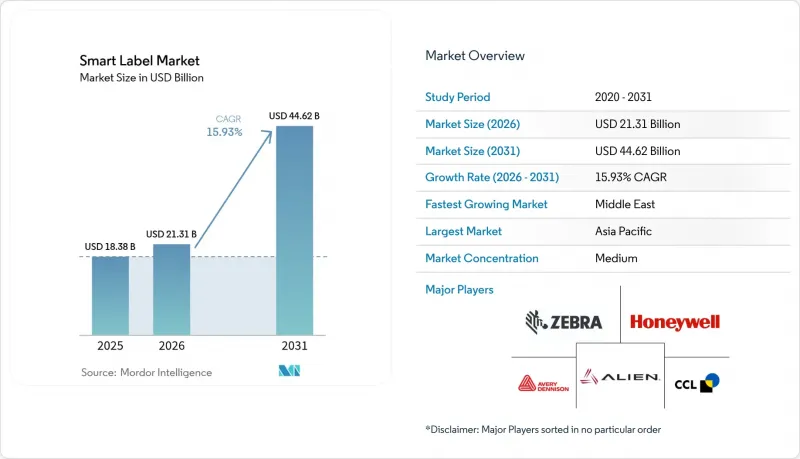
本報告按技術(RFID、感測標籤等)、終端用戶產業(零售、食品飲料等)、組件(微控制器/積體電路、感測器等)、應用(防盜/安防、冷鏈監控等)、標籤形式(吊牌、套模標籤、紡織服裝標籤等)和地區進行細分。市場預測以美元計價。
全球智慧標籤市場趨勢及洞察
擴大RFID技術在庫存視覺性方面的應用
物品等級RFID技術將庫存準確率從少於65%提升至約98%,可望將缺貨率降低一半。 2025年,沃爾瑪擴大了供應商要求,將家居用品和電子產品納入其中,加快了生產車間RFID編碼的實施,並推動利用即時門禁數據觸發自動補貨的舉措。讀寫器出貨量激增,斑馬技術公司報告稱,2025年上半年固定式門禁系統的出貨量年增40%。最新的GS1 EPCIS更新現已支援256位元用戶內存,允許品牌將批號和永續性證書寫入單一嵌體。
藥品供應鏈中對防偽措施的需求日益成長。
美國和歐盟法律強制要求藥品在單元層級進行序列化,這使得防篡改智慧標籤成為製藥企業的必備之選。艾利丹尼森公司於2025年推出了支援全像圖、RFID和NFC功能的標籤,可在藥房櫃檯實現三因素認證。世界衛生組織現已將RFID事件日誌認可為上市後檢測的主要證據,這進一步激勵了契約製造製造商擺脫紙本記錄。印度監管機構正在試行將區塊鏈連接的RFID技術應用於高價值生物製藥,這表明區域內打擊仿冒品的力道將進一步加大。
小規模零售商的初始硬體和整合成本較高
即使對於單店零售商而言,儘管由於大規模生產,嵌體的成本已降至每塊0.05美元,但讀寫器、編碼器和中間件的部署成本仍然在5萬至15萬美元之間。Honeywell和佐藤等公司提供的租賃方案可以將部署成本降低至每月約800美元,但由於淨利率低於3%,許多獨立零售商對此猶豫不決。編碼成本為每件0.03至0.06美元,與條碼相比獲利能力更低。基於雲端的SaaS服務雖然有用,但農村市場寬頻環境的不穩定性阻礙了其廣泛應用。
細分市場分析
到2025年,無線射頻辨識(RFID)將佔據智慧標籤市場67.33%的佔有率,這充分展現了其在大批量庫存追蹤領域的穩固地位。 RFID 3至10公尺的讀取範圍使其能夠實現自動化門禁掃描。而像Impinj的M800(通訊範圍達30公尺)這樣的遠端被動晶片的出現,正在拓展RFID在戶外資產追蹤領域的應用場景,進一步鞏固了其在智慧標籤市場的主導地位。
近距離場通訊 (NFC) 技術預計到 2031 年將以 17.19% 的複合年成長率成長,隨著每年超過 14 億部具備輕觸讀取功能的智慧型手機出貨量,NFC 技術正在降低消費者參與的硬體門檻。如今,只需輕輕一觸,支援 NFC 功能的電子貨架標籤即可提供營養資訊和會員獎勵,使這項技術從單純的身份驗證方式轉變為行銷媒介。這種變革正在推動智慧標籤市場中成長最快的細分領域。
到2025年,零售業將佔全球銷售額的34.83%。這主要歸功於服裝連鎖店採用產品級標籤技術,以減少庫存損失、提高庫存準確性並簡化路邊取貨流程。這項措施不僅提高了營運效率,還實現了更快、更準確的訂單處理,從而提升了客戶滿意度。沃爾瑪於2025年實施的供應商要求,將編碼工作轉移到了物流中心,進一步鞏固了RFID在智慧標籤市場中的地位,並為其他零售商樹立了標竿。
醫療保健和製藥業預計將以17.14%的複合年成長率(CAGR)在所有行業中成長最快,這主要得益於美國《藥品供應鏈安全法案》(DSCSA)和歐盟《藥品和醫療器械法案》(FMD)規定的藥品序列化截止日期(2027年),該法案要求為每件藥品配備安全的數位標識。此外,為確保病患安全和符合監管要求,供應鏈中對可追溯性和透明度的需求不斷成長,也推動了這項成長。同時,無需電池的感測器標籤能夠持續監測溫度數據,從而增強受監管冷鏈的合規性,並促進智慧標籤市場的擴張。這些標籤對於維持疫苗和生物製藥等溫度敏感產品在整個供應鏈中的品質尤其重要。
區域分析
到2025年,亞太地區將佔全球銷售額的38.29%。這反映了中國政府強制要求在主要城市銷售的高階服裝和電子產品進行單品級標籤化。中國的這項法規正為大規模實施奠定基礎,並將推廣至整個國內供應鏈。到2025年,日本便利商店連鎖將部署超過5,000萬個電子貨架標籤,從而顯著減少每日價格調整所需的時間。印度藥品監管機構已啟動抗癌藥物RFID序列化試點先導計畫,推動了契約製造生產商的早期需求。在韓國,零售商正在將NFC吊牌與忠誠度計畫連接起來,使復購率提高了約30%。
歐洲的成長取決於《包裝和包裝廢棄物法規》,該法規強制要求2028年後所有銷售的消費品都必須附帶數位產品護照。一家德國汽車零件供應商正在可重複使用的托特包嵌入RFID標籤,從而將卸貨點的停機時間減少多達30分鐘。英國國家醫療服務體系(NHS)正在試驗使用配備RFID標籤的藥櫃,初步試驗表明,受控藥品的庫存差異減少了40%。法國家樂福連鎖店已在1200家門市完成了電子貨架標籤的部署,每15分鐘更新一次價格,以支援其全通路履約策略。
北美地區仍是RFID技術應用率較高的地區,但由於《藥品供應鏈安全法案》(DSCSA)對醫療產業序列化實施的最後期限,投資水準仍居高不下。沃爾瑪已於2025年將編碼業務轉移至其物流中心,使門市員工能夠專注於客戶服務。加拿大合法大麻產業正在利用RFID技術滿足「從種子到銷售」的監管要求,而這項框架目前也正被營養補充品出口商所採用。中東地區預計將以16.91%的複合年成長率成為該地區成長最快的市場,這主要得益於「沙烏地阿拉伯2030願景」下物流走廊的建設以及阿拉伯聯合大公國冷鏈的數位轉型。巴西零售業的早期試點計畫以及阿根廷的藥品冷鏈追蹤計畫表明,南美洲正在迎來首波應用浪潮。這些區域趨勢共同吸引更多注重合規性的買家加入這個生態系統,並推動了智慧標籤市場的整體擴張。
其他好處:
- Excel格式的市場預測(ME)表
- 3個月的分析師支持
目錄
第1章:引言
- 研究假設和市場定義
- 調查範圍
第2章:調查方法
第3章執行摘要
第4章 市場狀況
- 市場概覽
- 市場促進因素
- 擴大RFID技術在庫存視覺性方面的應用
- 藥品供應鏈中對防偽措施的需求日益成長。
- 全通路零售的擴張需要即時定價。
- 擴大以物聯網為基礎的物流應用
- 無需電池、可列印的感測器標籤應運而生,以確保冷鏈的完整性。
- 歐盟的 ESG 包裝法規(PPWR 2026)正在加速智慧標籤的普及。
- 市場限制因素
- 小規模零售商的初始硬體和系統整合成本較高
- 缺乏通用的互通性標準
- 由於半導體供應受限,UHF RFID IC 的市場推廣被推遲。
- 資料隱私法規限制了使用NFC進行消費者互動分析。
- 產業價值鏈分析
- 監理情勢
- 技術展望
- 宏觀經濟因素對市場的影響
- 波特五力分析
第5章 市場規模與成長預測
- 透過技術
- RFID
- 電子產品監控系統
- 近距離場通訊
- 感知標籤
- 電子貨架標籤
- 其他技術
- 按最終用戶行業分類
- 零售
- 醫療和藥品
- 物流/運輸
- 製造業和工業
- 食品/飲料
- 其他終端用戶產業
- 按組件
- 微控制器/積體電路
- 電池和電源單元
- 天線和收發器
- 感應器
- 軟體和中介軟體
- 基板和保護材料
- 透過使用
- 資產和庫存追蹤
- 防盜與安保
- 冷鏈監測
- 動態定價和促銷
- 品牌認證與消費者互動
- 在製品管理
- 按形狀標記
- 濕式嵌體/貼紙標籤
- 吊牌
- 套模標籤
- 紡織品和服裝標籤
- 可列印軟性感測器標籤
- 按地區
- 北美洲
- 美國
- 加拿大
- 墨西哥
- 南美洲
- 巴西
- 阿根廷
- 其他南美國家
- 歐洲
- 英國
- 德國
- 法國
- 義大利
- 其他歐洲國家
- 亞太地區
- 中國
- 日本
- 印度
- 韓國
- 其他亞太國家
- 中東和非洲
- 中東
- 阿拉伯聯合大公國
- 沙烏地阿拉伯
- 其他中東國家
- 非洲
- 南非
- 埃及
- 其他非洲國家
- 中東
- 北美洲
第6章 競爭情勢
- 市場集中度
- 策略趨勢
- 市佔率分析
- 公司簡介
- Avery Dennison Corporation
- CCL Industries Inc.
- Zebra Technologies Corp.
- Honeywell International Inc.
- SATO Holdings Corp.
- William Frick & Company
- Invengo Information Technology Co. Ltd.
- Scanbuy Inc.
- Alien Technology LLC
- Roambee Corporation
- SES-imagotag SA
- Pricer AB
- Thinfilm Electronics ASA
- Digimarc Corporation
- Tapwow LLC
- Stora Enso Oyj
- Identiv Inc.
- Impinj Inc.
- Checkpoint Systems Inc.
- Confidex Ltd.
- NXP Semiconductors NV
第7章 市場機會與未來展望
According to Mordor Intelligence, the smart label market size was valued at USD 18.38 billion in 2025 and estimated to grow from USD 21.31 billion in 2026 to reach USD 44.62 billion by 2031, at a CAGR of 15.93% during the forecast period (2026-2031).
This report is Segmented by Technology (RFID, Sensing Labels, and More), End-User Industry (Retail, Food and Beverage, and More), Component (Micro-Controllers/ICs, Sensors, and More), Application (Anti-Theft and Security, Cold-Chain Monitoring, and More), Label Form Factor (Hang Tags, In-Mold Labels, Textile and Apparel Labels, and More), and Geography. The Market Forecasts are Provided in Terms of Value (USD).
Global Smart Label Market Trends and Insights
Growing RFID Adoption for Inventory Visibility
Item-level RFID lifts stock-count accuracy from below 65% to about 98%, trimming out-of-stock events by as much as half. Walmart broadened its supplier mandate in 2025 to cover home goods and electronics, pushing encoding upstream into manufacturing sites and turning real-time portal data into automated replenishment triggers. Reader shipments rose sharply, with Zebra Technologies reporting 40% year-on-year growth in fixed portals during the first half of 2025. The latest GS1 EPCIS update now supports 256-bit user memory, letting brands write batch numbers and sustainability certificates into a single inlay.
Rising Demand for Anti-Counterfeiting in Pharma Supply Chains
Mandatory unit-level serialization under U.S. and EU laws has turned tamper-evident smart labels into a non-discretionary line item for drug makers. Avery Dennison launched a hologram, RFID, and NFC label in 2025 to deliver three-factor authentication at pharmacy counters. The WHO now accepts RFID event logs as primary evidence in post-market inspections, giving contract manufacturers another incentive to migrate from paper trails. India's regulator is piloting blockchain-anchored RFID for high-value biologics, signaling a broader regional push against fake oncology drugs.
High Initial Hardware and Integration Costs for Small Retailers
A single-site retailer still faces a USD 50,000-150,000 price tag for readers, encoders, and middleware, even though inlay costs have fallen to USD 0.05 in high volumes. Leasing programs from Honeywell and SATO drop entry costs to roughly USD 800 a month, yet thin net margins under 3% keep many independents on the sidelines. Encoding labor adds another USD 0.03-0.06 per unit, eroding the business case versus barcodes. Cloud-based SaaS helps, but patchy broadband in rural markets limits adoption.
Other drivers and restraints analyzed in the detailed report include:
- Expansion of Omnichannel Retail Requiring Real-Time Pricing
- Increasing Penetration of IoT-Enabled Logistics
- Lack of Universal Interoperability Standards
For complete list of drivers and restraints, kindly check the Table Of Contents.
Segment Analysis
Radio-frequency identification captured 67.33% of smart label market share in 2025, underscoring the technology's entrenched role in high-volume inventory tracking, where 3-10 meter read ranges support automated portal scanning. The launch of extended-range passive chips, such as Impinj's M800 with 30-meter coverage, is expanding outdoor asset-tracking use cases and solidifying RFID's dominance in the smart label market.
Near-field communication is advancing at a 17.19% CAGR through 2031 as over 1.4 billion smartphones ship annually with tap-to-read capability, lowering hardware friction for consumer engagement. NFC-enabled electronic shelf labels now deliver nutrition data and loyalty rewards in one tap, transforming the technology from simple authentication to a marketing conduit, an evolution that is carving out the fastest-growing slice of the smart label market size.
In 2025, retail claimed 34.83% of global revenue, driven by apparel chains adopting item-level tagging to curb shrinkage, improve inventory accuracy, and facilitate curbside pickups. This adoption not only enhanced operational efficiency but also improved customer satisfaction by enabling faster and more accurate order fulfillment. Walmart's 2025 supplier mandate, which shifted encoding to distribution centers, further solidified RFID's role in the smart label market, setting a benchmark for other retailers to follow.
Healthcare and pharmaceuticals, facing serialization deadlines under U.S. DSCSA and EU FMD rules by 2027, are set to grow at a 17.14% CAGR, the fastest among all sectors, as each drug unit mandates a secure digital identity. This growth is further supported by the increasing need for traceability and transparency in the supply chain to ensure patient safety and regulatory compliance. Meanwhile, battery-free sensor labels, which consistently monitor temperature data, are enhancing compliance and broadening the smart label market within regulated cold chains. These labels are particularly critical for maintaining the integrity of temperature-sensitive products, such as vaccines and biologics, throughout the supply chain.
Complete Report Scope:
- By Technology
- RFID
- Electronic Article Surveillance
- Near Field Communication
- Sensing Labels
- Electronic Shelf Label
- Other Technologies
- By End-User Industry
- Retail
- Healthcare and Pharmaceuticals
- Logistics and Transportation
- Manufacturing and Industrial
- Food and Beverage
- Other End-User Industries
- By Component
- Micro-Controllers / ICs
- Batteries and Power Units
- Antennas and Transceivers
- Sensors
- Software and Middleware
- Substrate and Protective Materials
- By Application
- Asset and Inventory Tracking
- Anti-Theft and Security
- Cold-Chain Monitoring
- Dynamic Pricing and Promotion
- Brand Authentication and Consumer Engagement
- Work-in-Process Management
- By Label Form Factor
- Wet-Inlay / Sticker Labels
- Hang Tags
- In-Mold Labels
- Textile and Apparel Labels
- Printable Flexible Sensor Labels
- By Geography
- North America
- United States
- Canada
- Mexico
- South America
- Brazil
- Argentina
- Rest of South America
- Europe
- United Kingdom
- Germany
- France
- Italy
- Rest of Europe
- Asia Pacific
- China
- Japan
- India
- South Korea
- Rest of Asia Pacific
- Middle East and Africa
- Middle East
- United Arab Emirates
- Saudi Arabia
- Rest of Middle East
- Africa
- South Africa
- Egypt
- Rest of Africa
- Middle East
- North America
Geography Analysis
Asia-Pacific accounted for 38.29% of global revenue in 2025, reflecting government mandates requiring item-level tagging for premium apparel and electronics sold across tier-1 Chinese cities. China's regulations anchor large deployments that ripple through domestic supply chains. Japanese convenience-store brands installed more than 50 million electronic shelf labels in 2025, sharply reducing labor hours spent on daily price changes. India's drug regulator began an RFID serialization pilot for oncology products, driving early demand among contract manufacturers. In South Korea, retailers tie NFC hang-tag taps to loyalty programs, lifting repeat-purchase rates by roughly 30%.
Europe's growth hinges on the Packaging and Packaging Waste Regulation, which requires a digital product passport for every consumer good sold after 2028. Automotive suppliers in Germany embed RFID in reusable totes to shave dock-door dwell times by up to 30 minutes. The United Kingdom's National Health Service is piloting RFID medicine cabinets that have cut controlled-substance discrepancies by 40% in early trials. France's Carrefour chain completed a 1,200-store rollout of electronic shelf labels that update prices every 15 minutes and support omnichannel fulfillment strategies.
North America remains a high-penetration territory, yet healthcare serialization deadlines under the DSCSA keep investment levels elevated. Walmart moved encoding upstream to distribution centers in 2025, freeing store labor for customer engagement tasks. Canada's cannabis sector uses RFID to satisfy seed-to-sale regulations, a framework now adopted by nutraceutical exporters. The Middle East is projected to register the fastest regional CAGR of 16.91% thanks to Saudi Vision 2030's logistics corridors and the United Arab Emirates' cold-chain digitization. Early pilots in Brazil's retail sector and Argentina's pharmaceutical cold-chain traceability programs signal the first wave of South American adoption. Together, these regional dynamics expand the overall smart label market by attracting new compliance-led buyers into the ecosystem.
- Avery Dennison Corporation
- CCL Industries Inc.
- Zebra Technologies Corp.
- Honeywell International Inc.
- SATO Holdings Corp.
- William Frick & Company
- Invengo Information Technology Co. Ltd.
- Scanbuy Inc.
- Alien Technology LLC
- Roambee Corporation
- SES-imagotag SA
- Pricer AB
- Thinfilm Electronics ASA
- Digimarc Corporation
- Tapwow LLC
- Stora Enso Oyj
- Identiv Inc.
- Impinj Inc.
- Checkpoint Systems Inc.
- Confidex Ltd.
- NXP Semiconductors N.V.
Additional Benefits:
- The market estimate (ME) sheet in Excel format
- 3 months of analyst support
TABLE OF CONTENTS
1 INTRODUCTION
- 1.1 Study Assumptions and Market Definition
- 1.2 Scope of the Study
2 RESEARCH METHODOLOGY
3 EXECUTIVE SUMMARY
4 MARKET LANDSCAPE
- 4.1 Market Overview
- 4.2 Market Drivers
- 4.2.1 Growing RFID Adoption for Inventory Visibility
- 4.2.2 Rising Demand for Anti-Counterfeiting in Pharma Supply Chains
- 4.2.3 Expansion of Omnichannel Retail Requiring Real-Time Pricing
- 4.2.4 Increasing Penetration of IoT-Enabled Logistics
- 4.2.5 Emergence of Printed Battery-Free Sensor Labels for Cold-Chain Integrity
- 4.2.6 EU ESG Packaging Mandates (PPWR 2026) Accelerating Smart-Label Integration
- 4.3 Market Restraints
- 4.3.1 High Initial Hardware and Integration Costs for Small Retailers
- 4.3.2 Lack of Universal Interoperability Standards
- 4.3.3 Semiconductor Supply Constraints Delaying UHF RFID IC Availability
- 4.3.4 Data-Privacy Regulations Limiting NFC Consumer-Engagement Analytics
- 4.4 Industry Value Chain Analysis
- 4.5 Regulatory Landscape
- 4.6 Technological Outlook
- 4.7 Impact of Macroeconomic Factors on the Market
- 4.8 Porter's Five Forces Analysis
- 4.8.1 Bargaining Power of Suppliers
- 4.8.2 Bargaining Power of Buyers/Consumers
- 4.8.3 Threat of New Entrants
- 4.8.4 Intensity of Competitive Rivalry
- 4.8.5 Threat of Substitutes
5 MARKET SIZE AND GROWTH FORECASTS (VALUE)
- 5.1 By Technology
- 5.1.1 RFID
- 5.1.2 Electronic Article Surveillance
- 5.1.3 Near Field Communication
- 5.1.4 Sensing Labels
- 5.1.5 Electronic Shelf Label
- 5.1.6 Other Technologies
- 5.2 By End-User Industry
- 5.2.1 Retail
- 5.2.2 Healthcare and Pharmaceuticals
- 5.2.3 Logistics and Transportation
- 5.2.4 Manufacturing and Industrial
- 5.2.5 Food and Beverage
- 5.2.6 Other End-User Industries
- 5.3 By Component
- 5.3.1 Micro-Controllers / ICs
- 5.3.2 Batteries and Power Units
- 5.3.3 Antennas and Transceivers
- 5.3.4 Sensors
- 5.3.5 Software and Middleware
- 5.3.6 Substrate and Protective Materials
- 5.4 By Application
- 5.4.1 Asset and Inventory Tracking
- 5.4.2 Anti-Theft and Security
- 5.4.3 Cold-Chain Monitoring
- 5.4.4 Dynamic Pricing and Promotion
- 5.4.5 Brand Authentication and Consumer Engagement
- 5.4.6 Work-in-Process Management
- 5.5 By Label Form Factor
- 5.5.1 Wet-Inlay / Sticker Labels
- 5.5.2 Hang Tags
- 5.5.3 In-Mold Labels
- 5.5.4 Textile and Apparel Labels
- 5.5.5 Printable Flexible Sensor Labels
- 5.6 By Geography
- 5.6.1 North America
- 5.6.1.1 United States
- 5.6.1.2 Canada
- 5.6.1.3 Mexico
- 5.6.2 South America
- 5.6.2.1 Brazil
- 5.6.2.2 Argentina
- 5.6.2.3 Rest of South America
- 5.6.3 Europe
- 5.6.3.1 United Kingdom
- 5.6.3.2 Germany
- 5.6.3.3 France
- 5.6.3.4 Italy
- 5.6.3.5 Rest of Europe
- 5.6.4 Asia Pacific
- 5.6.4.1 China
- 5.6.4.2 Japan
- 5.6.4.3 India
- 5.6.4.4 South Korea
- 5.6.4.5 Rest of Asia Pacific
- 5.6.5 Middle East and Africa
- 5.6.5.1 Middle East
- 5.6.5.1.1 United Arab Emirates
- 5.6.5.1.2 Saudi Arabia
- 5.6.5.1.3 Rest of Middle East
- 5.6.5.2 Africa
- 5.6.5.2.1 South Africa
- 5.6.5.2.2 Egypt
- 5.6.5.2.3 Rest of Africa
- 5.6.5.1 Middle East
- 5.6.1 North America
6 COMPETITIVE LANDSCAPE
- 6.1 Market Concentration
- 6.2 Strategic Moves
- 6.3 Market Share Analysis
- 6.4 Company Profiles (includes Global Level Overview, Market Level Overview, Core Segments, Financials as available, Strategic Information, Market Rank/Share, Products and Services, Recent Developments)
- 6.4.1 Avery Dennison Corporation
- 6.4.2 CCL Industries Inc.
- 6.4.3 Zebra Technologies Corp.
- 6.4.4 Honeywell International Inc.
- 6.4.5 SATO Holdings Corp.
- 6.4.6 William Frick & Company
- 6.4.7 Invengo Information Technology Co. Ltd.
- 6.4.8 Scanbuy Inc.
- 6.4.9 Alien Technology LLC
- 6.4.10 Roambee Corporation
- 6.4.11 SES-imagotag SA
- 6.4.12 Pricer AB
- 6.4.13 Thinfilm Electronics ASA
- 6.4.14 Digimarc Corporation
- 6.4.15 Tapwow LLC
- 6.4.16 Stora Enso Oyj
- 6.4.17 Identiv Inc.
- 6.4.18 Impinj Inc.
- 6.4.19 Checkpoint Systems Inc.
- 6.4.20 Confidex Ltd.
- 6.4.21 NXP Semiconductors N.V.
7 MARKET OPPORTUNITIES AND FUTURE OUTLOOK
- 7.1 White-Space and Unmet-Need Assessment

 2026-2034年全球NFC和QR碼智慧標籤市場規模、佔有率、趨勢和成長分析報告
 損壞感測型智慧標籤:市場佔有率分析、產業趨勢與統計、成長預測(2026-2031)
 具備劇透檢測功能的智慧標籤市場-2026-2032年全球市場預測智慧標籤市場:2026-2032年全球市場預測(依標籤類型、技術、材料、組件、頻率、部署模式、應用程式和最終用戶分類)
 支援NFC和QR碼的消費級智慧標籤市場:市場機會、成長要素、產業趨勢分析及2026-2035年預測
 RFID智慧標籤市場預測至2034年-按組件、材料、頻率、應用、最終用戶和地區分類的全球分析全球物流智慧標籤市場:市場規模、佔有率、趨勢和成長分析(2026-2034)智慧標籤包裝市場預測至2034年—全球技術類型、組件、標籤類型、包裝形式、應用、最終用戶和區域分析
 智慧標籤市場報告:按技術、組件、最終用戶和地區分類(2026-2034 年)QR碼智慧標籤市場預測至2034年-全球標籤類型、代碼類型、材料類型、印刷技術、應用、最終用戶和區域分析