


 |
市場調查報告書
商品編碼
2120799
環氧塗料:市場佔有率分析、產業趨勢與統計、成長預測(2026-2031)Epoxy Coatings - Market Share Analysis, Industry Trends & Statistics, Growth Forecasts (2026 - 2031) |
||||||

※ 本網頁內容可能與最新版本有所差異。詳細情況請與我們聯繫。
根據 Mordor Intelligence 預測,環氧塗料市場規模將從 2025 年的 382.4 億美元成長到 2026 年的 395.1 億美元,然後在 2031 年達到 464.9 億美元,2026 年至 2031 年的複合年成長率為 3.31%。
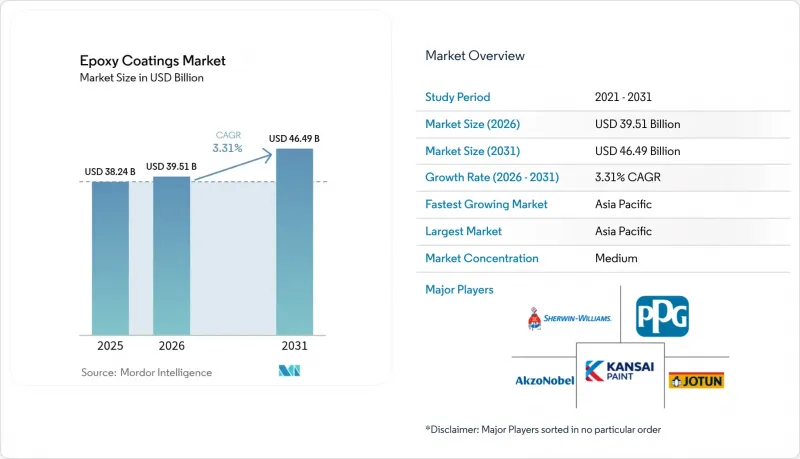
本報告按技術(水性、溶劑型、粉末型)、終端用戶產業(建築、汽車、交通運輸、工業及其他)和地區(亞太、北美、歐洲、南美以及中東和非洲)進行細分。市場預測以美元計價。
全球環氧塗料市場趨勢及洞察
水性環氧樹脂在工業防護塗料中的滲透率正在提高。
目前,雙組分水性系統的乾膜厚度均勻性可達±5µm,性能與溶劑型產品相當,同時VOC排放量降低80%,滿足REACH法規420 g/L的限值要求。使用碳酸丙烯酯作為助溶劑,可在不違反加州空氣資源委員會(CARB)規定的前提下,實現20分鐘的開放時間,從而可在美國各地推廣應用。石油化學和污水處理公司高度重視其零閃點特性,此特性可降低高達15%的保險費用。在德國,預計到2025年,水性儲槽內襯的應用量將成長28%。到2024年底,其價格將與溶劑型系統持平,從而掃清了其普及應用的最後一道障礙。
亞太和非洲建築業的擴張
在印度,已投資1.3兆美元用於公路、地鐵和機場建設,這些項目均規定鋼筋必須使用環氧底漆。預計到2025年,東協將吸引2,400億美元的外國直接投資(FDI),其中42%將用於需要耐化學腐蝕地板材料的工廠和資料中心。在沙烏地阿拉伯耗資5000億美元的NEOM計畫中,高鹽度區域正在使用船用級塗料。非洲開發銀行估計,非洲大陸每年的基礎設施缺口高達1,000億美元,其中很大一部分預計需要使用耐腐蝕環氧系統。南非的港口也在進行維修,使用環氧塗層來延長鋼材在潮濕沿海環境的使用壽命。
雙酚A和環氧氯丙烷的價格波動會擾亂成本結構。
由於對中國進口環氧樹脂徵收臨時反傾銷稅,歐洲雙酚A的價格在2025年上漲了22%。在美國,由於墨西哥灣沿岸的生產商因天然氣價格飆升而減產,環氧氯丙烷的價格也上漲了18%。印度供應商利用免稅原料的優勢,在中東的競標中提供的價格比歐洲供應商低12%。目前,大多數化合物生產商即使犧牲柔軟性,也更傾向於簽訂季度合約而非現貨合約。因此,原料成本已佔成品成本的62%,嚴重擠壓了中型企業的利潤空間。
細分市場分析
預計到2025年,水性塗料的銷售額將佔總銷售額的41.81%,並預計在2031年之前以4.38%的複合年成長率成長。這主要是由於REACH法規規定防護塗料的VOC含量限值為420克/公升,建築塗料的VOC含量限值為250克/公升。溶劑型塗料因其即使在10 度C以下也能快速固化,且耐鹽蝕鋼材,因此在海上作業和冬季施工中必不可少。歐盟的微塑膠法規正在影響粉末塗料市場,促使汽車製造商轉向低VOC液體塗料。紫外光固化系統目前仍處於小眾市場,市佔率不足1%,但在印刷基板的固化時間僅需3秒,預計未來將成長。
由於規模經濟效應,水性塗料自2024年下半年以來已達到與溶劑型塗料成本相當的水平,並且根據ISO 4624標準,其附著強度已達到3.5 MPa或更高,性能與溶劑型塗料相當。然而,在表面鹽濃度達到50 mg/m²的海洋儲槽中,超過了水性塗料的允許限值,溶劑型環氧塗料仍然是主流選擇。粉末樹脂供應商正在測試添加抗靜電劑的超低粉塵配方,他們願意接受每公斤0.40美元的成本增加以及在經過2000小時的QUV-A測試後光澤度降低10%。紫外光固化型塗料在電子產業越來越受歡迎,因為線上加工可將基板加工能力提高到每小時120個單元,並顯著降低能耗。
區域分析
預計到2025年,亞太地區將佔全球銷售額的46.55%,並在2031年之前以3.68%的複合年成長率成長,這主要得益於印度基礎設施建設的推進以及東南亞國協工廠2400億美元的外國直接投資(FDI)。印度環氧塗料市場成長最為迅速,因為本土企業正充分利用其在二線城市的銷售網路優勢。中國市場則受惠於半導體無塵室對符合ISO 5級標準的地板的需求。韓國市場的成長則主要得益於LG能源解決方案公司電池塗料產能的擴張。
北美市場的成長主要得益於美國《基礎設施法案》,這項價值1,100億美元的法案強制要求使用環氧樹脂甲板密封劑,以確保其能夠抵抗凍融循環。美國佔該地區銷售額的78%,其次是加拿大,佔14%。在加拿大,多倫多一項耗資250億加幣的交通網路擴建工程中,隧道內牆採用了帶有防潮層的材料。墨西哥則受益於一項價值350億美元的近岸外包投資,該投資涉及航太和汽車工廠,這些工廠都指定使用環氧樹脂地板材料。
歐洲佔據了大部分銷售額,但由於揮發性有機化合物 (VOC) 法規要求每條產品線進行配方調整,每條產品線需花費 800 萬至 1500 萬歐元,利潤率因此面臨壓力。德國位居榜首,佔該地區銷售額的 28%,這得益於其汽車 LED 生產線將固化週期縮短至 12 分鐘。英國緊隨其後,佔 18%,這主要得益於一項耗資 440 億英鎊的鐵路改造項目,該項目需要耐腐蝕鋼材塗層。法國、義大利和北歐地區也佔了該地區的大部分佔有率,這些地區擁有大規模地鐵、郵輪和離岸風力發電項目,都需要環氧樹脂保護。
其他好處:
- Excel格式的市場預測(ME)表
- 3個月的分析師支持
目錄
第1章:引言
- 研究假設和市場定義
- 調查範圍
第2章:調查方法
第3章執行摘要
第4章 市場狀況
- 市場概覽
- 市場促進因素
- 水性環氧塗料在工業防護塗料領域越來越受歡迎。
- 亞太和非洲建築業的擴張
- 食品飲料工廠工業地板材料維修
- 採用快速固化紫外線/LED固化環氧樹脂技術,提高了生產效率。
- 電動車電池機殼和馬達外殼需要耐化學腐蝕塗層。
- 市場限制因素
- 雙酚A和環氧氯丙烷的價格波動正在擾亂成本結構。
- PFAS 和微塑膠相關法規正在威脅粉末環氧樹脂的推廣應用。
- 先進噴塗生產線缺乏熟練的機器人操作員
- 價值鏈分析
- 波特五力模型
第5章 市場規模與成長預測
- 透過技術
- 水溶液
- 溶劑型
- 粉末型
- 按最終用戶行業分類
- 建築/施工
- 車
- 運輸
- 產業
- 其他
- 按地區
- 亞太地區
- 中國
- 印度
- 日本
- 韓國
- ASEAN
- 其他亞太國家
- 北美洲
- 美國
- 加拿大
- 墨西哥
- 歐洲
- 德國
- 英國
- 法國
- 義大利
- 北歐國家
- 俄羅斯
- 其他歐洲國家
- 南美洲
- 巴西
- 阿根廷
- 其他南美國家
- 中東和非洲
- 沙烏地阿拉伯
- 阿拉伯聯合大公國
- 南非
- 其他中東和非洲國家
- 亞太地區
第6章 競爭情勢
- 市場集中度
- 策略趨勢
- 市佔率和排名分析
- 公司簡介
- AkzoNobel NV
- Asian Paints
- Axalta Coating Systems LLC
- BASF
- Berger Paints India
- Diamond Vogel
- DuluxGroup Ltd
- Hempel A/S
- Jotun
- Kansai Paint Co., Ltd.
- Koster Bauchemie AG
- Nippon Paint Holdings Co., Ltd.
- Pidilite Industries Limited
- PPG Industries, Inc.
- RPM International Inc.
- Sika AG
- The Euclid Chemical Company
- The Sherwin-Williams Company
- Tikkurila
第7章 市場機會與未來展望
According to Mordor Intelligence, the epoxy coatings market size is expected to grow from USD 38.24 billion in 2025 to USD 39.51 billion in 2026 and is forecast to reach USD 46.49 billion by 2031 at 3.31% CAGR over 2026-2031.
This report is Segmented by Technology (Water-Based, Solvent-Based, and Powder-Based), End-User Industry (Building and Construction, Automotive, Transportation, Industrial, and Others), and Geography (Asia-Pacific, North America, Europe, South America, and Middle East and Africa). The Market Forecasts are Provided in Terms of Value (USD).
Global Epoxy Coatings Market Trends and Insights
Waterborne Epoxy Penetration Rising in Industrial Protective Coatings
Two-component waterborne systems now deliver dry-film uniformity within +-5 µm, matching solvent grades while cutting VOCs by 80% to meet the 420 g/L REACH limit. Propylene-carbonate co-solvents keep 20-minute open times without breaching CARB rules, enabling full U.S. roll-out. Petro-chemical and wastewater firms value the zero-flash-point profile, which lowers insurance premiums by up to 15%. Germany recorded a 28% rise in waterborne tank-lining volumes during 2025. Price parity with solvent systems, reached in late 2024, removed the final barrier to mainstream adoption.
Construction Sector Expansion in Asia-Pacific and Africa
India's pipeline dedicates USD 1.3 trillion to highways, metros, and airports that specify epoxy primers on steel rebar. ASEAN attracted USD 240 billion of FDI in 2025, and 42% funded factories and data centers needing chemical-resistant floors. Saudi Arabia's USD 500 billion NEOM allocates marine-grade coatings for high-salinity zones. The African Development Bank pegs the continent's infrastructure deficit at USD 100 billion per year, much of which will require corrosion-resistant epoxy systems. South Africa's ports are also upgrading with epoxy layers that prolong steel life in coastal humidity.
BPA and Epichlorohydrin Price Volatility Disrupting Cost Structures
Bisphenol A prices in Europe rose 22% during 2025 after provisional anti-dumping duties on Chinese epoxy imports. U.S. epichlorohydrin jumped 18% as Gulf Coast producers trimmed output on expensive natural gas. Indian vendors exploited duty-free feedstocks to undercut European suppliers by 12% in Middle East bids. Most formulators now favor quarterly instead of spot contracts, sacrificing flexibility. Raw materials consequently rose to 62% of finished-goods cost, squeezing mid-tier margins.
Other drivers and restraints analyzed in the detailed report include:
- Industrial Flooring Upgrades in Food and Beverage Plants
- Rapid-Cure UV/LED-Curable Epoxy Technologies
- PFAS and Microplastic Rules Threatening Powder Epoxy Adoption
For complete list of drivers and restraints, kindly check the Table Of Contents.
Segment Analysis
Water-based formulations seized 41.81% of 2025 revenue and are advancing at a 4.38% CAGR to 2031, owing to REACH caps of 420 g/L VOC for protective and 250 g/L for architectural coatings. Solvent-based blends cure faster below 10 °C and tolerate salt-contaminated steel, which offshore and winter jobs require. Powder grades face EU microplastics restrictions that push automakers toward low-VOC liquids. UV systems remain niche at under 1% yet deliver three-second cures for printed-circuit boards, offering future upside.
Waterborne chemistries have reached cost parity since late 2024 as scale economies emerged, and they achieve ISO 4624 adhesion above 3.5 MPa, matching solvent peers. Solvent-borne epoxies, however, still dominate marine tanks where surface salts up to 50 mg/m2 exceed waterborne tolerance limits. Powder suppliers are trialing ultra-low-dust recipes with anti-static aids but accept a USD 0.40/kg cost penalty and 10% gloss fade after 2,000 h QUV-A. UV-curable grades gained traction in electronics because inline processing boosts board throughput to 120 units/h and slashes energy consumption.
Complete Report Scope:
- By Technology
- Water-based
- Solvent-based
- Powder-based
- By End-user Industry
- Building and Construction
- Automotive
- Transportation
- Industrial
- Others
- By Geography
- Asia-Pacific
- China
- India
- Japan
- South Korea
- ASEAN
- Rest of Asia-Pacific
- North America
- United States
- Canada
- Mexico
- Europe
- Germany
- United Kingdom
- France
- Italy
- NORDIC
- Russia
- Rest of Europe
- South America
- Brazil
- Argentina
- Rest of South America
- Middle-East and Africa
- Saudi Arabia
- United Arab Emirates
- South Africa
- Rest of Middle-East and Africa
- Asia-Pacific
Geography Analysis
Asia-Pacific contributed 46.55% of 2025 revenue and is expected to grow 3.68% CAGR to 2031, propelled by India's infrastructure push and USD 240 billion of FDI into ASEAN factories. India's epoxy coatings market size is rising fastest as domestic players leverage distribution density in tier-2 cities. The Chinese market is supported by semiconductor cleanrooms that need ISO Class 5 compliant floors. LG Energy Solution's scaled battery-coat capacity is driving the South Korean market.
North America's market growth is anchored by the USD 110 billion U.S. infrastructure law that mandates epoxy deck sealers for freeze-thaw resilience. The United States delivered 78% of regional sales, followed by Canada at 14% where Toronto's CAD 25 billion transit expansion relies on tunnel linings with moisture barriers. Mexico benefited from USD 35 billion of nearshoring investment in aerospace and auto plants that specify epoxy floors.
Europe accounted for significant revenue but faces margin pressure from VOC caps that require EUR 8-15 million reformulation outlays per product line. Germany led with 28% of regional sales thanks to automotive LED lines that sliced cure cycles to 12 min. The United Kingdom followed at 18%, boosted by GBP 44 billion of rail upgrades that need corrosion-proof steel coatings. France, Italy, and the Nordic zone round out the region with major metro, cruise, and offshore wind projects requiring epoxy protection.
- AkzoNobel N.V.
- Asian Paints
- Axalta Coating Systems LLC
- BASF
- Berger Paints India
- Diamond Vogel
- DuluxGroup Ltd
- Hempel A/S
- Jotun
- Kansai Paint Co., Ltd.
- Koster Bauchemie AG
- Nippon Paint Holdings Co., Ltd.
- Pidilite Industries Limited
- PPG Industries, Inc.
- RPM International Inc.
- Sika AG
- The Euclid Chemical Company
- The Sherwin-Williams Company
- Tikkurila
Additional Benefits:
- The market estimate (ME) sheet in Excel format
- 3 months of analyst support
TABLE OF CONTENTS
1 Introduction
- 1.1 Study Assumptions and Market Definition
- 1.2 Scope of the Study
2 Research Methodology
3 Executive Summary
4 Market Landscape
- 4.1 Market Overview
- 4.2 Market Drivers
- 4.2.1 Waterborne Epoxy Penetration Rising in Industrial Protective Coatings
- 4.2.2 Construction Sector Expansion in Asia-Pacific and Africa
- 4.2.3 Industrial Flooring Upgrades in Food and Beverage Plants
- 4.2.4 Rapid-Cure UV/LED-Curable Epoxy Technologies Enabling Higher Throughput
- 4.2.5 EV Battery Casings and Motor Housings Need Chemically Resistant Coats
- 4.3 Market Restraints
- 4.3.1 BPA and epichlorohydrin price volatility disrupting cost structures
- 4.3.2 PFAS and micro-plastic rules threatening powder epoxy adoption
- 4.3.3 Shortage of skilled robotics applicators for advanced coating lines
- 4.4 Value Chain Analysis
- 4.5 Porter's Five Forces
- 4.5.1 Bargaining Power of Suppliers
- 4.5.2 Bargaining Power of Buyers
- 4.5.3 Threat of New Entrants
- 4.5.4 Threat of Substitutes
- 4.5.5 Competitive Rivalry
5 Market Size and Growth Forecasts (Value)
- 5.1 By Technology
- 5.1.1 Water-based
- 5.1.2 Solvent-based
- 5.1.3 Powder-based
- 5.2 By End-user Industry
- 5.2.1 Building and Construction
- 5.2.2 Automotive
- 5.2.3 Transportation
- 5.2.4 Industrial
- 5.2.5 Others
- 5.3 By Geography
- 5.3.1 Asia-Pacific
- 5.3.1.1 China
- 5.3.1.2 India
- 5.3.1.3 Japan
- 5.3.1.4 South Korea
- 5.3.1.5 ASEAN
- 5.3.1.6 Rest of Asia-Pacific
- 5.3.2 North America
- 5.3.2.1 United States
- 5.3.2.2 Canada
- 5.3.2.3 Mexico
- 5.3.3 Europe
- 5.3.3.1 Germany
- 5.3.3.2 United Kingdom
- 5.3.3.3 France
- 5.3.3.4 Italy
- 5.3.3.5 NORDIC
- 5.3.3.6 Russia
- 5.3.3.7 Rest of Europe
- 5.3.4 South America
- 5.3.4.1 Brazil
- 5.3.4.2 Argentina
- 5.3.4.3 Rest of South America
- 5.3.5 Middle-East and Africa
- 5.3.5.1 Saudi Arabia
- 5.3.5.2 United Arab Emirates
- 5.3.5.3 South Africa
- 5.3.5.4 Rest of Middle-East and Africa
- 5.3.1 Asia-Pacific
6 Competitive Landscape
- 6.1 Market Concentration
- 6.2 Strategic Moves
- 6.3 Market Share(%)/Ranking Analysis
- 6.4 Company Profiles (includes Global Overview, Market Overview, Core Segments, Financials, Strategic Information, Products and Services, Recent Developments)
- 6.4.1 AkzoNobel N.V.
- 6.4.2 Asian Paints
- 6.4.3 Axalta Coating Systems LLC
- 6.4.4 BASF
- 6.4.5 Berger Paints India
- 6.4.6 Diamond Vogel
- 6.4.7 DuluxGroup Ltd
- 6.4.8 Hempel A/S
- 6.4.9 Jotun
- 6.4.10 Kansai Paint Co., Ltd.
- 6.4.11 Koster Bauchemie AG
- 6.4.12 Nippon Paint Holdings Co., Ltd.
- 6.4.13 Pidilite Industries Limited
- 6.4.14 PPG Industries, Inc.
- 6.4.15 RPM International Inc.
- 6.4.16 Sika AG
- 6.4.17 The Euclid Chemical Company
- 6.4.18 The Sherwin-Williams Company
- 6.4.19 Tikkurila
7 Market Opportunities and Future Outlook
- 7.1 White-space and Unmet-Need Assessment

 2026年全球環氧塗料市場報告
 熔融環氧塗料:市場佔有率分析、產業趨勢與統計、成長預測(2026-2031)2026年全球高性能消光劑市場報告
 熔結環氧塗料市場規模、佔有率和趨勢分析報告:按最終用途、應用、地區和細分市場預測(2026-2033 年)
 環氧粉末塗料市場:2026-2032年全球市場預測(依樹脂類型、技術、顏色及應用分類)
 環氧塗料市場規模、佔有率、成長及全球產業分析:按類型和應用分類,區域洞察及2026-2034年預測環氧塗料市場:2026-2032年全球市場預測(依樹脂類型、形態、技術、應用及最終用途產業分類)環氧樹脂塗層增強材料市場:依形狀、等級、用途、應用和分銷管道分類-2026-2032年全球預測半導體環氧聚酯塗料市場:按應用、固化機制、最終用戶和產品類型分類-全球預測,2026-2032年2026年全球環氧塗料市場報告