


 |
市場調查報告書
商品編碼
2114163
熔融環氧塗料:市場佔有率分析、產業趨勢與統計、成長預測(2026-2031)Fusion Bonded Epoxy Coatings - Market Share Analysis, Industry Trends & Statistics, Growth Forecasts (2026 - 2031) |
||||||

※ 本網頁內容可能與最新版本有所差異。詳細情況請與我們聯繫。
根據 Mordor Intelligence 預測,熔結環氧塗料市場將從 2025 年的 14.5 億美元成長到 2026 年的 15.3 億美元,到 2031 年將達到 20.1 億美元,2026 年至 2031 年的複合年成長率為 5.60%。
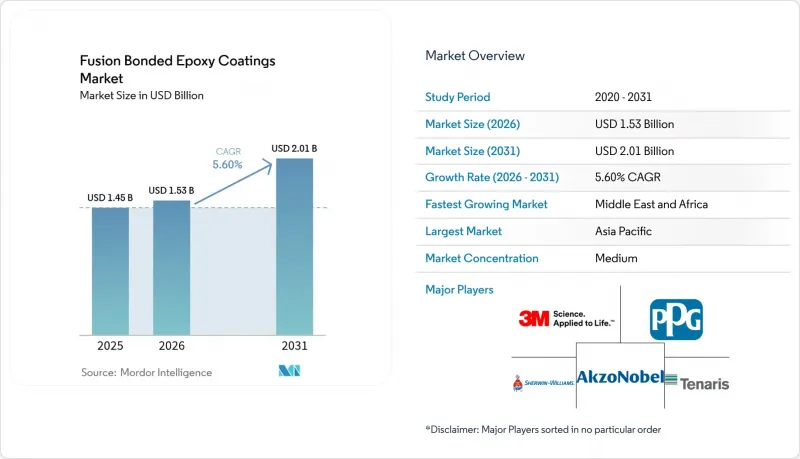
本報告按表面類型(內表面塗層和外部表面塗層)、終端用戶產業(石油天然氣、船舶、水和廢水處理、化學處理、基礎設施及其他終端用戶產業)和地區(亞太地區、北美地區、歐洲地區、南美地區以及中東和非洲地區)進行細分。市場預測以美元計價。
全球熔融黏結環氧塗料市場趨勢及洞察
石油和天然氣管道的擴張正在加速。
新建設的油氣運輸路線正在推動對大口徑管道的需求。 2024年1月,沙烏地阿美公司在傑夫拉氣田投資125億美元用於基礎建設,該項目要求管道採用雙層塗層,耐熱溫度高達120 度C,以應對酸性氣體的應用。在北美,一條從二疊紀盆地延伸出的36吋原油管線必須符合API RP 5L3標準,要求其外部塗覆400-600微米的熔結環氧塗層。在印度,帕拉迪普-海得拉巴-維傑普爾-班加羅爾管線全長2,600公里,橫跨季風多發地區,也必須採用熔結環氧塗層。在高風險地區,塗層厚度增加到800微米,相當於每米樹脂用量增加一倍。儘管全球鑽井活動有所波動,但這些項目仍能帶來短期收益。
快速推進的城市供水和污水項目
市政管道的更新周期與公共衛生要求密切相關。美國環保署 (EPA) 500 億美元的「兩黨基礎設施法案」預算撥款用於更換鉛管和維修污水處理廠,這兩項工程均要求使用符合 NSF/ANSI 61 認證的熔結環氧內塗層。英國水務監管機構 Ofwat 的 1040 億英鎊(1310 億美元)水務項目覆蓋了 12000 公里的主幹管道網路,並採用熔結環氧材料替代水泥砂漿,因為其具有更優異的耐高速水流磨損性能。目前,供水事業正在採用石油和天然氣行業的標準(AWWA C213 標準與 ISO 21809-1 標準接軌),認為塗層成本高出 15-20% 是合理的,因為這樣可以減少 1% 的洩漏。
與三層LPE和聚氨酯塗料的競爭
在高溫海洋工程項目中,三層聚乙烯系統性能優於單層熔結環氧塗層,在墨西哥灣的測試中,陰極剝離現象減少了40%。聚氨酯的300%延伸率使其適用於地震帶的管道。價格差異已縮小至每米8-12美元,營運商可以承擔這部分成本,從而避免在管道使用壽命中期重新塗裝。
細分市場分析
到2025年,受管道設計人員對600微米厚塗層的需求推動,外牆塗料將佔熔結環氧塗料市場的63.72%。這些塗層是用於埋地和海底管線的。光是沙烏地阿美公司的主天然氣系統擴建計畫預計在2024年至2028年間就需要40萬噸塗料粉末,這將進一步擴大該細分市場的規模。內牆塗料雖然規模較小,但其複合年成長率也達到了5.74%。在美國,氫氣摻混率超過20%的管道以及鉛管更換項目中,必須使用經NSF/ANSI 61認證的耐氫滲透熔結環氧塗料。
由於需要進行過渡測試和飲用水認證,內部系統的溢價平均比外部系統高出 25%。在離岸風力發電單樁中,目前已指定使用內部熔融環氧塗層來解決海水冷凝問題,這促使阿克蘇諾貝爾 2024 年第三季的塗料銷售額成長了 7%。內部雙層層級構造將過渡段的使用壽命延長至 35 年,降低了整體擁有成本。
區域分析
到2025年,亞太地區將佔全球銷售額的45.86%。印度價值670億美元的天然氣網以及中國「西氣東輸」項目四期工程的規劃,將在未來幾年持續推動市場需求。儘管印度承包商已將前置作業時間縮短至15天,但其品質標準仍落後於跨國公司。日本和韓國則專注於維修項目,充分利用熔融環氧樹脂在陰極防蝕方面的適用性。
中東和非洲地區以6.03%的複合年成長率呈現最快成長動能。涵蓋傑夫拉酸性天然氣管網、阿布達比國家石油公司(ADNOC)的富查伊拉原油管線以及長達300公里的拉斯穆海森輸水管道的塗料市場總規模超過5億美元。連接新阿布達比(NEOM)和歐洲的氫氣走廊將要求配方符合ISO 15156標準。
北美和歐洲對現有基礎設施升級的需求旺盛。美國環保署 (EPA) 耗資 500 億美元的水資源計畫正在利用國產熔融環氧樹脂替換鉛管。歐洲長達 9700 公里的氫氣管網預計在脆化處理規程最終確定後將迎來長期需求。南美的需求仍然波動不定。由於巴西石油公司 (Petrobras) 的資本紀律以及阿根廷管道短缺,大規模訂單的交付被推遲。
其他好處:
- Excel格式的市場預測(ME)表
- 3個月的分析師支持
目錄
第1章:引言
- 研究假設和市場定義
- 調查範圍
第2章:調查方法
第3章執行摘要
第4章 市場狀況
- 市場概覽
- 市場促進因素
- 石油和天然氣管道的擴張正在加速。
- 快速推進的城市供水和污水處理項目
- 促進印度和東南亞基礎設施發展的措施
- 為實現與氫氣相容而進行的管道維修
- 內建感測器的智慧型FBE塗層
- 市場限制因素
- 與 3-LPE 和 PU 塗料的競爭
- 環氧樹脂的原料成本波動很大。
- 資本密集型粉末塗裝廠
- 價值鏈分析
- 波特五力模型
第5章 市場規模與成長預測
- 表面
- 內表面塗層
- 外表面塗層
- 按最終用戶行業分類
- 石油和天然氣
- 海洋
- 供水和廢水處理
- 化學處理
- 基礎設施
- 其他終端用戶產業
- 按地區
- 亞太地區
- 中國
- 印度
- 日本
- 韓國
- 東南亞國協
- 其他亞太國家
- 北美洲
- 美國
- 加拿大
- 墨西哥
- 歐洲
- 德國
- 英國
- 義大利
- 法國
- 西班牙
- 俄羅斯
- 北歐國家
- 其他歐洲國家
- 南美洲
- 巴西
- 阿根廷
- 其他南美國家
- 中東和非洲
- 沙烏地阿拉伯
- 阿拉伯聯合大公國
- 南非
- 其他中東和非洲國家
- 亞太地區
第6章 競爭情勢
- 市場集中度
- 策略趨勢
- 市佔率和排名分析
- 公司簡介
- 3M
- Akzo Nobel NV
- Arkema Group
- Axalta Coating Systems, LLC
- BASF
- Jindal Group
- Jotun
- Maharashtra Seamless Limited
- PPG Industries, Inc.
- PSL Limited
- Shawcor(Bredero Shaw)
- SIGMA Corporation
- SolEpoxy Inc.
- Specialty Polymer Coatings Inc.
- Tecosy
- Teknos Group
- Tenaris
- The Sherwin-Williams Company
- Wasco Energy Group of Companies
第7章 市場機會與未來展望
According to Mordor Intelligence, the fusion bonded epoxy coatings market size is expected to grow from USD 1.45 billion in 2025 to USD 1.53 billion in 2026 and is forecast to reach USD 2.01 billion by 2031 at 5.60% CAGR over 2026-2031.
This report is Segmented by Surface (Internal Surface Coatings and External Surface Coatings), End-User Industry (Oil and Gas, Marine, Water and Wastewater Treatment, Chemical Processing, Infrastructure, and Other End-User Industries), and Geography (Asia-Pacific, North America, Europe, South America, and Middle East and Africa). The Market Forecasts are Provided in Terms of Value (USD).
Global Fusion Bonded Epoxy Coatings Market Trends and Insights
Accelerating Oil and Gas Pipeline Expansions
Newbuild hydrocarbon corridors dominate large-diameter demand. Saudi Aramco committed USD 12.5 billion to Jafurah gas-field infrastructure in January 2024, requiring dual-layer coatings rated to 120°C for sour-gas service. In North America, 36-inch crude pipelines leaving the Permian Basin are specified to have 400-600 microns of external fusion-bonded epoxy to meet API RP 5L3. India's Paradip-Hyderabad-Vijaypur-Bengaluru line stipulates fusion-bonded epoxy across 2,600 kilometers of monsoon-prone terrain. Film builds are thickening to 800 microns in high-consequence areas, effectively doubling resin consumption per meter. These projects underpin near-term revenue despite global drilling volatility.
Rapid Urban-Water and Wastewater Projects
Municipal replacement cycles are converging with health mandates. The U.S. Environmental Protection Agency's USD 50 billion Bipartisan Infrastructure Law budget earmarks lead pipe replacement and wastewater upgrades, both requiring NSF/ANSI 61-certified internal fusion-bonded epoxy coatings. Ofwat's GBP 104 billion (USD 131 billion) United Kingdom water program covers 12,000 kilometers of trunk mains, with fusion-bonded epoxy chosen over cement mortar for high-velocity abrasion resistance. Utilities now apply oil-and-gas-grade specifications-AWWA C213 is converging with ISO 21809-1-justifying a 15-20% coating premium for a 1% reduction in leakage.
Competition from 3-LPE and Polyurethane Coatings
Three-layer polyethylene systems outperform single-layer fusion-bonded epoxy in high-temperature offshore projects, delivering 40% lower cathodic disbondment in Gulf of Mexico trials. Polyurethane's 300% elongation is suitable for pipelines in seismic zones. Price gaps narrowed to USD 8-12 per meter, prompting operators to absorb premiums to avoid mid-life recoating.
Other drivers and restraints analyzed in the detailed report include:
- Infrastructure Stimulus in India and Southeast Asia
- Hydrogen-Ready Pipeline Retrofits
- Volatile Epoxy-Resin Input Costs
For complete list of drivers and restraints, kindly check the Table Of Contents.
Segment Analysis
External surface coatings captured 63.72% of the fusion-bonded epoxy coatings market share in 2025, driven by pipeline designers specifying 600-micron films for buried and subsea lines. Saudi Aramco's Master Gas System expansion alone demands 400,000 tons of powder between 2024 and 2028, reinforcing the segment's scale. Internal coatings, although smaller, are growing at a 5.74% CAGR. Hydrogen blending above 20% and US lead-service replacements mandate NSF/ANSI 61-certified fusion-bonded epoxy that resists hydrogen permeation.
Premium pricing for internal systems averages 25% above that of external programs due to migration testing and potable-water certifications. Offshore wind monopiles now specify internal fusion-bonded epoxy to combat seawater condensation, contributing to AkzoNobel's 7% coatings growth in Q3 2024. Dual-layer internal builds extend the life of transition pieces to 35 years, lowering total ownership costs.
Complete Report Scope:
- By Surface
- Internal Surface Coatings
- External Surface Coatings
- By End-User Industry
- Oil and Gas
- Marine
- Water and Wastewater Treatment
- Chemical Processing
- Infrastructure
- Other End-User Industries
- By Geography
- Asia-Pacific
- China
- India
- Japan
- South Korea
- ASEAN Countries
- Rest of Asia-Pacific
- North America
- United States
- Canada
- Mexico
- Europe
- Germany
- United Kingdom
- Italy
- France
- Spain
- Russia
- NORDIC Countries
- Rest of Europe
- South America
- Brazil
- Argentina
- Rest of South America
- Middle-East and Africa
- Saudi Arabia
- United Arab Emirates
- South Africa
- Rest of Middle-East and Africa
- Asia-Pacific
Geography Analysis
Asia-Pacific accounted for 45.86% of revenue in 2025. India's USD 67 billion gas grid and China's pending West-East Phase 4 provide multi-year certainty. Domestic Indian applicators cut lead times to 15 days but still trail multinational quality benchmarks. Japan and South Korea focus on rehabilitation, leveraging the cathodic-protection compatibility of the fusion-bonded epoxy.
The Middle East and Africa register the fastest expansion at a 6.03% CAGR. Jafurah's sour-gas network, ADNOC's Fujairah crude line, and the 300-kilometer Ras Mohaisen water pipeline collectively exceed USD 500 million in coating value. Hydrogen corridors linking NEOM to Europe will demand ISO 15156-tested formulations.
North America and Europe exhibit replacement dynamics. The US EPA's USD 50 billion water program funnels internal fusion-bonded epoxy into lead-service replacements. Europe's 9,700-kilometer hydrogen grid promises long-term demand once embrittlement protocols are finalized. South America remains lumpy; Petrobras' capital discipline and Argentina's pipeline deficits delay large-scale awards.
- 3M
- Akzo Nobel N.V.
- Arkema Group
- Axalta Coating Systems, LLC
- BASF
- Jindal Group
- Jotun
- Maharashtra Seamless Limited
- PPG Industries, Inc.
- PSL Limited
- Shawcor (Bredero Shaw)
- SIGMA Corporation
- SolEpoxy Inc.
- Specialty Polymer Coatings Inc.
- Tecosy
- Teknos Group
- Tenaris
- The Sherwin-Williams Company
- Wasco Energy Group of Companies
Additional Benefits:
- The market estimate (ME) sheet in Excel format
- 3 months of analyst support
TABLE OF CONTENTS
1 Introduction
- 1.1 Study Assumptions & Market Definition
- 1.2 Scope of the Study
2 Research Methodology
3 Executive Summary
4 Market Landscape
- 4.1 Market Overview
- 4.2 Market Drivers
- 4.2.1 Accelerating oil and gas pipeline expansions
- 4.2.2 Rapid urban-water and wastewater projects
- 4.2.3 Infrastructure stimulus in India and SE Asia
- 4.2.4 Hydrogen-ready pipeline retrofits
- 4.2.5 Smart FBE coatings with embedded sensors
- 4.3 Market Restraints
- 4.3.1 Competition from 3-LPE and PU coatings
- 4.3.2 Volatile epoxy-resin input costs
- 4.3.3 Capital-intensive powder-coating plants
- 4.4 Value Chain Analysis
- 4.5 Porter's Five Forces
- 4.5.1 Threat of New Entrants
- 4.5.2 Bargaining Power of Suppliers
- 4.5.3 Bargaining Power of Buyers
- 4.5.4 Threat of Substitutes
- 4.5.5 Industry Rivalry
5 Market Size & Growth Forecasts (Value)
- 5.1 By Surface
- 5.1.1 Internal Surface Coatings
- 5.1.2 External Surface Coatings
- 5.2 By End-User Industry
- 5.2.1 Oil and Gas
- 5.2.2 Marine
- 5.2.3 Water and Wastewater Treatment
- 5.2.4 Chemical Processing
- 5.2.5 Infrastructure
- 5.2.6 Other End-User Industries
- 5.3 By Geography
- 5.3.1 Asia-Pacific
- 5.3.1.1 China
- 5.3.1.2 India
- 5.3.1.3 Japan
- 5.3.1.4 South Korea
- 5.3.1.5 ASEAN Countries
- 5.3.1.6 Rest of Asia-Pacific
- 5.3.2 North America
- 5.3.2.1 United States
- 5.3.2.2 Canada
- 5.3.2.3 Mexico
- 5.3.3 Europe
- 5.3.3.1 Germany
- 5.3.3.2 United Kingdom
- 5.3.3.3 Italy
- 5.3.3.4 France
- 5.3.3.5 Spain
- 5.3.3.6 Russia
- 5.3.3.7 NORDIC Countries
- 5.3.3.8 Rest of Europe
- 5.3.4 South America
- 5.3.4.1 Brazil
- 5.3.4.2 Argentina
- 5.3.4.3 Rest of South America
- 5.3.5 Middle-East and Africa
- 5.3.5.1 Saudi Arabia
- 5.3.5.2 United Arab Emirates
- 5.3.5.3 South Africa
- 5.3.5.4 Rest of Middle-East and Africa
- 5.3.1 Asia-Pacific
6 Competitive Landscape
- 6.1 Market Concentration
- 6.2 Strategic Moves
- 6.3 Market Share/Ranking Analysis
- 6.4 Company Profiles (includes Global level Overview, Market level overview, Core Segments, Financials as available, Strategic Information, Market Rank/Share for key companies, Products & Services, and Recent Developments)
- 6.4.1 3M
- 6.4.2 Akzo Nobel N.V.
- 6.4.3 Arkema Group
- 6.4.4 Axalta Coating Systems, LLC
- 6.4.5 BASF
- 6.4.6 Jindal Group
- 6.4.7 Jotun
- 6.4.8 Maharashtra Seamless Limited
- 6.4.9 PPG Industries, Inc.
- 6.4.10 PSL Limited
- 6.4.11 Shawcor (Bredero Shaw)
- 6.4.12 SIGMA Corporation
- 6.4.13 SolEpoxy Inc.
- 6.4.14 Specialty Polymer Coatings Inc.
- 6.4.15 Tecosy
- 6.4.16 Teknos Group
- 6.4.17 Tenaris
- 6.4.18 The Sherwin-Williams Company
- 6.4.19 Wasco Energy Group of Companies
7 Market Opportunities & Future Outlook
- 7.1 White-space and Unmet-Need Assessment

 2026年全球環氧塗料市場報告
 環氧塗料:市場佔有率分析、產業趨勢與統計、成長預測(2026-2031)2026年全球高性能消光劑市場報告
 熔結環氧塗料市場規模、佔有率和趨勢分析報告:按最終用途、應用、地區和細分市場預測(2026-2033 年)
 環氧粉末塗料市場:2026-2032年全球市場預測(依樹脂類型、技術、顏色及應用分類)
 環氧塗料市場規模、佔有率、成長及全球產業分析:按類型和應用分類,區域洞察及2026-2034年預測環氧塗料市場:2026-2032年全球市場預測(依樹脂類型、形態、技術、應用及最終用途產業分類)環氧樹脂塗層增強材料市場:依形狀、等級、用途、應用和分銷管道分類-2026-2032年全球預測半導體環氧聚酯塗料市場:按應用、固化機制、最終用戶和產品類型分類-全球預測,2026-2032年2026年全球環氧塗料市場報告