


 |
市場調查報告書
商品編碼
2120751
胺類:市佔率分析、產業趨勢與統計、成長預測(2026-2031)Amines - Market Share Analysis, Industry Trends & Statistics, Growth Forecasts (2026 - 2031) |
||||||

※ 本網頁內容可能與最新版本有所差異。詳細情況請與我們聯繫。
根據 Mordor Intelligence 估計,胺類市場在 2026 年的價值將達到 169.1 億美元,高於 2025 年的 161.5 億美元,預計到 2031 年將達到 212.5 億美元。
預計 2026 年至 2031 年的複合年成長率為 4.69%。
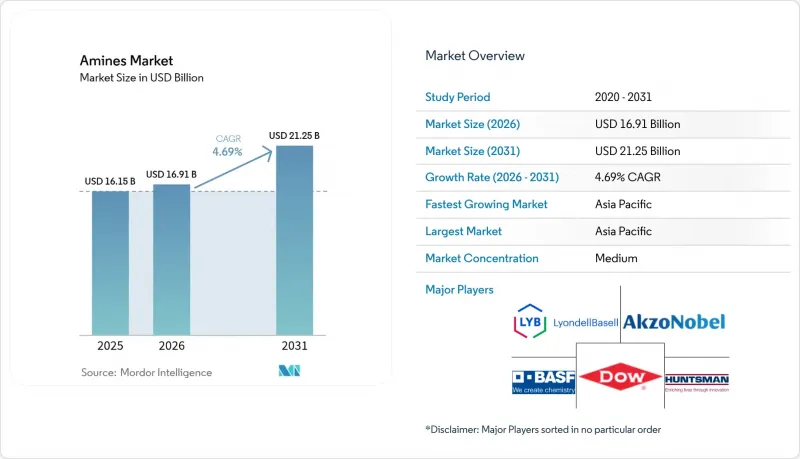
本報告按類型(乙烯胺、烷基胺、脂族胺、特殊胺、乙醇胺)、終端用途行業(橡膠、個人保健產品、清潔劑、黏合劑、油漆和樹脂、農藥、石油和石化產品以及其他終端用途)和地區(亞太地區、北美、歐洲、南美以及中東和非洲)進行細分。市場預測以美元計價。
全球胺類市場趨勢與洞察
亞洲個人保健產品製造商的需求正在激增。
自2010年以來,胺基酸基界面活性劑的性能優於傳統的硫酸基界面活性劑,年平均成長率達18%。亞洲配方研發公司主要採用低刺激性和高生物分解性的麩胺酸和丙胺酸衍生物,促使胺類供應商拓展其生物基產品線,並取得國際永續性與碳認證(ISCC-PLUS)。 Nurion公司獲得認證的綠色環氧乙烷和乙醇胺生產,顯示工廠營運商正在調整產品系列,轉向潔淨標示配方。同時,多功能胺氧化物在洗髮精、沐浴露和家居產品類型市場佔有率不斷成長,因為製造商在追求高發泡性能的同時,也希望保持溫和的使用感。由於中產階級消費者傾向於選擇「天然來源指數」接近100%的產品,因此預計胺類市場將進一步鞏固其在亞洲快速成長的清潔美容生態系統中的關鍵促進者作用。
新興農業區農藥的快速擴散
亞太地區和南美洲的現代農業實踐需要精準的化學投入,這推動了對胺類農藥鹽和乳化劑的需求,並促進了胺類市場的成長。採用可再生能源的新型分散式氨廠有助於降低物流成本,提高區域供應穩定性,尤其是在巴西和印度。 CF Industries 和 POET 共同進行的低碳氨肥先導計畫,展示了整合綠氫供應路線在農業和永續性的益處。這些趨勢正在推動對用於除草劑、殺蟲劑和種子處理劑的乙醇胺、烷基胺和脂肪胺的長期需求。
過渡到無木紙和數位文檔
已開發國家辦公用紙消費量的下降導致胺基紙漿漂白劑和紙張塗料的需求放緩。為了緩解長期需求下降的影響,各公司正將生產重新分配到快速成長的個人護理和建築業。BASF決定重組其傳統的胺類特種化學品資產,凸顯了該產業對此結構性變化的積極應對。
細分市場分析
預計到2025年,乙醇胺將佔整個胺類市場的42.18%,在天然氣脫硫、個人護理界面活性劑和腐蝕抑制劑等領域發揮至關重要的作用。天然氣加工和三乙醇胺基水泥添加劑的強勁需求為其市場奠定了堅實的基礎,同時,乙醇胺在碳回收溶劑等領域的新應用也正在湧現。此細分市場的規模使得主要供應商能夠在整個衍生產品鏈(從乙氧基化物到嗎福林)中享受成本優勢和業務協同效應。相較之下,特種胺預計將以4.84%的複合年成長率(CAGR)達到最高成長率,直至2031年,這主要得益於其在電子、製藥和先進複合材料等領域的細分應用。
生產商正在採用多功能反應器,以便在高純度嗎福林、二胺和手性胺中間體之間快速切換。贏創在南京的擴張標誌著這種向高附加價值分子轉型的趨勢。同時,釕/三磷酸催化劑等科學突破,利用可再生原料實現了90%的產率,可望擴大特種胺的永續原料來源。乙醇胺規模經濟的綜效以及特種胺的成長,共同支撐著胺市場實現平衡的長期成長。
區域分析
亞太地區繼續保持其兩大領先市場之一的地位,預計到2025年將佔全球銷售額的38.55%,並在2031年之前以5.64%的複合年成長率持續成長。中國4552萬噸的氨產能鞏固了該地區的原料優勢。印度特種化學品巨頭,如Alkyl Amines和Balaji Amines,憑藉其成本優勢和製造能力,經營20多家工廠,產品出口到100多個國家。台灣、韓國和中國當地半導體產業的擴張推動了電子產品對胺類物質的需求,而東南亞國協在醫藥、農業化學品和日用產品領域的需求預計將進一步成長。BASF計劃投資100億美元建設湛江一體化項目,該項目將完全運作再生能源,這表明跨國公司正積極尋求抓住該地區的永續成長機會。
北美是一個成熟且具有重要戰略意義的叢集,對整合碳捕獲系統的藍氨設施的投資不斷增加。預計到2030年,美國的氨產能將成長四倍。這項擴張將保障國內化肥供應,並為乙醇胺和尿素衍生物提供本地原料。同時,加拿大擁有豐富的水力資源,是面向國內和出口市場的低碳胺生產的理想選擇。
在歐洲,循環經濟的推動持續進行,推動了生物基中間體和節能反應器的創新。 Nurion公司綠色環氧乙烷的ISCC-PLUS認證滿足了該地區對生態標籤界面活性劑的需求。歐盟委員會收緊了VOC(揮發性有機化合物)法規,促使配方生產商用符合性能標準的高閃點衍生物取代傳統的揮發性胺。
在中東和非洲,天然氣作為原料的供應具有優勢,能夠以具有競爭力的價格生產氨和下游胺類物質,尤其是在沙烏地阿拉伯和阿曼。
在以大豆和玉米種植為主的南美洲,預計對除草劑胺鹽的需求將保持穩定,其中巴西和阿根廷的需求尤其突出。
其他好處:
- Excel格式的市場預測(ME)表
- 3個月的分析師支持
目錄
第1章:引言
- 研究假設和市場定義
- 調查範圍
第2章:調查方法
第3章執行摘要
第4章 市場狀況
- 市場概覽
- 市場促進因素
- 亞洲個人保健產品製造商的需求正在激增。
- 新興農業區農藥的快速擴散
- 基礎設施建設熱潮正在推動對建築化學品的需求。
- 用於尖端半導體製造工廠的電子級胺類物質
- 該場地綠色氫衍生胺試點項目
- 市場限制因素
- 向無木紙和數位文件過渡
- 氨和乙烯等原料價格的波動
- 加強對胺類揮發性有機化合物和氣味的監管
- 價值鏈分析
- 監理情勢
- 技術展望
- 目前技術
- 利用沸石催化劑生產甲胺的工藝
- 異丁烯的直接胺化
- 催化蒸餾
- 內分泌干擾物中的氨分解
- 未來科技趨勢
- 目前技術
- 波特五力模型
- 價格分析
- 生產分析
第5章 市場規模與成長預測
- 按類型
- 乙胺
- 烷基胺
- 脂肪胺
- 特殊胺類
- 乙醇胺
- 按最終用途行業分類
- 橡皮
- 個人保健產品
- 清潔用品
- 黏合劑、油漆、樹脂
- 農業化學品
- 石油/石化
- 其他最終用途
- 按地區
- 亞太地區
- 中國
- 印度
- 日本
- 韓國
- 其他亞太國家
- 北美洲
- 美國
- 加拿大
- 墨西哥
- 歐洲
- 德國
- 英國
- 法國
- 義大利
- 其他歐洲國家
- 南美洲
- 巴西
- 阿根廷
- 其他南美國家
- 中東和非洲
- 沙烏地阿拉伯
- 南非
- 其他中東和非洲國家
- 亞太地區
第6章 競爭情勢
- 市場集中度
- 策略趨勢
- 市佔率分析
- 公司簡介
- Air Products and Chemicals, Inc.
- Akzo Nobel NV
- Alkyl Amines Chemicals Limited
- Arkema
- BASF SE
- Celanese Corporation
- Clariant
- Daicel Corporation
- Dow
- Eastman Chemical Company
- Huntsman International LLC
- INEOS
- Invista
- Kemipex
- LyondellBasell Industries Holdings BV
- MITSUBISHI GAS CHEMICAL COMPANY, INC
- NIPPON SHOKUBAI CO., LTD.
- SABIC
- Solvay
- Tosoh Corporation
第7章 市場機會與未來展望
According to Mordor Intelligence, amines market size in 2026 is estimated at USD 16.91 billion, growing from 2025 value of USD 16.15 billion with 2031 projections showing USD 21.25 billion, growing at 4.69% CAGR over 2026-2031.
This report is Segmented by Type (Ethyleneamines, Alkylamines, Fatty Amines, Specialty Amines, Ethanolamines), End-Use Industry (Rubber, Personal Care Products, Cleaning Products, Adhesives/Paints/Resins, Agro-Chemicals, Oil/Petrochemicals, Other End-Uses), and Geography (Asia-Pacific, North America, Europe, South America, Middle East and Africa). The Market Forecasts are Provided in Terms of Value (USD).
Global Amines Market Trends and Insights
Surging Demand from Asian Personal-Care Formulators
Amino acid-based surfactants have outpaced traditional sulfate systems, recording 18% average annual growth since 2010. Asian formulators are mainstreaming glutamate and alaninate derivatives that offer low irritation and high biodegradability, forcing amine suppliers to expand bio-based lines with International Sustainability and Carbon Certification (ISCC-PLUS) credentials. Nouryon's certified production of green ethylene oxide and ethanolamines illustrates how plant operators are realigning portfolios toward clean-label formulations. In tandem, multifunctional amine oxides are gaining ground in shampoo, body-wash and household categories as manufacturers pursue high-foaming yet mild profiles. With middle-class consumers gravitating toward products boasting a natural-origin index approaching 100%, the amines market is set to deepen its role as a pivotal enabler of Asia's fast-growing clean-beauty ecosystem.
Rapid Pesticide Adoption in Emerging Agriculture Hubs
Modern farming practices in Asia Pacific and South America require precision chemical inputs, lifting demand for amine-based pesticide salts and emulsifiers, supporting growth in the amines market. Novel decentralized ammonia plants powered by renewable electricity are lowering logistics costs and improving regional supply security, notably in Brazil and India. CF Industries and POET's pilot of low-carbon ammonia fertilizer demonstrates the agronomic and sustainability pay-off of integrating green hydrogen pathways. Such developments bolster long-term offtake for ethanolamines, alkylamines, and fatty amines used in herbicides, insecticides, and seed-treatment agents.
Shift to Wood-Free Paper & Digital Documentation
Declining office-paper consumption in developed economies is dampening demand for amine-based pulp bleaching agents and paper coatings. Companies are reallocating volumes toward faster-growing personal-care and construction segments to cushion the long-term drag. BASF's decision to reconfigure legacy amine assets toward specialty chemicals highlights the industry's proactive adjustment to this structural shift.
Other drivers and restraints analyzed in the detailed report include:
- Infrastructure Boom Spurring Construction Chemicals
- Electronics-Grade Amines for Advanced Semiconductor Fabs
- Volatile Ammonia & Ethylene Feedstock Pricing
For complete list of drivers and restraints, kindly check the Table Of Contents.
Segment Analysis
Ethanolamines captured 42.18% of the overall amines market in 2025, owing to their indispensable role in gas sweetening, personal-care surfactants and corrosion inhibitors. Steady demand from natural-gas treatment and triethanolamine-based cement additives underpins a robust baseline, even as newer uses in carbon-capture solvents emerge. The segment's scale gives leading suppliers cost leverage and operational synergies across derivative chains ranging from ethoxylates to morpholine. In contrast, specialty amines are projected to post the fastest 4.84% CAGR through 2031, propelled by niche applications in electronics, pharmaceuticals and advanced composites.
Producers are installing multipurpose reactors capable of quick changeovers between high-purity morpholines, diamines and chiral amine intermediates. Evonik's expansion in Nanjing exemplifies this pivot toward higher value-added molecules. Concurrently, academic breakthroughs such as ruthenium/triphos catalysts achieving 90% yields on renewable feedstocks promise to widen the sustainable feedstock pool for specialty grades. The interplay of scale in ethanolamines and growth in specialty amines underpins the balanced long-term trajectory of the amines market.
Complete Report Scope:
- By Type
- Ethyleneamines
- Alkylamines
- Fatty Amines
- Specialty Amines
- Ethanolamines
- By End-use Industry
- Rubber
- Personal Care Products
- Cleaning Products
- Adhesives, Paints and Resins
- Agro-Chemicals
- Oil and Petrochemicals
- Other End-uses
- By Geography
- Asia-Pacific
- China
- India
- Japan
- South Korea
- Rest of Asia-Pacific
- North America
- United States
- Canada
- Mexico
- Europe
- Germany
- United Kingdom
- France
- Italy
- Rest of Europe
- South America
- Brazil
- Argentina
- Rest of South America
- Middle East and Africa
- Saudi Arabia
- South Africa
- Rest of Middle East and Africa
- Asia-Pacific
Geography Analysis
Asia Pacific retained its dual leadership position, generating 38.55% of global revenue in 2025 and expanding at a 5.64% CAGR through 2031. China's 45.52 million t ammonia capacity anchors the region's raw-material advantage. India's specialty chemicals champions, including Alkyl Amines and Balaji Amines, operate more than 20 plants and export to over 100 countries, leveraging cost-competitive manufacturing. Semiconductor expansions across Taiwan, South Korea and mainland China are pushing demand for electronics-grade amines, while ASEAN nations add incremental growth through pharmaceuticals, agro chemicals and household products. BASF's planned USD 10 billion Zhanjiang Verbund project, powered entirely by renewable electricity, illustrates how multinationals intend to capture enduring regional upside.
North America represents a mature yet strategically vital cluster, with rising investments in blue ammonia facilities integrated with carbon-capture systems. The United States is expected to quadruple ammonia capacity by 2030. This expansion safeguards domestic fertilizer supply and provides a local feedstock base for ethanolamine and urea derivatives. Meanwhile, Canada's abundant hydropower positions it as a contender for low-carbon amine production targeting both domestic and export markets.
Europe continues to pursue circular-economy objectives, driving innovations in bio-based intermediates and energy-efficient reactors. Nouryon's ISCC-PLUS certification for green ethylene oxide supports regional demand for eco-labeled surfactants. The European Commission's stricter VOC targets are encouraging formulators to substitute conventional volatile amines with higher-flashpoint derivatives that meet performance criteria.
The Middle East and Africa benefit from natural-gas feedstock availability, enabling competitively priced ammonia and downstream amine chains, especially in Saudi Arabia and Oman.
South America's focus on soybean and corn cultivation assures steady consumption of herbicidal amine salts, with Brazil and Argentina leading uptake.
- Air Products and Chemicals, Inc.
- Akzo Nobel N.V.
- Alkyl Amines Chemicals Limited
- Arkema
- BASF SE
- Celanese Corporation
- Clariant
- Daicel Corporation
- Dow
- Eastman Chemical Company
- Huntsman International LLC
- INEOS
- Invista
- Kemipex
- LyondellBasell Industries Holdings B.V.
- MITSUBISHI GAS CHEMICAL COMPANY, INC
- NIPPON SHOKUBAI CO., LTD.
- SABIC
- Solvay
- Tosoh Corporation
Additional Benefits:
- The market estimate (ME) sheet in Excel format
- 3 months of analyst support
TABLE OF CONTENTS
1 Introduction
- 1.1 Study Assumptions and Market Definition
- 1.2 Scope of the Study
2 Research Methodology
3 Executive Summary
4 Market Landscape
- 4.1 Market Overview
- 4.2 Market Drivers
- 4.2.1 Surging demand from Asian personal-care formulators
- 4.2.2 Rapid pesticide adoption in emerging agriculture hubs
- 4.2.3 Infrastructure boom spurring construction chemicals
- 4.2.4 Electronics-grade amines for advanced semiconductor fabs
- 4.2.5 On-site green-hydrogen-derived amines pilots
- 4.3 Market Restraints
- 4.3.1 Shift to wood-free paper and digital documentation
- 4.3.2 Volatile ammonia and ethylene feedstock pricing
- 4.3.3 Stricter amine VOC/odor regulations
- 4.4 Value Chain Analysis
- 4.5 Regulatory Landscape
- 4.6 Technological Outlook
- 4.6.1 Current Technologies
- 4.6.1.1 Zeolite-catalyzed methylamine processes
- 4.6.1.2 Direct amination of isobutylene
- 4.6.1.3 Catalytic distillation
- 4.6.1.4 Ammonolysis of EDC
- 4.6.2 Upcoming Technologies
- 4.6.1 Current Technologies
- 4.7 Porter's Five Forces
- 4.7.1 Bargaining Power of Suppliers
- 4.7.2 Bargaining Power of Buyers
- 4.7.3 Threat of New Entrants
- 4.7.4 Threat of Substitutes
- 4.7.5 Degree of Competition
- 4.8 Price Analysis
- 4.9 Production Analysis
5 Market Size and Growth Forecasts (Value)
- 5.1 By Type
- 5.1.1 Ethyleneamines
- 5.1.2 Alkylamines
- 5.1.3 Fatty Amines
- 5.1.4 Specialty Amines
- 5.1.5 Ethanolamines
- 5.2 By End-use Industry
- 5.2.1 Rubber
- 5.2.2 Personal Care Products
- 5.2.3 Cleaning Products
- 5.2.4 Adhesives, Paints and Resins
- 5.2.5 Agro-Chemicals
- 5.2.6 Oil and Petrochemicals
- 5.2.7 Other End-uses
- 5.3 By Geography
- 5.3.1 Asia-Pacific
- 5.3.1.1 China
- 5.3.1.2 India
- 5.3.1.3 Japan
- 5.3.1.4 South Korea
- 5.3.1.5 Rest of Asia-Pacific
- 5.3.2 North America
- 5.3.2.1 United States
- 5.3.2.2 Canada
- 5.3.2.3 Mexico
- 5.3.3 Europe
- 5.3.3.1 Germany
- 5.3.3.2 United Kingdom
- 5.3.3.3 France
- 5.3.3.4 Italy
- 5.3.3.5 Rest of Europe
- 5.3.4 South America
- 5.3.4.1 Brazil
- 5.3.4.2 Argentina
- 5.3.4.3 Rest of South America
- 5.3.5 Middle East and Africa
- 5.3.5.1 Saudi Arabia
- 5.3.5.2 South Africa
- 5.3.5.3 Rest of Middle East and Africa
- 5.3.1 Asia-Pacific
6 Competitive Landscape
- 6.1 Market Concentration
- 6.2 Strategic Moves
- 6.3 Market Share Analysis
- 6.4 Company Profiles (includes Global level Overview, Market level overview, Core Segments, Financials as available, Strategic Information, Market Rank/Share for key companies, Products and Services, and Recent Developments)
- 6.4.1 Air Products and Chemicals, Inc.
- 6.4.2 Akzo Nobel N.V.
- 6.4.3 Alkyl Amines Chemicals Limited
- 6.4.4 Arkema
- 6.4.5 BASF SE
- 6.4.6 Celanese Corporation
- 6.4.7 Clariant
- 6.4.8 Daicel Corporation
- 6.4.9 Dow
- 6.4.10 Eastman Chemical Company
- 6.4.11 Huntsman International LLC
- 6.4.12 INEOS
- 6.4.13 Invista
- 6.4.14 Kemipex
- 6.4.15 LyondellBasell Industries Holdings B.V.
- 6.4.16 MITSUBISHI GAS CHEMICAL COMPANY, INC
- 6.4.17 NIPPON SHOKUBAI CO., LTD.
- 6.4.18 SABIC
- 6.4.19 Solvay
- 6.4.20 Tosoh Corporation
7 Market Opportunities and Future Outlook
- 7.1 White-space and Unmet-Need Assessment

 2026-2030年全球胺市場
 二甲氨基丙胺(DMAPA):市場佔有率分析、產業趨勢與統計、成長預測(2026-2031)
 烷基胺市場:全球市場預測,2026-2032年對苯二胺市場 - 全球市場預測 2026-2032
 2026年乙二胺(EDA)及其衍生物全球市場報告
 胺氧化物市場規模、佔有率和成長分析:按產品類型、應用、最終用途產業、功能、形態、分銷管道和地區分類-2026-2033年產業預測
 胺類市場報告:按產品、功能、應用和地區分類(2026-2034 年)
 單異丙胺市場 - 全球產業規模、佔有率、趨勢、機會、預測:按應用、銷售管道、地區和競爭格局分類,2021-2031年
 Piperazine全球市場規模、佔有率、趨勢和成長分析報告(2026-2034年)二丁胺市場:按類型、應用和最終用途行業分類 - 2026-2032年全球市場預測