


 |
市場調查報告書
商品編碼
2115842
二甲氨基丙胺(DMAPA):市場佔有率分析、產業趨勢與統計、成長預測(2026-2031)Dimethylaminopropylamine (DMAPA) - Market Share Analysis, Industry Trends & Statistics, Growth Forecasts (2026 - 2031) |
||||||

※ 本網頁內容可能與最新版本有所差異。詳細情況請與我們聯繫。
據 Mordor Intelligence 稱,2026 年二甲基氨基丙胺的市場規模估計為 290.37 千噸,預計到 2031 年將達到 362.03 千噸,在預測期(2026-2031 年)內以 4.51% 的複合年成長率成長。
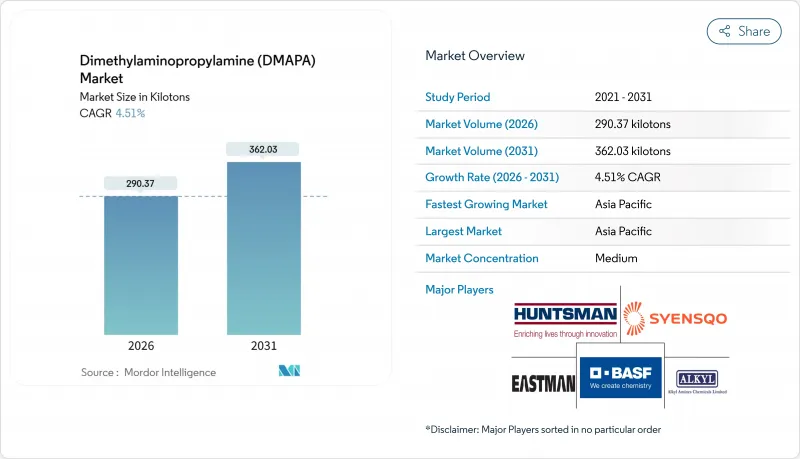
本報告按等級(例如,工業級)、應用(例如,美容和個人護理用界面活性劑、水和污水處理用化學品)、終端用戶行業(例如,個人護理和化妝品)以及地區(亞太地區、北美、歐洲、南美、中東和非洲)進行細分。市場預測以數量(千噸)為單位。
全球二甲氨基丙胺 (DMAPA) 市場趨勢與洞察
護髮和護膚配方中迅速轉向低刺激性的CAPB基界面活性劑
為了滿足長期皮膚接觸的監管指南並宣傳其產品不刺激的特性,洗髮精和沐浴露品牌正以椰油醯胺丙基甜菜鹼(CAPB)取代十二烷基硫酸鈉(SLS)。每生產一噸CAPB大約需要使用0.35噸DMAPA,因此每次配方調整都會增加對高純度胺類原料的需求。 Syensqo位於張家港的工廠於2023年獲得了ISCC PLUS認證,從而能夠供應可生物回收的二甲基氨基丙胺,並將其範圍3碳足跡減少了高達30%。目前,美國和德國的個人護理用品供應商正在簽署多年期採購協議,採購低胺級產品,而中國的契約製造生產商正在擴大批量生產,以供應區域性獨立品牌。首爾、上海和洛杉磯等都市區的消費者正在推動高階溫和潔面產品實現兩位數成長,鞏固了二甲基氨基丙胺在高價值細分市場的地位。
推動制定油漆和聚氨酯泡沫中不含甲醛和低揮發性有機化合物的化學品法規。
繼美國聯邦法規40 CFR第59部分和歐盟指令2004/42/EC對裝飾塗料中的揮發性有機化合物(VOC)含量設定限制後,配方研發人員正從溶劑型固化劑轉向基於二甲基苯胺(DMAPA)的水性系統。亨斯邁的「JEFFCAT LE-340」符合德國汽車零件製造商協會(VDA)頒發的汽車座椅VDA-278排放標準,隨著德國汽車製造商強制要求在新電動汽車內裝中使用低排放催化劑,該產品的訂單激增。贏創已將DMAPA添加到其「Ancamine」產品線中,以縮短高固態底漆的乾燥時間,使塗料製造商能夠在不犧牲產量的情況下滿足法規要求。隨著法規的日益嚴格,對於那些能夠保證殘留胺濃度低於0.2%的連續製程生產商而言,合規成本的增加轉化為銷售量的成長。
丙烯腈和二甲胺等原料價格的波動
2025年,丙烯腈和二甲胺的現貨價格波動超過20%,對那些不擁有上游業務的製造商的利潤率帶來壓力。亨斯邁高性能產品部門的息稅折舊攤提前利潤(EBITDA)下降了24%,原因是成本轉嫁延遲,這凸顯了資源依賴外部採購的地區面臨的重大風險。同時,BASF在路德維希港和南京的「一體化生產」(Verbund)模式透過整合環氧丙烷和氨的本地生產來保障利潤。印度和東南亞的中型企業以市場價格購買甲醇和丙烯,當原料運作飆升時,它們將面臨營運資金短缺,一些企業甚至被迫關閉反應器以避免損失。
細分市場分析
預計到2025年,工業級產品將成為市場主導力量,佔銷售量的60.58%,但隨著中國新生產線瞄準水處理和農藥調配企業,價格差距進一步擴大。醫藥級和化妝品級產品(先前在審計中被歸類為「其他等級」)正以4.91%的複合年成長率成長,這得益於歐盟附件三和良好生產規範(GMP)法規的日益嚴格。BASF南京工廠的升級改造增加了用於生產高純度產品的托盤,而贏創的2024年項目則引入了連續加氫和在線氣相色譜分析技術,將殘留仲胺含量降低至0.2%以下(evonik.com)。預計到2026年,優質二甲氨基丙胺的市場規模將達到約11.5萬噸,到2031年將超過15萬噸。
Syensqo的生物循環化妝品級產品售價比普通產品高出25-35%,吸引了許多高階洗髮精生產商的關注,他們渴望利用歐洲「綠色新政」的標籤優勢。亨斯邁公司利用其位於新加坡的GMP認證生產線,為胜肽類藥物合成提供EDC偶聯劑。在這個領域,批次可追溯性比價格敏感度更為重要。這種工業級、醫藥級和生物循環級三級產品層級構造,即使大宗商品利潤率受到壓縮,也能確保更高的平均售價。
區域分析
預計到2025年,亞太地區將佔全球需求的42.55%,年複合成長率為5.02%,主要得益於中國和印度的生產商在本地整合環氧丙烷、二甲胺和可再生能源。BASF南京工廠將於2025年7月實現產能翻番,確保向江蘇省個人護理契約製造提供本地供應。同時,贏創毗鄰的新廠則專注於生產藥品和低胺類產品。印度正從淨進口國向貿易平衡國轉變,這得益於烷基胺和巴拉地胺的產能擴張,但印度仍依賴來自中國的丙烯中間體。
在北美,亨斯邁公司將於2025年5月在康羅市運作其E-GRADE工廠,目標市場是新興的高純度半導體濕式製程化學品市場。美國買家支付的交付高於亞洲買家,但他們更重視本地供應和監管的確定性。在墨西哥,汽車和個人保健產品填充廠的近岸外包熱潮正在提振區域需求,但該國仍嚴重依賴進口。
在歐洲,生產商正努力應對能源附加費,但遵守歐盟附件三限制了供應,使他們在高階價格區間佔據優勢。 2025年7月,BASF完全子公司收購了位於沙朗普的胺前驅製造地,加強了其在歐盟內部的特種胺原料供應。市場需求主要集中在化妝品級和環氧樹脂固化級,儘管宏觀經濟消費疲軟,但二甲基氨基丙胺市場表現強勁。
在南美洲、中東和非洲,巴西聖保羅州和米納斯吉拉斯州的個人護理產業叢集推動了進口,而沙烏地阿拉伯朱拜勒的工廠則為優先使用DMAPA基腐蝕抑制劑前體的油田服務鏈提供產品。儘管交貨前置作業時間延長和外匯波動減緩了成長速度,但並未改變人口成長和基礎設施投資支撐的整體上升趨勢。
其他好處:
- Excel格式的市場預測(ME)表
- 3個月的分析師支持
目錄
第1章:引言
- 研究假設和市場定義
- 調查範圍
第2章:調查方法
第3章執行摘要
第4章 市場狀況
- 市場概覽
- 市場促進因素
- 護髮和護膚產品中正迅速轉向使用基於CAPB的低致敏性界面活性劑。
- 推動在油漆和聚氨酯泡沫中使用無甲醛和低VOC化學品的監管舉措。
- 擴大亞太地區間歇式和連續式DMAPA裝置的產能。
- 採用ISCC-PLUS認證原料的生物循環DMAPA的出現。
- 擴大電動車冷卻液和潤滑油的OEM添加劑配方
- 市場限制因素
- 丙烯腈和二甲胺等原料價格的波動
- 歐盟收緊化妝品中DMAPA殘留的監管規定。
- 防爆型連續加氫系統需要大量的資金投入。
- 價值鏈分析
- 波特五力模型
第5章 市場規模與成長預測
- 按年級
- 工業級
- 醫藥級
- 其他等級(用於化妝品,低胺)
- 透過使用
- 用於美容和個人護理的表面活性劑
- 用於水和廢水處理的化學品
- 聚氨酯泡棉催化劑
- 環氧樹脂固化劑和塗料
- 作物保護中間體
- 工業和設施清潔劑
- 其他應用(油田、腐蝕抑制劑、離子交換樹脂)
- 按最終用途行業分類
- 個人護理化妝品
- 水處理
- 建築/施工
- 農業
- 製藥
- 其他(電子產品、紡織品等)
- 按地區
- 亞太地區
- 中國
- 印度
- 日本
- 韓國
- 東南亞國協
- 其他亞太國家
- 北美洲
- 美國
- 加拿大
- 墨西哥
- 歐洲
- 德國
- 英國
- 法國
- 義大利
- 其他歐洲國家
- 南美洲
- 巴西
- 阿根廷
- 其他南美國家
- 中東和非洲
- 沙烏地阿拉伯
- 南非
- 其他中東和非洲國家
- 亞太地區
第6章 競爭情勢
- 市場集中度
- 策略趨勢
- 市佔率和排名分析
- 公司簡介
- BASF
- Alkyl Amines Chemicals Ltd.
- Arkema
- Eastman Chemical Company
- Evonik Industries AG
- Hefei TNJ Chemical Industry Co.
- Hubei Jusheng Technology Co., Ltd.
- Huntsman International LLC
- Jinan HNA Chemical Co. Ltd
- Merck KGaA
- Prasol Chemicals Pvt Ltd
- Shandong Zhishang Chemical Co. Ltd
- Syensqo
- Tokyo Chemical Industry Co., Ltd.(TCI)
第7章 市場機會與未來展望
According to Mordor Intelligence, the dimethylaminopropylamine market size is estimated at 290.37 kilotons in 2026, and is expected to reach 362.03 kilotons by 2031, at a CAGR of 4.51% during the forecast period (2026-2031).
This report is Segmented by Grade (Industrial Grade, and More), Application (Beauty and Personal Care Surfactants, Water and Waste-Water Treatment Chemicals, and More), End-Use Industry (Personal Care and Cosmetics, and More), and Geography (Asia-Pacific, North America, Europe, South America, and Middle East and Africa). The Market Forecasts are Provided in Terms of Volume (Kilotons).
Global Dimethylaminopropylamine (DMAPA) Market Trends and Insights
Rapid Shift to Mild, CAPB-Based Surfactants in Hair- and Skin-Care Formulations
Shampoo and body-wash brands are replacing sodium lauryl sulfate with cocamidopropyl betaine to meet irritation-free claims and regulatory guidance on chronic skin exposure. Each tonne of CAPB uses about 0.35 tonnes of DMAPA, so every reformulation cycle lifts demand for high-purity amine feedstock. Syensqo earned ISCC PLUS certification at Zhangjiagang in 2023, enabling bio-circular Dimethylaminopropylamine that lowers Scope 3 footprints by up to 30%. Personal-care suppliers in the United States and Germany now lock in multi-year purchase agreements for low-amine grades, while Chinese contract manufacturers ramp batch tolling to supply regional indie brands. Urban consumers in Seoul, Shanghai, and Los Angeles drive double-digit growth in premium mild cleansers, anchoring the Dimethylaminopropylamine market in value-added segments.
Regulatory Push for Formaldehyde-Free, Low-VOC Chemistries in Coatings and PU Foams
The U.S. 40 CFR Part 59 rule and EU Directive 2004/42/EC cap VOC content in decorative paints, prompting formulators to swap solvent-borne hardeners for DMAPA-derived waterborne systems. Huntsman's JEFFCAT LE-340 meets VDA-278 emission thresholds for automotive seating, and orders surged after German OEMs mandated low-emission catalysts in new electric-vehicle interiors. Evonik embeds DMAPA into its Ancamine line to cut drying time in high-solids primers, giving coatings producers a way to comply without sacrificing throughput. The regulatory clampdown converts compliance cost into volume upside for continuous-process producers that can guarantee residual amine below 0.2%.
Volatility in Acrylonitrile and Dimethylamine Feedstock Pricing
Spot acrylonitrile and dimethylamine swung by more than 20% inside 2025, eroding margins for producers without captive upstream units. Huntsman's Performance Products EBITDA slid 24% on cost pass-through lags, highlighting exposure in merchant-purchase regions. BASF's Verbund model at Ludwigshafen and Nanjing shelters earnings by integrating propylene oxide and ammonia on-site. Mid-tier Indian and Southeast Asian firms that buy methanol or propylene at market rates face working-capital strain when feedstocks spike, forcing some to idle reactors to avoid losses.
Other drivers and restraints analyzed in the detailed report include:
- Asia-Pacific Capacity Expansions for Batch and Continuous Plants
- Emergence of Bio-Circular DMAPA via ISCC PLUS Certified Feedstocks
- Stricter EU Cosmetic Limits on Residual DMAPA
For complete list of drivers and restraints, kindly check the Table Of Contents.
Segment Analysis
Industrial grade dominated with 60.58% volume in 2025, but price discounts widened as new Chinese lines targeted water-treatment and agrochemical blenders. Pharmaceutical and Cosmetic grades, grouped as "Other Grades" in earlier audits, are expanding at a 4.91% CAGR as EU Annex III and Good Manufacturing Practice rules tighten. BASF's Nanjing upgrade dedicated extra trays to high-purity cuts, while Evonik's 2024 project embeds continuous hydrogenation and inline GC analytics to keep residual secondary amine below 0.2% (evonik.com). The Dimethylaminopropylamine market size for premium grades reached about 115 kilotons in 2026 and is on track to cross 150 kilotons by 2031.
Syensqo's bio-circular cosmetic grade sells at a 25-35% premium, attracting luxury shampoo makers eager for Europe's Green Deal labeling advantage. Huntsman leverages GMP-certified lines in Singapore to supply EDC coupling agents in peptide drug synthesis, where lot traceability outweighs price sensitivity. This three-tier structure, industrial, pharmaceutical, and bio-circular, locks in higher average selling prices even as commodity margins compress.
Complete Report Scope:
- By Grade
- Industrial Grade
- Pharmaceutical Grade
- Other Grades (Cosmetics, Low Amine)
- By Application
- Beauty and Personal Care Surfactants
- Water and Waste-water Treatment Chemicals
- Polyurethane Foam Catalysts
- Epoxy Resin Hardeners and Coatings
- Crop-Protection Intermediates
- Industrial and Institutional Cleaning Agents
- Others (Oilfield, Corrosion Inhibitors, and Ion-Exchange Resins)
- By End-Use Industry
- Personal Care and Cosmetics
- Water Treatment
- Building and Construction
- Agriculture
- Pharmaceuticals
- Others (Electronics, Textile, and more)
- By Geography
- Asia-Pacific
- China
- India
- Japan
- South Korea
- ASEAN Countries
- Rest of Asia-Pacific
- North America
- United States
- Canada
- Mexico
- Europe
- Germany
- United Kingdom
- France
- Italy
- Rest of Europe
- South America
- Brazil
- Argentina
- Rest of South America
- Middle East and Africa
- Saudi Arabia
- South Africa
- Rest of Middle-East and Africa
- Asia-Pacific
Geography Analysis
Asia-Pacific anchored 42.55% of 2025 demand, with a 5.02% CAGR outlook as Chinese and Indian producers integrate propylene oxide, dimethylamine, and renewable power onsite. BASF's July 2025 doubling of Nanjing capacity secured local supply for Jiangsu's personal-care contract manufacturers, while Evonik's adjacent build targets pharmaceutical and low-amine variants. India, buoyed by Alkyl Amines and Balaji Amines expansions, shifts from a net importer to a balanced trade, yet still relies on Chinese propylene intermediates.
In North America, Huntsman opened its Conroe E-GRADE unit in May 2025, aiming at semiconductor wet-process chemicals, an emerging high-purity pocket. US buyers absorb higher delivered costs than Asian peers but value local supply and regulatory certainty. Mexico's near-shoring boom in autos and personal-care filling plants nudges regional uptake, though the country remains import-dependent.
In Europe, producers grapple with energy surcharges yet win on premium price points because Annex III compliance filters supply. BASF took full control of the Chalampe amine-precursor site in July 2025, increasing feedstock security for specialty amines in the bloc. Demand tilts to cosmetic and epoxy hardener grades, sustaining the Dimethylaminopropylamine market despite flat macro consumption.
In South America and Middle East and Africa, Brazil's personal-care clusters in Sao Paulo and Minas Gerais drive imports, while Saudi Arabia's Jubail site supplies oilfield service chains that value DMAPA corrosion-inhibitor precursors. Longer lead times and currency swings temper growth, but do not change the underlying upward trajectory tied to population expansion and infrastructure spend.
- BASF
- Alkyl Amines Chemicals Ltd.
- Arkema
- Eastman Chemical Company
- Evonik Industries AG
- Hefei TNJ Chemical Industry Co.
- Hubei Jusheng Technology Co., Ltd.
- Huntsman International LLC
- Jinan HNA Chemical Co. Ltd
- Merck KGaA
- Prasol Chemicals Pvt Ltd
- Shandong Zhishang Chemical Co. Ltd
- Syensqo
- Tokyo Chemical Industry Co., Ltd. (TCI)
Additional Benefits:
- The market estimate (ME) sheet in Excel format
- 3 months of analyst support
TABLE OF CONTENTS
1 Introduction
- 1.1 Study Assumptions & Market Definition
- 1.2 Scope of the Study
2 Research Methodology
3 Executive Summary
4 Market Landscape
- 4.1 Market Overview
- 4.2 Market Drivers
- 4.2.1 Rapid shift to mild, CAPB-based surfactants in hair- and skin-care formulations
- 4.2.2 Regulatory push for formaldehyde-free, low-VOC chemistries in coatings and PU foams
- 4.2.3 Asia-Pacific capacity expansions for batch and continuous DMAPA plants
- 4.2.4 Emergence of bio-circular DMAPA via ISCC-PLUS certified feedstocks
- 4.2.5 Growing OEM additive packages for electric-vehicle coolants and lubricants
- 4.3 Market Restraints
- 4.3.1 Volatility in acrylonitrile and dimethylamine feedstock pricing
- 4.3.2 Stricter EU cosmetic limits on residual DMAPA
- 4.3.3 High capex for explosion-proof continuous hydrogenation systems
- 4.4 Value Chain Analysis
- 4.5 Porter's Five Forces
- 4.5.1 Threat of New Entrants
- 4.5.2 Bargaining Power of Buyers
- 4.5.3 Bargaining Power of Suppliers
- 4.5.4 Threat of Substitutes
- 4.5.5 Degree of Competition
5 Market Size & Growth Forecasts (Volume)
- 5.1 By Grade
- 5.1.1 Industrial Grade
- 5.1.2 Pharmaceutical Grade
- 5.1.3 Other Grades (Cosmetics, Low Amine)
- 5.2 By Application
- 5.2.1 Beauty and Personal Care Surfactants
- 5.2.2 Water and Waste-water Treatment Chemicals
- 5.2.3 Polyurethane Foam Catalysts
- 5.2.4 Epoxy Resin Hardeners and Coatings
- 5.2.5 Crop-Protection Intermediates
- 5.2.6 Industrial and Institutional Cleaning Agents
- 5.2.7 Others (Oilfield, Corrosion Inhibitors, and Ion-Exchange Resins)
- 5.3 By End-Use Industry
- 5.3.1 Personal Care and Cosmetics
- 5.3.2 Water Treatment
- 5.3.3 Building and Construction
- 5.3.4 Agriculture
- 5.3.5 Pharmaceuticals
- 5.3.6 Others (Electronics, Textile, and more)
- 5.4 By Geography
- 5.4.1 Asia-Pacific
- 5.4.1.1 China
- 5.4.1.2 India
- 5.4.1.3 Japan
- 5.4.1.4 South Korea
- 5.4.1.5 ASEAN Countries
- 5.4.1.6 Rest of Asia-Pacific
- 5.4.2 North America
- 5.4.2.1 United States
- 5.4.2.2 Canada
- 5.4.2.3 Mexico
- 5.4.3 Europe
- 5.4.3.1 Germany
- 5.4.3.2 United Kingdom
- 5.4.3.3 France
- 5.4.3.4 Italy
- 5.4.3.5 Rest of Europe
- 5.4.4 South America
- 5.4.4.1 Brazil
- 5.4.4.2 Argentina
- 5.4.4.3 Rest of South America
- 5.4.5 Middle East and Africa
- 5.4.5.1 Saudi Arabia
- 5.4.5.2 South Africa
- 5.4.5.3 Rest of Middle-East and Africa
- 5.4.1 Asia-Pacific
6 Competitive Landscape
- 6.1 Market Concentration
- 6.2 Strategic Moves
- 6.3 Market Share (%)/Ranking Analysis
- 6.4 Company Profiles {(includes Global level Overview, Market level overview, Core Segments, Financials as available, Strategic Information, Products & Services, and Recent Developments)}
- 6.4.1 BASF
- 6.4.2 Alkyl Amines Chemicals Ltd.
- 6.4.3 Arkema
- 6.4.4 Eastman Chemical Company
- 6.4.5 Evonik Industries AG
- 6.4.6 Hefei TNJ Chemical Industry Co.
- 6.4.7 Hubei Jusheng Technology Co., Ltd.
- 6.4.8 Huntsman International LLC
- 6.4.9 Jinan HNA Chemical Co. Ltd
- 6.4.10 Merck KGaA
- 6.4.11 Prasol Chemicals Pvt Ltd
- 6.4.12 Shandong Zhishang Chemical Co. Ltd
- 6.4.13 Syensqo
- 6.4.14 Tokyo Chemical Industry Co., Ltd. (TCI)
7 Market Opportunities & Future Outlook
- 7.1 White-space & Unmet-Need Assessment
- 7.2 Bio-Based and Circular Feedstock Initiatives

 2026-2030年全球胺市場
 烷基胺市場:全球市場預測,2026-2032年對苯二胺市場 - 全球市場預測 2026-2032
 2026年乙二胺(EDA)及其衍生物全球市場報告
 胺類:市佔率分析、產業趨勢與統計、成長預測(2026-2031)
 胺氧化物市場規模、佔有率和成長分析:按產品類型、應用、最終用途產業、功能、形態、分銷管道和地區分類-2026-2033年產業預測
 胺類市場報告:按產品、功能、應用和地區分類(2026-2034 年)
 單異丙胺市場 - 全球產業規模、佔有率、趨勢、機會、預測:按應用、銷售管道、地區和競爭格局分類,2021-2031年
 Piperazine全球市場規模、佔有率、趨勢和成長分析報告(2026-2034年)二丁胺市場:按類型、應用和最終用途行業分類 - 2026-2032年全球市場預測