


 |
市場調查報告書
商品編碼
2120673
工業澱粉:市場佔有率分析、產業趨勢與統計、成長預測(2026-2031)Industrial Starches - Market Share Analysis, Industry Trends & Statistics, Growth Forecasts (2026 - 2031) |
||||||

※ 本網頁內容可能與最新版本有所差異。詳細情況請與我們聯繫。
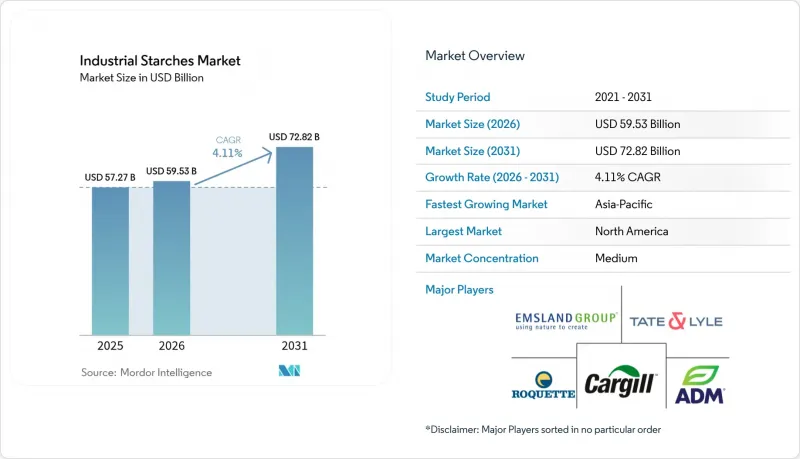
2025年工業澱粉市場價值為572.7億美元,預計到2031年將達到728.2億美元,而2026年為595.3億美元,預測期(2026-2031年)複合年成長率為4.11%。
本報告按原料(玉米、木薯、馬鈴薯等)、類型(天然澱粉、改性澱粉)、應用領域(食品飲料、醫藥、個人護理等)和地區(北美、歐洲、亞太、南美、中東和非洲)進行細分。市場預測以價值(美元)和數量(噸)表示。
全球工業澱粉市場趨勢與洞察
加工食品和速食消費量增加
都市化和雙薪家庭的增加顯著推動了即食食品、烘焙產品和常溫醬料消費量的成長。這些產品大量依賴澱粉來確保其質地、黏度和凍融穩定性等關鍵特性。根據美國農業部統計,亞太地區的加工食品出貨量呈現顯著成長,其中泡麵和冷凍餃子等澱粉含量高的食品是推動銷售成長的主要因素。在沙拉醬中,改性蠟玉米澱粉因其即使在高剪切混合和酸性pH環境下也能避免脫水收縮(水分分離)的特性,正被用作瓜爾膠的替代品。潔淨標示品牌在包裝正面突顯了這項技術優勢。在拉丁美洲,零食生產商正在改進其擠壓產品的配方,透過添加木薯澱粉來達到所需的酥脆口感,同時降低吸油量。這種方法不僅降低了生產成本,也符合消費者對健康產品的偏好。從傳統家庭烹飪向工業化食品生產的轉變,導致澱粉需求集中在少數大型買家手中。這一趨勢提高了配方開發商的議價能力,但也提高了人們對產品品質一致性的期望,而只有頂級供應商才能大規模、有效地滿足這項標準。
過渡到潔淨標示和天然成分
北美和歐洲的零售商越來越要求配料表上的成分少於10種,這促使品牌商用天然澱粉或消費者認為「加工最少」的物理加工替代品來取代化學加工澱粉。根據英聯食品配料公司(Ingredion)2025年的年度報告,市場對潔淨標示澱粉的需求呈現顯著成長,遠超整個澱粉產業的表現。這項轉變主要是由於烘焙企業和乳製品生產商修改產品配方,以避免標註歐盟標籤法規強制要求的「E編號」。在有機優格生產中,天然木薯澱粉作為乙醯化或羥丙基化澱粉的替代品的使用正在增加。這是因為天然木薯澱粉符合美國農業部國家有機計畫(NOP)的認證要求,且無需額外文件,從而簡化了供應鏈審核。然而,天然澱粉也存在一些局限性,包括加工溫度範圍較窄、冷藏過程中容易發生回生以及快速混合過程中容易被剪切稀釋。這些挑戰常常負責人增加修飾澱粉的用量或將其與親水膠體結合使用,這可能會對利潤率產生負面影響。儘管歐洲食品安全局 (EFSA) 在 2024 年重新評估了改質澱粉,並得出結論認為不存在安全隱患,但消費者的疑慮仍然強烈。這種趨勢持續存在,導致「清潔」替代品價格更高,並推動了不涉及化學試劑的酶促變性方法的應用。
食品、藥品和包裝方面的法規複雜且標準各不相同。
「改性澱粉」定義的差異造成了合規性的挑戰。美國食品藥物管理局(FDA) 允許在「天然」標籤下使用酵素水解工藝,而歐洲食品安全局 (EFSA) 則將相同工藝歸類為改性,需要標註 E 編號。這種差異迫使跨國品牌針對不同市場制定不同的配方和包裝設計。印度食品安全標準局 (FSSAI) 提出了澱粉純度標準,其重金屬殘留限量比國際食品法典委員會(轉碼器 Alimentarius Commission) 的標準更為嚴格。這迫使進口商從配備離子交換純化設備的工廠採購澱粉,而具備這種能力的工廠在全球範圍內數量有限。藥用澱粉必須符合美國藥典 (USP) 關於微生物限量、燃燒殘留和 pH 值的標準。然而,歐洲藥典對二氧化硫殘留的容許量更為嚴格,迫使供應商要麼建立雙重生產系統,要麼放棄進入其中一個市場。此外,包裝薄膜製造商也面臨不確定性,因為歐盟提案的「包裝和包裝廢棄物法規」不確定性影響。
細分市場分析
2025年,玉米佔工業澱粉銷售額的70.54%。這得歸功於美國中西部地區長期完善的濕磨加工基礎設施以及玉米的高直鏈澱粉含量,後者有利於成膜應用。然而,所有原料中成長最快的是木薯和木薯粉,預計到2031年年均成長率將達到7.82%。 2025年,泰國木薯澱粉出口量達320萬噸,成長11%。這主要歸功於歐洲食品品牌要求非基因改造認證和減少用水量,以實現供應鏈多元化,擺脫對美國玉米的過度依賴。馬鈴薯澱粉是第三大出口產品,但由於其含有磷酸酯基團,無需化學改質即可增強藥片的崩壞性能,因此在藥用輔料市場享有20-30%的溢價。印度學名藥生產商正在利用這種「潔淨標示」的優勢。
小麥澱粉仍是一種小眾產品,主要用於歐洲的紙張塗料廠,這主要歸功於其細小的顆粒和較低的糊化溫度。然而,麩質產品價格的大幅波動,包括2025年小麥麩質價格40%的漲幅,正在阻礙產能擴張。木薯需求的成長正在改變貿易格局。 2024年,兩家年總產能達18萬噸的木薯澱粉廠在越南運作,目標市場是醫藥和生物分解薄膜市場,但與基因改造玉米(GMO)的關聯是木薯進入這些市場的一大障礙。儘管木薯澱粉的需求持續成長,但其較低的直鏈澱粉與支鏈澱粉比例限制了其在高透明度薄膜和蒸餾醬料領域的應用,而玉米澱粉和馬鈴薯澱粉在這些領域仍具有技術優勢。
區域分析
2025年,北美佔工業澱粉銷售額的30.56%。這主要得益於美國玉米帶的綜合濕磨加工廠,這些工廠同時生產高果糖玉米糖漿、玉米油和飼料麵筋。英聯食品公司(Ingredion)位於錫達拉皮茲(Cedar Rapids)的5000萬美元擴建項目於2025年2月竣工,使玉米澱粉年產能增加了12萬噸,以滿足製藥和潔淨標示食品市場的需求。這凸顯了北美向高利潤特種澱粉等級的轉型。美國食品藥物管理局(FDA)於2024年發布的輔料可追溯性指南增加了小規模澱粉生產商的合規成本,導致市場佔有率集中在有能力投資電子批次記錄系統和第三方審核的前四大澱粉生產商手中。加拿大澱粉產業仍高度依賴出口,薩斯喀徹爾的小麥澱粉生產商為美國造紙塗料產業的客戶供貨。然而,2025 年加拿大和美國之間的軟木爭端間接影響了澱粉需求,減少了建築材料用瓦楞紙箱的訂單。
亞太地區正經歷最快成長,預計到2031年將以每年平均6.11%的速度成長。這一成長主要得益於泰國、印尼和越南木薯澱粉產能的擴張,印度藥片產量的增加,以及中國電商產業對可生物分解包裝的採用。預計到2025年,泰國木薯澱粉出口量將達到320萬噸,獲得非基因改造認證將使其能夠進入先前依賴美國玉米澱粉的歐洲和日本食品市場。由於國內玉米澱粉產量難以滿足醫藥需求,印度2025會計年度的澱粉進口量增加了14%。印度食品安全標準局正在製定純度標準,如果實施,將有利於國內生產商。在中國,從2025年1月起將在46個城市強制推行可生物分解包裝,促進了澱粉和Polybutylene Adipate Terephthalate(PBA-PTT)混合物在食品配送容器中的應用。然而,其成本比聚苯乙烯高出40%至60%,成為一大障礙,限制了其在主要大都市以外地區的普及。
歐洲工業澱粉市場正努力平衡消費者對「潔淨標示」的需求與歐盟的《包裝和包裝廢棄物法規》。該法規規定,到2030年,65%的塑膠包裝必須由回收材料製成。這些法規促進了澱粉-聚酯混合物的使用,這種混合物可在工業堆肥中生物分解。儘管受病害影響,德國的馬鈴薯澱粉產量預計在2025年下降6%,但該國仍是歐盟最大的生產國,Emsland集團和Abebe公司控制著該地區三分之二的產能。歐洲食品安全局(EFSA)在2024年對加工澱粉的重新評估中未發現安全隱患。然而,消費者對「潔淨標示」包裝的需求仍然傾向於天然澱粉和酵素改性澱粉,而乙醯化澱粉和交聯澱粉則持續面臨獲利壓力。
其他好處:
- Excel格式的市場預測(ME)表
- 3個月的分析師支持
目錄
第1章:引言
- 研究假設和市場定義
- 調查範圍
第2章:調查方法
第3章執行摘要
第4章 市場狀況
- 市場概覽
- 市場促進因素
- 加工食品和速食消費量增加
- 過渡到潔淨標示和天然成分
- 植物來源和無麩質產品的興起
- 利用澱粉作為粘合劑和崩壞拓展製藥領域。
- 澱粉廣泛應用於紙張、紙板和紡織品的上漿/塗層。
- 包裝產業對生物基和可生物分解產品的需求不斷成長。
- 市場限制因素
- 食品、藥品和包裝方面的法規複雜且標準各不相同。
- 對基因改造生物(GMO)在玉米澱粉生產中的應用實施嚴格監管。
- 受天氣、乾旱和作物疾病影響,農業供應出現波動。
- 改質澱粉的加工要求複雜
- 價值鏈分析
- 監理展望
- 波特五力模型
第5章 市場規模與成長預測
- 來源
- 玉米
- 木薯/木薯粉
- 馬鈴薯
- 小麥
- 其他
- 按類型
- 本國的
- 已更正
- 透過使用
- 食品/飲料
- 製藥
- 個人護理
- 紙、紙板、瓦楞紙板
- 紡織品
- 動物飼料
- 化學品
- 按地區
- 北美洲
- 美國
- 加拿大
- 墨西哥
- 其他北美國家
- 歐洲
- 德國
- 英國
- 義大利
- 法國
- 西班牙
- 荷蘭
- 波蘭
- 比利時
- 瑞典
- 其他歐洲國家
- 亞太地區
- 中國
- 印度
- 日本
- 澳洲
- 印尼
- 韓國
- 泰國
- 新加坡
- 其他亞太國家
- 南美洲
- 巴西
- 阿根廷
- 哥倫比亞
- 智利
- 秘魯
- 其他南美國家
- 中東和非洲
- 南非
- 沙烏地阿拉伯
- 阿拉伯聯合大公國
- 奈及利亞
- 埃及
- 摩洛哥
- 土耳其
- 其他中東和非洲國家
- 北美洲
第6章 競爭情勢
- 市場集中度
- 策略趨勢
- 市場排名分析
- 公司簡介
- Cargill Inc.
- Archer Daniels Midland Co.
- Roquette Freres SA
- Tate and Lyle PLC
- Emsland Group
- Agrana Beteiligungs-AG
- Tereos Group
- Sanwa Starch Co., Ltd.
- Grain Processing Corporation
- Altia Plc
- Manildra Group
- Angel Starch and Food Pvt. Ltd
- Japan Corn Starch Co. Ltd
- Universal Starch-Chem Allied Ltd
- Gulshan Polyols Ltd
- GrainCorp Ltd
- Siam Modified Starch Co.
- Vedan International(Holdings)Ltd
- Honest Derivatives Pvt. Ltd
- Avebe UA
第7章 市場機會與未來展望
According to Mordor Intelligence, the industrial starches market size was valued at USD 57.27 billion in 2025 and is estimated to grow from USD 59.53 billion in 2026 to reach USD 72.82 billion by 2031, at a CAGR of 4.11% during the forecast period (2026-2031).
This report is Segmented by Source (Corn, Tapioca / Cassava, Potato, and More), Type (Native, and Modified), Application (Food and Beverage, Pharmaceutical, Personal Care, and More), and Geography (North America, Europe, Asia-Pacific, South America, and Middle East and Africa). The Market Forecasts are Provided in Terms of Value (USD) and Volume (Tonnes).
Global Industrial Starches Market Trends and Insights
Increasing consumption of processed and convenience foods
Urbanization and the increasing prevalence of dual-income households are significantly contributing to the growing consumption of ready-to-eat meals, bakery products, and shelf-stable sauces. These products heavily rely on starches to provide essential properties such as texture, viscosity, and freeze-thaw stability. According to the United States Department of Agriculture, processed food shipments in the Asia-Pacific region have experienced notable growth, with starch-intensive categories like instant noodles and frozen dumplings leading the way in terms of volume. Modified waxy-maize starches are being adopted as a replacement for guar gum in salad dressings due to their ability to endure high-shear mixing and acidic pH levels without causing syneresis, a technical advantage that clean-label brands emphasize in their front-of-pack claims. In Latin America, snack manufacturers are reformulating extruded products by incorporating tapioca starch to achieve a desirable crispness while reducing oil absorption. This approach not only lowers production costs but also aligns with consumer preferences for healthier product options. The shift from traditional home cooking to industrial food preparation has concentrated starch demand among a smaller number of larger buyers. This trend provides formulators with increased negotiating power but also raises expectations for consistent quality, a standard that only top-tier suppliers are equipped to meet effectively at scale.
Shift toward clean-label and natural ingredients
Retailers in North America and Europe are increasingly requiring ingredient lists with fewer than ten components, prompting brands to replace chemically modified starches with native or physically modified alternatives that consumers perceive as minimally processed. According to the annual report released by Ingredion for the year 2025, the demand for clean-label starches has shown remarkable growth, significantly surpassing the overall performance of the starch division. This shift is largely driven by bakery and dairy manufacturers reformulating their products to avoid E-number declarations, which are mandated by the labeling regulations of the European Union . Native tapioca starch is increasingly being used as a substitute for acetylated and hydroxypropylated variants in organic yogurt production. This is because it complies with the certification requirements of the United States Department of Agriculture (USDA) National Organic Program without necessitating additional documentation, thereby streamlining supply chain audits. However, native starches come with certain limitations, such as narrower processing windows, the tendency to retrograde during refrigerated storage, and shear-thinning when subjected to high-speed mixing. These challenges often compel formulators to use higher quantities or combine them with hydrocolloids, which can negatively impact profit margins. Although the European Food Safety Authority conducted a re-evaluation of modified starches in 2024 and found no safety concerns, consumer skepticism remains strong. This ongoing sentiment continues to sustain the premium pricing for "clean" alternatives and drives the adoption of enzyme-based modification methods that do not involve chemical reagents .
Regulatory complexity and variations across food, pharma, and packaging standards
Divergent definitions of "modified starch" create compliance challenges. The United States Food and Drug Administration (FDA) allows enzymatic hydrolysis under the "native" label, while the European Food Safety Authority (EFSA) classifies the same process as a modification requiring E-number disclosure . This discrepancy forces multinational brands to maintain separate formulations and packaging artwork for each market. India's Food Safety and Standards Authority (FSSAI) has introduced draft starch-purity standards that impose stricter heavy-metal residue limits compared to those set by Codex Alimentarius. This compels importers to source starch from mills equipped with ion-exchange purification, a capability available only at a limited number of global facilities. Pharmaceutical starch must comply with United States Pharmacopeia (USP) monograph specifications for microbial limits, residue on ignition, and pH. However, the European Pharmacopoeia enforces stricter tolerances on sulfur dioxide residues, requiring suppliers to either conduct dual production campaigns or forgo access to one of the markets. Additionally, packaging-film converters face uncertainty as the European Union's proposed Packaging and Packaging Waste Regulation deliberates whether starch-polyester blends qualify for composting certification. This decision will significantly influence capital investments in extrusion lines over the next several years.
Other drivers and restraints analyzed in the detailed report include:
- Rise of plant-based and gluten-free product formulations
- Expansion of pharmaceutical sector using starch as binder and disintegrant
- Stringent GMO restrictions on corn-based starches
For complete list of drivers and restraints, kindly check the Table Of Contents.
Segment Analysis
In 2025, corn accounted for 70.54% of industrial starch revenue, driven by the United States Midwest's long-established wet-milling infrastructure and corn's high amylose content, which is advantageous for film-forming applications. However, tapioca and cassava are experiencing the fastest growth among all source segments, with an annual growth rate of 7.82% projected through 2031. Thailand's cassava-starch exports reached 3.2 million metric tons in 2025, an 11% increase, as European food brands sought non-genetically modified organism (non-GMO) certification and a lower water footprint to diversify supply chains heavily reliant on United States corn. Potato starch, while ranking third in volume, commands a 20% to 30% price premium in pharmaceutical excipients due to its phosphate ester groups, which enhance tablet disintegration without chemical modification. This clean-label advantage is being leveraged by generic-drug manufacturers in India.
Wheat starch remains a niche product, primarily used in European paper-coating mills for its fine granule size and low gelatinization temperature. However, volatility in gluten co-product prices, as wheat gluten prices fluctuated by 40% in 2025, has discouraged capacity expansions. The growing preference for cassava is altering trade dynamics. In 2024, Vietnam commissioned two new tapioca-starch plants with a combined annual capacity of 180,000 metric tons, targeting pharmaceutical and biodegradable-film markets where corn's genetically modified organism (GMO) association poses a barrier to market access. Despite its growth, cassava's lower amylose-to-amylopectin ratio limits its application in high-clarity films and retort-stable sauces, where corn and potato starches maintain technical advantages.
Complete Report Scope:
- By Source
- Corn
- Tapioca / Cassava
- Potato
- Wheat
- Others
- By Type
- Native
- Modified
- By Application
- Food and Beverage
- Pharmaceutical
- Personal Care
- Paper, Cardboard, and Corrugated Board
- Textile
- Animal Feed
- Chemicals
- By Geography
- North America
- United States
- Canada
- Mexico
- Rest of North America
- Europe
- Germany
- United Kingdom
- Italy
- France
- Spain
- Netherlands
- Poland
- Belgium
- Sweden
- Rest of Europe
- Asia-Pacific
- China
- India
- Japan
- Australia
- Indonesia
- South Korea
- Thailand
- Singapore
- Rest of Asia-Pacific
- South America
- Brazil
- Argentina
- Colombia
- Chile
- Peru
- Rest of South America
- Middle East and Africa
- South Africa
- Saudi Arabia
- United Arab Emirates
- Nigeria
- Egypt
- Morocco
- Turkey
- Rest of Middle East and Africa
- North America
Geography Analysis
North America accounted for 30.56% of the industrial starch revenue in 2025, driven by the United States Corn Belt's integrated wet-milling complexes, which co-produce high-fructose corn syrup, corn oil, and animal-feed gluten. Ingredion's USD 50 million expansion in Cedar Rapids, completed in February 2025, added 120,000 metric tons of annual corn-starch capacity to cater to pharmaceutical and clean-label food markets, highlighting North America's shift toward higher-margin specialty starch grades. The United States Food and Drug Administration's 2024 excipient traceability guidance is increasing compliance costs for smaller starch producers, consolidating market share among the top four millers capable of investing in electronic batch-record systems and third-party audits. Canada's starch industry remains export-focused, with wheat-starch mills in Saskatchewan supplying United States paper-coating customers. However, the 2025 Canada-United States softwood lumber dispute indirectly impacted starch demand by reducing corrugated-box orders for construction materials.
The Asia-Pacific region is experiencing the fastest growth, with an annual rate of 6.11% projected through 2031. This growth is driven by cassava-starch capacity expansions in Thailand, Indonesia, and Vietnam, increased pharmaceutical tablet production in India, and the adoption of biodegradable packaging in China's e-commerce sector. Thailand's tapioca-starch exports reached 3.2 million metric tons in 2025, with non-GMO (non-genetically modified organism) certification enabling access to European and Japanese food markets that previously relied on United States corn starch. India's starch imports rose by 14% in fiscal 2025 as domestic maize-starch production struggled to meet pharmaceutical demand. The Food Safety and Standards Authority of India is drafting purity standards that could benefit domestic producers once implemented. In China, the biodegradable-packaging mandate, effective January 2025 in 46 cities, is driving the use of starch-polybutylene adipate terephthalate blends in food-delivery containers. However, cost premiums of 40% to 60% over polystyrene are limiting adoption beyond tier-one urban centers.
Europe's industrial starch market is balancing clean-label consumer preferences with the European Union's Packaging and Packaging Waste Regulation, which requires 65% recycled content in plastic packaging by 2030. This regulation is encouraging the use of starch-polyester blends that biodegrade in industrial composting. Germany's potato-starch production declined by 6% in 2025 due to late-blight issues, but the country remains the European Union's largest producer, with Emsland Group and Avebe controlling two-thirds of the region's capacity. The European Food Safety Authority's 2024 re-evaluation of modified starches found no safety concerns. However, clean-label claims on packaging continue to favor native and enzymatically modified starches, putting pressure on margins for acetylated and cross-linked variants.
- Cargill Inc.
- Archer Daniels Midland Co.
- Roquette Freres SA
- Tate and Lyle PLC
- Emsland Group
- Agrana Beteiligungs-AG
- Tereos Group
- Sanwa Starch Co., Ltd.
- Grain Processing Corporation
- Altia Plc
- Manildra Group
- Angel Starch and Food Pvt. Ltd
- Japan Corn Starch Co. Ltd
- Universal Starch-Chem Allied Ltd
- Gulshan Polyols Ltd
- GrainCorp Ltd
- Siam Modified Starch Co.
- Vedan International (Holdings) Ltd
- Honest Derivatives Pvt. Ltd
- Avebe U.A.
Additional Benefits:
- The market estimate (ME) sheet in Excel format
- 3 months of analyst support
TABLE OF CONTENTS
1 INTRODUCTION
- 1.1 Study Assumptions and Market Definition
- 1.2 Scope of the Study
2 RESEARCH METHODOLOGY
3 EXECUTIVE SUMMARY
4 MARKET LANDSCAPE
- 4.1 Market Overview
- 4.2 Market Drivers
- 4.2.1 Increasing consumption of processed and convenience foods
- 4.2.2 Shift toward clean-label and natural ingredients
- 4.2.3 Rise of plant-based and gluten-free product formulations
- 4.2.4 Expansion of pharmaceutical sector using starch as binder and disintegrant
- 4.2.5 Widespread adoption of starches in paper, paperboard, and textile sizing/coating
- 4.2.6 Growing demand for bio-based and biodegradable products in packaging
- 4.3 Market Restraints
- 4.3.1 Regulatory complexity and variations across food, pharma, and packaging standards
- 4.3.2 Stringent GMO restrictions on corn-based starches
- 4.3.3 Variability in agricultural supply due to weather, droughts, and crop diseases
- 4.3.4 Complex processing requirements for modified starches
- 4.4 Value Chain Analysis
- 4.5 Regulatory Outlook
- 4.6 Porter's Five Forces
- 4.6.1 Threat of New Entrants
- 4.6.2 Bargaining Power of Buyers
- 4.6.3 Bargaining Power of Suppliers
- 4.6.4 Threat of Substitute Products
- 4.6.5 Intensity of Competitive Rivalry
5 MARKET SIZE AND GROWTH FORECASTS (VALUE AND VOLUME)
- 5.1 By Source
- 5.1.1 Corn
- 5.1.2 Tapioca / Cassava
- 5.1.3 Potato
- 5.1.4 Wheat
- 5.1.5 Others
- 5.2 By Type
- 5.2.1 Native
- 5.2.2 Modified
- 5.3 By Application
- 5.3.1 Food and Beverage
- 5.3.2 Pharmaceutical
- 5.3.3 Personal Care
- 5.3.4 Paper, Cardboard, and Corrugated Board
- 5.3.5 Textile
- 5.3.6 Animal Feed
- 5.3.7 Chemicals
- 5.4 By Geography
- 5.4.1 North America
- 5.4.1.1 United States
- 5.4.1.2 Canada
- 5.4.1.3 Mexico
- 5.4.1.4 Rest of North America
- 5.4.2 Europe
- 5.4.2.1 Germany
- 5.4.2.2 United Kingdom
- 5.4.2.3 Italy
- 5.4.2.4 France
- 5.4.2.5 Spain
- 5.4.2.6 Netherlands
- 5.4.2.7 Poland
- 5.4.2.8 Belgium
- 5.4.2.9 Sweden
- 5.4.2.10 Rest of Europe
- 5.4.3 Asia-Pacific
- 5.4.3.1 China
- 5.4.3.2 India
- 5.4.3.3 Japan
- 5.4.3.4 Australia
- 5.4.3.5 Indonesia
- 5.4.3.6 South Korea
- 5.4.3.7 Thailand
- 5.4.3.8 Singapore
- 5.4.3.9 Rest of Asia-Pacific
- 5.4.4 South America
- 5.4.4.1 Brazil
- 5.4.4.2 Argentina
- 5.4.4.3 Colombia
- 5.4.4.4 Chile
- 5.4.4.5 Peru
- 5.4.4.6 Rest of South America
- 5.4.5 Middle East and Africa
- 5.4.5.1 South Africa
- 5.4.5.2 Saudi Arabia
- 5.4.5.3 United Arab Emirates
- 5.4.5.4 Nigeria
- 5.4.5.5 Egypt
- 5.4.5.6 Morocco
- 5.4.5.7 Turkey
- 5.4.5.8 Rest of Middle East and Africa
- 5.4.1 North America
6 COMPETITIVE LANDSCAPE
- 6.1 Market Concentration
- 6.2 Strategic Moves
- 6.3 Market Ranking Analysis
- 6.4 Company Profiles (includes Global-level Overview, Market-level Overview, Core Segments, Financials (if available), Strategic Information, Market Rank/Share, Products and Services, Recent Developments)
- 6.4.1 Cargill Inc.
- 6.4.2 Archer Daniels Midland Co.
- 6.4.3 Roquette Freres SA
- 6.4.4 Tate and Lyle PLC
- 6.4.5 Emsland Group
- 6.4.6 Agrana Beteiligungs-AG
- 6.4.7 Tereos Group
- 6.4.8 Sanwa Starch Co., Ltd.
- 6.4.9 Grain Processing Corporation
- 6.4.10 Altia Plc
- 6.4.11 Manildra Group
- 6.4.12 Angel Starch and Food Pvt. Ltd
- 6.4.13 Japan Corn Starch Co. Ltd
- 6.4.14 Universal Starch-Chem Allied Ltd
- 6.4.15 Gulshan Polyols Ltd
- 6.4.16 GrainCorp Ltd
- 6.4.17 Siam Modified Starch Co.
- 6.4.18 Vedan International (Holdings) Ltd
- 6.4.19 Honest Derivatives Pvt. Ltd
- 6.4.20 Avebe U.A.
7 MARKET OPPORTUNITIES AND FUTURE OUTLOOK

 工業澱粉市場-2026-2032年全球市場預測
 工業澱粉市場-全球產業規模、佔有率、趨勢、機會、預測:按類型、原料、形態、功能、應用、地區和競爭格局分類,2021-2031年
 2026年全球工業澱粉市場報告
 工業澱粉市場:按類型、原料、應用、地區分類
 工業澱粉市場分析及預測(至2035年):依類型、產品、應用、技術、形態、製程、最終用戶、功能、安裝類型及設備分類
 工業澱粉市場規模、佔有率及成長分析(按來源、產品、形態、應用及地區分類)-2026-2033年產業預測
 工業澱粉市場機會、成長動力、產業趨勢分析與 2025 - 2034 年預測
 工業澱粉市場、規模、佔有率、趨勢、行業分析報告(按來源、產品、應用和地區)- 市場預測,2025-2034 年
 工業澱粉市場規模、佔有率、趨勢分析報告:按應用、按來源、按產品、按地區、細分市場預測,2025-2030 年