


 |
市場調查報告書
商品編碼
2120668
汽車安全氣囊充氣機:市佔率分析、產業趨勢與統計及成長預測(2026-2031)Automotive Airbag Inflator - Market Share Analysis, Industry Trends & Statistics, Growth Forecasts (2026 - 2031) |
||||||

※ 本網頁內容可能與最新版本有所差異。詳細情況請與我們聯繫。
據 Mordor Intelligence 稱,2025 年汽車安全氣囊充氣機市值為 52.3 億美元,預計到 2031 年將從 2026 年的 56.3 億美元成長至 81.7 億美元,預測期(2026-2031 年)的複合年成長率為 7.73%預計為 7.73%。
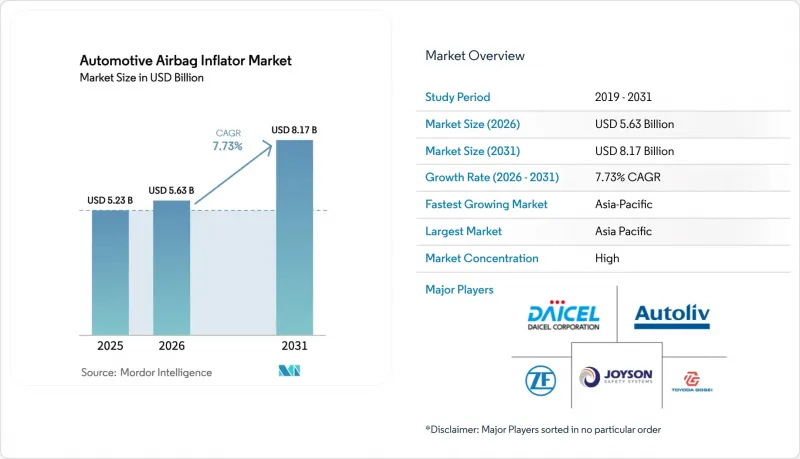
本報告按氣囊類型(乘客側氣囊、側簾式氣囊、膝部氣囊等)、充氣器類型(煙火式、儲氣式等)、車輛類型(乘用車等)、推進劑化學成分(疊氮化物基和非疊氮化物基)、技術階段(單級和兩級/多級)、銷售通路(OEM和售後市場)以及地區進行銷售管道(OEM和售後市場)以及地區銷售管道(OEM及多級)。市場預測以價值(美元)和數量(單位)表示。
全球汽車安全氣囊充氣機市場趨勢及洞察
電動車的千兆廣播底盤催生了對超薄簾式充氣機的需求。
特斯拉的Cybertruck和Model Y採用一體成型後底盤,由大型壓平機鑄造而成。這項創新取消了傳統的B柱加強區,顯著減少了側簾式安全氣囊充氣裝置的可用空間。同樣,比亞迪的海鷗和海豚系列也採用了巨型鑄造工藝,大幅減少了車身本體部件的數量,但同時也進一步壓縮了安全約束裝置的空間。為此,現代摩比斯於2024年推出了一款車門安裝式側簾模組,旨在滿足排放標準。因此,供應商正從圓柱形煙火充氣裝置轉向混合式扁平包裝裝置。這些新型裝置將氬氣或氮氣等壓縮氣體與晶片狀固體裝藥結合,以實現更快的展開速度和更低的峰值溫度。儘管煙火裝置在現有車輛中仍然廣泛使用,但這種轉變反映出人們對混合式充氣裝置的需求日益成長。
ADAS主導中國製造的中型SUV採用多級充氣裝置。
在中國品牌生產的中型SUV中,由於配備了眾多感測器,碰撞嚴重性數據與充氣機控制邏輯的融合能夠最佳化氣體釋放,從而保護更廣泛的乘員範圍。新車安全評鑑協會(NCAP)的五星評級提升了展示室吸引力,多級充氣機也成為高級駕駛輔助系統(ADAS)價值的直覺體現。在多級充氣機應用方面落後的汽車製造商,在展示室對比中可能處於劣勢,並面臨著迎頭趕上的壓力。軟體更新允許對未來的校準進行微調,使原始設備製造商(OEM)避免了設備升級成本。零件供應商正利用這一趨勢,提升銷售韌體維護契約,從而增加穩定的收入來源。因此,感測器融合與充氣機控制的融合,使得汽車安全氣囊充氣機市場維持了較高的價格水準。
氦氣供應短缺
地緣政治動盪推高了工業氦氣現貨價格,導致儲氣式充氣裝置的零件成本上升,利潤空間受到擠壓。坦尚尼亞正在探勘“綠色氦氣”,初步流量數據顯示,綠色氦氣可能對安全系統製造商具有商業可行性。為此,原始設備製造商(OEM)正在轉向採購混合式充氣裝置,該裝置使用煙火氣體稀釋氦氣。合約條款中現在包含了氦氣價格調整的計算公式,將部分風險轉移回供應商。儘管成本飆升只是暫時的,但它已經減緩了新型儲氣式充氣裝置設計的更新速度,從而抑制了汽車安全氣囊充氣裝置市場這一細分領域的短期成長。
細分市場分析
至2025年,乘員安全氣囊將佔汽車安全氣囊充氣機市場佔有率的30.69%。這一主導地位主要基於星級評定標準,該標準要求提供強大的側面碰撞保護。近期規範更新表明,人們對分段式氣體通道很感興趣,以提高沿著狹窄車頂橫桿充氣的均勻性。新興的一體式鑄造電動車車架採用更纖細的橫梁,允許使用橢截面氣缸,從而在不增加車頂高度限制的情況下保持氣體容量。在汽車安全氣囊充氣機市場,將形狀創新與可靠的化學技術相結合的平台仍然備受青睞。
預計到2031年,行人保護氣囊的複合年成長率將達到9.82%,成為所有氣囊中複合年成長率最高的。碰撞測試碰撞測試人偶更重視下肢損傷的檢測,以及保險評估模型的改進,正在推動行人保護氣囊的普及。供應商目前提供可直接卡入現有儀表板下方橫樑的整合式氣囊外殼,從而縮短生產線上的組裝時間。車隊採購商強調,配備膝部保護裝置可以減少工傷賠償,這也推動了相關規格的採用。這種不斷成長的勢頭正在增強汽車氣囊充氣裝置的長期多樣性,使其受益於多種成長要素,而不是單一的主導類別。
2025年,煙火充氣裝置憑藉成熟的供應鏈和相對於儲氣式充氣裝置的成本優勢,持續維持其核心產品地位,市佔率高達66.56%。然而,氦氣價格上漲以及對自適應控制系統的需求,促使人們對混合式充氣裝置的興趣日益濃厚,該細分市場正以8.27%的複合年成長率快速成長。由於歐盟制裁導致的供應短缺,依賴300巴氦氬混合氣體的儲氣裝置正逐漸失去市場支持。混合式設計將緊湊的固體裝藥與儲氣罐相結合,實現兩階段充氣,從而在翻車事故中既能快速充氣,又能長期維持壓力。採埃孚(ZF)和奧托立夫(Autoliv)正在對電動SUV的扁平式混合模組進行現場測試,利用Gigacasting技術,該模組的封裝深度僅為35毫米。
儘管煙火式充氣裝置仍能在30毫秒內為60公升安全氣囊充氣,但歐盟的REACH指令正推動人們轉向使用毒性較低的硝酸胍推進劑。儲氣式充氣裝置正被一些高階小眾車型採用,這些車型願意為更安靜的充氣方式支付更高的價格。受聯合國R155網路安全法規的推動,結合了電控系統和可變壓力閥的混合式充氣裝置預計到2031年將佔據18%的市場佔有率。
區域分析
預計到2025年,亞太地區將佔全球汽車安全氣囊充氣機銷量的38.88%,並將以9.42%的複合年成長率持續成長至2031年,成為所有地區中成長最快的地區。到2025年,光是中國就將佔據汽車安全氣囊充氣機市場28%的佔有率。由於2024年中國新車碰撞測試(C-NCAP)的嚴格法規生效,屆時中國76%的新乘用車將配備兩級駕駛側安全氣囊模組。印度充氣機市場受益於生產連結獎勵計畫(PLI)計劃,該計劃推動了相關投資,例如採埃孚雷恩(ZF Rane)在泰米爾納德邦建設一座年產300萬台的工廠。在日本,行人保護功能的普及率高達68%,位居全國之首,這得益於日本新車碰撞測試(JNCAP)評估標準的修訂,該標準正在促進外部安全氣囊的普及。
南美洲緊隨其後,複合年成長率為7.23%。巴西的「2030年路線圖」規定,自2026年起,大多數約束系統必須在地採購,這將加速巴西國內充氣裝置的組裝。阿根廷汽車製造商正利用南方共同市場的出口管道,而全球供應商的當地子公司則開設小規模的工廠以規避關稅。北美地區的成長率為4.76%。儘管駕駛員和乘客安全氣囊的搭載率飽和至98%,但由於電動車平台的引入和Takata氣囊的持續更換,其安裝率仍保持著小幅上升的趨勢。
歐洲的複合年成長率 (CAGR) 為 5.44%。隨著碳邊境調節機制 (CBAM) 於 2026 年 1 月生效,亞洲進口成本隨之增加,一級供應商正積極在波蘭和羅馬尼亞建立低碳生產基地。在歐洲,疊氮化鈉的市佔率已降至 26%,反映出 REACH 法規的合規性正在加速提升。中東和非洲地區正面臨假冒充氣裝置的湧入,損害了供應商的信心。同時,由於制裁阻礙了氦氣的供應(氦氣是儲氣模組的關鍵原料),俄羅斯的複合年成長率僅為 3.51%。
其他好處:
- Excel格式的市場預測(ME)表
- 3個月的分析師支持
目錄
第1章:引言
- 研究假設和市場定義
- 調查範圍
第2章:調查方法
第3章執行摘要
第4章 市場狀況
- 市場促進因素
- 電動車的千兆廣播底盤催生了對超薄簾式充氣機的需求。
- 受ADAS(高級駕駛輔助系統)的推動,中國中型SUV開始採用多段充氣裝置。
- L4/L5 自動駕駛車輛的引進需要先進的多方向充氣裝置陣列。
- 印度出口基地的崛起導致我們接收自用的充氣機數量增加。
- 歐盟和日本逐步淘汰疊氮化物推進劑,推動了船舶維修需求。
- UN-R155 網路安全合規性正在推動北美地區採用智慧充氣模組。
- 市場限制因素
- 氦氣供應緊張推高了儲氣罐的價格。
- 鋰離子電池起火的風險延緩了電動車安全氣囊系統的引進。
- 歐盟的碳邊境調節關稅增加了從亞洲進口充氣裝置的成本。
- 中東和非洲地區假冒充氣泵的氾濫正在破壞原始設備製造商 (OEM) 的項目。
- 價值供應鏈分析
- 監管和技術展望
- 波特五力模型
第5章 市場規模與成長預測
- 安全氣囊類型
- 搭乘用車
- 窗簾類型
- 膝蓋
- 邊
- 行人保護
- 充氣機類型
- 煙火風格
- 儲存類型
- 混合
- 車輛類型
- 搭乘用車
- 輕型商用車
- 大型商用車輛
- 推進劑的化學分類
- 阿齊多系統
- 非疊氮化物衍生物(例如,硝酸胍)
- 依技術階段
- 單級
- 兩階段和多階段
- 按銷售管道
- 原廠正品零件
- 售後/召回更換
- 按地區
- 北美洲
- 美國
- 加拿大
- 其他北美國家
- 南美洲
- 巴西
- 阿根廷
- 其他南美國家
- 歐洲
- 德國
- 英國
- 法國
- 西班牙
- 俄羅斯
- 其他歐洲國家
- 亞太地區
- 印度
- 中國
- 日本
- 韓國
- 其他亞太國家
- 中東和非洲
- 阿拉伯聯合大公國
- 沙烏地阿拉伯
- 土耳其
- 埃及
- 南非
- 其他中東和非洲國家
- 北美洲
第6章 競爭情勢
- 市場集中度
- 策略趨勢
- 市佔率分析
- 公司簡介
- Autoliv Inc.
- ZF Friedrichshafen AG
- Joyson Safety Systems(Key SS)
- Daicel Corporation
- Nippon Kayaku Co.
- ARC Automotive Inc.
- Toyoda Gosei Co.
- Hyundai Mobis Co.
- Continental AG
- Denso Corporation
- Yanfeng Safety Systems
- Nihon Plast Co.
- Ashimori Industry Co.
- Takata(Residual Recall Operations)
- Kolon Industries Inc.
- GWR Safety Systems
- ARC China Ltd.
- Tenaris Inflators
- Jinzhou Jinheng Automotive
第7章 市場機會與未來展望
According to Mordor Intelligence, the automotive airbag inflator market size was valued at USD 5.23 billion in 2025 and is estimated to grow from USD 5.63 billion in 2026 to reach USD 8.17 billion by 2031, at a CAGR of 7.73% during the forecast period (2026-2031).
This report is Segmented by Airbag Type (Passenger, Curtain, Knee, and More), Inflator Type (Pyrotechnic, Stored-Gas, and More), Vehicle Type (Passenger Cars and More), Propellant Chemistry (Azide-Based and Non-Azide), Technology Stage (Single-Stage, and Dual/Multi-Stage), Sales Channel (OEM and Aftermarket), and Geography. Market Forecasts are Provided in Terms of Value (USD) and Volume (Units).
Global Automotive Airbag Inflator Market Trends and Insights
EV Giga-Casting Chassis Creating Need for Ultra-Slim Curtain Inflators
Tesla's Cybertruck and Model Y utilize single-piece rear underbodies, cast in massive presses. This innovation removes traditional B-pillar reinforcement zones and significantly reduces the space available for side-curtain inflators. Similarly, BYD's Seagull and Dolphin lines employ mega-castings, which drastically cut the body-in-white part count but result in a more constrained space for restraint hardware. In response, Hyundai Mobis introduced door-mounted curtain modules in 2024, designed to meet ejection-mitigation standards. As a result, suppliers are shifting from cylindrical pyrotechnic inflators to hybrid flat-pack devices. These newer devices combine compressed gases, such as argon or nitrogen, with a wafer-style solid charge, enabling faster deployment and lower peak temperatures. This transition reflects the growing preference for hybrid inflators, even as pyrotechnic units remain widely used in existing installations.
ADAS-Led Adoption of Multi-Stage Inflators in Chinese Mid-SUVs
Sensor-rich mid-SUVs manufactured by Chinese brands fuse crash-severity data with inflator logic, allowing tailored gas releases that protect a wider occupant range. Five-star New Car Assessment Program scores support showroom appeal and showcase multi-stage inflators as visible proof of ADAS value. Automakers that lag in multi-stage deployment risk negative showroom comparisons, creating fast-follower pressure. Software updates allow future calibration tweaks, shielding OEMs from retooling costs. Component suppliers leverage the trend to upsell firmware maintenance contracts, adding an annuity-style revenue layer. Therefore, the convergence of sensor fusion and inflator modulation sustains premium price points within the automotive airbag inflator market.
Helium Supply Crunch
Geopolitical disruptions lifted industrial-grade helium spot prices, inflating the bill of materials for stored-gas inflators and squeezing margins. Exploration campaigns in Tanzania seek green helium, with preliminary flow-rate data suggesting a viable commercial supply for safety-system producers. OEMs respond by shifting procurement toward hybrid inflators that dilute helium with pyrotechnic gas. Contract clauses now include helium-price adjustment formulas, transferring part of the risk back to suppliers. While temporary, cost spikes have already slowed new design iterations for stored gas, moderating near-term growth for that subsegment of the automotive airbag inflator market.
Other drivers and restraints analyzed in the detailed report include:
- L4/L5 Autonomous Vehicle Rollout Demanding Multi-Directional Inflator Arrays
- Emergence of Indian Export Hubs
- Lithium-Ion Battery Fire Risks Delaying EV Airbag Integration
For complete list of drivers and restraints, kindly check the Table Of Contents.
Segment Analysis
Passenger airbags represented 30.69% of the automotive airbag inflator market share in 2025. Their dominance rests on star-rating protocols that mandate robust side-impact protection. Recent refreshes reveal interest in segmented gas channels that enhance fill uniformity along narrow roof rails. Emerging giga-cast EV frames create slimmer rails, so oval-section cylinders preserve gas volume without raising roof-height constraints. The automotive airbag inflator market continues to reward platforms that mix shape innovation with reliable chemistry.
Pedestrian-protection airbags register the fastest 9.82% CAGR to 2031. Crash dummies that weigh more on lower-leg injuries and insurance scoring models reinforce uptake. Suppliers now offer one-piece housings that clip into existing under-dash beams, trimming line-side assembly minutes. Fleet buyers highlight lower worker-compensation claims when knee protection is present, boosting specification rates. Growing traction strengthens the long-term diversity of the automotive airbag inflator industry, which benefits from multiple growth vectors rather than a single dominant category.
Pyrotechnic inflators remained the anchor with a 66.56% share in 2025, supported by well-established supply chains and cost advantages over stored-gas alternatives. However, rising helium prices and the need for adaptive control systems have driven increased interest in hybrid inflators, with the segment gaining traction at an 8.27% CAGR. Stored-gas units, which rely on 300-bar helium-argon blends, lose favor as EU sanctions squeeze supply. Hybrid designs fuse a compact solid charge with a gas reservoir, enabling two-stage inflation that balances rapid bag fill and extended pressure for rollover events. ZF and Autoliv are field-testing flat-pack hybrid modules for electric SUVs whose giga-castings allow only 35 mm of package depth.
Pyrotechnic inflators still inflate a 60-liter bag within 30 ms, but EU REACH directives drive a pivot toward low-toxicity guanidine-nitrate propellants. Stored-gas inflators occupy niche luxury programs that accept cost premiums for quieter deployment. Hybrid inflators are forecast to capture 18% share by 2031, driven by UN R155 cybersecurity rules that pair electronic control units with variable-pressure valves.
Complete Report Scope:
- By Airbag Type
- Passenger
- Curtain
- Knee
- Side
- Pedestrian Protection
- By Inflator Type
- Pyrotechnic
- Stored-Gas
- Hybrid
- By Vehicle Type
- Passenger Cars
- Light Commercial Vehicles
- Heavy Commercial Vehicles
- By Propellant Chemistry
- Azide-Based
- Non-Azide (e.g., Guanidine Nitrate)
- By Technology Stage
- Single-Stage
- Dual-Stage & Multi-Stage
- By Sales Channel
- OEM Fitted
- Aftermarket / Recall Replacement
- By Geography
- North America
- United States
- Canada
- Rest of North America
- South America
- Brazil
- Argentina
- Rest of South America
- Europe
- Germany
- United Kingdom
- France
- Spain
- Russia
- Rest of Europe
- Asia-Pacific
- India
- China
- Japan
- South Korea
- Rest of Asia-Pacific
- Middle East and Africa
- United Arab Emirates
- Saudi Arabia
- Turkey
- Egypt
- South Africa
- Rest of Middle-East and Africa
- North America
Geography Analysis
Asia-Pacific owned 38.88% of global revenue in 2025 and is on track for a 9.42% CAGR through 2031, the steepest among all regions. China alone accounted for 28% of the automotive airbag inflator market in 2025; stringent 2024 C-NCAP rules mean 76% of new Chinese passenger cars already feature dual-stage driver modules. India's inflator segment benefits from the Production-Linked Incentive plan, which has prompted investments such as ZF Rane's 3 million-unit plant in Tamil Nadu. Japan leads pedestrian-protection penetration at 68% as revised JNCAP scoring incentivizes external airbags.
South America follows with a 7.23% CAGR, as Brazil's Rota 2030 mandates most local content for restraint systems starting in 2026, encouraging in-country inflator assembly. Argentina's automakers leverage MERCOSUR export routes, while local subsidiaries of global suppliers open smaller plants to bypass tariffs. North America grows at 4.76%; although driver-passenger airbags saturate at 98% fitment, EV platform launches and ongoing Takata replacements sustain nominal upticks.
Europe posts a 5.44% CAGR as the Carbon Border Adjustment Mechanism raises costs on Asian imports from January 2026, motivating tier-ones to establish lower-carbon sites in Poland and Romania. Sodium-azide's share has already dropped to 26% in Europe, reflecting accelerated REACH compliance. The Middle East and Africa wrestle with counterfeit inflator influxes that depress supplier confidence, while Russia's 3.51% CAGR lags due to sanctions cutting helium supplies vital for stored-gas modules.
- Autoliv Inc.
- ZF Friedrichshafen AG
- Joyson Safety Systems (Key SS)
- Daicel Corporation
- Nippon Kayaku Co.
- ARC Automotive Inc.
- Toyoda Gosei Co.
- Hyundai Mobis Co.
- Continental AG
- Denso Corporation
- Yanfeng Safety Systems
- Nihon Plast Co.
- Ashimori Industry Co.
- Takata (Residual Recall Operations)
- Kolon Industries Inc.
- GWR Safety Systems
- ARC China Ltd.
- Tenaris Inflators
- Jinzhou Jinheng Automotive
Additional Benefits:
- The market estimate (ME) sheet in Excel format
- 3 months of analyst support
TABLE OF CONTENTS
1 Introduction
- 1.1 Study Assumptions & Market Definition
- 1.2 Scope of the Study
2 Research Methodology
3 Executive Summary
4 Market Landscape
- 4.1 Market Drivers
- 4.1.1 EV Giga-Casting Chassis Creating Need for Ultra-Slim Curtain Inflators
- 4.1.2 ADAS-Led Adoption of Multi-Stage Inflators in Chinese Mid-SUVs
- 4.1.3 L4/L5 Autonomous Vehicle Rollout Demanding Advanced Multi-Directional Inflator Arrays
- 4.1.4 Emergence of Indian Export Hubs Elevating Captive Inflator Off-take
- 4.1.5 Phase-out of Azide Propellants Driving EU & Japan Retrofit Demand
- 4.1.6 UN-R155 Cyber-Security Compliance Boosting Smart Inflator Modules in NA
- 4.2 Market Restraints
- 4.2.1 Helium Supply Crunch Inflating Stored-Gas Inflator Pricing
- 4.2.2 Lithium-ion Battery Fire Risks Delaying EV Airbag System Integration
- 4.2.3 EU Carbon Border Tariff Raising Cost of Asian Inflator Imports
- 4.2.4 Proliferation of Counterfeit Inflators in MEA Eroding OEM Programs
- 4.3 Value / Supply-Chain Analysis
- 4.4 Regulatory or Technological Outlook
- 4.5 Porter's Five Forces
- 4.5.1 Threat of New Entrants
- 4.5.2 Bargaining Power of Buyers/Consumers
- 4.5.3 Bargaining Power of Suppliers
- 4.5.4 Threat of Substitute Products
- 4.5.5 Intensity of Competitive Rivalry
5 Market Size & Growth Forecasts (Value & Volume)
- 5.1 By Airbag Type
- 5.1.1 Passenger
- 5.1.2 Curtain
- 5.1.3 Knee
- 5.1.4 Side
- 5.1.5 Pedestrian Protection
- 5.2 By Inflator Type
- 5.2.1 Pyrotechnic
- 5.2.2 Stored-Gas
- 5.2.3 Hybrid
- 5.3 By Vehicle Type
- 5.3.1 Passenger Cars
- 5.3.2 Light Commercial Vehicles
- 5.3.3 Heavy Commercial Vehicles
- 5.4 By Propellant Chemistry
- 5.4.1 Azide-Based
- 5.4.2 Non-Azide (e.g., Guanidine Nitrate)
- 5.5 By Technology Stage
- 5.5.1 Single-Stage
- 5.5.2 Dual-Stage & Multi-Stage
- 5.6 By Sales Channel
- 5.6.1 OEM Fitted
- 5.6.2 Aftermarket / Recall Replacement
- 5.7 By Geography
- 5.7.1 North America
- 5.7.1.1 United States
- 5.7.1.2 Canada
- 5.7.1.3 Rest of North America
- 5.7.2 South America
- 5.7.2.1 Brazil
- 5.7.2.2 Argentina
- 5.7.2.3 Rest of South America
- 5.7.3 Europe
- 5.7.3.1 Germany
- 5.7.3.2 United Kingdom
- 5.7.3.3 France
- 5.7.3.4 Spain
- 5.7.3.5 Russia
- 5.7.3.6 Rest of Europe
- 5.7.4 Asia-Pacific
- 5.7.4.1 India
- 5.7.4.2 China
- 5.7.4.3 Japan
- 5.7.4.4 South Korea
- 5.7.4.5 Rest of Asia-Pacific
- 5.7.5 Middle East and Africa
- 5.7.5.1 United Arab Emirates
- 5.7.5.2 Saudi Arabia
- 5.7.5.3 Turkey
- 5.7.5.4 Egypt
- 5.7.5.5 South Africa
- 5.7.5.6 Rest of Middle-East and Africa
- 5.7.1 North America
6 Competitive Landscape
- 6.1 Market Concentration
- 6.2 Strategic Moves
- 6.3 Market Share Analysis
- 6.4 Company Profiles (Includes Global level Overview, Market level overview, Core Segments, Financials as available, Strategic Information, Market Rank/Share for key companies, Products & Services, and Recent Developments)
- 6.4.1 Autoliv Inc.
- 6.4.2 ZF Friedrichshafen AG
- 6.4.3 Joyson Safety Systems (Key SS)
- 6.4.4 Daicel Corporation
- 6.4.5 Nippon Kayaku Co.
- 6.4.6 ARC Automotive Inc.
- 6.4.7 Toyoda Gosei Co.
- 6.4.8 Hyundai Mobis Co.
- 6.4.9 Continental AG
- 6.4.10 Denso Corporation
- 6.4.11 Yanfeng Safety Systems
- 6.4.12 Nihon Plast Co.
- 6.4.13 Ashimori Industry Co.
- 6.4.14 Takata (Residual Recall Operations)
- 6.4.15 Kolon Industries Inc.
- 6.4.16 GWR Safety Systems
- 6.4.17 ARC China Ltd.
- 6.4.18 Tenaris Inflators
- 6.4.19 Jinzhou Jinheng Automotive
7 Market Opportunities & Future Outlook
- 7.1 White-space and Unmet-Need Assessment

 汽車安全氣囊充氣機市場分析及預測(至2035年):類型、產品類型、技術、組件、應用、材料類型、展開方式、最終用戶、功能、安裝方式
 汽車安全氣囊充氣機市場報告:按類型、操作方式、車輛類型和地區分類,2026-2034 年
 汽車安全氣囊充氣機市場:按車輛類型、技術、銷售管道和安裝類型分類 - 2026-2032年全球預測
 汽車安全氣囊充氣機市場規模、佔有率、成長及全球產業分析:按類型、應用和地區分類,並提供2026-2034年的洞察和預測氣體採樣器市場:依產品類型、應用、終端用戶產業及通路分類,全球預測,2026-2032年
 汽車安全氣囊充氣機市場機會、成長要素、產業趨勢分析及2026年至2035年預測以推進劑類型、驅動機構、應用、終端用戶產業和分銷管道分類的煙火充氣器市場-2026-2032年全球預測安全氣囊管材市場按產品類型、安全氣囊類型、車輛類型、原料、分銷管道和應用分類-2026-2032年全球預測汽車安全氣囊氣體發生器市場按產品類型、展開機制、車輛類型、應用和最終用途分類-2026-2032年全球預測混合式安全氣囊充氣機市場按推進劑類型、部署位置、銷售管道和車輛類型分類 - 全球預測 2026-2032