


 |
市場調查報告書
商品編碼
2120628
風力發電機維護、修理和大修 (MRO):市場佔有率分析、行業趨勢和統計數據以及成長預測 (2026-2031)Wind Turbine Maintenance, Repair, And Overhaul (MRO) - Market Share Analysis, Industry Trends & Statistics, Growth Forecasts (2026 - 2031) |
||||||

※ 本網頁內容可能與最新版本有所差異。詳細情況請與我們聯繫。
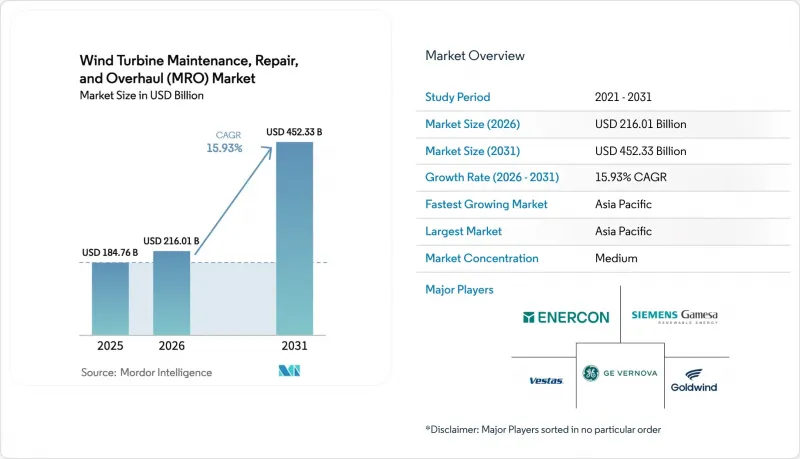
根據 Mordor Intelligence 預測,風力發電機維護、修理和大修 (MRO) 市場規模預計將在 2025 年達到 1847.6 億美元,2026 年達到 2160.1 億美元,到 2031 年達到 4523.3 億美元,2026 年 2031 年的複合年成長率 15.195 年。
本報告按部署地點(陸上、海上)、服務類型(維護、修理、大修)、零件(葉輪、機艙/傳動系統、發電機、塔架、電力電子/控制)和地區(北美、歐洲、亞太地區、南美、中東和非洲)進行分類。
全球風力發電機維護、修理和大修 (MRO) 市場趨勢及洞察
透過延長使用壽命的維修來延長風力發電機的使用壽命。
營運商越來越傾向於選擇維修方案,這種方案只需四分之一的資本投入,即可將風力渦輪機的運作延長5至10年,而完全更換渦輪機的成本則要低得多。光是在德國,透過加固葉片軸承和更換主軸承,就延長了2005年之前安裝的超過4吉瓦風力渦輪機的使用壽命,從而避免了新建基礎工程所需的24至36個月的授權期。專案成本通常在每台渦輪機15萬至40萬美元之間,而完全更換則需要120萬至180萬美元。維斯塔斯公司報告稱,延壽合約的業務收益將在2025年達到18%,高於2023年的11%。在美國,由於《通貨膨脹削減法案》下的生產稅額扣抵政策(該政策獎勵現有渦輪機提高發電量),這一趨勢正在加速發展。 DNV GL 於 2024 年發布了更新的 IEC 61400 延壽指南,降低了認證風險,並為網路服務供應商積極參與維修工作開闢了道路。
利用人工智慧驅動的預測分析減少意外停機時間。
透過分析SCADA資料流、振動資料和熱成像的機器學習演算法,可以提前4到8週進行故障偵測,將被動式工單轉變為狀態驅動型任務。西門子歌美颯的「數位服務」平台計畫於2025年中期在25吉瓦的裝置容量上部署,該平台已將意外停機時間減少了22%,並將每颱風機的緊急應變成本降低了3.5萬美元/年。通用電氣的「數位風電場」套件已將18吉瓦設施的運轉率提高了15%。離岸風力發電電場業主尤其青睞這項技術,他們利用早期預警將干預操作整合到單一的宣傳活動中,從而將船舶租賃成本降低了高達40%。 2018年之前生產的風扇感測器密度較低,限制了改造選擇,也催生了儀表維修的市場。
5MW以上等級齒輪箱持續有可靠性問題。
由於軸承微點蝕、齒輪嚙合和潤滑油污染,齒輪箱故障仍然是6-8兆瓦級風力發電機組停機的最大單一原因,緊急維修成本(包括海上起重機的調動和發電損失)有時高達120萬美元。一項發表於2024年的同行評審研究涵蓋了1,200颱風力發電機組,結果發現,儘管齒輪箱僅佔所有零件的12%,卻佔總停機時間的38%。西門子歌美颯在其8兆瓦平台上的軸承故障數量超出預期後,增加了1.8億歐元的保固準備金。採埃孚2025年推出的模組化齒輪箱可實現現場軸承更換,從而將工時縮短40%,但對大多數業主而言,改造舊設備在經濟上仍然不可行。
細分市場分析
到2025年,陸上風力渦輪機將佔風力發電機維護、維修和大修(MRO)市場收入的90.1%。這主要得益於陸上風力渦輪機便利的公路交通和較低的人事費用。該領域每台渦輪機的平均年度支出約為35,000美元,每年進行兩次定期維護,且船舶費用極低。相較之下,離岸風力渦輪機在離岸風力發電渦輪機維護、維修和大修(MRO)市場規模中的佔有率正在快速成長,預計到2031年將以28.3%的複合年成長率成長,因為開發商正在向內陸地區安裝容量超過15兆瓦的風力渦輪機。每台離岸風力發電渦輪機的年度MRO支出通常為95,000美元,其中近一半是船舶物流費用。
浮動式風力發電帶來了額外的成本因素。動態繫錨碇系統、平台因縱搖和橫搖引起的擺動以及有限的作業天氣條件,都要求使用舷梯來補償運動,並配備自主巡檢無人機。日本耗資120億日圓的機器人葉片維修工具研發項目,清楚顯示業界已體認到傳統的繩索作業方式不足以滿足海上作業的需求。隨著海上作業在全球整體產能中所佔佔有率的不斷擴大,專業的海上承包商有望獲得高利潤,並融入這條新興供應鏈。然而,該供應鏈目前仍面臨船舶和合格技術人員短缺的問題。
區域分析
預計到2025年,亞太地區將佔全球銷售額的53.9%,並將在2031年之前維持17.6%的複合年成長率。中國的「十四五」規劃要求對2015年之前安裝的50吉瓦風電場進行控制設備升級和葉片加長,這將增加維修成本,並擴大該地區風力發電機維護、維修和大修(MRO)市場的規模。金風科技位於內蒙古的服務中心於2025年10月投入運營,已將齒輪箱和備件的前置作業時間縮短了一半。印度的生產連結獎勵計畫計畫為翻新後的風力發電機提供每千瓦時15印度盧比的津貼,鼓勵業主透過更換多個零件進行重建,而不是直接報廢。
歐洲仍然是一個高價值市場,擁有30吉瓦的離岸風力發電裝置容量和嚴格的營運標準。英國第四輪海底權益授予條件要求開發商使用本國船舶完成60%的維護工作,從而刺激了當地價值鏈的擴張。德國和荷蘭正在支持對重型起重作業的需求,而西班牙則透過六個月的許可週期加快陸上風電場的改造升級。
在北美,《通貨膨脹抑制法案》延長了生產稅額扣抵政策,這為老舊風力渦輪機提供了助力,即使升級了齒輪箱、葉片和逆變器,它們仍能運作盈利。通用電氣於2025年11月簽署的價值3.2億美元的印度陸上維護、維修和大修(MRO)契約,清晰地表明了原始設備製造商(OEM)願意簽訂包含維修、大修和分析的長期契約。
南美洲、中東和非洲仍然是新興的需求來源。巴西國家環境工程和電氣設備管理局 (ANEEL) 現已強制要求每年進行葉片檢查,每兩年進行一次油質分析,這促使越來越多的新企業進入檢查和維護 (ISP) 領域。摩洛哥和南非是非洲市場上首批面臨大規模檢修的國家,因為2017年至2019年安裝的風力發電機已接近其使用壽命的過渡時期。
其他福利
- Excel格式的市場預測(ME)表
- 3個月的分析師支持
目錄
第1章:引言
- 研究假設和市場定義
- 調查範圍
第2章:調查方法
第3章執行摘要
第4章 市場狀況
- 市場概覽
- 市場促進因素
- 透過延長壽命維修來延長渦輪機壽命
- 利用人工智慧驅動的預測分析減少意外停機時間。
- 以服務為導向的OEM經營模式(按小時收費)
- 國家激勵計劃,旨在對運行超過 10 年的設備進行動力升級改造。
- 透過引入浮體式海上風力發電,創造了對專業MRO(維護、修理和大修)服務的需求。
- 市場限制因素
- 5MW以上等級齒輪箱持續有可靠性問題。
- 刀片維修技師和複合材料短缺。
- 長達 20 年的服務合約價格競爭給利潤帶來了壓力。
- 海上重型裝運船隻的物流瓶頸
- 供應鏈分析
- 監理情勢
- 技術展望
- 波特五力分析
第5章 市場規模與成長預測
- 按部署位置
- 陸上
- 離岸
- 按服務類型
- 維護
- 維修
- 大修
- 按組件
- 葉輪
- 引擎室傳動系統
- 發電機
- 塔
- 電力電子與控制
- 按地區
- 北美洲
- 美國
- 加拿大
- 墨西哥
- 歐洲
- 德國
- 英國
- 法國
- 西班牙
- 俄羅斯
- 芬蘭
- 瑞典
- 土耳其
- 荷蘭
- 其他歐洲國家
- 亞太地區
- 中國
- 印度
- 日本
- 韓國
- 澳洲
- 越南
- 其他亞太國家
- 南美洲
- 巴西
- 阿根廷
- 智利
- 其他南美國家
- 中東和非洲
- 沙烏地阿拉伯
- 南非
- 埃及
- 摩洛哥
- 其他中東和非洲國家
- 北美洲
第6章 競爭情勢
- 市場集中度
- 策略趨勢(併購、聯盟、購電協議)
- 市場佔有率分析(主要公司的市場排名和佔有率)
- 公司簡介
- Siemens Gamesa Renewable Energy SA
- Vestas Wind Systems A/S
- General Electric Company
- Goldwind Science & Technology Co. Ltd.
- Enercon GmbH
- Suzlon Energy Ltd.
- Nordex SE
- Envision Energy Ltd.
- ZF Friedrichshafen AG
- Moventas Gears Oy
- Stork(Fluor)
- Mistras Group
- Integrated Power Services LLC
- Dana SAC UK Ltd.
- Offshore Heavy Transport ASA(OHT)
- B9 Energy O&M Ltd.
- GEV Wind Power
- LM Wind Power(GE)
- BladeRepair.com
- Global Wind Service A/S
第7章 市場機會與未來展望
According to Mordor Intelligence, the wind turbine maintenance, repair, and overhaul market size is projected to be USD 184.76 billion in 2025, USD 216.01 billion in 2026, and reach USD 452.33 billion by 2031, growing at a CAGR of 15.93% from 2026 to 2031.
This report is Segmented by Location of Deployment (Onshore and Offshore), Service Type (Maintenance, Repair, and Overhaul), Component (Rotor Blades, Nacelle and Drivetrain, Generator, Tower, and Power-Electronics and Control), and Geography (North America, Europe, Asia-Pacific, South America, and Middle East and Africa).
Global Wind Turbine Maintenance, Repair, And Overhaul (MRO) Market Trends and Insights
Extended Turbine Lifespans Through Life-Extension Retrofits
Operators are increasingly choosing retrofit programs that add 5-10 additional operating years at one-quarter the capital outlay of full repowering. Germany alone has extended more than 4 GW of pre-2005 capacity by reinforcing blade spars and replacing main bearings, circumventing the 24-36-month permitting cycle tied to new foundations. Project costs typically fall between USD 150,000 and USD 400,000 per turbine, compared with USD 1.2 million to USD 1.8 million for a complete replacement. Vestas reported that life-extension contracts reached 18% of its 2025 service revenue, up from 11% in 2023. The trend is accelerating in the United States because the Inflation Reduction Act's production tax credit rewards incremental output from existing assets. Publication of DNV GL's updated IEC 61400 lifetime-extension guidelines in 2024 has lowered certification risk and opened the door for ISPs to compete aggressively for retrofit work.
AI-Driven Predictive Analytics Reduce Unplanned Downtime
Machine-learning algorithms that parse SCADA streams, vibration data, and thermal imagery are detecting failures 4-8 weeks in advance, turning reactive work orders into condition-based tasks. Siemens Gamesa's Digital Services platform, deployed across 25 GW by mid-2025, lowered unplanned downtime by 22% and trimmed emergency call-out costs by USD 35,000 per turbine per year. GE's Digital Wind Farm suite delivered a 15% availability gain across 18 GW of installations. Offshore owners value the technology most, using early alerts to cluster interventions into single campaigns and shave vessel charter budgets by up to 40%. Retrofits are limited by sparse sensor coverage on turbines built before 2018, creating an aftermarket for instrumentation upgrades.
Persistent Gearbox Reliability Issues in>5 MW Class
Bearing micropitting, gear-tooth spalling, and lubrication contamination keep gearbox failures the largest single cause of downtime in the 6-8 MW fleet, driving emergency repairs that can reach USD 1.2 million when offshore crane mobilization and lost generation are counted. A 2024 peer-reviewed study covering 1,200 turbines found gearbox outages at 38% of total downtime hours despite representing only 12% of the component count. Siemens Gamesa increased warranty provisions by EUR 180 million after higher-than-expected bearing failures on its 8 MW platform. While ZF's 2025 modular gearbox allows in-situ bearing swaps and trims intervention time by 40%, retrofitting legacy units remains uneconomical for most owners.
Other drivers and restraints analyzed in the detailed report include:
- Service-Oriented OEM Business Models (Power-by-the-Hour)
- National Repowering Incentives for >10-Year-Old Fleets
- Scarcity of Blade-Repair Technicians & Composite Materials
For complete list of drivers and restraints, kindly check the Table Of Contents.
Segment Analysis
Onshore installations represented 90.1% of wind turbine maintenance, repair & overhaul (MRO) market revenue in 2025, reflecting easier road access and lower labor rates. The segment's average annual spend per turbine hovers near USD 35,000, with two scheduled maintenance visits each year and minimal vessel costs. In contrast, the offshore share of the wind turbine maintenance, repair & overhaul (MRO) market size is rising quickly, advancing at 28.3% CAGR through 2031 as developers install >15 MW turbines farther from shore. A single offshore turbine typically consumes USD 95,000 annually in MRO outlays, with vessel logistics absorbing almost half of that bill.
Floating-wind adds yet another cost layer. Dynamic mooring systems, pitch-roll platform motion, and scarcer weather windows require motion-compensated gangways and autonomous inspection drones. Japan's JPY 12 billion program to build robotic blade-repair tools underscores industry recognition that conventional rope-access methods will not suffice offshore. As offshore work claims a larger slice of global capacity, specialized marine contractors are expected to capture outsized margins and consolidate a young supply chain still short on vessels and certified technicians.
Complete Report Scope:
- By Location of Deployment
- Onshore
- Offshore
- By Service Type
- Maintenance
- Repair
- Overhaul
- By Component
- Rotor Blades
- Nacelle and Drivetrain
- Generator
- Tower
- Power-Electronics and Control
- By Geography
- North America
- United States
- Canada
- Mexico
- Europe
- Germany
- United Kingdom
- France
- Spain
- Russia
- Finland
- Sweden
- Tukey
- Netherlands
- Rest of Europe
- Asia Pacific
- China
- India
- Japan
- South Korea
- Australia
- Vietnam
- Rest of Asia Pacific
- South America
- Brazil
- Argentina
- Chile
- Rest of South America
- Middle East and Africa
- Saudi Arabia
- South Africa
- Egypt
- Morocco
- Rest of Middle East and Africa
- North America
Geography Analysis
Asia-Pacific retained 53.9% of 2025 global revenue and is expected to clock a 17.6% CAGR through 2031. China's 14th Five-Year Plan mandates controller upgrades and blade extensions across 50 GW of pre-2015 assets, lifting retrofit outlays and enlarging the wind turbine maintenance, repair & overhaul (MRO) market size in the region. Goldwind's Inner Mongolia service hub, opened in October 2025, halves lead times for gearboxes and spares. India's production-linked incentive grants INR 15 per kWh for overhauled turbines, encouraging owners to invest in multi-component rebuilds rather than decommission.
Europe remains a high-value arena owing to its 30 GW offshore fleet and strict operating codes. The UK's Round 4 seabed awards compel developers to use domestic vessels for 60% of maintenance activity, spurring local supply-chain build-out. Germany and the Netherlands anchor demand for heavy-lift campaigns, while Spain accelerates onshore repowering with six-month permitting cycles.
North America benefits from the Inflation Reduction Act's extended production tax credit, which keeps older turbines profitably spinning after gearbox, blade, and inverter upgrades. GE's USD 320 million Indian onshore MRO contract in November 2025 illustrates OEM appetite for long-dated agreements that blend retrofit, overhaul, and analytics.
South America and the Middle East & Africa remain emerging contributors. Brazil's ANEEL now enforces annual blade inspections and biennial oil analysis, spawning new ISP entrants. Morocco and South Africa are the first African markets to confront large-scale overhauls as 2017-2019 turbines approach mid-life.
- Siemens Gamesa Renewable Energy SA
- Vestas Wind Systems A/S
- General Electric Company
- Goldwind Science & Technology Co. Ltd.
- Enercon GmbH
- Suzlon Energy Ltd.
- Nordex SE
- Envision Energy Ltd.
- ZF Friedrichshafen AG
- Moventas Gears Oy
- Stork (Fluor)
- Mistras Group
- Integrated Power Services LLC
- Dana SAC UK Ltd.
- Offshore Heavy Transport ASA (OHT)
- B9 Energy O&M Ltd.
- GEV Wind Power
- LM Wind Power (GE)
- BladeRepair.com
- Global Wind Service A/S
Additional Benefits:
- The market estimate (ME) sheet in Excel format
- 3 months of analyst support
TABLE OF CONTENTS
1 Introduction
- 1.1 Study Assumptions & Market Definition
- 1.2 Scope of the Study
2 Research Methodology
3 Executive Summary
4 Market Landscape
- 4.1 Market Overview
- 4.2 Market Drivers
- 4.2.1 Extended turbine lifespans through life-extension retrofits
- 4.2.2 AI-driven predictive analytics reduce unplanned downtime
- 4.2.3 Service-oriented OEM business models (power-by-the-hour)
- 4.2.4 National repowering incentives for >10-yr-old fleets
- 4.2.5 Floating-wind rollout creates specialized MRO demand
- 4.3 Market Restraints
- 4.3.1 Persistent gearbox reliability issues in >5 MW class
- 4.3.2 Scarcity of blade-repair technicians & composite materials
- 4.3.3 Revenue squeeze from 20-year service contract price-wars
- 4.3.4 Logistics bottlenecks for offshore heavy-lift vessels
- 4.4 Supply-Chain Analysis
- 4.5 Regulatory Landscape
- 4.6 Technological Outlook
- 4.7 Porter's Five Forces
- 4.7.1 Bargaining Power of Suppliers
- 4.7.2 Bargaining Power of Buyers
- 4.7.3 Threat of New Entrants
- 4.7.4 Threat of Substitutes
- 4.7.5 Competitive Rivalry
5 Market Size & Growth Forecasts
- 5.1 By Location of Deployment
- 5.1.1 Onshore
- 5.1.2 Offshore
- 5.2 By Service Type
- 5.2.1 Maintenance
- 5.2.2 Repair
- 5.2.3 Overhaul
- 5.3 By Component
- 5.3.1 Rotor Blades
- 5.3.2 Nacelle and Drivetrain
- 5.3.3 Generator
- 5.3.4 Tower
- 5.3.5 Power-Electronics and Control
- 5.4 By Geography
- 5.4.1 North America
- 5.4.1.1 United States
- 5.4.1.2 Canada
- 5.4.1.3 Mexico
- 5.4.2 Europe
- 5.4.2.1 Germany
- 5.4.2.2 United Kingdom
- 5.4.2.3 France
- 5.4.2.4 Spain
- 5.4.2.5 Russia
- 5.4.2.6 Finland
- 5.4.2.7 Sweden
- 5.4.2.8 Tukey
- 5.4.2.9 Netherlands
- 5.4.2.10 Rest of Europe
- 5.4.3 Asia Pacific
- 5.4.3.1 China
- 5.4.3.2 India
- 5.4.3.3 Japan
- 5.4.3.4 South Korea
- 5.4.3.5 Australia
- 5.4.3.6 Vietnam
- 5.4.3.7 Rest of Asia Pacific
- 5.4.4 South America
- 5.4.4.1 Brazil
- 5.4.4.2 Argentina
- 5.4.4.3 Chile
- 5.4.4.4 Rest of South America
- 5.4.5 Middle East and Africa
- 5.4.5.1 Saudi Arabia
- 5.4.5.2 South Africa
- 5.4.5.3 Egypt
- 5.4.5.4 Morocco
- 5.4.5.5 Rest of Middle East and Africa
- 5.4.1 North America
6 Competitive Landscape
- 6.1 Market Concentration
- 6.2 Strategic Moves (M&A, Partnerships, PPAs)
- 6.3 Market Share Analysis (Market Rank/Share for key companies)
- 6.4 Company Profiles (includes Global level Overview, Market level overview, Core Segments, Financials as available, Strategic Information, Products & Services, and Recent Developments)
- 6.4.1 Siemens Gamesa Renewable Energy SA
- 6.4.2 Vestas Wind Systems A/S
- 6.4.3 General Electric Company
- 6.4.4 Goldwind Science & Technology Co. Ltd.
- 6.4.5 Enercon GmbH
- 6.4.6 Suzlon Energy Ltd.
- 6.4.7 Nordex SE
- 6.4.8 Envision Energy Ltd.
- 6.4.9 ZF Friedrichshafen AG
- 6.4.10 Moventas Gears Oy
- 6.4.11 Stork (Fluor)
- 6.4.12 Mistras Group
- 6.4.13 Integrated Power Services LLC
- 6.4.14 Dana SAC UK Ltd.
- 6.4.15 Offshore Heavy Transport ASA (OHT)
- 6.4.16 B9 Energy O&M Ltd.
- 6.4.17 GEV Wind Power
- 6.4.18 LM Wind Power (GE)
- 6.4.19 BladeRepair.com
- 6.4.20 Global Wind Service A/S
7 Market Opportunities & Future Outlook
- 7.1 White-Space & Unmet-Need Assessment

 風力發電機運轉和維護市場:2026-2032年全球市場預測(按服務類型、渦輪機類型、渦輪機尺寸、應用和最終用戶分類)
 風力發電機運轉和維護市場-全球產業規模、佔有率、趨勢、機會、預測:按類型、地點、地區和競爭格局分類,2021-2031年風力發電機運轉和維護市場-全球產業規模、佔有率、趨勢、機會、預測:按類型、地點、地區和競爭格局分類,2021-2031年
 風力發電機運轉與維護市場:全球產業規模、佔有率、成長、類型/應用分析、區域洞察及2026-2034年預測全球風力發電機運轉和維護市場規模、佔有率、趨勢和成長分析報告(2026-2034年)風力發電機維護服務市場按服務類型、合約類型、零件類型、供應商類型和渦輪機尺寸分類 - 全球預測 2026-2032 年
 風力發電機運轉和維護市場規模、佔有率和成長分析(按類型、地點、組件和地區分類)-2026-2033年產業預測
 風力渦輪機運轉及維護市場機會、成長促進因素、產業趨勢分析及預測(2025-2034年)
 全球風力發電機營運和維護市場:預測至 2032 年 - 按服務類型、組件、部署、維護類型、服務供應商、應用程式和地區進行分析
 全球風力發電機營運與維護市場(按位置、類型、渦輪機拓撲結構和地區分類)- 預測至 2030 年