


 |
市場調查報告書
商品編碼
2120614
印度網路安全與網路風險管理:市場佔有率分析、產業趨勢與統計及成長預測(2026-2031)India Network Security And Cyber Risk Management - Market Share Analysis, Industry Trends & Statistics, Growth Forecasts (2026 - 2031) |
||||||

※ 本網頁內容可能與最新版本有所差異。詳細情況請與我們聯繫。
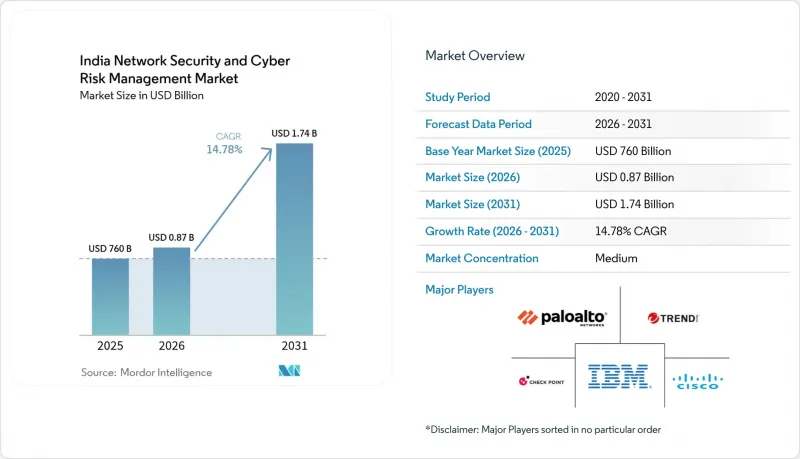
根據 Mordor Intelligence 預測,印度網路安全和網路風險管理市場規模預計將從 2025 年的 7.6 億美元成長到 2026 年的 8.723 億美元,到 2031 年將達到 17.4 億美元,2026 年至 2031 年的複合年成長率為 14.78%。
本報告按以下類別細分:(安全資訊和事件管理 (SIEM),其他)、(加密、識別及存取管理 (IAM),其他)、(網路安全,其他)、(銀行、金融服務和保險 (BFSI)、政府和國防,其他)以及(本地部署,其他)。市場預測以美元 (USD) 計價。
印度網路安全和網路風險管理市場的趨勢和洞察。
金融科技交易的擴張導致攻擊面擴大。
2023年,印度金融科技平台共記錄了429,847起網路安全事件。攻擊目標通常是開放API和第三方整合,這增加了攻擊者的入侵管道。 Aditya Birla Capital的資料外洩事件導致價值23萬美元的數位黃金損失,生動地展現了連網服務供應商帶來的連鎖風險。為符合DPDP 2023的要求,企業必須具備加密、稽核追蹤和違規通知機制,這迫使金融科技公司採用具備人工智慧異常偵測功能的先進SIEM平台。雖然競爭壓力推動了功能的快速發布,但每一次新的整合都會擴大攻擊面。因此,首席資訊安全(CISO)正在優先考慮持續監控、微隔離和以身分為中心的控制措施,以保護客戶交易並維護印度網路安全和網路風險管理市場的信任。
印度OEM韌體遭遇零日供應鏈攻擊
印度電腦緊急應變小組 (CERT-In) 已在本地 OEM韌體中發現多個嚴重漏洞,包括運行 Android 11 至 14 系統的三星裝置中存在的漏洞,這些漏洞可導致任意程式碼執行和敏感資料外洩。針對印度銀行的 2024 年勒索軟體攻擊利用嵌入 Jenkins 伺服器的 CVE-2024-23897 漏洞入侵付款閘道,凸顯了韌體缺陷如何在供應鏈中傳播。工業 4.0 設備的普及進一步加劇了這種風險,尤其是在出口導向製造地。因此,企業正在將韌體完整性檢查、供應商審計評分卡和持續漏洞掃描納入其採購流程。供應鏈安全性的提高推動了對整合到 SIEM 和 SOAR 平台中的端點檢測與回應 (EDR) 工具的需求,從而促進了印度網路安全和網路風險管理市場的成長。
網路安全專業技術人員短缺40萬人
到2027年,印度需要100萬名網路安全專業人員,但目前只有30萬人具備立即上崗所需的技能,缺口高達40萬人。其中一半的缺口來自銀行、金融和保險(BFSI)產業,導致人事費用上升,加重了企業內部團隊的負擔。為了彌補人才缺口,企業正擴大將網路安全工作外包給託管檢測與回應(MDR)服務供應商,並採用人工智慧驅動的自動化技術。政府主導的各項舉措,例如微軟的「網路教育」(CyberShikshaa)項目,致力於提升弱勢群體的技能,但每年培養的專業人員數量仍然無法滿足市場需求。因此,技能短缺正在減緩中小企業採用零信任等先進架構的速度,並阻礙印度網路安全和網路風險管理市場的成長。
細分市場分析
到2025年,SIEM(安全資訊和事件管理)領域將佔印度網路安全和網路風險管理市場規模的28.12%,反映出企業對集中式日誌分析和自動化警報的需求,以滿足CERT-In的要求。大型企業正在將SIEM與SOAR(安全營運自動化與回應)整合,以編配演練手冊,縮短回應時間並減輕審計負擔。中型企業則傾向選擇雲端託管的SIEM訂閱服務,以避免資本投資。同時,隨著身分驗證成為混合辦公環境中的一項新要求,身分管理自動化(IGA)解決方案正以17.18%的複合年成長率成長。自動化配置和基於風險的存取審查簡化了使用者生命週期管理,並改進了合規性報告。
這兩個細分市場的成長均受到多重雲端環境中整合可視性需求的驅動。供應商正在整合機器學習模型進行異常檢測,並利用市場洞察從SaaS、容器和物聯網層擷取遙測資料。隨著數位化供應鏈的不斷深化,客戶越來越傾向於採用整合SIEM、XDR和身分驗證管治的平台,這預示著保全行動模式的轉變,並將重塑印度的網路安全和網路風險管理市場。
到2025年,身分與存取管理(IAM)將佔據印度網路安全和網路風險管理市場31.05%的佔有率,成為從特權存取控制到單一登入等所有細分領域的基礎。監管機構強制要求詳細記錄訪問日誌,進一步鞏固了IAM平台的普及。同時,受遠端辦公和5G邊緣連接的推動,零信任網路存取(ZTNA)預計將以18.05%的複合年成長率(CAGR)實現最高成長。 ZTNA將透過持續檢驗、微隔離和情境感知策略取代基於邊界的VPN。
隨著企業為應對後量子威脅和滿足資料保護與防洩漏 (DPDP) 合規性要求做好準備,對加密和資料防洩漏 (DLP) 的需求日益成長。買家擴大採用整合身分與存取管理 (IAM)、零威脅網路分析 (ZTNA) 和加密功能的解決方案套件,這些功能整合在一個統一的實施引擎下。這種整合降低了營運成本,加速了微企業(MSME) 的採用,並擴大了印度網路安全和網路風險管理市場的商機。
其他福利
- Excel格式的市場預測(ME)表
- 3個月的分析師支持
目錄
第1章:引言
- 市場定義與研究假設
- 調查範圍
第2章:調查方法
第3章執行摘要
第4章 市場狀況
- 市場概覽
- 市場促進因素
- 金融科技交易的擴張導致攻擊面擴大。
- 印度OEM韌體遭遇零日供應鏈攻擊
- CERT-In有義務在6小時內通報侵權行為
- 微企業對雲端原生技術的採用率不斷提高
- 在智慧製造地部署5G專用網路
- 用於利用人工智慧生成的攻擊來打擊網路釣魚和深度造假的支出
- 市場限制因素
- 網路安全專業技術人員短缺40萬人
- 各州對資料保護法律的執行力度不一致。
- 中小企業零信任架構的總擁有成本高昂
- 關鍵基礎設施中的傳統OT系統
- 價值鏈分析
- 重要法規結構的評估
- 對關鍵相關人員的影響評估
- 技術展望
- 波特五力分析
- 宏觀經濟因素的影響
第5章 市場規模與成長預測
- 按細分市場
- 安全資訊和事件管理 (SIEM)
- 安全性 Web 閘道 (SWG)
- 身分管治與管理 (IGA)
- 企業級內容感知型資料遺失防護 (DLP)
- 透過解決方案
- 加密
- 識別及存取管理 (IAM)
- 預防資料外泄(DLP)
- 入侵偵測與防禦(IDS/IPS)
- 零信任網路存取(ZTNA)
- 按服務
- 網路安全
- 端點安全
- 無線安全
- 雲端安全
- 託管偵測與回應 (MDR)
- 按最終用戶行業分類
- BFSI
- 政府/國防
- 衛生保健
- IT/通訊
- 零售與電子商務
- 製造業
- 部署模式
- 現場
- 基於雲端的
第6章 競爭情勢
- 市場集中度
- 策略趨勢
- 市佔率分析
- 公司簡介
- Cisco Systems Inc.
- Palo Alto Networks Inc.
- IBM Corporation
- Check Point Software Technologies Ltd.
- Trend Micro Inc.
- Fortinet Inc.
- Sophos Group plc
- Safe Security(Safe Security Pvt Ltd.,前身為 Lucideus)
- Quick Heal Technologies Ltd.
- Tata Communications Ltd.
- Wipro Ltd.(Cybersecurity and Risk Services)
- HCL Technologies Ltd.
- Infosys Ltd.
- Instasafe Technologies Pvt Ltd.
- XenArmor Security Solutions
- ArrayShield Technologies Pvt Ltd.
- Data Resolve Technologies Pvt Ltd.
- Netrika Consulting India Pvt Ltd.
- Mirox Cybersecurity and Technology Pvt Ltd.
- Cyberoam Technologies Pvt Ltd.(Sophos 的子公司)
第7章 市場機會與未來趨勢
- 未開發市場和未滿足需求的評估
According to Mordor Intelligence, the India network security and cyber risk management market size is expected to grow from USD 760 million in 2025 to USD 872.3 million in 2026 and is forecast to reach USD 1.74 billion by 2031 at 14.78% CAGR over 2026-2031.
This report is Segmented by Segment (Security Information and Event Management (SIEM), and More), Solution (Encryption, Identity and Access Management (IAM), and More), Service (Network Security, and More), End-User Industry (BFSI, Government and Defence, and More), and Deployment Mode (On-Premise, and More). The Market Forecasts are Provided in Terms of Value (USD).
India Network Security And Cyber Risk Management Market Trends and Insights
FinTech Transaction-Sprawl Intensifying Attack Surface
Indian FinTech platforms recorded 429,847 cyber incidents in 2023, with exploits frequently targeting open APIs and third-party integrations that multiply entry points for attackers. The Aditya Birla Capital breach, which siphoned USD 0.23 million in digital gold, illustrates cascading risks created by interconnected service providers. Compliance with DPDP 2023 demands encryption, audit trails and breach notification, pushing FinTechs toward advanced SIEM platforms with AI-based anomaly detection. Competitive pressures encourage rapid feature releases, yet every new integration widens the attack surface. Consequently, chief information security officers prioritize continuous monitoring, micro-segmentation and identity-centric controls to protect customer transactions and sustain trust across the India network security and cyber risk management market.
Zero-Day Supply-Chain Exploits on Indian OEM Firmware
CERT-In has flagged multiple critical vulnerabilities in local OEM firmware, including Samsung devices running Android 11-14, enabling arbitrary code execution and sensitive-data exfiltration . A 2024 ransomware campaign against Indian banks leveraged CVE-2024-23897 embedded in Jenkins servers to breach payment gateways, underscoring how firmware flaws propagate across supply chains . Proliferation of Industry 4.0 devices magnifies this exposure, especially in export-oriented manufacturing hubs. Enterprises, therefore, embed firmware-integrity checks, vendor-audit scorecards, and continuous vulnerability scanning in procurement workflows. Tightening supply-chain security raises demand for endpoint detection and response tools integrated with SIEM and SOAR platforms, reinforcing growth in the India network security and cyber risk management market.
Shortage of 400k Skilled Cyber-Security Professionals
India requires 1 million cybersecurity professionals by 2027, yet only 300,000 people currently possess employable skills, creating a 400,000-person gap. BFSI alone accounts for half of this unmet demand, which raises labor costs and stretches internal teams . Organizations increasingly outsource to Managed Detection and Response providers and deploy AI-based automation to compensate for missing talent. Government initiatives like Microsoft's CyberShikshaa upskill underrepresented groups, yet annual output remains below market needs. Skills scarcity thereby slows implementation of sophisticated architectures such as zero-trust among small and mid-size enterprises, tempering the growth trajectory of the India network security and cyber risk management market.
Other drivers and restraints analyzed in the detailed report include:
- Mandatory CERT-In Six-Hour Breach-Reporting Rule
- Rising Cloud-Native Adoption Among MSMEs
- Fragmented State-Level Data-Protection Enforcement
For complete list of drivers and restraints, kindly check the Table Of Contents.
Segment Analysis
The SIEM segment generated 28.12% of the India network security and cyber risk management market size in 2025, reflecting organizations' need for centralized log analytics and automated alerts that satisfy CERT-In mandates. Large enterprises integrate SIEM with SOAR to orchestrate playbooks, reducing response times and audit overhead. Mid-sized firms prefer cloud-hosted SIEM subscriptions to avoid capital expenditure. Meanwhile, IGA solutions compound at a 17.18% CAGR as identity becomes the new perimeter in hybrid workplaces. Automated provisioning and risk-based access reviews improve user-lifecycle efficiency and compliance reporting.
Growth in both segments stems from demand for unified visibility in multi-cloud environments. Vendors embed machine-learning models for anomaly detection, while marketplace integrations pull telemetry from SaaS, container and IoT layers. As digital supply chains deepen, customers favor platforms that combine SIEM, XDR and identity governance, signaling a shift toward converged security operations that will redefine the India network security and cyber risk management market.
Identity and Access Management retained a 31.05% share of the India network security and cyber risk management market in 2025, anchoring everything from privileged-access controls to single sign-on. Regulatory clauses requiring granular access logs further entrench IAM platforms. Yet Zero Trust Network Access posts the fastest 18.05% CAGR, propelled by remote-work policies and 5G edge connectivity. ZTNA replaces perimeter-based VPNs with continuous verification, micro-segmentation, and contextual policies.
Encryption and DLP gain traction as enterprises prepare for post-quantum threats and DPDP compliance, respectively. Buyers increasingly adopt solution suites that integrate IAM, ZTNA, and encryption under unified policy engines. This convergence reduces operational overhead and accelerates adoption among MSMEs, expanding revenue opportunities across the India network security and cyber risk management market.
Complete Report Scope:
- By Segment
- Security Information and Event Management (SIEM)
- Secure Web Gateway (SWG)
- Identity Governance and Administration (IGA)
- Enterprise Content-Aware Data Loss Prevention (DLP)
- By Solution
- Encryption
- Identity and Access Management (IAM)
- Data Loss Protection (DLP)
- Intrusion Detection/Prevention (IDS/IPS)
- Zero-Trust Network Access (ZTNA)
- By Service
- Network Security
- Endpoint Security
- Wireless Security
- Cloud Security
- Managed Detection and Response (MDR)
- By End-user Industry
- BFSI
- Government and Defence
- Healthcare
- IT and Telecom
- Retail and E-Commerce
- Manufacturing
- By Deployment Mode
- On-premise
- Cloud-based
List of Companies Covered in this Report:
- Cisco Systems Inc.
- Palo Alto Networks Inc.
- IBM Corporation
- Check Point Software Technologies Ltd.
- Trend Micro Inc.
- Fortinet Inc.
- Sophos Group plc
- Safe Security (Safe Security Pvt Ltd., formerly Lucideus)
- Quick Heal Technologies Ltd.
- Tata Communications Ltd.
- Wipro Ltd. (Cybersecurity and Risk Services)
- HCL Technologies Ltd.
- Infosys Ltd.
- Instasafe Technologies Pvt Ltd.
- XenArmor Security Solutions
- ArrayShield Technologies Pvt Ltd.
- Data Resolve Technologies Pvt Ltd.
- Netrika Consulting India Pvt Ltd.
- Mirox Cybersecurity and Technology Pvt Ltd.
- Cyberoam Technologies Pvt Ltd. (a Sophos Company)
Additional Benefits:
- The market estimate (ME) sheet in Excel format
- 3 months of analyst support
TABLE OF CONTENTS
1 INTRODUCTION
- 1.1 Market Definition and Study Assumptions
- 1.2 Scope of the Study
2 RESEARCH METHODOLOGY
3 EXECUTIVE SUMMARY
4 MARKET LANDSCAPE
- 4.1 Market Overview
- 4.2 Market Drivers
- 4.2.1 FinTech transaction-sprawl intensifying attack surface
- 4.2.2 Zero-day supply-chain exploits on Indian OEM firmware
- 4.2.3 Mandatory CERT-In six-hour breach-reporting rule
- 4.2.4 Rising cloud-native adoption among MSMEs
- 4.2.5 5G private?network roll-outs in smart-manufacturing hubs
- 4.2.6 Generative-AI driven phishing and deep-fake prevention spend
- 4.3 Market Restraints
- 4.3.1 Shortage of 400k skilled cyber-security professionals
- 4.3.2 Fragmented state-level data-protection enforcement
- 4.3.3 High TCO of zero-trust architectures for SMEs
- 4.3.4 Legacy OT systems in critical infrastructure
- 4.4 Value Chain Analysis
- 4.5 Evaluation of Critical Regulatory Framework
- 4.6 Impact Assessment of Key Stakeholders
- 4.7 Technological Outlook
- 4.8 Porter's Five Forces Analysis
- 4.8.1 Bargaining Power of Suppliers
- 4.8.2 Bargaining Power of Consumers
- 4.8.3 Threat of New Entrants
- 4.8.4 Threat of Substitutes
- 4.8.5 Intensity of Competitive Rivalry
- 4.9 Impact of Macro-economic Factors
5 MARKET SIZE AND GROWTH FORECASTS (VALUE)
- 5.1 By Segment
- 5.1.1 Security Information and Event Management (SIEM)
- 5.1.2 Secure Web Gateway (SWG)
- 5.1.3 Identity Governance and Administration (IGA)
- 5.1.4 Enterprise Content-Aware Data Loss Prevention (DLP)
- 5.2 By Solution
- 5.2.1 Encryption
- 5.2.2 Identity and Access Management (IAM)
- 5.2.3 Data Loss Protection (DLP)
- 5.2.4 Intrusion Detection/Prevention (IDS/IPS)
- 5.2.5 Zero-Trust Network Access (ZTNA)
- 5.3 By Service
- 5.3.1 Network Security
- 5.3.2 Endpoint Security
- 5.3.3 Wireless Security
- 5.3.4 Cloud Security
- 5.3.5 Managed Detection and Response (MDR)
- 5.4 By End-user Industry
- 5.4.1 BFSI
- 5.4.2 Government and Defence
- 5.4.3 Healthcare
- 5.4.4 IT and Telecom
- 5.4.5 Retail and E-Commerce
- 5.4.6 Manufacturing
- 5.5 By Deployment Mode
- 5.5.1 On-premise
- 5.5.2 Cloud-based
6 COMPETITIVE LANDSCAPE
- 6.1 Market Concentration
- 6.2 Strategic Moves
- 6.3 Market Share Analysis
- 6.4 Company Profiles (includes Global level Overview, Market level overview, Core Segments, Financials as available, Strategic Information, Market Rank/Share for key companies, Products and Services, and Recent Developments)
- 6.4.1 Cisco Systems Inc.
- 6.4.2 Palo Alto Networks Inc.
- 6.4.3 IBM Corporation
- 6.4.4 Check Point Software Technologies Ltd.
- 6.4.5 Trend Micro Inc.
- 6.4.6 Fortinet Inc.
- 6.4.7 Sophos Group plc
- 6.4.8 Safe Security (Safe Security Pvt Ltd., formerly Lucideus)
- 6.4.9 Quick Heal Technologies Ltd.
- 6.4.10 Tata Communications Ltd.
- 6.4.11 Wipro Ltd. (Cybersecurity and Risk Services)
- 6.4.12 HCL Technologies Ltd.
- 6.4.13 Infosys Ltd.
- 6.4.14 Instasafe Technologies Pvt Ltd.
- 6.4.15 XenArmor Security Solutions
- 6.4.16 ArrayShield Technologies Pvt Ltd.
- 6.4.17 Data Resolve Technologies Pvt Ltd.
- 6.4.18 Netrika Consulting India Pvt Ltd.
- 6.4.19 Mirox Cybersecurity and Technology Pvt Ltd.
- 6.4.20 Cyberoam Technologies Pvt Ltd. (a Sophos Company)
7 MARKET OPPORTUNITIES AND FUTURE TRENDS
- 7.1 White-space and Unmet-need Assessment

 5G網路安全市場預測至2034年-按安全類型、組件、網路架構、部署模式、應用、最終用戶和地區分類的全球分析
 網路風險服務市場報告:趨勢、預測與競爭分析(至2035年)
 燈塔信標市場規模、佔有率和成長分析:按信標類型、光源、應用、電源和地區分類-2026-2033年產業預測
 網路安全軟體市場:按組件、定價模式、解決方案包、運作環境、產業、部署模式和組織規模分類-2026-2032年全球市場預測
 安全軟體:市場佔有率分析、產業趨勢與統計、成長預測(2026-2031)
 網路風險管理市場規模、佔有率和趨勢分析報告:按組件、部署類型、企業規模、最終用途、地區和細分市場預測(2026-2033 年)
 安全軟體市場 - 全球產業規模、佔有率、趨勢、機會、預測:按部署模式、服務、類型、企業規模、地區和競爭對手分類,2021-2031 年
 2026年全球安全套件市場報告
 燈塔網路市場:按組件、技術、應用和地區分類
 防毒軟體套裝市場規模、佔有率、趨勢和預測:按設備、作業系統、最終用戶和地區分類,2026-2034 年