


 |
市場調查報告書
商品編碼
2120612
甲基叔丁基醚(MTBE):市場佔有率分析、行業趨勢和統計數據、成長預測(2026-2031)Methyl Tertiary Butyl Ether (MTBE) - Market Share Analysis, Industry Trends & Statistics, Growth Forecasts (2026 - 2031) |
||||||

※ 本網頁內容可能與最新版本有所差異。詳細情況請與我們聯繫。
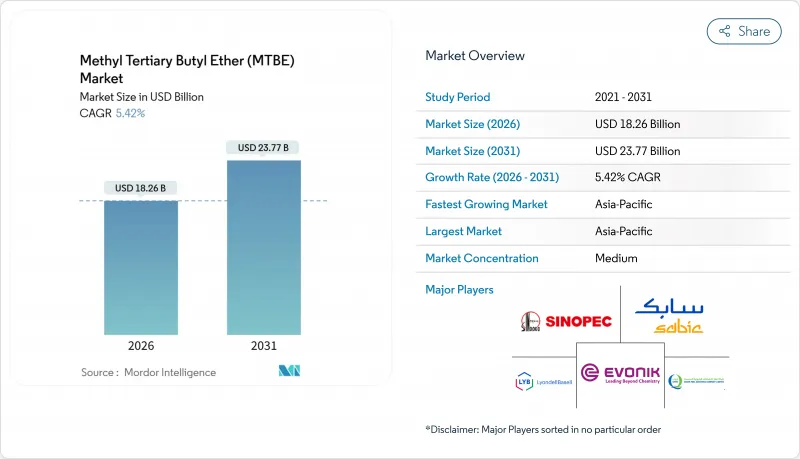
根據 Mordor Intelligence 估計,甲基叔丁基醚 (MTBE) 市場在 2026 年的規模為 182.6 億美元,預計到 2031 年將達到 237.7 億美元,在預測期(2026-2031 年)內以 5.42% 的複合成長率成長。
本報告按等級(工業級、醫藥級)、分銷管道(直銷、分銷商、其他)、應用(汽油添加劑、異丁烯、其他)、終端用戶行業(汽車、石油天然氣、其他)和地區(亞太地區、北美、歐洲、其他)進行細分。市場預測以美元計價。
全球甲基叔丁基醚 (MTBE) 市場趨勢及洞察
亞太地區強制使用低芳烴、高辛烷值汽油的需求激增。
亞太地區各國政府正在收緊汽油標準以遏制都市區空氣污染。中國的GB 17930-2016標準將苯含量限制在0.8%以內,芳烴含量限制在40%以內,並規定最低辛烷值(RON)為92。煉油廠可以透過摻入10-15%的甲基叔丁基醚(MTBE)來滿足這項規定,而無需投資建造大規模加氫裂解裝置。印度的Bharat Stage VI燃油標準(目前正在考慮於2025年進行修訂)也基於類似的邏輯,印度石油公司(IOC)和巴拉特石油公司(Bharat Petroleum)正在提高MTBE的摻混比例。在日本,由於耕地有限,燃油標準優先考慮MTBE而非乙醇,以維持穩定的需求基礎。亞太地區的乘用車保有量正以每年近5%的速度成長,每增加一輛車,每年就會產生120-225公升含MTBE汽油的需求。因此,在2030年後電動車在普通市場普及之前,這種添加劑將作為確保辛烷值的過渡解決方案。
中東地區煉油廠擴建及專用MTBE裝置的整合
這家國有石油公司正在整合其原油煉製和石化業務,以擺脫單純的原油出口模式。沙烏地阿美和中國石化於2025年4月宣布的亞斯里夫擴建計劃,除了年產能180萬噸的乙烯裂解裝置外,還將新增MTBE生產設施,以提高C4精煉油的附加價值。類似的計畫也出現在中國石化阿美福建計畫(投資100億美元,計畫於2024年11月開工)和卡達能源公司在其北方油田項目下投資60億美元的綜合設施中。由於精煉油的價格低於甲醇和遊離異丁烯,整合後的生產線將降低原料成本,並使煉油廠的綜合利潤率提高約3美元/桶。 「2030願景」下的「國家工業發展和物流計畫」將簡化授權程序並為企劃案融資提供支持,從而加快沿岸地區MTBE裝置的運作。
替代品的可用性(乙醇、乙基叔丁基醚、噻吩甲醚)
歐洲的RED II和RED III指令規定,到2030年,交通運輸領域可再生能源佔比必須達到14%,其中包括由生質乙醇生產的ETBE,但MTBE則必須源自石化燃料。到2024年,法國、德國和義大利的煉油廠幾乎已完全改用ETBE。在巴西,長期實施的「E27」乙醇強制令已完全取代MTBE,該國的靈活燃料汽車普及也鞏固了乙醇的地位。美國的可再生燃料標準(RFS)規定,調和燃料每年必須使用150億加侖玉米乙醇,因此MTBE被排除在辛烷值提升劑的選擇之外。韓國和台灣正在考慮引入TAME,因為其在地下水中的生物分解速度更快。東南亞國家正在推動生物柴油和乙醇的推廣計劃,預計在未來十年將進一步降低該地區對MTBE的需求。
細分市場分析
預計到2025年,工業用甲基叔丁基醚(MTBE)的銷售額將佔總銷售額的90.05%,顯示其在亞太和中東汽油市場作為辛烷值提升劑的廣泛應用。同時,由於原料藥藥(API)生產商看重其低極性和FDA 3級認證,預計到2031年,醫藥用MTBE的銷售額將成長5.93%。工業領域MTBE市場預計將維持較高的絕對成長率,因為每新增10-15%的MTBE用量,就能確保顯著的需求。中國和沿岸地區的綜合煉廠確保了萃餘油的穩定供應,從而維持了成本競爭力。
戰略成長潛力在於製藥領域,該領域對純度為99.8%、水分含量低於10 ppm、甲醇含量低於50 ppm的產品要求20-30%的溢價。印度和中國的原料藥生產中心——海得拉巴、艾哈默德巴德和維沙卡帕特南——正在擴大產能,預計將使醫藥級原料藥的需求保持5-6%的成長。歐洲原料藥生產商也在REACH法規的限制下逐步淘汰二氯甲烷,進一步鞏固了這個高利潤市場。如果這些轉化項目按計劃進行,預計將為依賴燃料循環的生產商帶來顯著的多元化經營。
2025年,直接銷售佔出貨量的70.12%,因為與煉油廠的採購協議包含數量、定價公式和技術支援等一攬子條款,從而確保汽油辛烷值符合標準。雖然這種銷售方式仍將是散裝燃料應用領域的主流,但甲基叔丁基醚(MTBE)市場正在湧現出新的電商模式,以滿足中型化學產品買家的需求。
1688.com 和 ChemBuyersClub 等線上平台正在中國沿海省份提供隔日送達的 MTBE 現貨供應,隨著物流網路的完善,其應用範圍也擴展到了印度。預計到 2031 年,線上銷售將以 6.32% 的複合年成長率快速成長。批發商繼續為那些沒有倉儲設施或信貸額度的區域買家供貨。到 2031 年,直接合約可能仍將佔據 60% 以上的市場佔有率,但預計數位商務將在特種級和醫藥級細分市場貢獻相當可觀的額外利潤。
區域分析
亞太地區在甲基叔丁基醚(MTBE)市場佔據主導地位,預計到2025年將佔據42.26%的市場佔有率,並有望在2031年之前以6.24%的複合年成長率持續成長。中國MTBE運作能超過1500萬噸,其摻混比例為10-15%,以滿足GB 17930-2016標準規定的辛烷值和芳烴含量限制。同時,印度、日本和東南亞正在加強燃油標準,強制要求類似的含氧劑含量。中國的甲醇制汽油轉化裝置正在創造一個獨立於煉油業務之外的額外結構性需求領域。受汽車數量每年約5%的成長推動,汽油運作仍居高不下,也支撐了該地區對MTBE的需求。
中東是成長速度第二快的地區,煉油商正將專用的MTBE裝置整合到石化園區內。沙烏地阿美中石化亞斯列夫煉油廠和福建煉油廠就是這種模式的典型例子,而卡達能源的北方油田擴建計畫將帶來新的供應來源,主要面向亞洲市場。一體化裝置能夠以折扣價將C4萃餘油貨幣化,與甲醇和異丁烯的獨立製程相比,經濟效益更高。在非洲,隨著南非修訂其燃料品質法規以及奈及利亞丹戈特煉油廠擴大產能,機會正在增加,儘管並不均衡。
北美和歐洲已基本退出MTBE混合燃料市場。在美國,各州的禁令已導致MTBE產量在2024年降至每日3萬桶以下,而加拿大煉油商已轉向使用乙醇。歐洲的RED III(可再生能源指令III)正迫使煉油商過渡到ETBE或乙醇,因此該地區對MTBE的需求僅限於一些小眾溶劑和化學品應用。拉丁美洲的需求也同樣有限,因為巴西使用E27乙醇混合燃料,而阿根廷也有類似的生質燃料強制令。因此,需求分佈圖顯示出明顯的偏向,且在可再生辛烷值替代燃料在亞洲普及之前,這種趨勢不太可能逆轉。
其他福利
- Excel格式的市場預測(ME)表
- 3個月的分析師支持
目錄
第1章:引言
- 研究假設和市場定義
- 調查範圍
第2章:調查方法
第3章執行摘要
第4章 市場狀況
- 市場概覽
- 市場促進因素
- 亞太地區強制使用低芳烴、高辛烷值汽油的需求激增。
- 中東地區煉油廠擴建及專用MTBE裝置的整合
- 亞洲甲醇制汽油技術的進步帶動了MTBE需求的成長。
- 高性能輪胎對異辛烯(由 MTBE脫氫裝置製得)的需求增加。
- 擴大MTBE作為助溶劑在特殊活性藥物成分萃取的應用
- 市場限制因素
- 替代品的可用性(乙醇、乙基叔丁基醚、噻吩甲醚)
- 在北美被列為污染物,並禁止與汽油混合。
- 蒸汽裂解裝置C4萃餘油供應的波動
- 價值鏈分析
- 波特五力分析
第5章 市場規模與成長預測
- 按年級
- 工業級
- 醫藥級
- 透過分銷管道
- 直銷
- 銷售代理
- 線上銷售
- 透過使用
- 汽油添加劑
- 異丁烯
- 溶劑
- 其他
- 按最終用戶行業分類
- 車
- 石油和天然氣
- 化學品
- 製藥
- 其他
- 按地區
- 亞太地區
- 中國
- 印度
- 日本
- 韓國
- 其他亞太國家
- 北美洲
- 美國
- 加拿大
- 墨西哥
- 歐洲
- 德國
- 英國
- 義大利
- 法國
- 其他歐洲國家
- 南美洲
- 巴西
- 阿根廷
- 其他南美國家
- 中東和非洲
- 沙烏地阿拉伯
- 阿拉伯聯合大公國
- 卡達
- 土耳其
- 南非
- 奈及利亞
- 其他中東和非洲國家
- 亞太地區
第6章 競爭情勢
- 市場集中度
- 策略趨勢
- 市佔率和排名分析
- 公司簡介
- BP plc
- Chevron Phillips Chemical Company LLC
- China Petrochemical Corporation
- CNPC
- Eni SpA
- ENOC Company
- Enterprise Products Partners LP
- PETRONAS Chemicals Group Berhad
- Evonik Industries AG
- Exxon Mobil Corporation
- Formosa Plastics Corporation, USA
- Gazprom
- Huntsman International LLC
- LUKOIL
- LyondellBasell Industries Holdings BV
- QAFAC
- Reliance Industries Limited
- SABIC
- Shell plc
- Vinati Organics Limited
- Wanhua
第7章 市場機會與未來展望
According to Mordor Intelligence, the methyl tertiary butyl ether market size is estimated at USD 18.26 billion in 2026, and is expected to reach USD 23.77 billion by 2031, at a CAGR of 5.42% during the forecast period (2026-2031).
This report is Segmented by Grade (Industrial Grade and Pharmaceutical Grade), Distribution Channel (Direct Sales, Distributors, and More), Application (Gasoline Additives, Isobutene, and More), End-User Industry (Automotive, Oil and Gas, and More), and Geography (Asia-Pacific, North America, Europe, and More). The Market Forecasts are Provided in Terms of Value (USD).
Global Methyl Tertiary Butyl Ether (MTBE) Market Trends and Insights
Surging Low-Aromatic, High-Octane Fuel Mandates in Asia-Pacific
Governments across the Asia-Pacific are tightening gasoline specifications to curb urban air pollution. China's GB 17930-2016 caps benzene at 0.8% and aromatics at 40% while requiring a minimum 92 RON; blending MTBE at 10-15% allows refiners to meet the rule without major hydrocracker investments. India's Bharat Stage VI fuel code under review for a 2025 update follows a similar logic, prompting Indian Oil Corporation and Bharat Petroleum to raise MTBE ratios. Japan's fuel standard favors MTBE instead of ethanol because arable land is scarce, sustaining a stable demand base. Passenger-car fleets in Asia-Pacific are expanding at nearly 5% annually, so every additional vehicle locks in 120-225 liters of MTBE-containing gasoline each year. The additive, therefore, acts as a transitional octane solution until electric vehicles reach mass-market penetration after 2030.
Petro-Refinery Expansion in the Middle East with On-Purpose MTBE
National oil companies are integrating crude refining and petrochemicals to diversify away from pure crude exports. Saudi Aramco and Sinopec's Yasref expansion, announced in April 2025, added a 1.8 million tpy ethylene cracker plus an MTBE unit to valorize C4 raffinate. Similar blueprints are evident in Sinopec-Aramco Fujian (USD 10 billion, ground-breaking November 2024) and QatarEnergy's USD 6 billion complex under the North Field program. Integrated flows cut feedstock costs because raffinate trades at a discount to methanol and free isobutylene, lifting refinery complexity margins by about USD 3 per barrel. Vision 2030's National Industrial Development and Logistics Program guarantees streamlined permitting and project-finance support, accelerating MTBE start-ups in the Gulf.
Availability of Substitutes Such as Ethanol, ETBE, and TAME
Europe's RED II and RED III require 14% renewable energy in transport by 2030, and ETBE made from bioethanol qualifies, whereas fossil-based MTBE does not. Refiners in France, Germany, and Italy had already shifted almost completely to ETBE by 2024. Brazil's long-standing E27 ethanol mandate displaces MTBE altogether, and the nation's flex-fuel fleet entrenches ethanol's position. The U.S. Renewable Fuel Standard compels blenders to use 15 billion gallons of corn ethanol annually, removing MTBE from the octane toolbox. South Korea and Taiwan are exploring TAME because it biodegrades faster in groundwater. Southeast Asian countries are rolling out biodiesel and ethanol programs that may further erode regional MTBE demand over the next decade.
Other drivers and restraints analyzed in the detailed report include:
- Methanol-to-Gasoline Adoption Elevates MTBE Demand
- Rising Iso-Octene Demand via MTBE Dehydrogenation for High-Performance Tires
- Pollutant Classification and Blending Bans in North America
For complete list of drivers and restraints, kindly check the Table Of Contents.
Segment Analysis
Industrial-grade MTBE accounted for 90.05% of 2025 revenue, underscoring its use as an octane booster in Asia-Pacific and Middle Eastern gasoline pools, whereas pharmaceutical-grade MTBE is forecast to increase at 5.93% through 2031 as API producers favor its low polarity and Class 3 FDA status. The Methyl tertiary butyl ether market size for the industrial segment is projected to maintain high absolute growth because every new refinery barrel blended at 10-15% MTBE locks in a large volumetric pull. Integrated complexes in China and the Gulf ensure secure raffinate supply, preserving cost competitiveness.
Strategic upside resides in the pharmaceutical niche, which commands a 20-30% price premium due to 99.8% assay, sub-10 ppm water, and sub-50 ppm methanol specifications. Indian and Chinese API hubs in Hyderabad, Ahmedabad, and Visakhapatnam are adding capacity that will sustain a 5-6% demand trajectory for pharmaceutical-grade. European API makers are also shifting away from dichloromethane under REACH, reinforcing this high-margin outlet. If conversion projects proceed as planned, this will provide meaningful diversification for producers exposed to fuel cycles.
Direct sales claimed 70.12% of 2025 deliveries because refinery offtake agreements bundle volume, pricing formulas, and technical support, ensuring octane compliance at the gasoline rack. This route will stay dominant for bulk fuel applications, but the Methyl tertiary butyl ether market is witnessing new e-commerce models that cater to mid-sized chemical buyers.
Online platforms such as 1688.com and ChemBuyersClub are posting spot MTBE offers with next-day delivery in China's coastal provinces, and adoption is spreading to India as logistics networks improve. Online sales are expected to expand faster at a 6.32% CAGR through 2031. Distributors keep serving regional buyers who lack storage or credit lines. By 2031, direct contracts may still exceed 60% share, yet digital commerce will capture most of the incremental margin in specialty and pharma grades.
Complete Report Scope:
- By Grade
- Industrial Grade
- Pharmaceutical Grade
- By Distribution Channel
- Direct Sales
- Distributors
- Online Sales
- By Application
- Gasoline Additives
- Isobutene
- Solvents
- Other Applications
- By End-user Industry
- Automotive
- Oil and Gas
- Chemicals
- Pharmaceuticals
- Other End-user Industries
- By Geography
- Asia-Pacific
- China
- India
- Japan
- South Korea
- Rest of Asia-Pacific
- North America
- United States
- Canada
- Mexico
- Europe
- Germany
- United Kingdom
- Italy
- France
- Rest of Europe
- South America
- Brazil
- Argentina
- Rest of South America
- Middle East and Africa
- Saudi Arabia
- United Arab Emirates
- Qatar
- Turkey
- South Africa
- Nigeria
- Rest of Middle East and Africa
- Asia-Pacific
Geography Analysis
Asia-Pacific dominated the Methyl tertiary butyl ether market with a 42.26% share in 2025 and is forecast to expand at a 6.24% CAGR to 2031. China operates over 15 million tons/year of capacity and blends MTBE at 10-15% to hit GB 17930-2016 octane and aromatic caps, while India, Japan, and Southeast Asia tighten fuel standards that require similar oxygenate levels. Methanol-to-gasoline plants in China create an additional structural demand layer that is decoupled from refinery runs. Vehicle-fleet growth of nearly 5% annually keeps gasoline consumption high, sustaining the regional pull for MTBE.
The Middle East is the second-fastest growing cluster due to refiners embedding on-purpose MTBE units within petrochemical parks. Saudi Aramco-Sinopec Yasref and the Fujian complex exemplify the model, while QatarEnergy's project under the North Field expansion adds new supply aimed primarily at Asian markets. Integrated sites monetize discounted C4 raffinate, improving economics relative to standalone methanol-plus-isobutylene routes. Africa offers scattered but rising opportunities as South Africa reviews fuel-quality laws and Nigeria's Dangote refinery ramps up.
North America and Europe have largely exited the MTBE blend pool. U.S. production fell below 30,000 bpd in 2024 after state-level bans, and Canadian refiners shifted to ethanol. Europe's RED III pushes refiners to ETBE or ethanol, so MTBE demand there is confined to niche solvent and chemical uses. Latin America is similarly limited because Brazil blends E27 ethanol, and Argentina follows comparable biofuel mandates. The demand map therefore shows a pronounced east-of-Suez tilt that is unlikely to reverse before renewable-octane substitutes scale in Asia.
- BP plc
- Chevron Phillips Chemical Company LLC
- China Petrochemical Corporation
- CNPC
- Eni S.p.A.
- ENOC Company
- Enterprise Products Partners L.P.
- PETRONAS Chemicals Group Berhad
- Evonik Industries AG
- Exxon Mobil Corporation
- Formosa Plastics Corporation, U.S.A.
- Gazprom
- Huntsman International LLC
- LUKOIL
- LyondellBasell Industries Holdings B.V.
- QAFAC
- Reliance Industries Limited
- SABIC
- Shell plc
- Vinati Organics Limited
- Wanhua
Additional Benefits:
- The market estimate (ME) sheet in Excel format
- 3 months of analyst support
TABLE OF CONTENTS
1 Introduction
- 1.1 Study Assumptions and Market Definition
- 1.2 Scope of the Study
2 Research Methodology
3 Executive Summary
4 Market Landscape
- 4.1 Market Overview
- 4.2 Market Drivers
- 4.2.1 Surging low-aromatic, high-octane gasoline mandates in Asia-Pacific
- 4.2.2 Petro-refinery expansion in Middle-East integrated with on-purpose MTBE units
- 4.2.3 Methanol-to-gasoline route adoption in Asia elevating MTBE demand
- 4.2.4 Rising demand for iso-octene (via MTBE dehydrogenation) in high-performance tyres
- 4.2.5 Growing use of MTBE as co-solvent in specialty API extraction
- 4.3 Market Restraints
- 4.3.1 Availability of substitutes (ethanol, ETBE, TAME)
- 4.3.2 Classification as pollutant and gasoline-blending bans in North America
- 4.3.3 Volatility in C4 raffinate availability from steam crackers
- 4.4 Value Chain Analysis
- 4.5 Porter's Five Forces Analysis
- 4.5.1 Bargaining Power of Suppliers
- 4.5.2 Bargaining Power of Buyers
- 4.5.3 Threat of New Entrants
- 4.5.4 Threat of Substitute Products and Services
- 4.5.5 Degree of Competition
5 Market Size and Growth Forecasts (Value)
- 5.1 By Grade
- 5.1.1 Industrial Grade
- 5.1.2 Pharmaceutical Grade
- 5.2 By Distribution Channel
- 5.2.1 Direct Sales
- 5.2.2 Distributors
- 5.2.3 Online Sales
- 5.3 By Application
- 5.3.1 Gasoline Additives
- 5.3.2 Isobutene
- 5.3.3 Solvents
- 5.3.4 Other Applications
- 5.4 By End-user Industry
- 5.4.1 Automotive
- 5.4.2 Oil and Gas
- 5.4.3 Chemicals
- 5.4.4 Pharmaceuticals
- 5.4.5 Other End-user Industries
- 5.5 By Geography
- 5.5.1 Asia-Pacific
- 5.5.1.1 China
- 5.5.1.2 India
- 5.5.1.3 Japan
- 5.5.1.4 South Korea
- 5.5.1.5 Rest of Asia-Pacific
- 5.5.2 North America
- 5.5.2.1 United States
- 5.5.2.2 Canada
- 5.5.2.3 Mexico
- 5.5.3 Europe
- 5.5.3.1 Germany
- 5.5.3.2 United Kingdom
- 5.5.3.3 Italy
- 5.5.3.4 France
- 5.5.3.5 Rest of Europe
- 5.5.4 South America
- 5.5.4.1 Brazil
- 5.5.4.2 Argentina
- 5.5.4.3 Rest of South America
- 5.5.5 Middle East and Africa
- 5.5.5.1 Saudi Arabia
- 5.5.5.2 United Arab Emirates
- 5.5.5.3 Qatar
- 5.5.5.4 Turkey
- 5.5.5.5 South Africa
- 5.5.5.6 Nigeria
- 5.5.5.7 Rest of Middle East and Africa
- 5.5.1 Asia-Pacific
6 Competitive Landscape
- 6.1 Market Concentration
- 6.2 Strategic Moves
- 6.3 Market Share/Ranking Analysis
- 6.4 Company Profiles (includes Global-level Overview, Market-level Overview, Core Segments, Financials as available, Strategic Information, Products and Services, and Recent Developments)
- 6.4.1 BP plc
- 6.4.2 Chevron Phillips Chemical Company LLC
- 6.4.3 China Petrochemical Corporation
- 6.4.4 CNPC
- 6.4.5 Eni S.p.A.
- 6.4.6 ENOC Company
- 6.4.7 Enterprise Products Partners L.P.
- 6.4.8 PETRONAS Chemicals Group Berhad
- 6.4.9 Evonik Industries AG
- 6.4.10 Exxon Mobil Corporation
- 6.4.11 Formosa Plastics Corporation, U.S.A.
- 6.4.12 Gazprom
- 6.4.13 Huntsman International LLC
- 6.4.14 LUKOIL
- 6.4.15 LyondellBasell Industries Holdings B.V.
- 6.4.16 QAFAC
- 6.4.17 Reliance Industries Limited
- 6.4.18 SABIC
- 6.4.19 Shell plc
- 6.4.20 Vinati Organics Limited
- 6.4.21 Wanhua
7 Market Opportunities and Future Outlook
- 7.1 White-space and Unmet-Need Assessment
- 7.2 Innovation in Bio-based MTBE for Gasoline


