


 |
市場調查報告書
商品編碼
2062357
乙基叔丁基醚:市佔率分析、產業趨勢與統計、成長預測(2026-2031)Ethyl Tertiary Butyl Ether - Market Share Analysis, Industry Trends & Statistics, Growth Forecasts (2026 - 2031) |
||||||

※ 本網頁內容可能與最新版本有所差異。詳細情況請與我們聯繫。
預計到 2025 年,乙基叔丁基醚 (ETBE) 市場規模將達到 71.2 億美元,到 2026 年將達到 77.9 億美元,到 2031 年將達到 122.1 億美元。
預計從 2026 年到 2031 年,其複合年成長率將達到 9.41%。
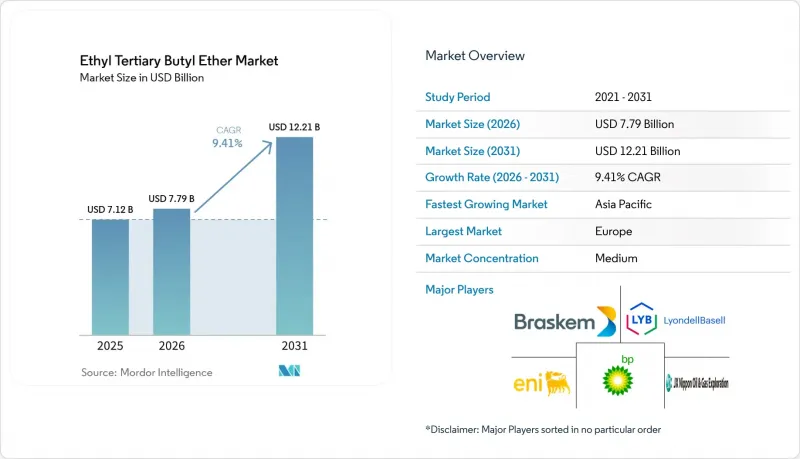
本報告按原料(乙醇基乙基叔丁基醚和異丁烯基乙基叔丁基醚)、燃料類型(無鉛汽油等)、功能(辛烷值改進劑等)、終端用戶產業(煉油廠和調合廠等)以及地區(亞太地區、北美地區、歐洲地區、南美地區、中東和非洲地區)進行細分。市場預測以美元計價。
全球乙基叔丁基醚 (ETBE) 市場趨勢及洞察
由於降低地下水污染風險,以MTBE取代ETBE。
加州於2003年禁用MTBE,並於2006年因MTBE造成廣泛的地下水污染而在全美範圍內逐步淘汰,這使得人們對更安全的醚類替代品ETBE的需求持續成長。日本也於2003年效仿,維修了Cosmo Oil位於堺市的工廠以適應ETBE的生產,並在2023會計年度摻入了29.7萬千升生物基ETBE。韓國和台灣仍在探索氧化方案,預計隨著老舊MTBE生產設施的逐步淘汰,ETBE的採用率將逐步提高。 ETBE的快速生物分解性和低水溶性減輕了燃料經銷商的污染防治負擔。到2030年後,隨著大多數現有MTBE工廠的改造或關閉,這種替代效應將會減緩。
加強汽車排放氣體法規
歐盟7、EPA Tier 3、中國國六和印度BS-VI排放標準正在收緊氮氧化物、顆粒物和芳烴的排放限值,迫使煉油商提高含氧量以實現更清潔的燃燒。乙基叔丁基醚(ETBE)的含氧量為15.66%(重量比),研究法辛烷值(RON)為119,這使得引擎能夠在不改變引擎控制的情況下以更稀的混合氣運作。中國的GB 18351-2025標準將無乙醇汽油的含氧量限制在2.7%,為ETBE在高辛烷值汽油混合燃料中創造了一個高階細分市場。歐洲低溫條件下的實際排放氣體測試進一步證明了低揮發性含氧劑的優點。即使監管趨勢導致直接乙醇混合燃料的擴張,這種添加劑的重要性仍然存在。
生物基醚與直接乙醇混合物之間的競爭
印度預計2025年實現全國範圍內的E20汽油標準,目前其乙醇產能為199億公升,因此直接調配乙醇比合成乙基叔丁基醚(ETBE)更經濟。中國的E10汽油標準禁止添加其他含氧化合物,因此ETBE僅限於高階無乙醇汽油。在歐洲,E10汽油的市佔率在2023年達到40.3%,如果德國逐步淘汰剩餘的E5汽油,這一比例可能會進一步上升。同時,叔戊基乙醚和其他C5醚類汽油也在高階汽油市場爭奪市場佔有率。未來兩年,這種不利因素在對成本高度敏感的亞洲市場將最為顯著。
細分市場分析
受符合可再生能源指令 (RED) 的纖維素原料供應以及美巴乙醇走廊促進日本進口的推動,乙醇衍生的乙基叔丁基醚 (ETBE) 預計到 2025 年將佔據 ETBE 市場佔有率的 62.22%。乙醇基 ETBE 市場預計到 2031 年將以 9.22% 的複合年成長率成長。由於其對成本高度敏感,成長將取決於玉米和甘蔗價格的波動,但 RED III 下的雙重累計獎勵可在一定程度上保障利潤率。隨著可再生路線的成熟,異丁烯基 ETBE 將獲得戰略重要性,尤其是在 Global Bioenergies 的 Leuna 工廠和 Gevo 的 Net-Zero 1 工廠開始初步商業化供應之後。
中期來看,獲得「高級認證」預計將進一步推動歐洲對纖維素乙醇和廢氣衍生異丁烯的需求成長。 2028年後,隨著規模經濟的成熟,可再生異丁烯可望取代15-20%的石化衍生供應,從而可能鞏固乙基叔丁基醚(ETBE)市場原料基礎的多元化。
到2025年,無鉛汽油將佔乙基叔丁基醚(ETBE)市場銷售額的45.11%,並將繼續成為市場支柱。這是因為在歐洲和日本,許多高檔汽油中不含乙醇,以抑制其蒸氣壓的急劇上升。然而,與E10和其他生質燃料混合燃料相關的ETBE市場規模預計將在預測期(2026-2031年)內以9.78%的複合年成長率(CAGR)快速成長。這主要是由於ETBE中生質乙醇的比例必須翻倍,以及為了滿足有害空氣污染物的監管限值而減少芳烴排放的排放。德國和法國的情況就充分體現了這種雙重性。儘管E10的滲透率正在提高,高檔E5汽油仍維持著盈利的ETBE細分市場。
展望未來,夏季汽油蒸氣限制和寒冷氣候下冷啟動問題的擔憂將繼續成為使用醚類混合燃料的必要理由。然而,隨著車輛全面符合E10標準以及零售網路重組,直接乙醇可能會獲得更大的市場佔有率,儘管乙基叔丁基醚(ETBE)在標準汽油中的使用量可能會減少,但其在高階汽油市場的地位或許能夠維持。這種微妙的變化對於參與企業至關重要。
區域分析
預計到2025年,歐洲將佔乙基叔丁基醚(ETBE)市場收入的36.22%,主要得益於RED III配額和成熟的高階汽油需求。德國、法國、義大利和西班牙佔據了歐洲大陸大部分的ETBE加工量,這主要歸功於這些國家高階汽油中ETBE含量較高。東歐煉油商,例如Orlen Lietuva,也考慮從MTBE轉向ETBE,以符合跨境出口標準。
亞太地區是成長最快的地區,預計到2031年將維持9.15%的複合年成長率。光是日本在2024年就將進口18.3億公升乙基叔丁基醚(ETBE),並維持嚴格的規定,要求進口相當於5億公升乙醇當量的乙醇。中國的優質汽油市場不受E10的限制,仍指定高階品牌使用醚類含氧添加劑,即使普通汽油轉向乙醇,乙基叔丁基醚(ETBE)市場仍有成長空間。在印度,隨著彈性燃料汽車在2028年後逐漸普及,煉油廠負責人正在評估ETBE是否能與E20在高階汽油市場共存。
北美市場已趨於成熟,並受到RFS2(再生燃料標準2)規定的每年150億加侖玉米乙醇配額的限制。因此,乙基叔丁基醚(ETBE)在市場上的應用僅限於專用賽車燃料和有限的航空汽油市場。加拿大和墨西哥也呈現類似的趨勢,出於成本和供應的考慮,兩國傾向於直接混合乙醇。在南美洲,尤其是巴西,由於甘蔗乙醇資源豐富且E27.5汽油混合燃料市場成熟,ETBE並未廣泛應用。
儘管中東和非洲地區對乙基叔丁基醚(ETBE)的應用仍處於起步階段,但該地區市場具有重要的戰略意義。沙烏地阿拉伯煉油商正在考慮使用ETBE來實現其國家辛烷值目標,而無需大幅擴建石腦油重整裝置;而南非則計劃提升燃油質量,這為優質汽油創造了小規模但可觀的需求機會。在這兩個地區,較低的汽油零售價格限制了短期銷售量,但高利潤的優質汽油細分市場仍有發展空間。
其他好處:
- Excel格式的市場預測(ME)表
- 3個月的分析師支持
目錄
第1章:引言
- 研究假設和市場定義
- 調查範圍
第2章:調查方法
第3章執行摘要
第4章 市場狀況
- 市場概覽
- 市場促進因素
- 由於降低地下水污染風險,以MTBE取代ETBE。
- 加強汽車排放氣體法規
- 歐盟基於 RED II 標準的先進生質燃料配額正在刺激高階需求。
- 透過工業廢氣發酵整合可再生異丁烯
- 低排放量船用燃料和永續航空燃料對含氧化合物的新需求
- 市場限制因素
- 生物基醚與乙醇直接混合所造成的競爭
- ETBE生產設施的維修和升級需要大量資金投入。
- 由於乙醇永續性認證體系分散,合規成本增加。
- 價值鏈分析
- 波特五力模型
第5章 市場規模與成長預測
- 按原料
- 乙醇衍生的乙基叔丁基醚
- 異丁烯基乙基叔丁基醚
- 按燃料類型
- 無鉛汽油
- 優質汽油
- E10 和其他生質燃料混合物
- 其他燃料類型
- 按功能
- 辛烷值提升劑
- 防敲劑
- 含氧燃料添加劑
- 排放氣體添加劑
- 按最終用戶行業分類
- 煉油廠和調和設施
- 燃料批發商和零售連鎖店
- 汽車原始設備製造商和售後市場
- 船舶和航空燃料供應商
- 政府和監管機構
- 測試實驗室和客製化攪拌機
- 按地區
- 亞太地區
- 中國
- 印度
- 日本
- 韓國
- 東南亞國協
- 其他亞太國家
- 北美洲
- 美國
- 加拿大
- 墨西哥
- 歐洲
- 德國
- 英國
- 法國
- 義大利
- 西班牙
- 俄羅斯
- 北歐國家
- 其他歐洲國家
- 南美洲
- 巴西
- 阿根廷
- 其他南美國家
- 中東和非洲
- 沙烏地阿拉伯
- 南非
- 其他中東和非洲國家
- 亞太地區
第6章 競爭情勢
- 市場集中度
- 策略趨勢
- 市佔率和排名分析
- 公司簡介
- BP plc
- Braskem
- Cosmo Engineering Co., Ltd.
- Eni SpA
- Exxon Mobil Corporation
- Georganics Ltd.
- Gevo, Inc.
- INEOS Group
- JX Nippon Oil and Energy Corporation
- LyondellBasell Industries Holdings BV
- Merck KGaA
- Mitsui Chemicals, Inc.
- Neste
- Orlen
- PETRONAS Chemicals Group
- Tokyo Chemical Industry(India)Pvt. Ltd.
- TotalEnergies
第7章 市場機會與未來展望
According to Mordor Intelligence, the ethyl tertiary butyl ether market size is projected to be USD 7.12 billion in 2025, USD 7.79 billion in 2026, and reach USD 12.21 billion by 2031, growing at a CAGR of 9.41% from 2026 to 2031.
This report is Segmented by Feedstock (Ethanol-Based ETBE and Isobutylene-Based ETBE), Fuel Type (Unleaded Gasoline and More), Function (Octane Enhancer and More), End-User Industry (Oil Refineries and Blending Facilities, and More), and Geography (Asia-Pacific, North America, Europe, South America, and the Middle East and Africa). The Market Forecasts are Provided in Terms of Value (USD).
Global Ethyl Tertiary Butyl Ether Market Trends and Insights
Substitution of MTBE With ETBE Due to Lower Groundwater-Contamination Risk
California banned MTBE in 2003, and the United States phased it out nationwide by 2006 after widespread groundwater contamination, opening durable demand for ETBE as a safer ether alternative. Japan followed in 2003, retrofitting Cosmo Oil's Sakai unit to ETBE and blending 297,000 kiloliters of bio-ETBE in fiscal 2023. South Korea and Taiwan still review oxygenate options, suggesting incremental uptake as older MTBE capacity retires. ETBE's faster biodegradation and lower water solubility reduce remediation liabilities for fuel distributors. The substitution effect will taper after 2030 because most legacy MTBE plants will already be converted or shut down.
Stricter Automotive-Emission Regulations
Euro 7, EPA Tier 3, China National VI, and India BS-VI standards tighten limits on NOx, particulates, and aromatics, prompting refiners to raise oxygen content for cleaner combustion. ETBE provides 15.66% oxygen by weight and a RON of 119, letting engines run leaner without calibration changes. China's GB 18351-2025 caps oxygen at 2.7% for non-ethanol gasoline, carving a premium niche for ETBE in high-octane blends. Europe's real-driving-emissions testing under cold conditions further rewards low-volatility oxygenates. Regulatory momentum keeps the additive relevant even as direct ethanol blending expands.
Competition From Bioderived Ethers and Direct Ethanol Blending
India reached E20 nationwide in 2025 and now holds 19.9 billion liters of ethanol capacity, making direct blending cheaper than ETBE synthesis. China's E10 standard forbids extra oxygenates, so ETBE stays limited to premium non-ethanol grades. Europe's E10 share of 40.3% in 2023 could grow if Germany scraps its residual E5 grade. Meanwhile, tertiary amyl ethyl ether and other C5-based ethers vie for the same premium-gasoline space. The headwind is strongest in cost-sensitive Asian markets during the next two years.
Other drivers and restraints analyzed in the detailed report include:
- European Union RED II Advanced Biofuel Quotas Unlocking Premium Demand
- Emerging Need for Oxygenates in Low-Emission Marine and Sustainable-Aviation Fuels
- High CAPEX for Retrofitting ETBE Production Units
For complete list of drivers and restraints, kindly check the Table Of Contents.
Segment Analysis
Ethanol-based ETBE secured 62.22% of the ethyl tertiary butyl ether market share in 2025, buoyed by RED-compliant cellulosic streams and the U.S.-Brazil ethanol corridor fueling Japanese imports. The Ethyl tertiary butyl ether market size for Ethanol-based ETBE feedstock is projected to expand at a 9.22% CAGR to 2031. Cost sensitivity ties growth to corn and sugarcane price swings, yet double-counting incentives under RED III partially shelter margins. Isobutylene-based ETBE gains strategic relevance as renewable routes mature, especially once Global Bioenergies' Leuna unit and Gevo's Net-Zero 1 supply early commercial volumes.
In the medium term, certified-advanced status tilts European demand further toward cellulosic ethanol and waste-gas-derived isobutylene. Beyond 2028, maturing scale economics could let renewable isobutylene replace 15-20% of petrochemical supply, cementing a diversified feedstock base for the Ethyl tertiary butyl ether market.
Unleaded gasoline captured 45.11% of the ethyl tertiary butyl ether market revenue in 2025 and remains the backbone because many premium European and Japanese grades exclude ethanol to limit vapor-pressure spikes. Yet the Ethyl tertiary butyl ether market size associated with E10 and other biofuel blends is set to rise fastest at a CAGR of 9.78% during the forecast period (2026-2031), propelled by mandates that double-count ETBE's bioethanol contribution and curb aromatics to meet toxic-air-pollutant limits. Germany and France illustrate this duality: E10 penetration rises, but premium E5 retains a profitable ETBE niche.
Going forward, vapor-pressure-limited summer gasoline and cold-start concerns in northern climates continue to justify ether blending. Even so, once vehicle fleets are fully E10-capable and retail networks reconfigured, direct ethanol could claim a larger share, trimming ETBE volumes in standard-grade petrol while preserving it in premium niches, a nuance critical to Ethyl tertiary butyl ether market participants.
Geography Analysis
Europe anchored 36.22% of the ethyl tertiary butyl ether market revenue in 2025, driven by RED III quotas and mature premium-gasoline demand. Germany, France, Italy, and Spain together make up most of the continental throughput because premium grades retain high ETBE loadings. Eastern European refiners such as Orlen Lietuva are also evaluating MTBE-to-ETBE conversions to comply with cross-border export standards.
Asia-Pacific is the fastest-growing region at a 9.15% CAGR through 2031. Japan alone imported 1.83 billion liters of ETBE in 2024 and maintains a hard 500 million-liter ethanol-equivalent mandate. China's premium gasoline pool, shielded from E10 constraints, still specifies ether oxygenates for high-end brands, preserving upside for the Ethyl tertiary butyl ether market even as mass grades migrate to ethanol. In India, refinery planners assess whether ETBE can coexist with E20 in premium categories once flex-fuel vehicles enter volume after 2028.
North America is mature, operating in the shadow of a 15 billion-gallon-per-year corn-ethanol quota under RFS2. As a result, the Ethyl tertiary butyl ether market presence is confined to specialty racing fuels and limited aviation-gasoline pools. Canada and Mexico follow similar patterns, each favoring direct ethanol blending for cost and availability reasons. South America, led by Brazil, abstains from ETBE because of abundant sugarcane ethanol and entrenched E27.5 gasoline blends.
Middle East-and-Africa uptake remains nascent but strategically interesting. Saudi refiners examine ETBE as a route to meet domestic octane targets without major naphtha reformer expansions, while South Africa's pending fuel-quality upgrade opens a small premium-grade opportunity. In both sub-regions, low pump prices temper near-term volumes yet leave room for high-margin premium niches.
- BP p.l.c.
- Braskem
- Cosmo Engineering Co., Ltd.
- Eni S.p.A.
- Exxon Mobil Corporation
- Georganics Ltd.
- Gevo, Inc.
- INEOS Group
- JX Nippon Oil and Energy Corporation
- LyondellBasell Industries Holdings B.V.
- Merck KGaA
- Mitsui Chemicals, Inc.
- Neste
- Orlen
- PETRONAS Chemicals Group
- Tokyo Chemical Industry (India) Pvt. Ltd.
- TotalEnergies
Additional Benefits:
- The market estimate (ME) sheet in Excel format
- 3 months of analyst support
TABLE OF CONTENTS
1 Introduction
- 1.1 Study Assumptions and Market Definition
- 1.2 Scope of the Study
2 Research Methodology
3 Executive Summary
4 Market Landscape
- 4.1 Market Overview
- 4.2 Market Drivers
- 4.2.1 Substitution of MTBE with ETBE due to lower groundwater-contamination risk
- 4.2.2 Stricter automotive-emission regulations
- 4.2.3 European Union RED II advanced biofuel quotas unlocking premium demand
- 4.2.4 Integration of renewable isobutylene from industrial waste-gas fermentation
- 4.2.5 Emerging need for oxygenates in low-emission marine and sustainable-aviation fuels
- 4.3 Market Restraints
- 4.3.1 Competition from bioderived ethers and direct ethanol blending
- 4.3.2 High CAPEX for retrofitting/refurbishing ETBE production units
- 4.3.3 Fragmented ethanol sustainability certification schemes raising compliance cost
- 4.4 Value Chain Analysis
- 4.5 Porter's Five Forces
- 4.5.1 Threat of New Entrants
- 4.5.2 Bargaining Power of Buyers
- 4.5.3 Bargaining Power of Suppliers
- 4.5.4 Threat of Substitutes
- 4.5.5 Competitive Rivalry
5 Market Size and Growth Forecasts (Value)
- 5.1 By Feedstock
- 5.1.1 Ethanol-based ETBE
- 5.1.2 Isobutylene-based ETBE
- 5.2 By Fuel Type
- 5.2.1 Unleaded Gasoline
- 5.2.2 Premium Gasoline
- 5.2.3 E10 and Other Biofuel Blends
- 5.2.4 Other Fuel Types
- 5.3 By Function
- 5.3.1 Octane Enhancer
- 5.3.2 Anti-knocking Agent
- 5.3.3 Oxygenate Fuel Additive
- 5.3.4 Emissions-reduction Additive
- 5.4 By End-user Industry
- 5.4.1 Oil Refineries and Blending Facilities
- 5.4.2 Fuel Distributors and Retail Chains
- 5.4.3 Automotive OEMs and Aftermarket
- 5.4.4 Marine and Aviation Fuel Suppliers
- 5.4.5 Government and Regulatory Agencies
- 5.4.6 Testing Labs and Custom Blenders
- 5.5 By Geography
- 5.5.1 Asia-Pacific
- 5.5.1.1 China
- 5.5.1.2 India
- 5.5.1.3 Japan
- 5.5.1.4 South Korea
- 5.5.1.5 ASEAN Countries
- 5.5.1.6 Rest of Asia-Pacific
- 5.5.2 North America
- 5.5.2.1 United States
- 5.5.2.2 Canada
- 5.5.2.3 Mexico
- 5.5.3 Europe
- 5.5.3.1 Germany
- 5.5.3.2 United Kingdom
- 5.5.3.3 France
- 5.5.3.4 Italy
- 5.5.3.5 Spain
- 5.5.3.6 Russia
- 5.5.3.7 Nordic Countries
- 5.5.3.8 Rest of Europe
- 5.5.4 South America
- 5.5.4.1 Brazil
- 5.5.4.2 Argentina
- 5.5.4.3 Rest of South America
- 5.5.5 Middle-East and Africa
- 5.5.5.1 Saudi Arabia
- 5.5.5.2 South Africa
- 5.5.5.3 Rest of Middle-East and Africa
- 5.5.1 Asia-Pacific
6 Competitive Landscape
- 6.1 Market Concentration
- 6.2 Strategic Moves
- 6.3 Market Share(%)/Ranking Analysis
- 6.4 Company Profiles (includes Global Overview, Market Overview, Core Segments, Financials, Strategic Information, Products and Services, and Recent Developments)
- 6.4.1 BP p.l.c.
- 6.4.2 Braskem
- 6.4.3 Cosmo Engineering Co., Ltd.
- 6.4.4 Eni S.p.A.
- 6.4.5 Exxon Mobil Corporation
- 6.4.6 Georganics Ltd.
- 6.4.7 Gevo, Inc.
- 6.4.8 INEOS Group
- 6.4.9 JX Nippon Oil and Energy Corporation
- 6.4.10 LyondellBasell Industries Holdings B.V.
- 6.4.11 Merck KGaA
- 6.4.12 Mitsui Chemicals, Inc.
- 6.4.13 Neste
- 6.4.14 Orlen
- 6.4.15 PETRONAS Chemicals Group
- 6.4.16 Tokyo Chemical Industry (India) Pvt. Ltd.
- 6.4.17 TotalEnergies
7 Market Opportunities and Future Outlook
- 7.1 White-space and Unmet-need Assessment

 甲基叔丁基醚(MTBE):市場佔有率分析、行業趨勢和統計數據、成長預測(2026-2031)
 乙基叔丁基醚市場:依純度等級、原料類型、應用、終端用戶產業及通路分類-2026-2032年全球市場預測
 全球乙基叔丁基醚市場規模、佔有率、趨勢和成長分析報告(2026-2034)
 2026年乙基叔丁基醚全球市場報告
 甲基叔丁基醚 (MTBE) 市場規模、佔有率和成長分析(按類型、製造流程、應用、最終用途和地區分類)—2026-2033 年產業預測
 乙基叔丁基醚市場預測至 2030 年:依生產方法、等級、通路、燃料類型、應用、最終用戶和地區進行全球分析