

 |
市場調查報告書
商品編碼
2120610
學習管理系統(LMS):市場佔有率分析、產業趨勢與統計數據、成長預測(2026-2031)Learning Management System (LMS) - Market Share Analysis, Industry Trends & Statistics, Growth Forecasts (2026 - 2031) |
||||||

※ 本網頁內容可能與最新版本有所差異。詳細情況請與我們聯繫。
根據 Mordor Intelligence 預測,學習管理系統 (LMS) 市場預計將從 2025 年的 271.3 億美元成長到 2026 年的 305.1 億美元,到 2031 年達到 548.6 億美元,2026 年至 2031 年的複合成長率預計為 12.45%。
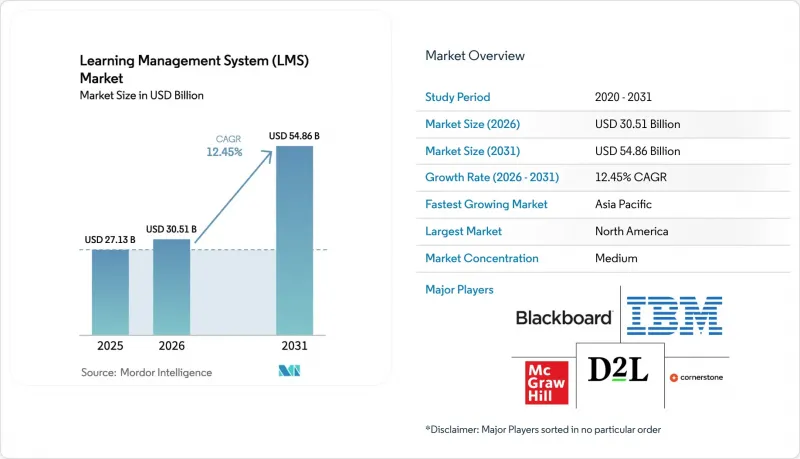
本報告按組件(解決方案、服務)、部署模式(雲端、本地部署)、交付模式(遠端教育、主導培訓、其他)、組織規模(大型企業、中小企業)、最終用戶行業(銀行、金融服務和保險、醫療保健/製藥、製造業、其他)以及地區進行細分。市場預測以美元計價。
全球學習管理系統(LMS)市場趨勢與洞察
遠距辦公和混合辦公模式的加速發展,推動了企業對學習管理系統(LMS)的需求不斷成長。
混合辦公模式的永久化已經徹底改變了企業進行新員工入職培訓和合規培訓的方式。截至2025年12月,58%的財富500強企業仍實行靈活的居家辦公政策,學習團隊也正從靜態入口網站遷移到行動友善平台,以便在Slack和Microsoft Teams等工具中展示微課程。開放的xAPI遙測技術能夠衡量虛擬實境(VR)模擬、快速參考影片和線上研討會的參與度,使學習與發展經理能夠在合規期限到期前進行干預。麥肯錫發布的《2025年數位技能發展研究》顯示,由人工智慧搜尋索引的同行創建的說明影片,使新員工掌握技能所需的時間縮短了23%。企業正在將這些社交學習資源整合到課程體系中,並培養知識共用文化,從而減少對高成本的講師主導課程的依賴。因此,能夠整合非同步和同步學習模式且不受地理限制的平台,其預算仍在增加。
透過引入人工智慧驅動的自適應學習演算法來提高課程完成率。
生成式人工智慧正在將學習管理系統 (LMS) 市場從單純的內容庫轉變為動態的教學環境。 2025 年,Instructure 整合了 GPT-4,實現了測驗的自動產生和討論總結。這使得教師的評分時間減少了 30%,同時保持了學術嚴謹性。自適應引擎會監控測驗分數、導航模式和作業完成時間,以預測輟學風險並實施干預措施,例如提供簡化的學習材料和同儕輔導。試行採用自適應工作流程的社區大學的課程完成率比基於小組的教學模式提高了 18 個百分點。同樣的演算法也支撐著一種基於能力的教育模式,在該模式下,成人學習者在進入下一階段之前需要展示其熟練程度,這種方法符合零工經濟對「即時技能發展」的需求。
學生人均 SaaS 授權成本不斷上漲,給 K-12 教育預算帶來了壓力。
預計到2025年,每位學生的平均學習成本將飆升11%,占美國許多學區教育科技預算的22%。面對高昂的續訂費用,學校管理者被迫在高級學習管理系統(LMS)功能和必要的硬體採購之間做出選擇,這進一步加劇了資金充足學校和資源匱乏學校之間的差距。一些學區正在協商聯盟定價,而另一些學區則正在遷移到開放原始碼的Moodle平台。商業供應商實施的免費增值模式造成了一種“兩極分化的生態系統”,使得融資緊張的教育機構難以負擔高級分析和自適應評估功能。如果這種情況無法改善,各學區將面臨重新採用過時的學習方法的風險,這將削弱疫情期間在數位素養方面取得的進步。
細分市場分析
從組成部分來看,打包解決方案在2025年佔據主導地位,銷售額佔比高達71.44%。然而,隨著買家越來越傾向於客製化和外包管理任務,預計到2031年,服務領域的成長速度將加快,複合年成長率將達到14.86%。儘管解決方案在2025年仍佔據銷售額的大部分,但服務領域的市場佔有率也實現了兩位數的成長。那些已經部署了最佳組合學習套件的公司,如今面臨著日益繁重的整合工作,從能力框架映射到跨不同人力資源和薪資系統設定單點登錄,不一而足。許多公司依賴託管服務供應商,這些提供者能夠保證99.9%的運轉率,並管理符合區域資料居住規定的全球內容目錄。
績效合約將報酬與課程完成率等可衡量的結果掛鉤,進一步推動了服務的成長。這使得供應商的獎勵與學習者的成功息息相關,並鼓勵規避風險的負責人批准大規模的轉型預算。對於教育機構而言,「培訓師訓練營」也大有裨益,它減少了對外部顧問的依賴,並使教師能夠自主設計數位化課程。企業外包和學術能力建構的雙重趨勢正在鞏固服務在學習管理系統 (LMS) 市場中的重要收入來源地位。
到2025年,雲端技術將佔據學習管理系統市場88.24%的佔有率,凸顯了能夠適應學生數量波動的彈性基礎設施的吸引力。跨國公司更傾向於多租戶SaaS模式,因為開放的REST API允許平台從其CRM、電子商務和行銷自動化系統中導入學習者數據,從而創建支援終身互動的整合檔案。即使是國防和銀行等資料管理法規嚴格的行業,也在考慮採用混合架構,將敏感記錄保存在本地伺服器上,同時將分析儀表板遷移到公共雲端。位於製造工廠和遠端校園的邊緣運算快取可提供低延遲、高解析度的內容,同時將能力記錄同步到中央資料湖,從而擴大目標需求並進一步鞏固雲端的優勢。
從部署模式來看,雲端平台預計不僅將在2025年佔據88.24%的市場佔有率,而且到2031年還將以14.22%的複合年成長率持續成長。另一方面,本地部署和混合模式的成長速度僅為個位數。雲端平台的普及速度正在加快,尤其是在全球學習生態系統日益分散化的背景下,各組織機構都在尋求可擴展的解決方案,同時又不希望承擔硬體升級週期帶來的額外開銷。儘管混合模式在嚴格監管的行業中仍然受到限制,但雲端部署的營運效率、深度整合和分析能力正在鞏固其作為學習管理系統(LMS)市場主要基礎的地位。
區域分析
預計到2025年,北美將維持36.52%的市場佔有率,成為最大的區域市場。美國企業正大力投資符合xAPI標準的分析技術,以視覺化詳細的技能缺口;而加拿大政府機構則優先考慮雙語服務,以滿足《個人資訊保護和電子文件法》(PIPEDA)的隱私要求。墨西哥正崛起為近岸實施服務中心,使供應商能夠在無需承擔矽谷高昂人事費用的情況下,延長對北美的支援期限。
亞太地區是成長最快的地區,複合年成長率高達12.88%,這主要得益於印度「PM eVIDYA 2.0」計畫的實施以及中國對國有企業智慧製造能力的強制性認證。在日本,政府為企業提供技能再培訓津貼,以彌補勞動流失,補貼金額最高可達學習管理系統(LMS)授權費用的70%。東南亞製造商正在採用區塊鏈檢驗來應對離職率,這鞏固了該地區作為學習管理系統(LMS)市場成長引擎的地位。
儘管歐洲正在穩步推動數位轉型,但各地不同的資料保護法規迫使供應商維護多個資料儲存位置。北歐國家正在試行以能力為基礎的教育模式,並採用自適應評估;德國則在推動學徒制追蹤的數位化。一個泛歐內容聯盟也在共用課程庫,以降低開發成本。中東地區的投資重點是具備離線同步功能的行動優先平台,而非洲的「最後一公里」連接仍然是一大障礙。在南美洲,隨著巴西推動大學課程數位化,智利正在探索一種公私合作的授權模式(以匿名分析數據換取平台使用費折扣),數位轉型的勢頭正在增強。
其他福利
- Excel格式的市場預測(ME)表
- 3個月的分析師支持
目錄
第1章:引言
- 研究假設和市場定義
- 調查範圍
第2章:調查方法
第3章執行摘要
第4章 市場狀況
- 市場概覽
- 市場促進因素
- 遠距辦公和混合辦公模式的加速發展,推動了企業對學習管理系統(LMS)的需求不斷成長。
- 政府為數位教育基礎設施提供資金
- 透過引入人工智慧驅動的自適應學習演算法來提高課程完成率。
- 亞太地區製造地企業對技能檢驗的微證書的需求。
- 歐盟關於醫療保健產業持續專業發展(CPD)的法規促進了專業學習管理系統(LMS)模組的廣泛應用。
- 自帶設備 (BYOD) 的普及正在加速中東地區「行動優先」雲端學習管理系統 (LMS) 的採用。
- 市場限制因素
- 學生人均 SaaS 授權成本不斷上漲,給 K-12 教育預算帶來了壓力。
- 在非洲和南亞的農村地區,寬頻網路存取分佈不均,限制了身臨其境型內容的可用性。
- 資料標準不一致阻礙了老字型大小企業中人力資源資訊系統 (HRIS) 和學習管理系統 (LMS) 的整合。
- 網路保險保費飆升阻礙了小規模醫療服務供應商遷移到雲端。
- 產業價值鏈分析
- 監理情勢
- 技術展望
- 宏觀經濟因素對市場的影響
- 波特五力分析
第5章 市場規模與成長預測
- 按組件
- 解決方案
- 服務
- 部署模式
- 雲
- 現場
- 根據配送方式而定
- 遠端教育
- 講師主導培訓
- 混合式學習
- 按組織規模
- 大公司
- 小型企業
- 按最終用戶行業分類
- BFSI
- 醫療和藥品
- 製造業
- 零售和消費品
- 教育機構
- 政府機構
- 其他終端用戶產業
- 按地區
- 北美洲
- 美國
- 加拿大
- 墨西哥
- 歐洲
- 英國
- 法國
- 德國
- 北歐的
- 其他歐洲國家
- 亞太地區
- 中國
- 印度
- 日本
- 韓國
- 其他亞太國家
- 南美洲
- 巴西
- 墨西哥
- 其他南美國家
- 中東
- 波灣合作理事會(GCC)成員國
- 土耳其
- 其他中東國家
- 非洲
- 南非
- 奈及利亞
- 其他非洲地區
- 北美洲
第6章 競爭情勢
- 市場集中度
- 策略趨勢
- 市佔率分析
- 公司簡介
- Cornerstone OnDemand Inc.
- Anthology Inc.(Blackboard)
- Instructure Inc.
- D2L Corporation
- SAP SE
- Oracle Corporation
- IBM Corporation
- Docebo SpA
- Adobe Inc.
- Absorb Software Inc.
- TalentLMS(Epignosis LLC)
- McGraw-Hill
- Saba Software
- Infor
- Skillsoft Corporation
- PowerSchool Holdings Inc.
- 360Learning SA
- Thought Industries Inc.
- Meridian Knowledge Solutions
- Google(Classroom)
- Microsoft Corporation
第7章 市場機會與未來展望
According to Mordor Intelligence, the learning management system market size is expected to increase from USD 27.13 billion in 2025 to USD 30.51 billion in 2026 and reach USD 54.86 billion by 2031, growing at a CAGR of 12.45% over 2026-2031.
This report is Segmented by Component (Solutions, and Services), Deployment Mode (Cloud, and On-Premise), Delivery Mode (Distance Learning, Instructor-Led Training, and More), Organization Size (Large Enterprises, Small and Medium Enterprises), End-User Vertical (BFSI, Healthcare and Pharmaceuticals, Manufacturing, and More), and Geography. The Market Forecasts are Provided in Terms of Value (USD).
Global Learning Management System (LMS) Market Trends and Insights
Accelerated Remote and Hybrid Work Models Sustaining Corporate LMS Demand
Permanent hybrid work norms have reshaped enterprise approaches to onboarding and compliance training. As of December 2025, 58% of Fortune 500 employers retained flexible location policies, prompting learning teams to replace static portals with mobile-responsive platforms that surface micro-lessons inside Slack and Microsoft Teams. Open xAPI telemetry now captures engagement across virtual-reality simulations, quick-reference videos, and live webinars, enabling learning-and-development managers to intervene before compliance deadlines lapse. Peer-generated video explainers, indexed by AI search, have shortened time-to-competency for new hires by 23% according to a 2025 McKinsey digital upskilling study. Corporations are inserting these social-learning artifacts into curricula, creating a knowledge-sharing culture that reduces reliance on expensive instructor-led sessions. The upshot is continued budget allocation to platforms that can orchestrate asynchronous and synchronous modalities without geographic constraints.
Integration of AI-Driven Adaptive Learning Algorithms Boosting Course-Completion Rates
Generative AI transforms the learning management system market from a content repository into a dynamic tutoring environment. In 2025, Instructure embedded GPT-4 to auto-generate quizzes and summarize discussions, cutting instructor grading time by 30% while maintaining academic rigor. Adaptive engines monitor quiz scores, navigation patterns, and time-on-task to predict drop-off risk, then trigger interventions such as simplified materials or peer mentoring. Community colleges piloting adaptive workflows posted an 18-percentage-point improvement in completion rates versus cohort-based instruction. The same algorithms underpin competency-based education models that let adult learners progress upon demonstrating mastery, an approach that aligns with the gig economy's demand for just-in-time upskilling.
Rising Per-Learner SaaS-Licensing Inflation Squeezing K-12 Budgets
Average per-learner fees jumped 11% in 2025, consuming 22% of instructional-technology budgets in many U.S. districts. Renewal sticker shock forces administrators to choose between premium LMS features and essential hardware purchases, widening equity gaps between affluent and under-resourced schools. Some districts negotiate consortium pricing, while others migrate to open-source Moodle instances. Freemium tiers introduced by commercial vendors create a two-speed ecosystem in which premium analytics and adaptive assessments remain out of reach for cash-strapped institutions. Without relief, districts risk reverting to outdated learning methods that undercut digital-literacy gains achieved during the pandemic.
Other drivers and restraints analyzed in the detailed report include:
- Government Funding for Digital Education Infrastructure
- Employer Demand for Skills-Verification Micro-Credentials in Asia Pacific Manufacturing Hubs
- Patchy Broadband Coverage Limiting Immersive-Content Delivery in Rural Africa and South Asia
For complete list of drivers and restraints, kindly check the Table Of Contents.
Segment Analysis
By component, packaged solutions dominated with a 71.44% revenue share in 2025, while services are projected to accelerate at a 14.86% CAGR through 2031 as buyers increasingly outsource customization and managed administration. Solutions generated the bulk of revenue in 2025, yet the services segment is widening its footprint on the strength of double-digit growth. Enterprises that deployed best-of-breed learning suites now face mounting integration chores, from mapping competency frameworks to configuring single-sign-on across disparate HR and payroll systems. Many rely on managed-services providers that guarantee 99.9% uptime and manage global content catalogs aligned with regional data-residency rules.
Services growth is further boosted by outcome-based contracts that peg fees to measurable gains such as course-completion rates. This realigns vendor incentives toward learner success and encourages risk-averse buyers to approve larger transformation budgets. Educational institutions also benefit from train-the-trainer bootcamps that reduce dependence on external consultants and enable faculty to design digital courses in-house. The dual dynamic of corporate outsourcing and academic capacity building reinforces services as a pivotal revenue lever in the learning management system (LMS) market.
Cloud deployments commanded 88.24% of the learning management system market in 2025, underscoring the appeal of elastic infrastructure that adapts to fluctuating enrollment. Multinationals favor multi-tenant SaaS models because open REST APIs allow platforms to ingest learner data from CRM, e-commerce, and marketing-automation stacks, creating unified profiles that support lifetime engagement. Even industries with sovereign data mandates, such as defense and banking, are exploring hybrid architectures that keep sensitive records on local servers while shifting analytics dashboards to the public cloud. Edge-computing caches placed inside manufacturing plants and remote campuses serve high-resolution content with low latency while synchronizing mastery records to central data lakes, broadening addressable demand and reinforcing cloud's primacy.
By deployment mode, cloud platforms not only held 88.24% market share in 2025, but are also projected to expand at a 14.22% CAGR through 2031, while on-premise and hybrid models post only single-digit growth. Adoption is further fueled by organizations seeking scalable delivery without the overhead of hardware refresh cycles, particularly as global learning ecosystems grow more distributed. Hybrid blueprints continue to gain selective traction for regulated sectors, yet the operational efficiencies, integration depth, and analytics capabilities of cloud deployments secure their position as the dominant backbone of the learning management system (LMS) market.
Complete Report Scope:
- By Component
- Solutions
- Services
- By Deployment Mode
- Cloud
- On-Premise
- By Delivery Mode
- Distance Learning
- Instructor-Led Training
- Blended Learning
- By Organization Size
- Large Enterprises
- Small and Medium Enterprises
- By End-User Vertical
- BFSI
- Healthcare and Pharmaceuticals
- Manufacturing
- Retail and Consumer Goods
- Educational Institutions
- Government Agencies
- Rest of End-User Verticals
- By Geography
- North America
- United States
- Canada
- Mexico
- Europe
- United Kingdom
- France
- Germany
- Nordics
- Rest of Europe
- Asia Pacific
- China
- India
- Japan
- South Korea
- Rest of Asia Pacific
- South America
- Brazil
- Mexico
- Rest of South America
- Middle East
- Gulf Cooperation Council Countries
- Turkey
- Rest of Middle East
- Africa
- South Africa
- Nigeria
- Rest of Africa
- North America
Geography Analysis
North America retained the largest regional share at 36.52% in 2025. United States enterprises invest heavily in xAPI-compliant analytics that surface granular skill gaps, while Canadian government agencies prioritize bilingual delivery to meet PIPEDA privacy mandates. Mexico is emerging as a near-shore hub for implementation services, letting vendors extend North American support windows without incurring Silicon Valley salary costs.
Asia Pacific is the fastest-growing territory with a 12.88% CAGR, propelled by India's PM eVIDYA 2.0 rollout and China's mandate that state-owned enterprises certify smart-manufacturing competencies. Japan subsidizes corporate reskilling to offset workforce shrinkage, covering up to 70% of LMS licensing fees. Southeast Asian manufacturers adopt blockchain-verified credentials to accommodate high labor turnover, cementing the region as a growth engine for the learning management system (LMS) market.
Europe shows steady adoption, but fragmented data-protection statutes force vendors to maintain multiple data-residency zones. Nordic countries pilot competency-based education that relies on adaptive assessments, Germany digitizes apprenticeship tracking, and pan-European content consortia share course libraries to dilute development costs. Middle East investments center on mobile-first platforms with offline-sync, while Africa's barrier remains last-mile connectivity. South America gains momentum as Brazil digitizes university curricula and Chile explores public-private licensing models that exchange anonymized analytics for platform discounts.
- Cornerstone OnDemand Inc.
- Anthology Inc. (Blackboard)
- Instructure Inc.
- D2L Corporation
- SAP SE
- Oracle Corporation
- IBM Corporation
- Docebo SpA
- Adobe Inc.
- Absorb Software Inc.
- TalentLMS (Epignosis LLC)
- McGraw-Hill
- Saba Software
- Infor
- Skillsoft Corporation
- PowerSchool Holdings Inc.
- 360Learning SA
- Thought Industries Inc.
- Meridian Knowledge Solutions
- Google (Classroom)
- Microsoft Corporation
Additional Benefits:
- The market estimate (ME) sheet in Excel format
- 3 months of analyst support
TABLE OF CONTENTS
1 INTRODUCTION
- 1.1 Study Assumptions and Market Definition
- 1.2 Scope of the Study
2 RESEARCH METHODOLOGY
3 EXECUTIVE SUMMARY
4 MARKET LANDSCAPE
- 4.1 Market Overview
- 4.2 Market Drivers
- 4.2.1 Accelerated Remote and Hybrid Work Models Sustaining Corporate LMS Demand
- 4.2.2 Government Funding for Digital Education Infrastructure
- 4.2.3 Integration of AI-Driven Adaptive Learning Algorithms Boosting Course-Completion Rates
- 4.2.4 Employer Demand for Skills-Verification Micro-Credentials in Asia Pacific Manufacturing Hubs
- 4.2.5 Mandatory CPD Regulations in EU Healthcare Catalyzing Specialised LMS Modules
- 4.2.6 BYOD Workforce Mobility Accelerating Mobile-First Cloud LMS Adoption in the Middle East
- 4.3 Market Restraints
- 4.3.1 Rising Per-Learner SaaS-Licensing Inflation Squeezing K-12 Budgets
- 4.3.2 Patchy Broadband Coverage Limiting Immersive-Content Delivery in Rural Africa and South Asia
- 4.3.3 Fragmented Data Standards Hindering HRIS-LMS Integrations in Legacy European Corporates
- 4.3.4 Escalating Cyber-Insurance Premiums Deterring Small Healthcare Providers from Cloud Migration
- 4.4 Industry Value Chain Analysis
- 4.5 Regulatory Landscape
- 4.6 Technological Outlook
- 4.7 Impact of Macroeconomic Factors on the Market
- 4.8 Porter's Five Forces Analysis
- 4.8.1 Threat of New Entrants
- 4.8.2 Bargaining Power of Buyers / Learners
- 4.8.3 Bargaining Power of Suppliers
- 4.8.4 Threat of Substitute Products
- 4.8.5 Intensity of Competitive Rivalry
5 MARKET SIZE AND GROWTH FORECASTS (VALUE)
- 5.1 By Component
- 5.1.1 Solutions
- 5.1.2 Services
- 5.2 By Deployment Mode
- 5.2.1 Cloud
- 5.2.2 On-Premise
- 5.3 By Delivery Mode
- 5.3.1 Distance Learning
- 5.3.2 Instructor-Led Training
- 5.3.3 Blended Learning
- 5.4 By Organization Size
- 5.4.1 Large Enterprises
- 5.4.2 Small and Medium Enterprises
- 5.5 By End-User Vertical
- 5.5.1 BFSI
- 5.5.2 Healthcare and Pharmaceuticals
- 5.5.3 Manufacturing
- 5.5.4 Retail and Consumer Goods
- 5.5.5 Educational Institutions
- 5.5.6 Government Agencies
- 5.5.7 Rest of End-User Verticals
- 5.6 By Geography
- 5.6.1 North America
- 5.6.1.1 United States
- 5.6.1.2 Canada
- 5.6.1.3 Mexico
- 5.6.2 Europe
- 5.6.2.1 United Kingdom
- 5.6.2.2 France
- 5.6.2.3 Germany
- 5.6.2.4 Nordics
- 5.6.2.5 Rest of Europe
- 5.6.3 Asia Pacific
- 5.6.3.1 China
- 5.6.3.2 India
- 5.6.3.3 Japan
- 5.6.3.4 South Korea
- 5.6.3.5 Rest of Asia Pacific
- 5.6.4 South America
- 5.6.4.1 Brazil
- 5.6.4.2 Mexico
- 5.6.4.3 Rest of South America
- 5.6.5 Middle East
- 5.6.5.1 Gulf Cooperation Council Countries
- 5.6.5.2 Turkey
- 5.6.5.3 Rest of Middle East
- 5.6.6 Africa
- 5.6.6.1 South Africa
- 5.6.6.2 Nigeria
- 5.6.6.3 Rest of Africa
- 5.6.1 North America
6 COMPETITIVE LANDSCAPE
- 6.1 Market Concentration
- 6.2 Strategic Moves
- 6.3 Market Share Analysis
- 6.4 Company Profiles (includes Global Level Overview, Market Level Overview, Core Segments, Financials as Available, Strategic Information, Market Rank/Share for Key Companies, Products and Services, and Recent Developments)
- 6.4.1 Cornerstone OnDemand Inc.
- 6.4.2 Anthology Inc. (Blackboard)
- 6.4.3 Instructure Inc.
- 6.4.4 D2L Corporation
- 6.4.5 SAP SE
- 6.4.6 Oracle Corporation
- 6.4.7 IBM Corporation
- 6.4.8 Docebo SpA
- 6.4.9 Adobe Inc.
- 6.4.10 Absorb Software Inc.
- 6.4.11 TalentLMS (Epignosis LLC)
- 6.4.12 McGraw-Hill
- 6.4.13 Saba Software
- 6.4.14 Infor
- 6.4.15 Skillsoft Corporation
- 6.4.16 PowerSchool Holdings Inc.
- 6.4.17 360Learning SA
- 6.4.18 Thought Industries Inc.
- 6.4.19 Meridian Knowledge Solutions
- 6.4.20 Google (Classroom)
- 6.4.21 Microsoft Corporation
7 MARKET OPPORTUNITIES AND FUTURE OUTLOOK
- 7.1 White-Space and Unmet-Need Assessment

 學習管理系統 (LMS) 市場規模、佔有率和成長分析:按部署方式、組織規模、應用、最終用戶產業、功能和地區分類-2026-2033 年產業預測
 亞太地區學習管理系統(LMS):市場佔有率分析、產業趨勢與統計及成長預測(2026-2031)
 2026年全球學習管理系統(LMS)市場報告
 學習管理系統(LMS)市場分析及預測(至2035年):按類型、產品類型、服務、技術、組件、應用、部署類型、最終用戶和功能分類
 全球學習管理系統(LMS)市場規模、佔有率、趨勢和成長分析報告(2026-2034年)學習管理系統(LMS)市場規模、佔有率、成長率及全球市場分析:按類型、應用和地區分類,並提供2026-2034年的洞察和預測
 學習管理系統(LMS)市場規模、佔有率、趨勢和預測(按組件、用戶類型、交付方式、應用、最終用戶和地區分類),2026-2034年
 學習管理系統市場 - 全球產業規模、佔有率、趨勢、機會及預測(按組件、部署方式、最終用戶、地區和競爭格局分類,2021-2031年)學習管理系統市場 - 全球產業規模、佔有率、趨勢、機會及預測(按組件、部署類型、最終用戶產業、地區和競爭格局分類,2021-2031 年)
 全球學習管理系統 (LMS) 市場預測至 2032 年:按組件、部署模式、交付模式、組織規模、使用者類型、產業垂直領域和地區分類