


 |
市場調查報告書
商品編碼
2063915
亞太地區學習管理系統(LMS):市場佔有率分析、產業趨勢與統計及成長預測(2026-2031)Asia-Pacific Learning Management Systems (LMS) - Market Share Analysis, Industry Trends & Statistics, Growth Forecasts (2026 - 2031) |
||||||

※ 本網頁內容可能與最新版本有所差異。詳細情況請與我們聯繫。
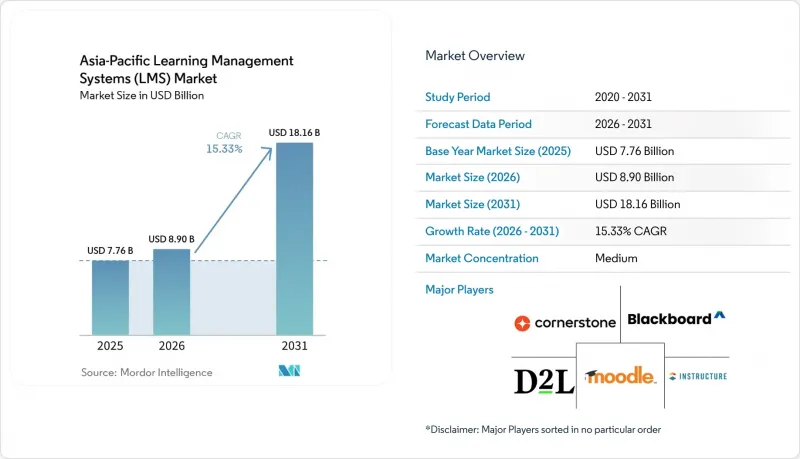
根據 Mordor Intelligence 預測,亞太地區的學習管理系統 (LMS) 市場規模預計將從 2025 年的 77.6 億美元成長到 2026 年的 89 億美元,到 2031 年將達到 181.6 億美元,2026 年至 2031 年的複合年成長率為 15.3%。
本報告按組件(解決方案和服務)、部署模式(雲端、本地部署、混合部署)、學習類型(學術學習等)、企業規模(大型企業、中小企業)、產業(資訊科技和電信等)以及地區進行細分。市場預測以美元計價。
亞太地區學習管理系統(LMS)市場趨勢與洞察
企業轉向技能導向和目標導向培訓轉變
亞太地區的企業正在調整學習預算,使其與技能和能力需求相匹配,而不是依賴固定的、基於角色的課程庫。這種轉變正在改變買家對亞太地區學習管理系統市場的評估方式。採購活動正轉向能夠在單一系統中整合內容、技能圖譜和可衡量的能力成果的平台。世界經濟論壇在其《2025年勞動力展望》中,將基於技能的人才招聘列為三大勞動力優先事項之一,凸顯了對具備能力映射和技能智慧功能的平台日益成長的需求。華僑銀行透過結構化的學習管理系統(LMS)培訓了900名財富顧問,使其掌握了生成式人工智慧工具,證明了這種方法的商業性有效性。結果顯示,三個月內收入增加了50%,受訓員工每週的客戶會議數量是未受訓同事的兩倍。這使得擁有原生技能和本體能力的供應商比主要依賴內容豐富性的供應商更具吸引力。 Cornerstone OnDemand 收購 SkyHive,透過在其廣泛的學習和人才管理平台中添加技能智慧功能,進一步加強了這一方向。
企業技能提升和合規培訓的需求日益成長。
亞太地區的學習管理系統 (LMS) 市場也受益於合規性和員工技能提升義務日益成長的重要性,尤其是在受監管行業。合規培訓不再僅僅被視為一項例行行政任務,因為企業需要在其分散的業務地點建立審計追蹤、更新記錄並標準化學習完成資料。 2025 年 8 月,香港銀行公會更新了其《反洗錢和反恐怖主義融資能力強化框架》,強制要求從業人員每年完成 10-12 小時的持續專業發展 (CPD)。香港《關鍵基礎設施保護條例》於 2026 年 1 月 1 日生效,擴大了銀行、金融及保險 (BFSI)、能源和交通運輸行業的強制性網路安全培訓要求,進一步增加了企業實施 LMS 的需求。在多個國家擁有工廠網路的製造集團也在利用整合平台大規模管理安全培訓和認證,這也是銀行、金融服務和保險 (BFSI) 產業在 2025 年佔區域收入 34.13% 的原因之一。另一方面,對其他受監管行業的需求也在擴大。
亞太地區新興市場數位基礎設施不平衡
網路連結不穩定仍然是亞太地區學習管理系統市場的一大限制因素,尤其是在一些低收入國家和新興地區。印尼、柬埔寨和緬甸的農村地區以及越南部分地區寬頻和行動網路的可靠性持續低下,阻礙了非同步學習的完成,並降低了企業買家可衡量的學習成果。當學習完成情境和學習效果的數據變得不可靠時,需要效果證明的客戶就難以續約。這導致該地區出現「兩極化」現象:在新加坡和澳洲行之有效的定價和交付模式無法直接應用於網路連線較差的地區。因此,純粹的雲端原生設計在這些環境下難以充分發揮作用,這使得那些優先考慮離線或低頻寬使用情境的供應商獲得了商業性優勢。亞洲基金會的「東協數位轉型」計畫自2020年以來已培訓了超過40萬人,其中90%的人表示對數位工具的信心有所增強。這表明,即使在基礎設施限制導致LMS全面部署仍面臨挑戰的地區,學習者的需求仍然存在。
細分市場分析
預計到2025年,亞太地區學習管理系統(LMS)市場中,解決方案將佔據80.19%的佔有率。這證實了該地區對平台主導採購的持續偏好,而非服務主導部署。企業和教育機構的負責人仍然優先考慮能夠在單一環境中支援內容管理、學習者追蹤、分析和管理工作流程的核心軟體。這一趨勢也反映了區域供應商基礎的成熟,即插即用的雲端平台消除了以往服務密集型部署中常見的大規模的初始客製化工作。實際上,許多機構現在希望平台能夠在採購週期的早期階段運作,因此軟體層成為合約的核心。在亞太地區學習管理系統市場,能夠提供清晰的平台功能,而無需採購者依賴長期、昂貴的部署專案的供應商仍然備受青睞。
同時,隨著這些平台營運環境的日益複雜,服務的重要性也與日俱增。為了滿足不斷成長的配置、整合、內容在地化和持續管理需求,服務市場預計到2031年將以16.24%的複合年成長率成長。許多受嚴格監管行業的買家不僅需要軟體訂閱,還需要合規相關的內容更新、工作流程調整以及內部報告支援。擁有多元化員工的多語言服務也促使客戶尋求外部支持,尤其是在其內部學習團隊小規模。從長遠來看,基於專案的工作模式正在轉向嵌入更廣泛的多年平台合約中的持續管理服務模式。這種模式提高了買家的轉換成本,同時也為供應商創造了更穩定、更可觀的收入。 Cornerstone OnDemand於2024年5月收購SkyHive,顯示了主要供應商如何將其業務從軟體產品擴展到技能智慧和更廣泛的人才分析。因此,在亞太地區的學習管理系統(LMS)產業,服務正從單純的支援層演變為能夠增強客戶維繫的策略性收入來源。這種轉變意義重大,因為客戶越來越希望找到能夠提供設計、實施、分析和合規管理等全方位支援的單一供應商。
到2025年,雲端運算將佔據亞太地區學習管理系統(LMS)市場68.62%的佔有率,並預計將成為成長最快的市場,到2031年複合年成長率(CAGR)將達到17.42%。這表明,雲端運算不僅是目前的行業標準,也是最能吸引新用戶的模式。其優勢在於可預測的訂閱成本、快速升級以及對內部基礎設施的低依賴性。這些優勢對於需要企業級功能但又不想投入大量前期資金的中小型企業、中型機構和政府機構而言尤其重要。因此,亞太地區的學習管理系統市場正在轉向雲端運算,將其作為新部署的預設架構,尤其是在組織需要快速部署和輕鬆跨地域擴展的情況下。
2026年4月,Instructure將Canvas簡化為三個套餐——Core、Plus和Next——這是供應商降低價格和套餐配置門檻以加速其在更廣泛客戶群中普及的典型例子。在中國和日本,本地部署平台仍然非常重要,尤其是在政府機構和監管嚴格的金融領域,因為資料主權法規仍然傾向於本地託管。混合部署也正在成為大型組織的一種實用橋樑,這些組織希望基於雲端的內容傳送,但又需要在本地管理敏感的員工記錄。這種折衷方案對於那些正在努力應對舊有系統不一致性和特定國家/地區合規性法規的公司非常有用。它也為那些能夠支援分段架構而無需向客戶強加單獨授權和碎片化管理的供應商創造了一個雖小但重要的機會。在亞太地區的學習管理系統(LMS)產業,競爭優勢如今不再僅取決於基本的託管選項,而是更取決於供應商如何應對合規性、價格透明度和系統柔軟性。混合架構需要先進的技術專長和強大的支援系統,這通常會使小規模的供應商處於劣勢。因此,雲端原生供應商正在中小企業領域獲得新客戶,而擁有本地部署經驗的成熟供應商則繼續在公共和金融領域獲得大規模合約。
其他好處:
- Excel格式的市場預測(ME)表
- 3個月的分析師支持
目錄
第1章:引言
- 研究假設和市場定義
- 調查範圍
第2章:調查方法
第3章執行摘要
第4章 市場狀況
- 市場概覽
- 市場促進因素
- 企業轉型為以技能為中心、以目標為導向的培訓
- 加速採用雲端優先和行動優先學習模式
- 企業內部對技能提升和合規培訓的需求日益成長。
- 高等教育中混合式和遠距學習的擴展
- 各國微證書框架與數位徽章基礎設施
- 一項以技能為基礎的內部調動計劃,要求學習路徑與資格證書掛鉤。
- 市場限制因素
- 亞太地區新興市場數位基礎設施差距
- 在分散的人力資源和學習系統中,證明培訓的投資報酬率是一項挑戰。
- 資料本地化和跨境資料傳輸的法規使雲端運算的普及變得複雜。
- 在高度多元化的市場中,多語言和教育在地化的負擔
- 產業價值鏈分析
- 監理情勢
- 技術展望
- 宏觀經濟因素對市場的影響
- 波特五力分析
第5章 市場規模與成長預測
- 按組件
- 解決方案
- 服務
- 不同的發展
- 雲
- 現場
- 混合
- 透過學習類型
- 學術學習
- 企業培訓
- 政府/公共培訓
- 技能發展/認證
- 最終用戶
- 資訊科技(IT)和通訊
- 銀行、金融服務和保險(BFSI)
- 醫療保健和生命科學
- 製造和工業運營
- 零售與電子商務
- 教育
- 政府/公共部門
- 能源公用事業
- 媒體與娛樂
- 按最終用戶公司規模分類
- 大公司
- 小型企業
- 按地區
- 中國
- 印度
- 日本
- 韓國
- 新加坡
- 馬來西亞
- 泰國
- 澳洲
- 其他亞太國家
第6章 競爭情勢
- 市場集中度
- 策略趨勢
- 市佔率分析
- 公司簡介。
- Moodle Pty Ltd.
- Blackboard LLC
- Cornerstone OnDemand, Inc.
- Instructure Holdings, Inc.
- D2L Inc.
- Docebo Inc.
- Absorb Software Inc.
- LearnUpon Limited
- CYPHER Learning, Inc.
- itslearning AS
- Epignosis LLC
- 360LEARNING SA
- Litmos US, LP
- Open LMS LLC
- Schoox, LLC
- SkyPrep Inc.
- Tovuti, Inc.
- Kallidus Limited
- eloomi A/S
- iSpring Solutions, Inc.
第7章 市場機會與未來展望
According to Mordor Intelligence, the asia-Pacific learning management systems (LMS) market size is expected to increase from USD 7.76 billion in 2025 to USD 8.90 billion in 2026 and reach USD 18.16 billion by 2031, at a CAGR of 15.33% over 2026-2031.
This report is Segmented by Component (Solutions, and Services), Deployment (Cloud, On-Premises, and Hybrid), Learning Type (Academic Learning, and More), Enterprise Size (Large Enterprises, and Small and Medium-Sized Enterprises), Industry Vertical (Information Technology and Telecommunications, and More), and Geography. The Market Forecasts are Provided in Terms of Value (USD).
Asia-Pacific Learning Management Systems (LMS) Market Trends and Insights
Enterprise Shift Toward Skills-Based and Objective-Driven Training
Enterprises across the region are reorganizing learning budgets around skills and competency needs rather than fixed, role-based course libraries, and that shift is changing how buyers evaluate the Asia Pacific learning management systems market. Procurement is moving toward platforms that can connect content, skills graphs, and measurable capability outcomes within one system. The World Economic Forum identified skills-based talent deployment as a top-three workforce priority in its 2025 workforce outlook, underscoring the growing demand for platforms with competency-mapping and skills-intelligence features. OCBC demonstrated the commercial impact of this approach when 900 wealth advisors were trained in generative AI tools through structured LMS pathways, resulting in a 50% revenue uplift within 3 months and a doubling of weekly client appointments for trained staff compared with untrained peers. This is making vendors with native skills and ontology capabilities more attractive than providers that rely mainly on content depth. Cornerstone OnDemand's acquisition of SkyHive reinforced that direction by adding skills intelligence to its broader learning and talent stack.
Rising Corporate Reskilling and Compliance Training Demand
The Asia Pacific learning management systems market is also benefiting from the growing weight of compliance and workforce reskilling obligations, especially in regulated sectors. Compliance training is no longer treated as a routine administrative task, as firms need audit trails, renewal records, and standardized learning-completion data across dispersed operations. The Hong Kong Institute of Bankers updated its Enhanced Competency Framework for Anti-Money Laundering and Counter-Terrorist Financing in August 2025, requiring practitioners to complete 10-12 continuing professional development hours each year. Hong Kong's Protection of Critical Infrastructures Ordinance took effect on January 1, 2026, and expanded mandatory cybersecurity training requirements across BFSI, energy, and transport, strengthening the case for enterprise LMS deployment. Manufacturing groups with multi-country factory networks are also using unified platforms to manage safety training and certification at scale, which helps explain why BFSI accounted for 34.13% of 2025 regional revenue, while demand is expanding into other regulated verticals.
Patchy Digital Infrastructure Across Emerging Asia-Pacific Markets
Patchy connectivity remains a practical constraint for the Asia Pacific learning management systems market in several lower-income and frontier locations. Rural Indonesia, Cambodia, Myanmar, and parts of Vietnam continue to face broadband and mobile-network instability, which disrupts asynchronous learning completion and weakens measurable outcomes for enterprise buyers. When learning completion and performance data become unreliable, renewal decisions also become harder for clients who need proof of effectiveness. This creates a 2-speed regional structure in which pricing and delivery models that work in Singapore or Australia do not transfer cleanly to lower-connectivity environments. The result is a commercial advantage for vendors that support offline-first or low-bandwidth use cases, because purely cloud-native designs do not perform as well in these settings. The Asia Foundation's Go Digital ASEAN program has trained more than 400,000 individuals since 2020, and 90% of participants reported higher confidence in digital tools, indicating that learner demand persists even where infrastructure still limits full LMS deployment.
Other drivers and restraints analyzed in the detailed report include:
- Accelerating Cloud and Mobile-First Learning Adoption
- Expansion of Hybrid and Distance Learning Across Higher Education
- Data Localization and Cross-Border Transfer Rules Complicating Cloud Deployments
For complete list of drivers and restraints, kindly check the Table Of Contents.
Segment Analysis
Solutions accounted for 80.19% of the Asia-Pacific learning management systems (LMS) market in 2025, underscoring the region's continued preference for platform-led procurement over service-led implementations. Buyers across enterprises and institutions are still prioritizing core software that supports content management, learner tracking, analytics, and administrative workflows in a single environment. This pattern also reflects the maturity of the regional vendor base, because plug-and-play cloud platforms have reduced the heavy upfront customization that once made service-intensive deployments more common. In practical terms, many organizations now expect a working platform much earlier in the buying cycle, which keeps the software layer at the center of the contract. The Asia Pacific learning management systems market continues to reward vendors that can offer clear platform functionality without requiring buyers to depend on lengthy, expensive implementation projects.
At the same time, services are becoming increasingly important as the operating environment around these platforms becomes more complex. Services are projected to expand at a 16.24% CAGR through 2031, reflecting rising demand for configuration, integration, content localization, and ongoing administration. Many buyers in regulated sectors need more than a software subscription, as they also require compliance content updates, workflow tuning, and support for internal reporting. Multi-language delivery across diverse workforces also pushes clients toward external support, especially when internal learning teams are small. The longer-term shift is from project work toward recurring managed services that sit inside broader multi-year platform contracts. That model raises switching costs for buyers and creates steadier recurring revenue for vendors. Cornerstone OnDemand's May 2024 acquisition of SkyHive showed how leading providers are expanding from software delivery into skills intelligence and broader workforce analytics. The Asia Pacific learning management systems industry is therefore seeing services evolve from a supporting layer into a strategic revenue stream that strengthens retention. This shift matters because clients increasingly want a single provider that can support design, deployment, analytics, and compliance management.
Cloud accounted for 68.62% of the Asia-Pacific learning management systems (LMS) market in 2025 and is projected to grow at the fastest pace, with a 17.42% CAGR through 2031. That combination shows that cloud is not only the current standard, but also the format attracting the widest set of new buyers. The appeal comes from predictable subscription costs, faster upgrades, and lower internal infrastructure needs. These benefits matter most to SMEs, mid-sized institutions, and government agencies that need enterprise-grade functionality without a capital-intensive implementation. The Asia Pacific learning management systems market is therefore moving toward cloud as the default architecture for most new deployments, especially where organizations want quick rollout and easier scaling across locations.
Instructure's April 2026 move to simplify Canvas into Core, Plus, and Next illustrated how vendors are reducing pricing and packaging friction to speed adoption across a broader customer base. On-premises platforms remain relevant in China and Japan, especially in government and regulated finance, where data sovereignty rules continue to support local hosting. Hybrid deployment is also becoming a practical bridge for large organizations that want cloud content delivery but need on-premises control for sensitive employee records. That middle path is useful for enterprises with uneven legacy systems and country-specific compliance rules. It also creates a narrow but meaningful opportunity for vendors that can support split architecture without forcing customers into separate licenses or fragmented administration. In this part of the Asia Pacific learning management systems industry, competitive advantage is now tied less to basic hosting choice and more to how well vendors handle compliance, pricing clarity, and system flexibility. Smaller vendors often struggle here because hybrid architecture requires deeper technical capability and stronger support capacity. As a result, cloud-native vendors are winning new SME and mid-market accounts, while incumbents with on-premises history continue to defend large public-sector and financial contracts.
List of Companies Covered in this Report:
- Moodle Pty Ltd.
- Blackboard LLC
- Cornerstone OnDemand, Inc.
- Instructure Holdings, Inc.
- D2L Inc.
- Docebo Inc.
- Absorb Software Inc.
- LearnUpon Limited
- CYPHER Learning, Inc.
- itslearning AS
- Epignosis LLC
- 360LEARNING SA
- Litmos US, L.P.
- Open LMS LLC
- Schoox, LLC
- SkyPrep Inc.
- Tovuti, Inc.
- Kallidus Limited
- eloomi A/S
- iSpring Solutions, Inc.
Additional Benefits:
- The market estimate (ME) sheet in Excel format
- 3 months of analyst support
TABLE OF CONTENTS
1 INTRODUCTION
- 1.1 Study Assumptions and Market Definition
- 1.2 Scope of the Study
2 RESEARCH METHODOLOGY
3 EXECUTIVE SUMMARY
4 MARKET LANDSCAPE
- 4.1 Market Overview
- 4.2 Market Drivers
- 4.2.1 Enterprise Shift Toward Skills-Based and Objective-Driven Training
- 4.2.2 Accelerating Cloud and Mobile-First Learning Adoption
- 4.2.3 Rising Corporate Reskilling and Compliance Training Demand
- 4.2.4 Expansion of Hybrid and Distance Learning Across Higher Education
- 4.2.5 National Micro-Credential Frameworks and Digital Badge Infrastructure
- 4.2.6 Skills-Based Internal Mobility Programs Requiring Credential-Mapped Learning Paths
- 4.3 Market Restraints
- 4.3.1 Patchy Digital Infrastructure Across Emerging Asia-Pacific Markets
- 4.3.2 Difficulty Proving Training ROI Across Disparate HR and Learning Systems
- 4.3.3 Data Localization and Cross-Border Transfer Rules Complicating Cloud Deployments
- 4.3.4 Multilingual and Pedagogical Localization Burdens Across High-Diversity Markets
- 4.4 Industry Value-Chain Analysis
- 4.5 Regulatory Landscape
- 4.6 Technological Outlook
- 4.7 Impact of Macroeconomic Factors on the Market
- 4.8 Porter's Five Forces Analysis
- 4.8.1 Threat of New Entrants
- 4.8.2 Bargaining Power of Buyers
- 4.8.3 Bargaining Power of Suppliers
- 4.8.4 Threat of Substitutes
- 4.8.5 Intensity of Competitive Rivalry
5 MARKET SIZE AND GROWTH FORECASTS (VALUE)
- 5.1 By Component
- 5.1.1 Solutions
- 5.1.2 Services
- 5.2 By Deployment
- 5.2.1 Cloud
- 5.2.2 On-premises
- 5.2.3 Hybrid
- 5.3 By Learning Type
- 5.3.1 Academic Learning
- 5.3.2 Corporate Training
- 5.3.3 Government / Public Training
- 5.3.4 Skill Development / Certification
- 5.4 By End User Vertical
- 5.4.1 Information Technology (IT) and Telecommunications
- 5.4.2 Banking, Financial Services, and Insurance (BFSI)
- 5.4.3 Healthcare and Life Sciences
- 5.4.4 Manufacturing and Industrial Operations
- 5.4.5 Retail and E-commerce
- 5.4.6 Education
- 5.4.7 Government and Public Sector
- 5.4.8 Energy and Utilities
- 5.4.9 Media and Entertainment
- 5.5 By End User Enterprise Size
- 5.5.1 Large Enterprises
- 5.5.2 Small and Medium-sized Enterprises
- 5.6 By Geography
- 5.6.1 China
- 5.6.2 India
- 5.6.3 Japan
- 5.6.4 South Korea
- 5.6.5 Singapore
- 5.6.6 Malaysia
- 5.6.7 Thailand
- 5.6.8 Australia
- 5.6.9 Rest of Asia-Pacific
6 COMPETITIVE LANDSCAPE
- 6.1 Market Concentration
- 6.2 Strategic Moves
- 6.3 Market Share Analysis
- 6.4 Company Profiles (includes Global Level Overview, Market Level Overview, Core Segments, Financials as available, Strategic Information, Market Rank/Share, Products and Services, Recent Developments).
- 6.4.1 Moodle Pty Ltd.
- 6.4.2 Blackboard LLC
- 6.4.3 Cornerstone OnDemand, Inc.
- 6.4.4 Instructure Holdings, Inc.
- 6.4.5 D2L Inc.
- 6.4.6 Docebo Inc.
- 6.4.7 Absorb Software Inc.
- 6.4.8 LearnUpon Limited
- 6.4.9 CYPHER Learning, Inc.
- 6.4.10 itslearning AS
- 6.4.11 Epignosis LLC
- 6.4.12 360LEARNING SA
- 6.4.13 Litmos US, L.P.
- 6.4.14 Open LMS LLC
- 6.4.15 Schoox, LLC
- 6.4.16 SkyPrep Inc.
- 6.4.17 Tovuti, Inc.
- 6.4.18 Kallidus Limited
- 6.4.19 eloomi A/S
- 6.4.20 iSpring Solutions, Inc.
7 MARKET OPPORTUNITIES AND FUTURE OUTLOOK
- 7.1 White-space and Unmet-need Assessment

 學習管理系統(LMS):市場佔有率分析、產業趨勢與統計數據、成長預測(2026-2031)
 學習管理系統 (LMS) 市場規模、佔有率和成長分析:按部署方式、組織規模、應用、最終用戶產業、功能和地區分類-2026-2033 年產業預測
 2026年全球學習管理系統(LMS)市場報告
 學習管理系統(LMS)市場分析及預測(至2035年):按類型、產品類型、服務、技術、組件、應用、部署類型、最終用戶和功能分類
 全球學習管理系統(LMS)市場規模、佔有率、趨勢和成長分析報告(2026-2034年)學習管理系統(LMS)市場規模、佔有率、成長率及全球市場分析:按類型、應用和地區分類,並提供2026-2034年的洞察和預測
 學習管理系統(LMS)市場規模、佔有率、趨勢和預測(按組件、用戶類型、交付方式、應用、最終用戶和地區分類),2026-2034年
 學習管理系統市場 - 全球產業規模、佔有率、趨勢、機會及預測(按組件、部署方式、最終用戶、地區和競爭格局分類,2021-2031年)學習管理系統市場 - 全球產業規模、佔有率、趨勢、機會及預測(按組件、部署類型、最終用戶產業、地區和競爭格局分類,2021-2031 年)
 全球學習管理系統 (LMS) 市場預測至 2032 年:按組件、部署模式、交付模式、組織規模、使用者類型、產業垂直領域和地區分類