


 |
市場調查報告書
商品編碼
2120524
汽車塑膠:市場佔有率分析、產業趨勢與統計、成長預測(2026-2031)Automotive Plastics - Market Share Analysis, Industry Trends & Statistics, Growth Forecasts (2026 - 2031) |
||||||

※ 本網頁內容可能與最新版本有所差異。詳細情況請與我們聯繫。
根據 Mordor Intelligence 估計,2026 年汽車塑膠市場價值為 336.7 億美元,預計到 2031 年將達到 499.6 億美元,在預測期(2026-2031 年)內複合年成長率為 8.21%。
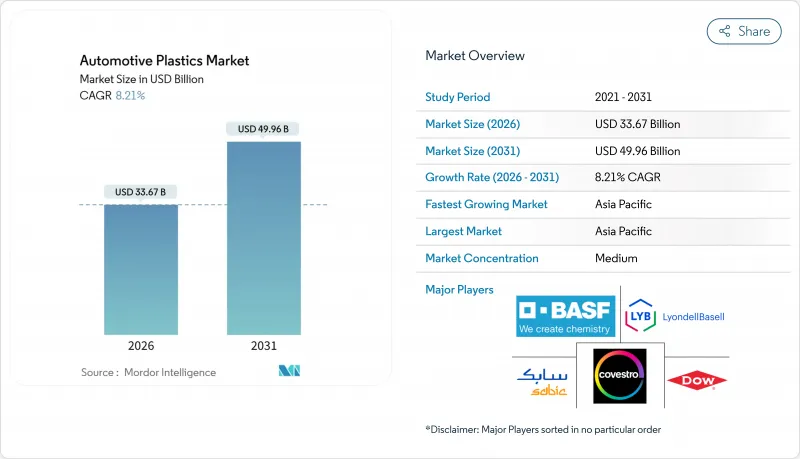
本報告按材料(聚丙烯、聚氨酯等)、應用(外部、內部、引擎艙及其他應用)、車輛類型(傳統車輛和電動汽車)、原料(原生塑膠、再生塑膠和生物基塑膠)以及地區(亞太地區、北美地區等)進行細分。市場預測以美元計價。
全球汽車塑膠市場趨勢及洞察
二氧化碳排放控制目標推動減重
在歐盟,更嚴格的整車平均二氧化碳排放上限,加上北美燃油效率標準的調整,正迫使汽車製造商減輕其車型陣容的重量。玻璃纖維增強聚丙烯正成為最具成本效益的合規解決方案,與鋼材相比,它能在成本極低的情況下顯著減輕重量。中國的雙軌制進一步刺激了需求,加速了輕量化汽車的普及以及車門面板和尾門等部件向聚合物的轉變。目前,塑膠已被用於先前使用金屬的大眾市場汽車平台的結構部件中,縮小了標準材料和尖端材料之間的性能差距。 ISO認證標準確保了產品生命週期結束時的可追溯性,使輕量化努力與循環經濟計劃相協調。
電動車架構的結構與熱作用
與內燃機汽車相比,電池式電動車(BEV)平台每輛車使用的塑膠更多。這主要是因為電池蓋、溫度控管外殼和底盤等部件通常使用聚合物,以增強其電絕緣性和設計柔軟性。特斯拉Model Y採用一體成型的聚碳酸酯-ABS屏蔽罩,減少了零件數量和組裝時間。隨著抗電弧追蹤性能日益重要,阻燃聚碳酸酯和高CTI聚醯胺已成為電池模組蓋和800V連接器的標準材料。電動車專案的早期車型塑膠用量最高,但後續的重新設計通常會使用金屬來降低成本。隨著歐盟新電池法規的訂定,強調使用回收材料,對回收聚碳酸酯和尼龍的需求正在激增。
原油價格波動給利潤率帶來壓力。
聚丙烯和聚乙烯的價格落後於石化原料價格走勢,導致季度價格波動。這些波動往往引發合約重新談判,進一步擠壓供應商本已微薄的利潤空間。 2025年第一季,布蘭特原油價格飆升推高了歐洲聚丙烯價格。此次價格暴漲觸發了不可抗力條款,導致兩家主要原始設備製造商(OEM)的產品上市日期延後。由於上游產能集中,聚醯胺市場尤其脆弱。例如,己內醯胺停產導致PA6價格大幅上漲。此外,指數掛鉤定價將風險轉移至汽車製造商,使其多年成本預測更加複雜。同時,財務基礎較弱的小型複合材料生產商要么正在整合行業,要么徹底退出市場。
細分市場分析
聚醯胺的複合年成長率 (CAGR) 為 8.92%,這反映出渦輪增壓和混合動力引擎對更高連續工作溫度的需求超過了聚丙烯的極限。預計聚醯胺在汽車塑膠市場的佔有率將顯著成長。此外,隨著電動車電池蓋轉向高 CTI 尼龍等級,聚醯胺在汽車塑膠市場的佔有率可能會進一步增加。聚氨酯在座椅和 NVH(噪音、振動與諧波)應用領域穩步發展利基市場,受益於可減輕重量的薄泡沫材料,而 PVC 在歐洲汽車內飾市場的佔有率正被不含鄰苯二甲酸酯的熱塑性聚烯所取代。
高級聚碳酸酯在全景天窗和LED照明透鏡等應用領域正穩步發展。儘管密度存在不足,ABS仍然是光面內裝件的主要選擇。聚乙烯的發展趨勢反映了整體生產趨勢。然而,由於符合更嚴格的蒸發法規,採用EVOH隔離層增強的多層HDPE燃料箱正逐漸成為業界標準。 PBT和PPA等特殊樹脂在感測器外殼和800伏匯流排中發揮至關重要的作用,其尺寸穩定性確保了其在高價位產品中的需求。此外,隨著產業向全球採購和回收轉型,標準化ISO簡稱的重要性日益凸顯。
預計到2025年,內裝零件的銷售額將佔總銷售額的32.98%,但其複合年成長率低於高溫環境下的引擎室零件,後者預計將成長8.96%。隨著渦輪增壓小型化引擎和混合動力汽車冷卻迴路的普及,引擎室零件的運作溫度不斷升高,汽車塑膠市場預計將會擴張。目前,進氣歧管主要採用玻璃纖維增強PA66材料以減輕重量並最佳化氣流,而散熱器端蓋則擴大採用PPA材料。
隨著汽車製造商權衡減重帶來的收益與維修成本,外飾面板的需求正在穩步成長。此外,隨著48伏特和800伏特架構的日益普及,其他應用領域(例如流體儲槽、高壓連接器和底盤護罩)也開始轉向使用高價值工程樹脂。雖然引擎室內零件的體積佔比很小,但其高等級樹脂的價格使其在材料價值方面佔據了相當大的佔有率。
區域分析
預計到2025年,亞太地區將佔據49.11%的市場佔有率,年複合成長率達9.94%,是所有地區中成長最快的。中國雄心勃勃的電動車生產目標正推動聚丙烯需求的顯著成長。同時,印度與生產連結獎勵計畫鼓勵BASF、LG化學和樂天等產業領導者建立新的混煉廠。日本致力於推廣碳中和汽車,顯著提高了蓖麻油衍生聚醯胺的應用。東南亞正在崛起為第二個中心,中國和韓國供應商正策略性地加強在泰國和印尼的生產能力,以降低地緣政治風險。
北美經濟正穩步發展。美國《通膨控制法案》規定的國內採購要求正促使加工廠遷回德克薩斯州和路易斯安那州。同時,墨西哥雖然是該地區主要的塑膠供應國,卻難以應對《美墨加協定》中嚴格的增值標準。加拿大經濟成長速度超過美國,這得益於政府為促進高階電動車生產而推出的獎勵,而這些電動車對工程塑膠的需求量很大。
儘管汽車產量停滯不前,歐洲仍保持穩定成長的勢頭。積極的再生材料使用法規和推廣無PVC內裝的努力持續支撐著市場需求。德國正在精簡產能以提高產能運轉率,而法國和義大利則在尋求電動車購置補貼。南美洲也呈現成長態勢。巴西有望成為未來的出口中心,這得益於Braschem公司的生物基聚丙烯先導計畫,儘管商業性規模化預計仍需兩年時間。中東和非洲地區正以驚人的速度成長,這得益於沙烏地阿拉伯的在地化努力和南非的組裝設施。
其他好處:
- Excel格式的市場預測(ME)表
- 3個月的分析師支持
目錄
第1章:引言
- 研究假設和市場定義
- 調查範圍
第2章:調查方法
第3章執行摘要
第4章 市場狀況
- 市場概覽
- 市場促進因素
- 二氧化碳排放法規正在推動減重。
- 電動汽車產量的激增正在推動塑膠/汽車產業的發展。
- 與金屬材料相比,成本和設計柔軟性
- 歐盟對車輛中再生材料含量設定強製配額
- 能夠容納額外 15-20 公斤塑膠的滑板式電動車平台的興起。
- 市場限制因素
- 樹脂價格波動與原油價格相關
- 生物基工程塑膠OEM認證延誤
- 關於含有微塑膠的輪胎和煞車粉塵的指令,限制某些聚合物混合物。
- 價值鏈分析
- 波特五力模型
第5章 市場規模與成長預測
- 材料
- 聚丙烯(PP)
- 聚氨酯(PU)
- 聚氯乙烯(PVC)
- 聚乙烯(PE)
- 丙烯腈丁二烯苯乙烯(ABS)
- 聚醯胺(PA)
- 聚碳酸酯(PC)
- 其他材料
- 透過使用
- 外部的
- 內部的
- 引擎蓋下
- 其他用途
- 車輛類型
- 傳統/傳統車輛
- 電動車
- 來源
- 原生塑膠
- 再生塑膠
- 生物基塑膠
- 按地區
- 亞太地區
- 中國
- 日本
- 印度
- 韓國
- 其他亞太國家
- 北美洲
- 美國
- 加拿大
- 墨西哥
- 歐洲
- 德國
- 英國
- 法國
- 義大利
- 其他歐洲國家
- 南美洲
- 巴西
- 阿根廷
- 其他南美國家
- 中東和非洲
- 沙烏地阿拉伯
- 南非
- 中東和非洲其他地區
- 亞太地區
第6章 競爭情勢
- 市場集中度
- 策略趨勢
- 市佔率/排名分析
- 公司簡介
- Arkema
- Asahi Kasei Advance Corporation
- BASF SE
- Borealis AG
- Braskem
- Celanese Corporation
- Covestro AG
- Daicel Corporation
- Dow
- dsm-firmenich
- DuPont
- Evonik Industries AG
- Exxon Mobil Corporation
- INEOS
- LANXESS
- LG Chem
- LyondellBasell Industries Holdings BV
- Mitsui Chemicals Inc.
- SABIC
- TEIJIN LIMITED
第7章 市場機會與未來展望
According to Mordor Intelligence, the automotive plastics market size is estimated at USD 33.67 billion in 2026, and is expected to reach USD 49.96 billion by 2031, at a CAGR of 8.21% during the forecast period (2026-2031).
This report is Segmented by Material (Polypropylene, Polyurethane, and More), Application (Exterior, Interior, Under Bonnet, and Other Applications), Vehicle Type (Conventional/Traditional Vehicles and Electric Vehicles), Source (Virgin Plastic, Recycled Plastic, and Bio-Based Plastic), and Geography (Asia-Pacific, North America, and More). The Market Forecasts are Provided in Terms of Value (USD).
Global Automotive Plastics Market Trends and Insights
Regulatory CO2 Targets Driving Lightweighting
In the EU, stricter fleet-average CO2 caps, alongside North America's fuel-economy adjustments, are pushing automakers to shed weight from their models. Glass-fiber-reinforced polypropylene, offering significant weight reduction over steel at a modest cost premium, emerges as the most cost-effective compliance solution. China's dual-credit scheme boosts demand further, incentivizing lightweight vehicles and accelerating the shift to polymers in door panels and tailgates. Mass-market platforms are now integrating plastics into structural areas traditionally reserved for metals, narrowing the performance divide between standard and advanced materials. ISO marking standards ensure traceability at the end of a product's life, harmonizing weight reduction efforts with circular-economy initiatives.
EV Architecture Unlocking Structural and Thermal Roles
Battery-electric platforms utilize more plastics per vehicle compared to their ICE counterparts. This is largely due to components like battery covers, thermal-management housings, and flat-floor pans, which leverage polymers for their electrical insulation properties and design flexibility. Tesla's Model Y features one-piece polycarbonate-ABS shields, reducing part count and assembly time. Given the heightened emphasis on arc-tracking resistance, flame-retardant polycarbonate and high-CTI polyamides have become the go-to materials for battery-module covers and 800-volt connectors. The initial model years of an EV program see the highest plastic usage, with subsequent redesigns often opting for metals to cut costs. With the introduction of new EU battery regulations emphasizing recycled content, there's a surge in demand for post-consumer polycarbonate and nylon.
Crude-Oil Volatility Compressing Margins
Polypropylene and polyethylene, tracking petrochemical feedstocks with a lag, experience quarterly price swings. These fluctuations often lead to contract renegotiations and strain already thin supplier margins. In Q1 2025, a rally in Brent crude pushed European polypropylene prices higher. This surge triggered force-majeure clauses and delayed launch dates for two major OEMs. The concentrated upstream capacity makes polyamide markets particularly vulnerable; for instance, a caprolactam outage led to a significant spike in PA6 prices. Additionally, index-linked pricing transfers risk to automakers, complicating their multi-year cost forecasts. Meanwhile, smaller compounders, lacking robust balance sheets, are either consolidating or exiting the sector.
Other drivers and restraints analyzed in the detailed report include:
- Mandatory Recycled-Content Quotas Reshaping Supply Chains
- Skateboard EV Platforms Consolidating Part Counts
- Microplastic Regulations Limiting Polymer Choices
For complete list of drivers and restraints, kindly check the Table Of Contents.
Segment Analysis
Polypropylene held the largest share at 34.22% in 2025 due to its dominance in interior panels and bumper skins. Polyamide's 8.92% CAGR reflects higher continuous-use temperatures in turbocharged and hybrid engines that exceed polypropylene limits. The market size for polyamide in automotive plastics is set to grow significantly. Furthermore, if EV battery covers transition to high-CTI nylon grades, polyamide's market share in automotive plastics could increase further. While polyurethane steadily carves out its niche in seating and NVH roles, benefiting from thinner foams that reduce weight, PVC is ceding ground to phthalate-free thermoplastic polyolefins in European car interiors.
Premium polycarbonate is making strides with its applications in panoramic roofs and LED lighting lenses. ABS, despite facing density penalties, continues to be the go-to choice for glossy interior trims. Polyethylene's performance mirrors overall production trends. However, multilayer HDPE fuel tanks, fortified with EVOH barriers, are now setting the standard by adhering to stricter evaporative regulations. Specialty resins like PBT and PPA are carving out significant roles in sensor housings and 800-volt busbars, commanding price premiums due to their dimensional stability. And as the industry moves towards global sourcing and recycling, standardized ISO abbreviations are proving invaluable.
Interior components captured 32.98% of 2025 revenue, yet their CAGR lags high-heat under-bonnet parts that grow at 8.96%. The automotive plastics market for under-bonnet parts is expected to expand as turbocharged downsized engines and hybrid cooling loops raise operating temperatures. Air-intake manifolds now rely on glass-fiber-reinforced PA66 for weight savings and optimized airflow, while radiator end tanks transition to PPA.
Exterior panels are growing steadily as OEMs weigh lightweighting benefits against repairability costs. Other applications, including fluid reservoirs, high-voltage connectors, and chassis shields, see a mix shift toward high-value engineering resins as 48-volt and 800-volt architectures proliferate. Under-bonnet parts, though a smaller portion of volume, account for a significant share of material value because of premium resin pricing.
Complete Report Scope:
- By Material
- Polypropylene (PP)
- Polyurethane (PU)
- Polyvinyl Chloride (PVC)
- Polyethylene (PE)
- Acrylonitrile Butadiene Styrene (ABS)
- Polyamides (PA)
- Polycarbonate (PC)
- Other Materials
- By Application
- Exterior
- Interior
- Under Bonnet
- Other Applications
- By Vehicle Type
- Conventional / Traditional Vehicles
- Electric Vehicles
- By Source
- Virgin Plastic
- Recycled Plastic
- Bio-based Plastic
- By Geography
- Asia-Pacific
- China
- Japan
- India
- South Korea
- Rest of Asia-Pacific
- North America
- United States
- Canada
- Mexico
- Europe
- Germany
- United Kingdom
- France
- Italy
- Rest of Europe
- South America
- Brazil
- Argentina
- Rest of South America
- Middle-East and Africa
- Saudi Arabia
- South Africa
- Rest of Middle-East Africa
- Asia-Pacific
Geography Analysis
Asia-Pacific held a 49.11% share in 2025 and is advancing at a 9.94% CAGR, the strongest among regions. China's ambitious EV production target fuels a significant surge in polypropylene demand. Meanwhile, India's production-linked incentives are catalyzing the establishment of new compounding plants by industry giants like BASF, LG Chem, and Lotte. Japan's commitment to carbon-neutral fleets is driving a notable uptick in the adoption of castor-oil-based polyamides. Southeast Asia is emerging as a secondary hub, with Chinese and Korean suppliers strategically bolstering capacities in Thailand and Indonesia to mitigate geopolitical risks.
North America is charting a steady course. The US Inflation Reduction Act's domestic-content rules are steering compounding operations back to Texas and Louisiana. Meanwhile, Mexico, despite being a significant resin supplier in the region, grapples with stringent USMCA value-content thresholds. Canada is outpacing the U.S. in growth, driven by incentives promoting premium EV production, which leans heavily on engineering plastics.
Europe is navigating a steady growth trajectory, even amidst stagnant vehicle builds. Demand remains buoyed by aggressive mandates for recycled content and commitments to PVC-free interiors. Germany is streamlining its capacity for better utilization, while France and Italy are banking on EV purchase subsidies. South America is witnessing growth. Braskem's pilot project on bio-based polypropylene could position Brazil as a future export hub, albeit with commercial scalability still two years away. The Middle East and Africa are growing at a commendable pace, bolstered by Saudi localization efforts and assembly hubs in South Africa.
- Arkema
- Asahi Kasei Advance Corporation
- BASF SE
- Borealis AG
- Braskem
- Celanese Corporation
- Covestro AG
- Daicel Corporation
- Dow
- dsm-firmenich
- DuPont
- Evonik Industries AG
- Exxon Mobil Corporation
- INEOS
- LANXESS
- LG Chem
- LyondellBasell Industries Holdings B.V.
- Mitsui Chemicals Inc.
- SABIC
- TEIJIN LIMITED
Additional Benefits:
- The market estimate (ME) sheet in Excel format
- 3 months of analyst support
TABLE OF CONTENTS
1 Introduction
- 1.1 Study Assumptions and Market Definition
- 1.2 Scope of the Study
2 Research Methodology
3 Executive Summary
4 Market Landscape
- 4.1 Market Overview
- 4.2 Market Drivers
- 4.2.1 Regulatory CO2 targets driving lightweighting
- 4.2.2 EV production surge elevating plastics/vehicle
- 4.2.3 Cost and design flexibility versus metals
- 4.2.4 Mandatory recycled-content quotas in EU vehicles
- 4.2.5 Rise of skateboard EV platforms allowing 15-20 kg more plastic integration
- 4.3 Market Restraints
- 4.3.1 Volatile crude-linked resin prices
- 4.3.2 OEM qualification delays for bio-based engineering plastics
- 4.3.3 Micro-plastic tyre and brake-dust directives limiting certain polymer blends
- 4.4 Value Chain Analysis
- 4.5 Porter's Five Forces
- 4.5.1 Bargaining Power of Suppliers
- 4.5.2 Bargaining Power of Buyers
- 4.5.3 Threat of New Entrants
- 4.5.4 Threat of Substitutes
- 4.5.5 Degree of Competition
5 Market Size and Growth Forecasts (Value)
- 5.1 By Material
- 5.1.1 Polypropylene (PP)
- 5.1.2 Polyurethane (PU)
- 5.1.3 Polyvinyl Chloride (PVC)
- 5.1.4 Polyethylene (PE)
- 5.1.5 Acrylonitrile Butadiene Styrene (ABS)
- 5.1.6 Polyamides (PA)
- 5.1.7 Polycarbonate (PC)
- 5.1.8 Other Materials
- 5.2 By Application
- 5.2.1 Exterior
- 5.2.2 Interior
- 5.2.3 Under Bonnet
- 5.2.4 Other Applications
- 5.3 By Vehicle Type
- 5.3.1 Conventional / Traditional Vehicles
- 5.3.2 Electric Vehicles
- 5.4 By Source
- 5.4.1 Virgin Plastic
- 5.4.2 Recycled Plastic
- 5.4.3 Bio-based Plastic
- 5.5 By Geography
- 5.5.1 Asia-Pacific
- 5.5.1.1 China
- 5.5.1.2 Japan
- 5.5.1.3 India
- 5.5.1.4 South Korea
- 5.5.1.5 Rest of Asia-Pacific
- 5.5.2 North America
- 5.5.2.1 United States
- 5.5.2.2 Canada
- 5.5.2.3 Mexico
- 5.5.3 Europe
- 5.5.3.1 Germany
- 5.5.3.2 United Kingdom
- 5.5.3.3 France
- 5.5.3.4 Italy
- 5.5.3.5 Rest of Europe
- 5.5.4 South America
- 5.5.4.1 Brazil
- 5.5.4.2 Argentina
- 5.5.4.3 Rest of South America
- 5.5.5 Middle-East and Africa
- 5.5.5.1 Saudi Arabia
- 5.5.5.2 South Africa
- 5.5.5.3 Rest of Middle-East Africa
- 5.5.1 Asia-Pacific
6 Competitive Landscape
- 6.1 Market Concentration
- 6.2 Strategic Moves
- 6.3 Market Share / Ranking Analysis
- 6.4 Company Profiles (includes Global-level Overview, Market-level Overview, Core Segments, Financials, Strategic Information, Products and Services, Recent Developments)
- 6.4.1 Arkema
- 6.4.2 Asahi Kasei Advance Corporation
- 6.4.3 BASF SE
- 6.4.4 Borealis AG
- 6.4.5 Braskem
- 6.4.6 Celanese Corporation
- 6.4.7 Covestro AG
- 6.4.8 Daicel Corporation
- 6.4.9 Dow
- 6.4.10 dsm-firmenich
- 6.4.11 DuPont
- 6.4.12 Evonik Industries AG
- 6.4.13 Exxon Mobil Corporation
- 6.4.14 INEOS
- 6.4.15 LANXESS
- 6.4.16 LG Chem
- 6.4.17 LyondellBasell Industries Holdings B.V.
- 6.4.18 Mitsui Chemicals Inc.
- 6.4.19 SABIC
- 6.4.20 TEIJIN LIMITED
7 Market Opportunities and Future Outlook
- 7.1 White-Space and Unmet-Need Assessment
- 7.2 Technological Developments in Electric Vehicles

 2026年全球汽車塑膠材料市場報告2026年全球汽車裝飾外飾塑膠市場報告2026年全球汽車門飾市場報告
 亞太地區汽車塑膠:市場佔有率分析、產業趨勢與統計及成長預測(2026-2031)
 2026-2030年全球汽車塑膠市場
 汽車引擎室塑膠零件市場報告:趨勢、預測及競爭分析(至2035年)
 汽車外飾塑膠市場-2026-2032年全球市場預測汽車塑膠市場:按材料類型、工藝類型、應用、最終用途和車輛類型分類-2026-2032年全球市場預測
 汽車塑膠內部裝飾市場分析及至2035年的預測:按類型、產品類型、技術、組件、應用、材料類型、最終用戶、功能和安裝類型分類
 PE和PP複合材料市場規模、佔有率和趨勢分析報告:按類型、聚合物類型、複合材料類型、應用、地區和細分市場預測(2026-2033年)