


 |
市場調查報告書
商品編碼
2119824
亞太地區汽車塑膠:市場佔有率分析、產業趨勢與統計及成長預測(2026-2031)Asia-Pacific Automotive Plastics - Market Share Analysis, Industry Trends & Statistics, Growth Forecasts (2026 - 2031) |
||||||

※ 本網頁內容可能與最新版本有所差異。詳細情況請與我們聯繫。
據 Mordor Intelligence 稱,亞太地區汽車塑膠市場預計到 2026 年將達到 1,022 萬噸,高於 2025 年的 973 萬噸,預計到 2031 年將達到 1,307 萬噸。
預計 2026 年至 2031 年的複合年成長率為 5.04%。
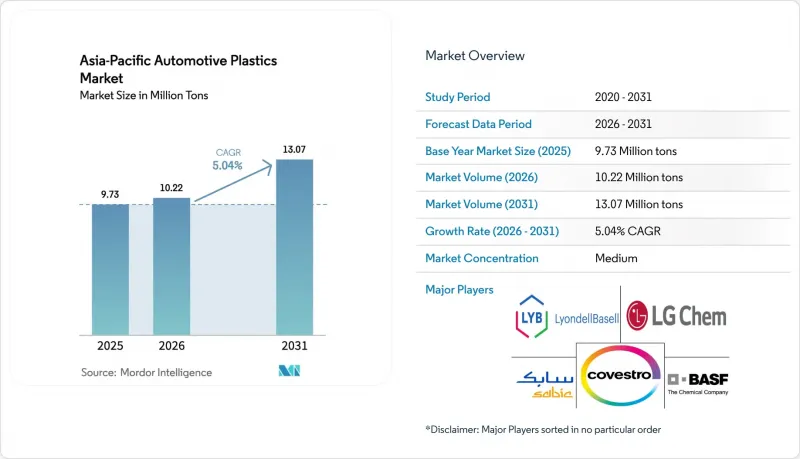
本報告按材料(聚丙烯、聚氨酯、聚氯乙烯及其他)、車輛類型(傳統車輛、電動車)、應用領域(外觀、內裝、引擎室及其他應用)和地區(中國、印度、日本、韓國、東協及其他亞太國家)進行分類。市場預測以噸為單位。
亞太地區汽車塑膠市場趨勢及洞察
應對減重法規
亞太地區的監管機構正將車隊平均排放量與減重目標掛鉤。汽車製造商正積極回應,以成本更低、形狀更複雜的先進聚丙烯複合材料取代金屬。北歐化工(Borealis)的Fibremod長纖維增強聚丙烯材料使大眾Multivan的重量減輕了200公斤,同時也達到了所需的剛度。特斯拉率先推廣的Gigacasting技術正在革新車身本體製造策略,並迫使塑膠供應商證明其在結構件製造中的作用。為了順應這一趨勢,複合材料生產商正在引入化學發泡,例如Aviento公司的Hydrocero,它可以在降低碳排放的同時,將車門面板的重量減輕20%。在中國,預計到2036年,電池式電動車將佔小型車總銷量的52.9%,因此,具有溫度控管功能的輕質塑膠模組正變得至關重要。
聚丙烯在室內外應用的滲透率不斷提高
聚丙烯的隔音和加工性能優勢正推動其在高性能零件領域的應用。與聚醯胺替代品相比,Rochling Automotive 的進氣歧管可將車廂噪音降低 10-15 分貝,材料成本降低 15%。日本一個研究團隊透過將纖維素奈米纖維與聚丙烯混合,在保持完全可回收性的同時提高了衝擊強度,這在生產者延伸責任制 (EPR) 法規下極具吸引力。 Sirmax 公司含有 30% 消費後回收樹脂的複合材料現已用於車門面板,在其生命週期內可減少 21% 的碳足跡,並符合氣味標準。在外飾覆層方面,諸如 LyondellBasell 的“CirculenRecover”等紫外線穩定型聚丙烯正在被使用,這些材料在保持尺寸穩定性的同時,還含有 20% 的回收材料。製程最佳化研究證實,提高成型壓力可以抑制收縮,從而進一步增強聚丙烯在 A 級重要表面上的優勢。
回收基礎設施和監管壓力的差異
儘管生產者延伸責任制(EPR)法規正在不斷擴展,但在某些市場,回收和分類能力仍無法跟上報廢車輛的速度。印度的《2025年報廢車輛法規》引入了一套全面的線上追蹤系統,但並未對塑膠設定詳細的配額,這限制了其對循環經濟的即時影響。越南強制要求硬質PET包裝的回收率達到22%,這意味著未來可能會對汽車塑膠模組也實施同樣的規定,這將導致合規成本的增加。日本成熟的責任管理系統目前仍專注於包裝材料,汽車零件尚未納入現有的回收系統。技術研究表明,如果底漆去除不徹底,重新壓碎的保險桿材料會失去抗衝擊性,這凸顯了化學回收對於補充機械加工的必要性。延鋒和Trinseo等供應鏈企業正致力於透過推廣溶解和先進分類技術來彌合這一差距,以實現2030年的目標。
細分市場分析
聚丙烯在汽車塑膠市場佔最大佔有率,按體積計佔41.10%。埃克森美孚的「Achieve Advanced」等級聚丙烯相比傳統共聚物具有更優異的衝擊強度,可實現更薄的結構、減輕重量,並導致每噸利潤率下降55美元。聚碳酸酯的複合年成長率最高,達7.12%,這主要得益於加工商採用科思創的機械回收材料生產玻璃組件和照明外殼。隨著BASF湛江巨型生產線全面運作,預計熱塑性聚氨酯的供應將趨緊,以滿足800V電氣化架構中對軟性電纜護套的需求。
汽車塑膠工程樹脂市場正在擴張,丙烯腈-丁二烯-苯乙烯共聚物(ABS)正轉向使用生質能衍生的苯乙烯單體,上海工廠預計聚醯胺66產能將增加4萬噸。聚乙烯繼續主導包裝和輕量化外飾市場,而聚氯乙烯(PVC)在循環經濟計劃的推動下面臨形象壓力。 ASA、PBT和PMMA等特殊樹脂則供應給防風雨格柵和踏板車電池組等小眾應用領域。隨著亞太地區煉油廠將原油轉化為化學品,與上游產業的整合提供了成本緩衝,從而鞏固了聚丙烯在快速成長的工程樹脂領域中的地位。
其他好處
- Excel格式的市場預測(ME)表
- 3個月的分析師支持
目錄
第1章:引言
- 研究假設和市場定義
- 調查範圍
第2章:調查方法
第3章執行摘要
第4章 市場狀況
- 市場概覽
- 市場促進因素
- 應對減重法規
- 聚丙烯在內飾和外飾領域的應用日益廣泛
- 電動車產量激增
- 透過高通量射出成型降低成本
- 生物基和再生塑膠的OEM評分卡目標
- 市場限制因素
- 缺乏回收基礎設施和監管壓力
- 原料(石腦油和丙烯)價格波動
- 在結構部件中以新型合金取代鋁方面的進展
- 價值鏈分析
- 波特五力模型
第5章 市場規模與成長預測
- 材料
- 聚丙烯(PP)
- 聚氨酯(PU)
- 聚氯乙烯(PVC)
- 聚乙烯(PE)
- 丙烯腈丁二烯苯乙烯(ABS)
- 聚醯胺(PA)
- 聚碳酸酯(PC)
- 其他材料(ASA、PET、PBT、PMMA 等)
- 車輛類型
- 傳統車輛
- 電動車
- 透過使用
- 外部的
- 內部的
- 引擎室內部
- 其他應用(儀錶面板、門系統等)
- 按地區
- 中國
- 印度
- 日本
- 韓國
- ASEAN
- 其他亞太國家
第6章 競爭情勢
- 市場集中度
- 策略趨勢
- 市佔率(%)和排名分析
- 公司簡介
- Arkema
- Asahi Kasei Advance Corporation
- BASF SE
- Borealis AG
- Celanese Corporation
- Covestro AG
- dsm-firmenich
- Evonik Industries AG
- Exxon Mobil Corporation
- Kingfa Science and Technology (India) Limited
- LG Chem
- LyondellBasell Industries Holdings BV
- Polyplastics Co., Ltd
- SABIC
- Toray Industries Inc
- Trinseo
- Victrex plc
第7章 市場機會與未來展望
According to Mordor Intelligence, Asia-Pacific automotive plastics market size in 2026 is estimated at 10.22 Million tons, growing from 2025 value of 9.73 Million tons with 2031 projections showing 13.07 Million tons, growing at 5.04% CAGR over 2026-2031.
This report is Segmented by Material (Polypropylene, Polyurethane, Polyvinyl Chloride, and More), Vehicle Type (Conventional/Traditional Vehicles and Electric Vehicles), Application (Exterior, Interior, Under-Bonnet, and Other Applications), and Geography (China, India, Japan, South Korea, ASEAN, and Rest of Asia-Pacific). The Market Forecasts are Provided in Terms of Volume (Tons).
Asia-Pacific Automotive Plastics Market Trends and Insights
Lightweighting Mandate Compliance
Regulatory authorities across Asia-Pacific tie fleet-average emissions to weight reduction goals. Automakers respond by substituting metals with advanced polypropylene blends that deliver complex geometries at lower cost. Borealis Fibremod long-glass-fiber polypropylene helped reduce the weight of Volkswagen's Multivan by 200 kg and met stiffness targets. Gigacasting adoption, first popularised by Tesla, is reshaping body-in-white strategies and puts pressure on plastics suppliers to justify structural roles. To keep pace, compounders introduce chemical foaming agents such as Avient Hydrocerol that cut door-panel weight by 20% while lowering carbon dioxide emissions. In China, where battery-electric vehicles are forecast to command 52.9% of total light-vehicle sales by 2036, lightweight plastic modules that also manage heat are becoming indispensable.
Growing Polypropylene Penetration in Interiors and Exteriors
Polypropylene's noise-dampening and processing advantages are driving adoption in high-performance components. Rochling Automotive intake manifolds trimmed cabin noise by 10-15 dB compared with polyamide alternatives and saved 15% on material cost. Research teams in Japan blend cellulose nanofibres into polypropylene, boosting impact strength while preserving full recyclability, a feature attractive under extended-producer-responsibility laws. Compounds with 30% post-consumer resin from Sirmax now appear in door panels, cutting lifecycle carbon footprints by 21% and meeting odor thresholds. Exterior cladding benefits from ultraviolet-stable grades such as LyondellBasell CirculenRecover that retain dimensional integrity while offering 20% recycled content. Process optimisation studies confirm that higher packing pressure mitigates shrinkage, reinforcing polypropylene's appeal for visible Class-A surfaces.
Recycling Infrastructure Gaps and Regulatory Pressure
Extended-producer-responsibility rules proliferate, yet collection and sorting capacity lag vehicle scrappage rates in several markets. India's End-of-Life Vehicles Rules 2025 introduce comprehensive online tracking but omit detailed plastic quotas, limiting immediate circularity gains. Vietnam mandates a 22% recycling rate for rigid PET packaging, signaling future obligations for automotive plastic modules that raise compliance costs. Japan's mature stewardship programmes still focus on packaging, so automotive parts fall outside current take-back streams. Technical studies show that bumper regrind loses impact resistance if primer removal is incomplete, underscoring the need for chemical recycling to complement mechanical routes. Supply-chain collaborations such as Yanfeng-Trinseo aim to bridge the gap by scaling dissolution and advanced-sorting technologies that meet 2030 targets.
Other drivers and restraints analyzed in the detailed report include:
- Surge in Electric-Vehicle Production Volumes
- Cost Reduction via High-throughput Injection Moulding
- Volatility in Raw-material (Naphtha / Propylene) Pricing
For complete list of drivers and restraints, kindly check the Table Of Contents.
Segment Analysis
Polypropylene commands the largest slice of the automotive plastics market at 41.10% volume share. ExxonMobil Achieve Advanced grades lift impact strength above legacy copolymers, allowing thinner structures that lower mass and support a USD 55 per-ton margin squeeze. Polycarbonate delivers the fastest 7.12% CAGR as processors embrace Covestro mechanically recycled content for glazing and lighting housings. Thermoplastic polyurethane supply is set to tighten once BASF's Zhanjiang mega-line ramps up, responding to electrification needs that require flexible cable jacketing in 800 V architectures.
The automotive plastics market size for engineering resins is climbing with acrylonitrile-butadiene-styrene shifting toward biomass styrene monomer and polyamide 66 seeing 40 000-ton capacity increments in Shanghai. Polyethylene still supports packaging and lightweight exterior trims, whereas PVC faces image pressure under circularity pledges. Specialty families like ASA, PBT, and PMMA supply niche roles such as weather-resistant grilles and scooter battery packs. As Asia-Pacific refineries convert crude to chemicals, upstream integration provides cost buffers that safeguard polypropylene's foothold against the surging engineering-resin cohort.
Complete Report Scope:
- By Material
- Polypropylene (PP)
- Polyurethane (PU)
- Polyvinyl Chloride (PVC)
- Polyethylene (PE)
- Acrylonitrile-Butadiene-Styrene (ABS)
- Polyamides (PA)
- Polycarbonate (PC)
- Other Materials (ASA, PET, PBT, PMMA, etc.)
- By Vehicle Type
- Conventional/Traditional Vehicles
- Electric Vehicles
- By Application
- Exterior
- Interior
- Under-bonnet
- Other Applications (Instrument Panel, Door Systems, etc.)
- By Geography
- China
- India
- Japan
- South Korea
- ASEAN
- Rest of Asia-Pacific
List of Companies Covered in this Report:
- Arkema
- Asahi Kasei Advance Corporation
- BASF SE
- Borealis AG
- Celanese Corporation
- Covestro AG
- dsm-firmenich
- Evonik Industries AG
- Exxon Mobil Corporation
- Kingfa Science and Technology (India) Limited
- LG Chem
- LyondellBasell Industries Holdings B.V.
- Polyplastics Co., Ltd
- SABIC
- Toray Industries Inc
- Trinseo
- Victrex plc
Additional Benefits:
- The market estimate (ME) sheet in Excel format
- 3 months of analyst support
TABLE OF CONTENTS
1 Introduction
- 1.1 Study Assumptions and Market Definition
- 1.2 Scope of the Study
2 Research Methodology
3 Executive Summary
4 Market Landscape
- 4.1 Market Overview
- 4.2 Market Drivers
- 4.2.1 Lightweighting Mandate Compliance
- 4.2.2 Growing Polypropylene Penetration in Interiors and Exteriors
- 4.2.3 Surge in Electric-Vehicle Production Volumes
- 4.2.4 Cost Reduction via High-throughput Injection Moulding
- 4.2.5 OEM Score-card Targets for Bio-based/Recycled Plastics
- 4.3 Market Restraints
- 4.3.1 Recycling Infrastructure Gaps and Regulatory Pressure
- 4.3.2 Volatility in Raw-material (Naphtha/Propylene) Pricing
- 4.3.3 Emerging Alloy-Aluminium Substitution in Structural Parts
- 4.4 Value Chain Analysis
- 4.5 Porter's Five Forces
- 4.5.1 Bargaining Power of Suppliers
- 4.5.2 Bargaining Power of Buyers
- 4.5.3 Threat of New Entrants
- 4.5.4 Threat of Substitutes
- 4.5.5 Degree of Competition
5 Market Size and Growth Forecasts (Volume)
- 5.1 By Material
- 5.1.1 Polypropylene (PP)
- 5.1.2 Polyurethane (PU)
- 5.1.3 Polyvinyl Chloride (PVC)
- 5.1.4 Polyethylene (PE)
- 5.1.5 Acrylonitrile-Butadiene-Styrene (ABS)
- 5.1.6 Polyamides (PA)
- 5.1.7 Polycarbonate (PC)
- 5.1.8 Other Materials (ASA, PET, PBT, PMMA, etc.)
- 5.2 By Vehicle Type
- 5.2.1 Conventional/Traditional Vehicles
- 5.2.2 Electric Vehicles
- 5.3 By Application
- 5.3.1 Exterior
- 5.3.2 Interior
- 5.3.3 Under-bonnet
- 5.3.4 Other Applications (Instrument Panel, Door Systems, etc.)
- 5.4 By Geography
- 5.4.1 China
- 5.4.2 India
- 5.4.3 Japan
- 5.4.4 South Korea
- 5.4.5 ASEAN
- 5.4.6 Rest of Asia-Pacific
6 Competitive Landscape
- 6.1 Market Concentration
- 6.2 Strategic Moves
- 6.3 Market Share(%)/ Ranking Analysis
- 6.4 Company Profiles (includes Global level Overview, Market-level Overview, Core Segments, Financials as available, Strategic Information, Market Rank/Share, Products and Services, Recent Developments)
- 6.4.1 Arkema
- 6.4.2 Asahi Kasei Advance Corporation
- 6.4.3 BASF SE
- 6.4.4 Borealis AG
- 6.4.5 Celanese Corporation
- 6.4.6 Covestro AG
- 6.4.7 dsm-firmenich
- 6.4.8 Evonik Industries AG
- 6.4.9 Exxon Mobil Corporation
- 6.4.10 Kingfa Science and Technology (India) Limited
- 6.4.11 LG Chem
- 6.4.12 LyondellBasell Industries Holdings B.V.
- 6.4.13 Polyplastics Co., Ltd
- 6.4.14 SABIC
- 6.4.15 Toray Industries Inc
- 6.4.16 Trinseo
- 6.4.17 Victrex plc
7 Market Opportunities and Future Outlook
- 7.1 White-space and Unmet-need Assessment

 2026年全球汽車塑膠材料市場報告2026年全球汽車裝飾外飾塑膠市場報告2026年全球汽車門飾市場報告
 2026-2030年全球汽車塑膠市場
 汽車引擎室塑膠零件市場報告:趨勢、預測及競爭分析(至2035年)
 汽車塑膠:市場佔有率分析、產業趨勢與統計、成長預測(2026-2031)
 汽車外飾塑膠市場-2026-2032年全球市場預測汽車塑膠市場:按材料類型、工藝類型、應用、最終用途和車輛類型分類-2026-2032年全球市場預測
 汽車塑膠內部裝飾市場分析及至2035年的預測:按類型、產品類型、技術、組件、應用、材料類型、最終用戶、功能和安裝類型分類
 PE和PP複合材料市場規模、佔有率和趨勢分析報告:按類型、聚合物類型、複合材料類型、應用、地區和細分市場預測(2026-2033年)