


 |
市場調查報告書
商品編碼
2120521
油田化學品:市場佔有率分析、產業趨勢與統計、成長預測(2026-2031)Oilfield Chemicals - Market Share Analysis, Industry Trends & Statistics, Growth Forecasts (2026 - 2031) |
||||||

※ 本網頁內容可能與最新版本有所差異。詳細情況請與我們聯繫。
據 Mordor Intelligence 稱,油田化學品市場預計將從 2025 年的 289.6 億美元成長到 2026 年的 299.5 億美元,到 2031 年達到 354.1 億美元,2026 年至 2031 年的複合年成長率為 3.41%。
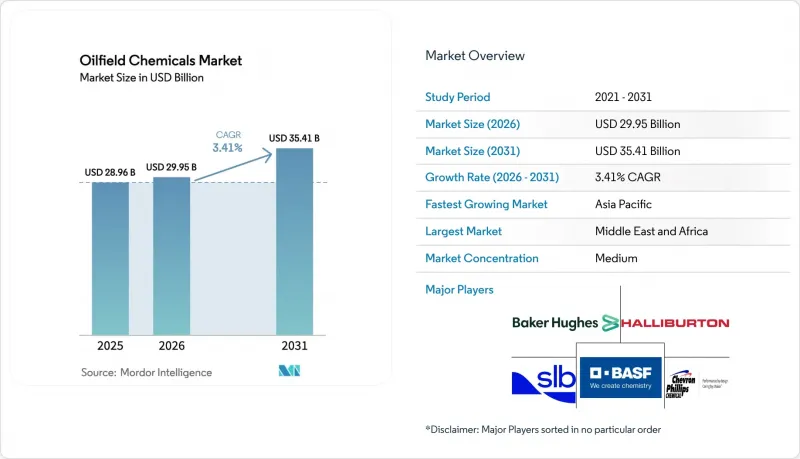
本報告按化學品類型(除生物劑、腐蝕抑制劑、去乳化劑、聚合物、界面活性劑及其他)、應用領域(鑽井和注水泥、生產、油井增產、提高採收率和修井完井)以及地區(亞太地區、北美地區、歐洲地區、南美地區以及中東和非洲地區)進行細分。市場預測以美元計價。
全球油田化學品市場趨勢及洞察
頁岩氣探勘及生產規模擴大
2025年,馬塞勒斯盆地和海恩斯維爾盆地乾氣產量創歷史新高,導致減磨劑、黏土穩定劑和殺菌劑的使用量居高不下。儘管投加效率有所提高,但業者仍持續延長井筒長度、增加壓裂段數,並提高單井化學品總消耗量。在阿根廷瓦卡穆埃爾塔油田,2024年至2025年間,上游投資額超過50億美元,促使當地採用了一套客製化的滑溜水壓裂系統,以適應該區塊高溫高黏土的特性。在中國,四川盆地頁岩氣商業化開發正面臨水資源短缺的困境,促使生產商測試發泡和無水壓裂液,這些壓裂液可將淡水用量減少高達70%。雖然北美成熟油田的每桶原油化學品用量持續下降,但光是這三個地區的頁岩氣開發成長就足以支撐油田化學品市場的相當大佔有率。
交通運輸領域對石油基燃料的需求增加
由於缺乏具有成本競爭力的電池替代品,全球對液體燃料的需求在航空、海運和長途貨運領域依然強勁。印度的石化整合計畫正在創造額外的原油需求,這需要在遠超初始生產週期的時期內提供可靠的流動保障化學品。中東的國有石油公司在維持低成本原油生產的同時,也確保用於腐蝕、結垢和乳化控制的生產化學品的穩定需求。即使在電氣化程度日益提高的地區,現有車輛仍支撐著對柴油和噴射機燃料的需求,從而支撐著現有油井和新油井的油田化學品市場。因此,隨著產量遞減管理的推進,生產化學品的支出也在增加,這有助於營運商透過化學干預而非新鑽井來維持產量水準。
全球向清潔能源和電氣化轉型
殼牌公司已將其石油產量上限設定為2024年的水平,並每年撥款150億美元用於低碳項目。英國石油公司計劃在2030年將油氣產量減少25%,此舉將削減鑽井預算,從而降低對化學品的需求。道達爾能源公司將其40%的資本支出用於可再生能源,這限制了用於新建油井的資金,而新建油井歷來需要大量的增產化學品。國際能源總署(IEA)的「淨零排放」情境預測,2025年後上游投資將下降,將對油田化學品市場構成結構性阻力。生產化學品對於現有油井仍然至關重要,但新油井數量的減少將降低成長上限。
細分市場分析
預計到2025年,緩蝕劑的銷售額將佔總銷售額的33.56%,證實了資產保護化學品仍佔油田化學品市場的最大佔有率。這種主導地位與老舊資產中水分和酸性氣體含量的增加有關,這些物質會腐蝕管道,並帶來意外停機的風險。相較之下,生物基界面活性劑預計將成為該產品組合中成長最快的,複合年成長率將達到4.82%,這主要得益於更嚴格的永續性法規以及金融機構對環保配方的重視。由於營運商回收利用了更多的回流液並減少了每級增稠劑的使用量,聚合物領域的油田化學品市場規模已趨於穩定,但圍繞奈米複合添加劑的聚合物創新旨在透過以更低的劑量實現更高的效率來重振市場成長。
在海上生產中,去乳化劑至關重要。由於人員頻繁更換和惡劣天氣的影響,需要在無需人工干預的情況下維持95%的分離效率。在巴西和西非深海,阻垢劑、石蠟阻垢劑和瀝青質阻垢劑能夠保護長距離回接管道,即使其銷售成長落後於其他更受關注的類別,它們仍然是一個穩定的細分市場。基於奈米技術的腐蝕抑制劑在現場試驗中表現出更高的膜密度,同時用量減少了20%,這表明隨著這些產品規模的擴大,其獲利能力有望提升。整體而言,化學品的多元化有助於供應商減輕週期性鑽井低迷對收入的影響,同時也有助於腐蝕抑制劑在油田化學品市場中保持其主導地位。
區域分析
到2025年,中東和非洲將佔全球需求的28.36%。這主要得益於沙烏地阿美公司的賈夫拉天然氣項目和阿布達比國家石油公司(ADNOC)的酸性天然氣項目,這兩個項目都需要具有耐腐蝕性和硫化氫去除能力的配方。在科威特和伊拉克,注水作業正在擴大,導致水滲透率超過80%,增加了對阻垢劑和乳化劑的需求。奈及利亞和安哥拉的深水開發計畫正在採用海底注入系統和長效阻垢劑來控制40公里回接管道中蠟和水合物的風險。隨著國有石油公司採用數位化加藥技術來保護低成本資產並實現永續性目標,該地區的油田化學品市場預計將保持成長動能。
預計到2031年,亞太地區將以4.94%的複合年成長率成長,主要驅動力來自中國大慶和吉林地區聚合物注入技術的擴張,以及印度克里希納-戈達瓦里盆地深海鑽探的推進。印尼和馬來西亞正在邊際油田推進提高採收率(EOR)技術,這需要使用針對高採收率、高鹽度原油的專用化學品。日本、韓國和泰國正在進口用於海上作業的特殊添加劑,而越南則更加重視前沿探勘,在生態系統敏感區域強制使用生物基鑽井液。這些項目正在擴大基本客群,並推動油田化學品市場的發展,同時,區域政策也逐漸轉向低碳能源。
北美仍然是一個至關重要的地區。美國二疊紀盆地的原油日產量超過500萬桶,帶動了對減磨劑、殺菌劑和阻垢劑的高需求。在加拿大油砂,適用於寒冷氣候管道的抗乳化劑和腐蝕抑制劑訂單源源不絕。墨西哥的淺水油田改造需要經濟高效的刺激性化學品,但資金限制限制了其發展。在歐洲北海,儘管產量下降,但日益嚴格的監管要求迫使營運商轉向生物基添加劑。俄羅斯的油氣產業依然重要,但限制其獲取西方特種化學品的製裁措施催生了對國產替代品的需求。南美洲的成長繼續依賴巴西的鹽層下油田,該地區已向綜合服務公司授予了多年期化學品供應合約。這種區域多樣性促進了整個油田化學品市場收入來源的多元化。
其他福利
- Excel格式的市場預測(ME)表
- 3個月的分析師支持
目錄
第1章:引言
- 研究假設和市場定義
- 調查範圍
第2章:調查方法
第3章執行摘要
第4章 市場狀況
- 市場概覽
- 市場促進因素
- 頁岩氣探勘及生產規模擴大
- 交通運輸領域對石油基燃料的需求增加
- 需要先進化學技術的深海和超深海專案的擴展
- 需要相容化學品的二氧化碳驅油/碳捕獲、利用與封存專案的擴展
- 一種符合ESG相關財務標準的生物基、低毒性配方。
- 市場限制因素
- 全球向清潔能源和電氣化轉型
- 原油價格波動抑制了上游產業的投資。
- 對 PFAS 和有害化學品的監管更加嚴格,合規成本也隨之增加。
- 原料(重晶石、溴)供應衝擊與價格飆升
- 價值鏈分析
- 監理情勢
- 技術展望
- 波特五力模型
第5章 市場規模與成長預測
- 依化學類型
- 除生物劑
- 腐蝕抑制劑
- 去乳化劑
- 聚合物
- 界面活性劑
- 其他化學類型(阻垢劑、石蠟/瀝青質抑制劑等)
- 透過使用
- 開挖和水泥灌漿
- 生產(流程保障/資產保全)
- 井刺激
- 提高採收率
- 訓練完成
- 按地區
- 亞太地區
- 中國
- 印度
- 日本
- 韓國
- ASEAN
- 其他亞太國家
- 北美洲
- 美國
- 加拿大
- 墨西哥
- 歐洲
- 德國
- 英國
- 法國
- 義大利
- 俄羅斯
- 北歐國家
- 其他歐洲國家
- 南美洲
- 巴西
- 阿根廷
- 其他南美國家
- 中東和非洲
- 沙烏地阿拉伯
- 阿拉伯聯合大公國
- 伊朗
- 伊拉克
- 南非
- 阿爾及利亞
- 奈及利亞
- 其他中東和非洲國家
- 亞太地區
第6章 競爭情勢
- 市場集中度
- 策略趨勢
- 市佔率和排名分析
- 公司簡介
- Albemarle Corporation
- Ashland
- Baker Hughes Company
- BASF
- CES Energy Solutions Corp.
- ChampionX
- Clariant
- Croda International plc
- Chevron Phillips Chemical Company LLC
- Dow
- Elementis plc
- Flotek Industries, Inc.
- Halliburton
- Huntsman International LLC
- Innospec Oilfield Services
- Kemira
- SNF Floerger
- MPRC
- Ecolab
- Nouryon
- SLB(Schlumberger Limited)
- Solvay
- The Lubrizol Corporation
- Weatherford
- Zirax
第7章 市場機會與未來展望
According to Mordor Intelligence, the oilfield chemicals market size is expected to increase from USD 28.96 billion in 2025 to USD 29.95 billion in 2026 and reach USD 35.41 billion by 2031, growing at a CAGR of 3.41% over 2026-2031.
This report is Segmented by Chemical Type (Biocides, Corrosion Inhibitors, Demulsifiers, Polymers, Surfactants, and More), Application (Drilling and Cementing, Production, Well Stimulation, Enhanced Oil Recovery, and Workover and Completion), and Geography (Asia-Pacific, North America, Europe, South America, Middle East and Africa). The Market Forecasts are Provided in Terms of Value (USD).
Global Oilfield Chemicals Market Trends and Insights
Increased Shale Gas Exploration And Production
Record dry-gas volumes from the Marcellus and Haynesville basins sustained high usage of friction reducers, clay stabilizers, and biocides in 2025. Operators continue to extend lateral lengths, increasing stage counts and raising total chemical consumption per well even as dosage efficiencies improve. Argentina's Vaca Muerta attracted more than USD 5 billion in upstream capital during 2024-2025, with custom slickwater systems formulated for the play's high-temperature, high-clay profile. China's push to commercialize Sichuan Basin shale faces water scarcity, so producers are trialing foamed and waterless fracturing fluids that cut freshwater requirements by up to 70%. Shale growth in these three regions alone underpins a sizable tranche of the oilfield chemicals market, even though per-barrel chemical intensity continues to decline in mature North American plays.
Rising Demand For Petroleum-Based Fuels From Transportation
Global liquids demand remains resilient because aviation, shipping, and long-haul trucking lack cost-competitive battery alternatives. Petrochemical integration projects in India pull additional crude volumes that require reliable flow-assurance chemistries well beyond first oil. National oil companies in the Middle East protect low-cost barrels, ensuring a steady call on production chemicals for corrosion, scale, and emulsion control. Even in electrifying regions, legacy fleets still anchor diesel and jet fuel demand, sustaining the oilfield chemicals market in legacy and incremental wells alike. As a result, production chemical spending grows in line with base-decline management, helping operators hold plateau rates through chemical intervention rather than fresh drilling.
Global Shift Toward Clean Energy And Electrification
Shell has capped oil output at 2024 levels and redirects USD 15 billion each year toward low-carbon ventures. BP plans a 25% reduction in hydrocarbon production by 2030, a move that trims drilling budgets and, by extension, chemical demand. TotalEnergies earmarks 40% of capital for renewables, limiting funds for green-field wells that historically pull large volumes of stimulation chemicals. The International Energy Agency's Net Zero scenario projects falling upstream investment beyond 2025, a structural headwind for the oilfield chemicals market. While production chemicals remain essential for existing wells, the growth ceiling is lower when fewer new wells enter the mix.
Other drivers and restraints analyzed in the detailed report include:
- Expansion Of Deep- And Ultra-Deep-Water Projects Needing Advanced Chemistries
- Growth In CO2-EOR And CCUS Projects Requiring Compatible Chemicals
- Crude-Price Volatility Curbing Upstream Investment
For complete list of drivers and restraints, kindly check the Table Of Contents.
Segment Analysis
Corrosion inhibitors retained 33.56% of 2025 revenue, confirming that asset-integrity chemistries remain the largest slice of the oilfield chemicals market. This dominance is linked to higher water cut and acid gas content in aging assets, conditions that corrode tubulars and threaten unplanned outages. In contrast, bio-based surfactants are projected to grow at a 4.82% CAGR, the fastest pace within the portfolio, as sustainability covenants tighten, coupled with financiers rewarding environmentally preferred formulations. The oilfield chemicals market size for polymers has plateaued because operators recycle more flowback water, reducing required viscosifier loads per stage, yet polymer innovation around nanocomposite additives aims to restore growth through higher efficiency at lower dosage.
Demulsifiers are indispensable in offshore production, where crew changes and rough weather can require chemicals that maintain 95% separation efficiency without intervention. Scale, paraffin, and asphaltene inhibitors protect long tiebacks in Brazilian and West African deepwater, making them a stable subsegment even if volume growth lags high-profile categories. Nanotechnology-enhanced corrosion inhibitors have shown field results of 20% lower dosage yet improved film density, indicating room for margin expansion as these products scale. Altogether, chemical-type diversification helps suppliers cushion revenue against cyclical drilling downturns while preserving the oilfield chemicals market share lead enjoyed by corrosion-control products.
Complete Report Scope:
- By Chemical Type
- Biocides
- Corrosion Inhibitors
- Demulsifiers
- Polymers
- Surfactants
- Other Chemical Types (Scale Inhibitors, Paraffin and Asphaltene Inhibitors, etc.)
- By Application
- Drilling and Cementing
- Production (Flow Assurance and Asset Integrity)
- Well Stimulation
- Enhanced Oil Recovery
- Workover and Completion
- By Geography
- Asia-Pacifc
- China
- India
- Japan
- South Korea
- ASEAN Countries
- Rest of Asia-Pacific
- North America
- United States
- Canada
- Mexico
- Europe
- Germany
- United Kingdom
- France
- Italy
- Russia
- NORDIC Countries
- Rest of Europe
- South America
- Brazil
- Argentina
- Rest of South America
- Middle East and Africa
- Saudi Arabia
- United Arab Emirates
- Iran
- Iraq
- South Africa
- Algeria
- Nigeria
- Rest of Middle East and Africa
- Asia-Pacifc
Geography Analysis
Middle East and Africa commanded 28.36% of global demand in 2025, anchored by Saudi Aramco's Jafurah gas program and ADNOC's sour-gas projects that require corrosion-resistant and hydrogen-sulfide-scavenging formulations. Kuwait and Iraq expand water-floods that push water cut above 80%, elevating demand for scale inhibitors and demulsifiers. Deepwater Nigeria and Angola developments rely on subsea injection systems and long-residence inhibitors to manage wax and hydrate risks in 40-kilometer tiebacks. The oilfield chemicals market size in the region will keep momentum as national oil companies protect low lifting-cost assets and integrate digital dosing to hit sustainability targets.
Asia-Pacific is forecast to grow at a 4.94% CAGR through 2031, thanks to China's expanding polymer floods at Daqing and Jilin and India's deepwater drilling in the Krishna-Godavari Basin. Indonesia and Malaysia pursue marginal-field EOR that needs tailor-made chemicals for high-water-cut, high-salinity crudes. Japan, South Korea, and Thailand import specialty additives for offshore workovers, and Vietnam attracts frontier exploration that mandates bio-based drilling fluids in ecologically sensitive zones. These projects widen the customer base and bolster the oilfield chemicals market even as regional policy moves gradually toward lower-carbon energy.
North America remains pivotal because the United States maintains crude output above 5 million barrels per day in the Permian Basin, driving large offtake of friction reducers, biocides, and scale inhibitors. Canada's oil sands generate steady orders for demulsifiers and corrosion inhibitors suitable for cold-weather pipelines. Mexico's shallow-water redevelopment needs cost-effective stimulation chemicals, although fiscal constraints cap growth. Europe's North Sea faces declining production yet rising regulatory demands, pushing operators toward bio-based additives. Russia's sector remains significant but is constrained by sanctions that limit access to Western specialty chemicals, creating room for domestic equivalents. South America's growth continues to hinge on Brazil's pre-salt, which awards multiyear chemical supply contracts to integrated service companies. This geographic mosaic underpins diversification of revenue streams across the oilfield chemicals market.
- Albemarle Corporation
- Ashland
- Baker Hughes Company
- BASF
- CES Energy Solutions Corp.
- ChampionX
- Clariant
- Croda International plc
- Chevron Phillips Chemical Company LLC
- Dow
- Elementis plc
- Flotek Industries, Inc.
- Halliburton
- Huntsman International LLC
- Innospec Oilfield Services
- Kemira
- SNF Floerger
- MPRC
- Ecolab
- Nouryon
- SLB (Schlumberger Limited)
- Solvay
- The Lubrizol Corporation
- Weatherford
- Zirax
Additional Benefits:
- The market estimate (ME) sheet in Excel format
- 3 months of analyst support
TABLE OF CONTENTS
1 Introduction
- 1.1 Study Assumptions and Market Definition
- 1.2 Scope of the Study
2 Research Methodology
3 Executive Summary
4 Market Landscape
- 4.1 Market Overview
- 4.2 Market Drivers
- 4.2.1 Increased shale gas exploration and production
- 4.2.2 Rising demand for petroleum-based fuels from transportation
- 4.2.3 Expansion of deep- and ultra-deep-water projects needing advanced chemistries
- 4.2.4 Growth in CO2-EOR and CCUS projects requiring compatible chemicals
- 4.2.5 Bio-based, low-toxicity formulations tied to ESG-linked finance criteria
- 4.3 Market Restraints
- 4.3.1 Global shift toward clean energy and electrification
- 4.3.2 Crude-price volatility curbing upstream investment
- 4.3.3 PFAS / hazardous-chem regulation tightening and compliance cost rise
- 4.3.4 Raw-material (barite, bromine) supply shocks and pricing spikes
- 4.4 Value Chain Analysis
- 4.5 Regulatory Landscape
- 4.6 Technological Outlook
- 4.7 Porter's Five Forces
- 4.7.1 Bargaining Power of Suppliers
- 4.7.2 Bargaining Power of Buyers
- 4.7.3 Threat of New Entrants
- 4.7.4 Threat of Substitutes
- 4.7.5 Degree of Competition
5 Market Size and Growth Forecasts (Value)
- 5.1 By Chemical Type
- 5.1.1 Biocides
- 5.1.2 Corrosion Inhibitors
- 5.1.3 Demulsifiers
- 5.1.4 Polymers
- 5.1.5 Surfactants
- 5.1.6 Other Chemical Types (Scale Inhibitors, Paraffin and Asphaltene Inhibitors, etc.)
- 5.2 By Application
- 5.2.1 Drilling and Cementing
- 5.2.2 Production (Flow Assurance and Asset Integrity)
- 5.2.3 Well Stimulation
- 5.2.4 Enhanced Oil Recovery
- 5.2.5 Workover and Completion
- 5.3 By Geography
- 5.3.1 Asia-Pacifc
- 5.3.1.1 China
- 5.3.1.2 India
- 5.3.1.3 Japan
- 5.3.1.4 South Korea
- 5.3.1.5 ASEAN Countries
- 5.3.1.6 Rest of Asia-Pacific
- 5.3.2 North America
- 5.3.2.1 United States
- 5.3.2.2 Canada
- 5.3.2.3 Mexico
- 5.3.3 Europe
- 5.3.3.1 Germany
- 5.3.3.2 United Kingdom
- 5.3.3.3 France
- 5.3.3.4 Italy
- 5.3.3.5 Russia
- 5.3.3.6 NORDIC Countries
- 5.3.3.7 Rest of Europe
- 5.3.4 South America
- 5.3.4.1 Brazil
- 5.3.4.2 Argentina
- 5.3.4.3 Rest of South America
- 5.3.5 Middle East and Africa
- 5.3.5.1 Saudi Arabia
- 5.3.5.2 United Arab Emirates
- 5.3.5.3 Iran
- 5.3.5.4 Iraq
- 5.3.5.5 South Africa
- 5.3.5.6 Algeria
- 5.3.5.7 Nigeria
- 5.3.5.8 Rest of Middle East and Africa
- 5.3.1 Asia-Pacifc
6 Competitive Landscape
- 6.1 Market Concentration
- 6.2 Strategic Moves
- 6.3 Market Share(%)/Ranking Analysis
- 6.4 Company Profiles {(includes Global level Overview, Market level overview, Core Segments, Financials as available, Strategic Information, Market Rank/Share, Products and Services, Recent Developments)}
- 6.4.1 Albemarle Corporation
- 6.4.2 Ashland
- 6.4.3 Baker Hughes Company
- 6.4.4 BASF
- 6.4.5 CES Energy Solutions Corp.
- 6.4.6 ChampionX
- 6.4.7 Clariant
- 6.4.8 Croda International plc
- 6.4.9 Chevron Phillips Chemical Company LLC
- 6.4.10 Dow
- 6.4.11 Elementis plc
- 6.4.12 Flotek Industries, Inc.
- 6.4.13 Halliburton
- 6.4.14 Huntsman International LLC
- 6.4.15 Innospec Oilfield Services
- 6.4.16 Kemira
- 6.4.17 SNF Floerger
- 6.4.18 MPRC
- 6.4.19 Ecolab
- 6.4.20 Nouryon
- 6.4.21 SLB (Schlumberger Limited)
- 6.4.22 Solvay
- 6.4.23 The Lubrizol Corporation
- 6.4.24 Weatherford
- 6.4.25 Zirax
7 Market Opportunities and Future Outlook
- 7.1 White-space and Unmet-Need Assessment
- 7.2 Digitally enabled "intelligent chemistry" programs lowering OPEX and emissions

 拉丁美洲油田化學品:市場佔有率分析、產業趨勢與統計及成長預測(2026-2031 年)
 油田化學品市場:依產品類型、油井類型、劑型及應用分類-2026-2032年全球市場預測
 油田化學品市場:依油田類型、化學品類型、產品類型、最終用途、國家及地區分類-產業分析、市場規模、市佔率及2026年至2033年預測
 油田化學品市場預測至2034年-按產品類型、功能、應用、最終用戶和地區分類的全球分析
 油田化學品市場規模、佔有率、趨勢和預測:按產品、應用和地區分類,2026-2034年
 油田化學品市場:按類型、性能、應用、地區、分銷管道分類
 油田化學品市場規模、佔有率、成長及全球產業分析:按類型、應用和地區的洞察,2026-2034年的預測
 油田化學品(乳化劑)市場規模、佔有率和成長分析:按類型、應用和地區分類-2026-2033年產業預測全球油田化學品市場規模、佔有率、趨勢和成長分析報告(2026-2034年)
 2026年全球油田化學品市場報告