


 |
市場調查報告書
商品編碼
2114489
拉丁美洲油田化學品:市場佔有率分析、產業趨勢與統計及成長預測(2026-2031 年)LATAM Oilfield Chemicals - Market Share Analysis, Industry Trends & Statistics, Growth Forecasts (2026 - 2031) |
||||||

※ 本網頁內容可能與最新版本有所差異。詳細情況請與我們聯繫。
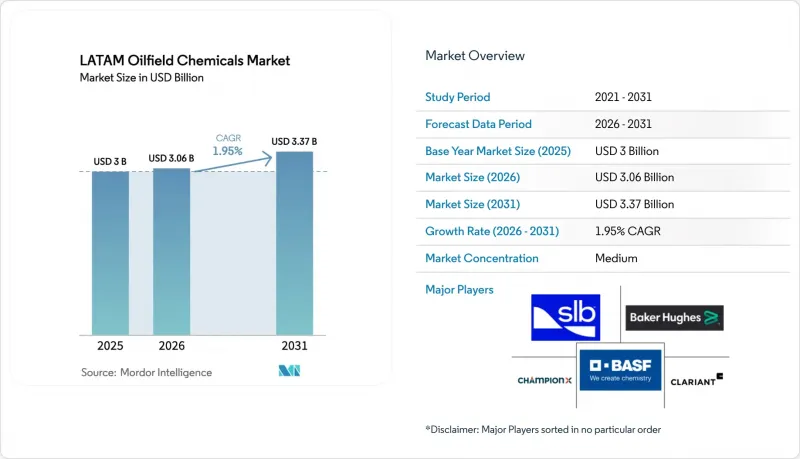
根據 Mordor Intelligence 預測,拉丁美洲 (LATAM) 油田化學品市場規模將從 2025 年的 30 億美元和 2026 年的 30.6 億美元成長到 2031 年的 33.7 億美元,2026 年至 2031 年的年複合成長率(CAGR)為 1.95%。
本報告按化學類型(除生物劑、緩蝕劑和阻垢劑、抗乳化劑、聚合物等)、應用領域(鑽井和注水泥、修井完井、油井增產、生產、增產方法)以及地區(墨西哥、巴西、哥倫比亞、阿根廷、秘魯、厄瓜多爾和其他拉丁美洲國家)進行細分。市場預測以美元計價。
拉丁美洲油田化學品市場趨勢與洞察。
繼續在巴西鹽層下盆地進行深海工程。
巴西石油公司(Petrobras)在2024年至2026年間運作的五艘浮式生產儲卸油船(FPSO)將使巴西鹽鹽層下的石油日產量在2026年初達到210萬桶。 2000公尺深處和5000公尺以下鹽層深處的極端溫度和腐蝕性環境,使得持續注入阻垢劑和腐蝕抑制劑成為必要。同時,在布濟奧斯(Buzios)和巴卡勞(Bacalhau)等油田,0.5%至1%劑量的動態水合物抑制劑正在取代大宗甲醇。將於2024年生效的修訂版《巴西國家石油公司(ANP)排放限值》要求供應商重新考慮使用可生物分解界面活性劑的配方,這為「綠色」化學技術創造了機遇,但開發成本也會隨之增加。目前,能夠輸送多種化學品的海底系統每口井的成本在500萬美元至1000萬美元之間,但可以延長油管壽命並減少意外停機時間。
能源改革後,墨西哥加快成熟油田的提高採收率計畫。
墨西哥國家石油公司(Pemex)計畫於2024年在坎塔雷爾油田啟動聚合物注入試點項目,並於2025年在庫馬洛扎普油田進行表面活性劑聚合物測試,從而將日產量提高5萬桶。在高溫高鹽度儲存中,標準聚丙烯醯胺劣化,因此,能夠保持90 度C以上黏度的磺酸鹽共聚物得到了更廣泛的應用,這一要求現已寫入Pemex的採購指南。私人公司仍保持謹慎,優先考慮原油生產,但國內採購法規強制要求35%的陸上原油採購比例,這鼓勵合資企業實現混合工藝的本地化,並降低物流成本。
布蘭特原油價格跌破70美元的波動導致資本支出核准延遲。
2025年初,布蘭特原油價格在每桶65美元至72美元之間波動,導致哥倫比亞國家石油公司(Ecopetrol)推遲了Uchuba-2評估井和其他區域項目。業者轉向週期較短的加密井作業,減少了鑽井和水泥注漿添加劑的使用,從而對高利潤化學品的需求造成了壓力。每月供應合約雖然保障了現金流,但也增加了供應商的營運資金需求。
細分市場分析
到2025年,腐蝕抑制劑和阻垢劑將佔拉丁美洲油田化學品市場佔有率的38.32%,這反映了它們在保護暴露於高濃度二氧化碳和硫化氫的管道和海底設備方面發揮的核心作用。隨著原油品質標準日益嚴格,以及老舊海上資產含水量不斷增加,預計到2031年,去乳化劑的複合年成長率將達到2.07%,成為成長最快的產品。光是巴西石油公司(Petrobras)一家,在2025年就向鹽層下油井注入了超過12,000噸的阻垢劑。特殊的低劑量水合物抑制劑被歸類為“其他化學品”,價格昂貴,每公斤8-12美元,但對於超深水回接專案而言,它們具有極具吸引力的優勢,因為它們可以將蘊藏量減少高達70%。隨著ANP排放標準於2024年生效,投資正轉向可生物分解的界面活性劑,增加了對環保組合藥物的需求。
在瓦卡穆爾塔油田和墨西哥的提高採收率(EOR)試點計畫中,聚合物得到了廣泛應用。界面活性劑主要用於鑽井液中,以改善高角度井中岩屑的輸送。殺菌劑對於抑制硫酸鹽還原菌仍然至關重要,因為硫酸鹽還原菌會加速腐蝕並使生產液酸化。在浮式生產儲卸油船(FPSO)上實施的劑量最佳化工具,使2025年腐蝕抑制劑的使用量減少了12%,且未對設備健康造成損害。
其他好處:
- Excel格式的市場預測(ME)表
- 3個月的分析師支持
目錄
第1章:引言
- 研究的先決條件
- 調查範圍
第2章:調查方法
第3章執行摘要
第4章 市場狀況
- 市場概覽
- 市場促進因素
- 繼續推進巴西鹽層下盆地的深海項目
- 能源改革後,墨西哥加快成熟油田的提高採收率計畫。
- 內烏肯(Vaca Muerta)頁岩氣試驗計畫的成功推動了對化學產品的需求。
- 促進國內化工產品生產的國內採購法規(巴西/墨西哥)
- 在超深海回接作業中,使用低劑量水合物抑制劑取代甲醇。
- 市場限制因素
- 布蘭特原油價格劇烈波動,已跌破 70 美元,導致資本支出核准延遲。
- 先進促效劑化學技術領域技術純熟勞工短缺
- ANP和CNH的產品註冊流程越來越長。
- 價值鏈分析
- 波特五力模型
第5章 市場規模與成長預測
- 依化學類型
- 除生物劑
- 腐蝕和結垢抑制劑
- 去乳化劑
- 聚合物
- 界面活性劑
- 其他化學類型
- 透過使用
- 開挖和水泥灌漿
- 鍛鍊和完成
- 井刺激
- 生產
- 提高採收率(EOR)
- 國家
- 墨西哥
- 巴西
- 哥倫比亞
- 阿根廷
- 秘魯
- 厄瓜多
- 其他拉丁美洲國家
第6章 競爭情勢
- 市場集中度
- 策略趨勢
- 市佔率和排名分析
- 公司簡介
- Ashland Inc.
- Baker Hughes Company
- BASF
- ChampionX
- Clariant AG
- Croda International PLC
- Dow Inc.
- Ecolab Inc.
- Elementis Plc
- Exxon Mobil Corporation
- Halliburton
- Huntsman International LLC
- Indorama Ventures Public Company Limited.
- Innospec Inc.
- Kemira
- SLB
- Solvay SA
- Stepan Company
- Weatherford International Plc
第7章 市場機會與未來展望
According to Mordor Intelligence, the LATAM oilfield chemicals market size is projected to expand from USD 3 billion in 2025 and USD 3.06 billion in 2026 to USD 3.37 billion by 2031, registering a CAGR of 1.95% between 2026 to 2031.
This report is Segmented by Chemical Type (Biocides, Corrosion and Scale Inhibitors, Demulsifiers, Polymers, and More), Application (Drilling and Cementing, Workover and Completion, Well Stimulation, Production, and Enhanced Oil Recovery), and Geography (Mexico, Brazil, Colombia, Argentina, Peru, Ecuador, and Rest of Latin America). Market Forecasts are Provided in Terms of Value (USD).
LATAM Oilfield Chemicals Market Trends and Insights
Continued Deep-Water Projects in Brazil Pre-Salt Basins
Brazil's pre-salt output rose to 2.1 million b/d in early 2026 as Petrobras brought five FPSOs online between 2024 and 2026. Extreme temperature and corrosive conditions below 2,000 m of water and 5,000 m of salt drive continuous injection of scale and corrosion inhibitors, while kinetic hydrate inhibitors at 0.5%-1% dosage have replaced bulk methanol on assets such as Buzios and Bacalhau. Revised ANP discharge limits, effective 2024, compel suppliers to reformulate with biodegradable surfactants, raising development costs but opening opportunities for "green" chemistries. Subsea systems capable of multi-stream chemical delivery now cost USD 5 million-10 million per well, yet they extend tubing life and cut unplanned downtime.
Accelerated Mature-Field EOR Programs in Mexico Post-Energy Reform
Pemex initiated polymer-flood pilots at Cantarell in 2024 and surfactant-polymer trials at Ku-Maloob-Zaap in 2025, targeting 50 kb/d of incremental recovery. High-temperature, high-salinity reservoirs degrade standard polyacrylamides, prompting the adoption of sulfonated copolymers that retain viscosity above 90 °C, now codified in Pemex procurement guidelines. Private operators remain cautious, favoring primary production, yet national-content rules requiring 35% domestic supply onshore have catalyzed joint ventures that localize blending and cut logistics costs.
Volatile Brent Price Below USD 70 Delaying CAPEX Approvals
Brent traded in the USD 65-72 band in early 2025, prompting Ecopetrol to postpone the Uchuva-2 appraisal well and other regional projects. Operators shifted to short-cycle infill workovers that require fewer drilling and cementing additives, compressing demand for high-margin chemistries. Month-to-month supply contracts protect cash flows but inflate suppliers' working-capital needs.
Other drivers and restraints analyzed in the detailed report include:
- Shale Pilot Successes in Neuquen (Vaca Muerta) Driving Chemical Demand
- National Content Rules Fostering Local Chemical Manufacturing (Brazil/Mexico)
- Skilled-Labor Shortages for Advanced Stimulation Chemistries
For complete list of drivers and restraints, kindly check the Table Of Contents.
Segment Analysis
Corrosion and scale inhibitors retained 38.32% of the LATAM oilfield chemicals market share in 2025, reflecting their central role in protecting tubulars and subsea hardware exposed to high CO2 and H2S streams. Demulsifiers are set to record the fastest 2.07% CAGR through 2031 as crude-quality specifications tighten and water cuts climb in aging offshore assets. Petrobras alone injected more than 12,000 t of scale inhibitors into pre-salt wells in 2025. Specialty low-dosage hydrate inhibitors, grouped under "other chemical types," command USD 8-12 per kg, yet lower storage volumes by up to 70%, an attractive trade-off for ultra-deepwater tie-backs. ANP discharge standards, effective 2024, are steering investment toward biodegradable surfactants, bolstering demand for green formulations.
Polymers are concentrated in Vaca Muerta and Mexican EOR pilots. Surfactants are used primarily in drilling fluids, where they improve cuttings transport in high-angle wells. Biocides remain critical to mitigate sulfate-reducing bacteria that accelerate corrosion and sour production streams. Digital dosage-optimization tools deployed on FPSOs reduced corrosion-inhibitor use by 12% in 2025 without compromising asset integrity.
Complete Report Scope:
- By Chemical Type
- Biocides
- Corrosion and Scale Inhibitors
- Demulsifiers
- Polymers
- Surfactants
- Other Chemical Types
- By Application
- Drilling and Cementing
- Workover and Completion
- Well Stimulation
- Production
- Enhanced Oil Recovery
- By Country
- Mexico
- Brazil
- Colombia
- Argentina
- Peru
- Ecuador
- Rest of Latin America
List of Companies Covered in this Report:
- Ashland Inc.
- Baker Hughes Company
- BASF
- ChampionX
- Clariant AG
- Croda International PLC
- Dow Inc.
- Ecolab Inc.
- Elementis Plc
- Exxon Mobil Corporation
- Halliburton
- Huntsman International LLC
- Indorama Ventures Public Company Limited.
- Innospec Inc.
- Kemira
- SLB
- Solvay S.A.
- Stepan Company
- Weatherford International Plc
Additional Benefits:
- The market estimate (ME) sheet in Excel format
- 3 months of analyst support
TABLE OF CONTENTS
1 Introduction
- 1.1 Study Assumptions
- 1.2 Scope of the Study
2 Research Methodology
3 Executive Summary
4 Market Landscape
- 4.1 Market Overview
- 4.2 Market Drivers
- 4.2.1 Continued deep-water projects in Brazil pre-salt basins
- 4.2.2 Accelerated mature-field EOR programs in Mexico post-energy reform
- 4.2.3 Shale pilot successes in Neuquen (Vaca Muerta) driving chemical demand
- 4.2.4 National content rules fostering local chemical manufacturing (Brazil/Mexico)
- 4.2.5 Low-dosage hydrate inhibitors replacing methanol in ultra-deepwater tie-backs
- 4.3 Market Restraints
- 4.3.1 Volatile Brent price below USD 70 delaying CAPEX approvals
- 4.3.2 Skilled-labor shortages for advanced stimulation chemistries
- 4.3.3 Lengthy product-registration cycles with ANP and CNH
- 4.4 Value Chain Analysis
- 4.5 Porter's Five Forces
- 4.5.1 Bargaining Power of Suppliers
- 4.5.2 Bargaining Power of Buyers
- 4.5.3 Threat of New Entrants
- 4.5.4 Threat of Substitutes
- 4.5.5 Degree of Competition
5 Market Size and Growth Forecasts(Value)
- 5.1 By Chemical Type
- 5.1.1 Biocides
- 5.1.2 Corrosion and Scale Inhibitors
- 5.1.3 Demulsifiers
- 5.1.4 Polymers
- 5.1.5 Surfactants
- 5.1.6 Other Chemical Types
- 5.2 By Application
- 5.2.1 Drilling and Cementing
- 5.2.2 Workover and Completion
- 5.2.3 Well Stimulation
- 5.2.4 Production
- 5.2.5 Enhanced Oil Recovery
- 5.3 By Country
- 5.3.1 Mexico
- 5.3.2 Brazil
- 5.3.3 Colombia
- 5.3.4 Argentina
- 5.3.5 Peru
- 5.3.6 Ecuador
- 5.3.7 Rest of Latin America
6 Competitive Landscape
- 6.1 Market Concentration
- 6.2 Strategic Moves
- 6.3 Market Share/Ranking Analysis
- 6.4 Company Profiles (includes Global level Overview, Market level overview, Core Segments, Financials as available, Strategic Information, Market Rank/Share for key companies, Products and Services, and Recent Developments)
- 6.4.1 Ashland Inc.
- 6.4.2 Baker Hughes Company
- 6.4.3 BASF
- 6.4.4 ChampionX
- 6.4.5 Clariant AG
- 6.4.6 Croda International PLC
- 6.4.7 Dow Inc.
- 6.4.8 Ecolab Inc.
- 6.4.9 Elementis Plc
- 6.4.10 Exxon Mobil Corporation
- 6.4.11 Halliburton
- 6.4.12 Huntsman International LLC
- 6.4.13 Indorama Ventures Public Company Limited.
- 6.4.14 Innospec Inc.
- 6.4.15 Kemira
- 6.4.16 SLB
- 6.4.17 Solvay S.A.
- 6.4.18 Stepan Company
- 6.4.19 Weatherford International Plc
7 Market Opportunities and Future Outlook
- 7.1 White-space and Unmet-Need Assessment

 油田化學品:市場佔有率分析、產業趨勢與統計、成長預測(2026-2031)
 油田化學品市場:依產品類型、油井類型、劑型及應用分類-2026-2032年全球市場預測
 油田化學品市場:依油田類型、化學品類型、產品類型、最終用途、國家及地區分類-產業分析、市場規模、市佔率及2026年至2033年預測
 油田化學品市場預測至2034年-按產品類型、功能、應用、最終用戶和地區分類的全球分析
 油田化學品市場規模、佔有率、趨勢和預測:按產品、應用和地區分類,2026-2034年
 油田化學品市場:按類型、性能、應用、地區、分銷管道分類
 油田化學品市場規模、佔有率、成長及全球產業分析:按類型、應用和地區的洞察,2026-2034年的預測
 油田化學品(乳化劑)市場規模、佔有率和成長分析:按類型、應用和地區分類-2026-2033年產業預測全球油田化學品市場規模、佔有率、趨勢和成長分析報告(2026-2034年)
 2026年全球油田化學品市場報告